Best Beginner Hydroponic Kits for Small Tents: 2×2 & 2×4 Blueprints (2025 Guide)

Table of Contents
- Small Tent Math: How Many Plants Fit in a 2x2 and 2x4?
- The 4-Part Hydro Kit Checklist for Small Tents
- Best 2x2 Kits for Compact Tomato, Pepper, and Herb Crops
- Best 2x4 Kits for Your First Multi-Crop Setup
- EC and PPM by Stage for Fruiting and Leafy Crops
- Water Temperature, Oxygen, and Root Health in Small Reservoirs
- Disaster Prevention Playbook for Small Tents
- Affiliate Arsenal: Only Kits and Nutrients We Would Use
- Frequently Asked Questions (FAQ)
- Conclusion
Most beginner hydro kits fail before the plants do. The killer is rarely the grower – it is a kit that looks complete in the box and then falls apart under real use: a reservoir too small to buffer pH swings, a pump that rattles itself to death, a light rated in watts that says nothing about how much light reaches the canopy. This guide covers what a beginner hydroponic kit for a small tent must include – usable LED PPFD, a properly sized reservoir, real airflow, and a pH meter you can trust – plus layout blueprints for 2×2 and 2×4 tents growing tomatoes, peppers, lettuce, and herbs, and the EC/PPM targets for each crop. Run it against the hydroponic grow checklist before you add anything to your cart.
Small Tent Math: How Many Plants Fit in a 2×2 and 2×4?
Plant count follows light and footprint, not hope. A 2×2 fits one fruiting plant or a few heads of leafy greens; a 2×4 fits two to four fruiting plants or a dense bed of lettuce and herbs. Overcrowding steals light and shrinks total harvest.
More plants does not mean more food in a small tent. In a 24 inch square footprint, a tomato or pepper spreads wide and needs every photon it can get, while the same space holds four heads of lettuce or a row of basil and mint. Packing the tent makes every plant go pale; a single well-placed fruiting plant out-yields two crowded ones. Read up on hydroponic kits for small spaces and match plant count to your footprint.
2×2 Layout Blueprint
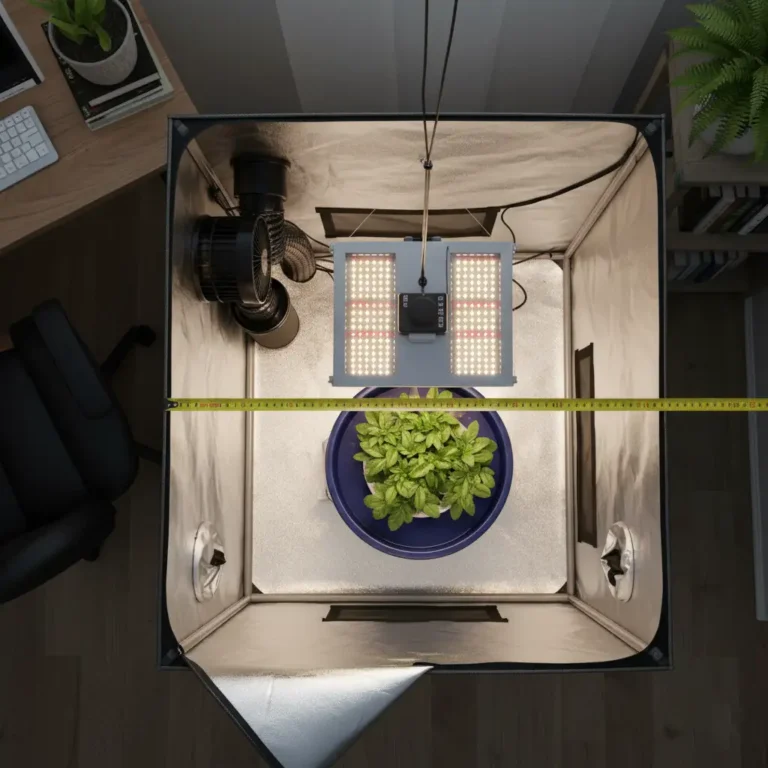
Think of a 2×2 as a studio apartment: a bed, a desk, and a chair, but not a family of four. The plan that works in practice:
- One fruiting plant: a single 5 gallon deep water culture bucket centered under the light. Bush or determinate tomatoes, compact peppers, and dwarf varieties fit best, and the canopy fills the full 24 inches of floor.
- Leafy rotation: a 2×4 tray holding four 1 gallon containers handles four heads of lettuce or a dozen herb plants on a staggered schedule.
- Airflow channel: leave 4-6 inches between the plant edge and the tent wall so the exhaust fan can pull air across the whole canopy.
2×4 Layout Blueprint
A 2×4 lets you run two crops side by side. The options that hold up over a full season:
- Two or three fruiting plants in 5 gallon buckets spaced 12-16 inches apart down the long axis, or four compact pepper plants in 3 gallon buckets if you want more variety.
- A mixed system: one NFT channel of lettuce and herbs beside a DWC bucket holding a tomato or pepper plant. It is the most forgiving way to keep greens and fruit coming from a single tent.
- Skip the fourth fruiting plant: light theft at the edges drops the total below what two happy plants produce, so resist the urge to jam the tent.
If you are still deciding between tent sizes, the grow tent buying guide covers height, venting, and light clearance for both footprints.
The 4-Part Hydro Kit Checklist for Small Tents
A kit is only as good as four parts: a light with real PPFD numbers, a reservoir big enough to buffer, airflow that keeps the tent dry, and a pH meter that stays calibrated. Miss one and the whole grow pays for it.
Before you click buy, every kit on your shortlist has to pass four checks.
The Non-Negotiables
| Component | Minimum Spec for a Small Tent | Why It Matters |
| LED light PPFD | 300-600 umol/m2/s at canopy for leafy greens; 600-900 umol/m2/s for fruiting crops | Weak light makes lettuce stretch and tomatoes drop flowers; too much light on young plants bleaches leaves |
| Reservoir size | 5 gallons per fruiting plant; 2-3 gallons per leafy plant | A small reservoir swings in pH and EC within hours and stresses the root zone |
| Airflow | 4 inch exhaust fan in a 2×2; 6 inch in a 2×4 | Stale air breeds mildew, traps heat, and starves leaves of CO2 |
| pH meter | A reliable pen plus calibration solution at pH 4.0 and 7.0 | A drifting pen produces lockouts that look like disease and get mistreated with more nutrients |
The cheap 100W blurple panels in budget kits rarely hold 300 umol/m2/s across a 2×2, which is fine for a single head of lettuce and nothing else. Target 300-600 umol/m2/s for leafy greens and 600-900 umol/m2/s for fruiting crops, and treat those as measured numbers rather than marketing watts. The LED distance and PPFD guide shows how to measure at the canopy, and the grow light PPFD and DLI calculator converts your fixture into a daily light integral so you know whether a 12 or 16 hour photoperiod is on target.
Reservoir volume is the part beginners underestimate most. A 1 gallon bucket of solution can drift half a pH point in an afternoon on a warm day, and that swing alone stalls growth for days. Five gallons per fruiting plant is the floor for stability; leafy greens run smaller because they are short-lived.
Best 2×2 Kits for Compact Tomato, Pepper, and Herb Crops
For a 24 inch square footprint, the best kit bundles a real 200-250W LED, a 5 gallon reservoir, and a 4 inch fan. It does not have to be fancy – it has to be balanced.
For a first grower, the 2×2 is the friendliest starting point: cheap to light, easy to clean, and small enough that mistakes compound slowly. A single bush tomato or pepper under a 240W light delivers weeks of steady harvest, and leafy greens run on a constant rotation.
Recommended: AC Infinity Complete Kit for 2×2 Tents
- Why it’s necessary: It pairs a 240W LED with a built-in 4 inch exhaust fan and a deep water culture bucket, covering all four checklist items in one balanced package.
- Key Spec: 240W LED, 4 inch inline fan with controller, single 5 gallon DWC bucket and net pot
- Check current pricing on Amazon: AC Infinity 2×2 Kit on Amazon
Once the kit is running, a lettuce and herb rotation builds confidence fast. Plant four lettuce seeds every two weeks and harvest as you go, tucking basil, mint, and cilantro into the gaps; herbs grow so fast in DWC that within a month you will be pruning instead of waiting. For the fruiting side, one determinate tomato or compact pepper fills the tent and outproduces three crowded ones.
Best 2×4 Kits for Your First Multi-Crop Setup
A 2×4 is where you graduate from single-plant tinkering to a real rotation. The kit needs a 200-300W light, two reservoirs, and a fan that moves enough air for the extra transpiration.
Scaling from a 2×2 to a 2×4 is the most common next step: the footprint doubles while light and ventilation only grow modestly. If you want a steady mix of tomatoes, peppers, and greens, this is the size where that becomes practical. The hydroponic tomatoes and peppers guide covers the fruiting side from pollination to harvest windows.
Recommended: Spider Farmer SF2000 Kit
- Why it’s necessary: The 200W LED covers two or three fruiting plants or a dense leafy bed, and the twin DWC buckets start you on multi-plant growing.
- Key Spec: 200W LED, two 5 gallon DWC buckets, 6 inch exhaust fan
- Check current pricing on Amazon: Spider Farmer SF2000 Kit on Amazon
Recommended: Mars Hydro FC-3000 Kit
- Why it’s necessary: The 300W bar-style LED spreads light evenly across the 2×4 footprint, which pays off when a fruiting plant runs beside a leafy channel.
- Key Spec: 300W bar LED with dimmer, 6 inch fan, multi-bucket reservoir setup
- Check current pricing on Amazon: Mars Hydro FC-3000 Kit on Amazon
One pro tip for 2×4 multi-plant growing: run four compact peppers in 3 gallon buckets instead of the included 5 gallon ones, and keep the big buckets for heavy fruiting plants. Smaller buckets leave floor space for airflow between containers. Keep one bucket empty as a mid-season spare.
EC and PPM by Stage for Fruiting and Leafy Crops
Fruiting crops eat like teenagers; leafy greens cruise on a light diet. Run EC 1.0-2.4 mS/cm for tomatoes and peppers depending on stage, and 0.8-1.2 mS/cm for lettuce and herbs, with a consistent 65-68F reservoir keeping every number stable.
Your nutrient solution is the engine room of the grow, and the most common beginner error is feeding everything the same. Tomatoes and peppers want the concentration to climb as fruit sets; lettuce, spinach, and most herbs burn at those numbers. Start with a complete hydroponic nutrient schedule and learn to read the plant.
| Crop Group | Growth Stage | EC (mS/cm) | PPM (500 scale) | pH | Water Temp |
| Leafy greens and herbs (lettuce, spinach, basil, mint) | Seedling | 0.4-0.6 | 200-300 | 5.8-6.2 | 65-68F |
| Leafy greens and herbs | Vegetative to harvest | 0.8-1.2 | 400-600 | 5.8-6.2 | 65-68F |
| Fruiting crops (tomatoes, peppers) | Seedling | 0.6-0.8 | 300-400 | 5.8-6.0 | 65-68F |
| Fruiting crops | Vegetative | 1.2-1.6 | 600-800 | 5.8-6.0 | 65-68F |
| Fruiting crops | Flowering and fruiting | 2.0-2.4 | 1000-1200 | 5.8-6.2 | 65-68F |
One meter reads two scales, which confuses plenty of first-timers. PPM is EC times a conversion factor: 1.0 mS/cm equals 500 ppm on the 500 scale or 700 ppm on the 700 scale. Note which scale your meter uses and stay consistent. The hydroponic nutrient calculator turns a target EC into a clean mix recipe, and the lettuce and spinach guide and herb gardens guide give stage-by-stage numbers for the leafy side.
Starting seedlings at full strength is the classic newbie mistake: 1000 ppm on a two-leaf seedling guarantees burnt root tips. Begin at the seedling EC and ramp up gradually.
Recommended: General Hydroponics Flora Series
- Why it’s necessary: The three-part system lets you adjust nitrogen and potassium ratios independently as crops move from leafy growth into fruiting, which a mixed 2×4 tent needs.
- Key Spec: Three-part concentrate (Grow, Micro, Bloom), pH-buffered formula
- Check current pricing on Amazon: General Hydroponics Flora Series on Amazon
Recommended: Botanicare KIND
- Why it’s necessary: A two-part system is the lowest-effort path to solid fruiting nutrition without mixing three bottles, and it pairs well with the 2.0-2.4 mS/cm fruiting stage.
- Key Spec: Two-part concentrate, complete macro and micro nutrition
- Check current pricing on Amazon: Botanicare KIND on Amazon
Water Temperature, Oxygen, and Root Health in Small Reservoirs
Warm water is the quiet killer in small tents. Keep the reservoir between 65 and 68F, keep oxygen moving with air stones, and top off with plain pH-matched water so EC does not creep between changes.
Roots want water that is cool and oxygen-rich, and a small tent fights you on both counts. The light radiates heat downward, the exhaust fan pulls warm air past the reservoir, and a dark bucket can climb toward 74F all day. Dissolved oxygen falls as temperature rises, so warm water slowly suffocates the root zone – and that is where slime and rot move in. The root rot prevention guide covers the warning signs, but the short version is cool, moving, dark water.
Three habits make the biggest difference in small reservoirs. Size the bucket up, because five gallons heats far slower than one. Run an air stone rated for the bucket volume; the bubbles add oxygen and keep temperature even. And top off evaporated water with plain water, then re-check EC, because topping off with nutrients slowly concentrates salts until the plant burns.
On hot weeks, keep the reservoir out of the light’s direct path, wrap it in reflective insulation, and run lights at night when the room is cooler. Between crops, flush everything with a mild hydrogen peroxide solution so nothing carries over to the next harvest.
Disaster Prevention Playbook for Small Tents
Most small-tent disasters come from three places: light too close, water too warm, and feed too strong. Fix those three and you have dodged the majority of beginner failures.
Every grower loses a plant at some point. The goal is to keep mistakes small, isolated, and cheap to fix, which in a small tent means reading the plant early.
Light Stress
Red flags: pale or bleached spots on the upper canopy, curling leaf tips, and seedlings that look scorched even though the water is fine.
The fix: keep the LED at the distance the manufacturer specifies and raise it for seedlings. A common start is 24 inches above young plants, dropping to 18 inches once they have several true leaves, then 12-14 inches for mature fruiting crops as long as canopy temperature stays below about 82F. If leaves bleach, the light is too close.
Root Rot
Red flags: brown or slimy roots with a swampy smell, and a plant that wilts despite plenty of water. The roots are drowning, not thirsty.
The fix: check water temperature first, because 70F and above is the danger zone. Drain the reservoir, mix fresh solution, and add a protective root treatment while you fix airflow and oxygen. Skipping pH checks in a small bucket stacks drift on top of whatever else is wrong.
Nutrient Burn and Blossom End Rot
Red flags: crispy brown leaf tips on new growth point to nutrient burn, while a sunken leathery patch on the bottom of a tomato or pepper fruit points to a calcium problem.
The fix: nutrient burn usually means the EC is too high for the stage, so dilute back to the table above and let the plant recover. Blossom end rot is not a fertilizer shortage; it is the plant failing to move calcium to fast-growing fruit, usually because the EC spiked or the root zone went too hot. Keep the reservoir topped and hold temperature in the 65-68F band.
Bolting Lettuce and Leggy Seedlings
Red flags: lettuce that stretches up and turns bitter is bolting; any seedling that grows tall, pale, and weak is starving for light.
The fix: bolting is triggered by heat and long days, so run leafy greens on a 14-16 hour photoperiod near 68-72F and harvest before the center starts elongating. Leggy seedlings mean PPFD is too low for the stage; move them under stronger light immediately.
Affiliate Arsenal: Only Kits and Nutrients We Would Use
The gear below covers the checklist items that actually matter in a small tent. Everything else on the market is a variation on these four requirements.
Every recommendation maps back to the four-part checklist: a light with honest PPFD, a reservoir that buffers, airflow that stays ahead, and a meter you can trust. If a kit skips any of those, no amount of app polish makes up for it.
Recommended: Vivosun Smart Grow Kit
- Why it’s necessary: The app-based controller ties light, fan, and timer together so a beginner gets automation for photoperiod and ventilation without wiring anything.
- Key Spec: App-connected controller, dimmable LED, inline exhaust fan, DWC bucket setup
- Check current pricing on Amazon: Vivosun Smart Grow Kit on Amazon
One honest warning on smart kits: the automation is only as good as the sensors behind it, so spot-check pH and EC by hand every other day anyway.
Frequently Asked Questions (FAQ)
Quick answers to the questions first-time tent growers ask most, from plant counts to meter readings.
How many tomato or pepper plants can fit in a 2×2 tent?
Stick to one fruiting plant in a 2×2 for your first grow. A single determinate tomato or compact pepper in a 5 gallon bucket fills the footprint and out-yields two crowded plants.
What is the difference between a 2×2 and a 2×4 kit?
The 2×4 has twice the floor space. A 2×2 supports one fruiting plant or a leafy rotation; a 2×4 handles two or three fruiting plants, or one fruiting plant beside an NFT channel of lettuce and herbs. It also needs a stronger light (200-300W) and a bigger fan.
What PPFD do lettuce and herbs need in a small tent?
Leafy greens and herbs want 300-600 umol/m2/s on a 14-16 hour photoperiod, a daily light integral of 15-20 mol/m2/day; fruiting crops want 600-900 umol/m2/s on a 16 hour day. Measure with a PPFD map or app rather than trusting printed wattage.
Why does reservoir water temperature matter so much?
Warmer water holds less oxygen, and roots need oxygen to stay healthy. Above 70F the risk of root rot climbs fast, and above 74F it is nearly guaranteed without intervention. A 65-68F reservoir protects oxygen and keeps pH and EC stable.
What is the biggest mistake a beginner makes when choosing a hydro kit?
Buying the cheapest underpowered bundle. These kits ship with a weak light, a tiny reservoir, and a fan that cannot move the air, setting off stretching, pH swings, and root problems. A balanced kit that passes the checklist costs far less in the long run.
How do I prevent blossom end rot on hydroponic peppers and tomatoes?
Blossom end rot is a calcium transport problem, not a fertilizer shortage. Keep EC steady, top off with fresh water, hold the reservoir at 65-68F, and avoid letting the root zone dry out. Once the environment is stable, new fruit comes out clean.
What EC should I run for leafy greens compared to fruiting crops?
Leafy greens and herbs cruise at 0.8-1.2 mS/cm (400-600 ppm on the 500 scale). Tomatoes and peppers climb from 1.2-1.6 mS/cm in vegetative growth to 2.0-2.4 mS/cm in flowering and fruiting. Seedlings start lower, around 0.4-0.8 mS/cm.
Conclusion
Buy the balanced kit, run the numbers, keep the water cool, and let the plants grow. That sequence covers almost every beginner failure before it happens.
Small-tent hydroponics rewards patience and measurement over complexity. Pick a 2×2 or 2×4 footprint based on what you want to eat, make sure the kit clears the four-part checklist, feed tomatoes and peppers differently than lettuce and herbs, and keep the reservoir cool. That is the whole job for the first season.
If you are still weighing a kit against a DIY build, start with the Hydroponics Comparison Hub to see DWC, NFT, and drip setups side by side, then plug your numbers into the PPFD and nutrient tools linked above.

Continue Your Learning Journey