LED Hanging Height & PPFD: A Photon Architecture Guide

Table of Contents
- The $200 Seedling Bleaching Disaster: A Post-Mortem in Photon Overdose
- Photometric Physics Demystified - PAR, ePAR, PPFD, and DLI
- The Inverse-Square Law & Canopy Height Dynamics
- Standardized Wattage & Tent Size Hanging Height Matrices
- Photoperiod & DLI Management by Crop Type
- Diagnosing Light Stress: Photo-Bleaching vs. Etiolation
- Precision Measurement Tools & Hardware Calibration
- Actionable LED Light Calibration Checklist
- Affiliate Spotlight - Lights That Hit Targets
- Faq
Executive Summary Optimizing LED grow light hanging height requires matching target Photosynthetic Photon Flux Density (PPFD) and Daily Light Integral (DLI) to plant developmental stages while accounting for the Inverse-Square Law of Irradiance. Target PPFD ranges are: Seedlings (200-300 µmol/m²/s at 24-30 inches), Vegetative Phase (400-600 µmol/m²/s at 18-24 inches), and Reproductive/Flowering Phase (800-1,000 µmol/m²/s at 12-18 inches, or up to 1,500 µmol/m²/s with >1,200 PPM CO2 enrichment). Dropping light height by 25% increases photon intensity by 77.8% at the central canopy.
The $200 Seedling Bleaching Disaster: A Post-Mortem in Photon Overdose
Early in controlled environment agriculture (CEA), a common misconception among growers is that more photons automatically equal faster growth. Hanging a high-output 1000W LED bar light just 12 inches above tender seedlings creates immediate optical devastation.
Within 48 hours, young green sprouts experience severe photo-bleaching. Chlorophyll molecules break down under excessive photon bombardment, turning leaf tissue chalk-white and destroying the plant’s photosynthetic machinery. This $200 mistake demonstrates a fundamental rule of indoor cultivation: you don’t simply buy a grow light, you have to act as a photon architect, positioning fixtures to deliver an exact daily photon dosage.
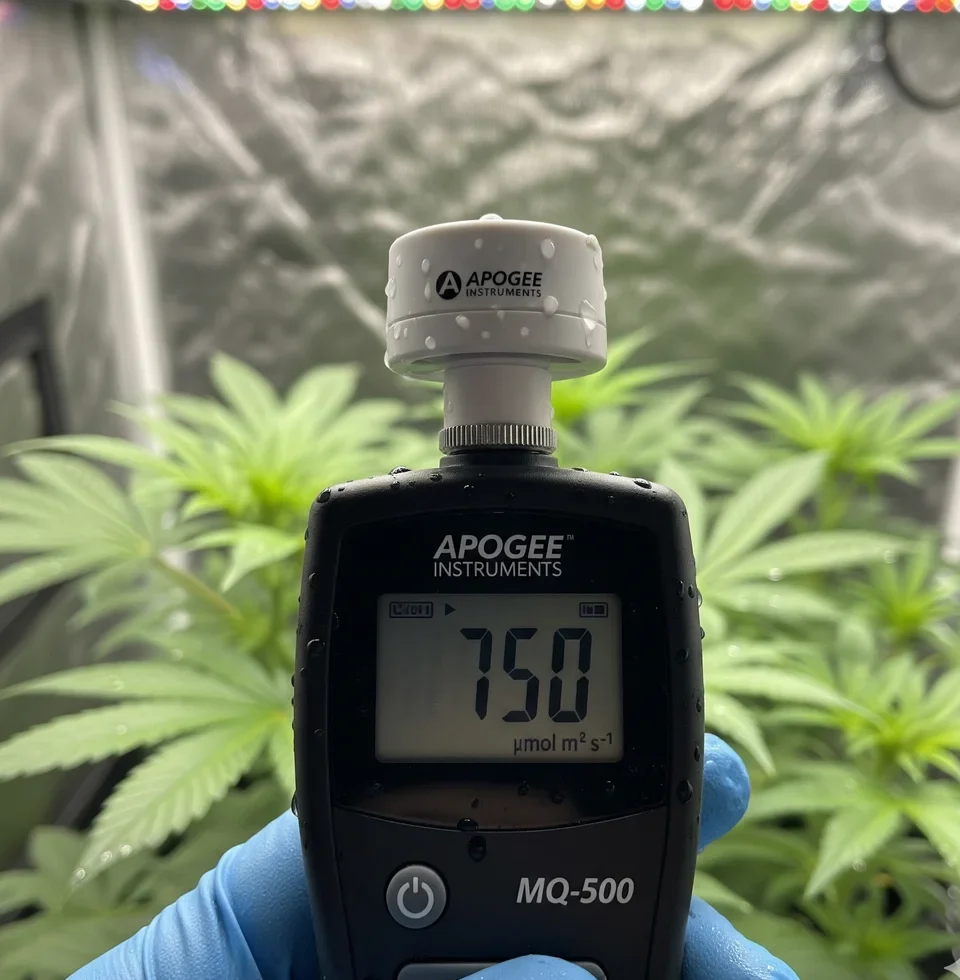
Using quantum PAR meters (such as the Apogee MQ-500), growers can eliminate guesswork and calculate exact hanging height matrices across all growth stages and tent configurations.
Photometric Physics Demystified – PAR, ePAR, PPFD, and DLI
Understanding grow light metrics requires breaking down four core horticultural lighting concepts.
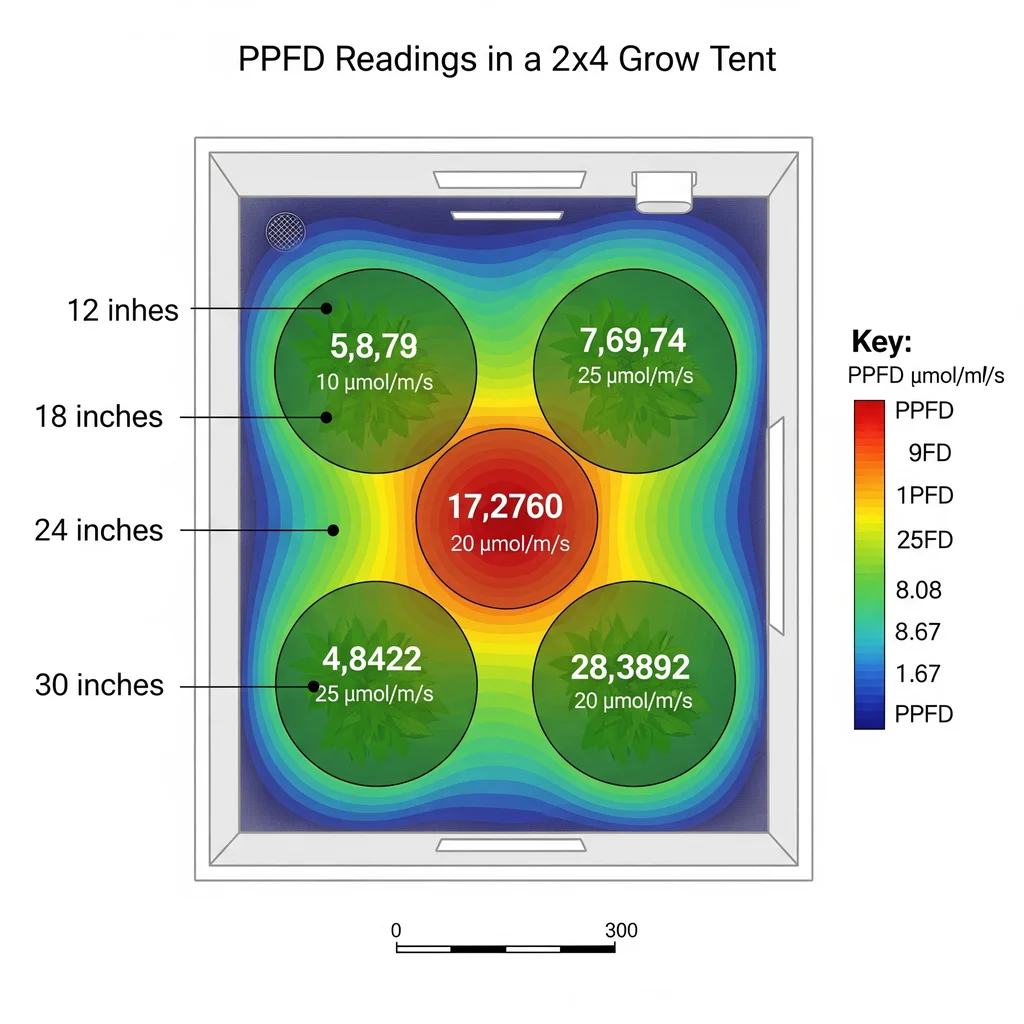
PAR (400-700nm) vs. ePAR (400-750nm)
Photosynthetically Active Radiation (PAR) defines the waveband of solar radiation from 400 to 700 nanometers that drives photosynthesis. Modern research expands this definition to extended PAR (ePAR), incorporating far-red wavelengths (700-750nm). Far-red photons drive the Emerson Enhancement Effect, accelerating photosystem II activity when combined with red light.
PPFD (Photosynthetic Photon Flux Density)
Measured in micromoles per square meter per second (µmol/m²/s), PPFD quantifies the actual number of PAR photons hitting a one-square-meter section of your crop canopy each second. Think of PPFD as real-time light intensity.
DLI (Daily Light Integral)
Daily Light Integral (DLI) measures the total cumulative volume of PAR photons delivered to one square meter over a 24-hour period, expressed in moles per square meter per day (mol/m²/day):
DLI = (PPFD × Photoperiod in hours × 3600) / 1,000,000
Target PPFD and DLI ranges scale with growth stage:
- Seedlings/clones: 200-300 µmol/m²/s at 18 hours of light → DLI of roughly 12.96-19.44 mol/m²/day.
- Vegetative phase: 400-600 µmol/m²/s at 18 hours of light → DLI of roughly 25.92-38.88 mol/m²/day.
- Reproductive/flower: 800-1,000 µmol/m²/s at 12 hours of light → DLI of roughly 34.56-43.20 mol/m²/day.
- High-CO2 bloom (1,200+ PPM): 1,200+ µmol/m²/s at 12 hours of light → DLI of 51.84+ mol/m²/day.
The Inverse-Square Law & Canopy Height Dynamics
Light intensity from a point source dissipates according to the Inverse-Square Law, where light intensity (E) is inversely proportional to the square of the distance (d) from the source: E = I / d².
Because point-source LED diodes disperse light outward, small changes in hanging height dramatically alter canopy photon density. A light at 24 inches producing a baseline PPFD of 500 µmol/m²/s jumps to roughly 889 µmol/m²/s (a 77.8% intensity increase) when lowered to 18 inches, and to about 2,000 µmol/m²/s (a 300% increase) when lowered further to 12 inches.
Moving an LED light down from 24 inches to 18 inches increases canopy photon density by 77.8%. Dropping it down to 12 inches roughly quadruples photon density, pushing un-supplemented crops straight into photo-inhibition and tissue bleaching.
Standardized Wattage & Tent Size Hanging Height Matrices
Use these height matrices, generated via Apogee MQ-500 PAR meter testing across standard grow tent footprints.
2×2 Foot Tent Footprint
| Fixture Wattage | Veg Height | Veg Center PPFD | Flower Height | Flower Center PPFD |
|---|---|---|---|---|
| 100W Board LED | 24 in | 350 µmol/m²/s | 18 in | 550 µmol/m²/s |
| 200W Compact LED | 30 in | 500 µmol/m²/s | 24 in | 850 µmol/m²/s |
| 300W High-Spec LED | 36 in | 650 µmol/m²/s | 30 in | 1,100 µmol/m²/s (requires CO2) |
2×4 Foot Tent Footprint
| Fixture Wattage | Veg Height | Veg Edge PPFD | Flower Height | Flower Edge PPFD |
|---|---|---|---|---|
| 200W Bar / Dual Board | 24 in | 300 µmol/m²/s | 18 in | 550 µmol/m²/s |
| 300W Bar Array | 30 in | 450 µmol/m²/s | 24 in | 750 µmol/m²/s |
| 600W High-Output Bar | 36 in | 700 µmol/m²/s | 30 in | 980 µmol/m²/s |
4×4 Foot Tent Footprint
| Fixture Wattage | Veg Height | Veg Center PPFD | Flower Height | Flower Center PPFD |
|---|---|---|---|---|
| 480W Foldable Bar | 28 in | 450 µmol/m²/s | 20 in | 800 µmol/m²/s |
| 640W Commercial Bar | 32 in | 550 µmol/m²/s | 18 in | 1,000 µmol/m²/s |
| 1000W CO2 Spec Bar | 36 in | 750 µmol/m²/s | 15 in | 1,450 µmol/m²/s (requires CO2) |
Photoperiod & DLI Management by Crop Type
Each crop species has a distinct daily photon saturation limit. Exceeding these thresholds wastes electricity and risks photo-toxicity.
| Crop Type | Target DLI | Optimal Photoperiod | Target Canopy PPFD |
|---|---|---|---|
| Butterhead Lettuce / Microgreens | 14-17 mol/m²/day | 16-18 hours | 220-260 µmol/m²/s |
| Culinary Herbs (Basil / Cilantro) | 12-16 mol/m²/day | 14-16 hours | 200-250 µmol/m²/s |
| Fruiting Tomatoes / Peppers | 25-35 mol/m²/day | 16-18 hours | 400-550 µmol/m²/s |
| High-Light Crop (Vegetative) | 25-35 mol/m²/day | 18-24 hours | 400-600 µmol/m²/s |
| High-Light Crop (Flower – Ambient Air) | 35-45 mol/m²/day | 12 hours | 800-1,000 µmol/m²/s |
| High-Light Crop (Flower + 1200 PPM CO2) | 50-60+ mol/m²/day | 12 hours | 1,200-1,500 µmol/m²/s |
The Carbon Dioxide (CO2) Threshold
At ambient atmospheric CO2 levels (~415 PPM), plants hit a photosynthetic saturation point around 1,000 µmol/m²/s PPFD. Pushing light intensity higher without extra carbon dioxide causes electron transport overload in chloroplasts, triggering Non-Photochemical Quenching (NPQ) and heat stress. Elevating indoor ambient CO2 to 1,200-1,500 PPM raises this saturation ceiling, allowing plants to convert up to 1,500 µmol/m²/s PPFD directly into biomass.
Diagnosing Light Stress: Photo-Bleaching vs. Etiolation
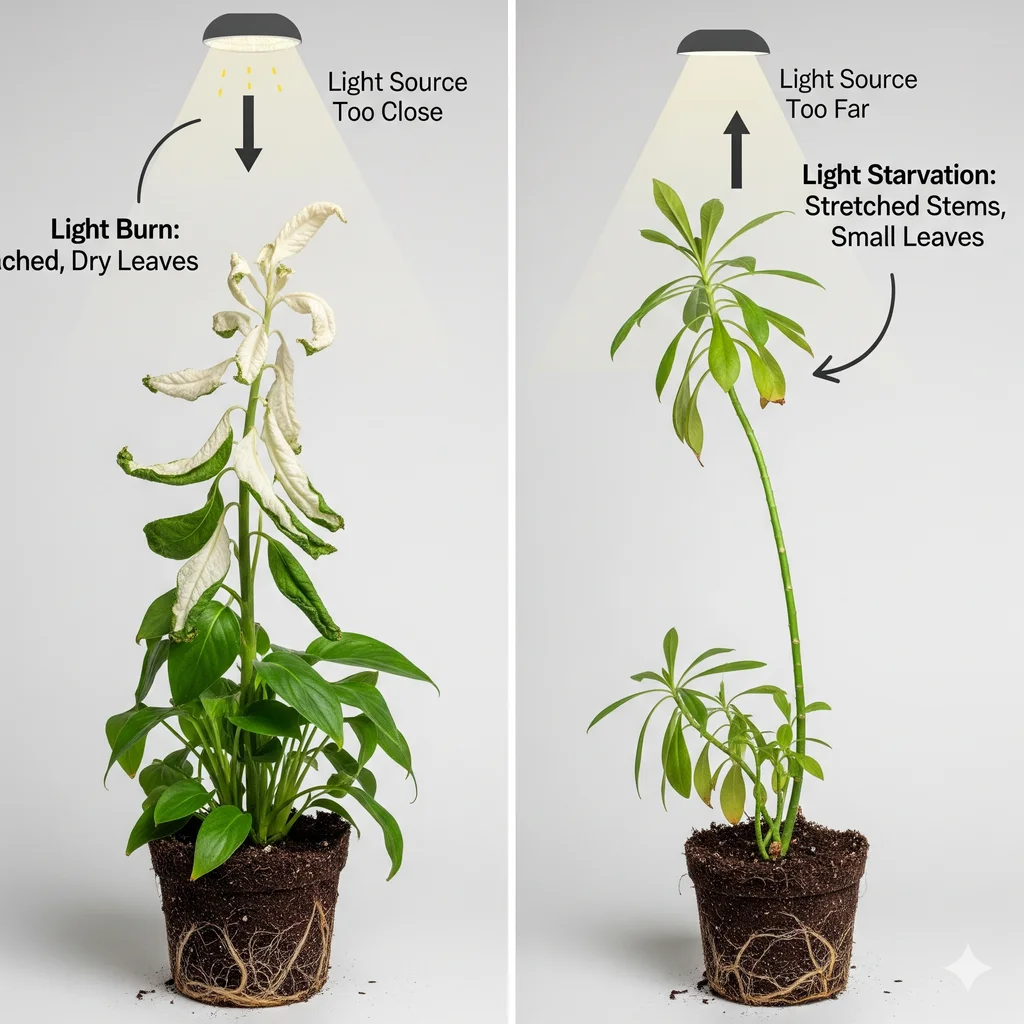
Plants signal light distance errors through visual physiological changes. Light overdose typically shows up as a bleached white or yellow canopy, upward leaf margin curling (“clawing”), and crispy leaf tips even under cool temperatures. Light starvation typically shows up as long internodal spacing (stretching), thin and weak stems, and lower foliage drop or chlorosis.
| Visual Symptom | Root Cause | Primary Physiological Indicator | Corrective Action |
|---|---|---|---|
| Bleached upper leaves | Excessive PPFD / light burn | Chlorophyll degradation at top canopy while temperatures remain cool. | Raise fixture height by 4-6 inches or dim ballast by 15%. |
| Leaf edge upward curling | Thermal heat stress / high VPD | Leaves curl upward into “tacos” to decrease surface area exposure. | Increase ventilation or raise fixture to drop canopy heat. |
| Severe canopy stretching | Light starvation (low PPFD) | Etiolation: plant elongates stem internodes to reach the photon source. | Lower light height by 4-6 inches or increase ballast output. |
Precision Measurement Tools & Hardware Calibration
Setting proper light height requires accurate measuring tools, don’t rely on estimated distance numbers alone.
Quantum PAR Meters vs. Smartphone Sensors
- Laboratory PAR meters (Apogee MQ-500): Use optical spectral sensors calibrated specifically for broadband LED light arrays, delivering ±5% accuracy across PAR and ePAR spectrums.
- Smartphone sensor apps (Photone / Light Meter): Useful for quick checks, but mobile camera diffusers vary widely across phone models. When using mobile apps, fit a 22lb white printer paper diffuser over the camera lens and select your exact LED light spectrum profile.
Heavy-Duty Ratcheting Suspension Protocols
Always suspend LED fixtures using 1/8-inch heavy-duty ratcheting rope hangers rated for at least 75 lbs per pair. Make sure crossbars are level across both axes using a bubble level — an unlevel fixture creates uneven photon distribution across your tent footprint, resulting in inconsistent canopy heights.
Actionable LED Light Calibration Checklist
Use this pre-flight checklist to calibrate grow light height and photon delivery:
Phase 1: Baseline Hardware Setup
- Verify LED fixture wattage rating and dimmer switch functionality.
- Level the fixture using a bubble level across top support bars.
- Confirm 1/8-inch ratchet hangers are locked securely to ceiling frame poles.
Phase 2: Stage-Specific Height Alignment
- Seedlings/clones: set height to 24-30 inches at 200-300 µmol/m²/s PPFD.
- Vegetative phase: set height to 18-24 inches at 400-600 µmol/m²/s PPFD.
- Flowering phase: set height to 12-18 inches at 800-1,000 µmol/m²/s PPFD.
Phase 3: DLI & CO2 Verification
- Calculate Daily Light Integral: DLI = PPFD × Hours × 0.0036.
- Verify DLI matches crop bounds (e.g., 35-45 mol/m²/day for high-light bloom).
- If PPFD exceeds 1,000 µmol/m²/s, confirm CO2 levels are supplemented to >1,200 PPM.
Phase 4: Daily Canopy Audits
- Inspect top leaf margins daily for photo-bleaching or leaf edge curling.
- Measure canopy growth weekly and raise light ratchets to preserve target height.
Affiliate Spotlight – Lights That Hit Targets
Spider Farmer SF-2000 LED Grow Light
A high-efficiency full-spectrum LED light with a stellar reputation for performance and reliability in a 2’x4′ flower coverage.
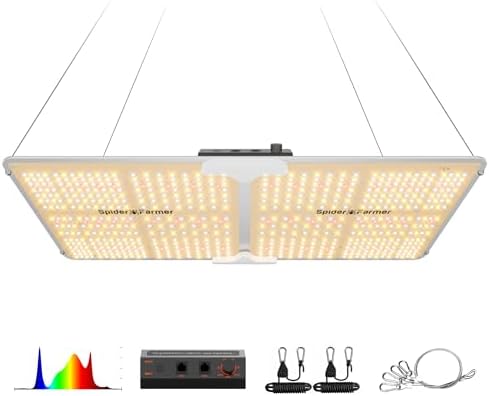
- Cutting-Edge Upgraded LED Chips for Unrivaled Performance: All-new premium upgraded LEDs with 2.7 µmol/J system PPE and …
- 5-Year Warranty: Our LED Plant Lights are often copied but will never have our quality or commitment, we provide 5 years…
- Ideal For All Growth Stages: Excellent full spectrum- white, blue, red and IR (3000K, 5000K, 660nm and IR 760nm, IR is d…
The Green Thumb Upside:
- Superb Efficiency & Penetration: Uses top-bin Samsung LM301B diodes and mean well driver, delivering intense, uniform light with low heat and power consumption.
- Dimming Knob: Built-in 0-100% dimmer allows for precise PPFD adjustment, which is absolutely critical for following the distance guidelines in the article.
- Excellent PAR Map: Provides a remarkably even spread of light across the entire canopy, eliminating hot spots and weak corners.
Things to Consider:
- Initial Investment: Priced higher than blurple or less efficient lights, but the cost is justified by the yield potential and energy savings.
- Brightness: This light is powerful; you must follow height recommendations to avoid light stress on young plants.
The Final Verdict:
This is the workhorse light for the serious home grower. It hits the perfect balance of advanced technology, reliable performance, and value. If you’re following a PPFD guide, the dimming feature is indispensable. Check Price on Amazon.
MARSHYDRO FC-E4800 LED Grow Light
A powerful bar-style light designed for full 4’x4′ coverage with incredible light uniformity and penetration.

- UPGRADED SPECS, BEST VALUE: The upgraded FC-E4800 now features an enhanced OSRAM red spectrum to maximize flowering—with…
- HIGH-EFFICIENCY LED GROW LIGHT: The New Version FC-E4800 Lighting wit BridgeLux Diodes, 2.8 µmol/J PPE 1344 µmol/J PPF. …
- REMOVABLE PARTS : Needs to be assembled before use. Specialized bar structure ensures optimal heat dissipation and stabl…
Root-Level Benefits:
- Flawless Coverage: The bar design and Samsung diode layout eliminate central hot spots, providing a perfectly even PAR distribution for a uniform canopy.
- Daisy-Chain Function: Allows you to connect multiple lights to a single timer and outlet, simplifying setup and cable management in larger tents.
- High Intensity: Delivers more than enough PPFD to crush the flowering stage, with dimming control to dial it back for seedlings and veg.
Room for Improvement:
- Size & Weight: This is a large, heavy light designed for a permanent setup in a 4’x4′ tent; it’s overkill for smaller spaces.
- Price Point: A significant investment, best suited for growers who have outgrown their first light and are committed to maximizing yield.
Who This Is For:
The grower ready to fill a 4’x4′ tent with a dense, even canopy. This light is a professional-grade tool that makes managing PPFD across a large area simple and effective. See Latest Discount.
VIPARSPECTRA P1000 LED Grow Light
A compact, dimmable quantum board perfect for 2’x2′ flower coverage or starting seeds in a larger tent.

- NEW DIODE LAYOUT & LOWER RUNNING COST: VIPARSPECTRA upgraded P1000 grow light adopts a more scientific diode distributio…
- OPTIMAL FULL SPECTRUM LIGHT & SUPERIOR HEAT DISSIPATION: Consists of 660nm red light, 3000K 5000K white light, and 730nm…
- LOW ENERGY CONSUMPTION GROW LIGHTING: Comparable to traditional 250W HPS/MH while consuming only 100W! Perfect for 2.5×2…
Grow Room Win:
- Perfectly Sized: Provides the ideal intensity for a small tent or as a dedicated veg/clone light without wasting energy or creating excess heat.
- Full Spectrum & Dimming: Features Samsung diodes and a mean well driver with a 0-100% dimmer, offering pro-level control in a small, affordable package.
- Low Heat Output: The efficient driver and board design allow you to keep the light closer to the canopy without worrying about heat stress.
Not a Perfect Fit For:
- Large Canopies: Its power is purpose-built for a 2’x2′ area; it will not provide enough intensity or coverage for a larger tent in flower.
Our Grow-O-Meter Says:
This is the ultimate “first real light” or supplemental light. It teaches you the importance of dimming and distance control without a huge upfront cost. An exceptional value for the performance. Check Price on Amazon.
UNI-T UT383BT Lux Meter
A digital light meter that connects to your phone to measure lux, which can be converted to PPFD for accurate light distance setting.

- UNI-T professional digital illuminance meter UT383BT. Effectively measures light intensity and display results in units …
- IOS/Android APP & Free download. Breeze through data recording, export, storage and analysis. Measurement data is transf…
- Compact & easy to use. Large 4 digital LCD screen with backlight. 0.5 s sampling time. Overload indication. Max/Min. Dat…
Why Growers Love It:
- Data-Driven Growing: Takes the guesswork out of “is this enough light?” by providing actual quantifiable data from the canopy level.
- Bluetooth App Integration: The connected app logs data over time, allowing you to track light levels and ensure consistency.
- Surprisingly Accurate: Provides readings consistent with much more expensive meters, making it the best tool for hobbyists to optimize their setup.
The Trade-Off:
- Measures Lux, Not PPFD: You must use a conversion factor (available in the MistCulture article and online) to estimate PPFD from the lux reading, which is highly accurate for white LED lights.
Bottom Line for Growers:
If you’re serious about nailing your light distance and intensity, you need data. This meter is the most cost-effective way to stop guessing and start optimizing your PAR levels like a pro. See Latest Discount.
Faq
What is the difference between PPFD and DLI?
PPFD (Photosynthetic Photon Flux Density) is a measure of the light intensity that reaches your plants at a given moment. DLI (Daily Light Integral) is the total amount of light your plants receive over a 24-hour period. You can think of PPFD as the rate of light delivery, while DLI is the total cumulative light dose.
How do I know if my plants are getting light burn?
The most common sign of light burn is bleached white or yellow leaves at the top of the plant canopy. This occurs when the light is too intense or too close, causing the plant to get u0022sunburned.u0022 You can fix this by raising your light or dimming its intensity.
u003cstrongu003eWhat is the ideal PPFD for each stage of plant growth?u003c/strongu003e
The ideal PPFD changes with the growth stage. Seedlings and clones need a lower PPFD of 200-300 µmol/m²/s, the vegetative stage benefits from 400-600 µmol/m²/s, and the flowering stage requires a higher intensity of 800-1000 µmol/m²/s to promote dense growth.
How can I fix a plant that is stretching and getting too lanky?
If your plant’s stems are long and lanky, and the leaves are small, it’s a sign that your light is too far away. The plant is u0022stretchingu0022 to try and get closer to the light source. To fix this, you should lower your light and increase the light intensity to encourage a more compact and bushier growth pattern.
How can I accurately measure PPFD without an expensive meter?
While a lab-grade PAR meter like the Apogee MQ-500 is the gold standard for accuracy, a budget-friendly alternative is to use a free or low-cost smartphone app like Photone. These apps can give you a rough but useful estimate of your PPFD so you can adjust your light height accordingly.
WARNING: Heavy fruiting crops demand higher DLI than leafy greens. Links fund our light testing lab.
The Math Behind Massive Harvests: Stop guessing your nutrient PPM or reservoir ratios; our precise calculators take the guesswork out of water chemistry so you can nail your targets every single time. Crunch the Numbers with Our Calculators →

Continue Your Learning Journey