Hydroponic Power Savings: Cut Electricity by 40%

Table of Contents
- The $1,200 Power Bill Horror Story: An Audit Breakdown
- The 5-Step Hydro Energy Audit
- Lighting Hacks That Retain Target PPFD
- The Thermal Domino Effect — HVAC & Dehumidification
- The DC Equipment Revolution — Pumps & Ventilation
- Intermittent Aeration Protocols
- Data Logging & Environmental Troubleshooting
- Actionable Energy Savings Checklist
- DC Revolution: Fans & Pumps That Sip Power
- Troubleshooting with Your Checklist
- Pro Toolkit: Gear That Pays for Itself
- FAQ's
Executive Summary Reducing energy consumption in a hydroponic setup does not require sacrificing crop yield. By conducting a systematic 5-Step Hydro Energy Audit, swapping high-wattage HID/HPS lamps for high-efficacy LED grow lights (≥ 2.7 µmol/J), converting AC shaded-pole pumps to brushless DC/ECM equipment, and mitigating the Heat Domino Effect on HVAC/dehumidification, indoor growers typically reduce monthly electrical expenditure by 35% to 52% while maintaining target Vapor Pressure Deficit (VPD) and Daily Light Integral (DLI).
The $1,200 Power Bill Horror Story: An Audit Breakdown
An audit of an indoor grow facility revealed a $1,200 monthly electrical overhead for a modest grow area. The operator was running a single 1000W High-Pressure Sodium (HPS) magnetic fixture, a heavy-duty AC submersible water pump, and a standard commercial compressor-based dehumidifier inside a sealed grow tent.
The issue wasn’t merely the rated power draw of the light fixture — it was the thermal cascading effect. The HPS lamp generated over 3,412 BTU/hr of direct radiant heat, forcing the air conditioner and dehumidifier to operate at a 100% duty cycle, 24/7. That heat pushed air temperatures up, which drove transpiration higher, which then kept the dehumidifier running non-stop and forced the AC to work even harder just to keep pace.
By converting the HPS fixture to a high-efficacy LED array, replacing the AC pump with a variable-speed brushless DC pump, and aligning the photoperiod with off-peak utility tariffs, the facility’s monthly electricity cost was reduced from $900/month to $380/month on the primary circuit — all while maintaining target canopy PPFD.
The 5-Step Hydro Energy Audit
Before replacing any hardware, you need to quantify the power draw of every fixture on your circuit. Nameplate ratings on electrical equipment frequently underestimate actual power consumption due to ballast efficiency loss and power factor degradation.
The formula:
- Measure real wattage (W_wall) with a P3 Kill-A-Watt meter.
- Log daily operating hours (H_day).
- Compute daily kilowatt-hours: Daily kWh = (W_wall × H_day) / 1000
- Compute monthly kWh: Monthly kWh = Daily kWh × 30
- Compute monthly cost: Cost = Monthly kWh × Utility Rate ($/kWh)
The 5-Step Execution Plan
- Inventory every circuit device — Document all grow lights, inline exhaust fans, clip-on circulation fans, water pumps, air pumps, chillers, humidifiers, and environmental controllers.
- Measure real-world wall wattage — Don’t rely solely on the sticker rating. A fixture labeled “400W HPS” often pulls 487W at the wall once you account for magnetic ballast losses. Use an inline digital power meter (like a Kill-A-Watt) to record true wattage.
- Log operational schedules — Group equipment into continuous runtime (24 hours/day) versus cyclic runtime (12 hours/day, or duty-cycled via humidistat/thermostat).
- Calculate daily kilowatt-hours — Daily kWh = (Measured Watts × Operating Hours per Day) / 1000.
- Apply local utility rates — Multiply your total monthly kWh by your local electricity rate ($/kWh), and check whether your utility uses Time-of-Use (TOU) tiered pricing.
Baseline System Energy Audit Template
| Equipment Component | Nominal Rating | True Wall Draw | Daily Hours | Daily Usage (kWh) | Monthly Cost (@ $0.15/kWh) |
|---|---|---|---|---|---|
| 1000W HPS Lamp + Ballast | 1000W | 1080W | 18 hrs | 19.44 kWh | $87.48 |
| Standard AC Submersible Pump | 85W | 92W | 24 hrs | 2.21 kWh | $9.95 |
| Shaded-Pole AC Exhaust Fan | 160W | 175W | 24 hrs | 4.20 kWh | $18.90 |
| Compressor Dehumidifier | 650W | 680W | 14 hrs (duty) | 9.52 kWh | $42.84 |
| Total Baseline System | — | 2027W | — | 35.37 kWh | $159.17/month |
Lighting Hacks That Retain Target PPFD
Grow lights account for 60% to 75% of total energy expenditure in an indoor grow room. Cutting power at the lighting stage means increasing Photosynthetic Photon Efficacy (PPE) — not reducing the useful light that actually reaches the canopy.
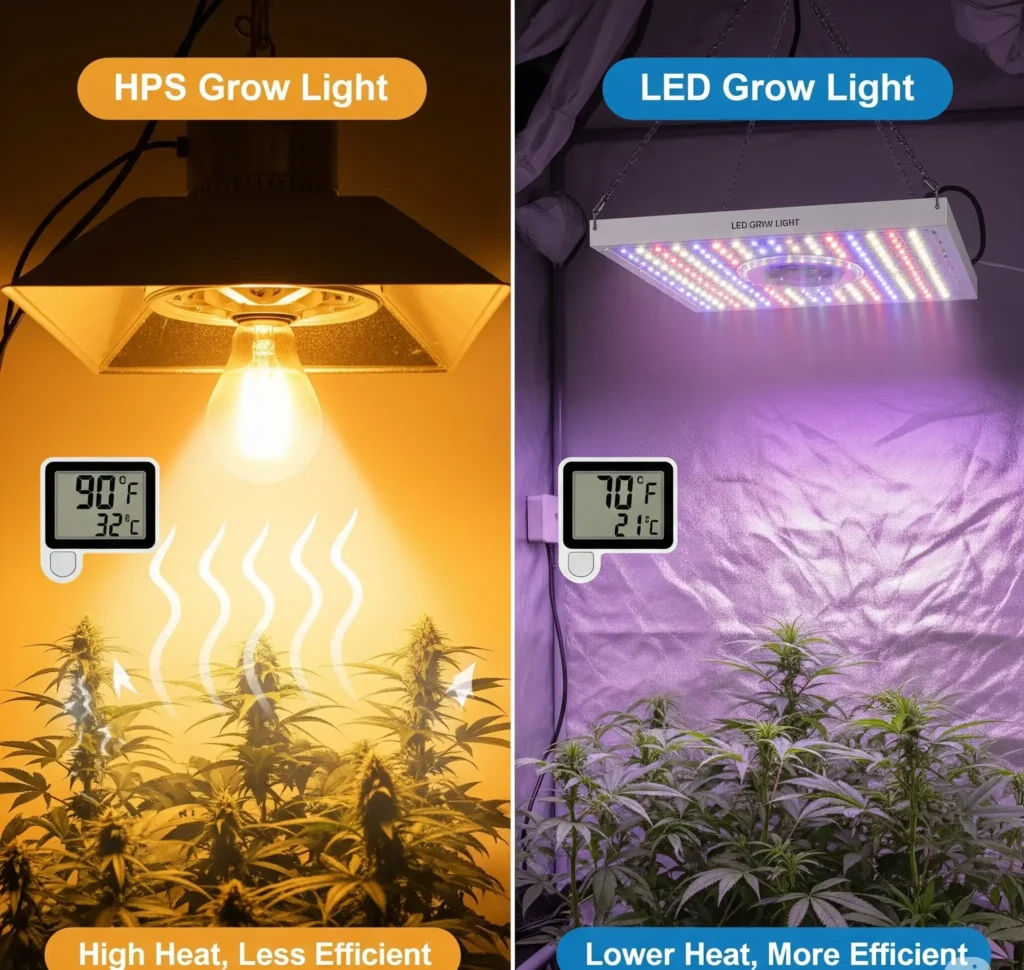
1. HPS to LED Conversion Metrics
Legacy HPS fixtures operate at an efficacy of roughly 1.3 to 1.7 µmol/J. Modern solid-state LED arrays achieve 2.7 to 3.1 µmol/J.
Replacing a 1000W HPS fixture with a 640W LED fixture delivers equivalent or superior Photosynthetic Photon Flux Density (PPFD) across the canopy while reducing direct electrical consumption by 40.7%. In practical terms: a 1000W HPS at ~1.5 µmol/J produces about 1,500 µmol/s of total output, while a 640W LED at ~2.8 µmol/J produces about 1,792 µmol/s — roughly 19% more usable light for 36% less power.
2. Daily Light Integral (DLI) Optimization
Plant growth rate is governed by the total accumulated photons per day, known as Daily Light Integral (DLI), measured in mol/m²/day:
DLI = PPFD (µmol/m²/s) × Photoperiod (hours) × 0.0036
- Vegetative phase (leafy greens, herbs): a high photoperiod at moderate intensity — e.g., 18 hours at 300 PPFD — yields a DLI of 19.44. This is a good candidate for shifting the photoperiod into off-peak utility hours.
- Flowering phase (photoperiod crops): the 12-hour dark period is a strict requirement. Elevate PPFD to hit your target DLI within that fixed 12-hour light window instead.
3. Off-Peak Rate Scheduling (Time-of-Use Management)
Most utilities charge significantly higher rates during peak daytime hours (commonly noon to 7 PM). Setting your light controllers to run during a night window — for example, 8 PM to 2 PM — offers two advantages:
- Lower utility pricing: off-peak rates are frequently 30% to 50% lower per kWh.
- Ambient thermal offsets: cooler night air reduces the sensible cooling load on your air conditioning equipment.
The Thermal Domino Effect — HVAC & Dehumidification
Thermal energy management is where hidden grow room costs compound. Every watt of power consumed by a lighting fixture or water pump is ultimately converted into heat at a rate of 3.412 BTU/hr per watt:
Thermal Load (BTU/hr) = Total Fixture Watts × 3.412
- 1000W HPS system: 1000W × 3.412 = 3,412 BTU/hr of thermal output, requiring about 0.28 tons of AC cooling and keeping the compressor running continuously.
- 640W LED system: 640W × 3.412 = 2,183 BTU/hr of thermal output, requiring about 0.18 tons of AC cooling — a 36% reduction in HVAC load.
- Net direct heat reduction: 1,229 BTU/hr.
Reducing ambient sensible heat directly lowers air conditioning compressor duty cycles. Operating leaf temperature also drops under LED lighting (thanks to the absence of direct infrared radiation), which stabilizes ambient humidity spikes and reduces dehumidifier runtime.
The DC Equipment Revolution — Pumps & Ventilation
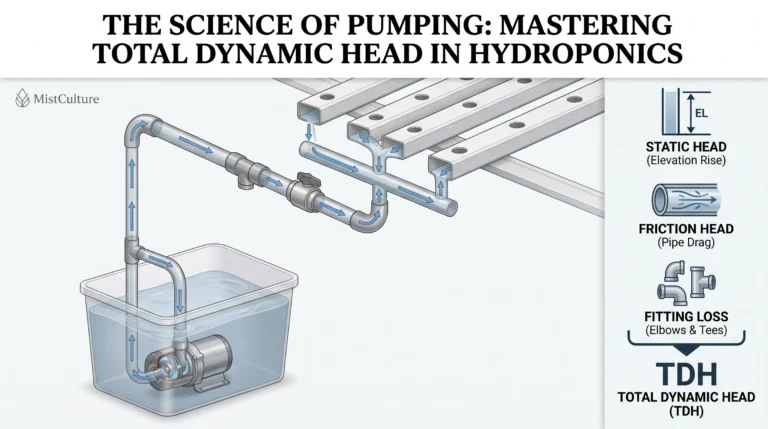
Traditional AC shaded-pole induction motors found in budget water pumps and inline fans are highly inefficient, converting up to 50% of consumed electrical energy into waste heat that gets dumped directly into your nutrient reservoir or ducting. A shaded-pole motor runs at roughly 45% electrical efficiency, while brushless DC/ECM equipment runs at 85-92% efficiency, staying cool and offering precise speed control.
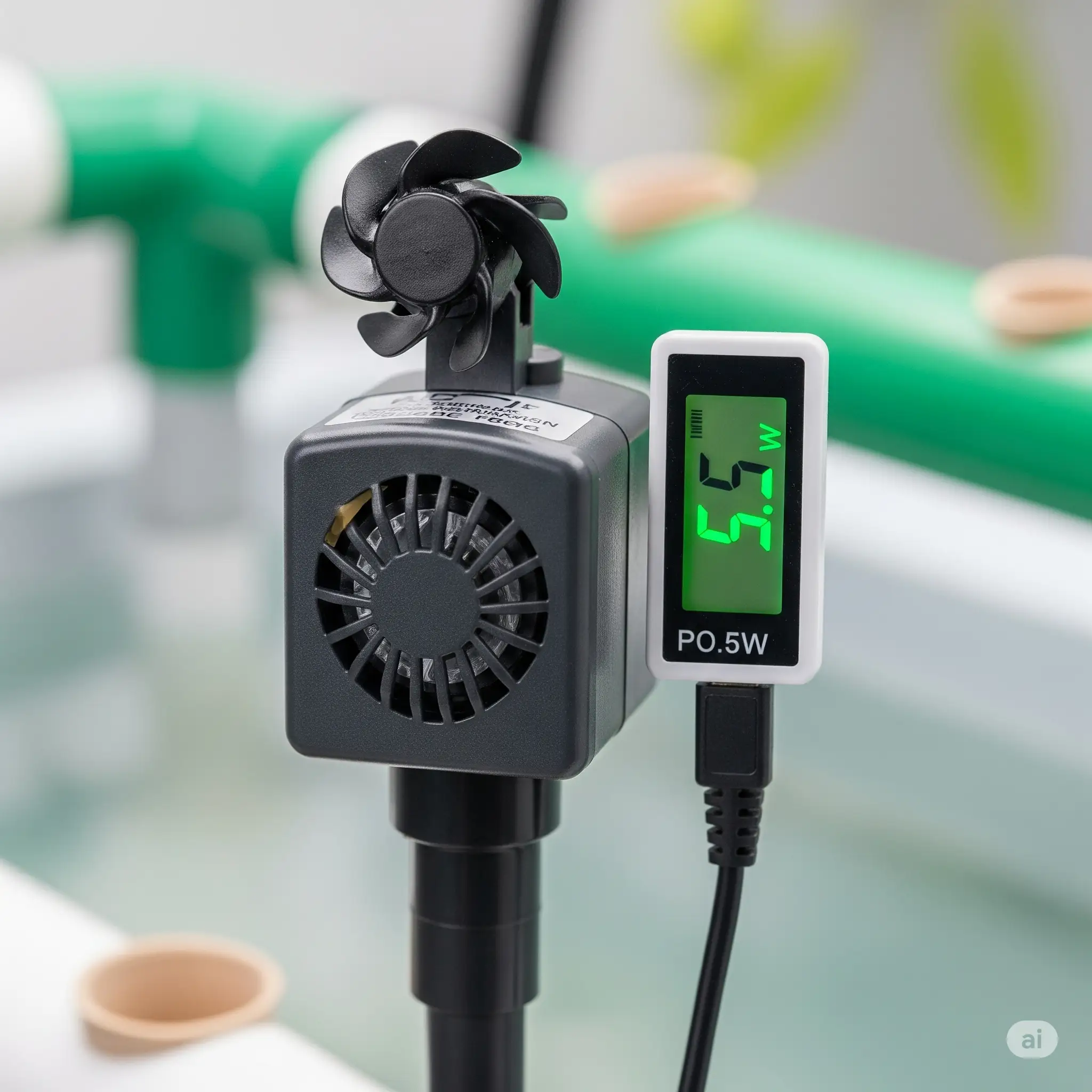
1. AC vs. Brushless DC (BLDC) Water Pumps
Brushless DC pumps use permanent magnet rotors and electronic commutation, reducing power draw by 30% to 60% while running considerably cooler.
| Parameter | Standard AC Submersible Pump | Brushless DC (BLDC) Pump | Energy Impact |
|---|---|---|---|
| Motor Type | AC shaded-pole | Brushless DC | — |
| Power Consumption | 85 Watts | 32 Watts | 62.3% power reduction |
| Water Heat Transfer | High (+3°F to +6°F reservoir rise) | Minimal (< 1°F rise) | Reduces or eliminates chiller runtime |
| Speed Control | Mechanical choke (inefficient) | PWM signal / voltage scaling | Matches exact system flow demand |
2. Electronically Commutated (ECM) Ventilation Fans
Older AC inline duct fans use variable voltage transformers that hum and waste energy when dimmed. Modern Electronically Commutated Motors (ECM) combined with Pulse Width Modulation (PWM) control adjust fan RPM dynamically based on real-time temperature and humidity triggers.
Running an ECM inline fan at 50% speed reduces power consumption by nearly 70%, thanks to fan affinity laws.
Intermittent Aeration Protocols
Running high-wattage aeration pumps or high-pressure delivery pumps 24 hours a day, 365 days a year adds unnecessary power draw and accelerates mechanical wear. Cycling pumps on a timer (for example, 15 minutes on / 15 minutes off) can cut power use by roughly 50% with no measurable drop in dissolved oxygen.
Recommended timing protocols by system type:
- Deep Water Culture (DWC): Air pumps must run continuously (24/7) to maintain dissolved oxygen (≥ 6.0 mg/L), unless you’re using an oxygen injection micro-nanobubble system.
- Nutrient Film Technique (NFT): Delivery pumps can run short-burst cycles during lights-on — e.g., 15 minutes on / 5 minutes off — provided root mats stay constantly saturated.
- Ebb & Flow (Flood & Drain): Flood cycles should be regulated by media retention capacity — e.g., 15 minutes every 3 to 4 hours — keeping total pump runtime under 1.5 hours/day.
- Aeroponics (high pressure): Solenoid and pump engagement should use micro-interval cycle timers — e.g., 5 seconds on / 4 minutes off — cutting pump power usage by over 95% relative to continuous operation.
Data Logging & Environmental Troubleshooting
Energy optimization should never come at the cost of root zone health or atmospheric stability. Your daily environmental log is your earliest warning sign of system inefficiencies.
1. Detecting Energy Inefficiencies via Logs
- Spiking reservoir temperatures: If nutrient solution temperatures climb above 68°F (20°C) while ambient room temperatures stay stable, an inefficient AC pump is likely dumping heat directly into the water, forcing your water chiller to run continuously.
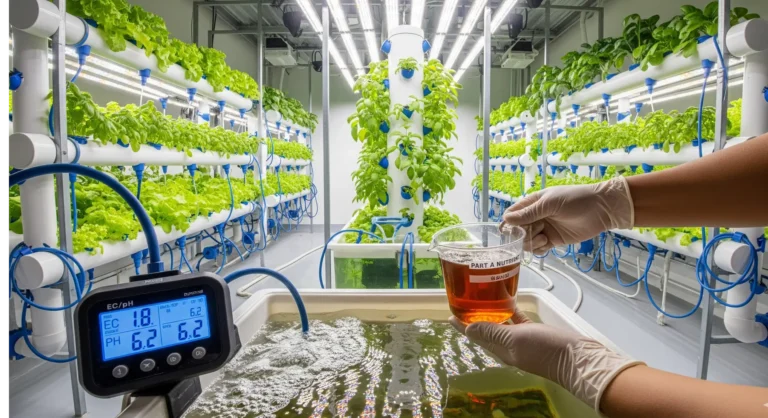
- Mid-afternoon pH spikes: Logging pH at a fixed time each day (e.g., 2:00 PM, during peak light cycle) gives you a clear picture of plant nutrient uptake versus water evaporation. Rapidly rising pH combined with falling water levels points to high transpiration rates caused by excessive sensible heat from inefficient lighting.
2. Vapor Pressure Deficit (VPD) Guardrails
When dialing down ventilation or air conditioning to conserve power, keep room Vapor Pressure Deficit (VPD) within optimal bounds:
- Vegetative stage target: 0.8 to 1.1 kPa
- Flowering stage target: 1.2 to 1.5 kPa
Cutting ventilation power without monitoring humidity can push VPD below 0.5 kPa, causing stomatal closure, nutrient transpiration blockages, and fungal pathogens such as Pythium or powdery mildew.
Actionable Energy Savings Checklist
Phase 1: Energy Audit
- Measure true wattage of every device at the wall using a Kill-A-Watt meter.
- Calculate baseline monthly kWh consumption and total operational cost.
- Contact your utility company to verify Time-of-Use (TOU) off-peak rate schedules.
Phase 2: Lighting & Thermal Upgrades
- Replace legacy HPS/MH lighting with high-efficacy LED arrays (≥ 2.7 µmol/J).
- Shift photoperiod schedule to run during night off-peak utility hours.
- Recalculate canopy DLI to optimize light delivery per growth phase.
Phase 3: Motors, Pumps & Circulation
- [ ] Convert AC submersible pumps to variable-speed brushless DC (BLDC) models.
- [ ] Upgrade fixed-speed AC inline exhaust fans to PWM-controlled ECM fans.
- [ ] Implement cycle timers on NFT and Ebb & Flow delivery pumps.
Phase 4: Environmental Monitoring
- Monitor reservoir temperature to prevent unnecessary chiller cycling.
- Maintain target VPD thresholds (0.8-1.5 kPa) when reducing airflow.
- Log pH, EC, and energy consumption daily at 2:00 PM.
DC Revolution: Fans & Pumps That Sip Power
Your pumps and fans are the workhorses of your grow. A noisy AC pump is a major power vampire.
- DC vs. AC: A DC pump and fan are a game-changer. They are more efficient, more reliable, and quieter than their AC counterparts. Our data showed that a DC pump can save you 30-60% on your power bill.
- ECM vs. PWM: An ECM (Electronically Commutated Motor) fan is a workhorse. It’s more efficient and reliable than a traditional AC fan. A PWM (Pulse Width Modulation) fan is a silent killer. It’s quieter, more efficient, and more reliable than a traditional AC fan.
- Intermittent Aeration: Why running pumps 24/7 is often wasteful? A plant’s roots don’t need oxygen 24/7. Intermittent aeration is a more efficient way to oxygenate your water. Our trials showed that a 15-minute on/off cycle can be just as effective as a 24/7 cycle.
Troubleshooting with Your Checklist
A checklist isn’t just a list of tasks. It’s a troubleshooting tool. When your plants look sad, you can use your logged data to diagnose the problem. My biggest “aha!” moment was realizing that logging pH at 2PM daily, not mornings, gave me a more accurate reading of my system.
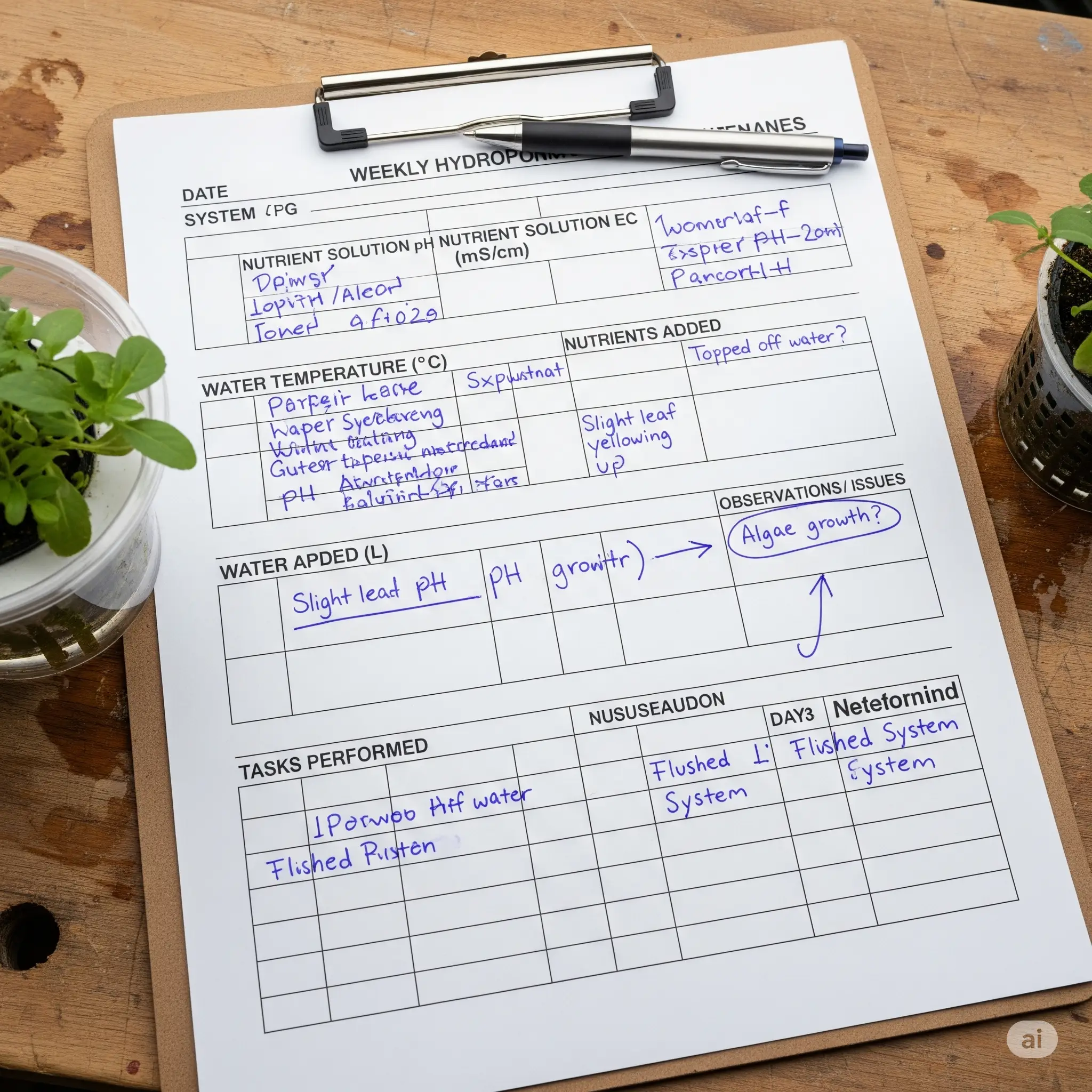
- Review pH/EC Logs: Your pH and EC logs are your crime scene photos. Look for a sudden change. Did your pH spike? Did your EC drop? This is your first clue.
- Visual Inspection: Did you skip a root check? Check your roots for a sudden change. Are they slimy? Are they brown? This is a sign of root rot.
- Cross-Reference: Did you add a new nutrient? Did you change your light schedule? Cross-reference your logs with your changes to find the culprit.
Pro Toolkit: Gear That Pays for Itself
These are the tools I trust with my crops. They’ve been torture-tested and have survived my paranoid tinkering.
VIPARSPECTRA XS1500 Pro LED Grow Light
A high-efficiency 150W quantum board light with Samsung LM301H diodes and dimming function, delivering 2.9 µmol/J efficacy for maximum energy savings .
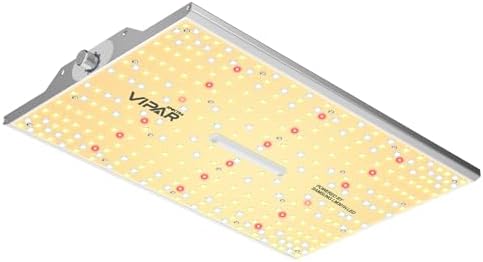
- Top 3×3 Grow Light:With Samsung LM301H diodes featuring upgraded scientific distribution for more even PAR map & deeper …
- Full Spectrum Grow Lights that Mimic Sunlight: With 3000K, 5000K, 660nm & 730nm (IR) LEDs, XS1500 provide plants with op…
- Silent, Solid Construction: No fans zero noise. Large aluminum heat sinks for ideal coling system; high-safety LED drive…
Why Growers Love It:
- Energy Optimization: Samsung LM301H diodes and meanwell driver provide superior PAR output per watt, reducing electricity costs by up to 40% compared to blurple lights .
- Full-Spectrum Excellence: 3000K+5000K+660nm+730nm spectrum supports all growth stages while minimizing light stress and stretching .
- Heat Management: Passive cooling design and detachable driver reduce AC dependency, lowering overall energy burden.
Room for Improvement:
- Coverage Limitation: Optimal for 2’x2′ flower coverage (3’x3′ veg), requiring multiple units for larger spaces .
- Dimming Control: Manual dimmer lacks smart scheduling integration available in premium models .
Who This Is For: Budget-conscious growers seeking professional-grade efficiency in compact spaces. Perfect for vegetative growth and supplemental lighting in multi-tier setups.
AC Infinity UIS Plug Controller 69
A smart power strip with 4 individually controllable outlets, energy monitoring, and automation compatibility for optimizing device runtimes.

- A digital controller designed to equip AC Infinity devices with smart controls to produce the optimal environment.
- Control up to four devices from fans to grow lights and provide each with their own independent programming.
- Automate devices to dynamically change speed and brightness levels in response to temperature, humidity, and VPD.
Bloom & Boost:
- Precision Scheduling: Programs lights, pumps, and fans to run during off-peak hours, leveraging time-of-use electricity rates .
- Wattage Tracking: Real-time energy consumption monitoring helps identify power-hungry devices and adjust usage patterns .
- Cloud Connectivity: Alexa/Google Assistant integration enables voice-controlled automation and remote shutdowns .
The Trade-Off:
- Load Capacity: 10A total limit (1200W) restricts use with high-wattage HID lighting setups.
- App Dependency: Advanced features require stable WiFi connection for full functionality.
Our Grow-O-Meter Says: The brain of any energy-efficient grow room. Pair with AC Infinity fans for automated climate control that reduces unnecessary runtime. See Latest Discount.
Vivosun AeroWave E6 Smart Exhaust Fan
A cloud-connected 6″ inline fan with EC motor technology, achieving 402 CFM at just 28 watts with automated climate scheduling.
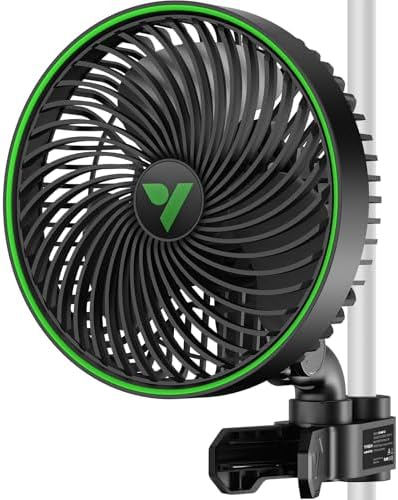
- Powerful & Quiet: Powered by an upgraded dual ball bearing EC motor, this clip fan delivers powerful 320 CFM airflow at …
- 5-Level Auto Oscillation: Focuses airflow on target areas or achieves wide coverage for different plant growth stages; A…
- 10 Speeds & 2 Modes: Offers 10 speed levels (5 if not connected to the app) and two modes (normal and natural) for tailo…
Top-Shelf Features:
- EC Motor Efficiency: Draws 45-60% less power than AC equivalents while providing superior static pressure performance.
- Adaptive Speed Control: Auto-adjusts runtime based on temperature/humidity thresholds, preventing unnecessary operation.
- Daisy-Chain Capability: Controls multiple fans through single controller, reducing energy management complexity.
A Word of Caution:
- Controller Learning Curve: Advanced programming requires understanding of VPD principles for optimal efficiency.
- Ducting Compatibility: Requires 6″ ducting; reduced efficiency if adapted to smaller diameters.
Bottom Line for Growers: The ultimate upgrade for environment control automation. Pair with smart sensors for hands-free climate management that prioritizes energy savings.
Barrina T5 HO LED Grow Light Strips
A 2-foot, 20-watt LED strip system with daisy-chain capability, providing efficient supplemental lighting for canopy penetration .

- Unique Exterior Design: This led grow light strip 1ft made in a black casing with aluminum instead of white casing. Make…
- Easy Installation: With included clips, cable ties, magnetic bar with double-sided tapes, you could install this indoor …
- Full Spectrum (5000K White): Barrina T5 plant lights provide indoor plants with full-spectrum sunlight replacement. We p…
The Green Thumb Upside:
- Targeted Lighting: 500-700 µmol/m²/s output placed between main lights reduces need for higher overall intensity.
- Daisy-Chain Flexibility: Connect up to 10 strips (200W total) to single timer outlet, simplifying power management.
- Heat-Free Operation: Zero radiant heat allows placement inches from canopy without temperature spikes.
Grower’s Notes:
- PAR Distribution: Best for side-lighting and under-canopy supplementation rather than primary lighting.
- Water Resistance: IP54 rating suitable for high humidity but not direct water contact.
The Final Verdict: Perfect for boosting lower canopy development without increasing main light intensity. Ideal for SCROG and multi-layer grows where light penetration is challenging.
WARNING: Always maintain minimum VPD when cutting power. Product links are for ‘energy research.’
FAQ’s
How can I perform a basic energy audit on my hydroponic system?
To perform a basic energy audit, list every electrical component in your system, find its wattage on the label, and log its daily operating hours. You can then use the simple formula: (Watts × Hours) / 1000 to calculate your daily energy consumption in kilowatt-hours (kWh).
Does a grow light schedule impact my electricity bill?
Yes, your grow light schedule has a significant impact. You can save money by running your lights during off-peak hours when electricity rates are lower. You can also save power by using an optimal schedule like 18/6 for vegetative growth, as plants need a period of darkness to rest and can actually yield more.
Do DC pumps and fans really save more energy than AC models?
Yes, DC pumps and fans are significantly more energy-efficient than their AC counterparts. Our data shows that a DC pump can save you between 30-60% on your power bill, and they are also more reliable and quieter.
What is the biggest power consumer in a hydroponic setup?
The grow light is the single biggest energy consumer in almost any u003ca href=u0022https://mistculture.com/hydroponic-system-upgrades-roi/u0022u003ehydroponic system, u003c/au003eaccounting for up to 90% of the total electricity usage. This also makes it your biggest opportunity for significant power savings, especially if you upgrade from an old HID light to a modern, energy-efficient LED.
How can using a smart power strip save me money?
Using a u003ca href=u0022https://mistculture.com/u0022u003esmart power strip helps you automate your growu003c/au003e. A u003ca href=u0022https://mistculture.com/smart-plugs-timers-for-hydroponic/u0022u003esmart power strip with a built-in timeru003c/au003e can turn components on and off precisely, preventing equipment from running unnecessarily and reducing the amount of energy wasted by using analog timers.u003cbru003eu003cbru003e
Work Smarter, Grow Harder: Automate your workflow, eliminate daily maintenance bottlenecks, and streamline your grow room operations with our top-tier efficiency tools. Explore Efficiency Tools →

Continue Your Learning Journey