Dehumidifier Sizing Math for Sealed Grow Rooms and Grow Tents

Table of Contents
- The Physics of Transpiration and Sealed Environments
- Calculating Daily Transpiration Load
- Understanding Dehumidifier Capacity Ratings
- Component Selection and Specification
- System Layout and Airflow Dynamics
- Installation and Commissioning Procedures
- Operation and Maintenance Protocols
- Troubleshooting and Problem Resolution
- Performance Monitoring and Data Analysis
- Safety Systems and Risk Management
- Economic Analysis and Business Planning
- Future Developments in Dehumidification
- Frequently Asked Questions
Disclosure: MistCulture summarizes verified product specs, engineering data, and community feedback. We may earn an affiliate commission if you purchase through our links. Regulations vary by location; this content is for educational purposes only.
Humidity control is the most challenging aspect of sealed grow room operation. Unlike vented tents that exhaust hot, humid air to the outside atmosphere and replace it with fresh air, sealed rooms recirculate the same air continuously. Every single ounce of water transpired by your plants accumulates as atmospheric humidity that must be mechanically removed. Dehumidifier sizing errors lead directly to chronic high humidity, aggressive mold outbreaks, and a complete loss of vapor pressure deficit parameters.
Engineering principles form the foundation of efficient climate control design. Consideration must be given to flow dynamics, pressure requirements, thermal loads, and environmental factors. The design process requires exact mathematical evaluation of your crop’s water usage. This guide provides the complete engineering framework for calculating true dehumidifier capacity requirements for any sealed hydroponic environment.
The Physics of Transpiration and Sealed Environments
Plants are essentially biological water pumps. A healthy hydroponic plant absorbs water through its root system, uses a fraction of a percent for cellular growth and photosynthesis, and transpires the remaining 95 to 99 percent into the air as water vapor. In an outdoor environment or a vented greenhouse, natural air currents carry this moisture away. In a sealed indoor grow room, this moisture is trapped entirely within the insulated walls.
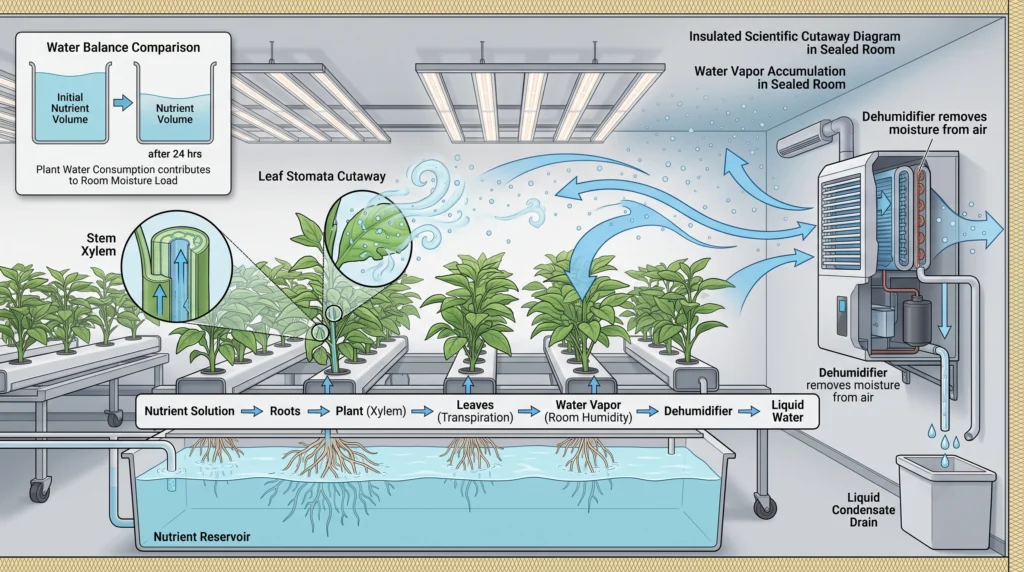
If you add 10 gallons of water to your hydroponic reservoir and the plants consume it over a 24-hour period, nearly all 10 gallons of that water has been converted into airborne vapor. Your dehumidification system must be capable of extracting exactly 10 gallons of water from the air every 24 hours just to maintain equilibrium. If your equipment can only extract 8 gallons per day, the remaining 2 gallons will accumulate in the air, driving relative humidity to 100 percent and causing water to condense on walls, lights, and plant leaves.
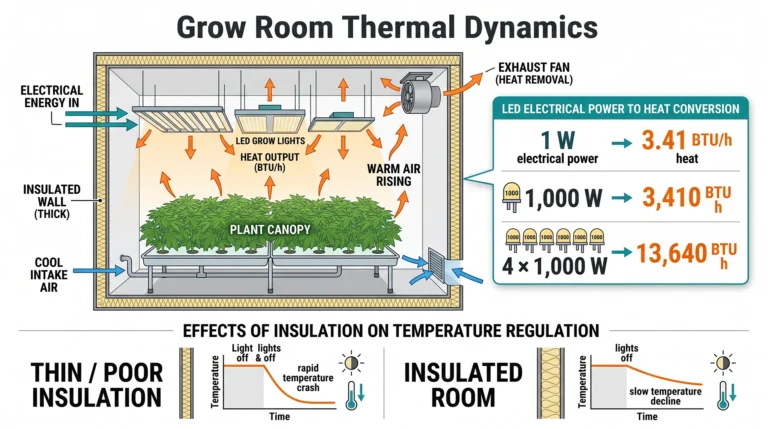
Air conditioning units naturally remove moisture as a byproduct of cooling the air. Warm air passes over the cold evaporator coils, causing moisture to condense and drain away. However, air conditioners only remove moisture while the compressor is actively running. During the “lights-off” night cycle, the heat load drops to zero, the air conditioner stops running, but the plants continue to transpire. This creates a massive humidity spike that can completely devastate a crop. A dedicated dehumidifier is mandatory for managing night-cycle humidity loads.
Calculating Daily Transpiration Load
The water removed by mechanical dehumidification must equal the total water transpired by the plants plus any direct evaporation from the nutrient reservoir and exposed growing media.
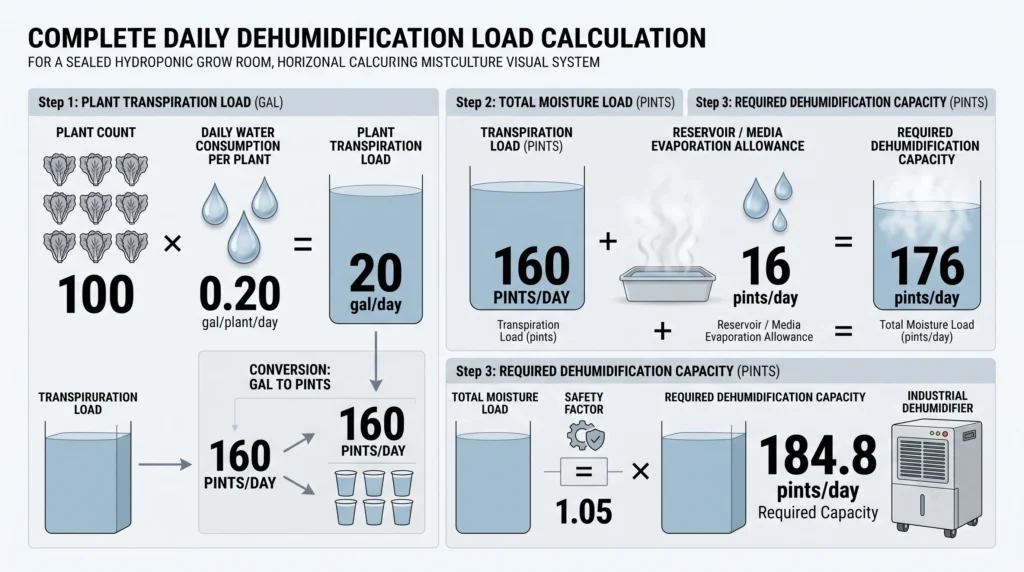
The standard mathematical formula for calculating this load is: Daily Dehumidification Load (pints) = (Plant Transpiration + Reservoir Evaporation) * 1.05
Plant transpiration rates vary heavily based on crop type, growth stage, canopy density, and lighting intensity. Standard baseline transpiration metrics for common indoor crops at peak maturity are:
- Lettuce (mature): 0.15 to 0.25 gallons per plant per day
- Tomatoes (fruiting): 0.30 to 0.50 gallons per plant per day
- Cucumbers (fruiting): 0.25 to 0.40 gallons per plant per day
- Heavy Vining/Flowering Crops: 0.50 to 1.0 gallons per plant per day
To run a precise calculation, you must determine total daily water consumption. Let us model a sealed room containing 100 mature lettuce plants. Plant Transpiration = 100 plants * 0.20 gallons/day = 20 gallons per day. To convert gallons to pints, multiply by 8 (since there are 8 pints in a US gallon). 20 gallons * 8 pints/gallon = 160 pints per day of direct plant transpiration.
Next, we calculate the passive reservoir evaporation. Open water surfaces and damp media evaporate water directly into the air. A standard engineering assumption allocates an extra 10 percent of the transpiration load to account for this evaporation. Evaporation Load = 160 pints * 0.10 = 16 pints per day.
Total Moisture Load = 160 + 16 = 176 pints per day.
Finally, we apply a 1.05 safety factor (a 5 percent buffer) to account for unexpected temperature swings or extreme peak growth days. 176 pints * 1.05 = 184.8 pints per day.
For this specific layout, you must select a dehumidifier configuration rated to remove at least 185 pints of water per day under real-world conditions. You can model your exact water usage metrics using our hydroponic water efficiency calculator.

- PRO-GRADE 70-PINT PERFORMANCE – This AlorAir Crawl Space Dehumidifier removes up to 70 pints per day under saturated con…
- BUILT TOUGH FOR DEMADING ENVIRONMENTS – Unlike standard residential dehumidifiers, this basement and crawl space dehumid…
- BUILT-IN PUMP FOR FLEXIBLE DRAINAGE INSTALLATION – Flexible two-way drainage for easy installation. Use the included gra…
- Why it’s necessary: Commercial-grade units are engineered to operate continuously in high-temperature, high-humidity environments without premature compressor failure.
- Key Spec: Removes 71 pints per day at true AHAM standards with high-efficiency hot gas bypass for continuous operation.
Understanding Dehumidifier Capacity Ratings
A frequent error made by DIY builders involves misinterpreting manufacturer capacity ratings. Dehumidifiers sold in retail hardware stores are rated based on the Association of Home Appliance Manufacturers (AHAM) testing standard. The AHAM standard tests moisture removal at exactly 80 degrees Fahrenheit and 60 percent relative humidity.
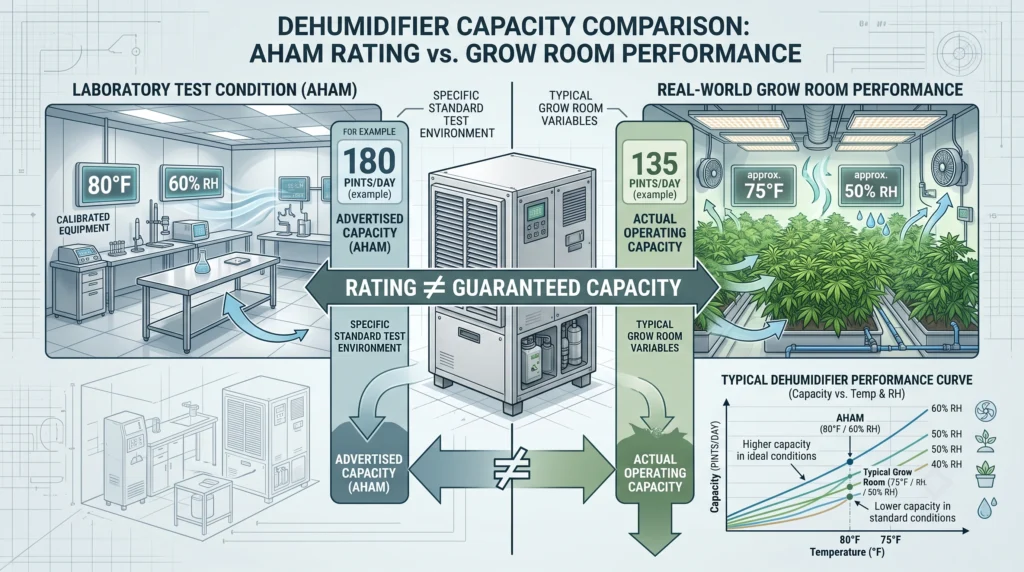
Your grow room rarely operates at these exact parameters. If you maintain your room at 75 degrees Fahrenheit and 50 percent relative humidity, there is less total moisture in the air per cubic foot than at the AHAM standard. Consequently, the dehumidifier has to work harder to extract water. A residential unit advertised as a “70-pint” dehumidifier might only pull 45 to 50 pints per day under your specific grow room conditions.
Commercial agricultural dehumidifiers provide capacity rating charts across multiple temperature and humidity spectrums. When sizing your equipment, you must match your calculated Daily Dehumidification Load against the manufacturer’s performance curve for your specific target temperature and humidity, not just the bold number printed on the retail box.
Component Selection and Specification
Selecting the right components ensures system reliability and performance. Dehumidifiers must be sized for required moisture removal rates while maintaining energy efficiency. Two primary types of dehumidifiers exist for indoor agriculture: refrigerant and desiccant.
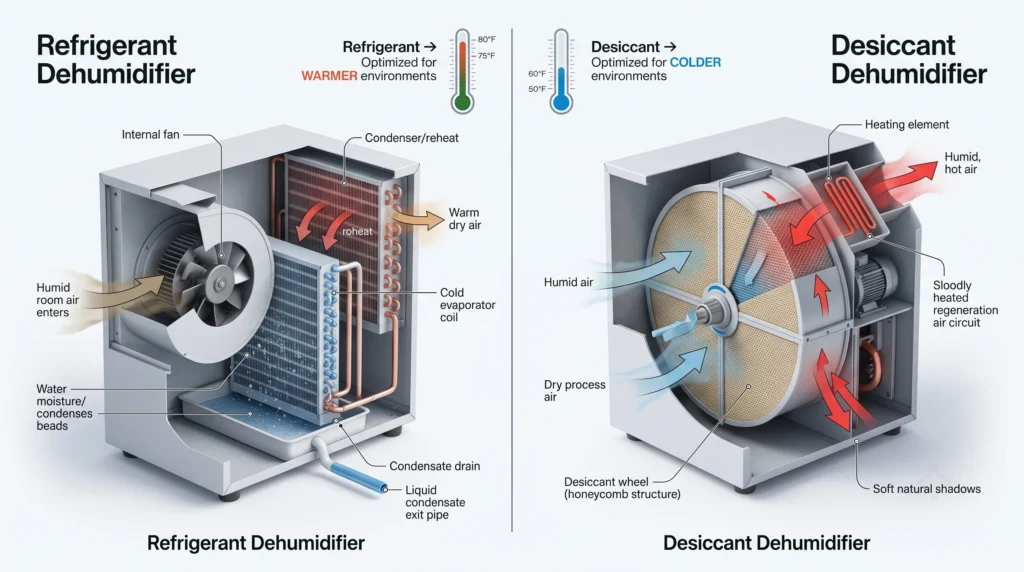
Refrigerant dehumidifiers are the standard choice. They use a compressor to cool a metal coil. A fan blows the humid grow room air across this cold coil, causing the water vapor to condense into liquid, which drips into a collection pan. The dry air is then reheated slightly and exhausted back into the room. Refrigerant units are highly efficient at temperatures above 65 degrees Fahrenheit.
Desiccant dehumidifiers use a rotating wheel coated with a moisture-absorbing chemical (like silica gel). As air passes through the wheel, the moisture is trapped. A separate heated airstream then bakes the moisture out of the wheel and exhausts it as hot, wet air. Desiccant units are necessary in cold environments (below 60 degrees Fahrenheit) where refrigerant coils would freeze solid, but they consume massive amounts of electricity to generate the heat needed to purge the wheel. For almost all indoor grow rooms, refrigerant models are the correct engineering choice.
Sensors need appropriate accuracy, response time, calibration stability, and environmental resistance for the specific application. Humidity sensors should have an accuracy of plus or minus 2 percent. Control systems should have sufficient processing capability, expansion options, user-friendly interfaces, and robust data logging capabilities. You can review appropriate sensor hardware in our hydroponic sensors guide.

- EASY TO CLEAN WASHABLE FILTER: Capture dust from the air and keep your dehumidifier working efficiently with our easy-to…
- CUSTOM HUMIDITY CONTROL: Maximize your comfort with customized control over the amount of humidity in your room.
- EASY TO CLEAN WASHABLE FILTER: Capture dust from the air and keep your dehumidifier working efficiently with our easy-to…
- Why it’s necessary: For smaller grow tents where commercial units are too large, this residential model features an internal pump to push condensate water up and out of the tent automatically.
- Key Spec: 50-pint capacity (AHAM) with a 15-foot vertical lift condensate pump.
System Layout and Airflow Dynamics
System layout requires careful attention to component positioning and flow path optimization. Dehumidifiers pull in wet air and exhaust dry, warm air. If you place a dehumidifier directly next to a wall or cram it into a tight corner, the exhaust air will bounce off the wall and be sucked straight back into the intake. The unit will sense that the air is dry and shut off, leaving the rest of the room completely saturated. This phenomenon is known as short-cycling.
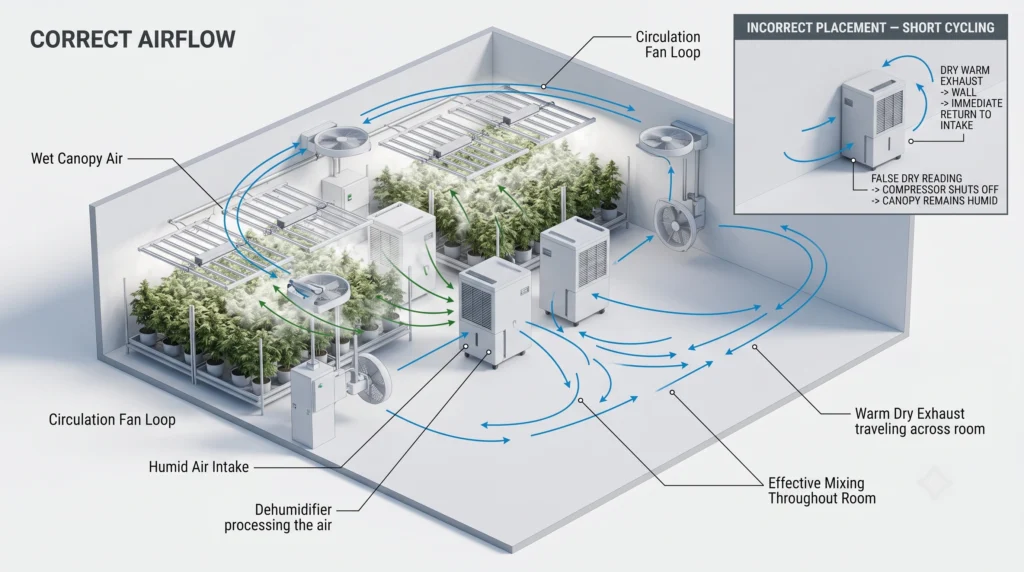
Place your dehumidifier so the exhaust air can project freely across the longest dimension of the room. Wall-mounted oscillating fans should be used to create a circular air current that constantly pushes wet canopy air toward the dehumidifier intake.
In commercial setups, dehumidifiers are suspended from the ceiling. This saves valuable floor space and takes advantage of thermal dynamics. Warm, humid air naturally rises toward the ceiling. Suspending the unit places the intake directly in the most saturated air zone. If suspending the unit, ensure structural supports are rated for the operating weight of the machine (which includes the weight of the water held in the internal drip pan).
Installation and Commissioning Procedures
Proper installation ensures system reliability and performance from day one. Follow manufacturer installation guidelines precisely and use proper tools and techniques. Test all components before introducing plants to verify correct operation.
The commissioning checklist must include component testing, system integration, performance verification, and documentation completion. Place the dehumidifier in its final location and allow it to sit unplugged for 24 hours. This allows the internal compressor oils, which may have shifted during shipping, to settle back into the sump. Starting a compressor with displaced oil will destroy the internal bearings immediately.
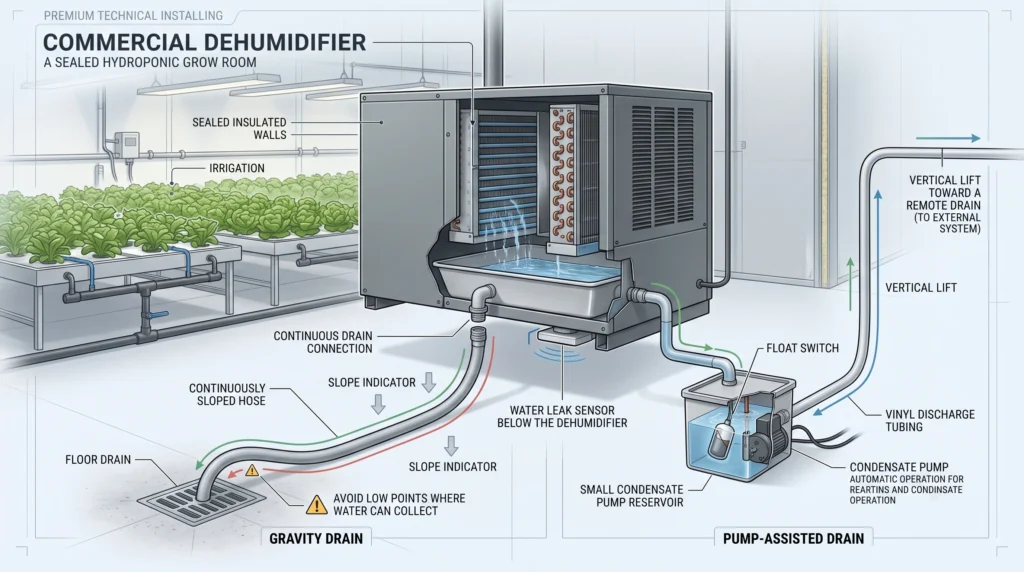
Condensate drainage is a major installation factor. A 100-pint dehumidifier generates over 12 gallons of liquid water per day. You cannot rely on internal collection buckets; they will fill up and shut the machine off within hours. You must hard-plumb a continuous drain line.
If your unit is mounted higher than your room’s floor drain, you can use a gravity drain hose. Ensure the hose maintains a constant downward slope with no dips or traps where water can pool and cause an air lock. If your drain is located across the room or at a higher elevation, you must install a condensate pump. The dehumidifier drains into the pump’s small reservoir. When the reservoir fills, a float switch activates the pump, pushing the water through a vinyl tube to your waste drain.
System integration testing verifies proper communication between the dehumidifier and external humidity controllers. Performance verification confirms the system meets design specifications under full load conditions. For guidance on sizing the footprint of your specific environment, refer to our grow tent buying guide.
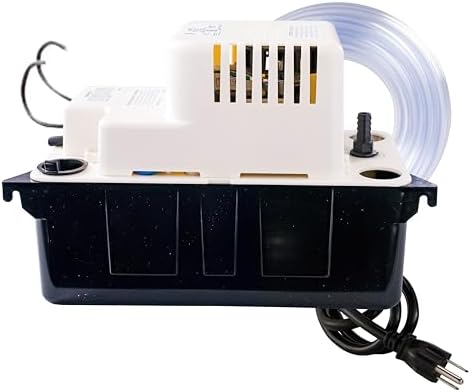
- AUTOMATIC CONDENSATE PUMP: features a vertical-type switch to reduce footprint and is designed to automatically remove c…
- THERMALLY PROTECTED, HIGH-PERFORMANCE MOTOR: 1/50 HP, 1.0 Amps, 60 Watts, 115 Volts, 60 Hz, fan-cooled motor; CSA certif…
- BUILT TO LAST: ABS tank, motor cover and volute; stainless steel motor shaft; thermal overload protected motor; can hand…
- Why it’s necessary: Gravity drains frequently fail or clog in flat grow rooms. A dedicated condensate pump actively forces collected water up and out of the environment to a remote drain.
- Key Spec: 1/30 HP motor capable of 15 feet of vertical lift with a 1-gallon ABS tank.
Operation and Maintenance Protocols
Regular maintenance prevents failures and extends equipment life. Daily checks include visual inspection, leak detection, and parameter verification. Operators should walk the system daily looking for signs of trouble. Leaks at hose connections or pump seal failures are common issues that daily inspection can catch.
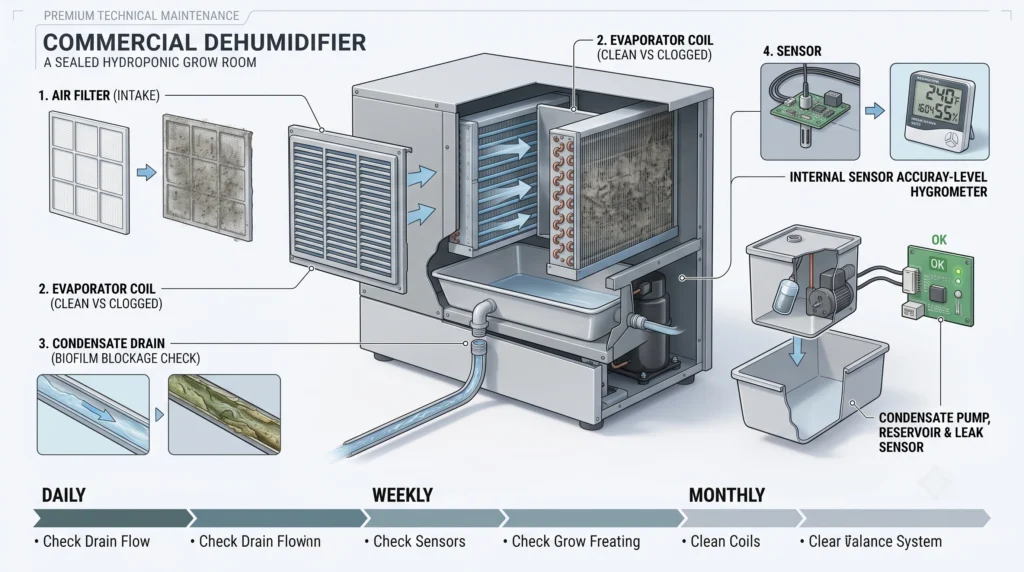
Dehumidifiers process massive volumes of air, which inevitably contains dust, pollen, and microscopic plant debris. This particulate matter gets sucked into the machine and slammed into the wet, sticky evaporator coils. If the air filter is not maintained, this sludge will coat the coils, destroying the machine’s ability to transfer heat and condensing efficiency.
Weekly maintenance covers filter replacement and cleaning. Washable pre-filter elements must be rinsed weekly in systems with high particulate loads. If the filter becomes completely obstructed, the reduced airflow will cause the internal coils to drop below freezing. Ambient moisture will instantly freeze to the coils, turning the machine into a block of ice and halting moisture removal completely.
Monthly maintenance involves comprehensive inspection and component testing. Electrical connections should be inspected for corrosion. Condensate drain lines frequently develop thick, slimy bacterial mats (biofilm) due to the warm, wet, dark environment. Flush the drain lines monthly with a mild bleach or hydrogen peroxide solution to clear this biological blockage before it backs up into the machine. You can diagnose common equipment failures using our hydroponic troubleshooting guide.
Troubleshooting and Problem Resolution
Systematic troubleshooting minimizes downtime and prevents catastrophic crop loss from fungal outbreaks. Common issues include short cycling, icing, and sensor drift.
If the dehumidifier is running continuously but humidity remains high, first verify that the room is actually sealed. A loose ducting connection pulling damp air from an outside crawlspace will overwhelm any dehumidifier. If the room is sealed, check the evaporator coils behind the filter. If they are frozen solid, the room ambient temperature is likely too low (below 65 degrees Fahrenheit) or the airflow is restricted. Turn the unit off, allow it to thaw, and increase ambient room temperatures or clean the filter.
Sensor drift requires recalibration or replacement of the sensing element. Many built-in dehumidifier sensors are notoriously inaccurate because they are measuring the air directly next to the machine. The air near the machine is always warmer and drier than the air inside the dense plant canopy. Always use an external, calibrated hygrometer placed at the canopy level to verify the true environmental conditions.
Diagnostic procedures involve visual inspection, parameter logging, and component testing. Parameter logging helps identify trends and correlations that point to root causes. For instance, if humidity spikes dangerously at exactly 8:00 PM every night, you can correlate this with your lighting timer shutting off, indicating a severe drop in sensible heat that causes relative humidity to skyrocket. We cover the biological fallout of poor climate control in our hydroponic root rot prevention manual.
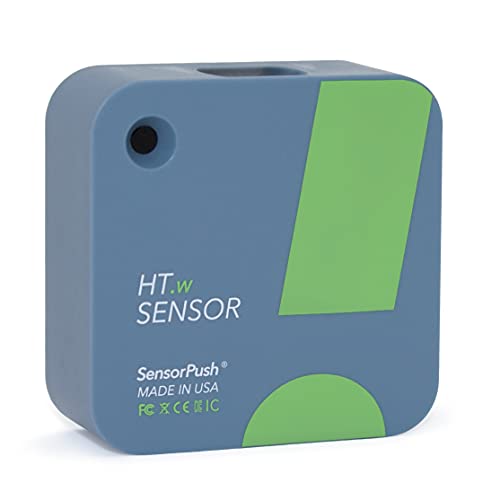
- NO INSTALLATION FRUSTRATION: While other temperature sensors require complicated, glitchy setup, SensorPush skips the he…
- SIMPLE & RELIABLE: Sensors are manufactured with reliable hardware, a 1-2 year battery life in typical conditions, & exc…
- 24/7 MONITORING AND REPORTING: Once connected, SensorPush constantly records temperature, humidity, heat index, dew poin…
- Why it’s necessary: Built-in dehumidifier sensors measure air at the machine, not in the plant canopy. This smart sensor logs exact canopy humidity to your phone, alerting you instantly to dangerous moisture spikes.
- Key Spec: Swiss-made sensing component with Bluetooth and WiFi data logging capabilities.
Performance Monitoring and Data Analysis
Continuous optimization maximizes yield and resource efficiency. Monitoring includes real-time parameter tracking, trend analysis, and anomaly detection. Real-time parameter tracking provides immediate visibility into system operation. Trend analysis identifies gradual changes, such as a slow loss of dehumidification capacity over several months, which points to a slow refrigerant leak or compressor wear.
Adjustment involves automated control responses and seasonal adaptations. Automated control responses maintain optimal conditions within defined parameters. Instead of relying on the dehumidifier’s internal humidistat, plug the unit into a dedicated environmental controller. The external controller utilizes a high-precision probe hung directly in the plant canopy. When the canopy humidity exceeds the set point, the controller sends power to the dehumidifier.
Analysis includes yield correlation and cost optimization. Yield correlation identifies environmental factors that affect production. High humidity during the late flowering stage drastically increases the risk of Botrytis (bud rot) and powdery mildew. By logging humidity data, you can correlate specific environmental parameters with clean, high-yielding harvests versus crops lost to fungal pathogens. Compare hardware management options in our breakdown of the best hydroponic controllers under 200. For simpler setups, review our smart plugs timers for hydroponic scheduling guide.
Safety Systems and Risk Management
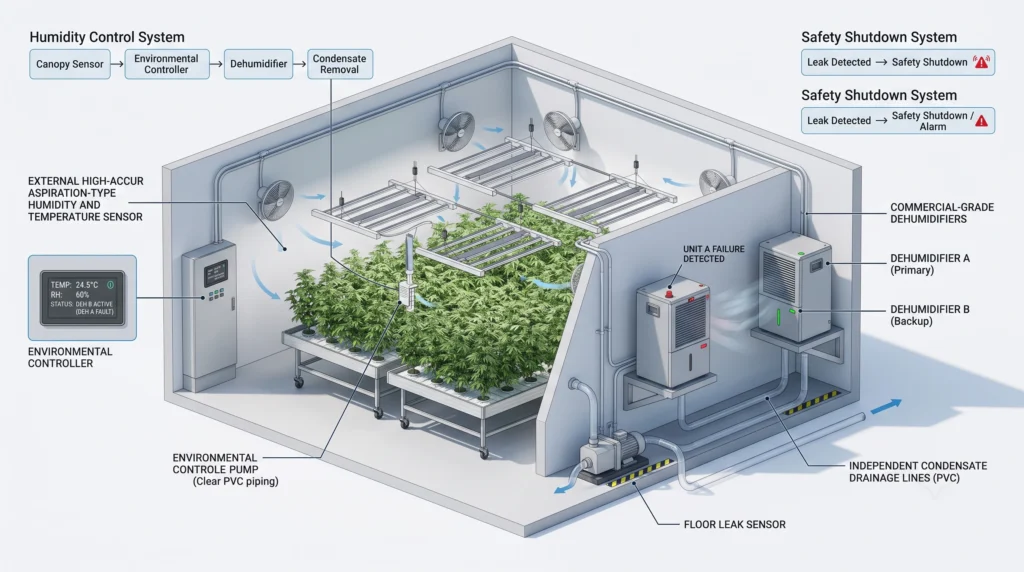
Safety systems protect both crops and equipment from damage and failure. Emergency shutdown systems include automatic triggers and fail-safe designs. Condensate overflow is a major risk. If the condensate pump fails, water will pour out of the dehumidifier onto the floor, potentially reaching electrical strips or ruining flooring.
Install a water leak detection sensor on the floor directly beneath the dehumidifier and the condensate pump. Connect this sensor to an alarm system or a smart plug that instantly cuts power to the water pumps in the reservoir if a flood is detected.
Redundancy measures include backup components. Dehumidifiers contain moving compressors that will eventually fail. In a commercial sealed room, a single dehumidifier failure during the late fruiting stage will destroy the crop within 48 hours. Instead of buying one massive 200-pint dehumidifier, purchase two 100-pint units. If one fails, the second unit will keep the humidity low enough to prevent immediate crop loss while you procure replacement parts.

- Designed to ventilate hydroponic grow rooms, transfer heating/cooling, cool AV closets, and exhaust odors.
- Dynamic temperature and humidity programming, with timers, grow cycles, scheduling, minimum speed.
- Remotely connect to our WiFi app to access advance programs, view climate data, and set automation.
- Why it’s necessary: Inline fans are used to scrub air through carbon filters or create active intake/exhaust airflow to dump excess humidity quickly if the sealed room dehumidifier fails.
- Key Spec: 400 CFM airflow with a digitally controlled EC motor for precise speed adjustment.
Economic Analysis and Business Planning
Economic viability determines the long-term sustainability of indoor operations. Cost analysis includes capital investment, operating expenses, and maintenance costs.
Capital investment covers initial equipment. Cheap residential dehumidifiers from big-box stores cost a fraction of commercial units. However, residential units are designed to run a few hours a day in a damp basement. If placed in a commercial grow room and forced to run 18 hours a day, the compressor will burn out within a single year. Commercial units like Quest or Anden cost three times as much upfront but will operate flawlessly for five to ten years.
Operating expenses include utilities. Dehumidifiers consume massive amounts of electricity. Check the Energy Factor (EF) rating, measured in liters of water removed per kilowatt-hour (L/kWh). A high-efficiency commercial unit might extract 3.0 L/kWh, while a cheap retail unit extracts only 1.5 L/kWh. Over a 12-month growing cycle, the inefficient unit will double your electrical costs for moisture removal, completely negating the initial purchase savings.
Future Developments in Dehumidification
Staying current with technology ensures a competitive advantage. Emerging technologies include AI-driven control systems and dedicated HVAC integrations.
Advanced facilities no longer use standalone dehumidifiers. They use precision HVAC units that cool and dehumidify simultaneously, utilizing hot-gas reheat coils. In these systems, the heat extracted from the air during the cooling phase is routed to a secondary coil. After the air is cooled to drop the moisture out, it passes over the hot reheat coil. The system pumps dry, room-temperature air back into the canopy, handling both temperature and humidity from a single piece of hardware.
Research trends cover controlled environment agriculture and sustainable practices. Cost optimization balances investment against operational savings. Implementing these advanced thermodynamic systems drastically reduces the total electrical load required to maintain perfect Vapor Pressure Deficit (VPD) levels.
Frequently Asked Questions
Can I just use an air conditioner instead of a dehumidifier?
An air conditioner will remove moisture while it is cooling the room. However, once the room reaches the target temperature, the air conditioner compressor shuts off. The plants will continue to transpire moisture into the air. Without a dedicated dehumidifier, the humidity will spike rapidly anytime the air conditioner cycles off, particularly during the night cycle when heat loads from the grow lights are eliminated.
What is the difference between sensible heat and latent heat?
Sensible heat is the heat you can feel and measure with a standard thermometer, generated by grow lights and pumps. Latent heat is the energy stored in moisture vapor. When plants transpire, they convert sensible heat in the room into latent heat in the form of water vapor. Dehumidifiers remove latent heat by condensing the vapor back into liquid water.
Why does my dehumidifier blow out hot air?
Refrigerant dehumidifiers pull in air, cool it to condense the moisture, and then blow that same air over the hot compressor and condenser coils before exhausting it. This process actually adds sensible heat to your grow room. You must factor the heat output of your dehumidifier into your total air conditioning cooling load calculations, or your room will overheat.
Can I recycle the water collected by my dehumidifier?
Dehumidifier condensate is essentially distilled water, reading near 0 PPM. However, the internal coils of the dehumidifier are often coated in dust and bacteria, and the collection pans can harbor heavy metals from the manufacturing process. If you plan to reuse this water in your hydroponic reservoir, you must pass it through a UV sterilizer and an active carbon filter to ensure no biological or chemical contaminants are introduced to your root zone.
What does Short-cycling mean and how do I prevent it?
Short-cycling occurs when the dehumidifier turns on, runs for a few minutes, turns off, and immediately turns back on. This happens when the unit’s exhaust air is bouncing off a wall and flowing straight back into its intake sensor. It destroys compressors rapidly. Prevent this by placing the unit in a wide-open area and using oscillating fans to constantly mix the room air, ensuring the dehumidifier pulls in an accurate representation of the room’s total humidity.

Continue Your Learning Journey