DLI Calculation Blueprint: Optimizing Daily Light Integral for Hydroponic Yields

Table of Contents
One of the most common mistakes indoor growers make is treating their lighting schedule as a guess. You buy a good LED fixture, hang it over the reservoir, and set a timer for 16 hours because that’s what a forum thread said to do. That plug-and-play approach might get you decent results with a basic basil plant, but it’s a fast way to end up with stunted fruiting crops, tip-burned lettuce, and an electric bill that’s higher than it needs to be. If you actually want to dial in an indoor garden, you need to understand daily light integral hydroponics, not just PPFD.
Light drives photosynthesis, but plants don’t just care how bright a light is at any single moment. They care about the total amount of light they get over the whole day. That total is what sets the pace for their metabolism, their water uptake, and ultimately how much you harvest.
This guide walks through the math behind the light your plants actually use, shows you how to map a photoperiod to a specific crop, and gets you off the guessing game for good.
Legal Note: Regulations vary by location. Always consult local guidelines. This content is for educational purposes only.
The Science of Daily Light Integral Hydroponics
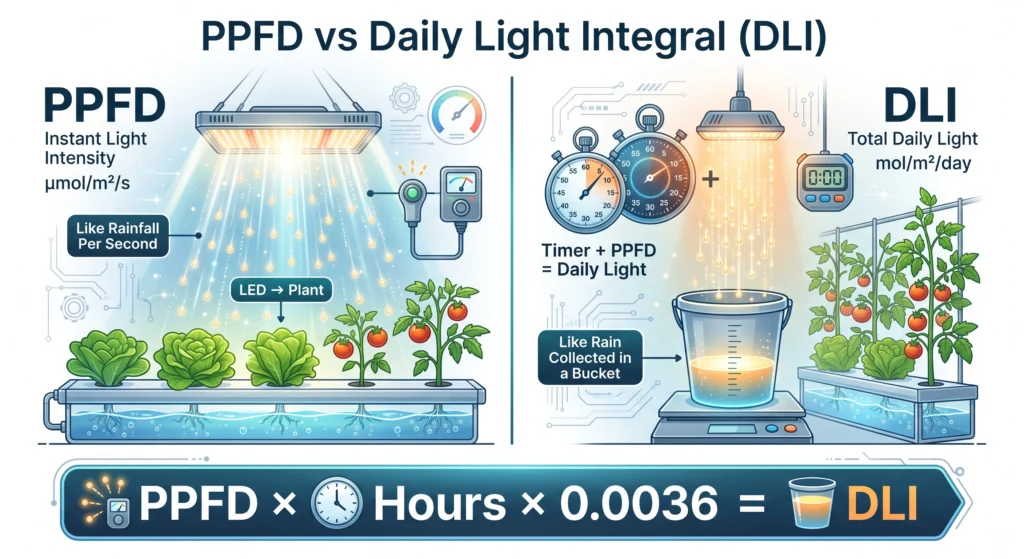
Daily Light Integral (DLI) measures the total number of photosynthetically active photons that land on a square meter of canopy over a full 24-hour period. Where PPFD tells you how intense the light is right now, DLI tells you the actual amount of light the plant gets to work with over the whole day.
To understand DLI, start with the metric used to measure light intensity: PPFD, or Photosynthetic Photon Flux Density. It’s measured in micromoles of photons per square meter per second, written as µmol/m²/s.
A simple way to picture it: PPFD is like standing outside during a rainstorm and counting how many raindrops hit your head in that one second. It tells you how hard it’s raining right now. DLI is the rain gauge sitting in your yard at the end of the day, telling you the total volume that fell over 24 hours. DLI is measured in moles of photons per square meter per day, written mol/m²/d.
The distinction matters because plants respond to light cumulatively. A plant under intense light for 8 hours can end up with roughly the same DLI as a plant under moderate light for 16 hours. Both got the same total “bucket” of light energy, even though it arrived at very different rates.
That gives indoor growers real flexibility. Using the ppfd to dli formula, you can adjust your photoperiod to match whatever your fixture is capable of. Weaker lights can run longer to hit a target DLI. Powerful commercial fixtures can be dimmed or run for fewer hours, which cuts down on both cooling load and electricity use. For more on balancing intensity and distance, see our LED PPFD Guide.
For a second opinion on how much this actually matters in practice, Purdue Extension has published detailed data on daily light requirements for a wide range of commercial greenhouse crops, and it backs up the idea that manipulating DLI has a real, measurable effect on flowering time, stem thickness, and root mass. (Purdue’s DLI publication, hosted via MSU)
How to Calculate Daily Light Integral
To calculate DLI, multiply your measured PPFD by the number of seconds your lights run in a day, then convert from micromoles to moles. This lets you dial in a timer schedule that hits a specific light accumulation target for whatever crop you’re growing.
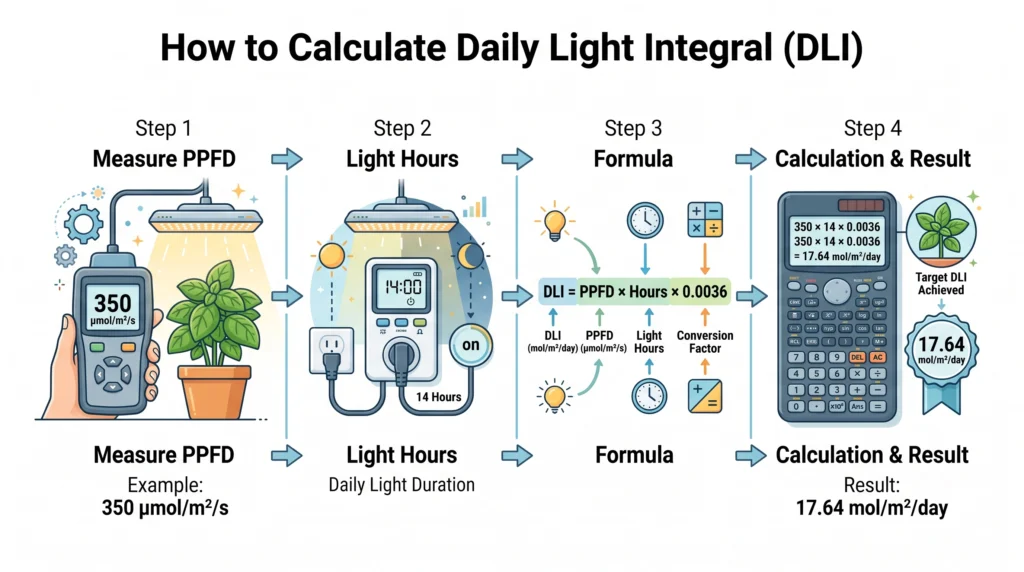
Calculating DLI only takes two numbers: the average PPFD hitting your canopy, and how many hours your lights run per day.
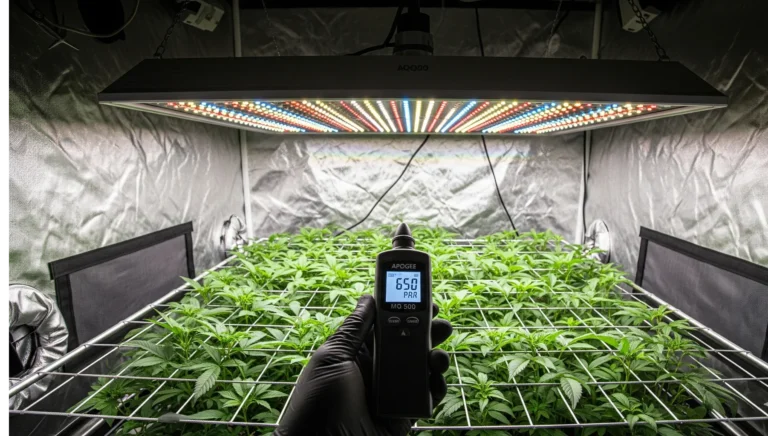
If you don’t already know your PPFD, you can’t calculate a real DLI. Don’t rely on a manufacturer’s hanging-height chart for this. Reflective tent walls, overlapping light footprints from multiple fixtures, and canopy density will all change the real number. Measure PPFD at the top of your canopy with an actual quantum meter.
Once you’ve got that reading, the formula is:
DLI = PPFD × Hours of Light × 0.0036
The Math Breakdown
- Take your PPFD reading (say, 400 µmol/m²/s).
- Multiply it by the hours your light runs (say, 16 hours).
- Multiply that result by 0.0036.
Why 0.0036? There are 3,600 seconds in an hour, so multiplying your per-second PPFD by 3,600 gives you total micromoles per hour. Since the final answer needs to be in moles, not micromoles, you divide by 1,000,000. Do both of those steps together and you get the constant 0.0036.
Example Scenario
Say you’re growing hydroponic basil. A reading at the top of the canopy shows 350 µmol/m²/s, and you’re planning to run lights 14 hours a day.
DLI = 350 × 14 × 0.0036 DLI = 17.64 mol/m²/d
That’s a solid DLI for basil. Drop the photoperiod to 12 hours and it falls to 15.12. If that’s too low for the growth rate you’re after, you either need to lower the fixture closer to the canopy to raise PPFD, or accept a somewhat slower growth pace.
DLI Parameter Table: Leafy Greens vs Fruiting Crops
Different crops need very different total light volumes to hit their genetic potential. Leafy greens do well on relatively low DLI and can develop tip burn if you overshoot it, while fruiting crops need a lot more total light to support the energy demands of flowering and fruit development.
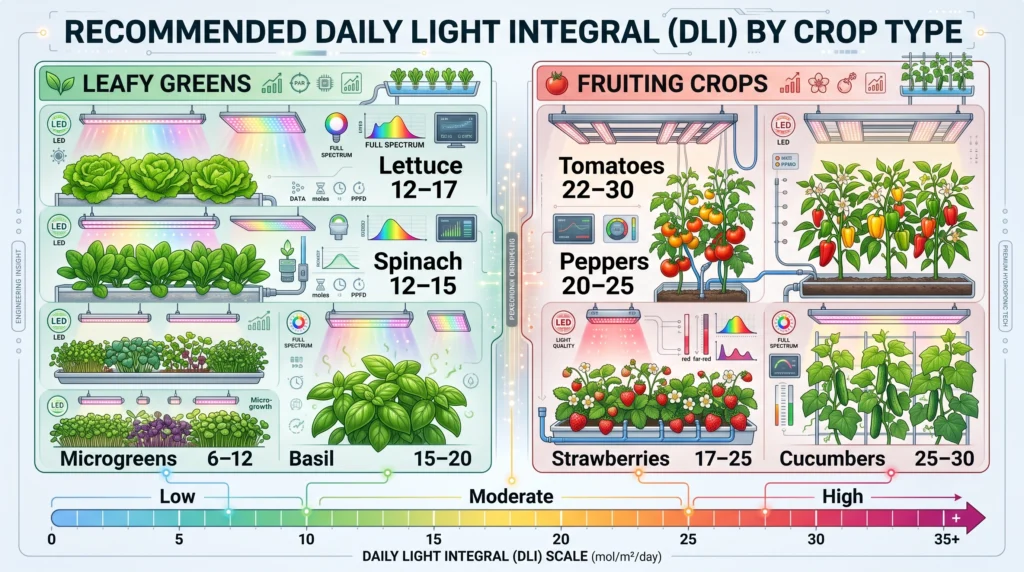
Doing the math is only useful if you also know what your specific crop actually needs. Here’s a DLI target chart for common hydroponic crops, along with the PPFD required to hit the high end of that range on a standard 16-hour photoperiod.
| Crop Type | Target DLI (mol/m²/d) | Required PPFD for High Target (16 Hours) |
|---|---|---|
| Lettuce (Head & Leaf) | 12 to 17 | about 295 µmol/m²/s |
| Spinach | 12 to 15 | about 260 µmol/m²/s |
| Microgreens | 6 to 12 | about 208 µmol/m²/s |
| Basil & Soft Herbs | 15 to 20 | about 345 µmol/m²/s |
| Strawberries | 17 to 25 | about 434 µmol/m²/s |
| Bell Peppers | 20 to 25 | about 434 µmol/m²/s |
| Tomatoes | 22 to 30 | about 520 µmol/m²/s |
| Cucumbers | 25 to 30 | about 520 µmol/m²/s |
Ranges referenced against commercial greenhouse standards; verify the Michigan State floriculture DLI table link before publishing, since it was a redirect URL in the source draft.
Reading the DLI Chart: Lettuce and Leafy Greens
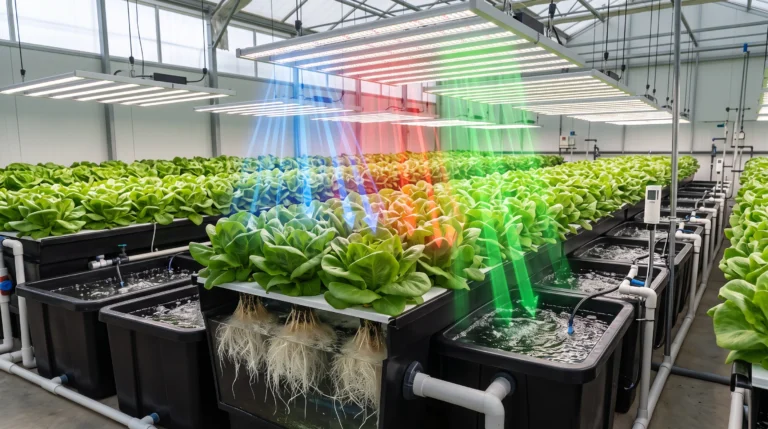
Lettuce stands out because its DLI needs are noticeably lower than fruiting crops. It converts light into leafy biomass efficiently, but it also has a fairly low ceiling before things start going wrong.
Push lettuce past a DLI of about 17 and it tends to transpire faster than its roots can keep up with on calcium uptake. That mismatch shows up as calcium deficiency in new tissue, which is what causes the crispy, brown, dying edges on inner leaves known as tip burn. High DLI environments also run hotter, which can push lettuce toward bolting earlier than you want. For more detail on growing clean, tip-burn-free greens, see our hydroponic lettuce guide.
Reading the DLI Chart: Fruiting Crops
Tomatoes, peppers, and cucumbers are a different story. A tomato plant can technically survive and stay green at a DLI of 15, but it won’t have the energy budget to set a heavy fruit load. Run a fruiting crop too low during the fruiting stage and you’ll see aborted flowers, stretched internodes, and small, low-sugar fruit.
To get commercial-style yields, you generally need to push fruiting crops into the 22 to 30 DLI range. Hitting a DLI of 30 over just 12 hours means running your fixture around 690 µmol/m²/s, which draws a lot of power and generates real heat at the canopy. That’s why a lot of growers extend the photoperiod to 16 or 18 hours instead, so they can dim the lights a bit and still land on the same daily total without cooking the top of the canopy. We go deeper on this for heavy feeders in our hydroponic tomatoes guide and our hydroponic strawberries deep dive.
Actionable Steps: Calibrating Your Grow Room
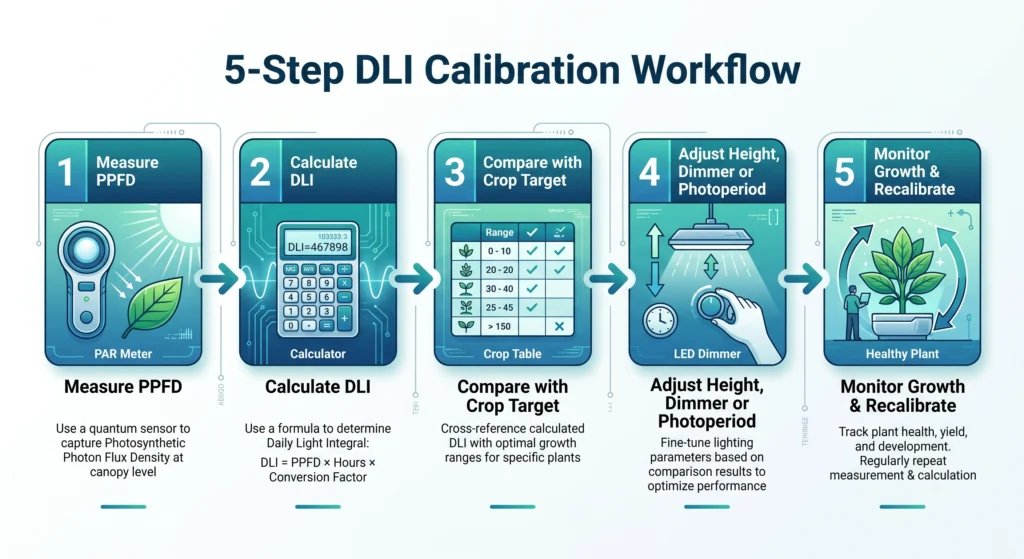
Dialing in a grow room comes down to a repeatable sequence: measure the light at canopy level, calculate your current DLI, check that number against what your crop actually needs, and adjust your hardware until the two match.
Here’s the process to run through whenever you’re starting a new crop cycle or installing a new fixture:
- Map the canopy grid. Turn your lights on to whatever setting you plan to run. Using a quantum meter, take a reading at the center of the canopy, then at all four corners of the grow space. Intensity drops off noticeably at the edges of a footprint, so average these readings for a realistic PPFD number rather than trusting a single center reading.
- Calculate your baseline. Decide how many hours you actually want your lights running. A lot of growers default to 16 hours as a balance between electricity cost and growth rate. Plug that into the formula to get your baseline DLI.
- Check it against crop needs. Compare your baseline number to the parameter table above. If you’re hitting a DLI of 28 while growing spinach, you’re burning a lot of extra electricity and risking real crop damage for no benefit.
- Adjust the hardware. You’ve got two levers here: time and intensity.
- To lower DLI: dim the fixture, raise it higher above the canopy, or cut hours on the timer.
- To raise DLI: turn the dimmer up, lower the fixture closer to the plants, or add hours to the photoperiod.
- Monitor and recalibrate as the plant grows. As plants get taller and closer to the light source, PPFD at the top of the canopy increases due to the inverse square law. A canopy reading 400 µmol/m²/s in week two might be sitting at 600 µmol/m²/s by week six with no changes made. Re-check your readings periodically and adjust fixture height or dimming to keep hitting your target DLI rather than drifting past it.
Getting this right doesn’t just help yield, it also stops you from paying for electricity you don’t need. If cutting overhead costs is a priority, check our power savings guide.
Core Equipment for DLI Measurement

The standard tool for measuring PAR in a hydroponic or greenhouse setting. Cheap light meters measure lux, which is calibrated to human vision rather than what plants actually use. The Apogee measures the specific photon range plants respond to, giving you an accurate PPFD baseline to calculate DLI from. Apogee also publishes solid supplemental documentation on light metrics in general.
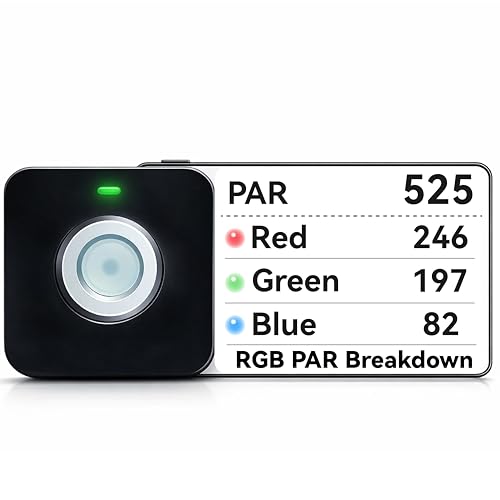
A budget-friendly alternative if an Apogee meter isn’t in the cards. Using a simple paper diffuser over your phone’s camera, the app leans on your phone’s ambient light sensor to estimate PPFD, and it calculates DLI directly inside the app.

For larger setups, a basic wall timer isn’t precise enough. The Hydro-X lets you control photoperiod exactly, automate dimming to simulate sunrise and sunset, and shut lights down automatically if the room exceeds a safe temperature threshold.
Great for small tents or DIY vertical hydroponic towers. Works as a phone-controlled timer for setting exact photoperiod hours, and the energy monitoring feature lets you see exactly how much power your lighting schedule is actually costing you.
“,”description_forced”:true,”ready”:true} /–>DLI Calculator Tool
Use the tool below to skip the manual math. Enter your PPFD reading and photoperiod to get your DLI instantly, check it against target ranges for common crops, or work backward from a target DLI to find the hours or PPFD you need.
Enter your measured PPFD and photoperiod to get your resulting DLI.
Know your target DLI and your PPFD? Find out how many hours per day to run your lights.
Know your target DLI and how many hours you want to run lights? Find the PPFD you need to hit it.
Educational tool. Always measure PPFD at actual canopy height with a real quantum meter rather than relying on manufacturer specs alone.
Frequently Asked Questions
Can you give a plant too much DLI?
Yes. Every plant has a light saturation point. Once a plant hits its maximum daily accumulation, its photosynthetic machinery shuts down to prevent oxidative stress. Any light provided beyond this point is wasted electricity. Pushing DLI extremely high can also cause photoinhibition, leading to bleached leaves, stunted growth, and severe tip burn in leafy greens.
How do I calculate DLI from lux?
You cannot directly convert lux to DLI with complete accuracy because lux measures light intensity as perceived by the human eye, heavily weighing yellow and green light while ignoring red and blue. However, as a rough estimate for white LEDs, you can divide your lux reading by 70 to get an approximate PPFD, and then plug that number into the DLI formula.
Does DLI change during the vegetative and flowering stages?
Absolutely. Fruiting plants like tomatoes and peppers require less light during their early vegetative growth (typically a DLI of 15-18). As they transition into flowering and fruit production, their energy demands skyrocket, requiring you to increase the DLI to 22-30 to support the dense biomass accumulation of the fruit.
Can I just leave my lights on for 24 hours to reach my target DLI?
While mathematically you can hit your DLI target with a 24-hour photoperiod using very weak lights, biologically, it is a bad idea for most plants. Plants require a dark period for respiration, where they break down the sugars accumulated during the day to fuel new cellular growth. Running a 24-hour cycle often stresses plants, leading to curled leaves and poor nutrient translocation.
Why are my lettuce leaves burning even if my PPFD is low?
If your PPFD is low (e.g., 200 µmol/m²/s) but you are running your lights for 24 hours, your resulting DLI is 17.28. While the intensity is low, the total accumulation is pushing the very upper limit for lettuce. The continuous, uninterrupted transpiration without a rest period can cause calcium deficiency in the new leaf tissue, resulting in tip burn.
Master Your Canopy DLI & Lighting Efficiency
Stop guessing your indoor photoperiods and PPFD targets. Calculate exact Daily Light Integral (DLI) requirements for leafy greens and fruiting crops to maximize photosynthetic output while eliminating wasted energy.
⚡ 100% Free interactive PPFD & DLI tools • Instant photoperiod optimization

Continue Your Learning Journey