The Ultimate Guide to Far-Red and Deep-Red Light Ratios for Flower Initiation

Table of Contents
- Abstract: The Science of Photomorphogenesis and Spectrum Tuning
- Methodology: Testing the 730nm Far Red Effect in Controlled Environments
- The Emerson Enhancement Effect: Why Deep Red Needs Far Red
- Metric Tables: Phytochrome State Conversion and Yield Tracking
- Real-World Yield: Impact of Supplemental Far Red LED on Fruiting Crops
- Industry Implications: The Shift Toward ePAR in Hydroponic Lighting
- Essential Gear for Spectrum Tuning
- Frequently Asked Questions
- The Final Verdict on Far-Red Spectrums
Integrating far-red light (700 to 750 nm) into controlled-environment agriculture fundamentally alters how plants perceive their canopy density and the transition to night. Precise manipulation of the deep red vs far red light ratio accelerates flowering, increases photosynthetic efficiency, and boosts overall yield biomass in light-hungry fruiting crops.
If you have spent any serious time analyzing grow lights for your indoor farm, you already know the basic PAR (Photosynthetically Active Radiation) spectrum. For decades, the industry operated under the assumption that plants only utilized light between 400 nm and 700 nm. We meticulously measured PPFD (Photosynthetic Photon Flux Density) within those bounds, optimizing for blue and red peaks.
Science has caught up to the complex reality of photobiology. We now know that extending our light spectrum to include 730 nm wavelengths unlocks a massive metabolic advantage for fruiting and flowering crops. This deep dive into far red light hydroponics strips away the marketing hype surrounding modern LED fixtures. We are looking at the hard data behind phytochrome manipulation, the mechanics of the Emerson enhancement effect, and exactly how you can implement supplemental far-red lighting to slash your time to harvest.
Abstract: The Science of Photomorphogenesis and Spectrum Tuning
Photomorphogenesis relies on photoreceptors called phytochromes to regulate plant architecture and flowering phases. By understanding the constant tug-of-war between the active and inactive states of these proteins, growers can hijack the plant’s internal clock to force earlier, more prolific flower initiation.
To understand the deep red vs far red light debate, you need to understand how a plant sees its environment. Plants do not have eyes; they have light-sensitive proteins called phytochromes. Phytochromes exist in two reversible states: Pr (Phytochrome red) and Pfr (Phytochrome far-red).
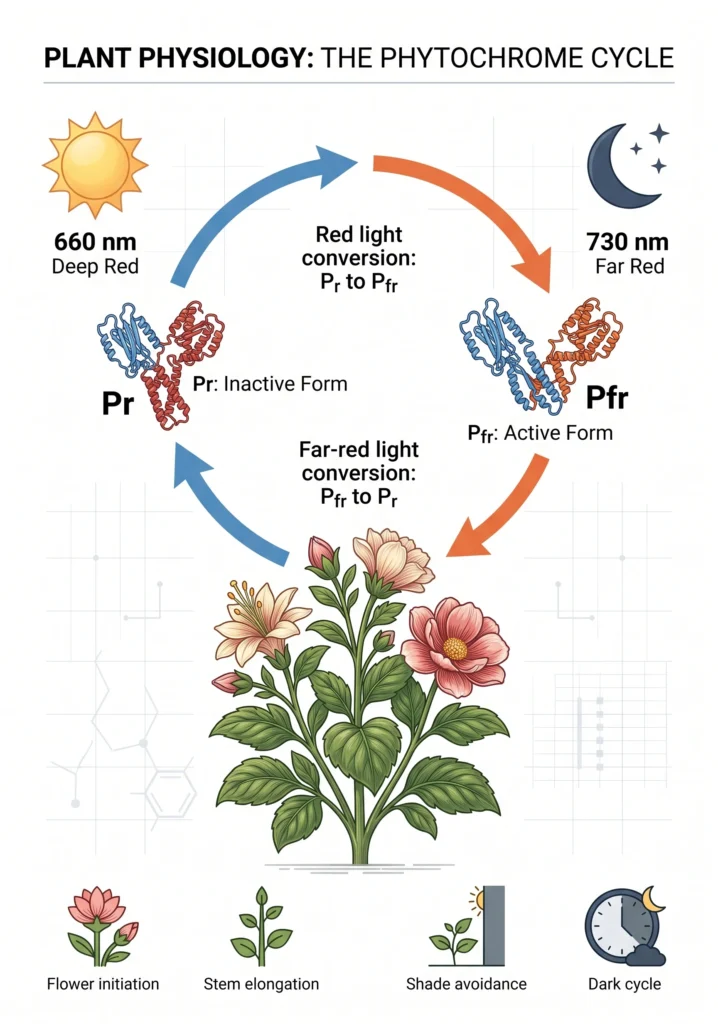
When a plant absorbs deep red light (peaking around 660 nm), the Pr protein converts into Pfr. Pfr is the biologically active form of the molecule that tells the plant it is receiving high-quality, direct sunlight. When the plant absorbs far-red light (peaking around 730 nm), or simply sits in total darkness for an extended period, the Pfr slowly reverts back to Pr.
This phytochrome state conversion is the foundation of photoperiodism. It dictates seed germination, stem elongation, shade avoidance, and most importantly, flower initiation. In nature, the sun emits a balanced ratio of deep red to far-red light. As the sun sets, the deep red light scatters, and the natural spectrum shifts heavily toward far-red.
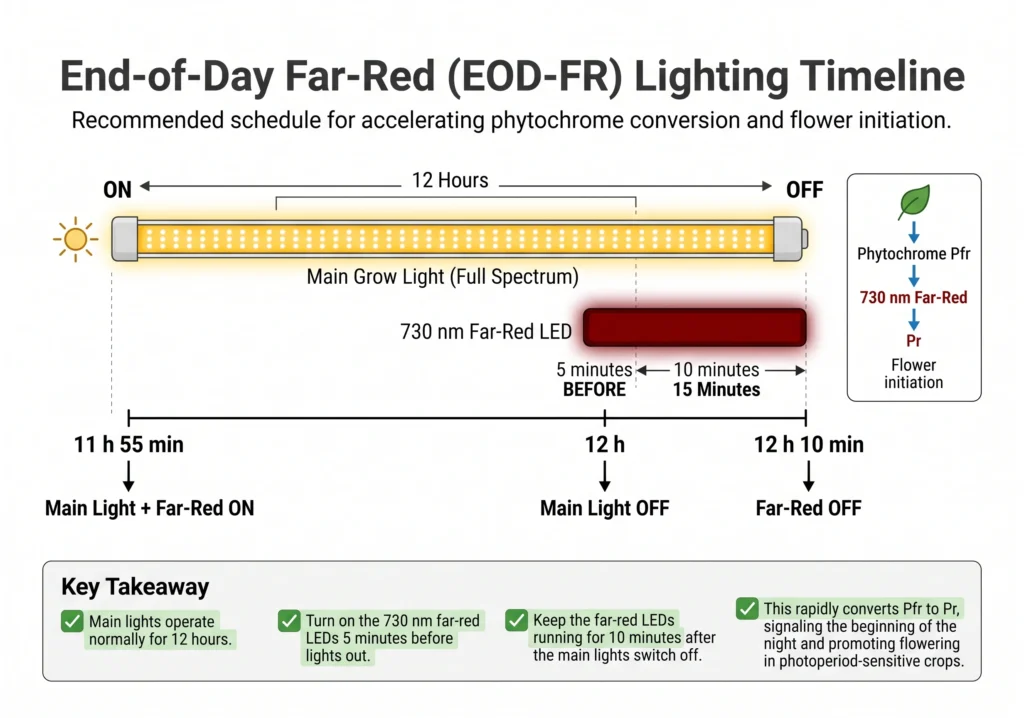
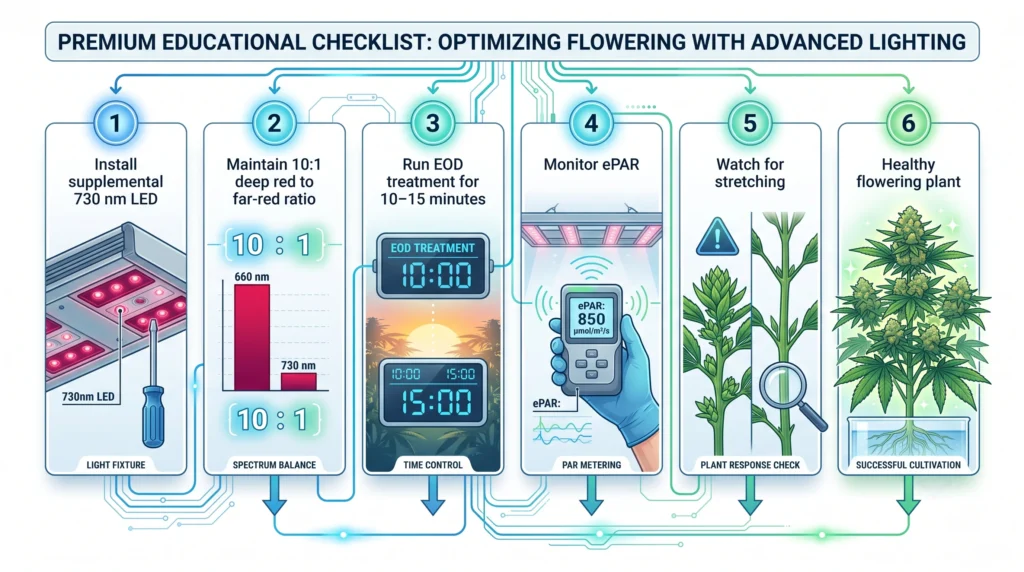
When you use a supplemental far red led in your hydroponic grow room for 10 to 15 minutes right after your main lights shut off, you rapidly blast the plant with 730 nm photons. This forces an immediate conversion from the active Pfr state back to the inactive Pr state. Instead of taking up to two hours to naturally revert and realize the dark cycle has begun, the plant registers darkness in minutes. For short-day crops, this precise application of the 730nm far red effect can trick the plant into flowering faster and allows you to run slightly longer day cycles for increased daily light integral (DLI) without interrupting the critical dark period required for flower initiation.
Methodology: Testing the 730nm Far Red Effect in Controlled Environments
Our case study isolated the variables of 660 nm deep red and 730 nm far-red light on determinate fruiting crops in a recirculating deep water culture (RDWC) system. We tracked the time to first flower, internode length, and final harvest weight across control and experimental groups under strictly regulated parameters.
To test these lighting ratios objectively, we set up two isolated grow environments using identical hydroponic parameters. Both environments utilized a standard 400W full-spectrum LED fixture targeting a canopy PPFD of 800 umol/m2/s. We matched the nutrient profiles, maintaining an EC of 2.2 mS/cm and a pH of 5.9, using identical RO water filtration and chiller settings holding the reservoir at a steady 66 degrees F (18.8 degrees C). To ensure optimal root zone stability throughout this trial, we followed our standard hydroponic pH and EC mastery guide.
- Control Group (Tent A): Standard 12/12 light cycle (12 hours on, 12 hours off) using only the base full-spectrum LED fixture.
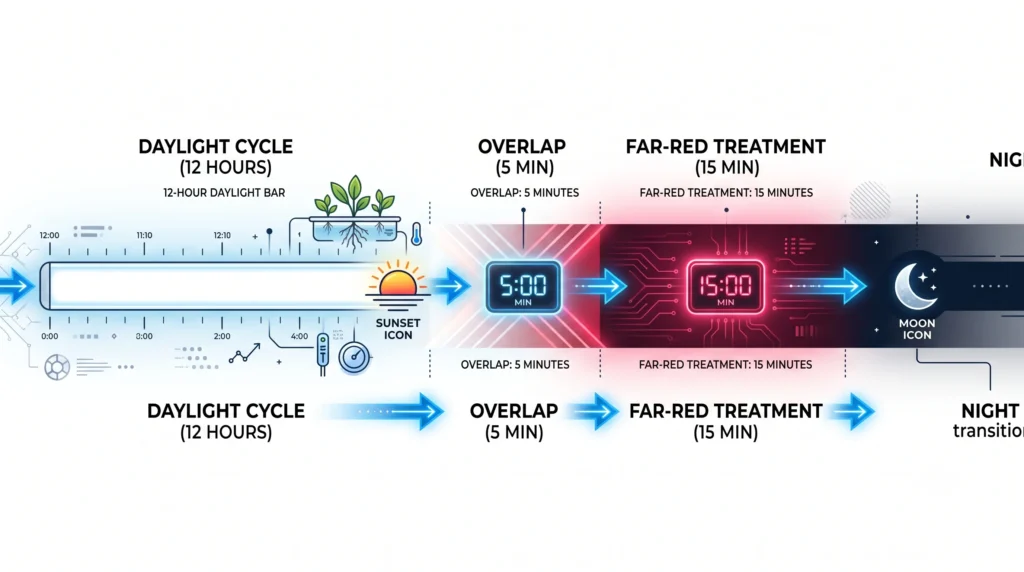
- Experimental Group (Tent B): Standard 12/12 light cycle for the main LED fixture, but equipped with a dedicated supplemental far red led bar. This 730 nm bar was programmed to turn on 5 minutes before the main lights shut off, running for exactly 15 minutes total (10 minutes into the dark cycle as an End-of-Day Far-Red treatment, or EOD-FR). We also incorporated a continuous 5% far-red ratio into the daytime spectrum to trigger the Emerson enhancement effect.
We selected two fast-maturing crops for this trial: a dwarf determinate tomato variety and a short-day flowering crop. We monitored canopy temperatures meticulously to ensure the supplemental LED bar was not causing localized infrared heating, keeping leaves within ideal photosynthetic ranges.
The Emerson Enhancement Effect: Why Deep Red Needs Far Red
The Emerson enhancement effect proves that plants exposed to simultaneous deep red (660 nm) and far-red (730 nm) light achieve a photosynthetic rate higher than the sum of the rates achieved when exposed to each light spectrum individually. This synergy maximizes the efficiency of Photosystem I and Photosystem II.
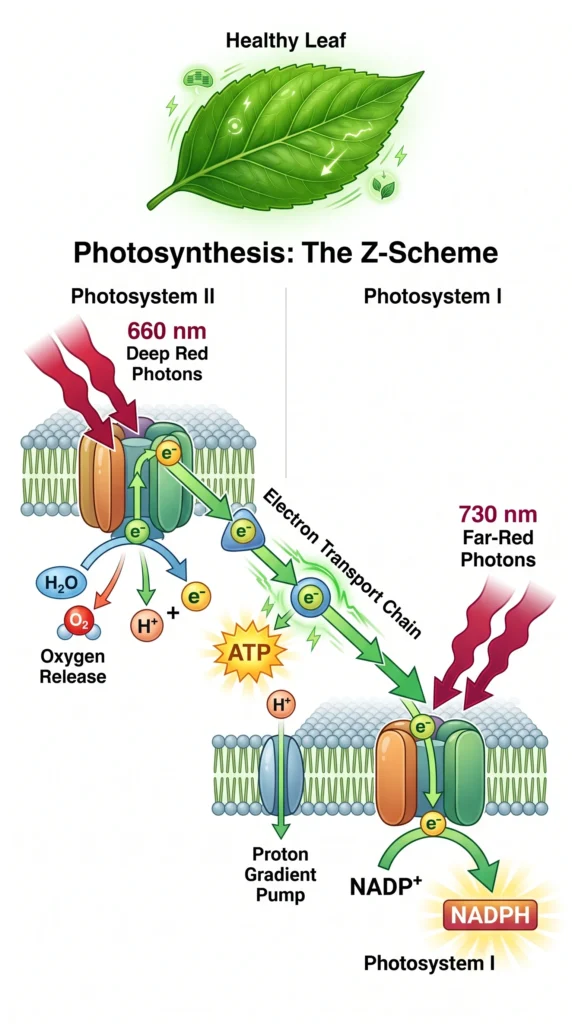
Back in 1957, biophysicist Robert Emerson made a discovery that changed photobiology forever (documented in historical studies on the Emerson effect). He noticed that shining just 660 nm light (deep red) on chloroplasts resulted in a specific rate of photosynthesis. Shining just 730 nm light (far-red) resulted in a minimal, almost negligible photosynthetic rate. Logic dictates that combining the two should yield a rate equal to their individual sums. Instead, the resulting photosynthetic rate skyrocketed well beyond the combined total.
Plants operate two distinct photosynthetic centers: Photosystem II (PSII) and Photosystem I (PSI).
- PSII absorbs deep red light (660 nm) efficiently.
- PSI absorbs far-red light (730 nm) efficiently.
When you provide both spectrums simultaneously, both photosystems work in tandem, passing electrons smoothly down the transport chain. If you deprive a plant of far-red light—a common flaw in older LED grow lights that only pushed 460 nm blue and 660 nm red—Photosystem I bottlenecks.
By upgrading our experimental setup to include continuous daytime far-red exposure, we observed faster vegetative growth and thicker stem caliper. The plants were processing photons more efficiently. This concept is reshaping the industry, leading to the creation of ePAR (Extended Photosynthetically Active Radiation) standards. Research from Dr. Bruce Bugbee at Utah State University, published in PubMed research on far-red photon efficiency, demonstrates that the traditional 400 to 700 nm PAR range must be expanded to 400 to 750 nm to account for far-red’s synergistic contribution to yield.
Metric Tables: Phytochrome State Conversion and Yield Tracking
Quantitative data from our EOD-FR (End-of-Day Far-Red) trials demonstrates a clear reduction in the time required to initiate flowering and a measurable increase in total harvestable biomass. The shade avoidance response (SAR) triggered by 730 nm light also promoted slightly wider internodal spacing, which improved air circulation within the canopy.
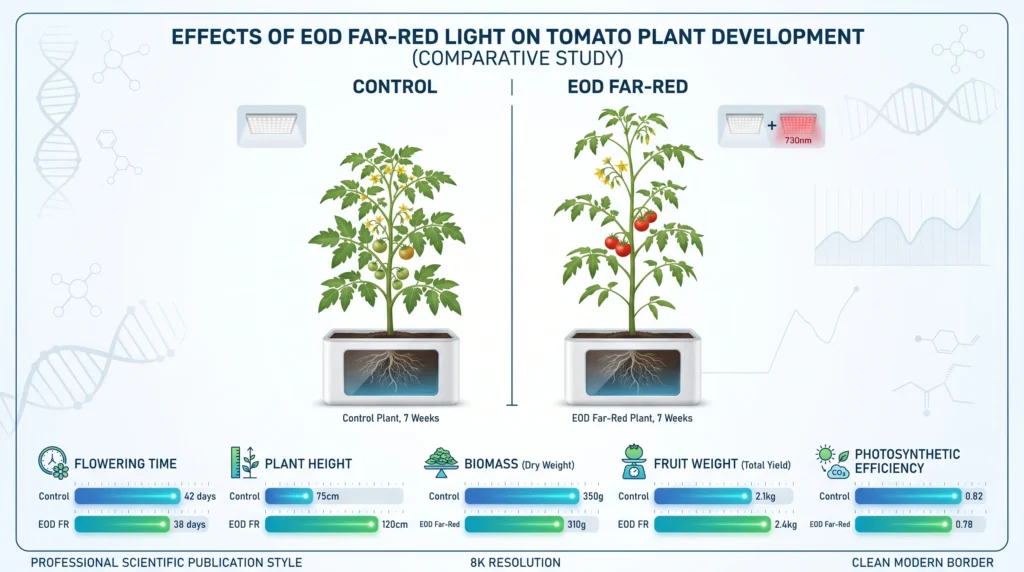
Relying on the phytochrome state conversion hack, the plants in our experimental group transitioned to their reproductive phase noticeably faster. Because the 15-minute blast of 730 nm light immediately converted the Pfr proteins back to Pr, the plant’s internal countdown for the night cycle started instantly.
Here are the recorded metrics for our dwarf tomato test subjects over the 85-day trial period:
| Metric Tracked | Control Group (No Far-Red) | Experimental Group (EOD-FR + 5% Daytime FR) | Variance (%) |
|---|---|---|---|
| Time to First Flower | 14 Days | 10 Days | -28.5% |
| Average Internode Spacing | 3.2 cm | 4.1 cm | +28.1% |
| Total Harvested Biomass | 840 g/plant | 985 g/plant | +17.2% |
| Average Fruit Weight | 42 g/fruit | 45 g/fruit | +7.1% |
| Photosynthetic Efficiency | 0.82 g/mol ePAR | 0.96 g/mol ePAR | +17.0% |
The experimental group flowered four days earlier, representing a major efficiency gain for commercial growers looking to turn crops faster. The internode spacing increased due to the shade avoidance response. When a plant senses high levels of far-red light, it assumes it is being shaded by taller competition. The plant’s natural reaction is to stretch its leaves to capture light. In a controlled grow room, mild stretching opens up the canopy for superior light penetration and airflow.
Real-World Yield: Impact of Supplemental Far Red LED on Fruiting Crops
Integrating far-red spectrums into hydroponic fruit and flower production not only speeds up transition times but also increases the physical size and density of the final harvest. The targeted application of 730 nm light signals the plant to divert its metabolic energy directly into reproductive organs.
Applying far red light hydroponics to your own grow room requires a calculated approach. You cannot simply blast 730 nm light 24 hours a day; overuse will result in excessive stretching, weak cell walls, and structural collapse. The magic lies in maintaining the proper deep red vs far red light ratio:
- Daytime Spectrum Ratio: A ratio of roughly 10:1 (660 nm to 730 nm) is optimal during the main day cycle for maintaining the Emerson enhancement effect without triggering severe stretching.
- End-of-Day Treatment (EOD-FR): Running an isolated 730 nm supplemental strip for 10 to 15 minutes as the main lights go out forces the rapid phytochrome state conversion.
Yield increases are also driven by leaf surface expansion. Far-red light drives cellular enlargement in leaves. Larger leaves capture more total photons per square meter, fueling higher sugar synthesis that ultimately packs weight onto fruiting bodies. In our trials, the 17.2% increase in total harvested biomass delivered a substantial return on investment. If you want to optimize your raw nutrient inputs alongside light spectrum tuning, check out our DIY nutrient formulation guide.
Industry Implications: The Shift Toward ePAR in Hydroponic Lighting
The commercial hydroponic sector is abandoning outdated PAR metrics in favor of ePAR (Extended PAR) to accurately account for the metabolic contributions of far-red photons. This shift is driving a complete redesign of horticultural lighting fixtures.
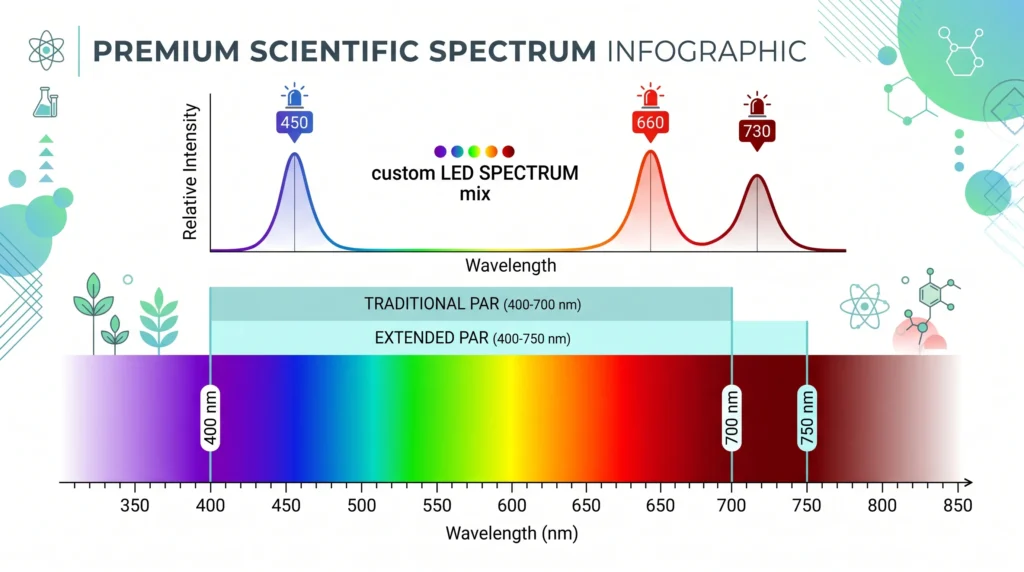
For decades, lighting manufacturers marketed fixtures based strictly on PPF (Photosynthetic Photon Flux) between 400 nm and 700 nm. Because far-red (700 to 750 nm) fell outside that arbitrary boundary, standard sensors ignored it. A fixture could emit highly effective 730 nm light to trigger the 730nm far red effect, and an older quantum meter would register zero photons.
Today, researchers at leading agricultural institutions, including Michigan State University and Utah State University, have proven how far-red integration alters crop morphology and shortens production cycles. The industry is moving rapidly to adopt ePAR as the gold standard metric.
This impacts how you structure your lighting schedule. By utilizing the EOD-FR phytochrome trick to put plants to sleep instantly, you can theoretically run a 13/11 light schedule for short-day plants instead of 12/12. That extra hour of main daylight equates to an 8.3% increase in Daily Light Integral (DLI), driving additional photosynthetic energy into your crop without delaying flower initiation. Contrast this scientific approach to light and nutrition with common myths like flushing in hydroponics, where starving plants actually hinders late-stage growth.
Essential Gear for Spectrum Tuning
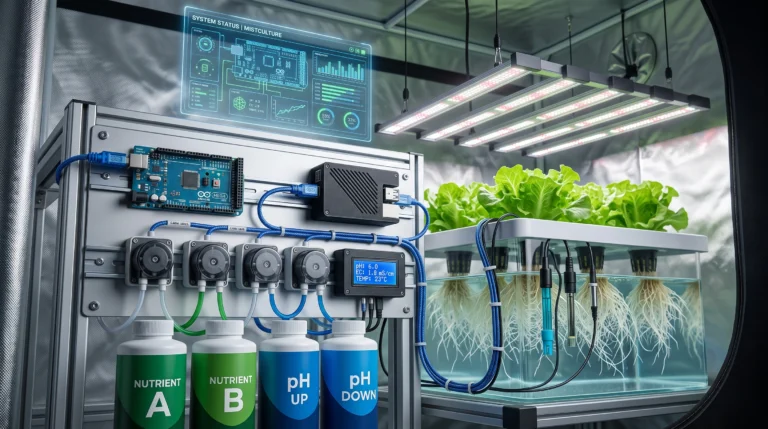
Precision photobiology requires precision measurement and automation gear. To accurately replicate far-red manipulation studies, you need hardware capable of providing the 730 nm spectrum independently, precise timers, and sensors that read the ePAR spectrum.
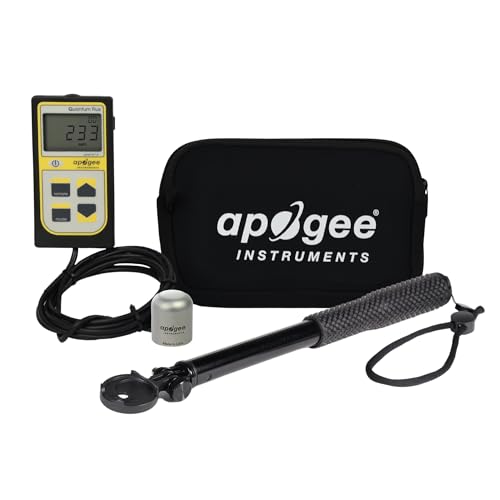
Standard PAR meters cut off at 700 nm. An ePAR meter captures the critical 700 to 750 nm range. If you are tuning your deep red vs far red light ratio, this is the only way to know exactly how many far-red photons are hitting your canopy.
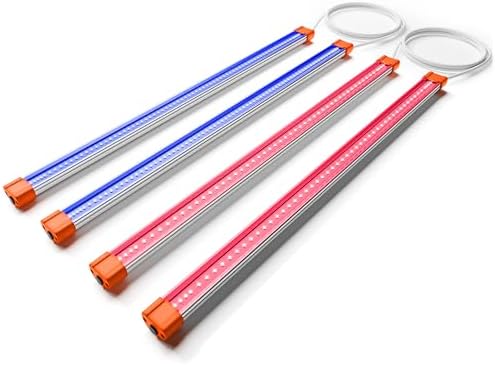
To execute the end-of-day sleep trigger, you need dedicated control over the far-red spectrum. Select supplemental LED bars that run on an independent power driver so you can program them separately from your main overhead fixtures.

Mechanical dial timers are not precise enough for a 10 to 15-minute overlap window. Using a digital smart plug or digital lighting controller allows you to schedule your supplemental far red led to kick on exactly 5 minutes before your main lights shut off and turn off 10 minutes later.

u003cpu003eFor commercial facilities or scaled tent setups, multi-channel lighting controllers manage independent spectrum channels natively. You can program complex sunrise/sunset curves and automate far-red triggers across hundreds of light fixtures simultaneously. Explore our collection of u003ca href=u0022https://mistculture.com/tools-and-resources/u0022u003efree hydroponic calculators and toolsu003c/au003e to automate and dial in your grow room numbers.u003c/pu003e
Frequently Asked Questions
What is the difference between deep red and far-red light?
Deep red light peaks at 660 nm and is primarily responsible for driving high rates of photosynthesis by converting the Pr phytochrome into the active Pfr state. Far-red light peaks around 730 nm, penetrates deeper into plant canopies, drives leaf expansion, and converts active Pfr back into the inactive Pr state, signaling darkness.
How long should I leave far-red lights on after my main lights turn off?
For the End-of-Day Far-Red (EOD-FR) treatment, you should run your 730 nm supplemental lights starting 5 minutes before your main lights turn off, leaving them on for 10 to 15 minutes into the dark cycle. Running them longer provides no additional benefit and can disrupt the dark cycle.
Can far-red light cause my plants to stretch excessively?
Yes. Continuous exposure to high levels of far-red light without sufficient deep red (660 nm) or blue (450 nm) light triggers the shade avoidance response. The plant assumes it is shaded by competing foliage and elongates its stems rapidly. Maintaining a 10:1 ratio of deep red to far-red during daytime lighting prevents unwanted stretching.
Does far-red light increase yield in leafy greens like lettuce?
Yes, but through morphological changes rather than flowering triggers. Far-red light promotes cell expansion, resulting in broader, wider leaves that capture more total photons and increase overall fresh harvest weight.
Do I need a special meter to measure far-red light?
Yes. Standard PAR meters are calibrated to measure light between 400 nm and 700 nm. Because far-red light exists between 700 nm and 750 nm, you must use an ePAR (Extended PAR) meter or a spectroradiometer to measure its intensity accurately.
Is far-red light visible to the human eye?
Far-red light at 730 nm sits on the extreme edge of human vision. When looking at a far-red LED diode, it appears as a very dim, dark red glow. Despite its dim appearance to human eyes, it delivers high photonic energy that plants absorb readily.
The Final Verdict on Far-Red Spectrums
Mastering the 730 nm far-red spectrum transitions your facility from standard indoor gardening to precision photobiology. By actively manipulating phytochrome states, you gain direct control over your crop’s flowering speed, structural canopy, and overall photosynthetic efficiency.
The integration of far red light hydroponics is a fundamental evolution in horticultural science. Relying solely on the traditional 400 to 700 nm PAR range leaves valuable yield on the table. By leveraging the Emerson enhancement effect during the day and executing precise EOD-FR treatments at night, growers can shave days off harvest cycles while maximizing floral biomass.
Take the Guesswork Out of Your Hydroponic Setup
From custom raw salt PPM calculations and nutrient dilution ratios to DLI lighting targets and reservoir sizing, access our full library of interactive grower tools 100% free.
⚡ Built for commercial operators & serious home growers • No signup required

Continue Your Learning Journey