Uncovering the Flushing Hydroponics Myth: Does a Harvest Flush Actually Work?

Table of Contents
Reviewed against published trial data. Written for growers who want the physiology, not the forum folklore.
Every grower has heard the golden rule passed down through forums and grow shops: run plain water through your system for the last one to two weeks of the grow cycle. Starve the plant of nutrients right before harvest, force it to consume its internal reserves, and you “leach out” harsh chemicals for a cleaner-burning smoke or sweeter tomato.
Plant physiology tells a different story.
The idea that plain water can pull nutrients back out of plant tissue is one of the most persistent misunderstandings in indoor agriculture. This piece breaks down the flushing hydroponics myth using tissue analyses, blind taste tests, and commercial agricultural trials to answer one question: does flushing work hydroponics growers expect it to, or are you starving your plants right as they’re trying to pack on final harvest weight?
The Physiology Behind the Flushing Hydroponics Myth
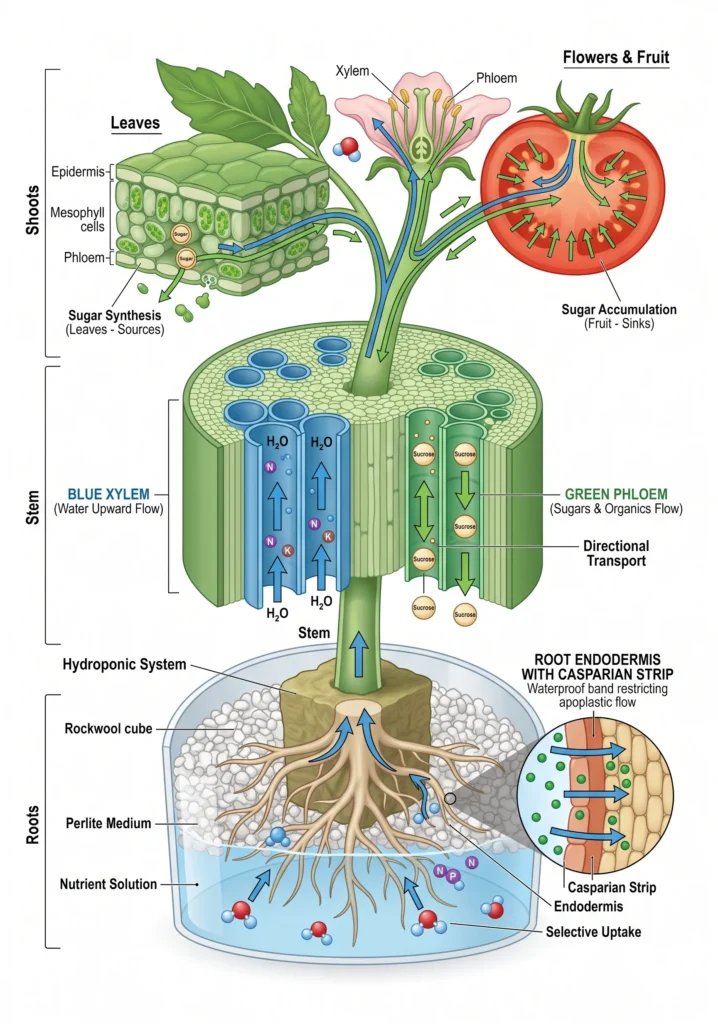
Pre-harvest flushing involves starving plants of nutrients in the final 7-14 days before harvest, theoretically forcing them to use up stored minerals. However, peer-reviewed plant science shows that a harvest flush nutrient cutoff does not significantly alter the elemental composition of the harvested fruit or flower, making the flushing hydroponics myth largely unsupported by chemical analysis.
To understand why flushing doesn’t do what most people claim, look at how a plant moves water and minerals. Plants run two circulatory systems: the xylem and the phloem.
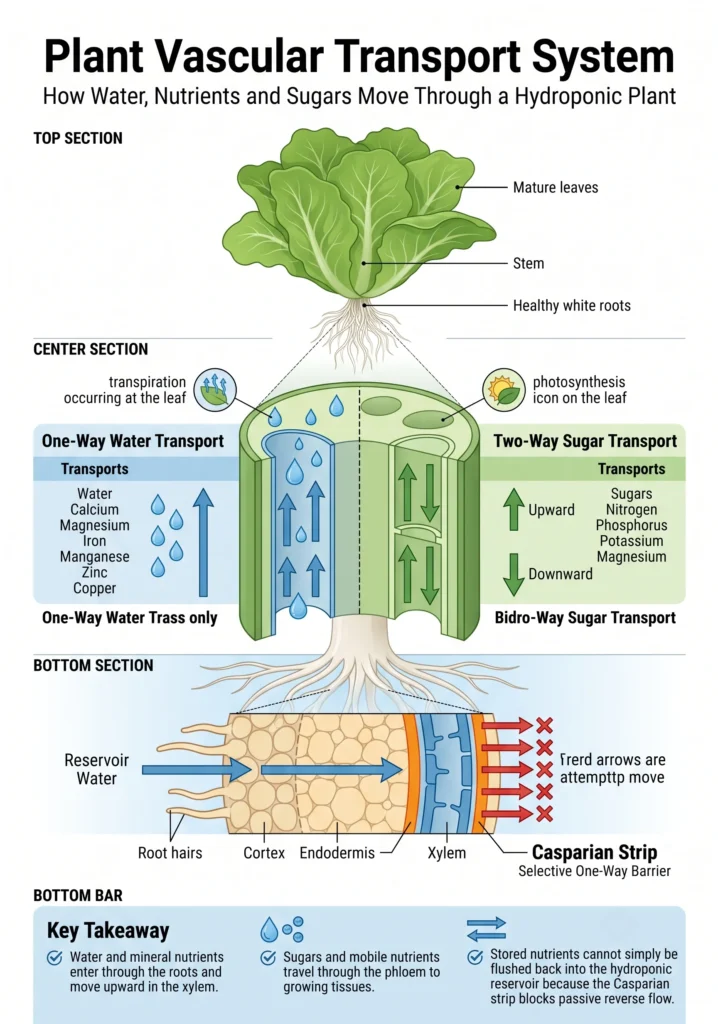
The Xylem (One-Way Upward Transport)
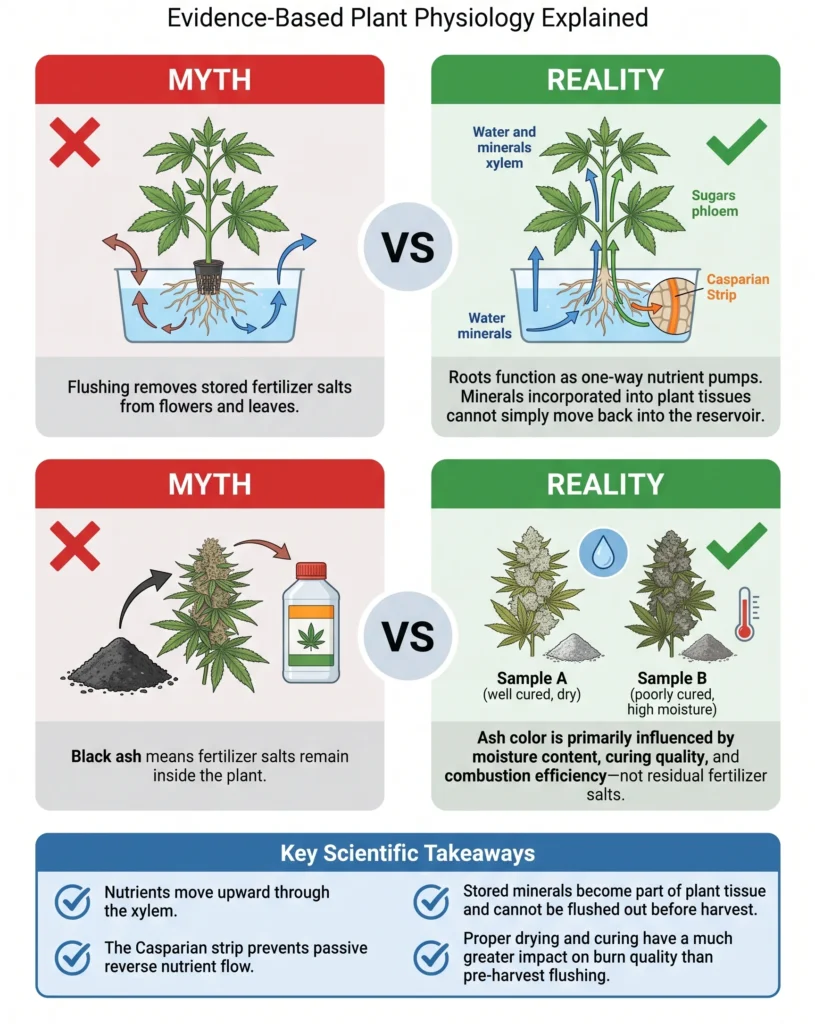
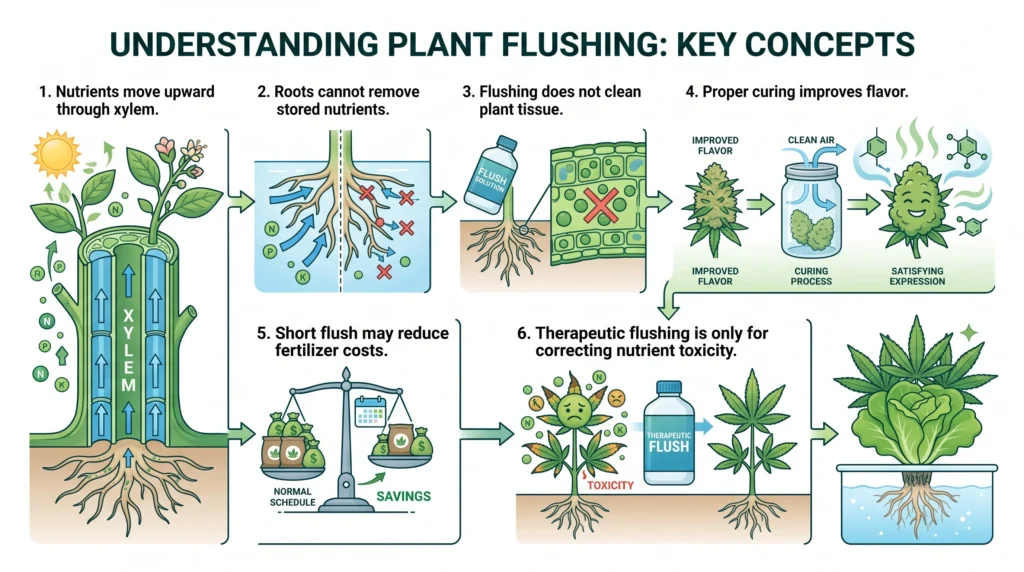
The xylem acts as a one-way street. Driven by the evaporative pull of transpiration, it draws water and dissolved mineral ions upward from the root zone and distributes them throughout the foliage, fruit, and flowers. Once an elemental mineral (such as Calcium or Iron) is incorporated into the cellular matrix of a leaf or flower, it is permanently fixed.
The Phloem (Selective Internal Distribution)
The phloem is the two-way street, it moves sugars made during photosynthesis to wherever they’re needed. Mobile nutrients like nitrogen, phosphorus, and potassium can travel through the phloem. Under a severe deficiency (like a prolonged harvest flush), the plant cannibalizes these mobile nutrients from older, lower leaves and ships them to newer growth or developing fruit. That’s exactly why you see the classic “fade” or yellowing during a flush.
Immobile nutrients, calcium, sulfur, heavy metals, can’t be relocated at all. They’re permanently locked into the cell walls.
Why Roots Cannot “Bleach” or “Leach” Minerals Back Out
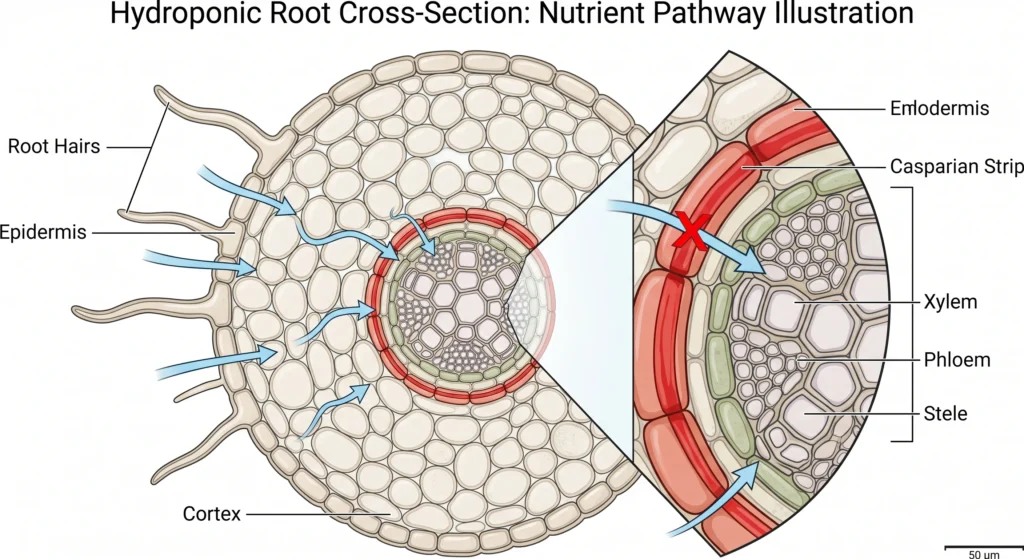
More importantly, leaching accumulated minerals back out of flower tissue and into the reservoir is biologically impossible. Root endodermal cells feature a waterproof layer called the Casparian strip, which forces all absorbed ions through active transport proteins.
Roots function as selective, one-way ion pumps. They lack any physiological mechanism to reverse direction and bleed stored elemental salts from mature buds back down the stem into the water. Running a harvest flush cleans your substrate and reservoir, it does not clean the inside of the plant.
If you are struggling to distinguish nutrient mobility patterns from true root zone issues during the final weeks, review our guide on identifying pH-induced nutrient lockouts.
Methodology: Testing the Harvest Flush Nutrient Theory
To determine if does flushing work hydroponics, researchers compared control groups receiving full nutrient feeds against test groups receiving zero nutrients (flushed) for up to 14 days prior to harvest. Tissue was analyzed for mineral concentration, overall yield mass, and terpene or sugar (Brix) profile.
Anecdotal evidence invites confirmation bias, a grower flushes, tastes a good harvest, and credits the flush. To get past that, independent agricultural trials have tested the flushing hydroponics myth under controlled conditions.
One of the most cited trials in the high-EC fruiting crop space came from RX Green Technologies, an agricultural research and nutrient company. Their researchers evaluated the effects of different flushing times on chemical profile, flavor, and smoking characteristics, imposing flushing periods of 14, 10, 7, and 0 days on a uniform tomato cultivar.
At harvest, tissue samples were dried, cured, and sent to independent testing laboratories to measure:
- Total mineral concentration in flower tissue.
- Total terpene and cannabinoid profiles.
- Final dry yield mass.
- Blind consumer taste preferences.
Commercial tomato production runs similar trials, growers monitor how nutrient timing in the late fruiting stage affects total yield weight and Brix (a measurement of dissolved sugars that correlates directly with sweetness and flavor). Potassium in particular plays a major role here: it’s involved in sugar production and transport, and Yara’s agronomy research on tomato potassium links inadequate potassium to uneven ripening and lower fruit quality, the opposite of what a late-stage nutrient cutoff would encourage.
Understanding your base nutrient profile before the flush even begins matters just as much. See our walkthrough on dialing in your baseline feed.
Metric Tables: Tissue Analysis and Yield Impacts
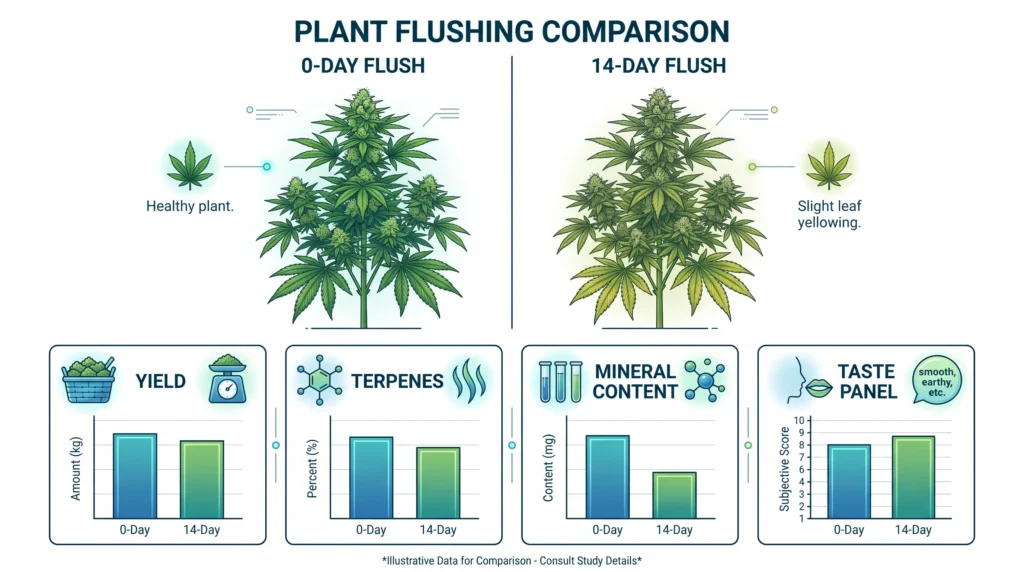
Data from the RX Green Technologies trial demonstrated no statistically significant differences in yield, potency, or terpene content across 0, 7, 10, or 14 day flush periods. Chemical analysis confirmed that withholding nutrients for two weeks did not decrease total mineral content in the flower tissue.
| Metric Tested | 0-Day Flush (Control) | 7-Day Flush | 10-Day Flush | 14-Day Flush | Statistical Significance |
|---|---|---|---|---|---|
| THC / Potency | 21.18 | 21.02 | 20.89 | $21.43%$ | No significant difference |
| Terpene Profile | 1.64 | 1.61 | 1.58 | $1.62%$ | No significant difference |
| Yield (Dry Grams/Plant) | 98.2 | 97.1 | 95.8g | $94.6text{g}$ | No significant difference |
| Iron (Fe) Tissue Conc. | Baseline | Baseline | Slight Increase | Slight Increase | Slight upward trend ($14text{d}$) |
| Zinc (Zn) Tissue Conc. | Baseline | Baseline | Slight Increase | Slight Increase | Slight upward trend ($14text{d}$) |
| Blind Consumer Preference | Rated Best | Rated Moderate | Rated Moderate | Rated Lowest | Preferred 0-Day (Unflushed) |
Data Source: RX Green Technologies Analytical Research Report.
The laboratory data directly contradicts conventional forum wisdom:
- Withholding nutrients for two weeks does not purge nitrogen, phosphorus, or potassium from the flower tissue.
- Yield and potency were not drastically reduced within this specific 14-day window, but a subtle downward trend in dry yield mass occurs as flushing extends toward 14 days.
Extended nutrient cutoffs force the plant to expend metabolic energy breaking down its own structural tissue to survive, rather than synthesizing new sugars and essential oils.
To keep your water chemistry stable throughout the final bloom phase without causing unintended starvation, monitor your parameters using our hydroponic pH and EC mastery guide.
Real-World Yield and Flavor Results
Blind consumer taste panels and combustion chemistry show no improvement in flavor, smoothness, or ash color from pre-harvest flushing, with taste panels frequently preferring unflushed controls.
The primary defense of flushing is subjective: “Flushing makes the product taste smoother.”
In the RX Green blind taste panel, participants evaluated samples from each flush group (0, 7, 10, and 14 days) without knowing which was which. The results indicated that smokers preferred the 0-day (unflushed) sample for flavor quality and smoke smoothness, rating the 14-day flushed sample as harsher and less flavorful.
The “White Ash” Myth Explained
A widespread myth claims that white ash indicates a clean, well-flushed product, whereas dark or black ash proves the plant is full of residual fertilizer salts.
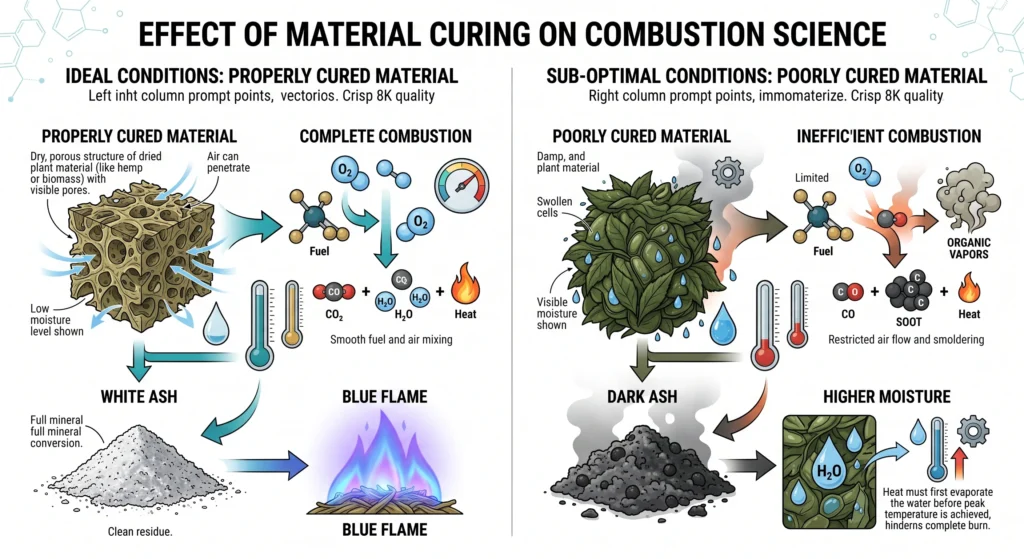
In combustion science, ash color is determined by combustion temperature, carbon conversion, and moisture content, not fertilizer residue:
- White/Light Gray Ash: Indicates complete combustion where organic carbon compounds burn off fully into CO2, leaving behind inorganic mineral oxides (which are naturally white/gray).
- Dark/Black Ash: Indicates incomplete combustion caused by high moisture content, poor drying, or an improper cure. Trapped moisture prevents the burn temperature from reaching the threshold needed to fully combust carbon into gas.
The same principles apply to fruiting crops like hydroponic tomatoes and peppers. Cutting potassium and phosphorus during final ripening starves the plant of the elements needed to synthesize sugars, resulting in watery, bland fruit.
Essential Gear for Monitoring Harvest Quality
To track actual chemical data instead of relying on forum folklore, you need accurate measurement tools.
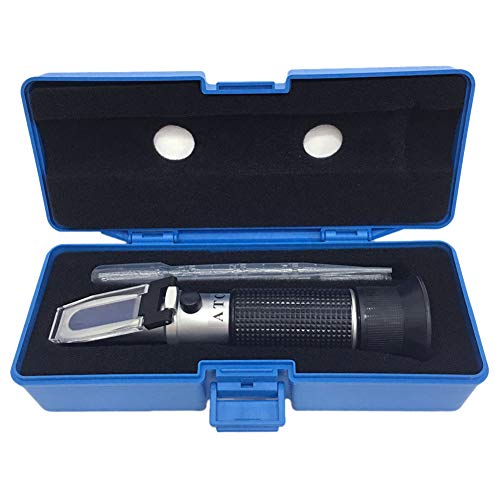
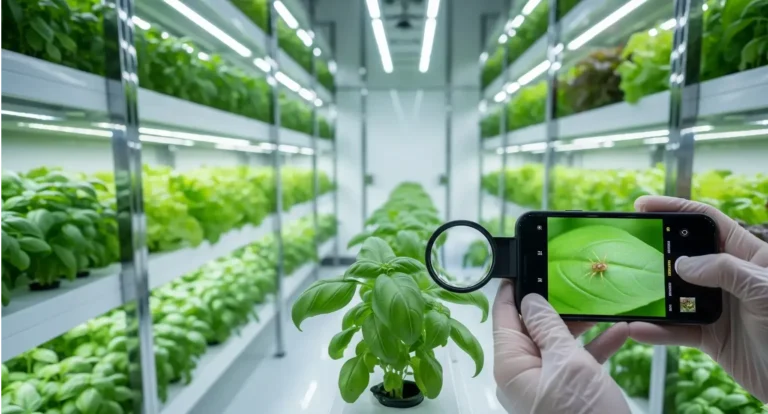
Why it matters: Squeeze a drop of sap or fruit juice onto the lens and read sugar concentration instantly, the only objective way to check whether a nutrient cutoff is hurting your crop’s sweetness.
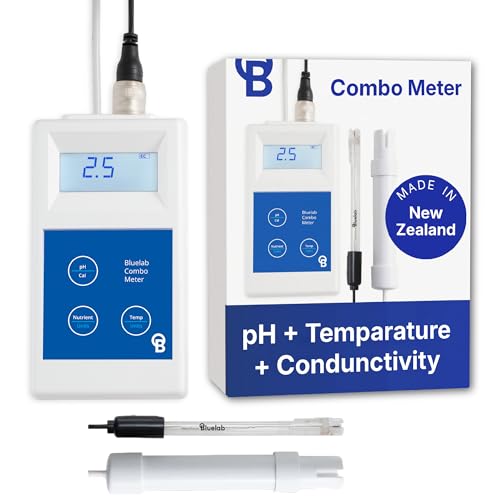
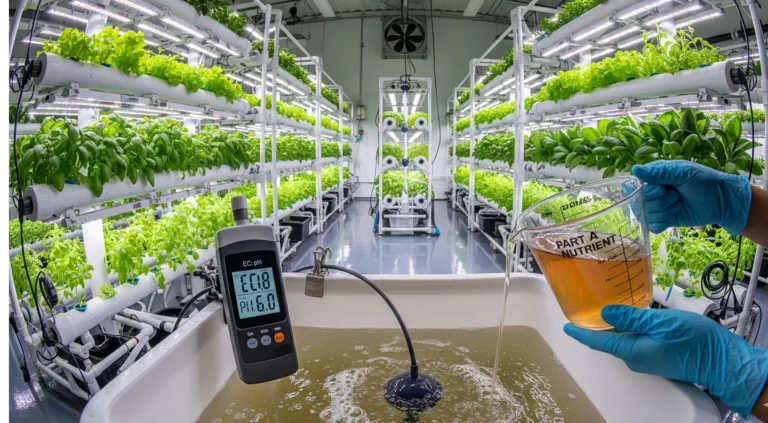
Why it matters: You can’t tell whether a plant is still feeding in late flower without lab-grade EC and pH tracking. If EC rises while water level drops, the plant has stopped feeding, that’s the real sign it’s finishing, not a date on a calendar.
Industry Implications: Why Flushing Might Still Make Sense
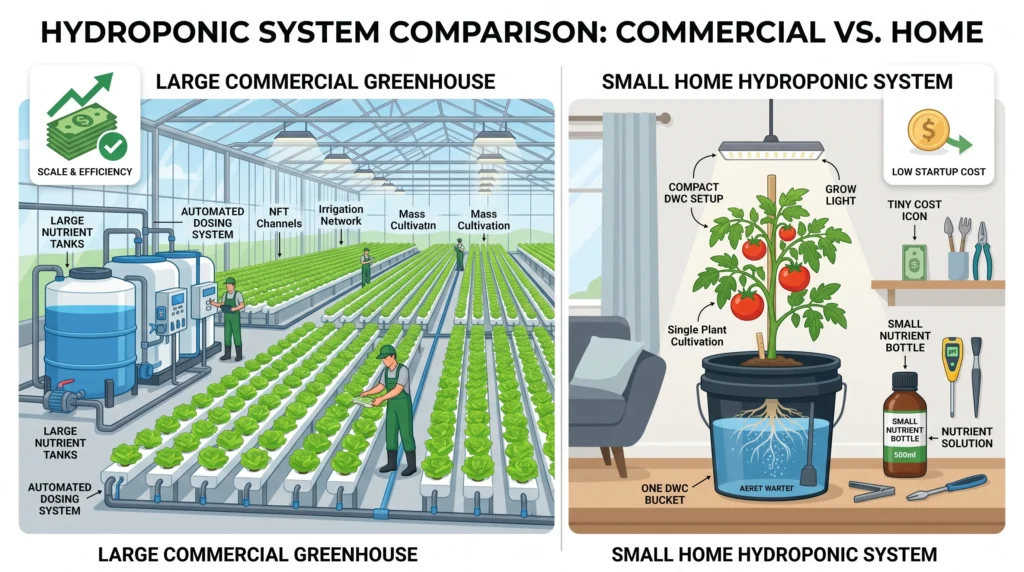
Even though flushing doesn’t chemically clear out plants, commercial growers still use a harvest flush nutrient cut-off to save money. Halting fertilizer inputs for the final stretch of a crop’s life cycle reduces nutrient costs without a severe hit to final yield.
If the flushing hydroponics myth is busted, why do large commercial facilities still flush before harvest? Economics. Hydroponic fertilizer is expensive, and running thousands of gallons of nutrient-dense solution daily adds up fast. By the final 7-10 days of the cycle, the plant has already accumulated most of the minerals it needs to reach maturity, so switching to plain, pH-balanced water for the last stretch saves real money, and the plant coasts on nutrients already stored in its fan leaves.
For the commercial grower, flushing isn’t about “cleaning” the plant, it’s about margin.
For the home grower running a 4×4 tent or a modest DWC system, the economics look different. The cost of running nutrients an extra 10 days is pennies. If you’re growing for personal consumption, flavor and yield usually matter more than fertilizer savings, cutting nutrients early just deprives the plant of what it needs to finish strong.
Seeing severe leaf yellowing or necrosis well before your harvest window isn’t a sign you’re flushing correctly, it might be a hard lockout. See our guide on identifying and correcting pH-induced nutrient lockouts.
Frequently Asked Questions
Does flushing work hydroponics for tomatoes and peppers?
No, flushing doesn’t improve flavor in tomatoes or peppers. Cutting potassium and phosphorus during final ripening can actually lower Brix (sugar) content, resulting in a blander harvest. Commercial tomato growers generally maintain steady EC levels right up until harvest.
Will a harvest flush fix nutrient burn?
There’s a real difference between a pre-harvest flush and a therapeutic flush. If you’ve over-fertilized and plants show clawing, tip burn, or toxicity, flushing the reservoir with plain, pH-balanced water for 24 hours to clear excess salts from the root zone is a legitimate corrective step, it’s just not a harvest strategy.
Does a pre-harvest flush change the color of the ash?
Ash color comes down to moisture content and cure quality, not fertilizer residue. A proper slow dry and cure breaks down chlorophyll, letting material burn hotter and cleaner into white ash, regardless of whether it was flushed.
If I don’t flush, will I taste the chemical fertilizers?
No. Plants don’t store raw fertilizer salts as u0022chemicalsu0022 in the buds, they break ions down and use them to build amino acids, proteins, and sugars. Harsh flavors in a harvest are almost always from drying too fast, which traps chlorophyll in the tissue.
Can a harvest flush trigger nutrient lockout earlier than expected?
Yes. Unbuffered RO water can swing pH wildly, causing a sudden, severe lockout at the root zone right in the critical final weeks. If you choose to flush, keep the water pH-balanced.
How long should you flush hydroponics if you want to save money?
If the goal is purely cost savings, 5-7 days is enough. Beyond 7 days you’re pushing the plant into real starvation, which will noticeably cost you yield weight and terpene production.
Ready to Stop Overpaying for Bottled Nutrients?
Mastering elemental PPMs, ionic balances, and raw salt formulations is the fastest way to save up to 80% on reservoir costs while boosting crop yield and quality.
⚡ 100% Free interactive tools • Built for commercial & hobby indoor growers

Continue Your Learning Journey