Bacillus vs Trichoderma for DWC: Which Beneficial Microbe Actually Wins?

Table of Contents
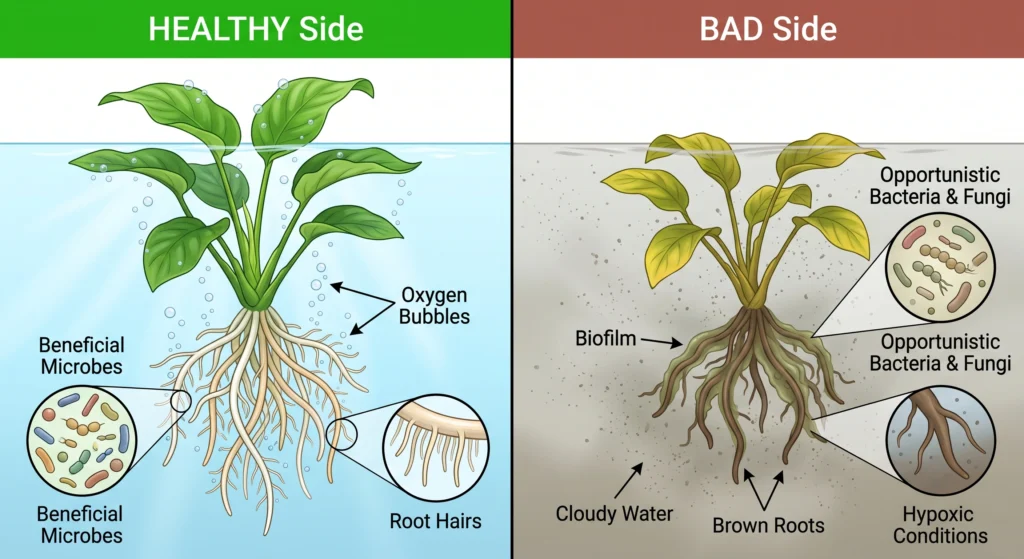
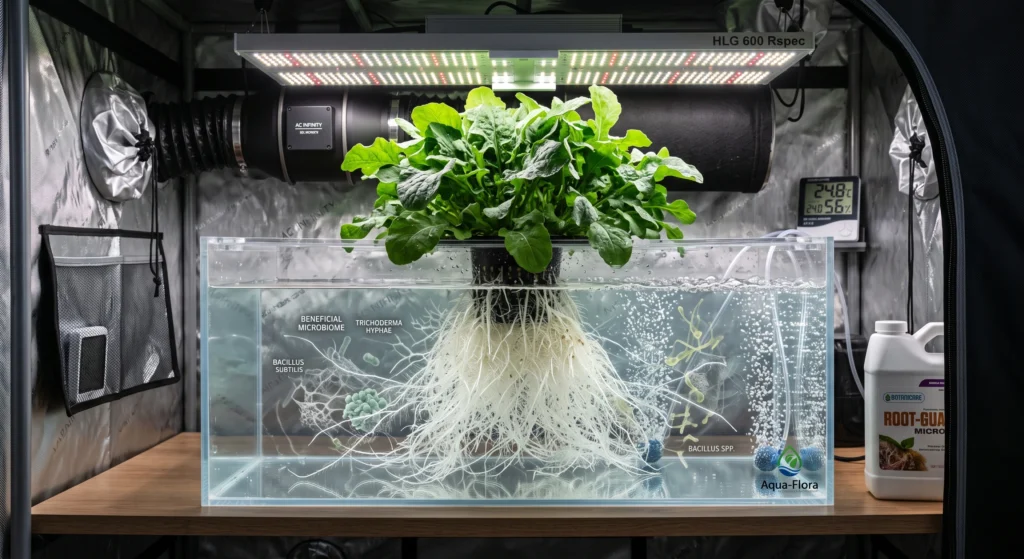
Running a sterile DWC reservoir is a constant, genuinely stressful fight against microscopic invaders. The moment water temperature drifts above roughly 72°F (22°C), opportunistic pathogens like Pythium and Fusarium take advantage of falling dissolved oxygen to attack vulnerable roots. Rather than fighting that battle purely with chemical sterilization, a lot of indoor growers are shifting toward biology instead, introducing specific beneficial microbes so the reservoir becomes a living, self-defending ecosystem rather than a fragile sterile void.
Two organisms dominate this space: the bacterium Bacillus amyloliquefaciens and the fungus Trichoderma. Both are genuinely effective, but through very different mechanisms, and DWC’s fully aqueous environment favors one of them more than the other for reasons rooted in real biology, not just marketing.
The Biological Shift in Deep Water Culture
Moving from a sterile to a biologically active DWC reservoir means giving up oxidizing agents like hydrogen peroxide in favor of living inoculants that outcompete pathogens rather than simply killing everything in the water.
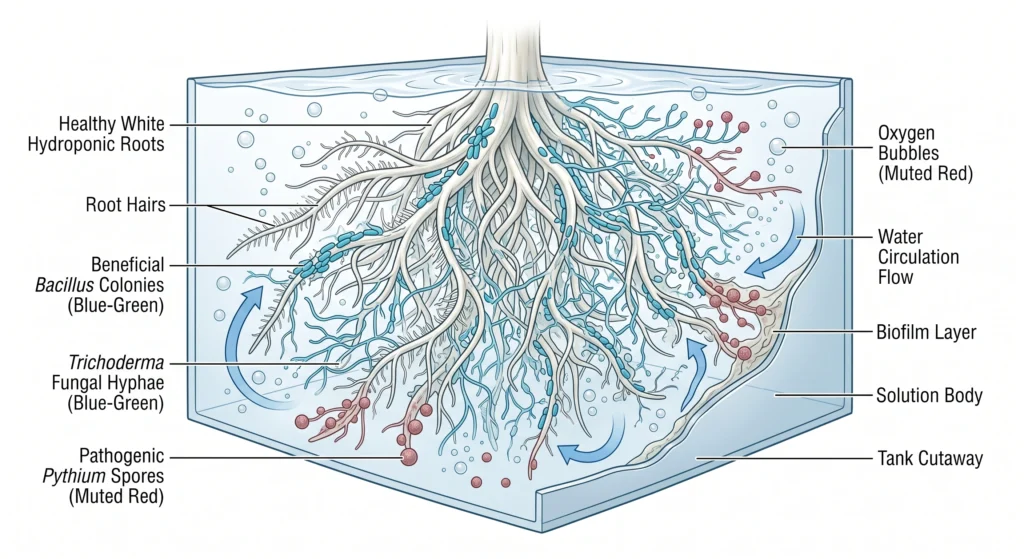
Hydroponic root rot is fundamentally an environmental disease, triggered by low oxygen and elevated temperature that let anaerobic pathogens thrive. Traditional management leans on chilling water and applying sterile oxidizers. A biological approach is a real paradigm shift: instead of trying to kill everything, you’re cultivating a dominant population of beneficial microbes that physically and chemically outcompete the harmful ones.
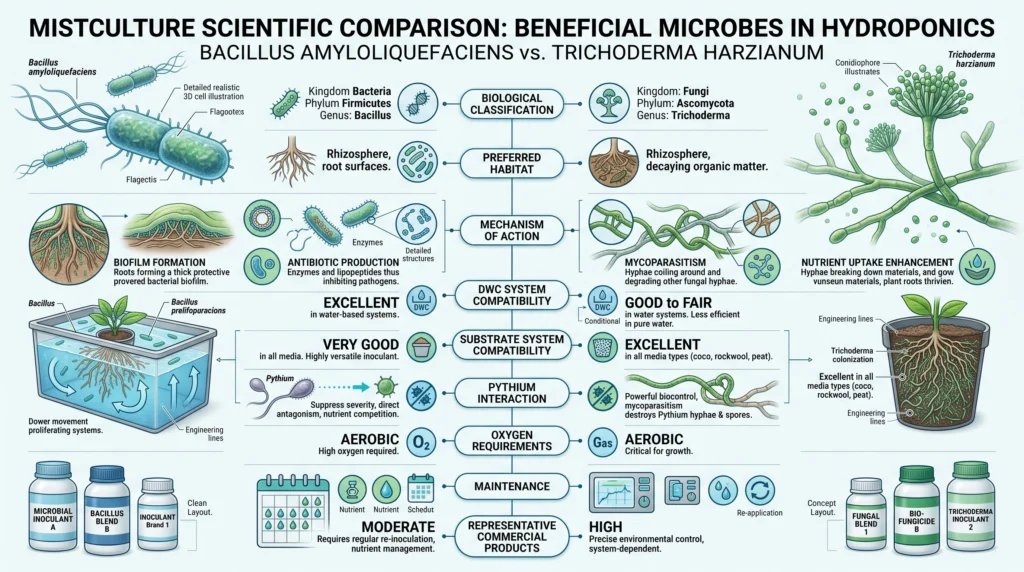
Bacillus amyloliquefaciens is a fast-reproducing bacterium that forms a protective biofilm across root tissue and produces lipopeptides that disrupt fungal cell walls. Trichoderma (commonly T. harzianum in commercial products) works completely differently, it’s a mycoparasitic fungus that actively seeks out other fungi, coils around their hyphae, and secretes enzymes that break down the pathogen’s cell walls from the outside in, a genuinely well-documented mechanism in plant pathology literature going back decades.
Both organisms are real, effective, and widely used in agriculture generally. The question for a DWC grower specifically is which one is actually suited to a fully aqueous, heavily aerated environment with no solid substrate to anchor into.
How Each Organism Actually Works
Bacillus suspends and multiplies readily in rolling, oxygenated water. Trichoderma is a mycoparasite that generally prefers a physical substrate to anchor its mycelial network, which matters a lot in a pure water culture setup.

Bacillus amyloliquefaciens. This bacterium reproduces quickly in liquid and doesn’t need anything to physically attach to beyond the root surface itself. It builds a biofilm directly over root tissue and produces antifungal lipopeptides (compounds like surfactin and iturin are commonly cited in the broader Bacillus literature) that interfere with pathogen cell membranes. Because it’s naturally suspended and mobile in water, it’s a fairly intuitive fit for a rolling, highly aerated DWC bucket.

Trichoderma harzianum. This fungus is a genuine predator of other fungi. It detects chemical signals from nearby pathogens, grows toward them, physically coils around their hyphae, and releases enzymes (chitinases and glucanases, among others) that digest the pathogen’s cell wall. This mechanism is real and well studied in soil and substrate-based systems. The catch for DWC specifically: Trichoderma’s growth habit generally favors anchoring into a physical medium, root fibers, substrate, or debris, rather than existing purely suspended in open water. In a system with real substrate at the crown (net cups packed with coco coir or clay pebbles, for instance), it has more to work with than in a pure open-water bucket.
Neither organism is objectively “better” in the abstract, they’re suited to different physical environments, which is really the core practical question for a DWC grower to answer before choosing one.
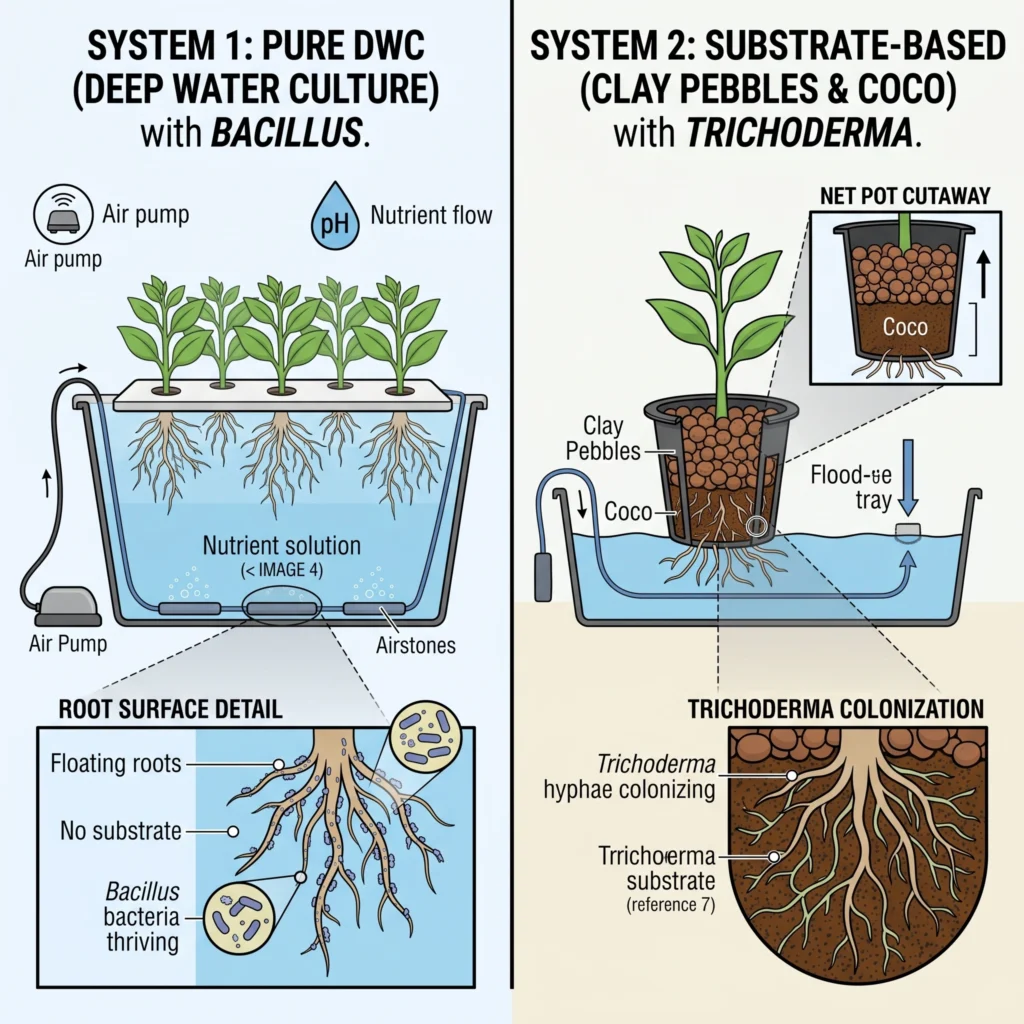
Bacillus vs Trichoderma in a DWC-Specific Context
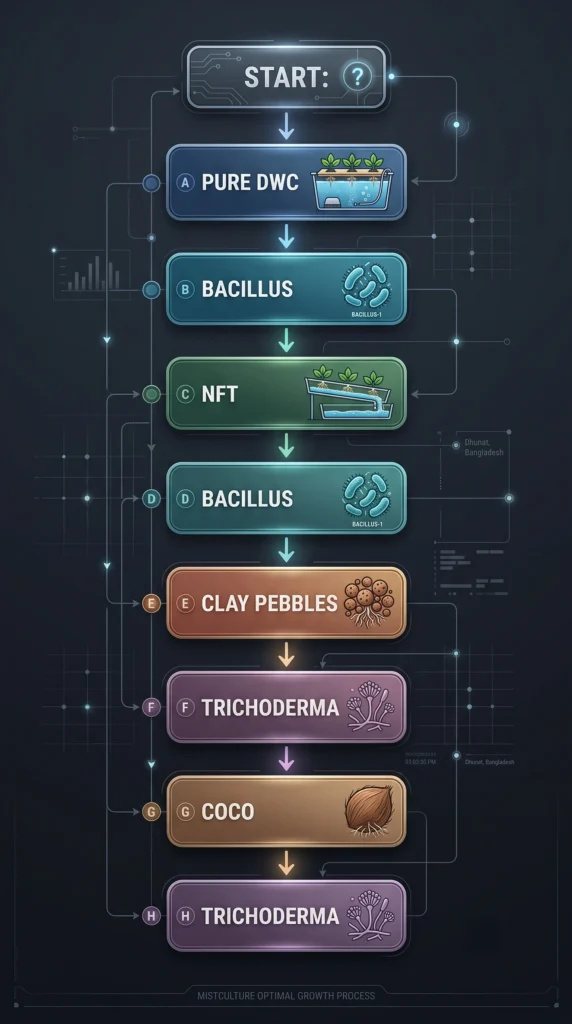
For a fully aqueous DWC reservoir with no significant substrate, Bacillus’s suspension-friendly biology is a more natural fit than Trichoderma’s substrate-anchoring growth habit. Systems with substantial net cup substrate may see real value from Trichoderma at the crown specifically.
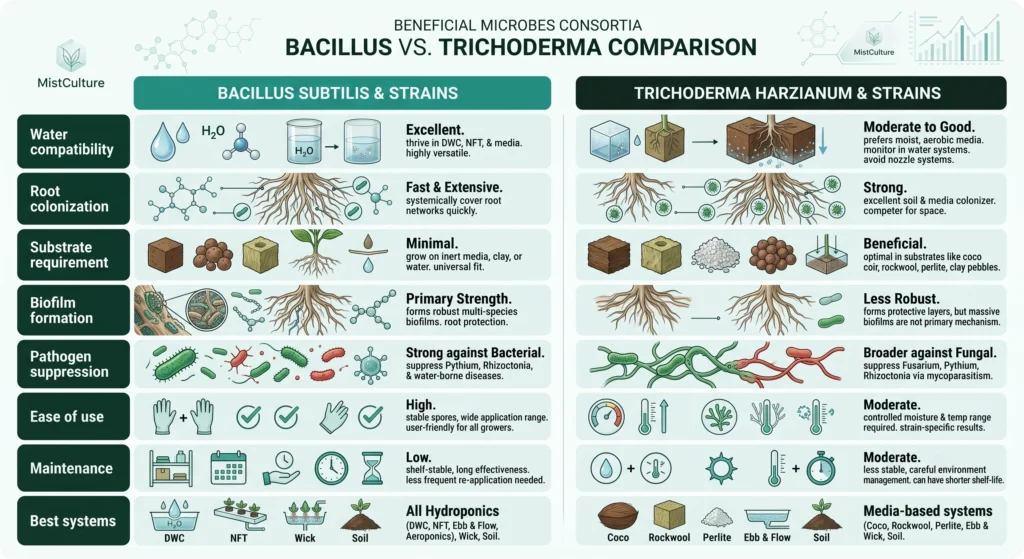
Given the mechanisms above, a reasonable, biologically grounded expectation (not a claimed test result) is that Bacillus establishes and functions more readily in a pure open-water DWC bucket, since it doesn’t need anything to anchor to and is naturally suited to a suspended, mobile existence. Trichoderma is more likely to show its strength where a DWC system includes meaningful substrate at the crown, since that gives its mycelial network something physical to colonize.
This tracks with how these organisms are generally recommended in the wider hydroponic and greenhouse industry, Bacillus-based products (Hydroguard being the best known consumer example) are the default recommendation for pure DWC and NFT systems specifically, while Trichoderma products see more use in substrate-based systems like coco or soil-adjacent setups.
For broader identification of pathogen symptoms before they get out of hand, see our root rot prevention guide, and for combining microbial approaches with supporting enzymes, our microbes and enzymes guide covers that pairing.
Finding a Real Hydroguard Alternative for DWC
Botanicare’s Hydroguard is a well-established, effective Bacillus amyloliquefaciens product for home DWC growers, but its relatively low active concentration means real ongoing cost at scale. Southern Ag Garden Friendly Fungicide contains the same bacterial strain at a much higher concentration, making it a genuinely cost-effective alternative when diluted correctly.
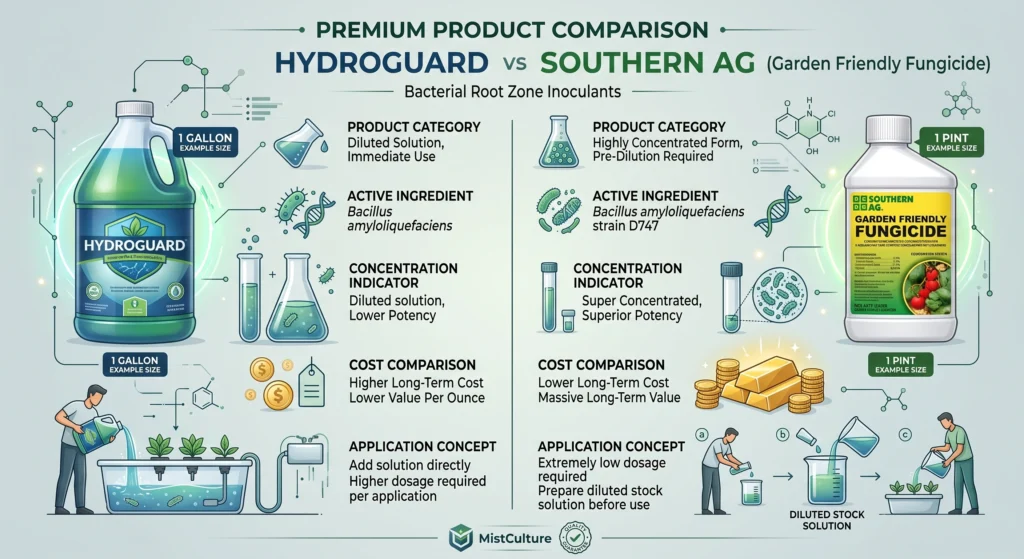
Hydroguard has been a go-to product for home DWC growers for a long time, and it works, it’s a legitimate Bacillus amyloliquefaciens product. Its concentration is relatively low though, which means higher per-gallon dosing to maintain a defensive population, and that cost adds up fast running multiple buckets or a larger recirculating system.
Southern Ag Garden Friendly Fungicide contains the same active bacterial strain, Bacillus amyloliquefaciens D747, confirmed at 98.85% concentration on its own label, and is OMRI-listed for organic use. Its labeled application rate (one teaspoon per gallon for general garden and foliar use, covering up to 500 square feet) is built for foliar and soil application, not specifically for DWC reservoir dosing, so there’s no official manufacturer guidance for hydroponic reservoir use specifically.
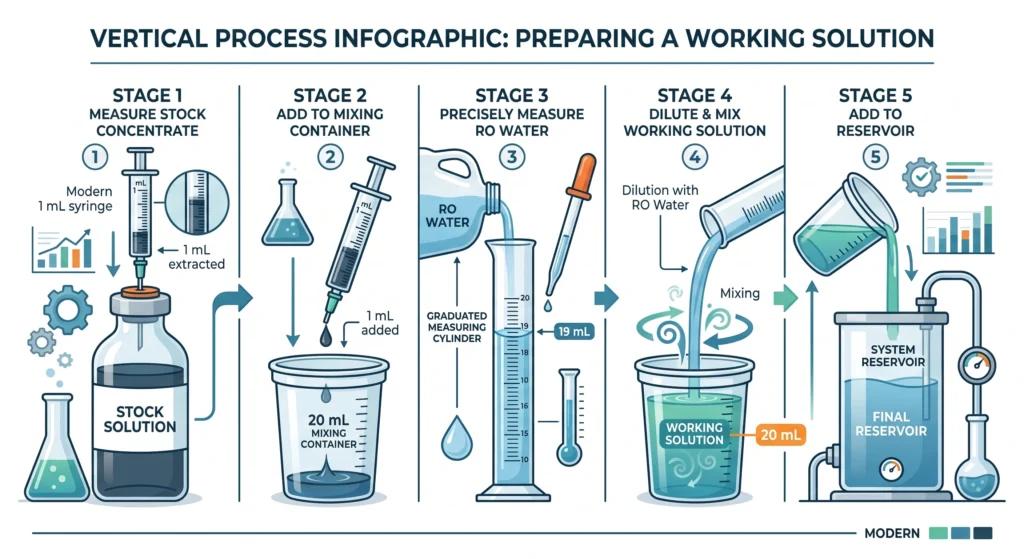
A commonly discussed home-grower approach (not an official label rate): because the product is so concentrated, using it at anywhere near the labeled foliar rate directly in a DWC reservoir risks a bacterial bloom strong enough to cloud the water and meaningfully deplete dissolved oxygen. A widely discussed workaround in grower communities is heavy pre-dilution:
- Mix 1mL of Southern Ag Garden Friendly Fungicide into 20mL of RO water to create a diluted working solution.
- Dose the DWC reservoir with a small amount (commonly discussed starting points run 1 to 2mL of that working solution per gallon) rather than the concentrate directly.
This is a community-derived approach, not an official manufacturer protocol, so start conservative, watch for excessive cloudiness or biofilm buildup, and adjust from there rather than assuming a fixed number is correct for your specific setup. The calculator at the end of this guide handles the dilution math for whatever ratio you decide to test.
This kind of approach fits within a broader IPM strategy that favors proactive biological management over purely reactive chemical treatment.
Recommended Equipment for DWC Microbe Management
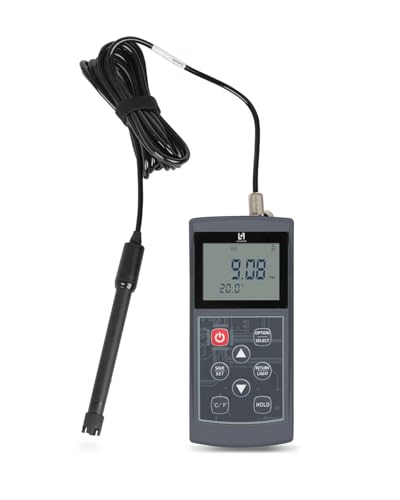
Beneficial bacteria consume oxygen right alongside your plant roots. Guessing DO levels from surface bubbles alone is risky once you introduce a biological load, a real DO meter tells you if a bacterial bloom is pulling oxygen down before roots start to suffer.

Working with a concentrated product like Southern Ag means precision matters, a full milliliter dropped directly into a small bucket can be a real overdose. A lab-grade micropipette lets you measure consistent microliter doses of your diluted working solution.

Biological DWC depends on strong, continuous aeration. A weak aquarium pump can’t sustain both a full root system and an active bacterial colony. A commercial-grade piston pump keeps dissolved oxygen high even as water temperature drifts upward.

Microbial metabolism shifts water chemistry over time as bacteria process nutrients and release exudates. A frequently calibrated, accurate pH pen helps you catch drift before it locks out micronutrients.
Frequently Asked Questions
Can I mix Bacillus amyloliquefaciens and Trichoderma together?
Generally not recommended in a pure DWC setup. Trichoderma is a genuinely aggressive mycoparasite, and in an enclosed reservoir without much organic matter to occupy it, there’s a real possibility it turns its attention toward competing bacterial colonies rather than just pathogens. Most growers pick one primary biological strategy for a liquid-only system, typically Bacillus, rather than running both at once.
Will hydrogen peroxide kill my beneficial microbes?

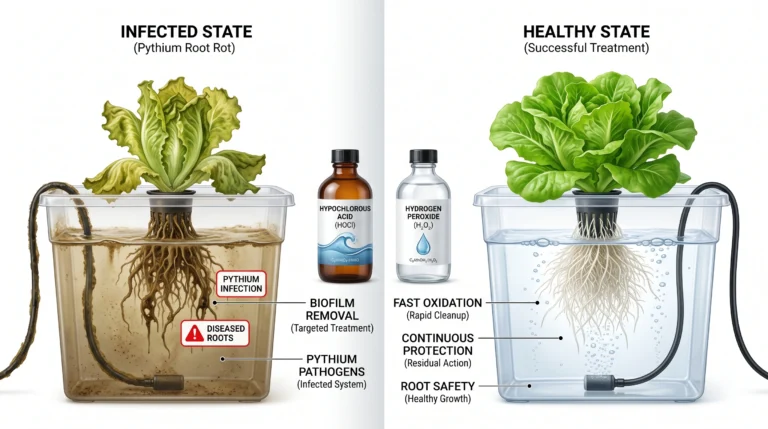
Yes, without exception. H2O2 is a non-selective oxidizer, it kills beneficial Bacillus or Trichoderma just as readily as it kills Pythium. Running a sterile reservoir and a biological reservoir at the same time isn’t really possible, pick one strategy.
How often do I need to reapply the microbes?
In a well-balanced system, microbes colonize and self-replicate to some degree, but routine top-offs and water changes dilute or flush out part of that population over time. A small maintenance dose after each nutrient change is a reasonable habit to keep a defensive population dominant.
What happens if I overdose Southern Ag fungicide in my reservoir?
Overdosing concentrated Bacillus risks a rapid bacterial bloom, cloudy water, and a thick biofilm coating roots and air stones. That bloom can consume enough dissolved oxygen to cause the same kind of root suffocation you were trying to prevent in the first place. Dilute heavily and start conservative.
Does Trichoderma work better with substrate in the system?
Generally, yes. While Bacillus is well suited to suspension in open water, Trichoderma’s growth habit favors anchoring into a physical medium. A DWC system using large net cups packed with coco coir or clay pebbles gives Trichoderma more to work with at the crown than a pure open-water bucket would.
Dilution Calculator
Use the tool below to calculate a diluted working solution and reservoir dose for a concentrated biological product like Southern Ag Garden Friendly Fungicide, starting conservative and adjusting from there.
Calculate a diluted working solution and reservoir dose for a concentrated biological product. Defaults reflect commonly discussed grower starting points, not an official manufacturer rate, start conservative and adjust based on your own results.
Start at the lower end of any range and monitor water clarity, biofilm buildup, and dissolved oxygen before scaling up. This is a dilution calculator, not a guarantee of a specific outcome.
The Practical Takeaway
Moving from a purely sterile mindset to a biological one turns a DWC reservoir from a fragile, constantly-defended void into a more self-sustaining system. Based on how each organism actually behaves biologically, Bacillus amyloliquefaciens is generally the better-suited default for a pure open-water DWC bucket, since it doesn’t need anything to anchor to and thrives in a rolling, aerated environment. Trichoderma remains a genuinely powerful tool, particularly where your system includes real substrate for it to colonize.
Whichever you choose, dilution and dosing precision matter a lot with concentrated agricultural-grade products, start conservative, watch your dissolved oxygen and water clarity, and adjust from there rather than assuming a single fixed number applies to every setup.

Continue Your Learning Journey