Hydroponic Reservoir Sterilization: Ozone vs UV-C Clarifiers

Table of Contents
- The Threat Lurking in Your Nutrient Solution
- Quick Comparison: UV-C vs Ozone
- Evaluation Criteria
- Head-to-Head Comparison
- How They Actually Work
- Essential Equipment
- Frequently Asked Questions
- UV-C Sizing Calculator
- The Final Verdict: Which Sterilization Method Wins?
- Hydroponic Reservoir Sterilization: Ozone vs UV-C Clarifiers
You lift the lid of your reservoir expecting clear water and bright white roots. Instead there’s a foul, earthy smell, a layer of brown foam, and a slimy film coating your air stones and pump intakes. The water’s gone turbid and your plants are starting to wilt. That’s a pathogen outbreak, and it’s a serious one.
Chemical treatments like hydrogen peroxide or hypochlorous acid work well as a temporary fix, but they need constant manual dosing. For a genuinely automated, chemical-free sterile system, the two real options are UV-C sterilizers and ozone generators. Both rely on physics rather than chemistry to destroy pathogen DNA, RNA, and cell structure, but they work in fundamentally different ways: UV-C requires pathogens to physically pass through a radiation chamber, while ozone gets injected directly into the water to hunt down and oxidize organic material before reverting to plain oxygen.
This comparison covers kill efficacy, nutrient impact, setup complexity, and real safety considerations for both.
The Threat Lurking in Your Nutrient Solution
Hydroponic reservoirs are highly oxygenated, nutrient-rich, and often warmed by submersible pumps, which makes them genuinely good breeding grounds for algae, biofilm, and waterborne pathogens like Pythium.
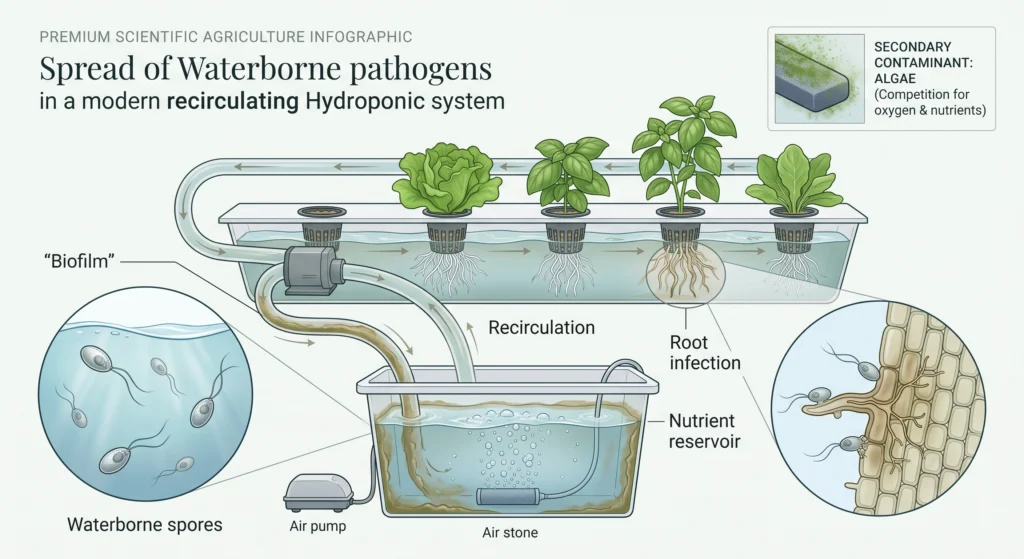
A reservoir is, from a microbe’s perspective, an all-you-can-eat buffet: nitrogen, phosphorus, and trace minerals, constant aeration, and water temperature typically sitting in the high 60s to low 70s Fahrenheit. If you’re not running a biological system with beneficial bacteria to outcompete the bad ones, that reservoir is essentially an open canvas. A single pathogen spore entering through the air, a dirty tool, or an infected clone can multiply fast.
Biofilm is usually the first sign of trouble, a sticky protective matrix bacteria build up along reservoir walls and inside tubing. It shields pathogens from mild chemical treatment and can clog fine emitter lines. Once biofilm establishes, pathogens like Pythium release zoospores that swim through the water column, locate roots, and start consuming tissue. Our root rot prevention guide covers identifying and stopping this specific pathogen in more depth.
Algae is the other common intruder. It doesn’t directly attack plants, but it consumes oxygen and nutrients, and when it dies, its decomposition spikes biological oxygen demand, which can suffocate roots. Good sterilization neutralizes both algae and pathogens before either takes hold.
Quick Comparison: UV-C vs Ozone
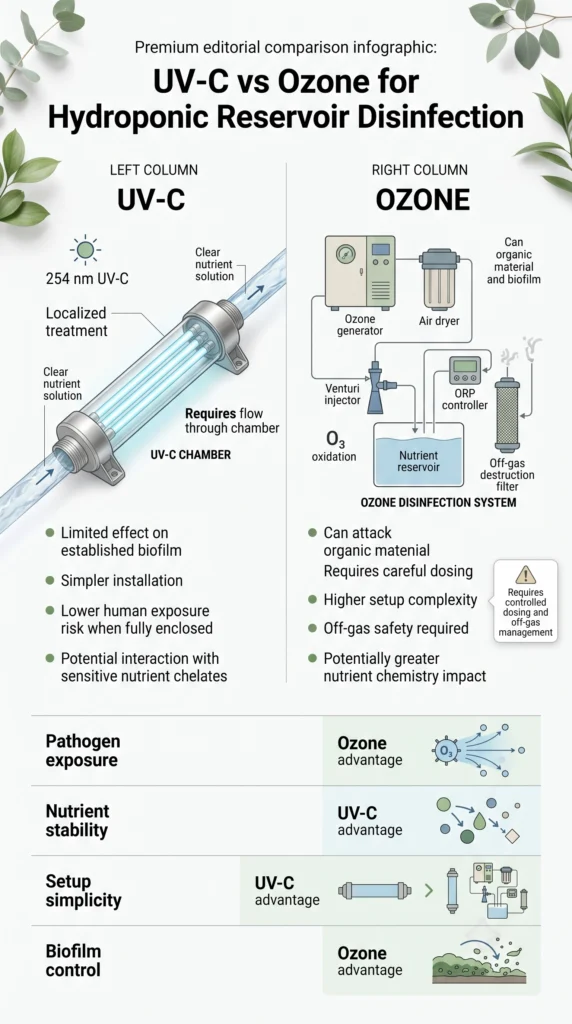
| Feature | UV-C Sterilizer | Ozone (O3) Generator |
|---|---|---|
| Kill Mechanism | DNA/RNA mutation via 254nm light | Cellular oxidation via O3 gas |
| Action Zone | Localized, only inside the light chamber | System-wide, travels through the water |
| Biofilm Removal | Poor, doesn’t touch existing slime | Genuinely effective, oxidizes slime on contact |
| Dissolved Oxygen Impact | Neutral | Meaningfully increases DO as O3 degrades to O2 |
| Nutrient Impact | Mild chelate degradation over time | More significant chelate degradation if overdosed |
| Setup Complexity | Low, inline plumbing | High, needs venturi injector, air dryer, ORP control |
| Human Safety Risk | Low, fully contained in housing | Real, off-gassing causes respiratory irritation |
Evaluation Criteria
Evaluating sterilization equipment means balancing pathogen kill rate against collateral damage to nutrient chelates, while factoring in how complex the technology is to actually integrate safely.
Four criteria matter most:
- Pathogen eradication efficacy. How effectively does it destroy free-floating spores, bacteria, and established biofilm, and how fast?
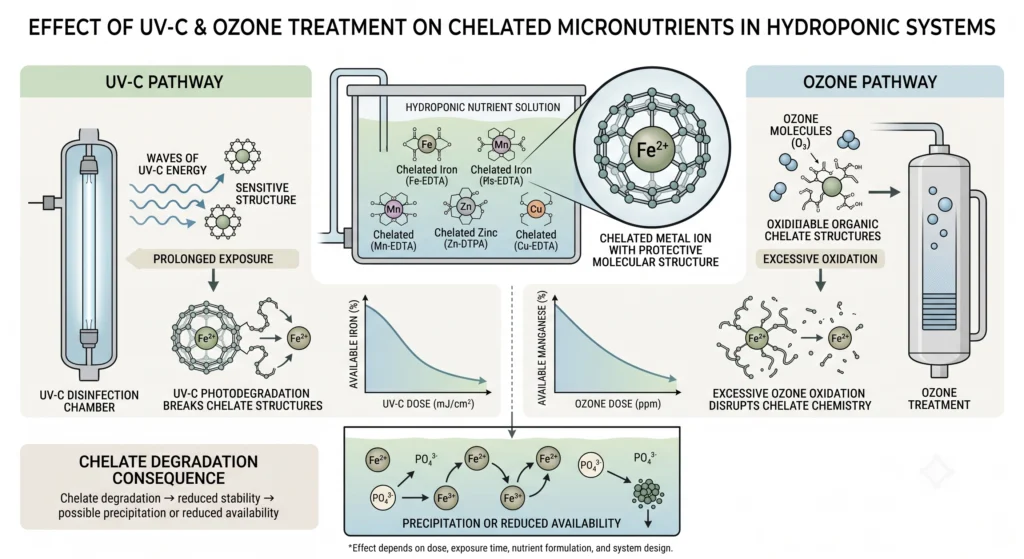
- Nutrient stability. Both technologies are genuinely aggressive oxidizers. How much do they degrade chelating agents (EDTA, DTPA, EDDHA) that keep micronutrients in solution?
- Setup and maintenance complexity. How hard is the system to plumb, calibrate, and maintain, and what are the ongoing costs?
- Secondary root health benefits. Does the system offer anything beyond sterility, like a dissolved oxygen boost?
Head-to-Head Comparison
Ozone is an aggressive, system-wide oxidizer that destroys biofilm and boosts dissolved oxygen, but genuinely requires careful monitoring. UV-C is a simpler, safer, plug-and-play option that kills pathogens passively without the same nutrient or human safety risk.
Pathogen eradication efficacy. UV-C operates at 254 nanometers. As water passes through the chamber, the light penetrates cell walls of algae, bacteria, and fungi and fuses their DNA so they can’t reproduce. Properly dosed UV can achieve very high kill rates, but it only kills what actually passes in front of the bulb, biofilm growing on channel walls or reservoir sides never gets exposed. Ozone, dissolved directly into the water, travels through the whole plumbing system, oxidizing suspended pathogens and actively breaking down biofilm clinging to pipes and air stones.
Ozone wins here, its reach into the whole system and ability to attack established biofilm is a real advantage.
Nutrient stability. Hydroponic fertilizers rely on chelates, organic molecules that keep metal ions like iron, manganese, and zinc soluble. UV-C does degrade chelates somewhat over time (photodegradation of iron EDTA is a documented issue in systems running high-wattage UV continuously), but the effect is gradual and routine reservoir changes or minor iron supplementation generally offset it. Ozone doesn’t discriminate, at heavy or poorly controlled doses it will attack chelates fast, and iron, manganese, and copper can oxidize and precipitate out as sludge. Running ozone safely in a recirculating system generally means low, carefully monitored doses, or dosing a separate makeup water tank before nutrients go in.
UV-C wins here, it’s meaningfully gentler on nutrient formulations.
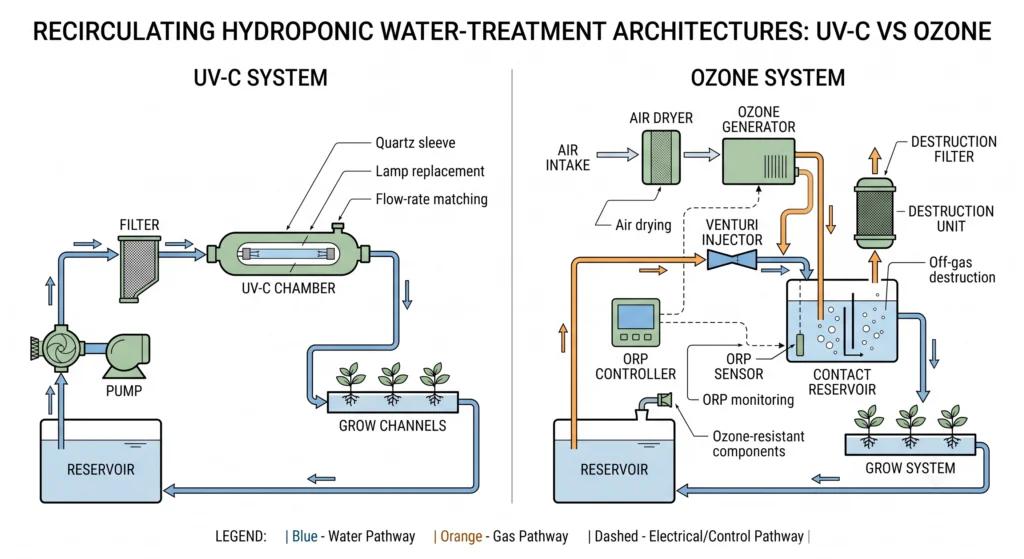
Setup and maintenance complexity. A UV-C unit is close to plug-and-play: size it to your pump’s flow rate, plumb it into the return line, and turn it on. Maintenance is wiping the quartz sleeve monthly and replacing the bulb roughly annually, since output degrades over time even if the bulb still visibly glows. An ozone setup is a real project: ambient air needs to pass through a desiccant dryer first (moist air plus ozone corona discharge produces nitric acid), a venturi injector or fine-pore diffuser dissolves the gas into water, an off-gassing carbon destruction filter is needed on the reservoir lid, and the whole thing should be wired to an ORP controller to automatically cut power once the target level is reached.
UV-C wins clearly here on simplicity for most home and small commercial setups.
Secondary root health benefits. UV-C does one thing: sterilize. It doesn’t change water chemistry, pH, or oxygen levels. Ozone leaves pure O2 behind as it breaks down, which meaningfully boosts dissolved oxygen in the reservoir, and higher DO supports root metabolism and nutrient uptake, growers running well-managed ozone systems commonly report notably healthy, white root systems.
Ozone wins here, the dissolved oxygen boost is a genuine secondary benefit UV-C simply doesn’t offer.
How They Actually Work
Both technologies rely on strict adherence to physical parameters, contact time for UV-C, and carefully monitored concentration for ozone, to work safely and effectively.
UV-C Sterilization
UV-C sterilization uses the 254 nanometer band specifically. At this wavelength, light penetrates a microorganism’s cell membrane and creates dimers in its DNA strands, scrambling its ability to replicate rather than destroying it outright.
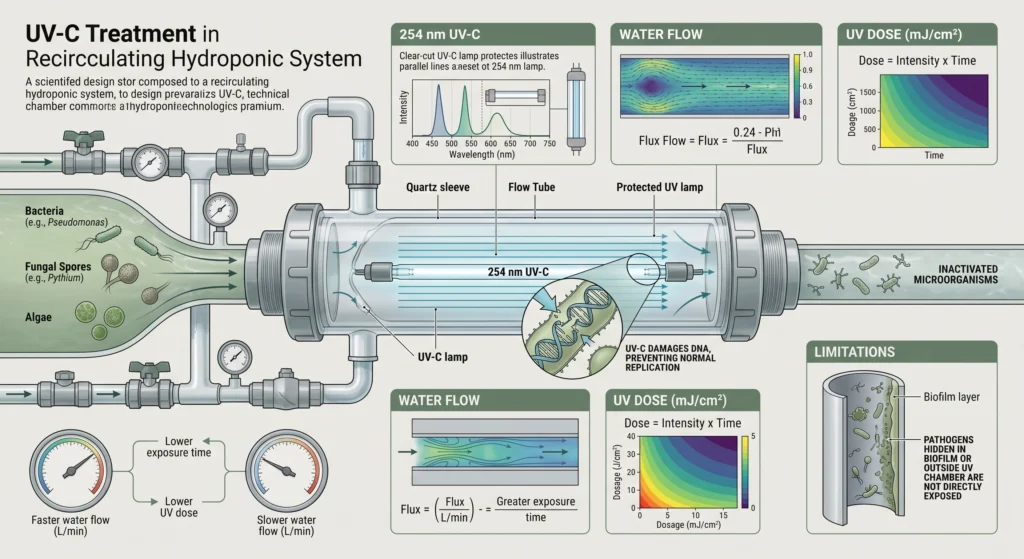
Contact time matters a lot. Think of it like sun exposure, a second outside does nothing, an hour causes a burn. If water moves through the UV chamber too fast, pathogens don’t absorb a lethal dose and survive. Matching UV wattage to pump flow rate is essential, a commonly cited rule of thumb in the aquarium and pond industry is roughly 1 watt of UV power per 40 to 50 gallons per hour of flow, though actual requirements vary with chamber design, water clarity, and the specific pathogen you’re targeting (Pythium zoospores generally need more dose than simple bacteria). Check your specific unit’s manufacturer specs rather than relying on a single rule of thumb alone.
Turbidity matters too. UV light can’t penetrate cloudy water effectively. If your reservoir runs dark with organic additives like kelp or humic acid, light gets blocked by particles and pathogens hiding behind them survive. UV-C is best suited to clear, synthetic mineral reservoirs.
Ozone Generation
Ozone forms naturally in the upper atmosphere from UV light, or during lightning strikes. Commercial generators recreate this through corona discharge: ambient air passes across a high-voltage field, splitting O2 molecules into single oxygen atoms that attach to other O2 molecules to form O3.
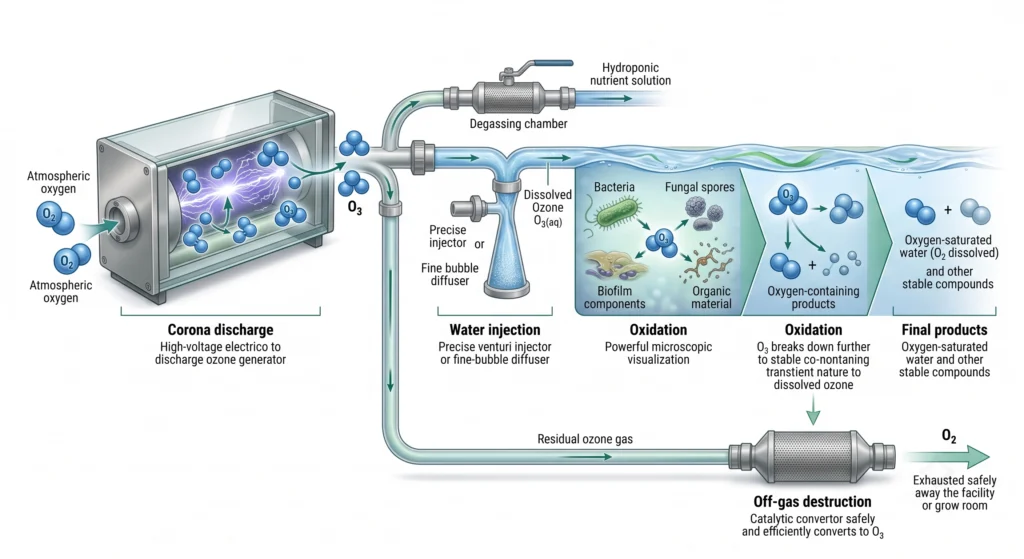
Measuring it with ORP. Since ozone itself isn’t directly visible, its presence in water is tracked with an Oxidation-Reduction Potential (ORP) meter, in millivolts. This is genuinely one of the more disputed numbers across different sources. General hydroponic guidance (without ozone specifically in mind) commonly cites a healthy baseline reservoir ORP around 300 to 400mV, safe for roots and inhospitable to most pathogens through normal aeration and nutrient practice alone. Sources specifically covering active ozone disinfection describe a meaningfully higher effective range, commonly 650 to 750mV, especially when using intermittent on/off dosing cycles rather than continuous exposure, with published research on tomato seedlings showing no root damage at ozonated water concentrations higher than older rule-of-thumb cutoffs suggest.
The practical takeaway: don’t treat any single mV number here as gospel. Start conservative, use an ORP controller that automatically cuts power at a set threshold rather than running ozone on a blind timer, watch root health closely as you dial in your specific system, and check your specific ozone generator manufacturer’s guidance, since output and dosing behavior vary by unit.
If you’re running beneficial microbes (Bacillus, mycorrhizae), skip both of these technologies entirely, UV and ozone are both indiscriminate and will kill your inoculants right along with the pathogens. Our microbes and enzymes guide covers the biological alternative.
Essential Equipment

A large radiation chamber capable of handling higher hydroponic pump flow rates, with a highly transparent quartz sleeve and a twist-lock housing that makes the required monthly cleaning quick. Plumb inline on your return manifold.

An entry-level unit suited to smaller 20 to 50 gallon reservoirs rather than commercial corona discharge equipment, with Teflon tubing and fine-pore diffusion stones included, often used for short shock treatments between crop cycles.

Warm water breeds pathogens faster than any sterilizer can realistically keep up with. Pairing a temperature controller with your chiller to keep the reservoir cool reduces the biological load your sterilization equipment has to fight in the first place.
Frequently Asked Questions
Does UV-C light alter the pH or EC of the nutrient solution?
No. UV-C is a physical light treatment, not a chemical one. It doesn’t add or remove dissolved solids, so EC stays unaffected, and it doesn’t introduce acidic or basic compounds, so pH stays stable.
Can I run UV-C and beneficial microbes at the same time?
No. UV-C doesn’t distinguish beneficial bacteria from harmful ones, any Bacillus inoculant passing through the light chamber gets killed along with the pathogens you’re targeting.
Is it safe to breathe the air around an ozone generator?
No. Ozone is a genuine respiratory irritant, and exposure can cause chest pain, coughing, shortness of breath, and throat irritation. Ozone equipment should only run in well-ventilated spaces, with off-gassing routed through a catalytic carbon destruction filter before it can enter the room.
How often do I need to replace the bulb in my UV sterilizer?
UV-C bulbs lose intensity and their specific germicidal wavelength output over time, even while still visibly glowing. Sterilization power commonly drops off significantly after 9 to 12 months of continuous use, so annual replacement is a reasonable default.
Will ozone destroy the plastic in my hydroponic system?
It can. Ozone is a strong oxidizer that degrades standard plastics, rubber, and silicone over time, making them brittle. If you’re running ozone, use ozone-resistant materials like Teflon (PTFE) or Kynar (PVDF) specifically for gas delivery tubing and injector fittings.
Can I use a cheap aquarium UV sterilizer for hydroponics?
Only if you match the flow rate carefully. Aquarium units are often rated for much slower flow than hydroponic pumps push. Running a 9-watt aquarium UV rated for 100 GPH on a 600 GPH hydroponic pump means water moves too fast for an effective dose, oversize the wattage to match your actual flow rate.
UV-C Sizing Calculator
Use the tool below to check whether your UV-C sterilizer’s wattage is adequate for your pump’s flow rate, using the commonly cited industry sizing guideline. Always cross-check against your specific unit’s manufacturer spec, since chamber design and target pathogen affect the real requirement.
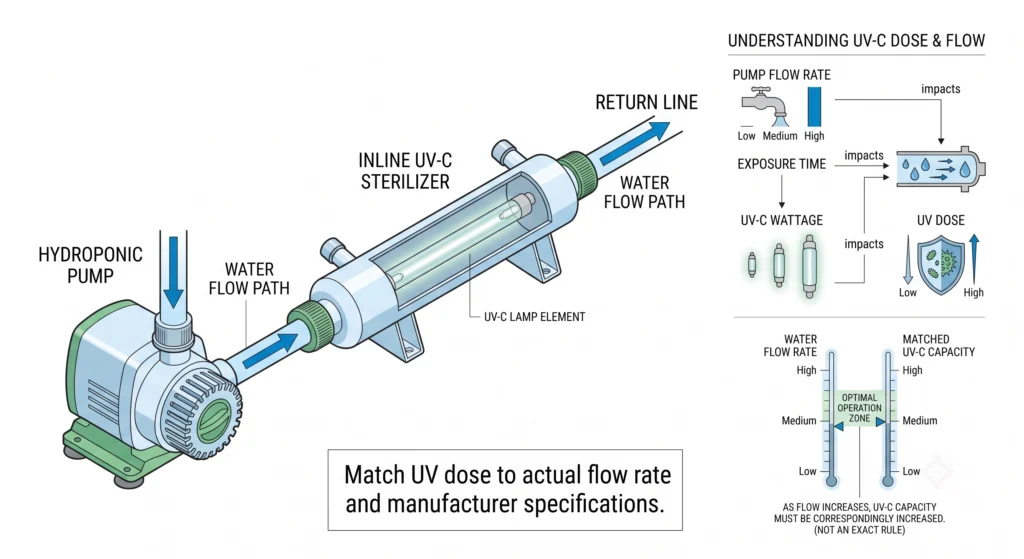
Check whether your UV-C sterilizer’s wattage is adequate for your pump’s flow rate, using the commonly cited industry guideline of roughly 1 watt per 40 to 50 GPH. Always verify against your specific unit’s manufacturer spec too, since chamber design and target pathogen affect the real requirement.
General guideline only. Pythium and other tougher pathogens may need a higher dose than this baseline rule assumes, when in doubt, size up.
The Final Verdict: Which Sterilization Method Wins?
The choice between UV and ozone really comes down to your technical comfort level and risk tolerance rather than one being objectively better.
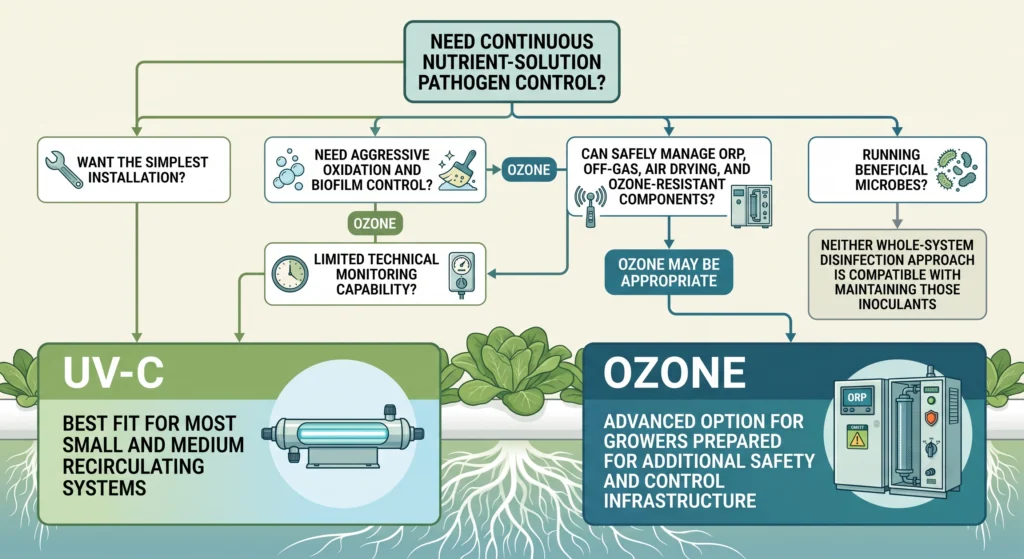
For most hydroponic growers, from basement hobbyists to mid-sized indoor farms, UV-C is the more practical choice. It’s close to plug-and-play, protects against pathogen outbreaks without meaningfully threatening your nutrient chelates, and carries no inhalation risk.
Ozone is the more powerful tool in absolute terms, genuinely the most effective way to purify water, break down stubborn biofilm, and boost dissolved oxygen. But it demands real infrastructure, air dryers, ozone-resistant plumbing, a venturi injector, and continuous ORP monitoring, to run safely. An uncalibrated ozone system can wreck a nutrient profile or create a genuine air quality hazard in your grow space.
If you’re running a standard recirculating DWC or NFT system, a properly sized UV-C clarifier paired with solid temperature control covers most needs well. Save ozone for situations where you’re prepared to invest in the full safety infrastructure it requires, whether that’s an end-of-season deep clean protocol or a commercial-scale operation with dedicated environmental controls.

Continue Your Learning Journey