pH & Nutrients Decoded: Stop Nutrient Lockout Before It Kills Your Crop

Table of Contents
- What Nutrient Lockout Actually Is (and Why It Feels Like Magic)
- Why pH Rules the Root Zone: The 5.5-6.5 Window
- The pH Availability Table: Which Elements Drop First
- Reading the SOS Signals: Deficiency or Toxicity?
- EC and PPM Diagnostics: Feeding Is a Number, Not a Guess
- Crop-by-Crop Feeding Cheat Sheet
- The Impostors: Root Rot and Temperature Fake Lockout
- The Recovery Plan: Draining, Flushing, and Refeeding
- Recommended Gear to Keep Lockout Away
- Frequently Asked Questions (FAQ)
- Conclusion: Own Your Reservoir
Your tomatoes look healthy at lights-on and limp by Thursday. The peppers stop setting fruit. The lettuce edges crisp up overnight even though you feed exactly by the bottle. What you are watching is very likely hydroponic nutrient lockout, and it rarely announces itself until the damage is on the leaves. Lockout is not running out of fertilizer; it is the root zone refusing to let perfectly good food through, and nine times out of ten the cause is pH. This guide covers what lockout is, why pH rules it, the 5.5-6.5 availability window, the EC and PPM readings that catch it early, and the steps to pull a crop back from the edge. New to the terms? Run through the hydroponic troubleshooting guide first, then come back for the deep dive.
What Nutrient Lockout Actually Is (and Why It Feels Like Magic)
Nutrient lockout is a root zone failure, not a shopping problem. The minerals are dissolved in the solution, but the roots cannot take them up, usually because pH, salt load, or root health has closed the door. It is preventable, detectable, and reversible if you catch it early.
Picture a buffet with a bouncer at the door. Every mineral your crop needs is on the trays, and the bouncer is the chemistry of the solution around the roots. When conditions are right, each nutrient is waved through; when they are wrong, whole groups are blocked. The food is right there and the plant cannot touch it. That is lockout.
Lockout comes in two flavors, and treating the wrong one wastes days. Chemical lockout is driven by pH: mineral salts fall out of solution or hold a charge the roots cannot move across the membrane, fixed by adjusting pH, not adding fertilizer. Osmotic lockout is driven by salt concentration: when EC climbs too high, the solution outside the root cells is saltier than the sap inside, and water flows the wrong way across the root membrane. Adding nutrients to a burnt crop makes this worse.
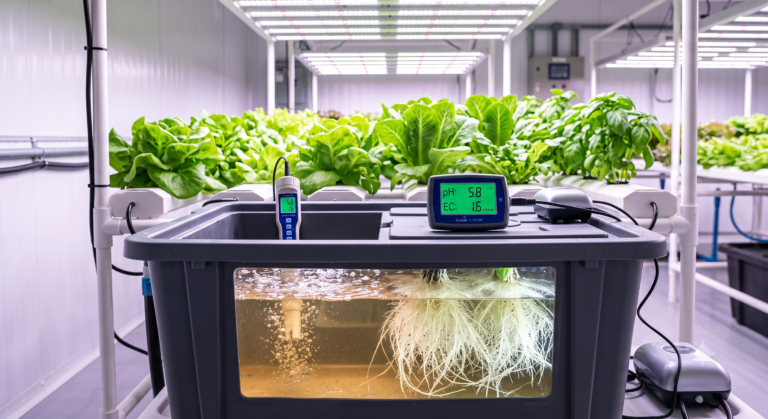
Both flavors look identical from above: yellowing, brown spots, curling edges, stalled growth. So the first rule of any rescue is to measure before you pour. Daily pH and EC checks, same time, same meter, diagnose most of these problems before the leaves ever change color.
Why pH Rules the Root Zone: The 5.5-6.5 Window
Every mineral salt only stays soluble and absorbable inside a narrow pH band. Below 5.5 the macro nutrients lock out while trace elements spike to toxic levels. Above 6.5 iron and phosphate become nearly impossible for roots to pull in. Hold 5.5-6.5 and let the pH drift within that band.
Why does every bottle and guide chant “5.5 to 6.5”? It is not a rule invented by the fertilizer companies. It is the window where most mineral salts stay dissolved in a soilless solution. Below 5.5, iron, manganese, and copper dissolve so aggressively that the plant can overdose on trace elements while nitrogen, phosphorus, potassium, calcium, and magnesium become harder to pull in, starving for the main course while overdosing on the garnish.
Above 6.5, the opposite happens. Iron drops out first, followed by manganese, zinc, and copper, while phosphate precipitates into forms the roots cannot use. That is why interveinal yellowing on new growth is the most common lockout symptom in the hobby: an iron shortage at the root surface, not in the bottle.
You do not have to hold a single number. Nitrogen and potassium peak near the lower end of the band, calcium and magnesium near the upper half. Pin the reservoir at exactly 6.0 every day and you never fully feed either group. The pro move is pH drifting: let the solution rise from around 5.6 to 6.3 over a few days, then adjust it back down. The pH and EC guide has the daily routine, including how often to re-check after top-ups.
The pH Availability Table: Which Elements Drop First
The table below is the cheat sheet that saves the most crops. It shows the pH band where each element stays available and the first symptom you will see when that element locks out. Match symptoms to elements before you touch a bottle.
| Element | Most available pH | First symptom when locked out |
|---|---|---|
| Nitrogen (N) | 5.5 – 6.5 | Oldest leaves pale green, then yellow, moving upward |
| Phosphorus (P) | 5.5 – 6.5 | Dark, purplish older leaves, weak stems |
| Potassium (K) | 5.5 – 6.5 | Yellowing and browning leaf margins, starting at tips |
| Calcium (Ca) | 6.0 – 6.5 | Rust spots on new growth, curled young leaves, blossom end rot |
| Magnesium (Mg) | 6.0 – 6.5 | Interveinal chlorosis on older leaves, yellow striping |
| Iron (Fe) | 5.5 – 6.0 | Bright yellow new growth at the top of the plant |
| Manganese (Mn) | 5.5 – 6.0 | Yellow stippling between veins on young leaves |
| Zinc (Zn) | 5.5 – 6.5 | Stunted new growth, small misshapen leaves |
| Boron (B) | 5.5 – 6.5 | Brittle stems, distorted growing tips |
| Molybdenum (Mo) | 5.5 – 6.5 | General yellowing, twisted young leaves |
Read the table like a wiring diagram. New growth yellow? Suspect iron and check the high end of your pH. Old growth yellowing between the veins? Suspect magnesium and check pH and the Cal-Mag line. Rust spots on fruit and young leaves? That is calcium, and the answer is usually stability, not volume.
The table also explains why chelated minerals exist: the cage keeps a metal ion like iron soluble across a wider pH range. If you run hard water or your pH swings wide, a chelated iron line, DTPA or EDDHA depending on your band, buys real protection. The iron chelate guide breaks down which chelate holds up in which range.
Reading the SOS Signals: Deficiency or Toxicity?
Most apparent deficiencies in hydroponics are actually lockouts. The nutrient is present in the tank; the root zone just cannot deliver it. Before you add anything, check pH and EC first, because the fix for a toxicity is the opposite of the fix for a deficiency.
Plants telegraph their problems, but you have to learn the dialect. Here are the messages you will see most often:
- Nutrient burn: Leaf tips turn yellow, then brown and crispy, as if dipped in flame. This is a toxicity, usually because EC is too high, often from topping up with nutrients instead of water. The fix is dilution, never more food.
- Nitrogen deficiency: The oldest leaves turn uniformly pale, then yellow, then drop, and the yellowing climbs the plant. Nitrogen is mobile, so the plant cannibalizes old leaves to feed new growth. Check pH first.
- Calcium and magnesium deficiency: Yellow or rusty-brown spots between green veins, often on upper leaves, with magnesium as yellow striping and calcium as scattered rust spots. Most of the time the cause is pH above 6.5 locking calcium out; if pH is fine, add a Cal-Mag supplement.
- Iron deficiency: The newest growth at the very top emerges shockingly yellow while older leaves stay green. Iron is immobile, so symptoms start at the growing tips, and this is almost always a pH problem. Drop the reservoir to 5.6-5.8 and the new growth colors up within days.
The pattern: mobile nutrients (nitrogen, phosphorus, potassium, magnesium) show symptoms on old leaves first, because the plant strips them from the bottom. Immobile nutrients (calcium, iron, boron) show symptoms on new growth first. Know which direction to look and the suspect list halves.
EC and PPM Diagnostics: Feeding Is a Number, Not a Guess
EC tells you how strong the nutrient solution is, and the way it drifts over 24 hours tells you what the crop is actually doing. A rising EC means the plants are drinking but not feeding; a falling EC means they are feeding but the reservoir is getting diluted. Both are early warning lights for lockout.
EC (electrical conductivity) measures the total dissolved salts in the solution. PPM is the same idea as a weight, and the conversion depends on your meter scale: a 0.5 scale reads 500 ppm at EC 1.0, a 0.7 scale reads 700 ppm at the same EC. Record your scale, or better, work in EC and skip the translation. The nutrient schedule guide lists targets in EC so you never fall into the scale trap.
Watch the direction of EC drift, not just the number. When plants drink water and leave salts behind, EC climbs. When they take up nutrients faster than they drink, EC falls. When nothing moves, the crop has stalled. If EC climbs hard daily, the feed is too strong or the roots are struggling. If it falls hard, the feed is too weak or the plants are growing fast.
Calibration is the boring part that saves everything: a meter that reads 0.3 high will steer you into a slow overfeed. Most cheap pens drift within weeks, so calibrate monthly and keep the probe wet. When a reading disagrees with how the plants look, trust the plants.
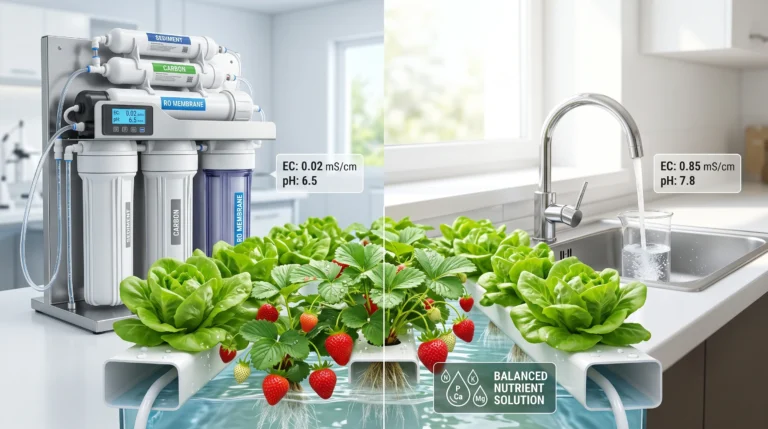
Do the math before you mix, not after. If your target is EC 1.6 and your stock hits 2.0 at the label dose, cut to (1.6 / 2.0) of the rate. The hydroponic nutrient calculator does this dilution math for you. Hard tap water also loads the tank with unknown minerals before you add a drop of fertilizer, pushing your EC off and fighting your pH buffers.
Crop-by-Crop Feeding Cheat Sheet
No single nutrient program fits every crop. Tomatoes and peppers want strong, warm-season feeds; lettuce and herbs run cool and light. Feed a lettuce formula to a tomato plant and you get skinny fruit; feed a tomato formula to lettuce and you get burnt edges. This table is the starting point.
| Crop | pH band | EC band (mS/cm) | Feeding notes |
|---|---|---|---|
| Tomatoes | 5.5 – 6.5 | 2.0 – 2.8 | Heavy feeder; calcium attention or blossom end rot appears |
| Peppers | 5.8 – 6.3 | 1.8 – 2.4 | Moderate feeder; drop EC if flowers drop or edges burn |
| Lettuce and leafy greens | 5.5 – 6.0 | 1.0 – 1.4 | Light feeder; excess nitrogen delays head formation |
| Basil and herbs | 5.5 – 6.5 | 1.2 – 1.8 | Keep EC steady; aroma drops when overfed |
| Strawberries | 5.8 – 6.2 | 1.2 – 1.8 | Keep calcium up; avoid EC spikes during fruit set |
| Microgreens | 5.5 – 6.2 | 0.5 – 1.0 | Barely feed; most failures are overfeeding |
Notice the range: almost a 2-point EC spread from microgreens to fruiting tomatoes. Lockout shows up so often when growers switch crops in the same system without changing the feed. Rebuild the solution for the crop in the tray. The tomatoes and peppers guide goes deeper into fruiting-stage programs, and the crop guides hub carries the leafy and herb programs.
The Impostors: Root Rot and Temperature Fake Lockout
Some lockouts are not pH at all. Warm, stagnant reservoirs breed pythium, a water mold that rots roots until they cannot absorb anything, which looks exactly like a deficiency. If symptoms appear suddenly across the whole plant and the roots are brown and slimy, treat the roots, not the feed.
Healthy roots are bright white and smell like clean earth after rain. Root rot changes everything: brown, slimy roots, a sour swamp smell from the reservoir, and plants that yellow from the bottom up no matter what you feed. The usual cause is pythium, a water mold that thrives in low-oxygen, warm water.
The prevention play is environmental, not chemical. Keep the reservoir between 68 and 72 F; a chiller handles this on larger systems, and frozen bottles rotated through small buckets work in a pinch. Oxygenate hard so aerobic, beneficial microbes outcompete the anaerobic pathogens that cause rot. Keep every drop of light off the solution: algae blooms, dies, and feeds the very microbes you are starving. The root rot prevention guide has the full checklist.
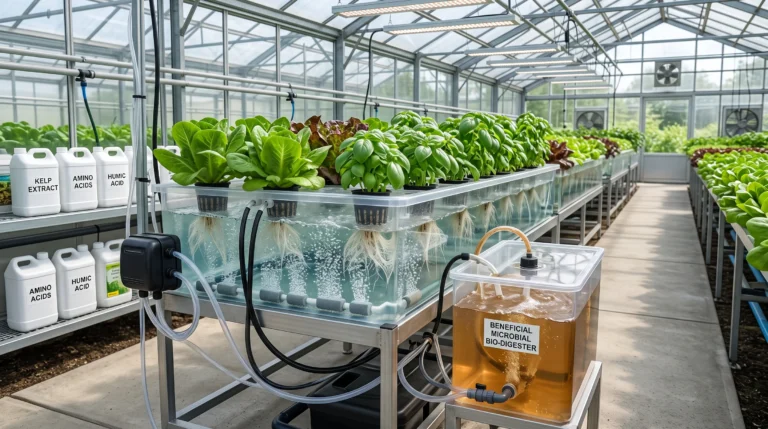
You can also add a biological bodyguard: products containing Bacillus amyloliquefaciens colonize the root zone and consume the food pathogens need. Root rot and pH lockout can arrive together, so a crop that fails to recover after a flush should be inspected at the roots first.
The Recovery Plan: Draining, Flushing, and Refeeding
When lockout is confirmed, resist the urge to fix the tank in place. Drain it, flush the root zone for 12 to 24 hours, then refeed at half strength and watch. Recovery takes days, not hours, and the new growth tells you when you have won.
The temptation is to pour in a bottle of this and a cap of that. Do not. Here is the recovery sequence:
- Stop chasing pH. Do not dump pH Up and pH Down back and forth; every adjustment shocks the roots. One adjustment, then wait.
- Drain the reservoir completely. While it is empty, inspect the root zone for decayed matter, slime, or algae.
- Flush the system. Run plain water at pH 5.8-6.0, or a commercial flushing agent, for 12 to 24 hours to dissolve the salt crust on the roots. The flushing guide sorts out when flushing helps and when it is wasted effort.
- Refeed at half strength. Mix a fresh batch at 50 percent of your normal target EC. The roots are sensitive after a lockout, and full-strength feed on damaged roots is a heavy meal after a stomach bug.
- Monitor for the next 24-48 hours. Check pH and EC after 4 to 6 hours, then twice a day; stability is the goal.
- Wait for new growth. Damaged leaves will not heal. Clean, green new growth from the crown is the sign you won; then step the feed back up.
If the crop is large or the diagnosis is muddy, let the Hydro Doctor tool walk the checklist with you step by step.
Recommended Gear to Keep Lockout Away
None of this gear is expensive compared to a lost crop. The short list: a reliable pH and EC meter, an automated pH controller for big reservoirs, a flushing agent for rescues, and a reverse osmosis system if your tap water fights you.
Recommended: Digital pH and TDS Combo Meter
- Why it’s necessary: Daily pH and EC checks are the entire early warning system for lockout, and a cheap, drifting pen will send you in the wrong direction.
- Key Spec: Dual-probe meter with auto-calibration and LCD readout for pH and TDS/PPM in one pass.
- Check current pricing on Amazon: Digital pH and TDS meter combo kit
Recommended: pH Control Kit
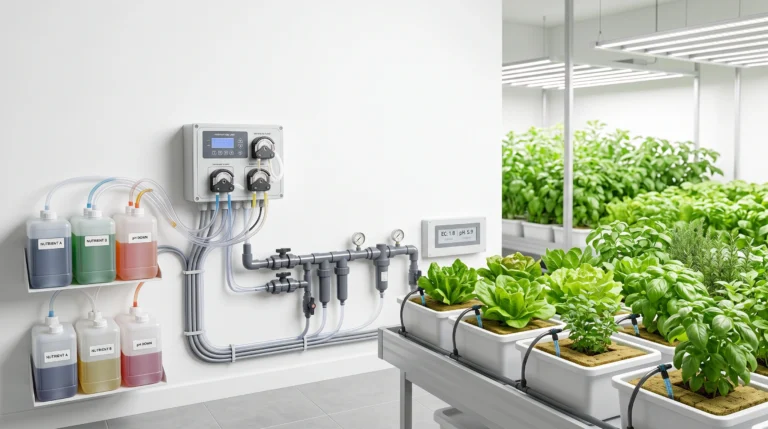
- Why it’s necessary: Keeping the reservoir pinned in the 5.5-6.5 band without daily fiddling is the most reliable way to prevent chemical lockout in any crop.
- Key Spec: Complete kit with test solution, calibration fluid, and dosing guide for holding a stable pH window.
- Check current pricing on Amazon: pH control kit with calibration gear
Recommended: Flushing Agent for Lockout Rescues
- Why it’s necessary: When lockout is already underway, a proper flush dissolves the salt crust on the roots far faster than plain water and gets the crop eating again.
- Key Spec: Liquid nutrient rinse formulated to break up fertilizer buildup in recirculating and media systems.
- Check current pricing on Amazon: Flushing agent for nutrient buildup
Recommended: Reverse Osmosis System
- Why it’s necessary: Hard tap water loads the reservoir with unknown minerals that push EC around and fight your pH buffers, a recipe for repeat lockouts.
- Key Spec: Multi-stage RO/DI filter producing clean water with predictable, near-zero background EC.
- Check current pricing on Amazon: Reverse osmosis purification system
Frequently Asked Questions (FAQ)
Quick answers to the lockout questions growers ask most.
What exactly is nutrient lockout and how does pH cause it?
Nutrient lockout is a condition where roots cannot absorb minerals that are already present in the solution. pH acts as the gatekeeper. Below 5.5, nitrogen and phosphorus become unavailable while trace elements spike. Above 6.5, iron and phosphate lock out. Holding the 5.5-6.5 window keeps that gate open.
What pH should I run for tomatoes, peppers, lettuce, and herbs?
Most crops do best inside 5.5-6.5: lettuce and leafy greens near the lower half, peppers around 5.8-6.3, tomatoes and herbs across the full band. Let the pH drift across the range over a few days.
How do I fix nutrient lockout once it has started?
Drain the reservoir, flush the root zone with pH-balanced water or a flushing agent for 12 to 24 hours, then refeed at half strength. Check pH and EC again after 4 to 6 hours, and only raise feed strength once new growth looks healthy.
Is EC the same as PPM, and how do I convert between them?
EC measures conductivity and PPM estimates the same salts as a weight. A 0.5 conversion scale reads 500 ppm at EC 1.0; a 0.7 scale reads 700 ppm at the same EC. Always note your meter scale or work in EC.
Why does my pH swing wildly overnight?
Two common causes: microbial activity and plant uptake. Decaying organic matter feeds bacteria whose waste swings pH, and heavy-feeding crops take up nutrients unevenly. Drain, clean, and refresh the solution, then monitor stability.
Should I flush the system between every crop?
A full flush between crops is good hygiene and removes salt buildup, but flushing during active growth is only needed for a rescue or a specific quality goal. Never flush with un-buffered water when the roots are stressed.
Conclusion: Own Your Reservoir
Lockout is not a mystery disease. It is chemistry you can measure and a routine you can own. Check pH and EC at the same time every day, feed the crop in front of you, and keep the root zone cool, oxygenated, and dark.
Check pH and EC daily, let the numbers drift inside the band, feed the crop in front of you, and keep the root zone cool, oxygenated, and dark. Do those four things and lockout stops being your story.
Ready to put the routine on rails? Dial in your feed and compare setups in the hydroponics comparison hub so the system matches the crop. Your meters are calibrated. Go check the reservoir.

Continue Your Learning Journey