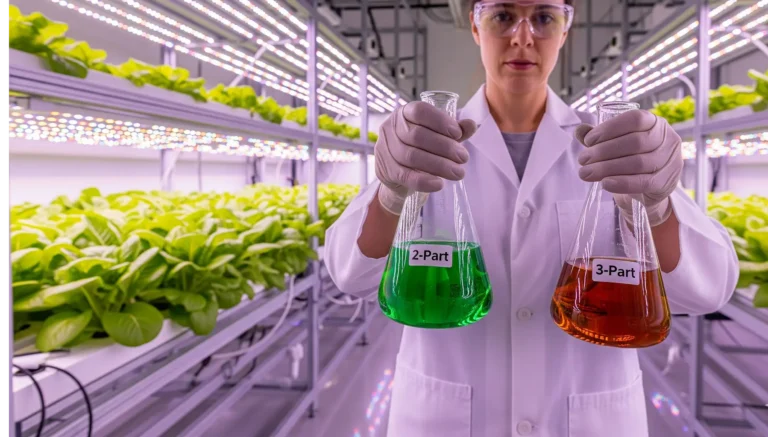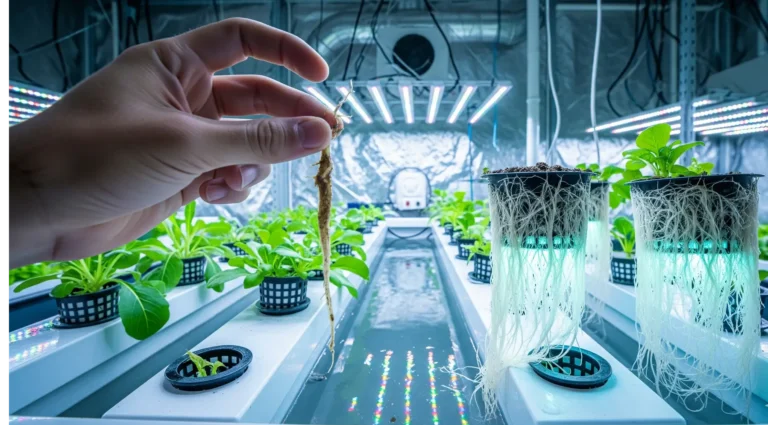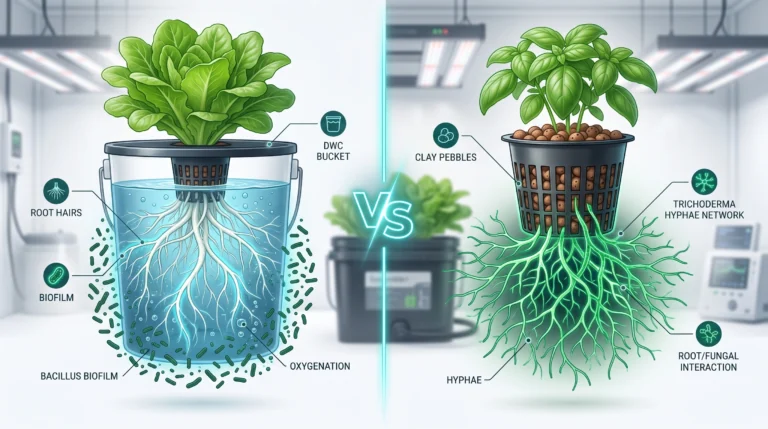
Stop the Cloudiness: Managing Calcium Nitrate Potassium Silicate Hydroponics

Table of Contents
- The Science of Hydroponic Nutrient Precipitation
- Calcium Nitrate vs Potassium Silicate: The Chemical Clash
- Actionable Steps: The Flawless A B Tank Mixing Order
- Parameter Table: Ideal Mixing Targets
- Equipment Needed for Safe Nutrient Management
- Monosilicic Acid (MSA) vs. Potassium Silicate: The Bioavailability & Stability Upgrade
- Frequently Asked Questions
Nothing ruins a perfectly dialed-in grow room faster than looking into your reservoir and seeing a swirling, cloudy blizzard of white flakes. You meticulously measured your fertilizers, checked your water temperature, and flipped on the circulation pump. But instead of a clear, balanced liquid ready to feed your hungry crop, you are left with a tank full of useless sludge.
You have just experienced the nightmare of hydroponic nutrient precipitation.
If you are pushing your crop yields to the absolute limit, you already know the value of adding silica to your feeding regimen. It builds thicker cell walls, increases resistance to pests, and helps plants endure heat stress. The trouble begins when you try to integrate it into a standard two-part fertilizer system. Navigating the delicate chemistry of calcium nitrate potassium silicate hydroponics requires absolute precision. When these compounds meet under the wrong conditions, they instantly bind together, falling out of solution and starving your plants of the exact minerals they need to thrive.
We are going to break down the chemistry of why this happens, the exact a b tank mixing order required to keep your reservoir crystal clear, and the best practices for maintaining peak bioavailability in your systems.
Legal Note: Regulations vary by location. Always consult local guidelines. This content is for educational purposes only.
The Science of Hydroponic Nutrient Precipitation
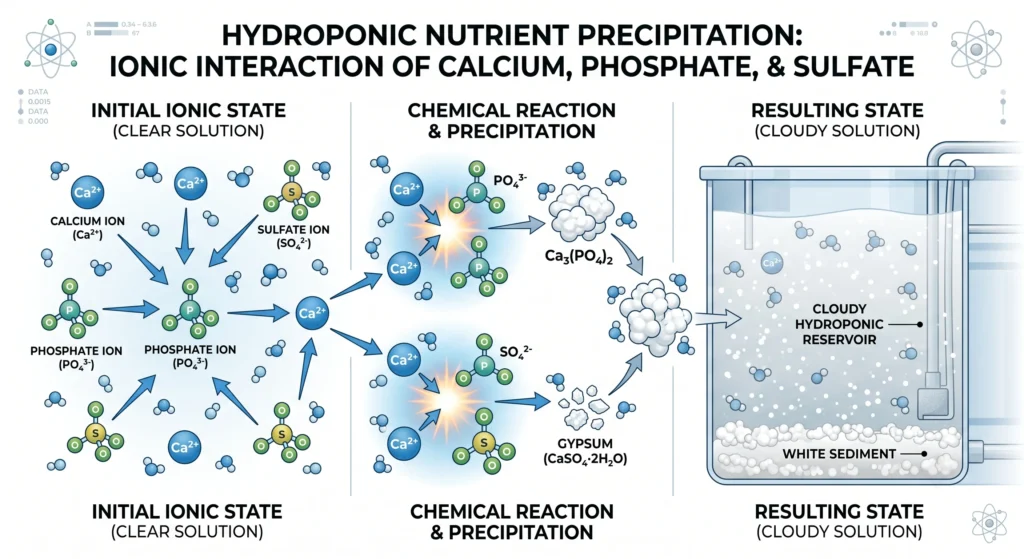
Hydroponic nutrient precipitation happens when incompatible concentrated fertilizer salts react to form insoluble compounds, rendering them unavailable for plant uptake and clogging irrigation lines.
To understand how to fix the problem, we have to understand the underlying chemistry of your reservoir. Plants absorb nutrients in their ionic forms. When you dissolve fertilizer salts into water, they break apart into positively charged cations and negatively charged anions. For example, calcium nitrate dissociates into calcium ions (Ca²⁺) and nitrate ions (NO₃⁻).
These ions float freely in the water, waiting to be absorbed by your plant’s root system. The danger arises when specific ions find each other and decide they prefer to bond together rather than stay dissolved in the water.
When calcium (Ca²⁺) meets sulfate (SO₄²⁻) at high concentrations, they bind to form calcium sulfate; better known as gypsum. When calcium meets phosphate (PO₄³⁻), they form calcium phosphate. Both of these resulting compounds are heavy, insoluble, and completely useless to your plants. They drop to the bottom of your reservoir as a gritty white powder or form a crust inside your plumbing. Once they precipitate, no amount of stirring or pH adjustment will force them back into solution. You have effectively removed the calcium, phosphorus, and sulfur from your feeding regimen, guaranteeing a severe nutrient deficiency in your crop within days.
This chemical reality is the exact reason the hydroponics industry uses a two-part dosing system. By keeping calcium nitrate in “Tank A” and the sulfates and phosphates in “Tank B,” we keep these reactive enemies separated while they are in their highly concentrated stock forms. They only meet once they are heavily diluted in your main reservoir, where the sheer volume of water keeps them safely distanced from one another.
For a deeper dive into managing these basic reservoir dynamics, check out our comprehensive hydroponic nutrients guide.
Calcium Nitrate vs Potassium Silicate: The Chemical Clash
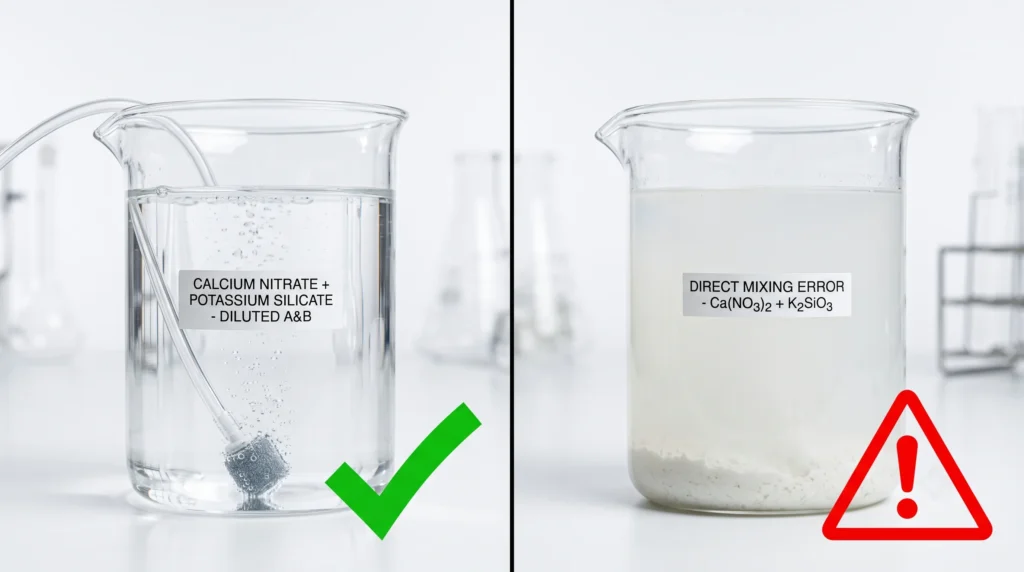
Mixing calcium nitrate and potassium silicate directly in concentrated forms creates an immediate precipitation reaction, binding the calcium and silica into an insoluble sludge that starves your hydroponic plants.
Introducing silica into this finely tuned ecosystem complicates the chemistry significantly. Potassium silicate (K2SiO₃) is the most common and cost-effective form of silica used in controlled environment agriculture. It is highly effective at reinforcing plant cell walls, but it is notoriously difficult to mix.
Potassium silicate is extremely alkaline. In its concentrated liquid form, it boasts a pH well over 10.0. Silica requires this high alkalinity to remain soluble. If the pH of a concentrated potassium silicate solution drops too low, the silicic acid molecules begin to link together; a process called polymerization. The liquid will literally turn into a thick, useless gel.
When you run a standard two-part system, you might be tempted to add your potassium silicate into either Tank A or Tank B to save time. Doing so will trigger an immediate disaster.
If you add it to Tank A, the high-pH potassium silicate will react violently with the calcium nitrate. The calcium will immediately precipitate, creating a cloudy, milky mess. You will lose both your calcium and your silica.
If you add it to Tank B, which houses your phosphates and sulfates, you run into a different problem. Tank B is often slightly acidic. Dropping highly alkaline potassium silicate into the slightly acidic environment of Tank B will cause the silica to polymerize, turning the bottom of your stock tank into a thick layer of gel.
The golden rule of calcium nitrate potassium silicate hydroponics is simple: Silica cannot exist in concentrated stock tanks with any other nutrients. It must be treated as a standalone “Tank C” additive and dosed with extreme care.
Actionable Steps: The Flawless A B Tank Mixing Order
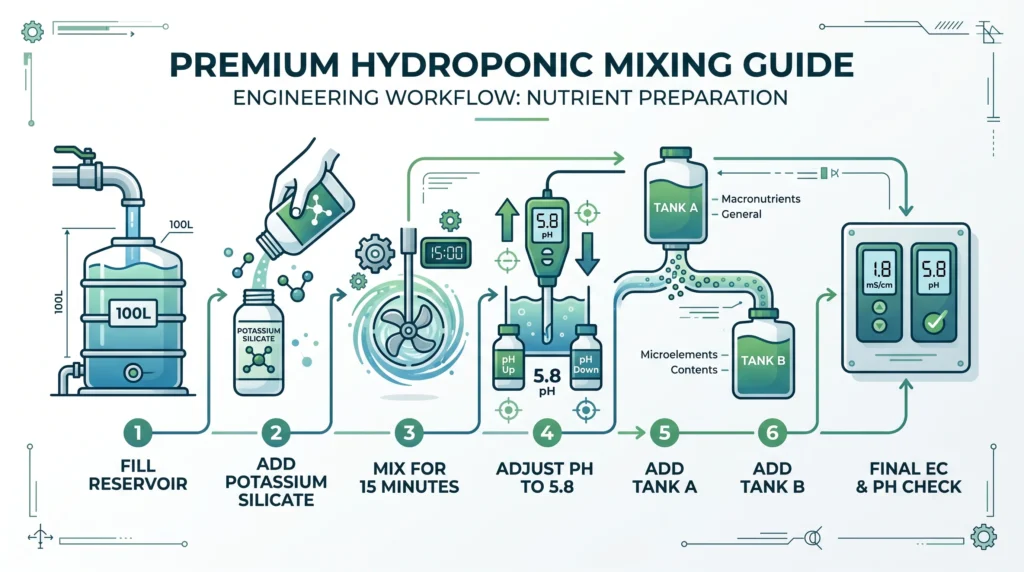
The correct a b tank mixing order requires keeping calcium nitrate in Tank A and sulfates, phosphates, and silicates in Tank B, diluting them fully in the main reservoir before they ever interact.
To successfully run potassium silicate alongside your base nutrients without triggering hydroponic nutrient precipitation, you must follow a strict sequence when filling your main reservoir. The goal is maximum dilution before introducing the next reactive variable.
Here is the exact step-by-step a b tank mixing order to guarantee a clear, bioavailable reservoir every single time:
- Start with Clean, Moving Water: Fill your main reservoir with your source water. Reverse osmosis (RO) water is highly recommended to eliminate baseline mineral interference. Ensure your circulation pump is running vigorously. You need rapid water movement to disperse the nutrients the second they hit the tank.
- Add Potassium Silicate First: Always add your silica supplement to plain water before any other nutrients. Pour it slowly into the current created by your circulation pump.
- Allow for Complete Dispersion: Give the potassium silicate at least 10 to 15 minutes to fully mix into the total volume of the reservoir.
- Adjust the pH: Potassium silicate will drastically spike the pH of your water. Before you add your base nutrients, you must bring the pH back down to a safe range; typically around 5.8 to 6.2 for most crops. Slowly add your pH Down (phosphoric acid) to reach your target. Do not let the pH drop below 5.5, or the diluted silica may begin to polymerize.
- Add Tank A (Calcium Nitrate/Micro-nutrients): Once the pH is stabilized and the silica is diluted, slowly pour in your required dose of Tank A. Allow the system to circulate for another 5 to 10 minutes. The extreme dilution prevents the calcium from reacting with the silica.
- Add Tank B (Phosphates/Sulfates): Finally, slowly pour in your required dose of Tank B. Allow the system to circulate for 10 minutes.
- Final Parameter Check: Check your final Electrical Conductivity (EC) and pH. Make any micro-adjustments to the pH if necessary.
If you automate your dosing, this exact sequence must be programmed into your controller. Your controller should dose the silica, pause for a mixing delay, dose the pH down, pause for a mixing delay, dose Part A, pause, and finally dose Part B.
If you need help setting up the monitoring parameters for this type of system, our hydroponic pH and EC mastery guide is an excellent resource for dialing in your sensors.
Parameter Table: Ideal Mixing Targets
Relying on precise metrics will save your crop from the devastating effects of nutrient lockout. Keep these parameters in mind when executing your mixing order.
| Nutrient Component | Safe Stock Concentration Limit | Ideal Reservoir pH Target | Interaction Danger |
| Potassium Silicate (K2SiO₃) | 7% to 10% (Liquid) | 5.8 to 6.2 (Post-adjustment) | Highly reactive with Ca²⁺ and Mg²⁺ |
| Calcium Nitrate Ca(NO₃)2 | ~1 lb per gallon of water | N/A (Mixes into res) | Precipitates with SO₄²⁻ and PO₄³⁻ |
| Phosphates / Sulfates (Tank B) | ~1 lb per gallon of water | N/A (Mixes into res) | Precipitates with Ca²⁺ |
| pH Down (Phosphoric Acid) | Dilute before adding | N/A | Can cause localized precipitation if poured too fast |
Sourcing raw salts and mixing your own concentrations can save you thousands of dollars at scale. For more information on safely storing and managing bulk nutrients, review the guidelines provided by the University of Florida IFAS Extension on hydroponic nutrient management.
Equipment Needed for Safe Nutrient Management
Attempting to manage a three-part additive sequence with a wooden stir stick and a bucket is a recipe for localized precipitation. You need proper fluid dynamics to ensure the salts disperse the millisecond they hit the water.
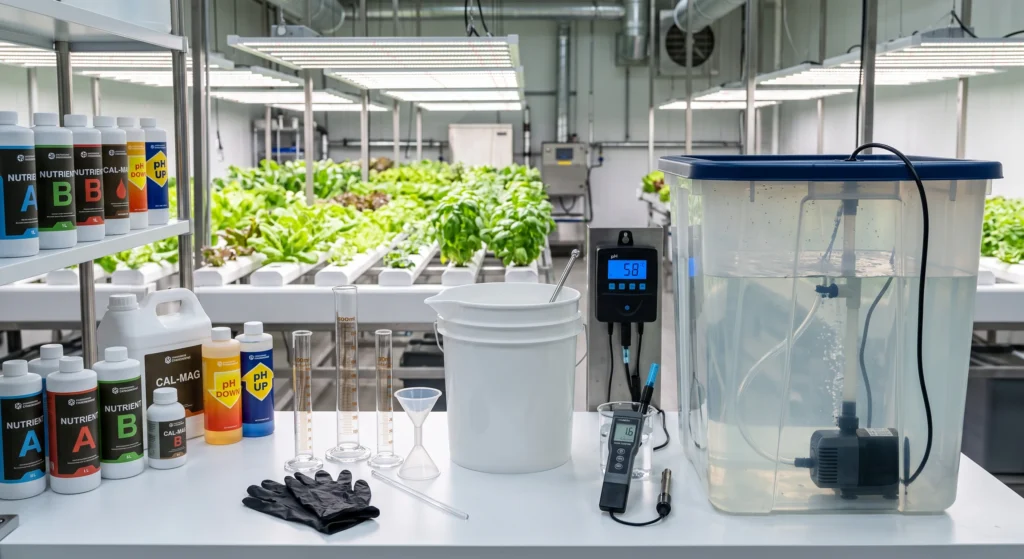
To build a fail-safe mixing station, invest in the following essentials:
- High-Flow Submersible Circulation Pump: Position a 300-500 GPH pump at the bottom of your mixing reservoir to create a strong vortex. Never pour concentrated silica or calcium into stagnant water.
- Graduated Beakers & Pipettes: Use dedicated glass or polypropylene measuring tools for each stock bottle. Never dip a pipette used for Tank A into your silica or Tank B bottle.
- Automated Dosing Controllers (Optional for Scale): If running automated pumps (such as Peristaltic Dosing Systems), ensure your controller features programmable delay timers (minimum 10-minute pauses) between dosing cycles to allow full dilution.
- Calibrated pH & EC Pens: Check water parameters after every individual additive to ensure your solution stays within the safe 5.8-6.2 pH window.

Why I use it: A dedicated circulation pump sitting at the bottom of your reservoir ensures zero dead zones. I point the output nozzle slightly upward to create a rolling boil effect on the surface. When you pour in your silica or calcium nitrate directly over this upward flow, the nutrients are instantly shattered into the surrounding water volume, eliminating the high-concentration pockets that cause precipitation.

- Durable Plastic Construction: Made from eco-friendly food-grade plastic for durability and non-toxicity.
- Multiple Sizes: Includes 4 plastic cylinder sizes (10-1000ml) and 5 plastic beaker sizes (50-1000ml) for versatile use.
- Clear Scale Lines: Standard metric scale lines on cylinders and beakers for accurate measurement.
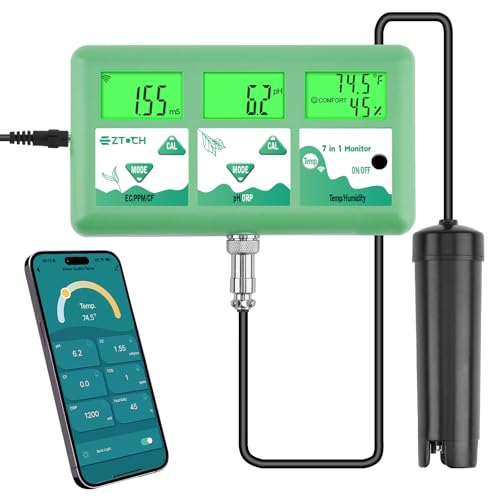
Why I use it: When dosing potassium silicate, the pH swing is violent and immediate. Using drops or test strips takes too long and leaves too much room for interpretation. A continuous monitor allows me to watch the pH drop in real-time as I add phosphoric acid, ensuring I hit the exact 5.8 target before introducing Tank A.
If you run into issues with your pumps or sensors while setting up this mixing station, our hydroponic troubleshooting guide will help you get back online quickly.
Monosilicic Acid (MSA) vs. Potassium Silicate: The Bioavailability & Stability Upgrade
While potassium silicate (K2SiO₃) is the most budget-friendly way to add silica to a reservoir, its high alkalinity and tendency to cause precipitation lead many commercial growers to switch to Monosilicic Acid (H₄SiO₄, also known as orthosilicic acid).
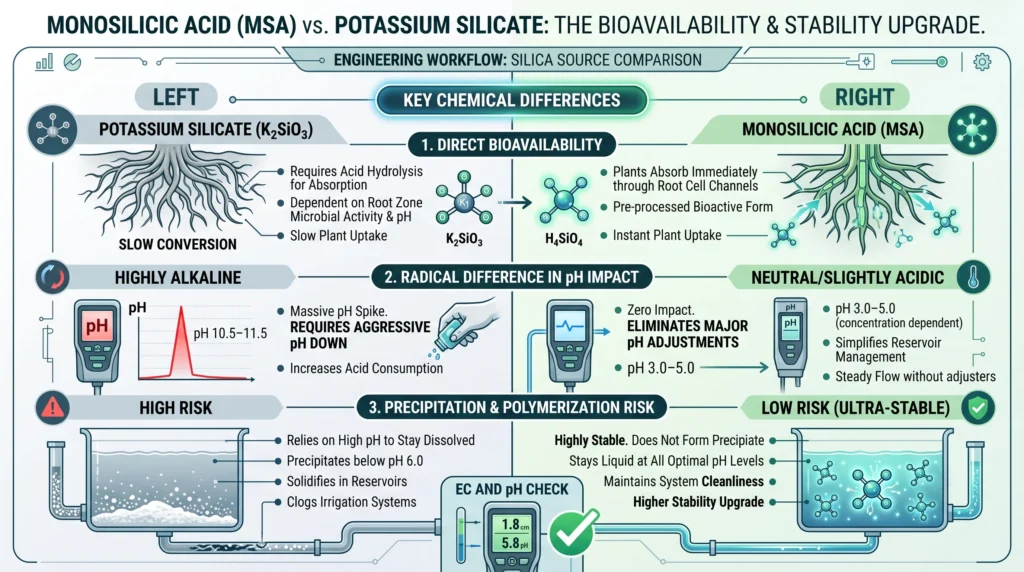
Understanding the fundamental differences between these two silica sources can help you determine if the chemical upgrade is worth the higher price tag:
1. Direct Bioavailability
Plants cannot absorb potassium silicate directly. In the root zone, K2SiO₃ must first undergo acid hydrolysis to convert into monomeric silicic acid (H₄SiO₄). This process is slow and highly dependent on root zone microbial activity and pH. Monosilicic acid, by contrast, is pre-processed into its bioactive form, allowing plants to absorb it through root cell channels immediately.
2. Radical Difference in pH Impact
- Potassium Silicate: Highly alkaline (pH 10.5-11.5). Adding it to a reservoir causes a massive pH spike, requiring aggressive doses of phosphoric acid to bring the water back down to 5.8.
- Monosilicic Acid: Slightly acidic to neutral (pH 3.0-5.0 depending on concentration). It has virtually zero impact on your reservoir’s pH, eliminating the need for major pH adjustments.
3. Precipitation & Polymerization Risk
Because potassium silicate relies on high pH to stay dissolved, dropping it into water with a pH below 6.0 can trigger silica polymerization—turning your solution into a sticky gel. Monosilicic acid is chemically stable at low pH levels and does not react violently with calcium nitrate, making reservoir cloudiness almost impossible.
| Feature | Potassium Silicate ($K_2SiO_3$) | Monosilicic Acid ($H_4SiO_4$) |
|---|---|---|
| Cost | Extremely Low ($) | High ($$$) |
| Plant Availability | Slow (Requires conversion) | Immediate (100% Bioavailable) |
| pH Impact | Heavy Spike (Alkaline) | Minimal / Neutral |
| Precipitation Risk | High (Reacts with $Ca^{2+}$ & acids) | Very Low |
| Mixing Sequence | Must go in FIRST before base nutrients | Can be mixed at any stage |
Frequently Asked Questions
Why did my hydroponic reservoir turn cloudy?
A cloudy reservoir is the hallmark sign of hydroponic nutrient precipitation. It means that incompatible minerals; usually calcium and phosphorus, or calcium and sulfur; have reacted to form insoluble compounds. This typically happens when you mix Tank A and Tank B together in a concentrated form, or if you pour them into the reservoir simultaneously without giving the first part time to dilute.
Can I put potassium silicate in Tank A or Tank B?
No. Potassium silicate must be kept completely separate from your base nutrients. Adding it to Tank A will cause the calcium to precipitate. Adding it to Tank B will cause the silica to polymerize into a gel due to the acidic nature of the sulfates and phosphates. It must be dosed directly into the main reservoir before any other nutrients.
How long should I wait between adding Tank A and Tank B?
You should wait at least 5 to 10 minutes between adding Tank A and Tank B, provided you have a high-flow circulation pump actively mixing the reservoir. If you have slow or poor water movement, you need to wait longer to ensure the first part is entirely diluted.
Does temperature affect nutrient precipitation?
Yes. Cold water holds less dissolved solids than warm water. If your source water is extremely cold (below 60°F / 15°C), fertilizer salts will take much longer to dissolve, increasing the risk of precipitation. Aim to mix your nutrients in water that is between 65°F and 72°F (18°C to 22°C).
What happens if I accidentally mix A and B together in a bucket?
You must throw the mixture away and start over. Once calcium phosphate or calcium sulfate has precipitated and formed a white sludge, it cannot be reversed by adding water or adjusting the pH. The nutrients are permanently locked out and useless to your plants.
How do I clean precipitation sludge out of my reservoir?
If you have a buildup of calcium scale or white precipitate sludge in your reservoir and lines, you will need to flush the system with an acidic cleaning solution. Circulating a mixture of water and a hydroponic descaler (or heavy doses of phosphoric acid) for several hours can help dissolve the calcium carbonate deposits.
Can I use Mono-Silicic Acid instead of Potassium Silicate?
Yes. Mono-silicic acid (also known as orthosilicic acid) is a pre-processed form of silica that is immediately bioavailable to the plant and has a minimal effect on reservoir pH. It is much easier to mix and poses a far lower risk of precipitation, though it is significantly more expensive than standard potassium silicate.
Ready to keep growing? Mastering your reservoir chemistry is just the start. Check out our complete library of growing guides, troubleshooting tips, and setup walk-throughs: View all our Plant care articles.

Continue Your Learning Journey