Spider Mites in Hydroponics: Predatory Mites vs Organic Contact Sprays

Table of Contents
- The Microscopic Threat in Indoor Hydroponics
- Quick Comparison: Predators vs Organic Sprays
- Evaluation Criteria
- Head-to-Head Comparison
- Predator Profiles: The Bug-Eating Cavalry
- Organic Spray Profiles: The Contact Killers
- Essential IPM Accessories
- Frequently Asked Questions
- Frequently Asked Questions
- Predator Match Tool
- The Final Verdict on Spider Mite Eradication
- Spider Mites Hydroponics Eradication: Predators vs Sprays
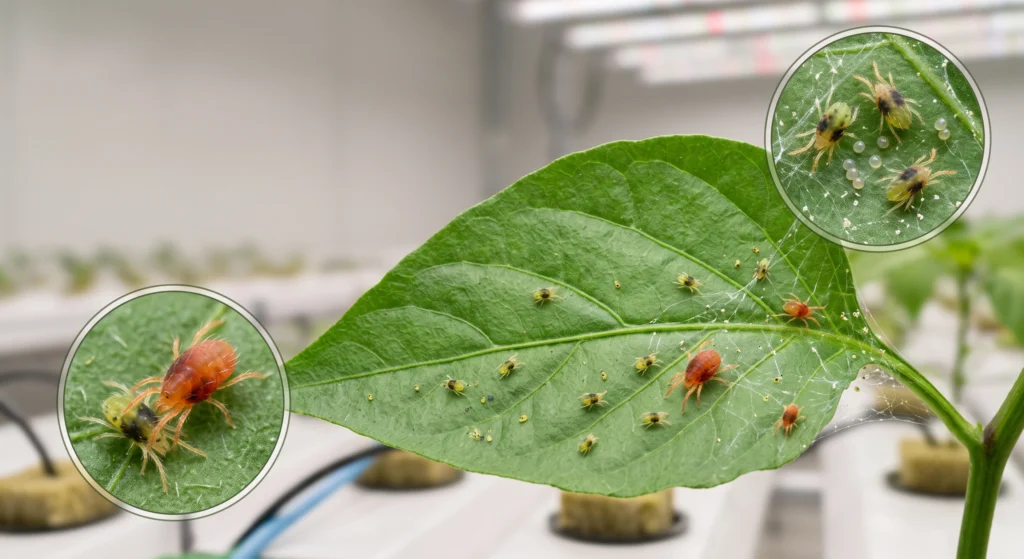
You walk into your grow room expecting lush foliage and instead notice a dull, stippled look on the upper leaves of your fruiting plants. Lean in closer and there it is: fine webbing stretched between leaf nodes. That’s a two-spotted spider mite (Tetranychus urticae) infestation.
Dealing with spider mites is close to a rite of passage for indoor growers. Since our controlled environments are usually cut off from natural predators, these tiny arachnids treat a grow tent like an all-you-can-eat buffet. They thrive in hot, dry conditions and multiply fast, a single female can lay somewhere around 100 eggs over her lifetime, and under warm, dry conditions the life cycle from egg to sexual maturity can complete in under two weeks. Left unchecked, they’ll drain the sap right out of your crop, leading to chlorosis, leaf drop, and real crop loss.
Harsh synthetic pesticides don’t have much place in a clean hydroponic system, especially with food or medicinal crops. That leaves two genuinely effective organic approaches: deploying predatory mites, or knocking the infestation down with organic contact sprays. Both work, but they work in very different ways, with different environmental requirements and labor tradeoffs. This comparison walks through kill rates, labor, cost, and residual harvest impact so you can pick the right tool.
The Microscopic Threat in Indoor Hydroponics
Spider mites are arachnids, not insects, feeding by piercing plant cells and extracting fluid. They thrive in warm, dry indoor environments, which makes hydroponic grow rooms genuinely susceptible to fast, damaging infestations.
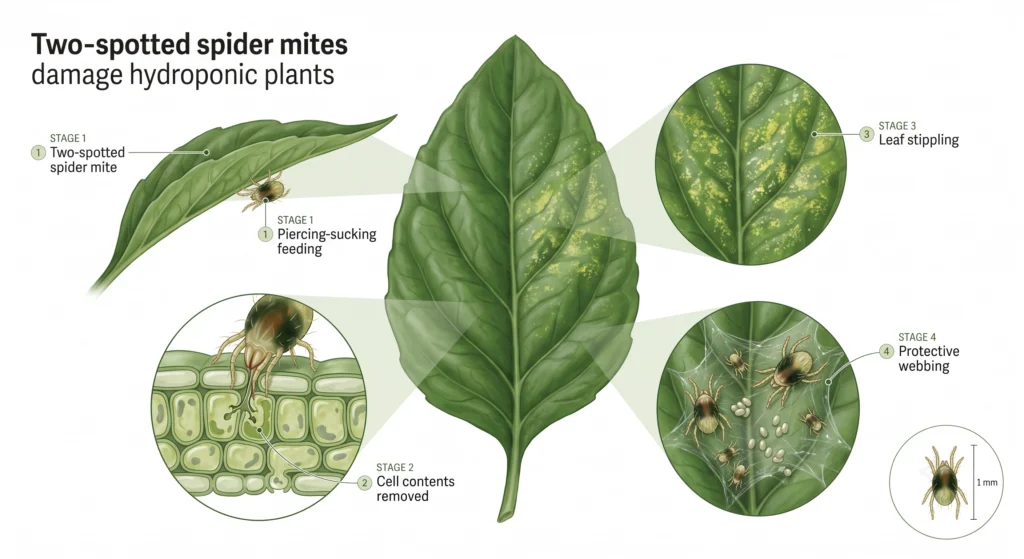
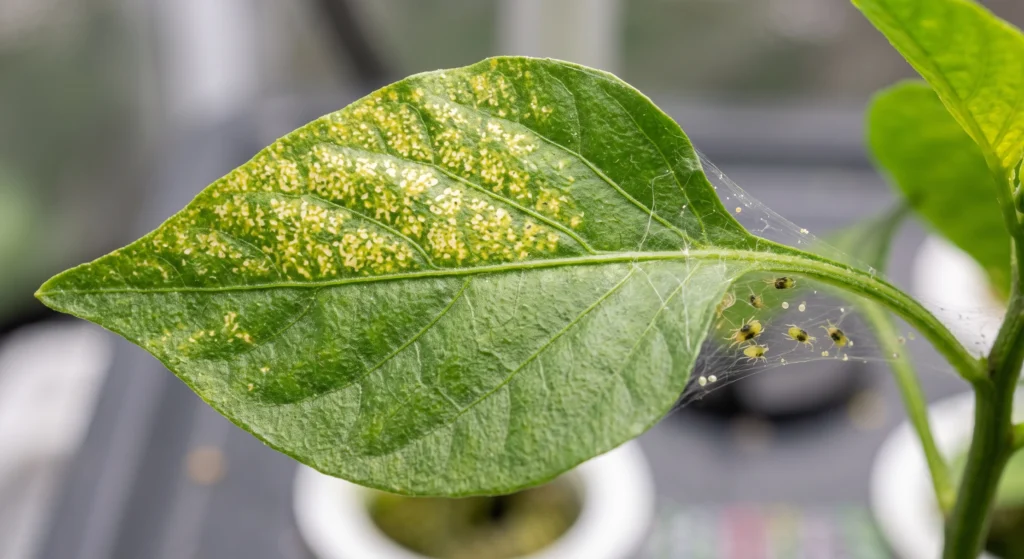
Spider mites are tiny, usually under 0.04 inches (1mm), looking to the naked eye like moving specks of pepper or dust on the undersides of leaves. Their piercing-sucking mouthparts stab individual plant cells and drain the contents, which is what causes the classic stippling effect, tiny yellow or white dots across the leaf surface.
They spin protective silk webbing over their colonies to shield eggs from predators and environmental stress, which means visual identification usually happens well after the infestation is already established. Visible webbing is a sign the colony is thriving, not just starting out.
Spider mites favor dry, dusty, low-humidity, high-heat conditions, doing best around 80°F (27°C). Outdoors, rain, wind, and natural predators keep populations in check. Inside a sealed tent, there’s no wind to disperse them and no rain to wash them off. Running intense lighting without solid airflow or humidity control is effectively rolling out a welcome mat.
Early detection matters. If you suspect a problem but can’t see anything clearly, hold a piece of white paper under a leaf and flick the stem sharply, then check the paper for tiny specks moving around. For broader prevention strategy, see our hydroponic IPM guide.
Quick Comparison: Predators vs Organic Sprays
| Feature | Predatory Mites | Organic Contact Sprays |
|---|---|---|
| Action Speed | Gradual, days to weeks | Immediate, on contact |
| Application Labor | Very low, release and wait | High, requires thorough repeat spraying |
| Environmental Dependency | High, needs specific temp/RH ranges | Low, works across most environments |
| Residue on Crop | None | Oils and soaps can leave a film |
| Preventative Use | Excellent, patrols the canopy continuously | Poor, only works when applied to present pests |
| Best For | Early detection, ongoing maintenance | Severe infestations, immediate knockdown |
Evaluation Criteria
Eradication methods get judged on kill efficacy, plant safety, residual impact, and how much labor the treatment actually takes. A solid IPM strategy balances fast knockdown with longer-term prevention.
Four criteria matter most here:
- Eradication efficacy and speed. How fast does the treatment stop the feeding cycle, and what share of the population, including eggs, does it actually reach?
- Plant safety and phytotoxicity. Does the treatment risk damaging the plant? Heavy oils can clog leaf stomata and reduce transpiration, while live predators carry no chemical burn risk at all.
- Application labor and frequency. Spraying a dense canopy thoroughly, undersides included, takes real time and attention. Predators hunt on their own.
- Residue and harvest impact. Does the treatment leave taste, smell, or physical residue on the harvestable part of the plant? This matters a lot for consumable crops.
Head-to-Head Comparison
Contact sprays deliver a fast kill by suffocating or disrupting pests, but need repeated, labor-intensive application. Predatory mites hunt continuously and reach deep into the canopy, but need managed temperature and humidity to survive and reproduce.
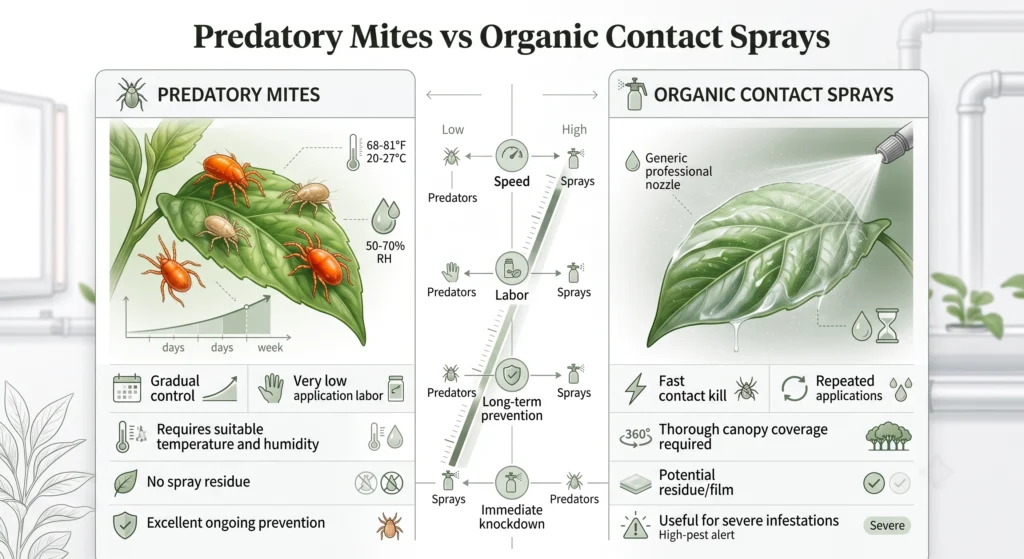
Eradication efficacy. Organic sprays like neem oil or insecticidal soap suffocate adults and disrupt larval development fast, the kill is close to immediate on contact. Their weakness is coverage, miss a leaf node or a folded inner leaf and surviving mites repopulate within days. Spraying every 3 to 5 days is generally needed to break the cycle. Predatory mites are the opposite: they actively search out spider mites, crawling into tight canopy crevices sprays can’t easily reach, but it takes real time for a predator population to establish and outpace a heavy, already-established infestation.
Roughly a tie: sprays win for instant knockdown, predators win for thorough canopy coverage.
Plant safety. Foliar sprays under intense grow lights carry a real phytotoxicity risk, the liquid droplets can act like small magnifying lenses and cause leaf burn, so application timing matters (right as lights go out). Heavy oil applications can also clog stomata and reduce transpiration. Predatory mites carry no phytotoxicity risk at all, they eat other bugs, not plant tissue, and can be released any time under any lighting condition.
Predatory mites win clearly here.
Labor and frequency. Spraying a mature crop thoroughly is genuinely tedious, mixing solution, pressurizing a sprayer, lifting every branch to coat leaf undersides, repeated every few days for at least two weeks to catch newly hatching eggs. Releasing predators takes a few minutes: gently rotate the bottle to distribute the carrier material and mites, then sprinkle it onto your plants. The predators handle the rest.
Predatory mites win clearly here too.
Residue and harvest impact. For ornamentals, residue barely matters. For tomatoes, strawberries, or medicinal herbs, spraying oils late in flowering risks tainting flavor, neem oil in particular has a strong, sulfurous odor that can carry into the harvest. Even milder insecticidal soaps leave a film that needs washing off. Predatory mites leave nothing behind, once their food source is gone they die off naturally or are consumed by remaining predators, without affecting taste, smell, or safety.
Predatory mites win here as well.
Predator Profiles: The Bug-Eating Cavalry
Phytoseiulus persimilis is a specialist that eats spider mites exclusively and consumes them fast, but needs consistently high humidity to thrive. Neoseiulus californicus is a hardier generalist that tolerates drier, hotter conditions and can survive on alternate food sources, making it a solid preventative patrol option.
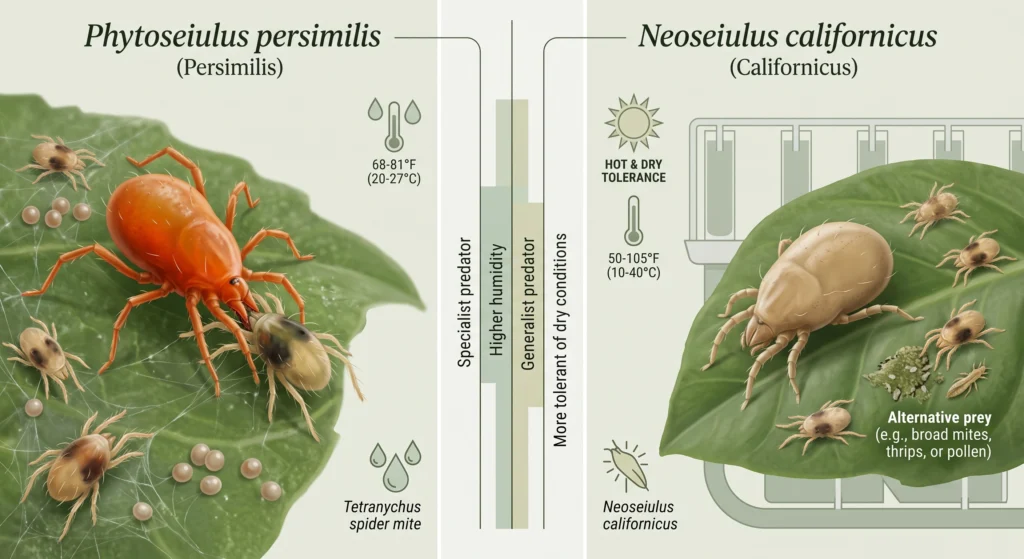
Not all predatory mites are built the same. Matching the species to your actual grow room climate matters a lot for whether the release actually works.
Phytoseiulus persimilis (The Specialist)
Persimilis is widely regarded as the most effective commercial biocontrol agent for spider mites, in fact it was the very first biological pest control product Koppert brought to market back in 1967. This bright orange-red mite eats spider mites exclusively, at all life stages, with a preference for eggs. UC IPM describes it as having the highest known consumption rate of any phytoseiid mite, with adults eating somewhere in the range of 5 to 20 prey items (eggs or mites) per day, depending on temperature, humidity, and prey availability.
The catch: persimilis genuinely needs humidity to function well. Development slows significantly below roughly 65 to 70% RH and effectively stalls at 25 to 30% RH. Its optimal temperature range runs about 68 to 79°F, with feeding activity dropping off above roughly 86°F and stopping altogether above about 95°F. Run a tent hot and dry and persimilis simply won’t keep pace. Because it eats nothing but spider mites, it also starves out once the infestation clears, meaning periodic reintroduction is needed rather than treating it as a one-time preventative release.
Neoseiulus californicus (The Generalist)
Californicus is a pale, pear-shaped mite considerably hardier than persimilis. It tolerates the hotter, drier conditions common in grow tents, generally handling temperatures up to around 90°F and lower humidity than persimilis can manage. While it prefers spider mites, it’s a genuine generalist, willing to eat pollen, thrips, and other small arthropods when spider mites are scarce, which lets it persist much longer without its primary prey than the specialist persimilis can.
The catch: being a generalist means it doesn’t hunt spider mites with quite the same urgency or consumption rate as persimilis. Californicus works best as an ongoing preventative patrol force rather than an emergency knockdown tool, releasing it early in the vegetative cycle means a predator is already established if spider mites show up later.
Sources: UC IPM on Phytoseiulus persimilis · Koppert’s persimilis product page · Cornell factsheet on Neoseiulus californicus
For detailed climate tracking to keep predator populations viable, see our hydroponic troubleshooting guide.
Organic Spray Profiles: The Contact Killers
Organic sprays generally work through mechanical or hormonal disruption rather than systemic chemical toxicity. Neem oil disrupts molting cycles, insecticidal soaps dissolve protective coatings, and horticultural oils physically suffocate pests.

When webbing is already thick and the infestation is serious, waiting on predators to establish isn’t realistic. These are the standard organic knockdown options.
Neem oil (azadirachtin). Cold-pressed neem oil comes from the seeds of the neem tree (Azadirachta indica) and contains azadirachtin, a naturally occurring insect growth regulator. On contact or ingestion, it disrupts hormonal signaling in mites, preventing larvae from molting properly and effectively trapping them in their current life stage until they die. It also suppresses feeding and acts as a mild repellant. Neem oil is hydrophobic, so it needs a few drops of mild soap as an emulsifier to disperse evenly in a sprayer, and should only be applied with grow lights off.
Insecticidal soaps. These are specifically formulated potassium salts of fatty acids, not standard dish soap, and are genuinely effective against soft-bodied pests like spider mites and aphids. The soap breaks down the pest’s protective waxy coating, dissolving cell membranes and causing rapid dehydration. They have zero residual effect, once the spray dries, it’s no longer active against new mites crawling across the treated surface.
Horticultural oils. Often derived from mineral or plant oils (soybean, cottonseed), these work as a physical smothering agent. Mites breathe through small pores called spiracles rather than lungs, and a thorough oil coating blocks those pores, suffocating mites and eggs on contact. Heavy applications can clog plant stomata too, so avoid spraying oils on plants already under water stress.
Essential IPM Accessories

A pressurized sprayer provides continuous fine mist rather than the hand fatigue of a trigger bottle, important for getting thorough coverage under leaves where mites hide.

An inexpensive, LED-lit pocket microscope for confirming exactly what’s on a leaf, dust, spider mites, or the predators you just released, taking guesswork out of identification.

A potassium salt fatty acid soap for fast knockdown without the strong smell of neem, economical to mix in larger batches and effective against soft-bodied pests on contact.

If you’re investing in live persimilis, knowing your actual temperature and humidity matters for their survival. A basic monitor with max/min tracking confirms your tent stays in a hospitable range.
Frequently Asked Questions
Frequently Asked Questions
Can I use predatory mites and organic sprays at the same time?
No, this is a common mistake. Organic sprays don’t distinguish between beneficial and pest insects, spraying neem oil or insecticidal soap will kill your predatory mites right alongside the spider mites. If you need both, spray first for an initial knockdown, wait at least 5 to 7 days for residual oils to degrade, then release predators.
How do spider mites get into a sealed indoor hydroponic system?
They’re excellent hitchhikers, riding in on clothing, pet fur, or through intake fans without proper filtration. The most common entry point by far is bringing in infected clones or new plants from an outside source. Quarantining new plants before introducing them to your main grow space is a genuinely effective habit.
How long does it take for predatory mites to clear an infestation?
With the right species matched to your climate and a reasonable predator-to-pest ratio, a real reduction in spider mite activity within roughly 1 to 2 weeks is a reasonable expectation, though this varies with infestation severity and how well your environment matches the predator’s needs.
Do I need to clean my hydroponic system after a spider mite infestation?
Yes. While spider mites live on foliage rather than in the reservoir, sterilizing the tent, light hoods, and system exterior between crop cycles matters, mites can enter a resting state in corners and seams, waiting for the next crop.
Are spider mites harmful to humans?
No, they’re obligate plant feeders that don’t bite humans or transmit disease. That said, consuming or inhaling large amounts of webbing and mite waste on unwashed, heavily infested plant material is unsanitary and worth avoiding regardless.
Predator Match Tool
Enter your grow tent’s actual temperature and humidity to see which predatory mite species is the better fit, or whether a spray-first approach makes more sense for your current conditions.
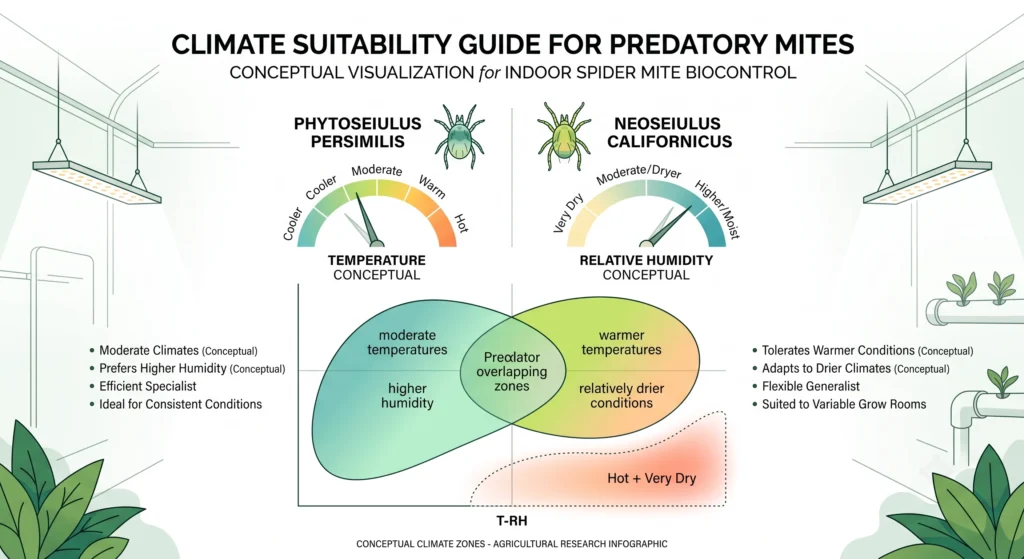
Enter your grow tent’s actual conditions to see which predatory mite species fits, or whether your environment favors a spray-first approach.
General guidance based on published optimal ranges for these species. Local conditions, cultivar, and infestation severity all matter too, use this as a starting point.
The Final Verdict on Spider Mite Eradication
The most effective approach is usually an integrated one: organic contact sprays for immediate knockdown on a serious infestation, followed by predatory mites for ongoing biological control.
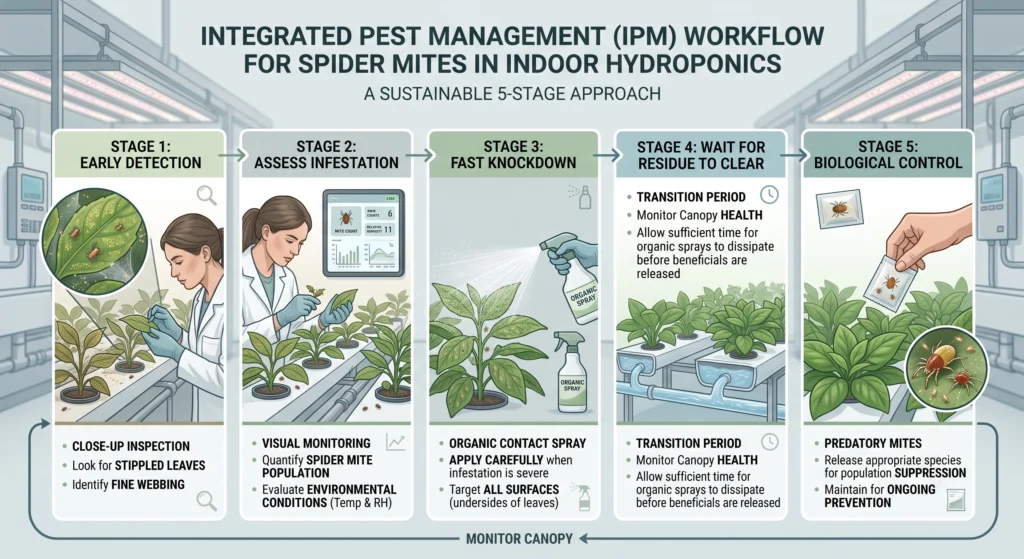
Relying entirely on sprays is exhausting and leaves real room for human error, miss one leaf and the mites come back. Relying entirely on predators during a heavy, web-covered outbreak is risky too, since the sheer volume of pests can outpace how fast a fresh predator population can establish and catch up.
If you spot webbing and heavy stippling, hit the plants with insecticidal soap or neem oil right as lights go out, then repeat the spray about three days later to catch newly hatched larvae. That combination knocks down the large majority of the visible population. Wait roughly five days for surfaces to clear of residue, then release persimilis if your humidity supports it, or the hardier californicus if your tent runs warmer and drier. Combining fast knockdown with relentless ongoing predation is what actually makes a tent inhospitable to spider mites long-term.

Continue Your Learning Journey