Aspirin Spray for Hydroponics: Systemic Acquired Resistance

Table of Contents
- The Defense Priming Mechanism
- Foliar vs Root Zone Application
- Calculating Optimal Elicitor Dosages
- Real-World Yield Impact: The Cost of Defense
- Industry Implications and Biological Synergies
- Core Equipment for SAR Application
- Frequently Asked Questions
- SA and Aspirin Dosing Calculator
- Elevating Hydroponic Immunity
Modern controlled-environment agriculture runs close to the edge. Intense lighting, hyper-optimized nutrients, and accelerated crop cycles push plants to their metabolic limits, and that same high-performance environment is a great incubator for pathogens. A fungal spore or bacterial pathogen entering a sterile reservoir can wreck a crop in days.
Reacting after an outbreak, dumping fungicides or algaecides into an already-stressed system, often stresses the crop nearly as much as the pathogen does. A different approach growers are increasingly exploring is proactive biology: using specific elicitor molecules to prime a plant’s defenses before a real threat shows up, essentially getting the plant to manufacture defensive compounds ahead of time.
This guide covers the real science behind Systemic Acquired Resistance (SAR) in hydroponics, how salicylic acid (SA) or aspirin can be used to trigger it, and the actual math behind dosing it correctly rather than guessing.
The Defense Priming Mechanism
Systemic Acquired Resistance is a genuine, well-studied, broad-spectrum plant immune response triggered by localized infection or by applying specific phytohormones. Salicylic acid is the primary signaling molecule for this pathway, and low-dose exogenous SA or aspirin can induce a similar heightened defense state without introducing actual disease.
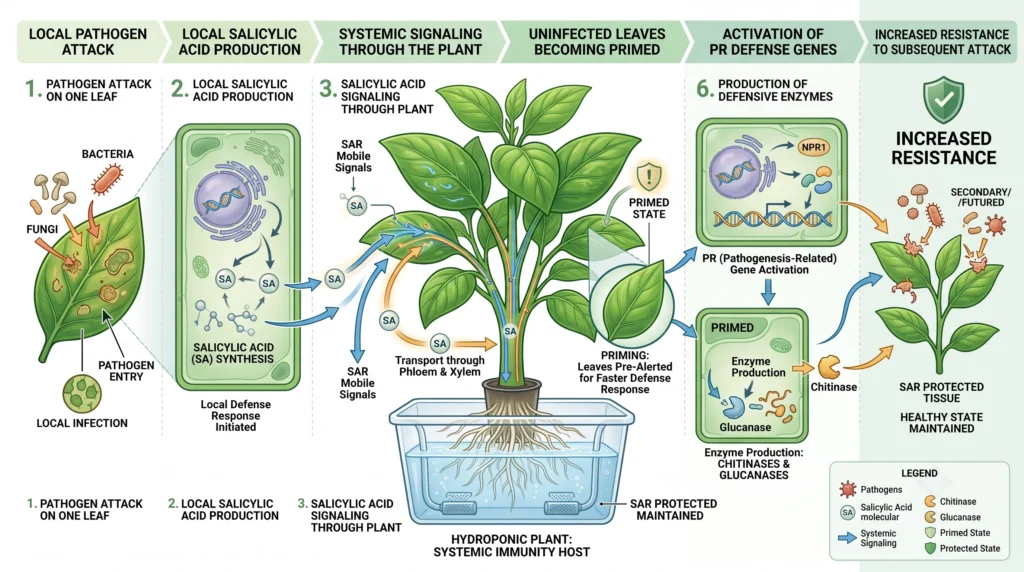
Plants don’t have a circulatory immune system with mobile defender cells the way animals do. Instead, they rely on cellular-level innate immunity. When a pathogen attacks a specific leaf or root zone, cells at the infection site can trigger a localized hypersensitive response, often involving rapid, deliberate cell death to starve the pathogen out.
That localized infection also triggers salicylic acid synthesis. SA acts as an internal signal, traveling through the plant’s phloem to uninfected tissue and putting it on heightened alert. This whole-plant mobilization is Systemic Acquired Resistance.
Once SAR engages, the plant transcribes pathogenesis-related (PR) genes, producing defensive compounds including chitinases and glucanases, enzymes that break down fungal cell walls. Applying an aspirin spray or dosing pure salicylic acid deliberately triggers this same alarm, the plant reads the chemical signal as an active infection and arms itself accordingly against threats like powdery mildew or root rot.
Foliar vs Root Zone Application
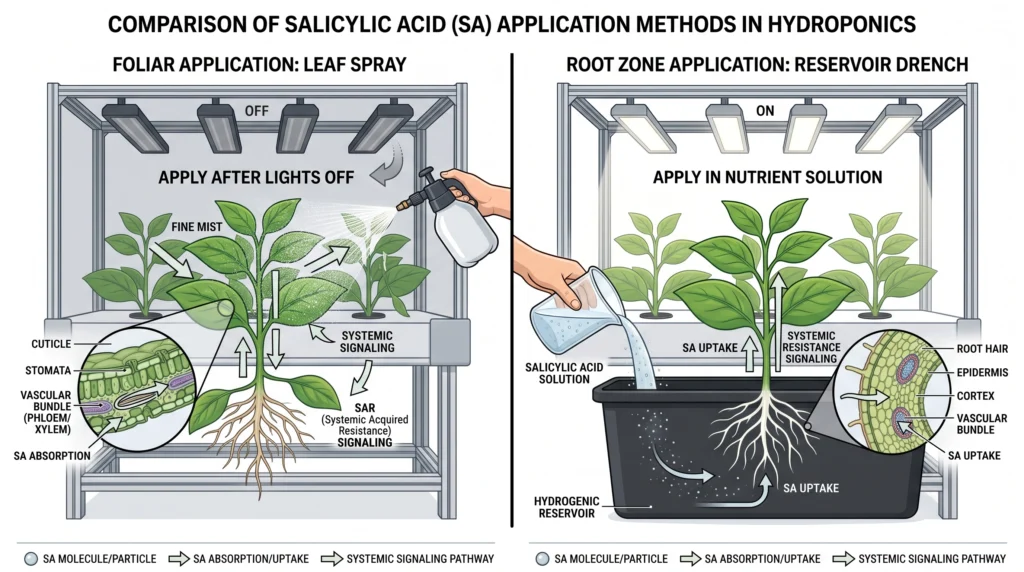
Growers can introduce SA through foliar sprays or direct reservoir dosing. Foliar application mimics an airborne pathogen attack and absorbs quickly through leaf tissue. Reservoir dosing protects the root zone directly but needs careful pH and EC monitoring.
Foliar Application (The Aspirin Spray)
Foliar spraying is the more common, generally effective method for SAR induction. Stomata and the leaf’s cuticular layer absorb the SA solution fairly readily, and since SAR signals naturally travel from leaves down to roots, a foliar spray mimics a localized airborne fungal attack well.
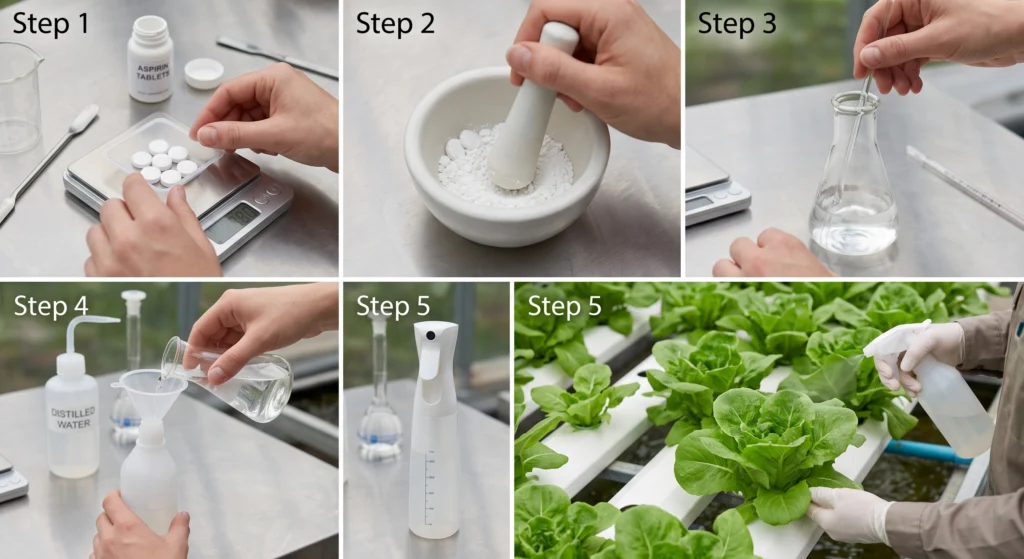
Plain, uncoated acetylsalicylic acid (aspirin) tablets dissolved in water slowly hydrolyze into salicylic acid and acetic acid, a cheap, accessible option. The tradeoff is that tablet binders and fillers (starch, cellulose) can clog fine-mist sprayers or leave a white residue on leaves. Laboratory-grade salicylic acid powder, dissolved first in a small amount of solvent like ethanol before dilution, gives a cleaner, fully soluble application without that residue.
Applying foliar sprays right after lights go out, or during the lowest light period, reduces rapid evaporation and gives leaf tissue more time to actually absorb the elicitor.
Reservoir Drenching
Dosing SA directly into the reservoir triggers SAR from the root zone up, useful for crops prone to root-borne pathogens common in wet systems. See our root rot prevention guide for the mechanisms of those specific pathogens.
Reservoir dosing needs real caution, SA is a weak organic acid and can shift reservoir pH depending on concentration, and can interact with positively charged cations in your nutrient mix. A rock-solid baseline before adding any hormonal elicitor to your water matters a lot here, see our pH and EC mastery guide.
Calculating Optimal Elicitor Dosages
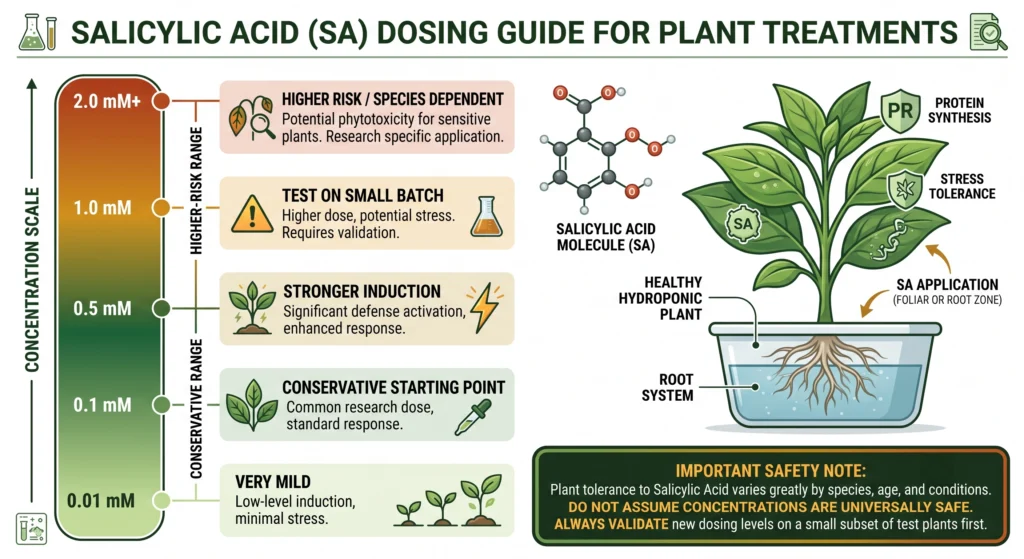
The line between useful immune priming and actual phytotoxicity depends heavily on species and application context. Published research spans a considerably wider dosing range than any single fixed number suggests, so treat the figures below as a solid, conservative starting point rather than a universal law.
Applying SA accurately requires understanding molarity, “drop an aspirin in a gallon of water” isn’t precise enough for consistent results.
Salicylic acid (C7H6O3) has a molar mass of 138.12 g/mol. Acetylsalicylic acid, aspirin (C9H8O4), has a molar mass of 180.16 g/mol.
A 1.0 millimolar (mM) solution of pure salicylic acid requires 138.12 milligrams per liter of water. Published research on SA foliar application spans a wide range depending on species and goal, some maize studies use concentrations up to 5.0mM to drive strong defense chemical responses, while a strawberry study found 2.0mM maximized yield and vegetative growth with no reported burn. For a hydroponic grower without species-specific research to lean on, starting conservative in the 0.1 to 0.5mM range and observing plant response before scaling up is the more sensible approach, since tolerance genuinely varies by crop.
Salicylic Acid (Pure SA) Dosing Chart
| Target Concentration | Pure SA per Liter | Pure SA per Gallon (3.78L) | General Guidance |
|---|---|---|---|
| 0.01 mM | 1.38 mg/L | 5.21 mg/gal | Likely too mild for reliable SAR induction |
| 0.1 mM | 13.8 mg/L | 52.1 mg/gal | Conservative starting point, reasonable for regular foliar use |
| 0.5 mM | 69.0 mg/L | 260 mg/gal | Stronger induction, commonly used during known high-risk periods |
| 1.0 mM | 138.1 mg/L | 522 mg/gal | Used successfully in some published research, but test on a small batch first for your specific crop |
| 2.0 mM+ | 276.2 mg/L+ | 1,044 mg/gal+ | Some studies use this range successfully; others report toxicity in different species, proceed cautiously and test small |
Acetylsalicylic Acid (Aspirin) Dosing Chart
Using standard 325mg uncoated aspirin tablets:
| Target Concentration | Aspirin per Liter | Tablets (325mg) per Gallon | Application Notes |
|---|---|---|---|
| 0.1 mM | 18.0 mg/L | About 0.2 tablets (roughly 1/5th pill) | Gentle preventative foliar spray |
| 0.5 mM | 90.0 mg/L | About 1 tablet per gallon | Standard priming spray during elevated risk periods |
| 1.0 mM | 180.1 mg/L | About 2 tablets per gallon | Higher-end dose, test on a small batch first |
Application frequency: SAR is a temporary heightened-alert state, defense proteins degrade over time. Reapplying a conservative 0.1 to 0.5mM foliar dose every 10 to 14 days during a vulnerable crop phase is a reasonable maintenance schedule.
Real-World Yield Impact: The Cost of Defense
Activating SAR isn’t biologically free. Producing pathogenesis-related proteins takes real metabolic energy, and plant biology research well supports a genuine tradeoff between investment in defense and investment in growth, though the exact the exact yield cost varies a varies a lot by species, dosing frequency, and growing conditions.
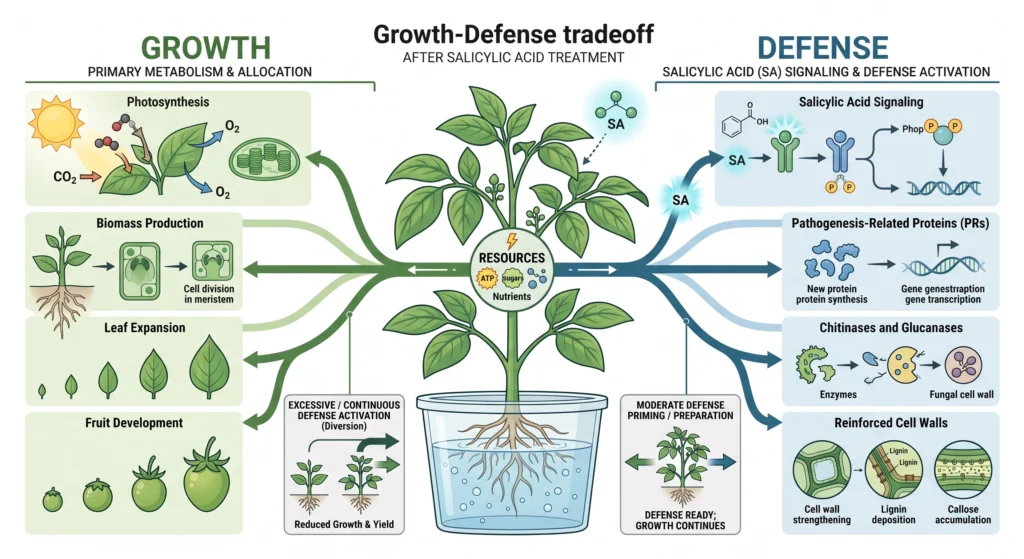
In nature, plants constantly balance energy between growth and defense, and that same tradeoff applies when using elicitors in hydroponics. Applying an aspirin spray pulls resources away from sugar production and vegetative expansion to fuel chitinase synthesis, oxidative burst enzymes, and reinforced cell walls.
Dosing aggressively and continuously (say, a strong SA concentration every few days without a break) keeps a plant in a persistent, energetically costly defensive posture. This growth-defense tradeoff is a well-established concept in plant physiology generally, though I couldn’t find a specific, verifiable source for an exact percentage yield loss tied to hydroponic tomato operations specifically, so treat any precise number you see quoted elsewhere with some skepticism unless it’s tied to a real study.
The practical implication: don’t run SA as a constant daily additive. Trigger it ahead of a known stress window instead. If your cooling system typically struggles during a summer heatwave, creating exactly the humid conditions powdery mildew likes, applying a foliar spray a few days ahead of that window is a more strategic use than continuous dosing. If reservoir temperature is the underlying issue, our passive cooling guide addresses that directly, with SA as a bridge during the vulnerable window rather than a substitute for fixing the root cause.
SAR induction is a genuinely useful tool within a broader hydroponic IPM strategy, a complement to environmental controls, not a replacement for them.
Industry Implications and Biological Synergies
The shift toward biological and hormonal elicitors reflects a real trend in commercial controlled environment agriculture, driven partly by regulatory pressure around chemical fungicide residue on edible and consumable crops.
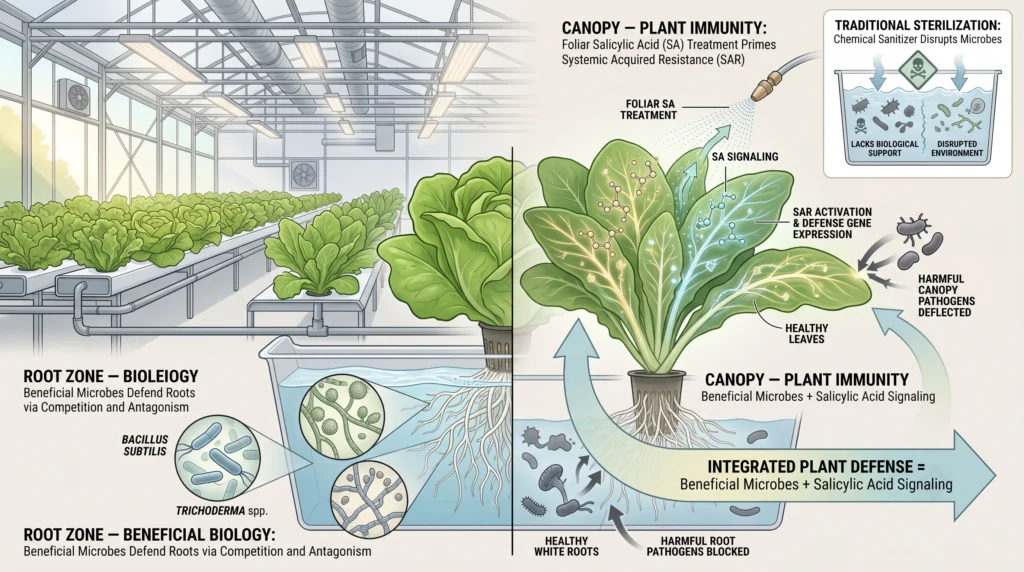
Commercial hydroponic operations face real regulatory scrutiny around fungicide residue on food and consumable crops. SAR offers a residue-free alternative, since SA is a naturally occurring plant hormone (present in willow bark, among other sources) and poses minimal risk at the concentrations used agriculturally.
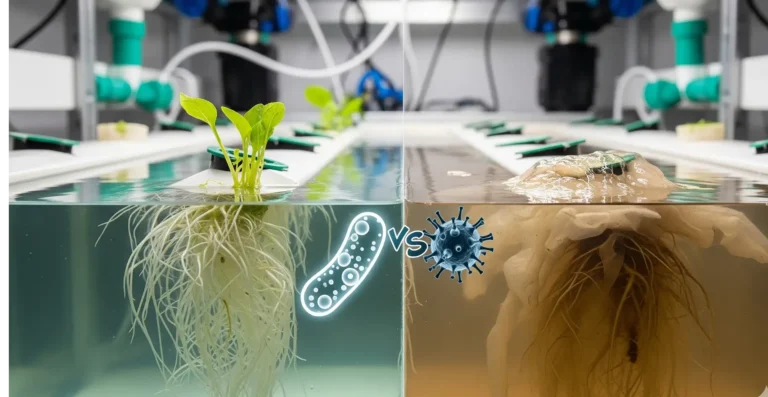
One real advantage over traditional chemical sanitizers (chlorine, heavy H2O2 dosing) is compatibility with living biology. Growers relying on beneficial bacteria and fungi like Bacillus subtilis and Trichoderma to protect the root zone need those organisms to survive, and heavy chemical sanitizers wipe them out indiscriminately.
Salicylic acid works within the plant’s own biochemistry rather than sterilizing the reservoir. That means beneficial microbe inoculation in the water and SA-triggered SAR in the canopy can run at the same time, the microbes compete with pathogens in solution while primed plant immunity handles anything that breaches the root epidermis. See our microbes and enzymes guide for more on that combined approach.
For deeper reading on the molecular pathways involved in SA-mediated plant immunity, the PubMed-indexed research on SA concentration effects in maize and broader coverage in Frontiers in Plant Science‘s phytohormone signaling research are solid starting points.
Core Equipment for SAR Application

The gap between a useful dose (13.8mg) and a much stronger one (138.1mg) is a fraction of a gram. A standard kitchen scale can’t resolve milligrams, a digital scale with real 0.001g precision is genuinely necessary here.

Crushed drugstore aspirin works, but inactive binders leave a cloudy residue that can block light and clog sprayers. Pure SA powder gives a cleaner, fully soluble foliar application.

Hormonal foliar sprays need even coverage without dripping, heavy droplets pooling at leaf tips risk localized toxicity. A continuous-pressure sprayer gives a finer, more even mist across both leaf surfaces.

If you’re dosing the reservoir rather than foliar spraying, SA will affect water chemistry. A combined pH/EC tester lets you confirm the addition of a weak acid isn’t pushing your reservoir outside the optimal range.
Frequently Asked Questions
How do I dissolve pure salicylic acid powder in water?
Pure SA has low solubility in cold water. Dissolve your measured powder first in a small amount of warm water or a few milliliters of rubbing alcohol until it turns clear, then add that into your main volume of room-temperature water.
Can I mix salicylic acid with my regular nutrient foliar spray?
It’s better applied as a standalone spray in plain RO or distilled water. Mixing it with a complex nutrient solution, especially one heavy in calcium or magnesium, risks unpredictable precipitation. Apply the SA spray, wait about 24 hours, then resume normal foliar feeding.
How long does it take for SAR to become active after spraying?
Not instantly. The plant needs time to interpret the signal, transcribe defense genes, and build the actual enzymes. Peak systemic immunity commonly develops around 48 to 72 hours after application and tapers off over the following 10 to 14 days.
Will an aspirin spray cure an active, severe powdery mildew infection?
No. SAR is preventative, not curative. It may modestly support a plant already fighting an infection, but it’s not a contact fungicide. An active, visible outbreak needs a real contact treatment like potassium bicarbonate or horticultural oil, see our u003ca href=u0022https://mistculture.com/hydroponic-troubleshooting-guide/u0022u003etroubleshooting guideu003c/au003e for managing active outbreaks.
Does inducing SAR affect the final taste or quality of the crop?
Used at a conservative concentration, SA generally doesn’t hurt flavor. Some research on secondary metabolite production in herbs suggests mild elicited stress can actually increase essential oil, terpene, or flavonoid production as part of the plant’s natural defensive response, though this varies by species and isn’t guaranteed.
SA and Aspirin Dosing Calculator
Use the tool below to calculate an exact dose for either pure salicylic acid or standard aspirin tablets, scaled to your actual reservoir or spray tank volume.
Calculate the exact weight of pure salicylic acid (99%+) needed for your target concentration and volume.
Calculate how many standard aspirin tablets to use for your target concentration and volume.
Tolerance for salicylic acid varies by species. Start conservative with an unfamiliar crop and test on a small batch before scaling up, especially above 0.5 mM.
Elevating Hydroponic Immunity
Using salicylic acid well means shifting from reactive disease control to proactive biological priming, working with a plant’s own evolved defense signaling instead of just reacting after an outbreak starts.
Getting real value from an aspirin spray or SA dosing protocol comes down to precision and timing rather than a blanket rule. Start conservative, especially with an unfamiliar crop, respect that defense has a real metabolic cost, and use accurately measured, properly dissolved compounds rather than eyeballing it. Paired with solid environmental control and, where appropriate, beneficial root inoculants, this becomes a genuinely useful layer in an integrated approach to keeping a hydroponic crop healthy.

Continue Your Learning Journey