Powdery Mildew Prevention in High-Humidity Grow Tents

Table of Contents
- The Science of Powdery Mildew in Hydroponics
- Recognizing the Early Signs of Infection
- Environmental Control: Managing the High Humidity Grow Tent
- How to Stop an Active Infection: Actionable Steps
- Potassium Bicarbonate Eradication Protocol
- VPD and Environmental Parameter Table
- Recommended Products
- Frequently Asked Questions
- Dew Point Risk Calculator
- Conclusion
- Protect Your Crops Inside Every Powdery Mildew Grow Tent
Walking into your grow room and finding what looks like powdered sugar dusted across your canopy is a gut-sinking moment. You wipe a leaf with your thumb, hoping it’s just dust or humidifier residue, but it smears into a greasy white paste instead. That’s powdery mildew (PM). Left alone in a high-humidity grow tent, it colonizes plants fast, cripples photosynthesis, and can ruin a harvest.
The conditions that push explosive vegetative growth indoors, warm temperatures, dense canopies, plenty of moisture, are exactly the conditions powdery mildew spores need to thrive. Unlike soil-borne diseases that attack roots, PM travels through the air. It rides on oscillating fan currents, hitches along on clothing, and waits for the right trigger to germinate.
If you’re running deep water culture or a dense vertical system, your baseline humidity is naturally elevated, which makes managing this microclimate the difference between a clean harvest and a total loss. This guide covers the biology of the fungus, how to adjust your environment to stop its spread, and a step-by-step potassium bicarbonate protocol for eradicating it without leaving toxic residue behind.
The Science of Powdery Mildew in Hydroponics
Powdery mildew is an obligate biotrophic fungus that needs living plant tissue to survive. Unlike a lot of other fungal pathogens, its spores don’t need free water on the leaf to germinate, high humidity alone is enough, and free water sitting on the leaf can actually inhibit or kill the spores.
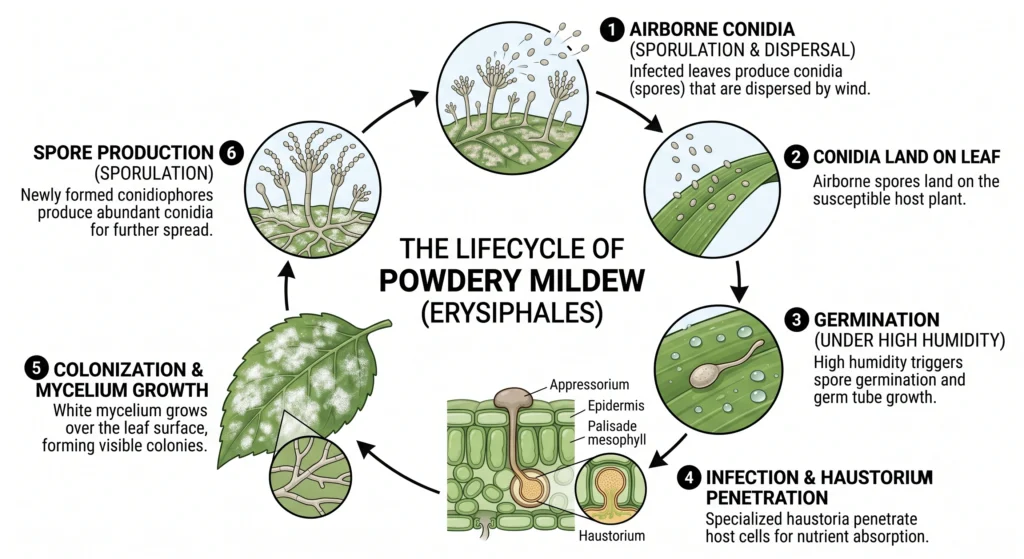
Powdery mildew isn’t one single organism, it’s a catch-all term for several related fungi (species like Podosphaera xanthii or Golovinomyces cichoracearum show up often) that produce similar symptoms. Inside a high-humidity grow tent, its life cycle moves fast.
The fungus spreads by releasing microscopic spores called conidia into the air. When a spore lands on a leaf, conditions determine what happens next. If relative humidity is high and temperature is moderate, commonly cited ranges run from around 60% to 90% RH and roughly 68°F to 86°F, the spore germinates. It sends a specialized feeding structure called a haustorium directly into the leaf’s epidermal cells, siphoning off water and photosynthates the plant needs for its own growth, without killing the cell outright.
As it feeds, the fungus builds a network of white, thread-like mycelium across the leaf surface, that’s the visible white powder. Within days, that mycelial mat produces stalks that release thousands of new spores into the tent’s air currents, and the cycle repeats.
What makes powdery mildew genuinely unusual among plant pathogens is that it doesn’t need free water the way diseases like Botrytis or Pythium do. In fact, extended periods of free water on a leaf surface can inhibit germination and even kill the spores of many powdery mildew species. High ambient humidity, on the other hand, is exactly what it wants. Large open-water hydroponic systems naturally run a higher baseline humidity, and if exhaust is weak, that turns into a solid incubation chamber. For baseline setup strategy, see our hydroponic IPM guide.
Sources: UC IPM on powdery mildew (ornamentals) · Clemson HGIC factsheet on powdery mildew
Recognizing the Early Signs of Infection
Catching powdery mildew early matters a lot for containment. The first symptoms usually show up as subtle raised blisters or faint circular white spots on lower, shaded leaves, since that’s where microclimate humidity tends to run highest.
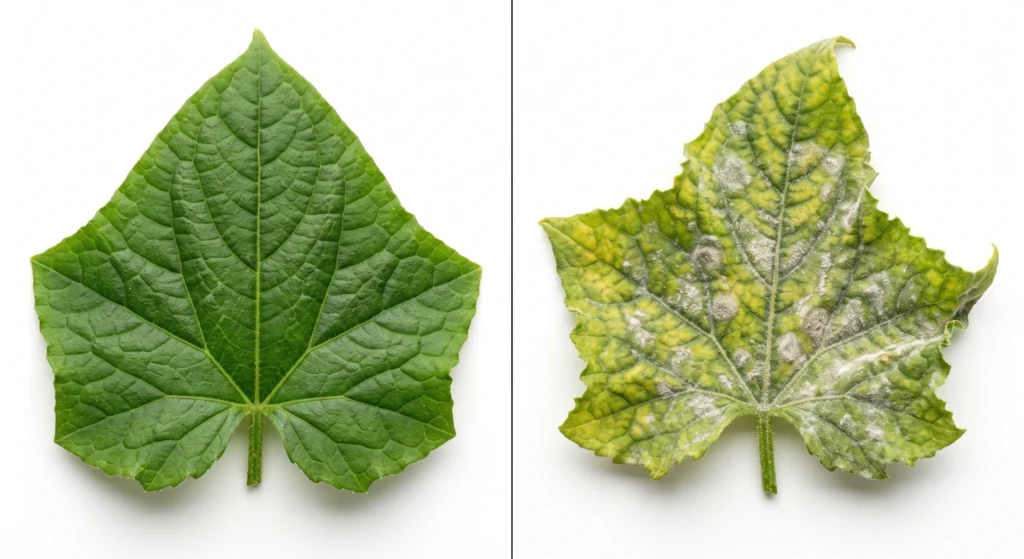
If you wait until a plant looks dusted in flour, the infection is already well established. Since spores settle via gravity and air currents, the lower canopy is almost always ground zero, those leaves get less light, less airflow, and sit in higher localized humidity as neighboring leaves transpire onto each other.
Start daily inspections at the bottom of the plant and look for:
- Faint white spots. Small, circular patches of white or light gray fuzz, sometimes no bigger than a pinhead at first.
- Leaf mottling. Before visible mycelium shows up, the top of a leaf may show pale yellow or chlorotic spots where the fungus is already feeding underneath.
- Leaf curling. Infected leaves can twist or curl at the margins as the infection disrupts normal cell expansion.
- Stem and petiole patches. PM isn’t limited to leaf surfaces, check main stems and the small stalks connecting leaves to the stem too.
Don’t confuse PM with hard water residue. Ultrasonic humidifiers running on tap water can leave a fine white dust of precipitated calcium and magnesium on leaves. The difference is easy to check: hard water dust brushes off cleanly like baby powder, while PM smears into the leaf and leaves a damaged, chlorotic patch underneath.
Environmental Control: Managing the High Humidity Grow Tent
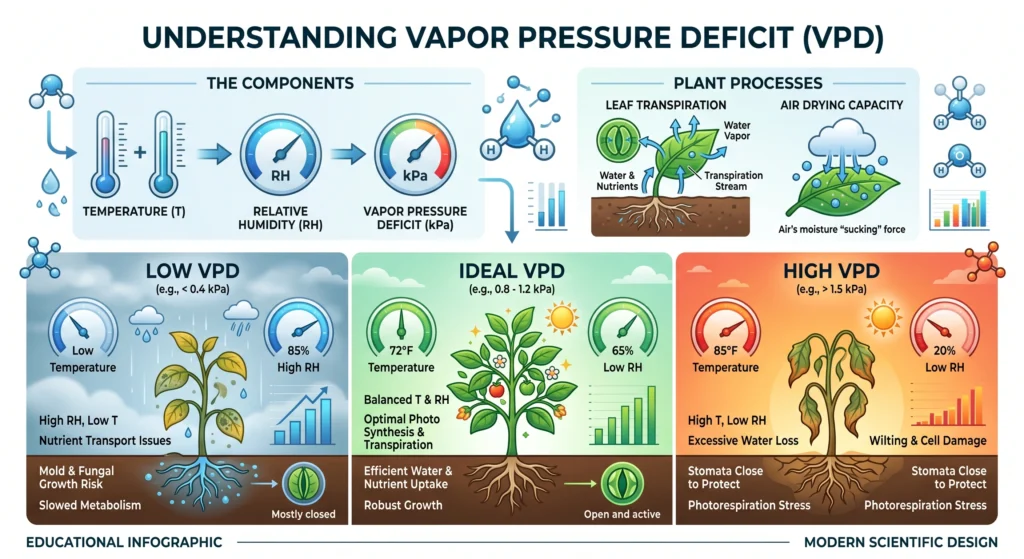
Controlling powdery mildew comes down to managing Vapor Pressure Deficit (VPD) and eliminating microclimates. Matching temperature to humidity targets and keeping air exchange aggressive removes the conditions the fungus needs to germinate in the first place.
Sprays alone won’t solve a PM problem if the environment still favors the fungus. The root cause in most grow tents is usually a sharp environmental swing, a warm, humid day cycle followed by a fast temperature drop when the lights go out.
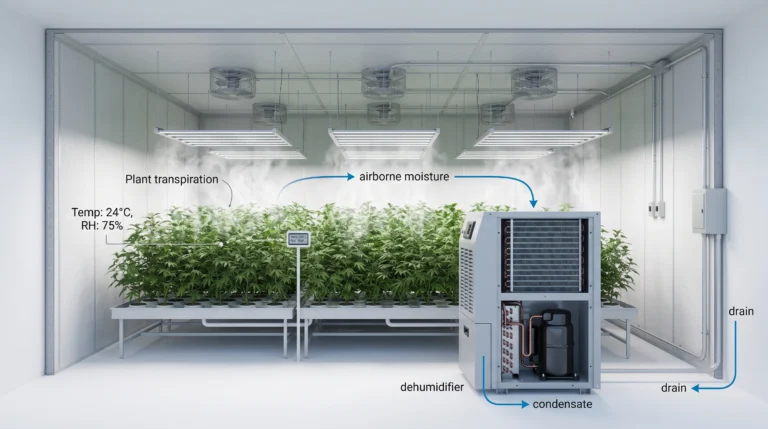
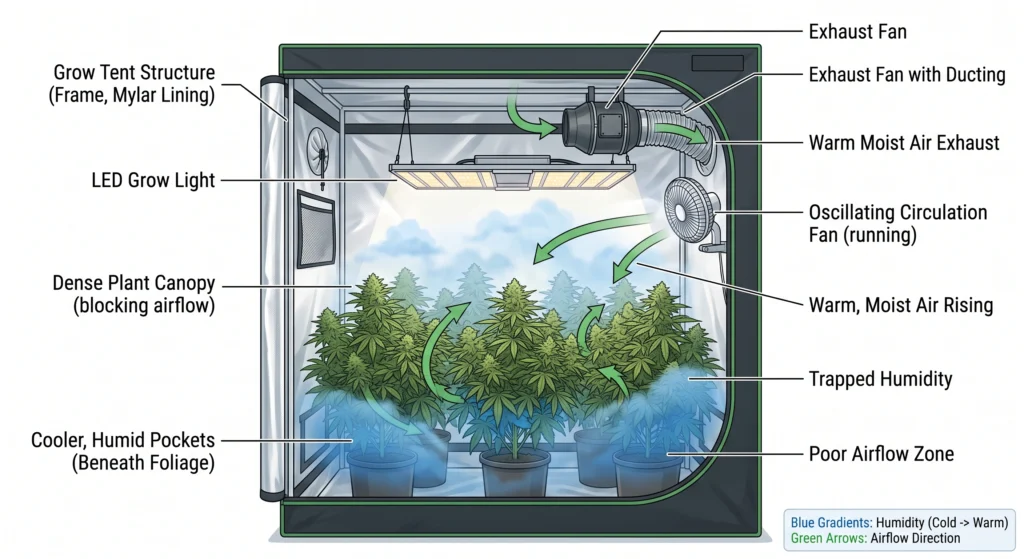
When lights turn off, ambient temperature drops, and cooler air holds less moisture than warm air. As the air cools, relative humidity spikes. If it drops far enough to hit the dew point, you get microscopic condensation forming right on the leaves, exactly the trigger PM spores are waiting for.
Breaking this cycle means managing Vapor Pressure Deficit, the measure of the air’s actual drying power, essentially the gap between how much moisture the air currently holds and how much it could hold at that temperature. Too low a VPD (high humidity, low temp) and plants can’t transpire properly while PM thrives. Too high a VPD (low humidity, high temp) and plants suffer drought stress instead.
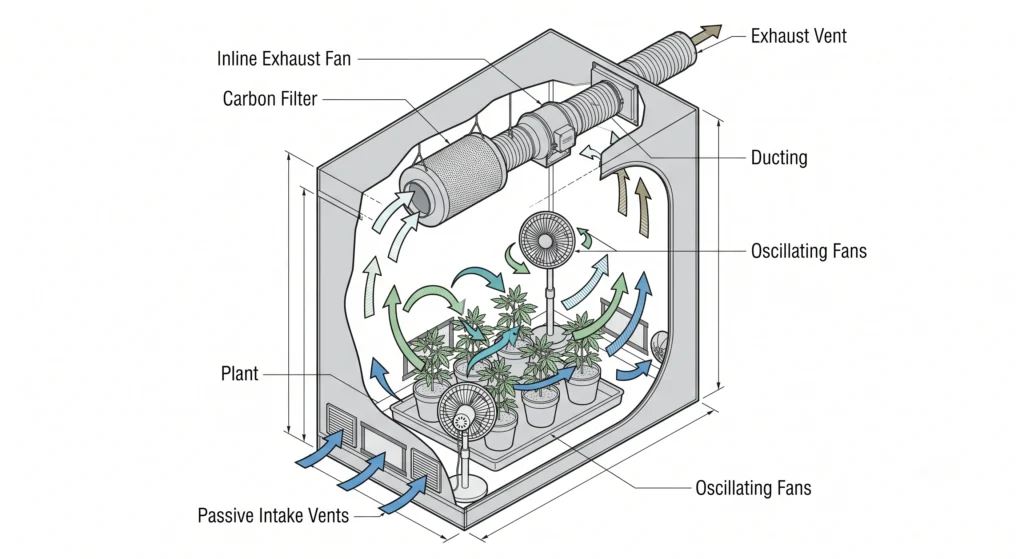
Airflow and exhaust matter a lot here. Stagnant air lets humidity pool right around transpiring leaves.
- Inline exhaust fans. Aim for your fan pulling a full tent volume of air out every 1 to 3 minutes. Our grow tent buying guide covers matching fan CFM to tent size.
- Oscillating fans. Position fans above and below the canopy, aiming for a gentle “dancing” motion on every leaf. That turbulence disrupts the moisture boundary layer around leaves, making it much harder for a floating spore to settle and germinate.
- Nighttime dehumidification. Run a dehumidifier through the dark cycle, and set your controller to trigger exhaust or dehumidification the moment RH climbs above roughly 55% at night.
If you’re running a naturally humid passive system like Kratky or basic DWC, water temperature has a real effect on ambient tent humidity too, our passive cooling guide covers reducing that.
How to Stop an Active Infection: Actionable Steps
Eradicating an active outbreak takes a combined approach: physically removing heavily infected tissue, defoliating to improve airflow, and applying a targeted fungicide.
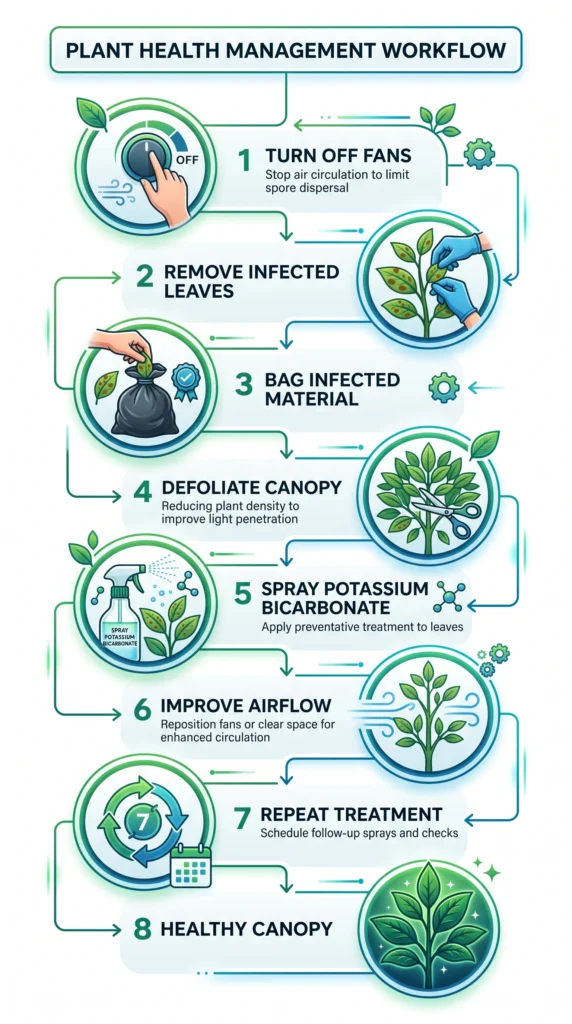
Spores can mature and release within about 72 hours, so a minor spot on Tuesday can become a tent-wide problem by Friday. Act decisively.
Step 1: Turn off fans first. Before touching an infected plant, shut off oscillating fans and exhaust. Disturbing a heavily infected leaf while air is moving will launch spores across the whole room.
Step 2: Bag and remove heavily infected tissue. Place a plastic bag over leaves covered in white powder, seal it around the stem, then cut the stem inside the bag. This contains spores during removal, don’t carry infected material openly through the grow space.
Step 3: Defoliate aggressively. PM tends to start in the stagnant, shaded lower third of the plant. Stripping the bottom 30% of leaves and unproductive shoots (sometimes called lollipopping) opens a real air channel under the canopy that sweeps out the humid microclimates PM needs. If you’re not sure how to tell pest damage from nutrient stress while doing this, our troubleshooting guide can help.
Step 4: Treat remaining foliage. Once heavily infected leaves are gone, treat what’s left to kill invisible spores and early mycelium. Never spray while intense grow lights are on, water droplets can act like tiny magnifying lenses and cause light burn. Apply treatments right before lights-out, or raise the lights significantly first.
Potassium Bicarbonate Eradication Protocol
Potassium bicarbonate is a genuinely effective organic contact fungicide. It shifts the pH and osmotic balance right on the leaf surface, which dehydrates and collapses fungal cells on contact, without leaving harmful residue behind.
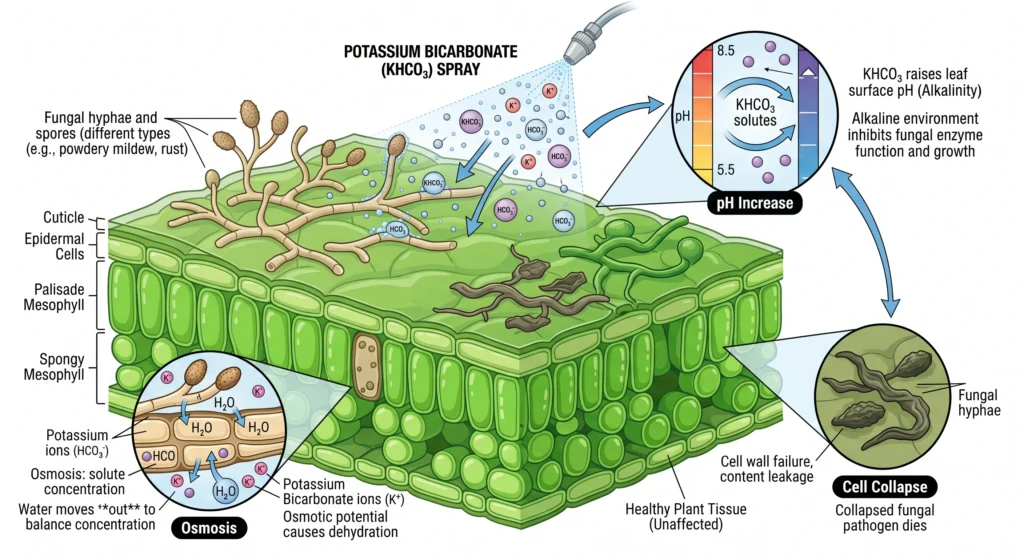
Potassium bicarbonate (KHCO3) is a naturally occurring, water-soluble alkaline compound. Sprayed onto a leaf, it pushes the surface pH sharply alkaline, commonly cited around pH 8 or higher, conditions powdery mildew fungal cells can’t tolerate. The bicarbonate’s salt concentration also draws water out of fungal cells through osmosis, desiccating and collapsing the pathogen. Since it breaks down into potassium, a macronutrient your plants already use, it’s genuinely low-risk for hydroponic crops and is approved for organic agriculture.
Mix and application:
- The mix. In a clean pump sprayer, combine roughly 1 tablespoon (about 15 grams) of agricultural-grade potassium bicarbonate per gallon of water.
- Add a surfactant. Plain water beads up and rolls off a leaf without a wetting agent. Add about half a teaspoon of mild, unscented liquid castile soap, or a horticultural wetting agent like yucca extract, so the spray actually spreads across the surface.
- Apply thoroughly. Agitate gently and spray from the bottom of the plant up, making sure to fully coat the undersides of leaves along with stems and top canopy. PM hides in crevices, a missed spot is where the infection comes back from.
- Follow a schedule. Apply every 3 days for three total applications to break the spore cycle, then shift to roughly every 10 to 14 days as ongoing prevention.
Important: don’t substitute sodium bicarbonate (regular baking soda). It kills the fungus through the same alkaline and osmotic mechanism, but the sodium builds up in a hydroponic reservoir and in plant tissue, causing real sodium toxicity and nutrient lockout over time. Stick with potassium bicarbonate specifically.
VPD and Environmental Parameter Table
Holding to consistent environmental targets is the only truly durable fix for powdery mildew. A solid VPD chart lets you balance temperature and humidity for healthy transpiration while keeping conditions unfavorable for fungal germination.
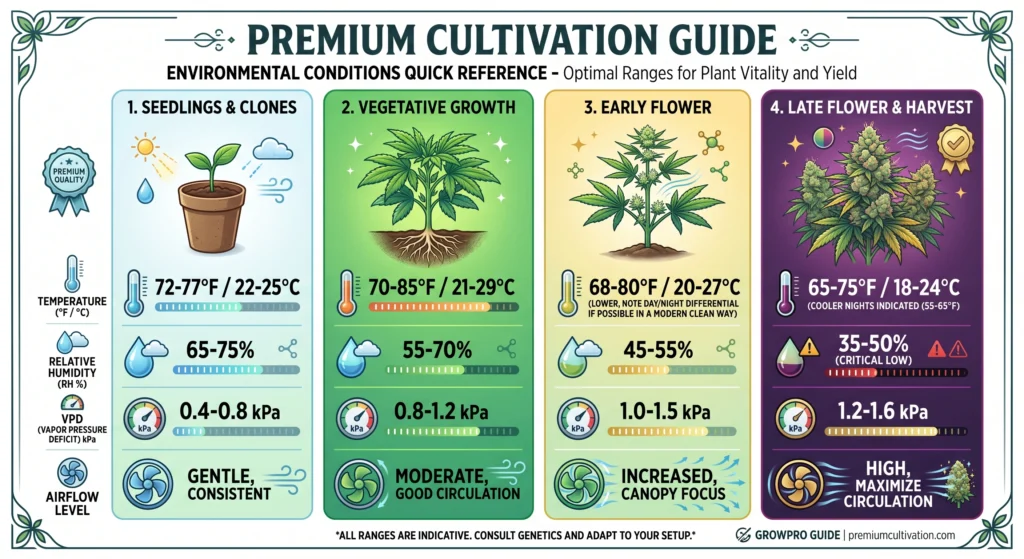
| Growth Stage | Target Temp (Day) | Target Temp (Night) | Target RH | Target VPD (kPa) | Airflow |
|---|---|---|---|---|---|
| Seedling / Clone | 75-80°F | 70-75°F | 65-75% | 0.4-0.8 | Gentle, indirect |
| Vegetative | 75-82°F | 68-75°F | 55-65% | 0.8-1.2 | Moderate, rustling leaves |
| Early Flower | 75-80°F | 65-72°F | 45-55% | 1.2-1.4 | Aggressive, under canopy |
| Late Flower | 72-78°F | 62-68°F | 40-45% | 1.3-1.6 | Aggressive, full exchange |
Running higher temperatures generally lets you tolerate slightly higher humidity safely, as long as air exchange is genuinely aggressive. If hitting these numbers is a struggle, check that your sensors are actually reading accurately, our hydroponic sensors guide covers calibration.
For deeper technical background on humidity dynamics and disease control in commercial growing environments, see the University of Massachusetts Amherst Greenhouse Floriculture fact sheet on reducing humidity.
Recommended Products

An EPA-registered potassium bicarbonate product that comes pre-formulated with a built-in surfactant, no need to mix in separate soap. Kills PM on contact and leaves no toxic residue behind. [Insert Amazon Associate link.]

A smart fan that automatically ramps up the moment your tent crosses a set humidity threshold, useful for avoiding the dew point during the dark cycle without manual adjustment.

For larger spaces where standard residential dehumidifiers fall short, this commercial-grade unit hangs from the ceiling, pulling significant moisture from the air while keeping floor space clear.

Holds pressure well and produces a fine, even mist, useful for reliably coating the undersides of leaves during a treatment application.
Frequently Asked Questions
Can I use hydrogen peroxide to kill powdery mildew?
A dilute mix of 3% hydrogen peroxide (commonly cited around 1 part peroxide to 3 parts water) can work as a contact treatment, the oxidative effect damages fungal cell walls. It evaporates quickly, though, leaving no residual protection, so the fungus can return fast if the environment stays humid. Potassium bicarbonate is generally preferred since it leaves an alkaline buffer behind on the leaf.
Is it safe to consume or smoke plants that had powdery mildew?
If an infection was caught and fully eradicated early in vegetative growth, the harvest is generally fine. Never consume or smoke flower with visible PM webbing on it though, the spores and mycelium can trigger allergic reactions, asthma flare-ups, and respiratory issues. If PM has embedded deep into flowering tissue, that portion of the crop should be destroyed rather than used.
Why does powdery mildew keep coming back after I spray it?
Sprays treat the symptom, not the cause. If it keeps returning, something in your environment is off, most often a humidity spike when lights go dark, or dense canopy areas blocking airflow. Combining aggressive defoliation with a dedicated dehumidifier addresses the actual root cause rather than just the visible symptom. Our root rot prevention guide covers related root-zone environmental health if that’s part of the picture too.
Can I use a sulfur vaporizer to prevent powdery mildew?
Sulfur vaporizers are genuinely effective at preventing and killing PM, but only use them during vegetative growth. Vaporizing sulfur during flowering or fruiting means the crop absorbs it, which ruins taste and aroma. Also never use sulfur within 14 days of an oil-based spray like neem oil, the combination can severely burn foliage.
Will increasing my grow light intensity help kill the fungus?
Direct, intense light can suppress fungal growth somewhat, but simply cranking up your lights won’t cure an active infection. If your tent is already humid, more intense light means more plant transpiration, which raises humidity further and can actually help the disease spread faster.
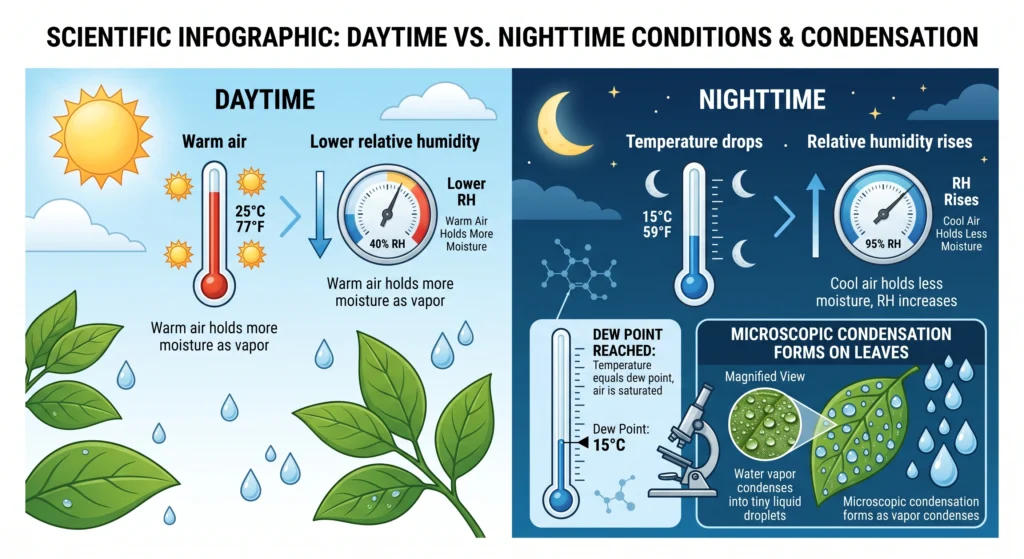
Dew Point Risk Calculator
The core trigger for most indoor powdery mildew outbreaks is hitting the dew point when lights go out and temperature drops. Use the tool below to check how close your current conditions are to that threshold, and what temperature drop would actually cause condensation on your leaves.
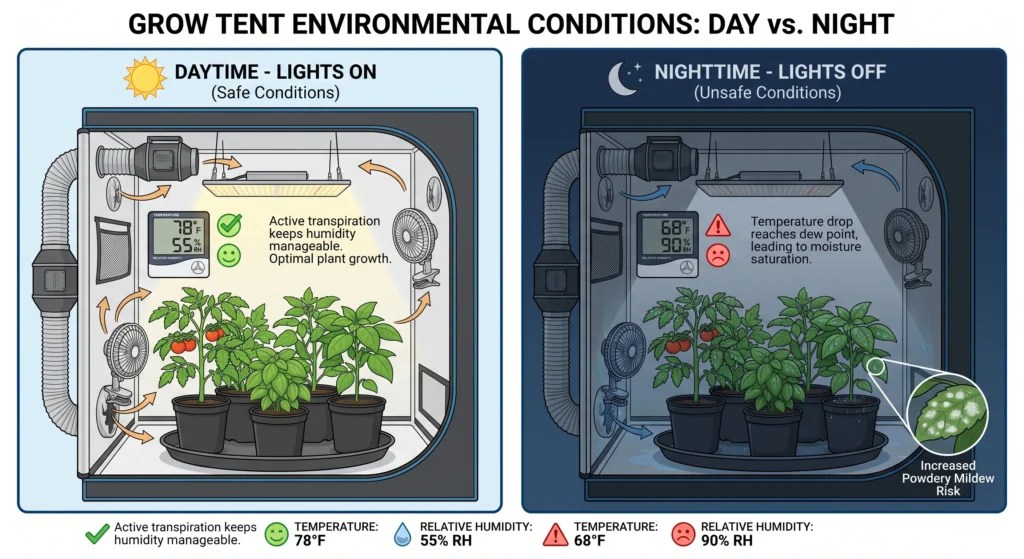
Calculate your current dew point and check whether your expected nighttime temperature drop will trigger condensation, the exact trigger that sets off most indoor powdery mildew outbreaks. Uses the standard Magnus formula for dew point.
Assumes total moisture in the tent’s air stays roughly constant overnight (a reasonable estimate for a sealed tent without active dehumidification). Real conditions vary with air exchange, so use this as a planning check, not an exact guarantee.
Conclusion
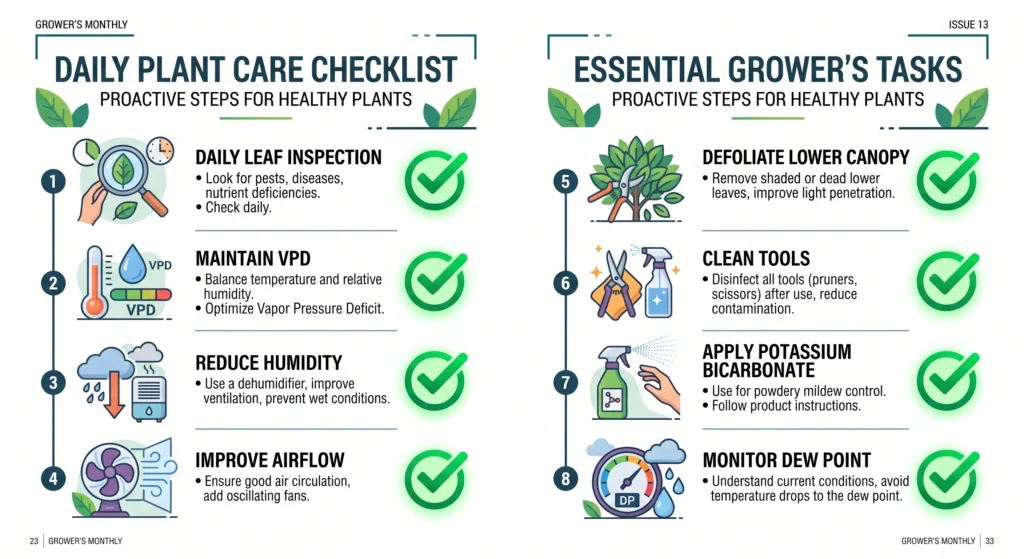
Preventing powdery mildew in a high-humidity grow tent is really an exercise in environmental engineering: pushing plants toward their maximum metabolic rate without crossing into conditions that let fungal pathogens take hold. Focusing on VPD, keeping airflow genuinely turbulent through smart defoliation, and using a safe contact fungicide like potassium bicarbonate when needed will keep a tent productive and largely PM-free. Stay on top of lower-canopy inspections, and treat any localized humidity spike as something worth addressing immediately rather than later.

Continue Your Learning Journey