Water Hardness in Hydroponics: dGH, dKH & pH Buffering

Table of Contents
- The Science of General Hardness (dGH) and Carbonate Hardness (dKH)
- Neutralizing High dKH: Phosphoric vs. Sulfuric vs. Nitric Acid
- Metric Tables: Water Hardness Parameters & Nutrient Lockout Thresholds
- Real-World Experience: The Hard Water Nutrient Mix Case Study
- Industry Implications: Scaling dKH Buffering in Commercial Facilities
- The Water Softener Trap: Why Ion-Exchange Systems Kill Hydroponics
- Equipment Loadout
- FAQ: Navigating Hard Water in Hydroponics
If you are constantly battling upward pH drift or staring down at stunted plants with inexplicable calcium deficiencies, your nutrient line is likely not the culprit. The unseen force dictating the chemical stability of your reservoir is the starting quality of your source water. Specifically, the relationship between general hardness (dGH) and carbonate hardness (dKH) determines exactly how your nutrient solution will behave once the lights turn on and your plants start feeding.
Water is rarely just H2O. Municipal tap water and well water are complex chemical soups carrying dissolved minerals from miles of underground aquifers and piping. These dissolved minerals fundamentally alter the baseline electrical conductivity (EC) of your reservoir and dictate the required buffering capacity of your hydroponic system. Ignoring your baseline water chemistry inevitably leads to antagonistic nutrient interactions, rapid pH swings, and catastrophic yield losses.
Understanding the precise mechanics of water hardness hydroponics shifts you from a reactive grower, constantly chasing pH levels with harsh acids, to a proactive engineer who shapes the nutrient profile around the exact chemical composition of the source water. We will break down the science of dGH and dKH, explore exactly how carbonate alkalinity buffers your system, and examine a real-world case study on utilizing a hard water nutrient mix to prevent nutrient lockout.
Quick Summary: Ideal Water Hardness Ranges for Hydroponics
- General Hardness (dGH): Target 2-4 dGH (35-70 ppm). Exceeding 10 dGH (>175 ppm) causes severe calcium lockout with sulfates and phosphates.
- Carbonate Hardness (dKH): Target 2-4 dKH (35-70 ppm) for optimal pH stability. A dKH of 0 risks fatal pH crashes; a dKH above 8 causes constant upward pH bounce.
- Conversion Rule: 1 dGH or dKH = 17.85 ppm (mg/L) of CaCO3 equivalents
Legal Note: Regulations vary by location. Always consult local guidelines. This content is for educational purposes only.
The Science of General Hardness (dGH) and Carbonate Hardness (dKH)
General hardness (dGH) measures the concentration of divalent metal cations, primarily calcium (Ca²⁺) and magnesium (Mg²⁺), while carbonate hardness (dKH) measures the total alkalinity or buffering capacity driven by carbonates (CO₃²⁻) and bicarbonates (HCO₃⁻). Understanding the distinction between these two metrics is the foundation of stabilizing hydroponic chemistry.
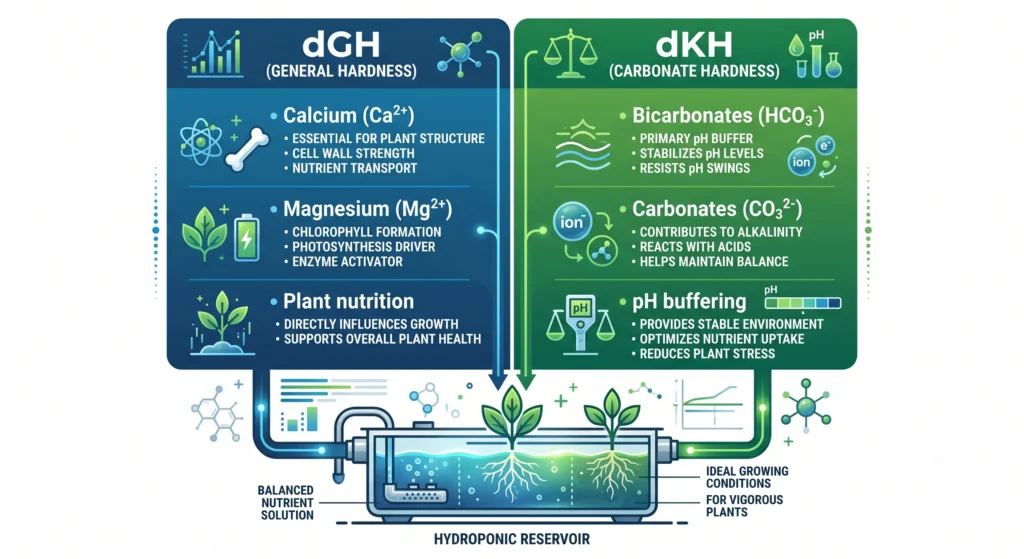
When growers talk about “hard water,” they are usually lumping several distinct chemical properties into one generic term. To maintain a stable reservoir, we must separate the mineral content from the buffering capacity.
General Hardness (dGH)
General hardness refers almost exclusively to the concentration of dissolved calcium and magnesium in your water. It is measured in degrees of general hardness (dGH), where 1 dGH equals 17.848 parts per million (ppm) of calcium carbonate (CaCO₃) equivalents.
Calcium and magnesium are essential macronutrients for plant growth. Calcium is the structural mortar of plant cell walls, and magnesium sits at the exact center of the chlorophyll molecule, driving photosynthesis. Having these elements in your source water is not inherently negative. The problem arises because commercial hydroponic base nutrients are formulated with the assumption that you are starting with reverse osmosis (RO) water containing zero ppm of any mineral.
If your tap water already contains 150 ppm of calcium, and you add a standard dose of calcium nitrate based on the manufacturer’s feeding chart, you push the calcium levels into the toxic zone. Excess calcium antagonizes the uptake of potassium (K⁺) and magnesium (Mg²⁺), leading directly to severe deficiencies despite the presence of those elements in the water.
Carbonate Hardness (dKH) and Alkalinity
Carbonate hardness, or dKH (from the German Karbonathärte), is the measure of your water’s alkalinity. Alkalinity is not the same as being alkaline (having a pH above 7.0). Alkalinity is the water’s ability to neutralize acids. It is a measurement of the bicarbonate (HCO₃⁻) and carbonate (CO₃²⁻) ions suspended in the liquid.
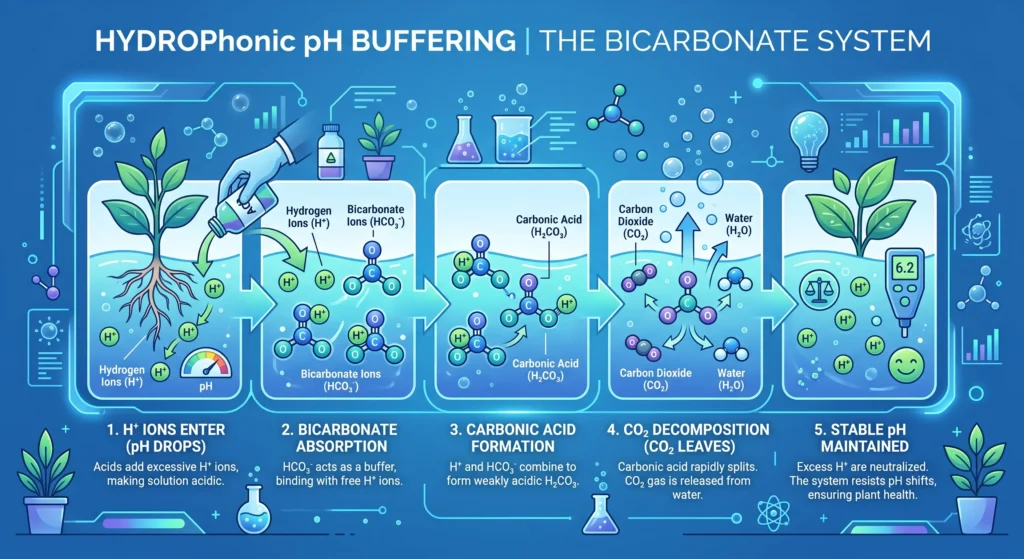
In hydroponics, dKH is the invisible shield that protects your reservoir from rapid pH crashes. As plants uptake positively charged nutrient ions (cations like K⁺ or Ca²⁺), their roots excrete hydrogen ions (H⁺) to maintain electrical neutrality. Free hydrogen ions lower the pH of the water. If your reservoir has zero dKH (pure RO water), a heavy feeding day can crash your pH from 6.0 down to 4.0 in a matter of hours, destroying root tissue.
Bicarbonates act as a buffer. They absorb those free hydrogen ions, converting into carbonic acid, which then breaks down into water and carbon dioxide gas. This chemical reaction consumes the acid, keeping your pH stable.
However, excessive dkh buffering hydroponics creates a nightmare scenario. High dKH means your water is heavily buffered against pH drops. If your well water has a dKH of 12 (roughly 214 ppm of alkalinity), the water will fiercely resist your attempts to lower the pH into the optimal 5.5 to 6.2 range. You will add massive amounts of phosphoric acid (pH Down), only to see the pH bounce right back up to 7.8 the next morning as the bicarbonates neutralize the acid.
To master this balance, you need to understand how to manipulate both parameters to achieve the sweet spot for your specific crop. You can learn more about managing these precise ranges in our hydroponic pH and EC mastery guide.
Neutralizing High dKH: Phosphoric vs. Sulfuric vs. Nitric Acid
When your source water has a dKH above 5, you must inject acid to neutralize excess bicarbonates (HCO₃⁻). However, the acid you choose alters your base N-P-K-S ratios.
| Acid Type | Active Ion Added | Best Used For | Caution / Risk |
|---|---|---|---|
| Phosphoric Acid (H₃PO₄) | Phosphate (PO₄³⁻) | Standard buffering in soft to moderate water | High doses in hard water cause calcium phosphate precipitation. |
| Sulfuric Acid (H2SO₄) | Sulfate (SO₄²⁻) | Hard water & high dKH. Neutralizes alkalinity cleanly | Can cause calcium sulfate (gypsum) scaling if calcium exceeds 250 ppm. |
| Nitric Acid (HNO₃) | Nitrate (NO₃⁻) | Vegetative stage buffering in high-alkalinity water | Adds extra nitrogen; can cause unwanted vegetative stretching in bloom. |
The Neutralization Strategy
When dealing with a high dKH ($>6$), use Sulfuric Acid for daily pH adjustments during bloom, and Nitric Acid during vegetative growth. This avoids overloading your reservoir with elemental phosphorus, preserving your Ca²⁺ bioavailability.
Metric Tables: Water Hardness Parameters & Nutrient Lockout Thresholds
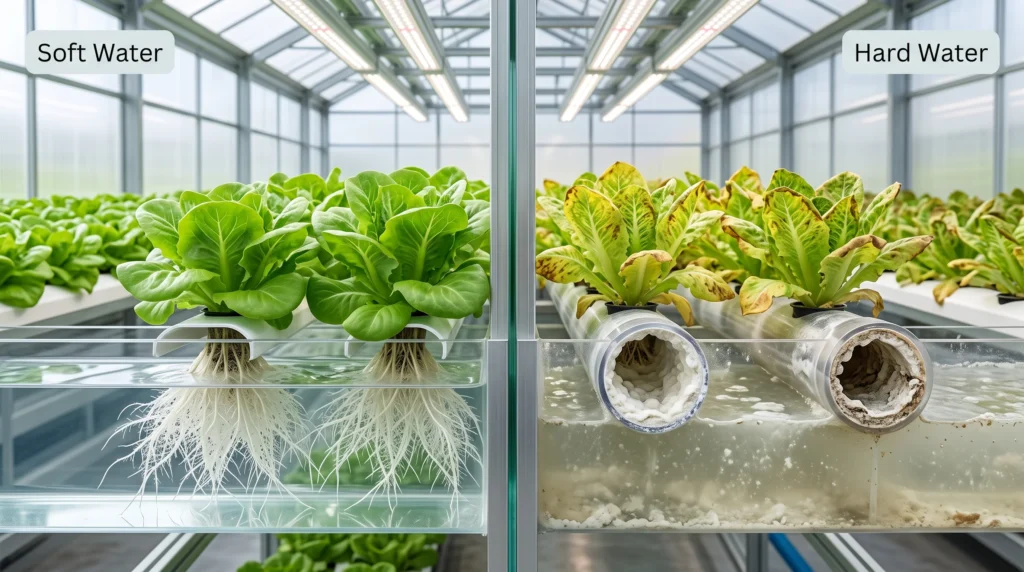
Hydroponic systems thrive when source water dGH is kept below 4 degrees (70 ppm) and dKH is maintained between 2 and 4 degrees (35-70 ppm). Exceeding a dGH of 10 (178 ppm) rapidly accelerates nutrient lockout as calcium binds with phosphorus and sulfur to form insoluble precipitates.
To accurately dose your nutrients, you must classify your source water. The following data tables are sourced from extensive agricultural extension research on water quality parameters for controlled environment agriculture.
Source Water Classification by dGH
| Classification | dGH (Degrees) | PPM (CaCO3 Equiv.) | Hydroponic Suitability & Strategy |
| Soft | 0 – 3 dGH | 0 – 50 ppm | Excellent. Requires standard Cal-Mag supplementation. |
| Moderately Hard | 3 – 6 dGH | 50 – 100 ppm | Good. Reduce baseline Cal-Mag additives by 50%. |
| Hard | 6 – 12 dGH | 100 – 200 ppm | Poor. Requires a dedicated hard water nutrient formulation. |
| Very Hard | 12+ dGH | > 200 ppm | Unusable. Requires Reverse Osmosis (RO) filtration. |
The Threat of Nutrient Lockout
When you mix a standard nutrient profile into hard water, you run a massive risk of water hardness nutrient lockout. Calcium (Ca²⁺) is a highly reactive cation. In a high pH environment driven by high dKH, calcium readily reacts with sulfates (SO₄²⁻) to form calcium sulfate (gypsum), and with phosphates (H2PO₄⁻) to form calcium phosphate.
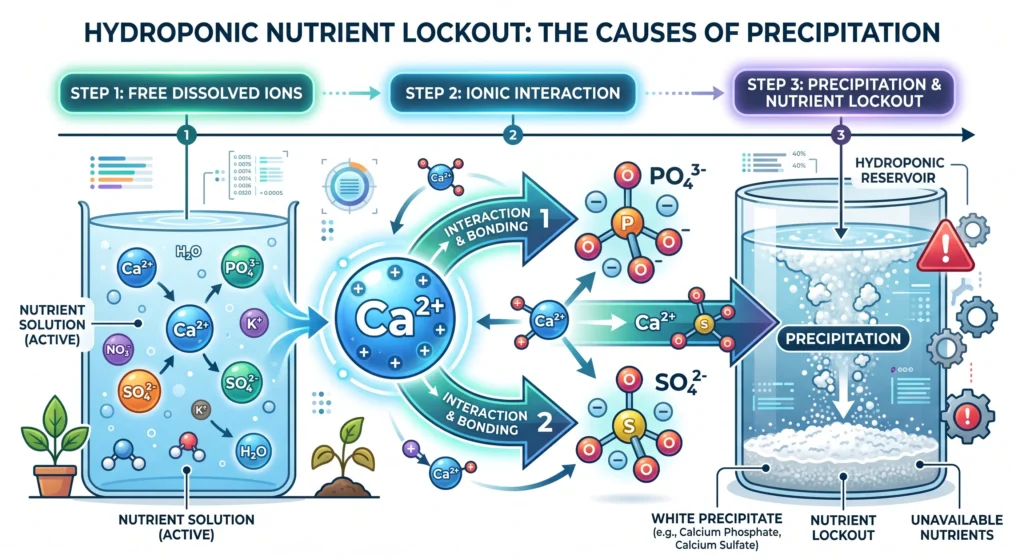
Both of these compounds are completely insoluble in water. They precipitate out of your solution, forming a white, crusty sludge on the bottom of your reservoir and inside your pump impellers. Once these elements fall out of solution, they are permanently locked away from the plant roots. Your plants will rapidly display phosphorus and sulfur deficiencies, even though you added those exact nutrients to the tank. High water hardness forces you to completely rethink your base nutrient ratios, which is covered thoroughly in our hydroponic nutrients guide.
The dKH Alkalinity Buffering Scale
| dKH (Degrees) | Alkalinity PPM | pH Stability Characteristics |
| 0 – 1 dKH | 0 – 17 ppm | Dangerous. Zero buffering capacity. Rapid pH crashes occur. |
| 2 – 4 dKH | 35 – 70 ppm | Optimal. Resists acid spikes while allowing easy down-adjustments. |
| 5 – 8 dKH | 89 – 142 ppm | High. Requires significant acid to adjust; prone to upward drift. |
| 9+ dKH | > 160 ppm | Extreme. Severe pH rebound; requires heavy acid additions. |
When dealing with a dKH above 8, the sheer volume of phosphoric acid required to neutralize the bicarbonates will inadvertently inject massive amounts of elemental phosphorus into your nutrient solution, pushing your N-P-K ratios wildly out of balance and risking heavy metal toxicities.
Real-World Experience: The Hard Water Nutrient Mix Case Study
A 14-day tracking study on hydroponic tomatoes utilizing a standard commercial nutrient line in 220 ppm source water demonstrated rapid calcium precipitation, severe upward pH drift, and ultimate crop lockout. Switching to a customized hard water base formulation stabilized the EC and restored vigorous vegetative growth.
During a consultation for a mid-sized indoor vertical farm operating in a region known for limestone-heavy aquifers, we encountered a textbook example of hard water catastrophe. The facility was utilizing municipal tap water boasting a starting EC of 0.6 mS/cm (roughly 300 ppm on the 500 scale), a dGH of 14, and a dKH of 11.
The grower was running a premium, two-part liquid nutrient line formulated for RO water, targeting a final EC of 2.2 mS/cm for a crop of indeterminate cherry tomatoes in Dutch buckets.
The Problem: Precipitation and pH Bounce
Within 48 hours of mixing the reservoir, the water turned distinctly cloudy. The pH, initially adjusted down to 5.8 using 85% phosphoric acid, rebounded to 7.4 by the second morning. The grower continued to add acid daily to fight the rising pH.
By day 7, the plants halted vertical growth. The new foliage exhibited severe interveinal chlorosis (classic iron deficiency), while the older leaves showed distinct necrotic spotting along the margins (potassium lockout).
We pulled a water sample and ran a full laboratory analysis. The results showed that the constant addition of phosphoric acid to combat the 11 dKH alkalinity had pushed the elemental phosphorus levels beyond 150 ppm. The excess phosphorus reacted violently with the 200+ ppm of calcium naturally present in the tap water. The resulting calcium phosphate dropped out of the solution entirely. The plants were starving for calcium and iron because the chemical environment had locked them out.
The Solution: The Hard Water Nutrient Mix
To salvage the crop, we completely drained the 200-gallon reservoir and rebuilt the nutrient profile from scratch, acknowledging the starting water chemistry rather than fighting it.
- Baseline Accounting: We accepted the starting 200 ppm of Calcium and 40 ppm of Magnesium as our base.
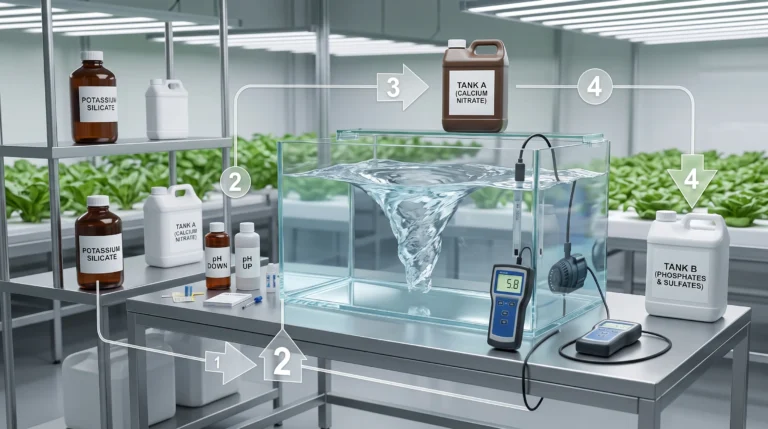
- Nutrient Selection: We abandoned the RO-formulated liquid nutrients and switched to a dry, hard water nutrient mix. Hard water formulations entirely omit calcium nitrate from the “Part A” mix and rely heavily on potassium nitrate and chelated micronutrients.
- Acid Injection: Instead of phosphoric acid, we switched the pH down dosing system to use food-grade sulfuric acid. Sulfuric acid neutralizes high dKH bicarbonates without adding excess phosphorus to the tank, avoiding the calcium phosphate precipitation trigger entirely.
- Chelate Adjustment: Because the pH was naturally prone to drift higher, we ensured all iron was provided as EDDHA or DTPA chelates, which remain plant-available at pH levels up to 7.5, preventing the iron chlorosis observed in week one.
Within five days of the reservoir swap, the necrotic spotting halted, new growth resumed a vibrant, waxy green, and the pH stabilized, requiring only minimal acid adjustments every 72 hours. You can see similar recovery strategies outlined in our deep-dive on nutrient lockout.
Industry Implications: Scaling dKH Buffering in Commercial Facilities
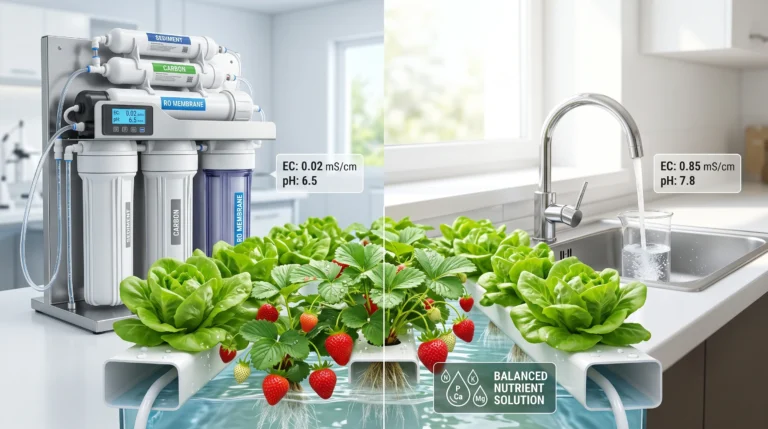
Commercial hydroponic facilities mitigate high dGH and dKH through industrial reverse osmosis (RO) filtration to strip the water to a 0 EC baseline, followed by precise reconstitution using potassium bicarbonate to rebuild the exact alkalinity buffer required for the specific crop.
Operating at a commercial scale means removing variables. You cannot scale a consistent product if your source water chemistry fluctuates with municipal treatment cycles or seasonal aquifer changes. For operations pulling hundreds of gallons a day, relying on specialized hard water nutrient mixes becomes a logistical liability.
The Reverse Osmosis Imperative
The industry standard is to obliterate the baseline chemistry entirely. Commercial facilities deploy heavy-duty Reverse Osmosis (RO) skids. RO membranes force pressurized feed water through microscopic pores, stripping out 98% to 99% of all dissolved solids, including calcium, magnesium, carbonates, and heavy metals.
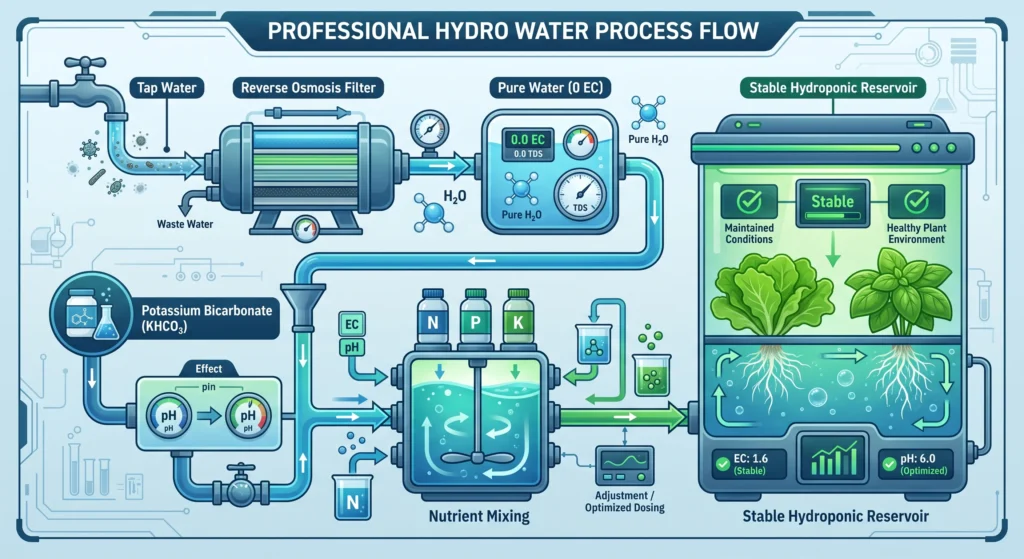
The water exits the RO system with a dGH of 0, a dKH of 0, and an EC of 0.0 mS/cm.
While this provides a perfect blank canvas for nutrient dosing, using pure RO water directly in a recirculating system is highly dangerous. As discussed in the science section, a dKH of 0 means the water has zero buffering capacity. The biological activity of the root zone, combined with automated dosing pumps injecting acidic fertilizers, will cause the pH to crash wildly, potentially destroying the root mass of an entire facility in a single night.
Rebuilding the Buffer
To fix this, automated fertigation skids in commercial setups feature a specific dosing channel dedicated solely to rebuilding the dKH buffer.
Facility managers typically use potassium bicarbonate (KHCO₃) injected into the pure RO water before any other nutrients are added. Potassium bicarbonate adds the exact amount of alkalinity needed—usually targeting a precise dKH of 3 (roughly 50 ppm of alkalinity)—without introducing the calcium scaling associated with calcium carbonate.
This meticulously constructed buffer absorbs the daily acid fluctuations from root exudates and nutrient additions, locking the system pH into a highly stable, predictable curve. It represents the pinnacle of hydroponic engineering: stripping away the chaos of natural source water and mathematically rebuilding the exact chemical environment required for maximum biological yield.
The Water Softener Trap: Why Ion-Exchange Systems Kill Hydroponics
A common mistake made by growers dealing with high dGH source water is running their tap water through a standard residential water softener before filling their reservoir.
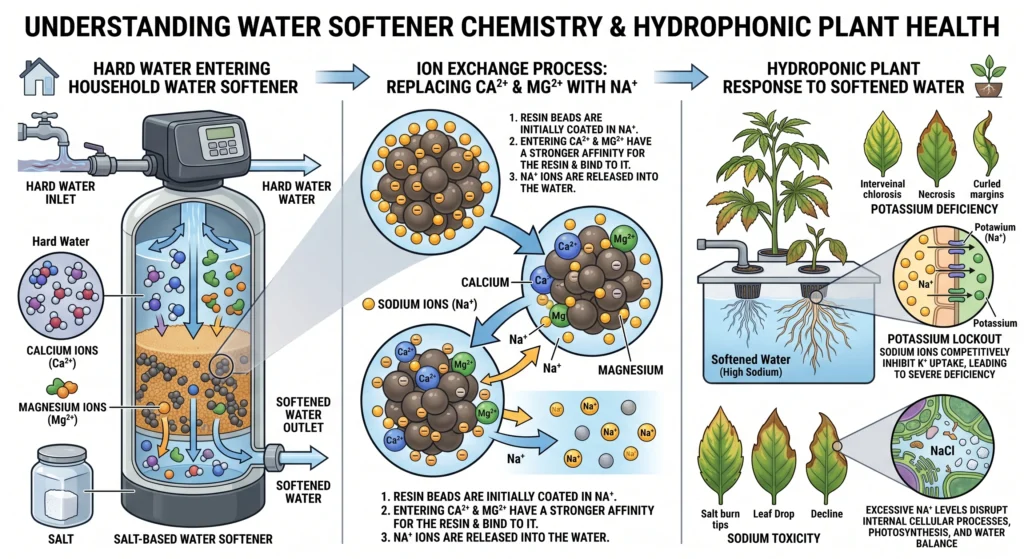
Residential water softeners do not remove minerals—they exchange them. These systems use ion-exchange resin beads charged with sodium ions (Na⁺). As hard water passes over the resin, calcium (Ca²⁺) and magnesium (Mg²⁺) ions bind to the beads, releasing two sodium ions into the water for every calcium ion removed.
While this prevents limescale buildup in household pipes, it creates a toxic environment for hydroponic roots:
- Sodium Toxicity: Plants only require trace amounts of sodium (<50 ppm). Softened water frequently delivers sodium concentrations exceeding 150-300 ppm}.
- Potassium Lockout: High sodium levels directly compete with potassium for uptake at the root membrane, causing severe leaf margin necrosis and stunted fruiting.
- Osmotic Stress: High sodium increases reservoir EC without providing functional plant nutrition, raising the osmotic pressure and making it harder for roots to absorb water.
Rule: Never use water from an ion-exchange home softener for hydroponics. If your home has a water softener, bypass it using an unsoftened outdoor spigot, or install a dedicated Reverse Osmosis unit after the softener.
Equipment Loadout
If you are dealing with unknown water quality, guessing will cost you your crop. You need precise data to formulate your nutrient strategy.

Why I use it: This is a cheap, reliable, titration-based drop test originally designed for aquaculture. It allows you to exactly pinpoint your dGH and dKH in degrees within minutes, letting you know immediately if you need a hard water nutrient mix or an RO filter.

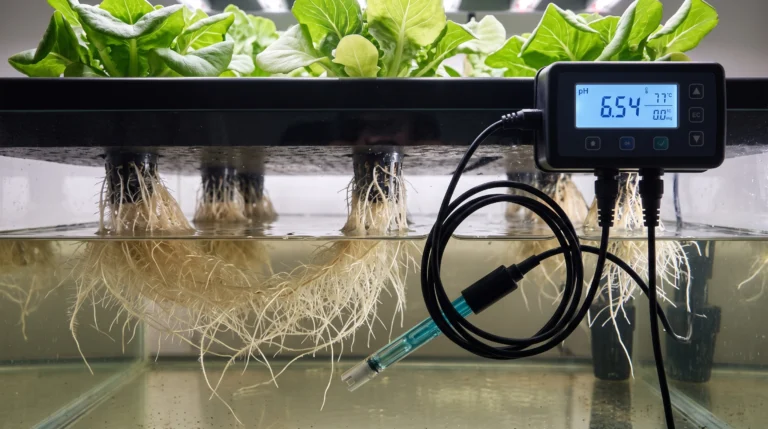
Why I use it: A laboratory-grade, waterproof pen that accurately reads pH, EC, TDS, and temperature. You cannot manage nutrient lockout without precise EC and pH daily tracking.

Why I use it: When your dGH pushes past 12 and your dKH refuses to let your pH drop, this unit saves your sanity. It produces 150 gallons per day of pure, 0 EC water, giving you the perfect blank slate for nutrient mixing.
FAQ: Navigating Hard Water in Hydroponics
What happens if my dKH is too low in hydroponics?
If your dKH is 0 or 1, your water has no alkalinity to buffer acids. The natural acidic excretions from plant roots and the addition of slightly acidic fertilizers will cause your pH to drop rapidly, sometimes falling from 6.0 to 4.0 overnight, which will physically burn the root hairs and destroy your crop.
How do I safely increase my dKH buffering capacity?
To increase buffering without spiking your EC with unwanted minerals, add potassium bicarbonate. It raises the alkalinity (dKH) and provides a useful source of potassium (K) for the plants without adding excess calcium that could cause precipitation issues.
Can I boil my tap water to reduce the hardness?
Boiling water only removes u0022temporary hardnessu0022 (bicarbonates of calcium and magnesium) by causing them to precipitate as scale on your pot. It does not remove u0022permanent hardnessu0022 (sulfates and chlorides of calcium and magnesium). Furthermore, boiling hundreds of gallons of water for a hydroponic reservoir is incredibly energy-intensive and practically impossible for a continuous grow.
Why does phosphoric acid cause issues in hard water?
Hard water already contains high levels of dissolved calcium. When you add phosphoric acid to lower the pH of high dKH water, you introduce massive amounts of phosphate ions. The calcium and phosphate react instantly to form calcium phosphate, an insoluble solid that falls to the bottom of your tank, permanently locking both nutrients out of your plants’ reach.
Do I need a Cal-Mag supplement if I have hard water?
Usually, no. If your tap water has a starting EC of 0.4 mS/cm or higher, that conductivity is almost entirely made up of calcium and magnesium. Adding a Cal-Mag supplement on top of that baseline will push the calcium levels into the toxic zone, antagonizing potassium uptake and causing severe nutrient lockout.
What is the difference between TDS and dGH?
Total Dissolved Solids (TDS) is an estimate of all conductive ions in the water (sodium, chloride, calcium, nitrates, etc.) derived from an EC reading. General Hardness (dGH) is a specific chemical measurement of only the divalent cations, strictly calcium and magnesium. You can have a high TDS water that is actually soft (e.g., water run through a sodium-based water softener), which is deadly to plants.
Ready to Take Your System to the Next Level?
Mastering your reservoir’s nutrient solution is the foundation of high-yielding harvests—but it’s only one piece of the puzzle. From diagnosing early root issues to dialing in ideal reservoir temps and lighting schedules, we’ve got you covered. View All Plant Care Articles →

Continue Your Learning Journey