Stop Algae in Hydroponic Tubing & NFT Channels

Table of Contents
Setting up a fresh hydroponic system is genuinely satisfying. The water’s pristine, roots are bright white, and the whole thing looks like lab equipment. A lot of growers, eager to actually watch the nutrient solution flow, make the mistake of using clear vinyl tubing and leaving NFT channels exposed to stray light. Three weeks later, that crystal-clear water has turned into thick, green, oxygen-stealing slime.
Algae in hydroponic tubing and channels is more than an eyesore, it’s a real biological competitor threatening your crop’s health and yield. It suffocates roots, causes real pH swings, clogs irrigation lines, and feeds pests like fungus gnats. This guide covers what actually triggers algae growth and the mechanical and chemical steps to starve it out for good.
The Science Behind Algae in Hydroponic Tubing
Algae needs three things to survive: light, water, and nutrients. In a hydroponic system, water and nutrients are non-negotiable, they have to be there. Light is the one variable you fully control, and clear tubing or exposed channels hand algae exactly what it needs.
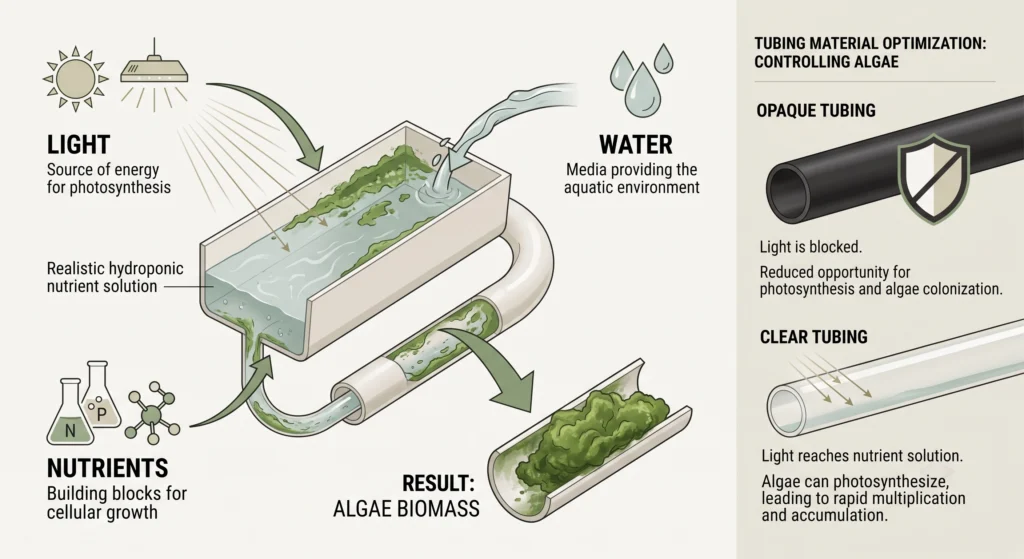
Algae is photosynthetic, just like the crop you’re actually trying to grow. Give it water, nitrogen and phosphorus, and light, and it thrives. Using clear tubing to move nutrient solution is effectively building algae a protective incubator.
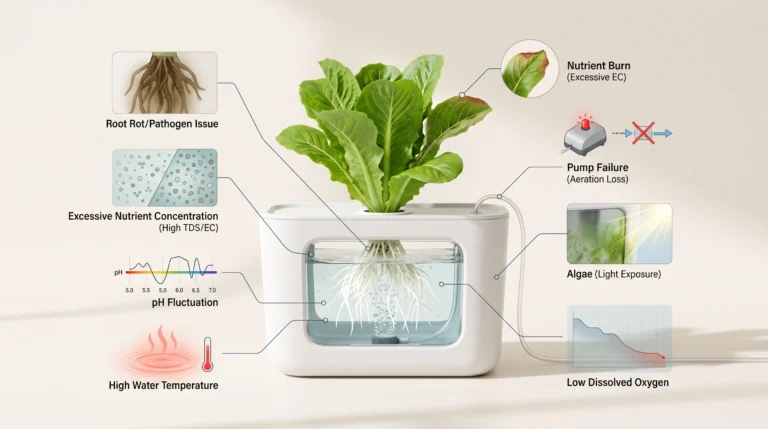
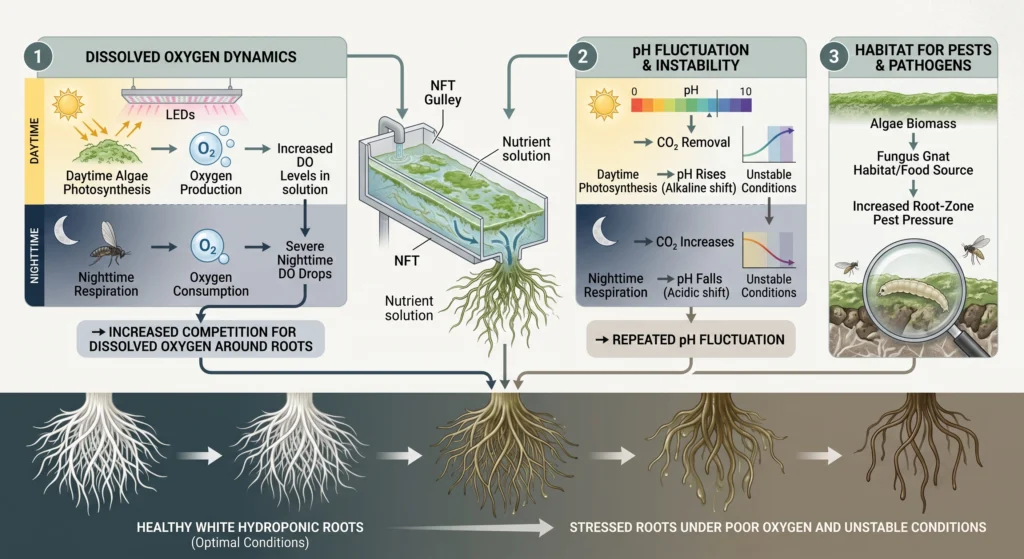
Dissolved oxygen depletion. During the day, algae photosynthesizes and produces oxygen. When lights go off, it switches to respiration and starts consuming dissolved oxygen from the solution instead, competing directly with your root zone for the oxygen plants need to absorb nutrients and water. That low-oxygen, anaerobic window is a primary trigger for Pythium (root rot). Our passive cooling guide covers how temperature management helps keep DO levels up.
Extreme pH swings. As algae photosynthesizes during light hours, it pulls CO2 out of the water, reducing carbonic acid and pushing pH upward. During dark hours, respiration releases CO2 back into the water, crashing pH back down. This daily swing stresses plants and can lock out nutrients. If you’re constantly chasing your pH target for no obvious reason, algae is a likely culprit. Our pH and EC mastery guide covers what stable baseline parameters actually look like without algae interference.
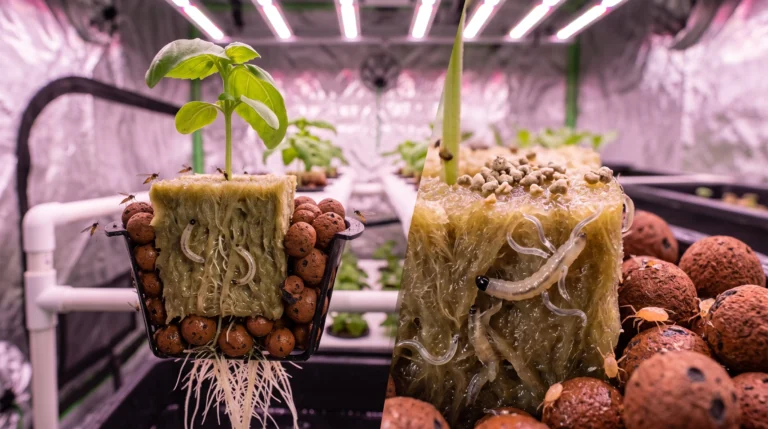
Pest and pathogen habitat. Algae is a favorite food source for fungus gnat larvae. Where algae forms, in NFT channels, on rockwool tops, inside tubing, adult gnats lay eggs nearby, and hatching larvae feed on the algae before turning to your actual root tissue. That physical damage opens the door to fungal pathogens. See our root rot prevention guide for more on protecting the root zone.
Actionable Steps: How to Stop Algae Growth in Hydroponics
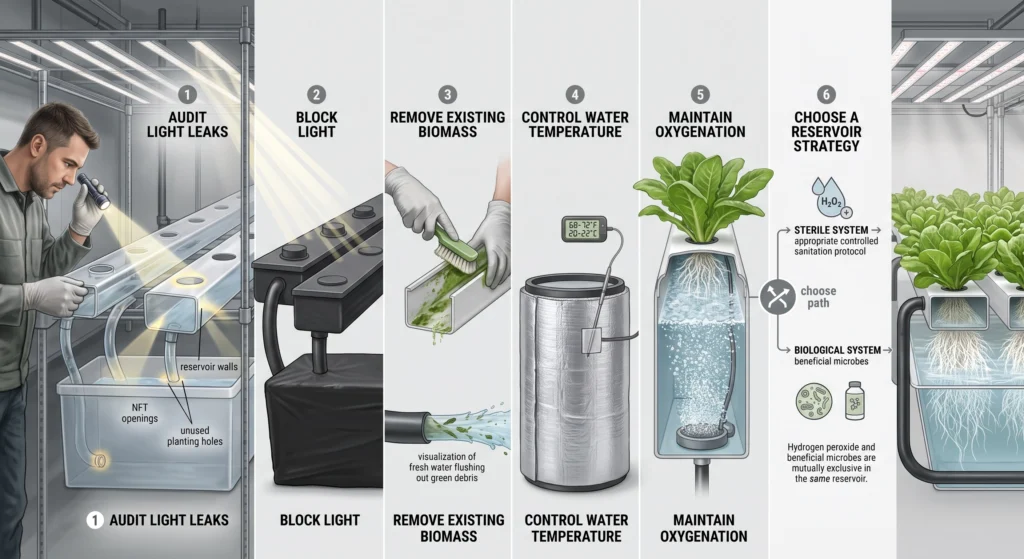
Stopping algae takes a combined approach: eliminate light leaks completely, physically remove existing biofilm, and use a chemical treatment to keep the water genuinely sterile.
Step 1: Light-Proof Your Reservoir and Channels
Absolute light deprivation is the single most effective algae control method. No light reaching the solution means no algae growth, full stop.
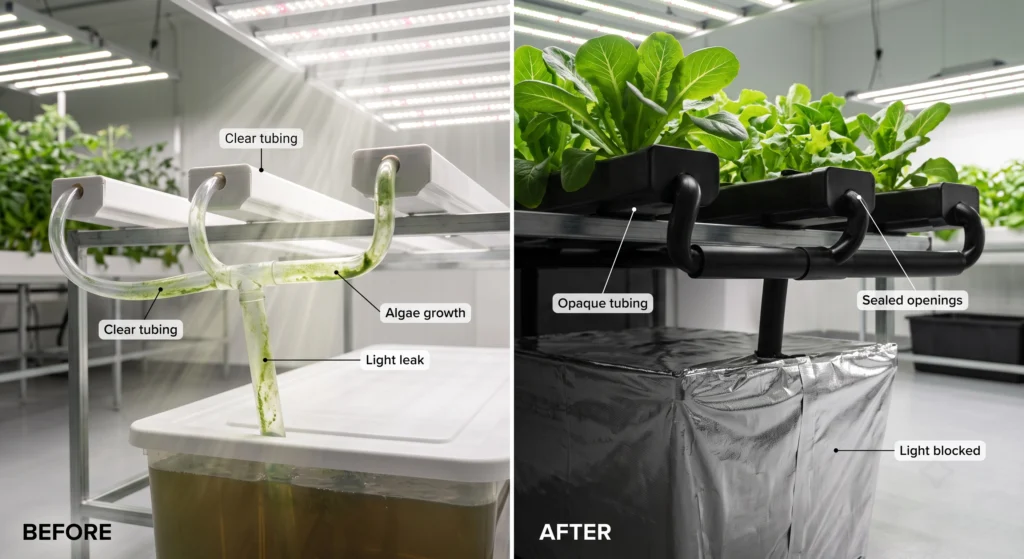
- Ditch clear tubing. Clear vinyl belongs in aquariums, not hydroponic systems. Replace it with opaque black vinyl. If tubing runs directly under intense lights, double-walled tubing (black inside, white outside for heat reflection) is worth the extra cost. Schedule 40 PVC blocks light well for rigid plumbing runs, see our DIY PVC vertical hydroponics guide for integration details.
- Wrap the reservoir. Light-colored totes (yellow, clear, translucent grey) let real light through the walls. Wrap the whole reservoir in black-and-white poly film (Panda film), white side out to reflect heat, black side in to block light. Painting works too, black coat first for blocking, white coat over it for heat reflection.
- Seal channel gaps. NFT channels leak light through empty planting holes constantly. Cap every unused hole, and use neoprene collars or opaque covers around young seedling stems to block light spilling into the channel below.
Step 2: Mechanical Cleaning and Flushing
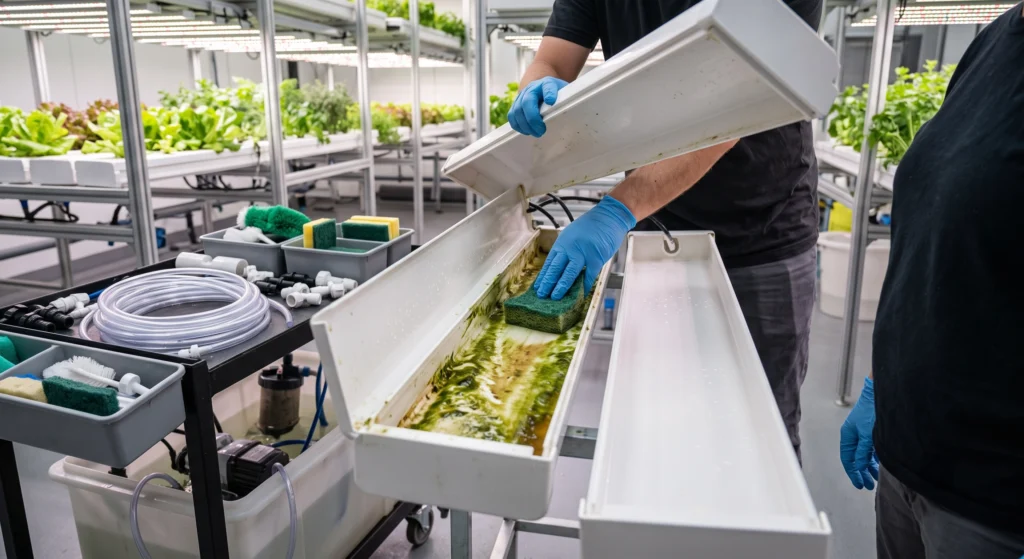
If algae is already established, physically remove the biomass before chemical treatment does much good, dead algae left in the system clogs pumps and feeds bacteria that further deplete oxygen.
- Flush the lines. For minor tubing buildup, a flexible pipe-cleaning brush on a wire can clear it. For a badly fouled small-diameter microtube, replacing it outright is often cheaper and safer than trying to salvage it.
- Swab the channels. NFT gullies are prime algae real estate given their shallow, slow-moving water. Between crop cycles, scrub the inside with a coarse sponge, or for seamless extrusions, tie a sponge to a string and pull it through the channel. Left unchecked, buildup here eventually causes real flow blockages, see our NFT channel clogs guide for more.
Step 3: Chemical Control
Once light is eliminated and physical mass is scrubbed out, sanitizing the water handles the remaining microscopic spores.
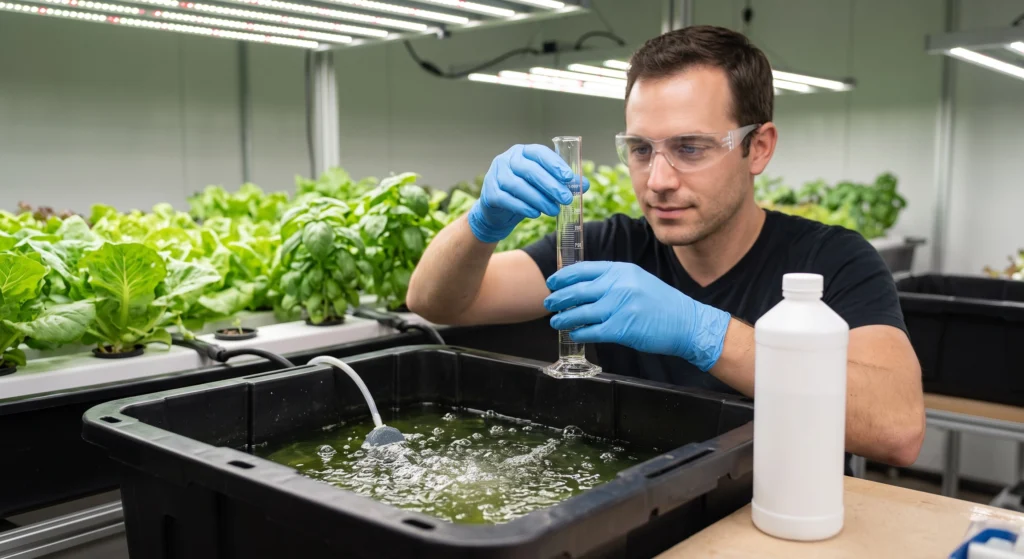
Hydrogen peroxide (H2O2). Food-grade H2O2 is the standard here. It oxidizes algae and bacterial cell walls, then breaks down entirely into water and oxygen, leaving no residue and actually boosting DO in the process.
- Active control dosage: commonly cited hobbyist rates run around 3ml of 12% food-grade H2O2 per gallon, applied every 3 to 4 days since it degrades quickly in water. If you’re using a different concentration product, the calculator at the end of this guide converts the dose for you, always match dosage to your product’s actual concentration.
- Between-crop sterilization: a stronger treatment, commonly cited around 15 to 20ml of 12% H2O2 per gallon, run through the system for 24 hours with no plants present, then drained and flushed with fresh water.
Don’t use H2O2 if you’re running a biological reservoir. It’s non-selective and will kill beneficial microbes like Bacillus and Trichoderma right alongside the algae. Pick one strategy, sterile or biological, not both at once.
Step 4: Temperature Management
Algae favors warm water, reproduction accelerates noticeably above roughly 72°F (22°C), and warm water also holds less dissolved oxygen, compounding the risk to roots. Keeping reservoir temperature in the roughly 65 to 68°F (18-20°C) range slows algae down meaningfully. Insulating the reservoir and correctly sizing your submersible pump (an oversized pump dumps more waste heat into the water than necessary) both help here.
Algae Control Parameter Table
| Parameter | Target Range | Danger Zone | Mitigation |
|---|---|---|---|
| Reservoir Water Temp | 65-68°F (18-20°C) | Above 72°F (22°C) | Add a chiller or insulate the reservoir |
| Light Transmission | 0%, full darkness | Any detectable light leak | Wrap reservoir in Panda film; use black vinyl tubing |
| Dissolved Oxygen (DO) | 6.0-8.0+ mg/L | Below 4.0 mg/L | Add air stones; lower water temp; consider H2O2 |
| pH Stability | 5.5-6.2 (crop dependent) | Wild daily swings | Eliminate algae; check for decaying root mass |
| Preventative H2O2 (12%) | 1-2 ml per gallon | 0 ml, unsterilized system | Dose every 3-4 days in a sterile system |
| Tubing Material | Black vinyl or PVC | Clear vinyl | Replace all clear tubing |
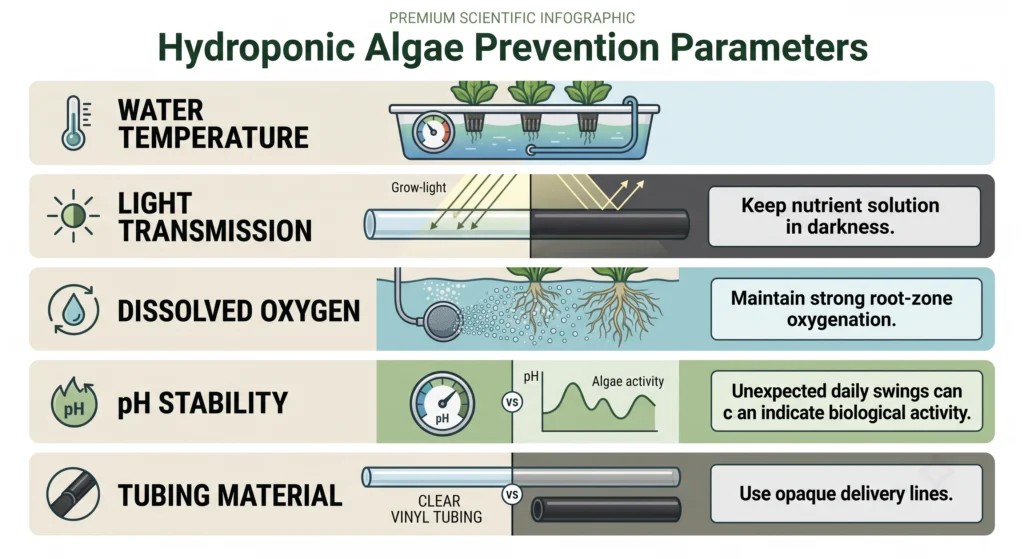
For more on how these parameters tie into overall nutrient strategy, see our aeroponic nutrient guide.
Core Equipment for Algae Prevention

Completely blocks UV and visible light from reaching the solution, flexible, fits standard barbed fittings, and food-safe. If you’re building a new system, skip the clear tubing aisle entirely.

Standard drugstore 3% H2O2 contains stabilizers you don’t want in a food-growing system. A genuine food-grade product, whatever concentration you choose to stock, breaks down cleanly into water and oxygen and is the reliable go-to for sterile reservoir maintenance. Handle concentrated product with gloves and eye protection.

For any reservoir made of light-colored plastic, wrapping in 5.5 mil poly film (white out for heat reflection, black in for light blocking) is cheap, waterproof, tear-resistant insurance against algae.

Useful for covering empty NFT holes or gaps around young seedling stems where light would otherwise spill into the channel below, reusable and gentle on the stem.

For physically scrubbing biofilm and dead algae out of a long PVC run or clogged manifold before a chemical flush, since chemicals alone often can’t reach established buildup on plastic surfaces.
Frequently Asked Questions
Will algae directly kill my hydroponic plants?
Not directly, algae isn’t a plant pathogen. It kills indirectly: consuming dissolved oxygen at night (suffocating roots), causing pH swings that lock out nutrients, and feeding fungus gnat larvae that go on to chew through actual root tissue.
Can I use household bleach to kill algae while plants are growing?
No. Never use bleach (sodium hypochlorite) in a reservoir with live plants, chlorine is highly toxic to root tissue. Bleach has a place sterilizing hard plastics and channels between crop cycles (commonly diluted around 1:50), always rinsed thoroughly before replanting. For active systems with plants present, food-grade H2O2 is the appropriate choice instead.
Why does my NFT system’s pH crash at night and spike during the day?
That’s a classic sign of an algae infestation. Daytime photosynthesis strips CO2 and raises pH, nighttime respiration releases CO2 back and crashes it. Eliminating the algae stabilizes this swing.
How do I clean algae off my rockwool cubes?
Surface algae on rockwool is common since the top stays moist and lit. Don’t scrape it, you risk damaging the stem. Covering the cube top with a small square of Panda film or a neoprene collar to block light lets it die off naturally instead.
I painted my reservoir black but still have algae. Why?
Black paint alone absorbs heat, which raises water temperature and can actually help algae. Use a full system: a black coat to block light, then a white coat over it to reflect heat. Check by shining a flashlight against the outside of an empty reservoir in a dark room, if it shines through, you need another coat.
Can I use beneficial microbes and hydrogen peroxide at the same time?
No. H2O2 is a broad-spectrum oxidizer that will kill beneficial bacteria like Bacillus and Trichoderma right alongside the algae. Choose one reservoir strategy, sterile or biological, and commit to it.
Does clear hydroponic tubing have any practical use?
Really only as an external sight glass for checking water level from outside an otherwise opaque reservoir, and even then, sight glasses are prone to growing algae internally over time. Delivery lines should stay fully opaque.
H2O2 Dosing Calculator
Use the tool below to calculate the correct dose regardless of which food-grade H2O2 concentration you actually have on hand.
Calculate the correct dose for your reservoir based on the actual concentration of food-grade H2O2 you have. Dosing rules of thumb online usually assume one specific concentration, this converts to whatever you actually stock.
Based on commonly cited hobbyist ratios scaled to actual pure H2O2 content. Always handle concentrated H2O2 (above 10%) with gloves and eye protection, and start conservative if you’re unsure, you can always add more.
Total System Clarification
Fighting algae in hydroponic tubing and NFT channels is close to a rite of passage for indoor growers. The appeal of clear water over pristine roots is real, but the basic biology of photosynthesis means anywhere light, water, and nutrients meet, something will grow to take advantage of it.
The best defense is a real audit: check every inch of your system for light leaks, swap clear lines for black vinyl, wrap reservoirs tightly, cap unused plant sites, and hold temperature down. Combined with a sterile reservoir protocol using genuine food-grade hydrogen peroxide, that keeps your expensive nutrients feeding only the crop you actually want to harvest. For a full foundational walkthrough, see our NFT for beginners guide.

Continue Your Learning Journey