VPD Optimization: The Engineering Guide to Vapor Pressure Deficit

Table of Contents
- The Physics of Transpiration and Vapor Pressure
- The Biological Engine: Guard Cells and Stomatal Conductance
- Why Relative Humidity is a Flawed Metric
- Calculating VPD: The Mathematical Framework
- Crop-Specific VPD Targets by Life Cycle
- The Calcium Transport Mechanism
- Hardware Integration for Climate Control
- Diagnosing Environmental Stress and Pathogen Risks
- Frequently Asked Questions
- Mastering Your Hydroponic Environment
Disclosure: MistCulture summarizes verified product specs, engineering data, and community feedback. We may earn an affiliate commission if you purchase through our links. Regulations vary by location; this content is for educational purposes only.
Vapor Pressure Deficit (VPD) represents the most powerful environmental metric in the modern grower’s climate control arsenal. Relying on simple temperature and humidity targets is an outdated methodology. Independent temperature and humidity readings fail to account for the physical forces driving water movement through plant tissue. VPD combines these two variables into a single, actionable pressure reading that directly correlates with plant transpiration rates, nutrient uptake efficiency, and overall growth potential.
If your grow room feels like a sauna but your plants are stalled, your VPD is broken. If your leaves are curled like tacos and the tips are burned despite perfect nutrient strength, your VPD is broken.
This guide breaks down the exact physics of vapor pressure, provides the mathematical framework for calculating your room’s drying power, and outlines specific VPD targets across every phase of plant development. By mastering VPD, you dictate the exact metabolic rate of your crop.
The Physics of Transpiration and Vapor Pressure
Vapor pressure deficit measures the difference between the amount of moisture the air currently holds and the maximum amount of moisture it can hold at a specific temperature. It is the atmospheric suction force driving fluid through the plant.
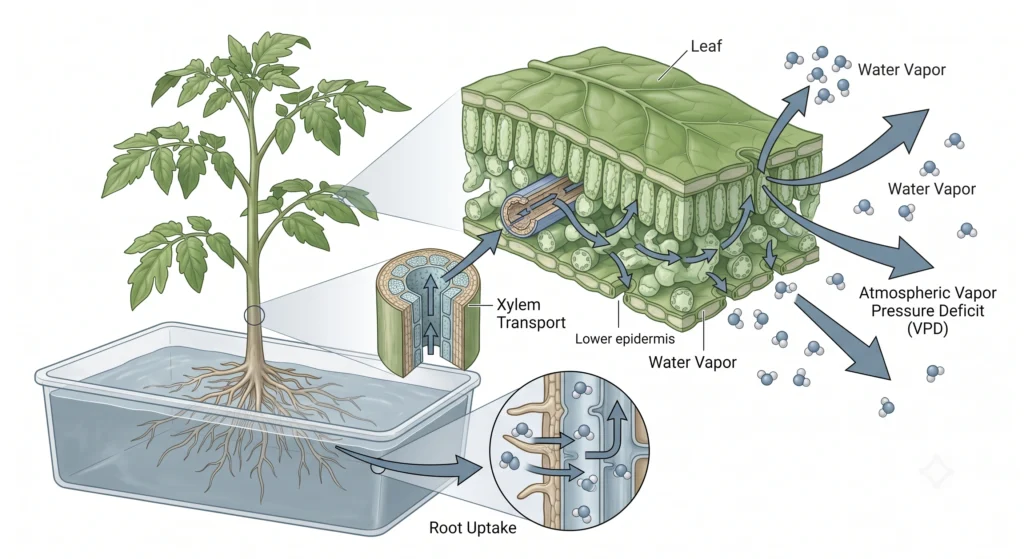
Plants operate as biological water pumps. They extract nutrient-rich water from the hydroponic reservoir, move it upward through the xylem tissue, and release it as water vapor through microscopic pores on the underside of their leaves called stomata. This process is called transpiration.
Transpiration does not happen by magic. It is driven by physics. Water moves from areas of high pressure to areas of low pressure. The inside of a plant leaf is heavily saturated, maintaining a relative humidity of nearly 100%. The air outside the leaf is drier. Because the atmosphere has a lower moisture pressure than the inside of the leaf, it acts as a vacuum, physically pulling water vapor out of the stomata.
VPD measures the exact strength of that vacuum.
If the air in your grow tent is hot and bone-dry, the vacuum is massive. The VPD is high. The atmosphere sucks water out of the plant faster than the roots can replace it. To prevent total dehydration, the plant slams its stomata shut. Photosynthesis stops. Growth halts.
If the air in your grow tent is cold and heavily saturated with moisture, the vacuum disappears. The VPD is low. The atmosphere cannot accept any more water vapor. The plant cannot transpire, which means it stops pulling water from the roots. Nutrient transport ceases. Water pools on the leaves, inviting catastrophic fungal outbreaks. Managing this exact pressure balance is mandatory for maximum yield.
The Biological Engine: Guard Cells and Stomatal Conductance
To fully grasp VPD optimization, you must understand the mechanical behavior of stomata. Each stoma pore is surrounded by two guard cells. These guard cells act as hydraulic valves, swelling to open the pore and shrinking to close it.
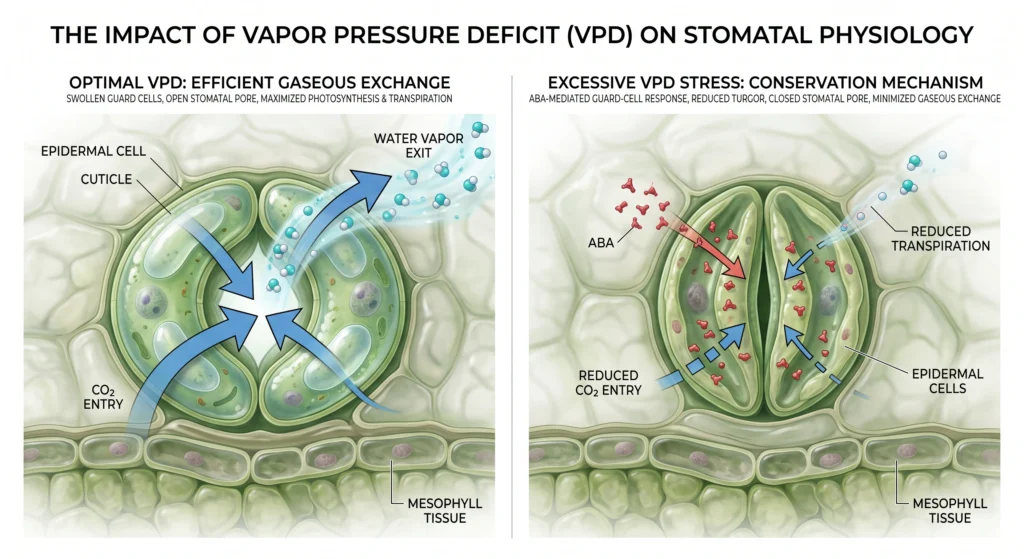
When the environment falls within an optimal VPD range, the plant actively pumps potassium ions into the guard cells. Water follows the potassium via osmosis, causing the guard cells to swell with turgor pressure. As they swell, they bow outward, opening the stomatal pore. This open pore allows carbon dioxide to enter the leaf for photosynthesis while allowing water vapor to exit.
When the VPD spikes into the danger zone—meaning the air is too dry—the rapid loss of water triggers an emergency response. The plant releases a stress hormone called abscisic acid (ABA). ABA forces the potassium ions out of the guard cells, causing water to rapidly exit back into the surrounding tissue. The guard cells lose turgor pressure, go limp, and seal the stomatal pore shut.
This biological lockdown prevents the plant from drying out, but it also completely blocks the intake of carbon dioxide. Without CO2, the plant cannot build cellular mass. Understanding this mechanism makes it obvious why strict climate management is required.
Why Relative Humidity is a Flawed Metric
Relative Humidity (RH) only measures the percentage of saturation at a given temperature, ignoring the actual carrying capacity of the air. Warm air holds exponentially more water vapor than cold air, rendering RH useless on its own.
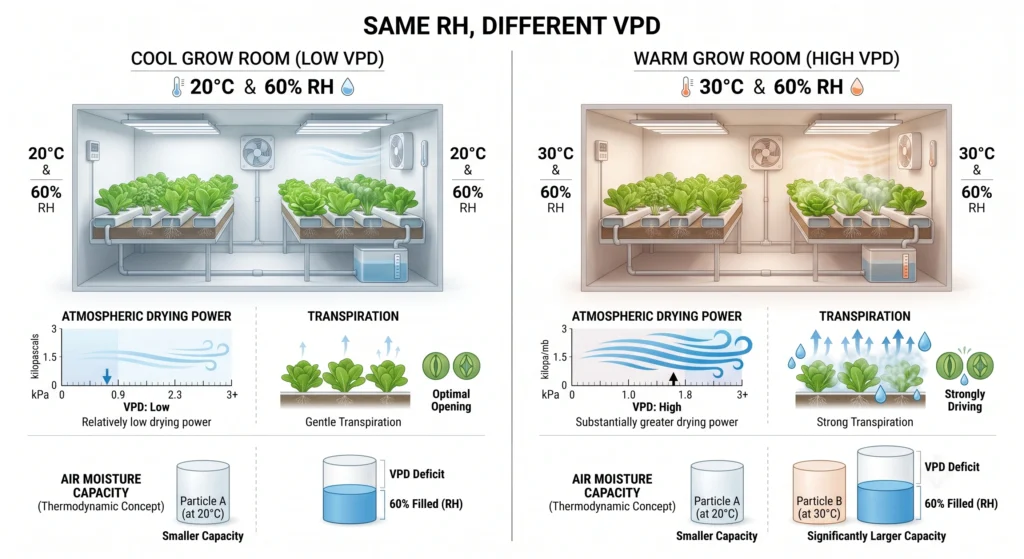
A common error among indoor growers is trying to maintain a static 50% relative humidity regardless of the room temperature. This shows a fundamental misunderstanding of thermodynamics.
Relative humidity is exactly that: relative. Air expands as it heats up, increasing its capacity to hold water vapor. Cold air contracts, shrinking its capacity to hold water vapor.
Consider a grow room sitting at 20 degrees Celsius (68 F) with a relative humidity of 60%. The air feels comfortable. Now, you turn on your high-intensity grow lights. The room temperature spikes to 30 degrees Celsius (86 F). You adjust your humidifier to ensure the room stays at exactly 60% relative humidity.
Even though the RH is identical in both scenarios (60%), the actual amount of water vapor in the air at 30 C is vastly larger than at 20 C. The drying power of the air—the VPD—has changed completely. At 20 C and 60% RH, the VPD is low, and plants transpire slowly. At 30 C and 60% RH, the VPD is high, and plants are transpiring aggressively.
Basing your climate control on relative humidity alone guarantees inconsistent plant metabolism. You must integrate temperature and humidity into a unified VPD target using environmental management hardware. Review the best hydroponic controllers under 200
to see how modern sensor arrays track these shifting dynamics in real time.
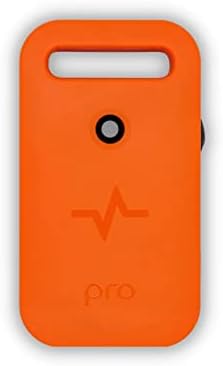
- Boost Yields and Prevent Crop Loss: Remotely track and optimize crop yields by using the ultimate Pulse Pro indoor therm…
- Room Thermometer, Hygrometer, and More: Equipped with several sensors that provide accurate CO2, PAR/PPFD, VPD, temperat…
- Reliable Grow Monitor System: This smart monitor sends instant alerts through unlimited sensors at different locations, …
- Why it’s necessary: Standard hygrometers do not calculate VPD. The Pulse Pro tracks temperature, humidity, light intensity, and CO2, instantly calculating real-time VPD and logging it to your smartphone.
- Key Spec: Wi-Fi enabled with precision Swiss-made sensors providing instant VPD calculations based on custom leaf temperature offsets.
Calculating VPD: The Mathematical Framework
Calculating Vapor Pressure Deficit requires determining the Saturated Vapor Pressure (SVP) of the leaf, determining the Actual Vapor Pressure (AVP) of the air, and finding the difference in kilopascals (kPa).
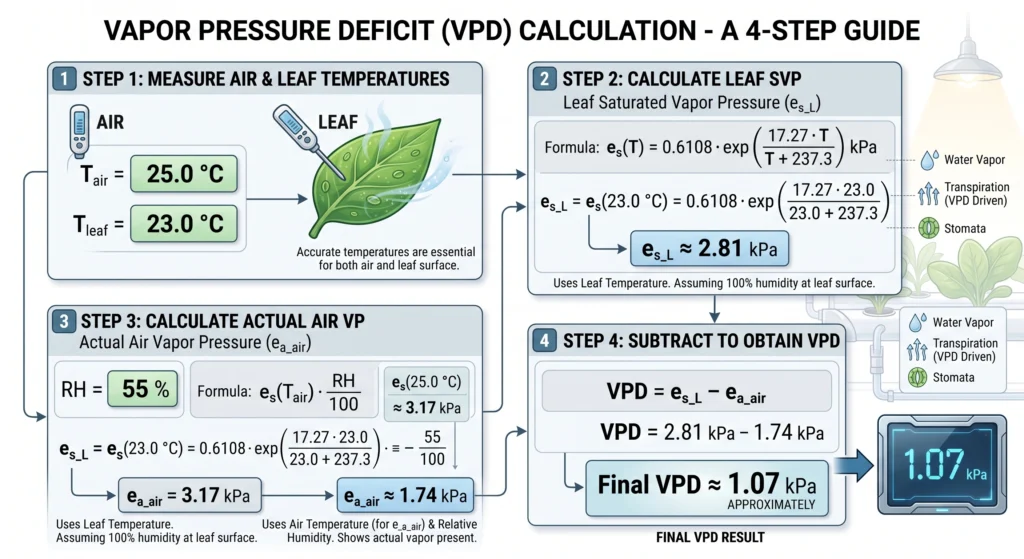
To master VPD, you must understand the math running behind the scenes of your environmental controllers. Engineers and botanists use the Tetens formula to determine vapor pressure. The standard unit of measurement is the kilopascal (kPa). To verify the accuracy of your environmental inputs, ensure you have reviewed our hydroponic sensors guide
Step 1: Determine Leaf Temperature and Air Temperature
Air temperature is read from your wall thermostat. Leaf temperature must be read using an infrared (IR) thermometer targeting the plant canopy. Leaves are almost always cooler than the surrounding air because the act of transpiration provides evaporative cooling. A healthy, transpiring leaf is typically 1 to 3 degrees Celsius cooler than the ambient air. This difference is called the Leaf Surface Temperature Offset (LSTO).
Step 2: Calculate Saturated Vapor Pressure (SVP) of the Leaf
We assume the inside of the leaf is at 100% relative humidity. We use the leaf temperature in Celsius (T_leaf) to find the maximum vapor pressure it generates.
Formula: SVP_leaf = 0.61078 * exp((17.27 * T_leaf) / (T_leaf + 237.3))
Step 3: Calculate Actual Vapor Pressure (AVP) of the Air
First, find the Saturated Vapor Pressure of the air using the ambient air temperature (T_air).
Formula: SVP_air = 0.61078 * exp((17.27 * T_air) / (T_air + 237.3))
Next, multiply the SVP_air by the room’s Relative Humidity (expressed as a decimal) to find the Actual Vapor Pressure.
Formula: AVP_air = SVP_air * (RH / 100)
Step 4: Calculate Vapor Pressure Deficit (VPD)
Formula: VPD = SVP_leaf - AVP_air
Let us run a real-world grow tent calculation.
Your air temperature is 25 C (77 F). Your relative humidity is 55%. You shoot the plant canopy with a laser thermometer and find a leaf temperature of 23 C.
SVP_leaf(at 23 C) = 0.61078 * exp((17.27 * 23) / (23 + 237.3)) = 2.808 kPa.SVP_air(at 25 C) = 0.61078 * exp((17.27 * 25) / (25 + 237.3)) = 3.167 kPa.AVP_air= 3.167 * 0.55 = 1.741 kPa.VPD= 2.808 kPa (Leaf Pressure) – 1.741 kPa (Air Pressure)- Final VPD = 1.067 kPa.
A VPD of 1.06 kPa is a perfect target for vigorous vegetative growth. Understanding this math allows you to accurately size your HVAC equipment. For complex water consumption modeling under different VPD loads, utilize our hydroponic water efficiency calculator

- 𝐕𝐞𝐫𝐬𝐚𝐭𝐢𝐥𝐞 𝐓𝐨𝐨𝐥𝐬: Infrared technology allows you to measure various objects at home and outdoors; Use it for 𝒎𝒆𝒂𝒕, 𝑫𝑰𝒀 𝒄𝒂…
- 𝐁𝐞𝐭𝐭𝐞𝐫 𝐀𝐜𝐜𝐮𝐫𝐚𝐜𝐲: The Lasergrip’s 12:1 𝒅𝒊𝒔𝒕𝒂𝒏𝒄𝒆-𝒕𝒐-𝒔𝒑𝒐𝒕 𝒓𝒂𝒕𝒊𝒐 enables you to accurately measure temperatures from a comfo…
- 𝐄𝐚𝐬𝐞 𝐨𝐟 𝐮𝐬𝐞: Scan the surface of your object, hold down the trigger of the thermometer gun, get temp anywhere within the…
- Why it’s necessary: You cannot calculate accurate VPD without knowing the exact surface temperature of your leaves. Ambient air temperature alone will skew your VPD results by up to 0.4 kPa.
- Key Spec: -58 F to 1022 F range with a 12:1 distance-to-spot ratio and adjustable emissivity for precise biological surface readings.
Crop-Specific VPD Targets by Life Cycle
Plants demand different atmospheric pressures as their root mass and vascular infrastructure develop. A rigid VPD scaling protocol from 0.4 kPa to 1.6 kPa dictates maximum yield potential.
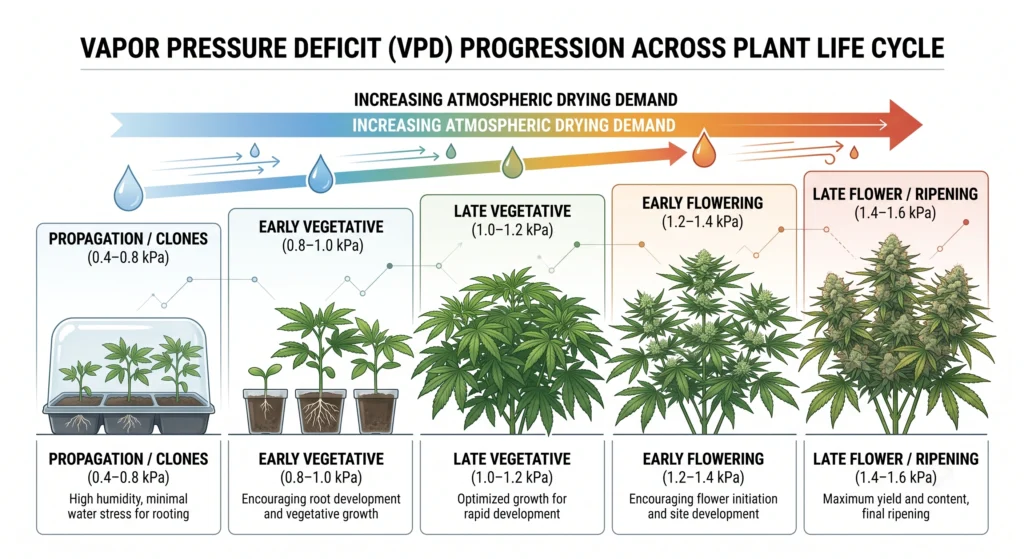
Running a static VPD from seed to harvest results in sub-optimal growth and severe late-stage pathogen risks. You must manipulate the drying power of the air to match the mechanical capabilities of the plant’s plumbing system.
| Growth Phase | Target VPD (kPa) | Goal / Physiological Response |
| Propagation / Clones | 0.4 – 0.8 kPa | Minimize transpiration. Roots are unformed. High humidity prevents dehydration and tissue death. |
| Early Vegetative | 0.8 – 1.0 kPa | Gentle suction. Roots are establishing. Encourages upward xylem flow without stressing guard cells. |
| Late Vegetative | 1.0 – 1.2 kPa | Aggressive transpiration. Pulls heavy volumes of water and nitrogen from the reservoir to build canopy mass. |
| Early Flowering | 1.2 – 1.4 kPa | High nutrient transport. Forces calcium and phosphorus into developing bud sites. Keeps dense canopies dry. |
| Late Flower / Ripening | 1.4 – 1.6 kPa | Stress simulation. High atmospheric suction triggers defensive resin and trichome production. Prevents Botrytis. |
Phase 1: Propagation and Seedlings (0.4 – 0.8 kPa)
Cuttings and newly germinated seedlings have near-zero root mass. They lack the physical plumbing to pull water from the reservoir. If the VPD is high, the air will strip moisture from the leaves, and the plant will desiccate and die within hours. You must maintain a very low VPD (high humidity, warm temperatures) so the air does not demand water from the fragile foliage.
Phase 2: Vegetative Canopy Expansion (0.8 – 1.2 kPa)
Once the root system hits the hydroponic reservoir, you must increase the VPD. A higher VPD forces the stomata to open wide, intaking massive amounts of CO2 for photosynthesis. The atmospheric suction pulls a continuous stream of water and vegetative nutrients up the main stem. This is the period of explosive vertical growth. Monitor your nutrient strength closely using our hydroponic pH and EC mastery guide because aggressive transpiration rapidly depletes reservoir water levels.
Phase 3: Flowering and Fruiting (1.2 – 1.5 kPa)
As the plant transitions into the reproductive phase, the canopy becomes dense, and flowers begin to stack. A higher VPD serves two mechanical purposes. First, it drives the heavy transport of phosphorus and potassium required to build fruit mass. Second, the drier air acts as a physical shield against fungal pathogens. High humidity inside a dense floral cluster guarantees bud rot.
Phase 4: Late Ripening (1.5 – 1.7+ kPa)
In the final two weeks of the crop cycle, aggressive growers push the VPD into the stress zone. Extreme drying pressure signals to the plant that the environment is becoming hostile. In crops pushed to the edge, this environmental stress triggers a defensive response that shuts down stomata and stalls growth, protecting whatever moisture remains. Ensure your hardware is dialed in by checking our grow tent buying guide for ventilation layouts capable of handling high-stress purging.

- Designed with smart controls and precision vapors to obtain optimal humidity levels for plant growth.
- Next-gen EC ultrasonic vaporizer can reach up to 10 levels of humidity for fine-tuned moisture control.
- Built with a specially designed water-resistant seal to prevent leakage and extend operational lifespan.
- Why it’s necessary: Maintaining the low VPD required during the propagation and vegetative phases demands high-volume, precise moisture injection without soaking the floor.
- Key Spec: 15-liter capacity with an integrated smart controller that automatically targets exact VPD or relative humidity setpoints.
The Calcium Transport Mechanism
Calcium is a non-mobile element within plant tissue. It cannot be relocated from old leaves to new growth. It moves exclusively through the transpiration stream driven by VPD.
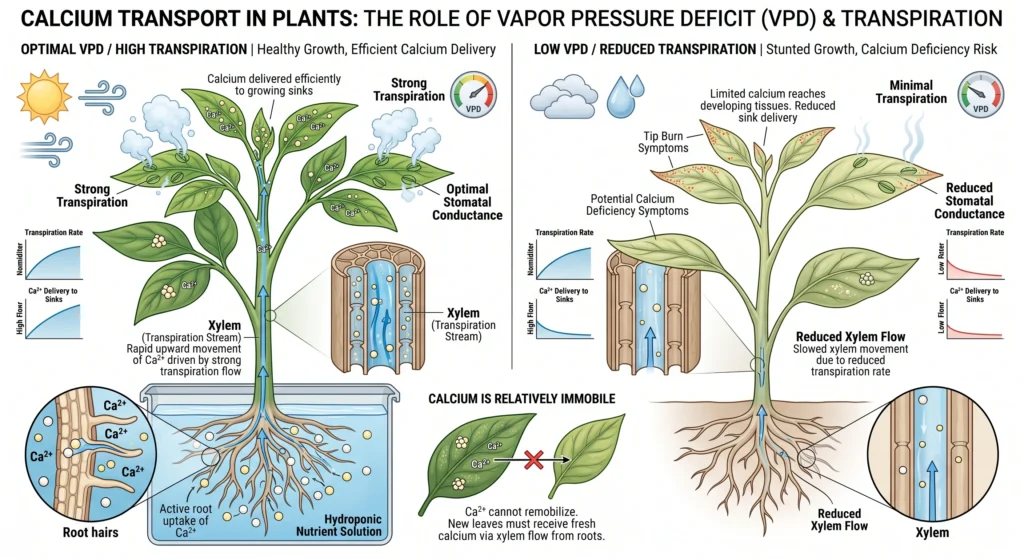
Understanding VPD is the only way to resolve chronic calcium deficiencies. Many hydroponic growers see burned leaf tips on their lettuce or black, rotting bottoms on their tomatoes and immediately dump excessive amounts of Cal-Mag into their reservoir. The problem persists, and the excess salts lock out other essential nutrients.
Calcium is immobile. Once a plant deposits a calcium molecule into a cell wall, it is locked in place permanently. If a new leaf is forming at the top of the canopy, it requires a continuous supply of fresh calcium from the roots.
The plant has no internal pump to push calcium upward. It relies entirely on the atmospheric vacuum—the VPD—to pull water and calcium up the xylem tubes. If your grow room is too humid (low VPD), transpiration stops. Water stops moving up the stem. The new leaves at the top of the canopy receive zero calcium. The cell walls physically collapse, turning brown and crispy. This is why indoor hydroponic lettuce and spinach crops frequently suffer from tip burn despite swimming in perfectly balanced nutrient solutions.
You do not need more calcium in the reservoir. You need a higher VPD to pull the existing calcium up to the canopy. Dial in your base nutrient ratios by reviewing our Cal-Mag hydroponics guide
.
Hardware Integration for Climate Control
Manipulating VPD requires absolute control over three independent mechanical systems: heating, cooling, and dehumidification. Changing one variable instantly alters the others.
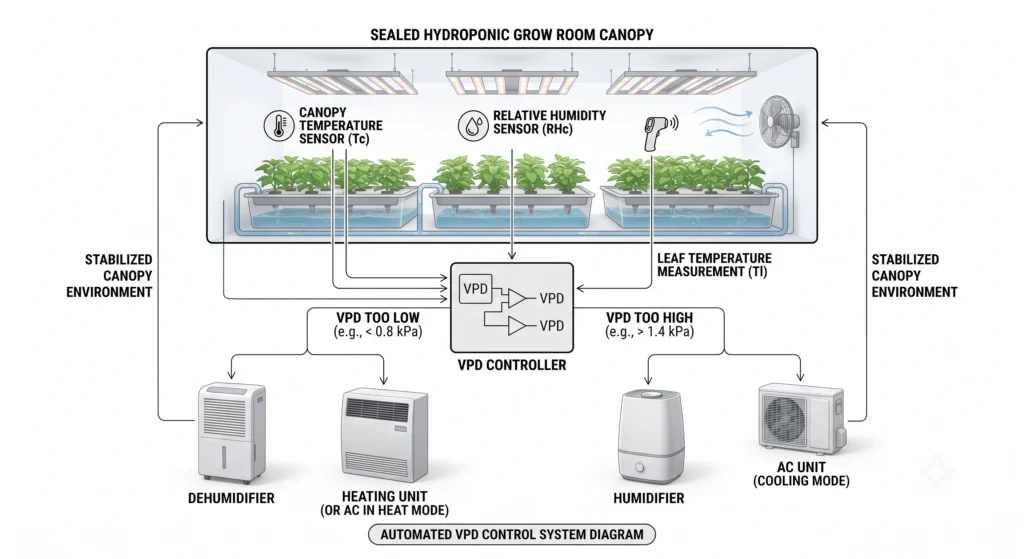
You cannot manage VPD manually. Attempting to adjust humidifiers and exhaust fans by hand results in violent environmental swings that devastate plant metabolism. You require automated systems reading from accurate canopy sensors. You can explore scheduling tactics in our breakdown of smart plugs timers for hydroponic operations.
Raising VPD (Increasing Drying Power):
If your VPD is too low (air is too humid/wet), the plants cannot transpire. To raise the VPD, you must increase the capacity of the air to hold water, or physically remove water from the air.
- Increase Temperature: Heating the air expands it, instantly lowering relative humidity and raising VPD.
- Activate Dehumidifiers: Mechanical compressors strip moisture from the air, increasing the atmospheric vacuum.
- Increase Exhaust Fan Speed: Dumping wet canopy air outside the tent and pulling in dry ambient air instantly raises VPD.
Lowering VPD (Decreasing Drying Power):
If your VPD is too high (air is too hot/dry), the plants will close their stomata and burn. You must add moisture to the air or shrink the air’s carrying capacity.
- Lower Temperature: Cooling the air forces it to contract, raising relative humidity and dropping the VPD. You can review cooling hardware options in our passive hydro cooling guide.
- Activate Humidifiers: Ultrasonic foggers inject microscopic water vapor directly into the canopy, satisfying the atmospheric deficit.
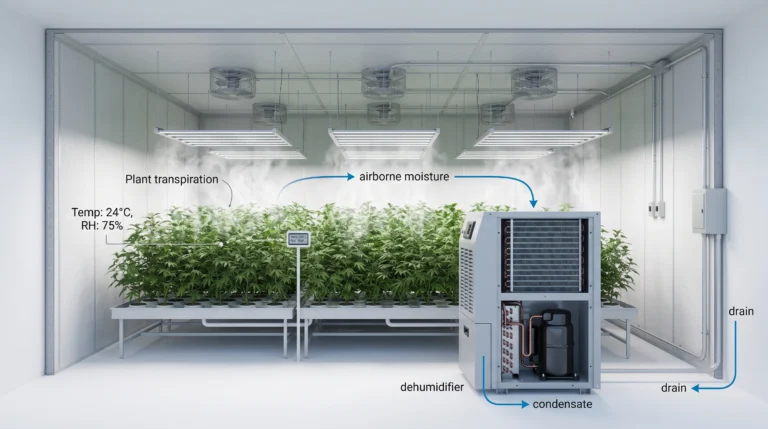
The challenge lies in the thermodynamic crossover. Dehumidifiers generate massive amounts of sensible heat while running. If you turn on a dehumidifier to raise your VPD, the heat it exhausts will raise the room temperature, which raises the VPD even further. Your air conditioning must be sized to counter the heat load of your dehumidification equipment.

- PRO-GRADE 70-PINT PERFORMANCE – This AlorAir Crawl Space Dehumidifier removes up to 70 pints per day under saturated con…
- BUILT TOUGH FOR DEMADING ENVIRONMENTS – Unlike standard residential dehumidifiers, this basement and crawl space dehumid…
- BUILT-IN PUMP FOR FLEXIBLE DRAINAGE INSTALLATION – Flexible two-way drainage for easy installation. Use the included gra…
- Why it’s necessary: High-density canopies transpire gallons of water per day. Standard residential dehumidifiers will freeze over or burn out. Commercial units maintain exact VPD targets continuously.
- Key Spec: Removes 71 pints of water per day at true AHAM conditions, utilizing an ultra-efficient compressor and top-exhaust airflow design.
Diagnosing Environmental Stress and Pathogen Risks
Plants communicate VPD stress through physical morphological changes. Failing to read these signals results in necrotic tissue, stalled growth, and systemic fungal colonization.
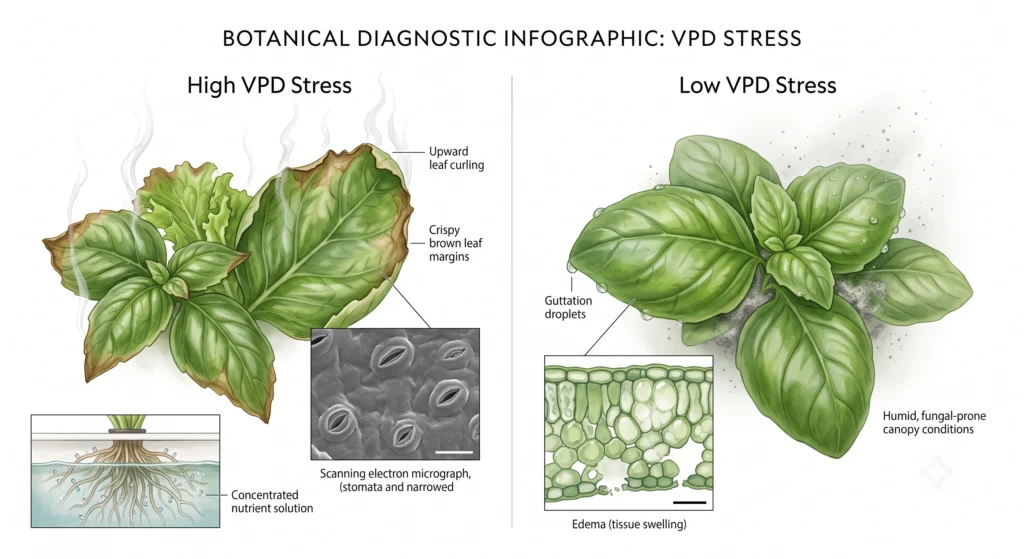
When hardware fails or parameters drift, your crop will visually indicate the specific direction of the VPD error. Recognizing these symptoms allows for rapid intervention before permanent yield reduction occurs. Check our hydroponic troubleshooting guide for complete diagnostic protocols.
Symptoms of High VPD Stress (Air is too hot/dry):
When the VPD exceeds 1.6 kPa during vegetative growth, the atmospheric vacuum is stripping water out of the leaves faster than the roots can supply it.
- Leaf Curling (Taco-ing): The margins of the leaves curl upward and inward, resembling a taco shell. The plant is attempting to reduce its exposed surface area to minimize moisture loss.
- Marginal Necrosis: The edges of the leaves turn crispy and brown as the perimeter cells dehydrate and die.
- EC Spikes: Because the plant is desperately drinking water to survive the dry air, it leaves the heavier fertilizer salts behind in the reservoir. The water level drops rapidly, and the EC concentration skyrockets, leading to toxic salt burn.
Symptoms of Low VPD Stress (Air is too cold/humid):
When the VPD drops below 0.6 kPa during late growth, the air is saturated and cannot accept transpired moisture.
- Guttation: Droplets of water form along the edges of the leaves during the night cycle. Because the plant cannot transpire vapor into the wet air, root pressure forces liquid water directly out of specialized pores called hydathodes.
- Edema: Blister-like swellings appear on the undersides of leaves and stems. The roots are taking up water, but the leaves cannot release it. The internal cellular pressure builds until the cells rupture and scar over.
- Fungal Pathogens: Stagnant, wet air surrounding the canopy provides the exact germination conditions required for Powdery Mildew and Botrytis (Bud Rot) spores to colonize plant tissue. High humidity environments require aggressive bio-security as detailed in our hydroponic IPM guide.
Frequently Asked Questions
What is the difference between VPD and Relative Humidity?
Relative humidity measures how much water vapor the air holds as a percentage of its maximum capacity at a specific temperature. Vapor Pressure Deficit (VPD) measures the absolute physical pressure difference between the moisture inside the leaf and the moisture in the air. VPD determines the actual drying power of the environment, making it a far superior metric for predicting plant transpiration rates.
Why do my plants stop growing when the VPD is too high?
When VPD is excessively high, the air pulls moisture from the leaves faster than the roots can replenish it. To prevent fatal dehydration, the plant closes its stomata. Closing the stomata stops water loss, but it also physically blocks Carbon Dioxide (CO2) from entering the leaf. Without CO2, photosynthesis completely halts, and all plant growth stops until the environmental pressure is reduced.
Do I measure VPD using the air temperature or the leaf temperature?
Accurate VPD calculations require the leaf surface temperature. Because plants transpire water, evaporative cooling causes the leaf surface to be 1 to 3 degrees Celsius cooler than the ambient room air. Using only the wall thermostat air temperature to calculate VPD will yield an artificially high number, leading to incorrect climate adjustments. Always use an infrared thermometer to read the canopy temperature.
How does VPD affect nutrient uptake in my hydroponic reservoir?
VPD dictates how much water the plant drinks. At a high VPD, the plant drinks massive volumes of water to stay hydrated, often leaving the fertilizer salts behind in the reservoir. This causes the reservoir EC to spike to toxic levels. At a low VPD, the plant drinks very little water but still requires nutrients, which can cause the reservoir EC to drop rapidly. You must adjust your nutrient feed strength based on the daily VPD load. Utilize our u003ca href=u0022https://mistculture.com/tools-and-resources/hydroponic-nutrient-calculator/u0022 target=u0022_blanku0022 rel=u0022noreferrer noopeneru0022u003ehydroponic nutrient calculatoru003c/au003e to match your feed schedule to your atmospheric demand.
Can I run the same VPD target from seedling to harvest?
No. Seedlings and fresh clones have minimal root systems and cannot uptake enough water to survive a high VPD environment; they require a low VPD (0.4-0.8 kPa). As the plant matures and builds a massive root network, it requires a higher VPD (1.0-1.5 kPa) to drive heavy transpiration, which pulls calcium and other immobile nutrients up into the expanding canopy and dense fruit structures.
Does turning off the grow lights affect my VPD?
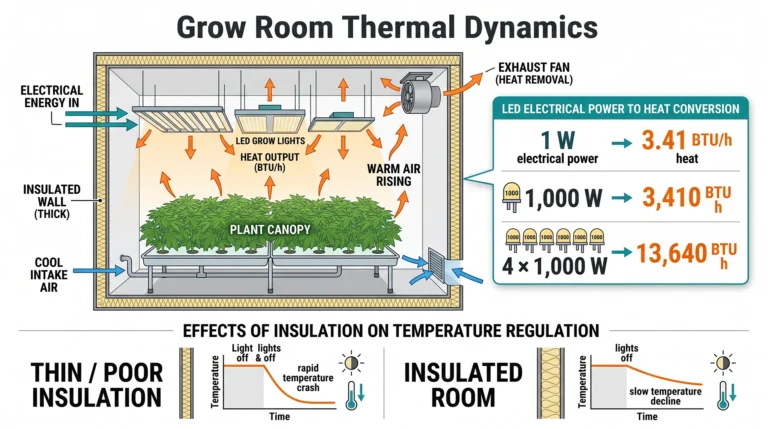
Yes, dramatically. When grow lights turn off, the sensible heat in the room drops instantly. Because cold air holds less water than warm air, the relative humidity spikes rapidly, causing the VPD to plummet. This sudden drop in VPD causes condensation to form on the cooling plant tissue, inviting powdery mildew. You must use dehumidifiers or exhaust fans to strip moisture from the air the exact moment the lights power off to stabilize the VPD.
Mastering Your Hydroponic Environment
Managing your Vapor Pressure Deficit is the dividing line between amateur growing and professional yield optimization. By transitioning away from basic temperature and relative humidity targets and embracing the thermodynamic reality of VPD, you gain absolute control over plant metabolism. You dictate how much water the roots pull, how wide the stomata open, and how efficiently calcium moves into your canopy.
Equip yourself with the proper infrared sensors, calculate your leaf surface temperature offsets, and automate your environmental hardware to hold your VPD exactly where your crop demands it. Do not let your environment govern your harvest. For a complete strategy on balancing your reservoir chemistry with your atmospheric targets, dive into our comprehensive hydroponic nutrients guide.
Keep your environment dialed in: For humidity, temperature, and climate-control guidance beyond VPD, visit the Plant Care Hub.

Continue Your Learning Journey