DWC vs NFT vs Aeroponics: The Ultimate Hydroponic Showdown (Yield, Cost & Risk)

Table of Contents
Disclosure: MistCulture summarizes verified product specs, engineering data, and community feedback. We may earn an affiliate commission if you purchase through our links. Regulations vary by location; this content is for educational purposes only.
When a commercial grow space smells like wet compost in July, it usually boils down to a single engineering failure: a fundamental mismatch between the chosen hydroponic method and the grower’s operational capacity. Tracing clogged tubes, sifting through buckets of necrotic roots, and calculating how a cheap pump failure wiped out hundreds of plants in 72 hours reveals a harsh reality. Hydroponics is an unforgiving science.
Marketing materials heavily gloss over the mechanical liabilities of different hydroponic designs. To operate a stable, high-yield environment, growers must understand the raw physics of their systems. This comprehensive breakdown evaluates the three heavyweights of the hydroponic world: Deep Water Culture (DWC), Nutrient Film Technique (NFT), and Aeroponics. We will examine exactly how they operate, where they fail, and how to engineer them for maximum yield and minimum risk.
System Mechanics: Engineering the Grow Space
Hydroponic systems act as mechanical engines for plant growth. While they all deliver water, oxygen, and nutrients, the method of delivery dictates the required maintenance, the potential for yield, and the margin of error.
To determine the best fit for a specific crop profile, it is necessary to strip away the marketing claims and look directly at fluid dynamics, dissolved oxygen ratios, and pressure requirements.
Deep Water Culture (DWC): The High-Volume Buffer
Deep Water Culture suspends plant roots directly into a large reservoir of nutrient-rich water. Aeration is provided mechanically by an air pump forcing ambient air through submerged airstones. This continuous bubbling agitates the water surface, maximizing the gas exchange required to keep roots healthy in a submerged state.
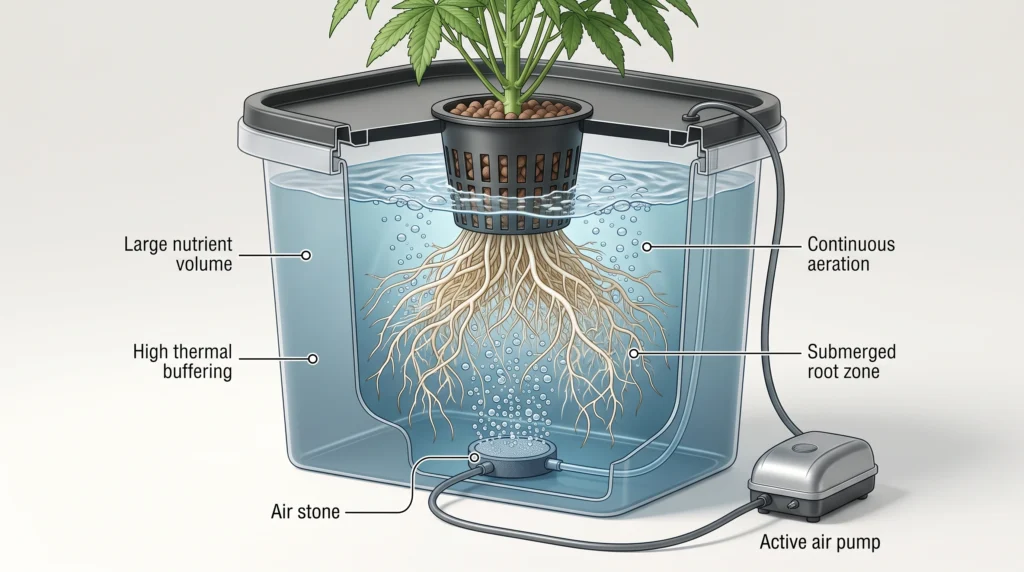
The primary engineering advantage of DWC is volume. A massive volume of water operates as a thermal and chemical buffer. If the ambient temperature of the room spikes, the large thermal mass of a 50-gallon reservoir warms very slowly, protecting the root zone from sudden shock. Similarly, pH and Electrical Conductivity (EC) drift slowly in high-volume environments.
The math behind DWC success relies heavily on Dissolved Oxygen (DO). Water temperature strictly dictates how much oxygen the solution can hold.
- At 60F (15.5C), water can hold approximately 10.0 mg/L of DO.
- At 70F (21.1C), the maximum DO capacity drops to about 8.9 mg/L.
- At 80F (26.6C), DO capacity plummets to 8.0 mg/L, while root oxygen demand doubles.
When establishing a setup for the first time, ensuring quiet and efficient air delivery is a priority. Designing a system properly from day one prevents major headaches later. For a breakdown on minimizing equipment noise while maximizing aeration, review our DIY DWC hydroponics quiet setup guide.

- COMPACT POWER FOR COLD THERAPY: Engineered for smaller cold plunge setups, this 0.10 HP chiller delivers spa-grade cooli…
- CONSISTENT, PRECISE COOLING: Digital control system maintains your target temperature with exceptional accuracy, giving …
- PURE TITANIUM PERFORMANCE: Built with a corrosion-resistant titanium evaporator, designed for long-lasting durability in…
- Why it’s necessary: DWC relies entirely on cool water temperatures to maintain high Dissolved Oxygen levels. Without a chiller in warm environments, root suffocation is a mathematical certainty.
- Key Spec: 1/10 HP compressor, capable of chilling up to 40 gallons down to the optimal 65F to 68F range.
Nutrient Film Technique (NFT): The Velocity Assembly Line
Nutrient Film Technique abandons the large reservoir in favor of high-velocity efficiency. Plants are suspended in sloped, shallow channels. A pump delivers a continuous, millimeter-deep “film” of nutrient solution across the bottom of the channel. The tips of the roots absorb the flowing nutrients, while the upper root mass remains exposed to the ambient air, drawing in massive amounts of oxygen.
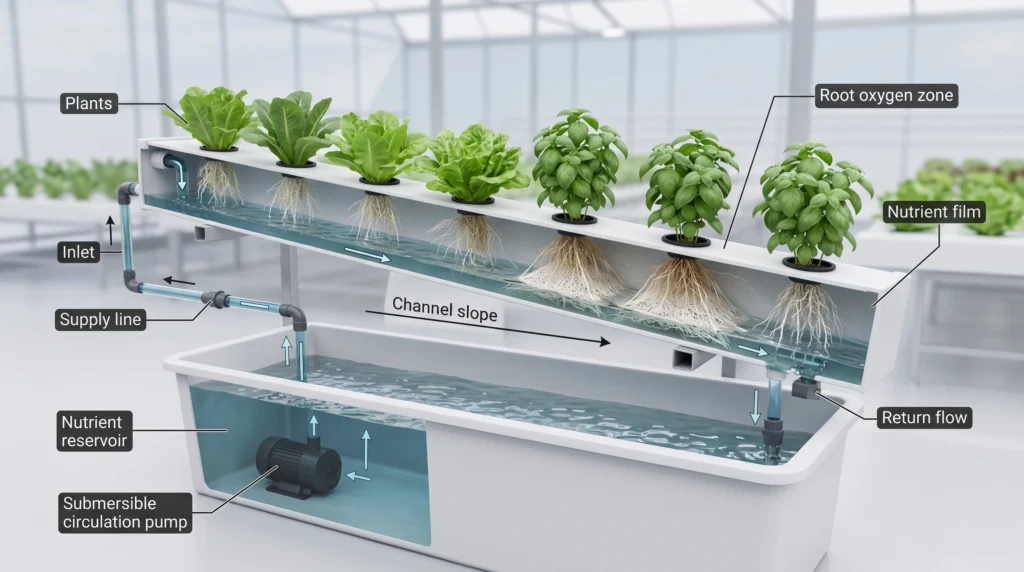
NFT engineering requires precise slope and flow rate calculations. The industry standard slope is between 1:30 and 1:40.
- Calculation: Drop (inches) = Length (inches) / Slope Ratio.
- For a 120-inch channel at a 1:30 slope, the drop must be exactly 4 inches from end to end (120 / 30 = 4).
Flow rates must be maintained between 1 and 2 liters per minute. If the flow is too slow, plants at the end of the channel suffer nutrient depletion. If the flow is too fast, the liquid depth increases, cutting off oxygen to the upper root mass. Proper equipment sizing dictates the success of this delicate balance. Reviewing the hydroponic pump sizing guide ensures the correct head height and gallon-per-hour metrics are met for complex channel arrays.

- Supreme Aqua-Mag 1200 Pumps are ideal for saltwater or freshwater aquariums and can operate in-line or submerged, with …
- Recommended Tank Size: 150 Gallons
- Operates Submerged or In-Line
- Why it’s necessary: NFT systems require continuous, 24/7 operation. Magnetic drive pumps have no seals to leak and consume minimal electricity, making them reliable for non-stop nutrient delivery.
- Key Spec: Continuous duty rating with adjustable flow control.
Aeroponics: High-Pressure Precision
Aeroponics suspends roots in an entirely enclosed, dark chamber with no liquid volume or solid media. Nutrient solution is atomized into micro-droplets and sprayed directly onto the root mass at precise intervals.
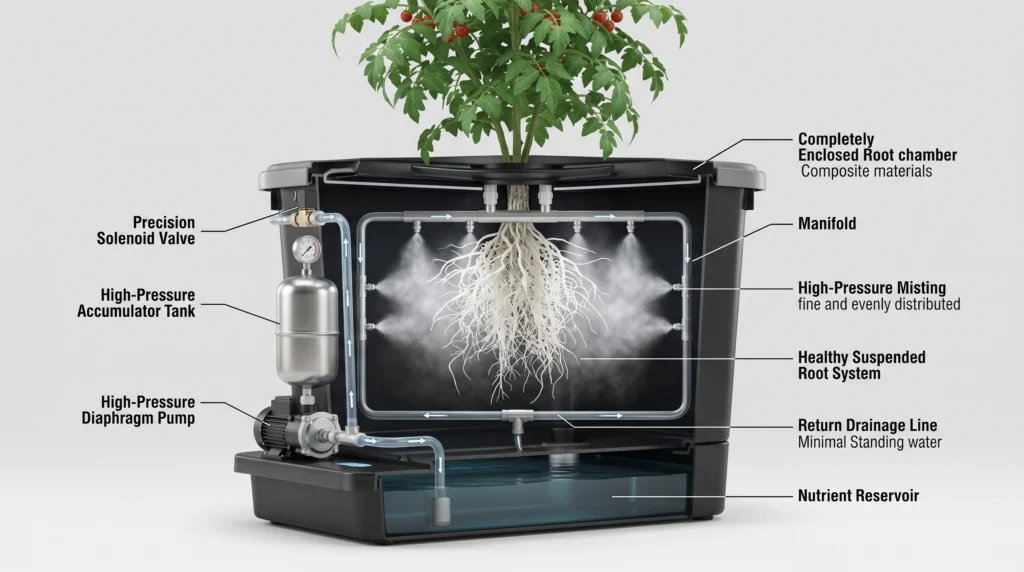
This is the most mathematically demanding system. True aeroponics (High-Pressure Aeroponics or HPA) requires droplets sized between 30 and 50 microns. Droplets larger than 50 microns contain too much mass; they hit the roots, coalesce, and drip off, failing to stick to the microscopic root hairs. Droplets smaller than 30 microns remain suspended in the air as a fog and fail to deliver sufficient nutrient payload before evaporating.
To achieve this specific 30-50 micron droplet size, the delivery system must operate at pressures between 80 and 120 PSI. Standard water pumps cannot achieve this. Diaphragm booster pumps paired with pressurized accumulator tanks are required. The misting cycles run in extremely short intervals, typically 3 to 5 seconds of misting followed by 3 to 5 minutes of downtime. Designing the layout requires advanced plumbing and timing knowledge. Refer to the DIY aeroponic tower blueprint for exact manifold construction parameters.

- This pump kit includes Aquatec high flow booster pump 8852-2J03-B424 with heavy duty steel base plate with damper, PSW-3…
- This pump is designed to increase the water supply pressure to a RO water system. Increase input pressure from 30-40 psi…
- This kit is good for 1/4″ OD tubing or 3/8″ OD tubing since we include 3/8″ to 1/4″ reducer fittings for pump and for pr…
- Why it’s necessary: Low-pressure submersible pumps cannot force water through fine misting nozzles. A diaphragm pump generates the sheer force required to atomize water into the necessary 30-50 micron range.
- Key Spec: Operates up to 100 PSI, bypass compatible.
The 4-Point Comparison Matrix
Evaluating yield, failure modes, cost, and complexity provides a clear benchmark for system selection. The data presented reflects idealized conditions operating at maximum mechanical efficiency.
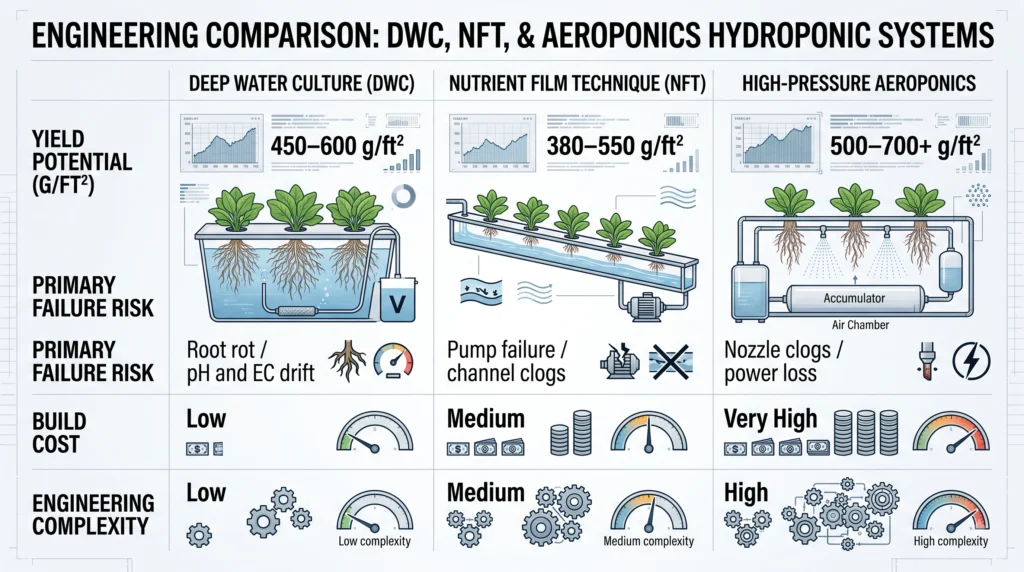
| Metric | DWC | NFT | Aeroponics |
| Average Yield Potential (g/ft2) | 450 – 600 | 380 – 550 | 500 – 700+ |
| Primary Failure Modes & Risks | Root Rot, pH/EC Drift | Pump Failure, Channel Clogs | Clogged Misters, Power Loss |
| Component & Build Cost | Low | Medium | Very High |
| Engineering Learning Curve | Low | Medium | High |
The yield potential of aeroponics strictly assumes the system is perfectly optimized. NASA-funded agricultural studies demonstrate that finely tuned aeroponics can outpace traditional soil and standard hydroponic methods significantly, but only when the nutrient payload is mathematically perfect. Because the roots lack a buffering medium, tracking inputs demands precision. Utilizing a robust hydroponic nutrient calculator is a mandatory step for mapping parts-per-million (PPM) thresholds when running HPA systems.
Crop-Specific Engineering
System selection must follow the biological demands of the intended crop. Root architecture, transpiration rates, and fruiting mass dictate the mechanical requirements of the grow space.
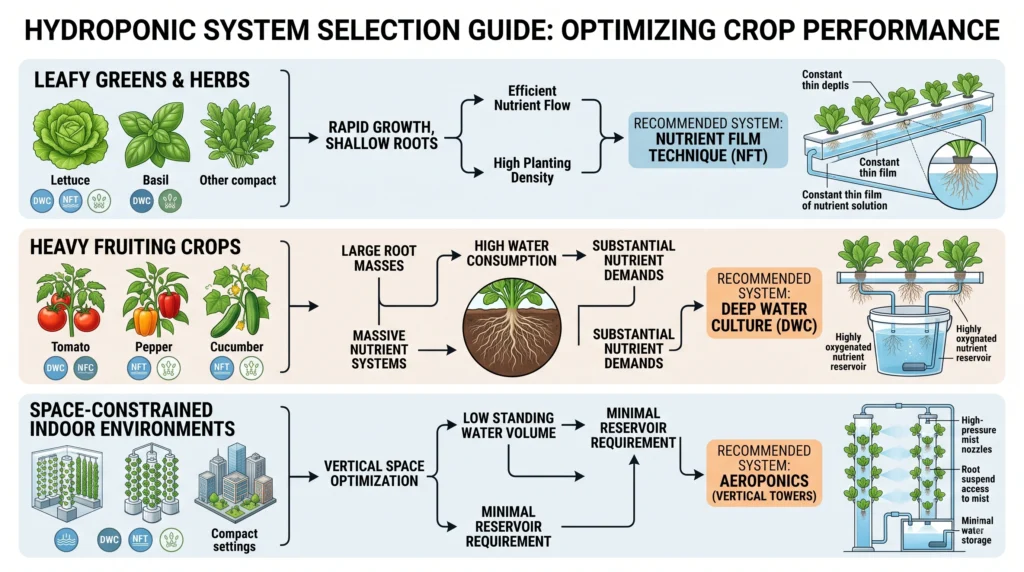
Leafy Greens and Herbs
Lettuce, basil, and fast-growing greens feature shallow, dense root networks. NFT is precision-engineered for these crops. The shallow channels limit the physical space the roots can occupy, preventing waterlogging while maintaining an unbroken stream of nutrients. Because leafy greens have high transpiration rates but low structural weight, they thrive in the rapid-turnover environment of an NFT channel.
Heavy Fruiting Crops (Tomatoes, Peppers, Cucumbers)
Fruiting crops demand massive nutritional uptake and develop extensive root systems capable of choking standard plumbing lines. DWC provides the sheer physical space required for these aggressive root mats. A mature tomato plant will easily consume several gallons of water per day. In a DWC reservoir, this uptake is easily managed. If placed in an NFT setup, the root mass of a single pepper plant can dam the channel, causing immediate overflow and crop death. Understanding the spatial limits of these plants is essential; mapping out the growth parameters via a hydroponic systems for fruits guide will prevent structural blowouts.
Space Constrained and Indoor Environments
Growers operating in apartments or tightly sealed indoor spaces must factor in humidity, structural weight, and noise. DWC reservoirs are incredibly heavy (water weighs 8.34 lbs per gallon), making large setups a structural risk for older apartment floors. NFT systems distribute weight effectively but require long horizontal runs. Aeroponics provides the highest vertical space efficiency with minimal water weight, though pump noise must be isolated. Evaluating these limits against specific property restrictions ensures safe operation. Check the hydroponic systems for apartments breakdown for load-bearing and leak-mitigation protocols.
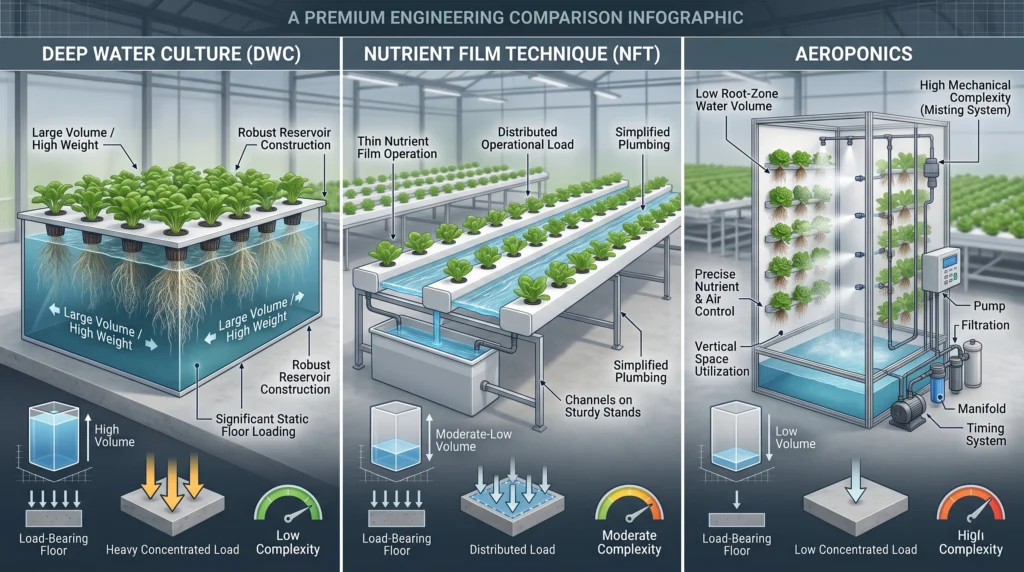
Failure Autopsy Reports: Engineering Disasters
Understanding how systems fail provides the blueprint for preventing catastrophic losses. Hydroponic failures are rarely random; they are mathematical certainties born from unchecked variables.
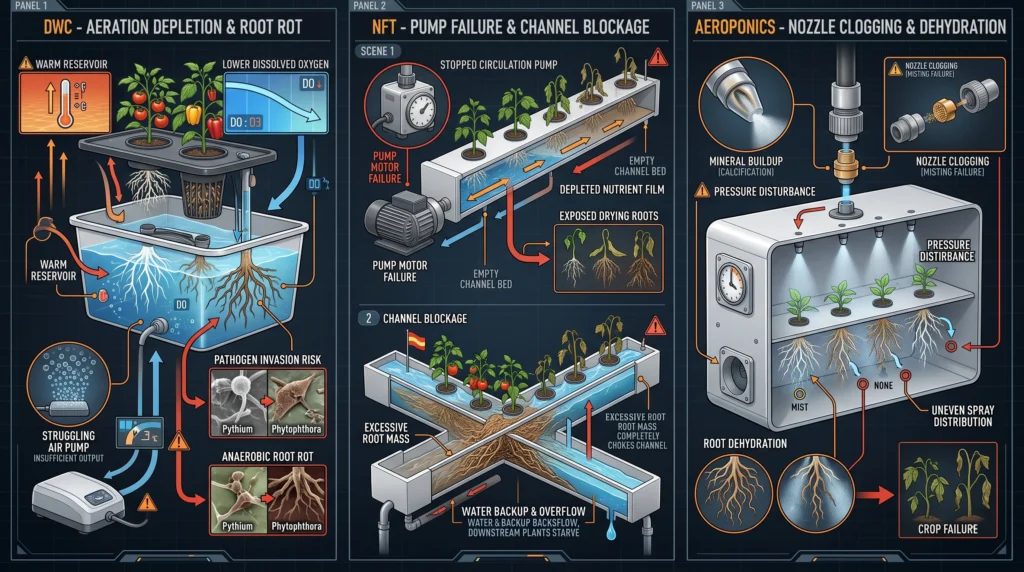
DWC: The Silent Pythium Collapse
The most frequent destroyer of a DWC crop is a collapse in Dissolved Oxygen, leading directly to Pythium (root rot). This pathogen thrives in warm, oxygen-depleted water. The failure cascade typically looks like this:
- Ambient room temperature rises, warming the reservoir water above 72F.
- The warmer water physically sheds dissolved oxygen molecules.
- Simultaneously, the warmer water accelerates the plant’s metabolism, doubling the root zone’s oxygen demand.
- The air pump, pushing warm ambient air into the water, fails to meet the deficit.
- Anaerobic conditions trigger rapid fungal replication.
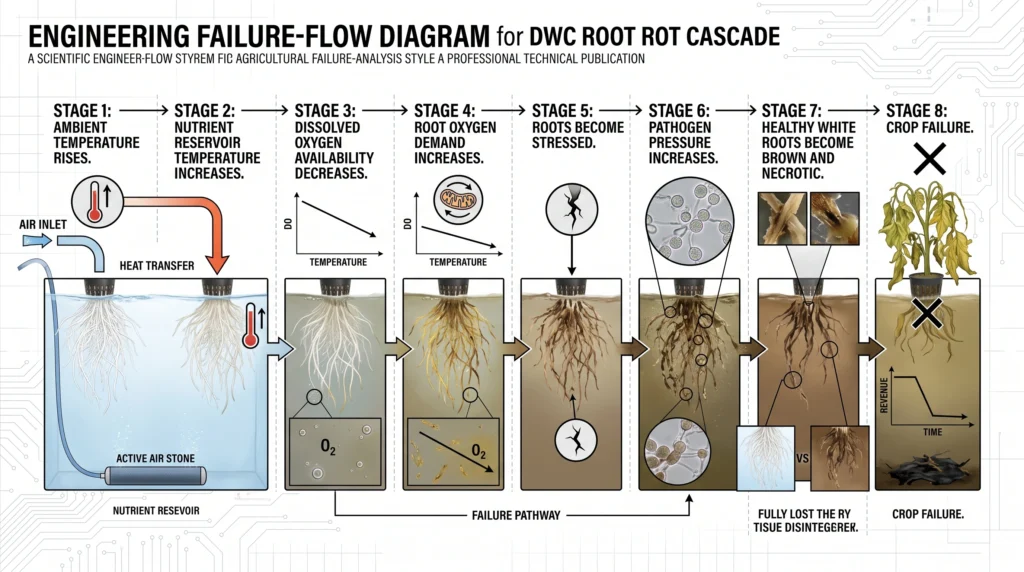
Within a week, white fibrous roots turn into brown, necrotic sludge. Prevention requires strict thermal control and proactive biological inoculation. Implementing the exact protocols found in our hydroponic root rot prevention guide will armor the reservoir against this specific failure loop.

- Premium Materials: This pump dissipates heat more effectively with aluminum alloy heat-radiating plates and delivers exc…
- Powerful Airflow: VIVOSUN’s 40W electromagnetic motor delivers exceptional air pressure up to 0.03 MPa and a high volume…
- Continuous Operation: Innovative material engineering on the steel engine column and piston makes this pump highly energ…
- Why it’s necessary: Small aquarium pumps cannot push sufficient air volume to agitate deep reservoirs. Commercial electromagnetic air pumps deliver the high LPM (Liters Per Minute) required to force massive oxygen exchange at the water’s surface.
- Key Spec: Electromagnetic motor, 60+ liters per minute output.
NFT: The Domino Effect of Flow Interruption
NFT systems operate on a razor-thin margin of error. The system relies entirely on a continuous, uninterrupted flow of water.
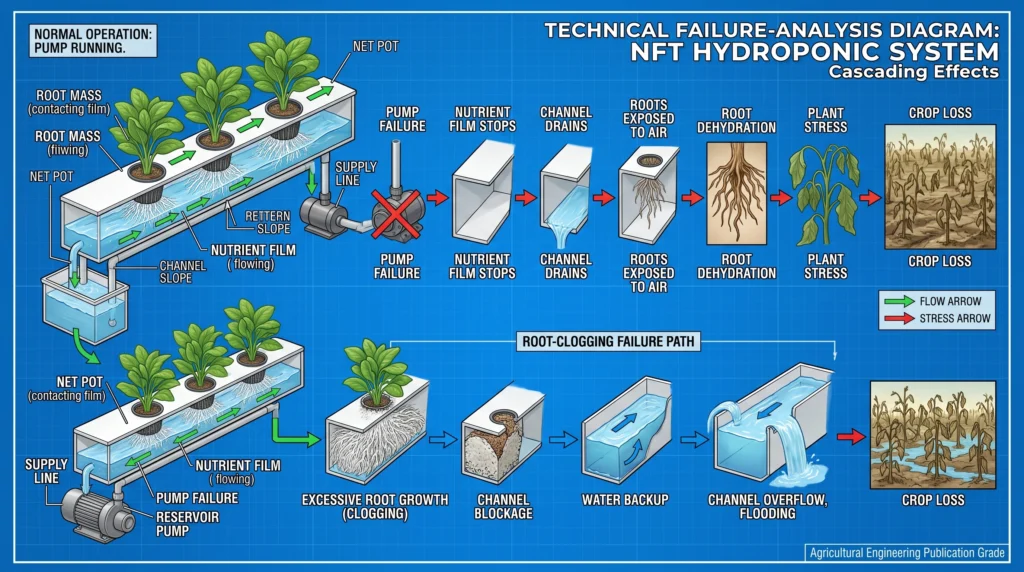
A standard failure involves a grower leaving a system unmonitored for 48 hours. A localized power outage trips the circuit, or a loose piece of root mass gets sucked into the submersible pump impeller. The pump stops. Because the channel is sloped and contains almost no standing water, the liquid drains out completely within minutes. The exposed roots, unaccustomed to dry air, begin to desiccate immediately. Within four to six hours, cellular damage is irreversible.
A secondary NFT failure mode involves bio-fouling. As roots grow thick, they trap particulate matter and microbial slime, creating dams inside the channel. The water backs up, drowning the upper oxygen-breathing roots, leading to immediate localized rot. Monitoring flow rates and installing physical filters prevents this. For advanced plumbing diagrams on filtration, see the NFT channel clogs guide.
Aeroponics: The Precision Bottleneck
Aeroponic systems fail violently and expensively. High-pressure misters feature microscopic orifices (often 0.016 inches in diameter). They are highly susceptible to calcium and magnesium precipitation.
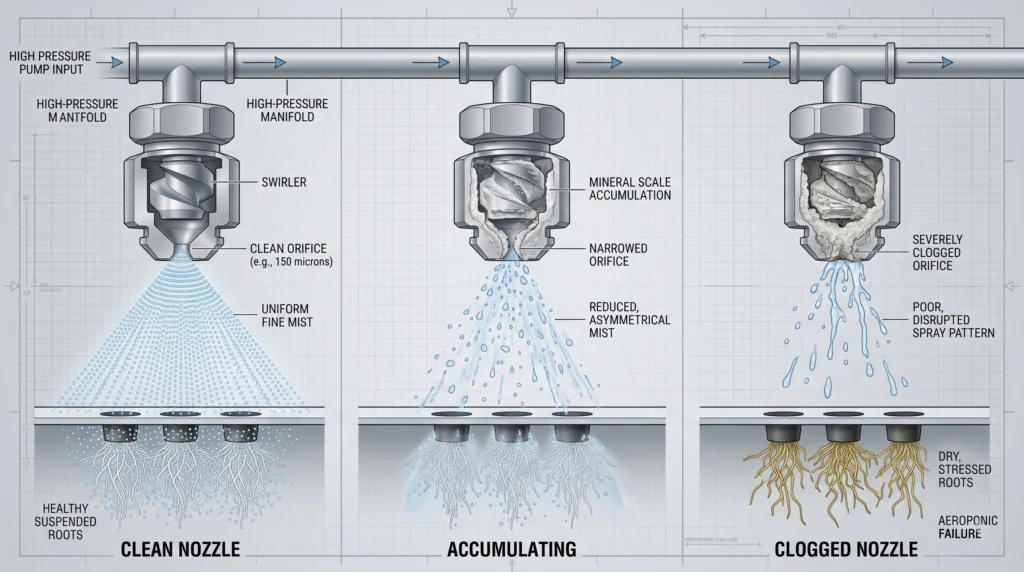
If a grower mixes a nutrient solution with hard tap water, or fails to properly buffer the pH, scale begins to form inside the plumbing lines. A single microscopic flake of calcium carbonate can jam a misting nozzle. In a manifold containing twenty nozzles, a single clog causes a localized pressure spike, forcing more fluid through the remaining nozzles. This alters the droplet size from 50 microns up to 100+ microns. The system stops producing fog and starts producing rain. The roots dry out or become waterlogged, and the crop dies rapidly.
Running high-pressure systems requires strict chemical management. Managing the solubility of distinct fertilizer salts ensures the nozzles remain clear. Studying the aeroponic nutrient guide is a requirement for maintaining uninterrupted misting cycles.
Nutrient Dosing and Chemical Buffering Dynamics
The interaction between hydroponic nutrients, pH levels, and the volume of the system dictates crop stability. Chemical buffering prevents sudden spikes in acidity or alkalinity that lock out essential elements.
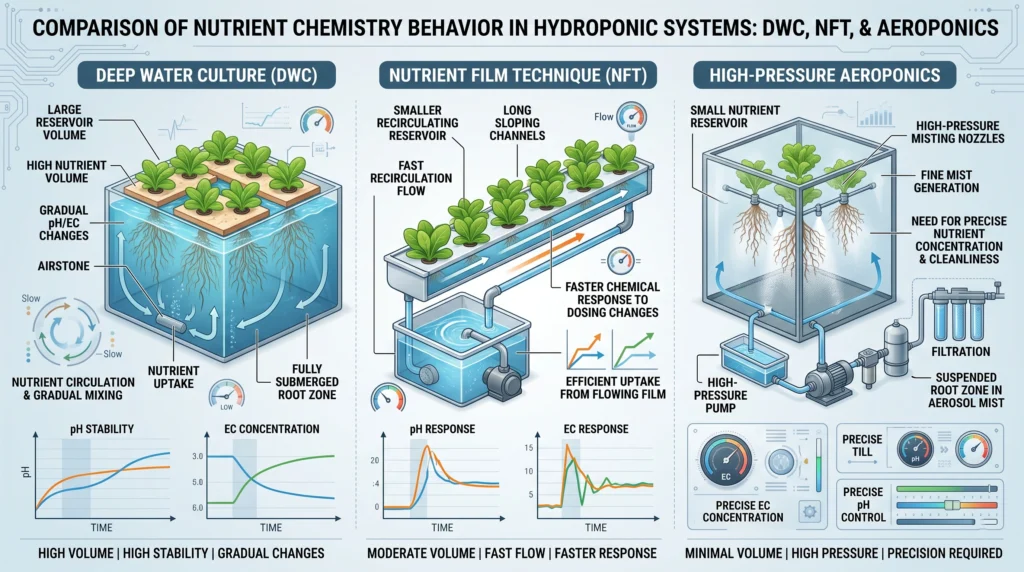
Chemical stability behaves differently across DWC, NFT, and Aeroponics due to the distinct volumes of water in play.
In a 50-gallon DWC reservoir, adding 10ml of Phosphoric Acid (pH Down) will lower the pH gradually. The sheer mass of the water dilutes the acid, creating a slow, measurable shift. The high volume also means that as plants consume nitrate (which naturally raises pH) or ammonium (which lowers pH), the total drift per day is minimal.
In an NFT system, the total system volume might only be 15 gallons for a large array of channels. The same 10ml of acid will cause a sharp, aggressive drop in pH. Rapid swings in pH cause immediate nutrient lockout. For example, if pH drops below 5.5, the absorption of Calcium (Ca2+) and Magnesium (Mg2+) halts, leading directly to blossom end rot and leaf curling.
Aeroponics introduces an entirely different chemical dynamic. Because the water is atomized, the concentration of the nutrients hitting the root zone is absolute. There is no surrounding water to dilute the immediate impact of the droplet. If the EC (Electrical Conductivity) is mixed too high, the resulting mist will cause rapid osmotic shock, burning the root hairs instantly. Precision in mixing and testing is non-negotiable. Mastering these chemical thresholds is complex but entirely necessary. A full breakdown of these interactions is available in the hydroponic pH and EC mastery guide.
Pro Tips for Advanced Engineering
Transitioning from a basic setup to a commercial-grade yield requires engineering foresight. Apply these specific mechanical upgrades to stabilize the grow space.
- DWC Sub-Surface Agitation: Do not rely solely on air stones. Implement a Venturi injector on a submersible water pump. As the pump circulates water within the reservoir, the Venturi valve sucks in ambient air, smashing it into micro-bubbles. This dual-action approach increases dissolved oxygen saturation far beyond standard air stones. Furthermore, inoculating the reservoir with specific biological agents will aggressively outcompete root rot pathogens. To identify the exact strains needed, review the hydroponic microbes and enzymes guide.
- NFT Channel Calibration: Standard 4-inch PVC pipe is cheap but structurally flawed for NFT. The curved bottom forces water into a narrow, deep stream in the center, missing the lateral roots. Use flat-bottomed, commercial NFT channels with ribbed flooring. The ribs force the water to spread evenly across the entire width of the channel, guaranteeing total root contact.
- Aeroponic Accumulator Tanks: Never wire a diaphragm pump directly to a misting timer. The constant on/off cycling (e.g., 3 seconds on, 3 minutes off) will burn out the pump’s internal motor rapidly. Plumb the pump into a pressurized RO (Reverse Osmosis) accumulator tank. The pump fills the tank until it reaches 100 PSI and shuts off. The misting solenoids draw from the pressurized tank, allowing the pump to rest.
Frequently Asked Questions
What is the most forgiving hydroponic system for a beginner?
Deep Water Culture (DWC) offers the highest margin of error. The large volume of water provides a massive buffer against temperature spikes and sudden pH shifts. If a power outage occurs, the roots remain submerged in a nutrient solution, allowing the plants to survive for days without mechanical intervention. The initial setup requires minimal plumbing, making it highly accessible.
Which system has the highest risk of total crop failure?
High-Pressure Aeroponics (HPA) carries the greatest mechanical risk. Because the roots are suspended in the air without any moisture-retaining media, a power failure or a clogged nozzle will cause the root zone to dry out completely within hours. System redundancy, including backup power and secondary filtration, is mandatory to prevent sudden, catastrophic losses.
What is the primary operational advantage of NFT over DWC?
Nutrient Film Technique drastically reduces the total weight and water volume required to operate the system. A 100-plant DWC system may require 200 gallons of heavy, standing water. A 100-plant NFT system can operate on a highly efficient 20-gallon reservoir. This rapid turnover ensures exact nutrient delivery while keeping the overall structural load of the grow space extremely low.
Can heavy fruiting plants like tomatoes be grown effectively in NFT channels?
While possible, it is highly problematic and mechanically risky. Tomatoes and peppers develop massive, dense root networks that quickly expand to fill the entire cavity of standard NFT channels. Once the channel is blocked, the nutrient solution dams up, overflows the channel, and cuts off oxygen to the roots. DWC or specialized Bato (Dutch) bucket systems are vastly superior for heavy fruiting crops.
Why do aeroponic systems produce higher yields under laboratory conditions?
Aeroponics maximizes the exposure of the root zone to atmospheric oxygen while delivering perfectly sized nutrient payloads. By utilizing 30-50 micron droplets, the nutrient solution adheres directly to the micro-root hairs, facilitating rapid cellular absorption. Because the plant expends zero energy searching for oxygen or breaking down soil compounds, 100% of its metabolic energy is redirected into rapid vegetative and floral growth.
How does water temperature affect hydroponic root health?
Water temperature directly controls the solubility of oxygen. As water warms above 72F (22C), it physically loses its ability to hold dissolved oxygen. Simultaneously, the warm water acts as an incubator for anaerobic pathogens like Pythium. Maintaining water temperatures between 65F and 68F guarantees high oxygen retention and suppresses aggressive fungal development in the root zone.
Is it necessary to run NFT pumps continuously, or can they be placed on a timer?
NFT pumps must run continuously, 24 hours a day, 7 days a week. The system is designed to provide a constant, shallow film of flowing water. Placing an NFT pump on an intermittent timer causes the roots to cycle through wet and dry phases, stressing the plant, destroying delicate root hairs, and severely stunting growth.
Conclusion
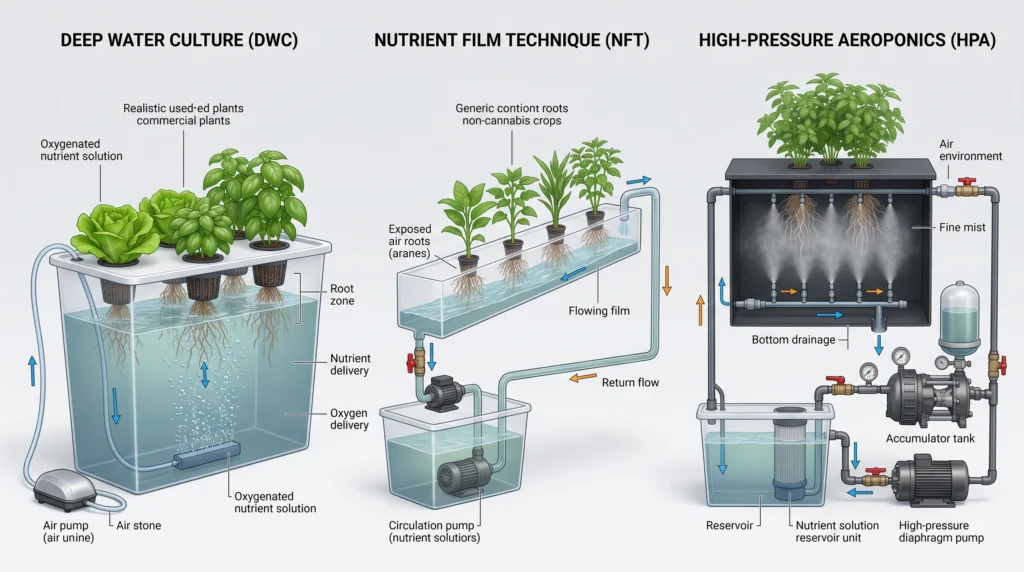
Selecting between DWC, NFT, and Aeroponics is an engineering decision, not a matter of preference. Deep Water Culture provides unparalleled buffering and volume for massive root systems, making it a resilient powerhouse. Nutrient Film Technique offers lean, high-velocity efficiency tailored perfectly for commercial leafy green production. Aeroponics sits at the pinnacle of high-risk, high-reward agriculture, demanding mechanical perfection in exchange for explosive growth rates. Align the system’s physical mechanics with your specific crop profile, environmental constraints, and operational capacity.
To explore specific build schematics, calculate nutrient loads, and refine your grow space architecture, visit the MistCulture Hydroponics Comparison Hub.

Continue Your Learning Journey