Masterblend vs Jack’s 321 vs FloraSeries: Best Nutrients

Table of Contents
- At a Glance: Masterblend vs Jack's 321 vs FloraSeries Comparison
- Key Evaluation Criteria: How We Benchmark Hydroponic Nutrients
- Deep-Dive Chemistry: Dry Concentrates vs. Liquid Formulations
- Head-to-Head #1: Masterblend 4-18-38 Tomato Formula Breakdown
- Head-to-Head #2: Jack's 3-2-1 (5-12-26) System Breakdown
- Head-to-Head #3: General Hydroponics FloraSeries (3-Part Liquid) Review
- Cost-Per-Gallon Analysis and ROI
- Mixing Workflow, Precipitation Risks, and A/B Reservoir Management
- Real-World Crop Compatibility: Matching Formula to Plant
- Recommended Accessories & Essential Tools
- Frequently Asked Questions (FAQ)
- Final Verdict: Which Nutrient System Belongs in Your Grow Room?
Every hydroponic grower eventually faces a defining crossroads: should you stick with the plug-and-play convenience of pre-mixed liquid fertilizers, or transition to commercial-grade hydroponic dry nutrients? Selecting the right fuel for your system dictates your crop yield, elemental availability, reservoir stability, and long-term operating costs.
In the world of controlled-environment agriculture (CEA), three nutrient systems dominate the conversation: Masterblend 4-18-38, Jack’s 3-2-1 (5-12-26), and General Hydroponics FloraSeries. Two of these are dry multi-part powders that require manual weighing and dissolving; one is an iconic three-part liquid concentrate that has powered hobby and commercial grow rooms for decades.
If you are running recirculating Deep Water Culture (DWC), Nutrient Film Technique (NFT), or drip-irrigated Dutch buckets, understanding the exact chemistry, ease of use, and cost-per-gallon metrics of these formulations is critical. Let’s pit these three powerhouses head-to-head to see which nutrient program earns a permanent spot in your reservoir.
Legal Note: Regulations vary by location. Always consult local guidelines. This content is for educational purposes only.
At a Glance: Masterblend vs Jack’s 321 vs FloraSeries Comparison
Selecting the ideal fertilizer program requires balancing chemical versatility against labor requirements. The table below breaks down the technical parameters, operational mechanics, and cost efficiencies of all three systems.
| Feature / Metric | Masterblend Tomato Formula | Jack’s 3-2-1 System | General Hydroponics FloraSeries |
| Physical Form | Dry Salt Powder (3-Part System) | Dry Salt Powder (3-Part System) | Liquid Concentrate (3-Part System) |
| Core Base NPK | 4-18-38 (Tomato Formula) | 5-12-26 (Hydroponic) | 2-1-6 (Gro) / 5-0-1 (Micro) / 0-5-4 (Bloom) |
| Required Add-Ons | Calcium Nitrate (15.5-0-0) + Epsom Salt | Calcium Nitrate (15.5-0-0) + Epsom Salt | Optional Cal-Mag depending on source water |
| Standard Mix Ratio (per Gal) | 2.4g Masterblend / 1.2g Epsom / 2.4g CalNit | 3.6g Jack’s / 1.2g Epsom / 2.4g CalNit | Variable (1.5mL to 7.5mL of each per Gal) |
| Target Application | Heavy fruiting crops, tomatoes, peppers | Universal (Leafy greens, peppers, tomatoes) | Highly adaptable for all crop stages |
| Iron Chelate Source | Fe-EDTA | Fe-DTPA (Superior for higher pH ranges) | Fe-DTPA / Fe-EDDHA mix |
| Cost per 100 Gallons | ~$1.20 – $1.80 | ~$1.10 – $1.60 | ~$8.50 – $14.00 |
| Shelf Life | Indefinite (if kept sealed & dry) | Indefinite (if kept sealed & dry) | 2-3 Years (susceptible to salt fallout) |
| System Compatibility | DWC, Dutch Buckets, Run-to-Waste | DWC, NFT, Aeroponics, Drip Systems | All systems, highly forgiving for small spaces |
Key Evaluation Criteria: How We Benchmark Hydroponic Nutrients
Hydroponic performance is evaluated across five engineering metrics: Elemental Bioavailability, Mixing Complexity, Economic Efficiency, Buffer Stability, and System Versatility. A superior nutrient system must deliver essential ions without causing chemical precipitation, pH drift, or prohibitive operational costs.
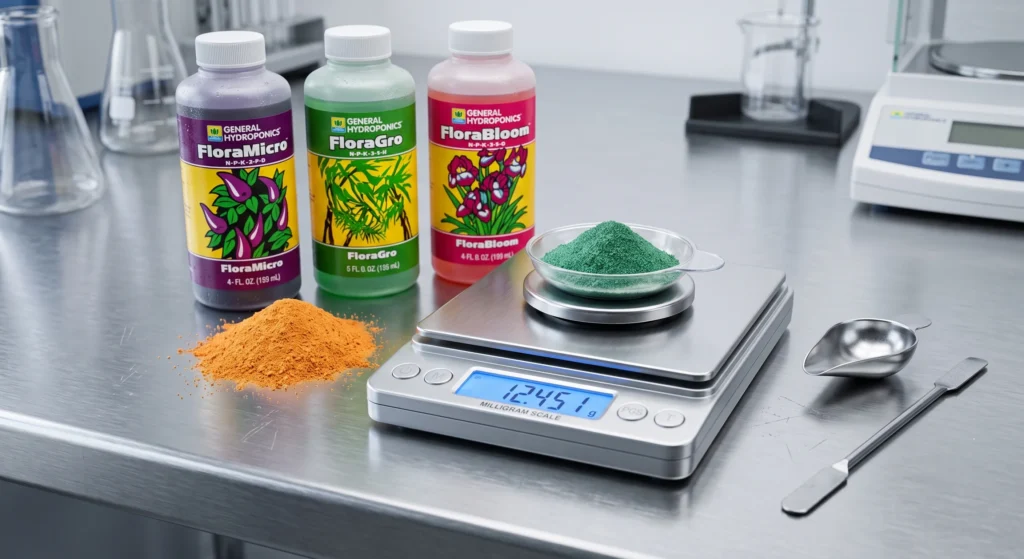
To evaluate these nutrients, we look directly at elemental parts-per-million (PPM) delivered to the root zone at target Electrical Conductivity (EC) levels. A complete hydroponic nutrients guide emphasizes that plants absorb ions in inorganic form: nitrogen as nitrate (NO3-) or ammonium (NH4+), phosphorus as orthophosphate (H2PO4-), and potassium as K+.
We benchmark these systems based on how effectively they deliver these ions without clogging emitters or requiring excessive pH adjustments.
- Elemental Bioavailability & Ratio Control: Does the formula supply correct macro- and micro-element balances across vegetative, flowering, and fruiting phases?
- Dissolution & Chemical Compatibility: How rapidly do dry salts dissolve, and do they leave behind insoluble sediment or scum?
- Cost Efficiency (Cost per Gallon Working Solution): How far does your investment go when mixing thousands of gallons of working solution?
- pH and EC Stability: How well does the final solution hold its charge and maintain target acidity in a active recirculating system?
- Ease of Use & Storage: Is the system user-friendly for home setups, or does it demand milligram scales and A/B stock mixing tanks?
Deep-Dive Chemistry: Dry Concentrates vs. Liquid Formulations
Dry salt powders offer near-infinite shelf life and extreme cost savings by eliminating the cost of shipping water weight, whereas liquid concentrates provide instant, dust-free dissolution ideal for small-scale systems. The primary chemical distinction lies in water density and trace element chelation stability over time.
Liquid nutrients like General Hydroponics FloraSeries are essentially pre-dissolved mineral salts suspended in water. Because calcium ions react with sulfate and phosphate ions at high concentrations to form insoluble calcium sulfate (gypsum) and calcium phosphate (sand), liquid fertilizers must be separated into at least two or three distinct bottles. FloraMicro contains the calcium and nitrogen, while FloraGro and FloraBloom carry the phosphorus, potassium, and magnesium.
PRECIPITATION REACTION (WHEN MIXED IN HIGH CONCENTRATIONS):
Ca(NO3)2 + MgSO4  --->  CaSO4 (Insoluble Gypsum) + Mg(NO3)2
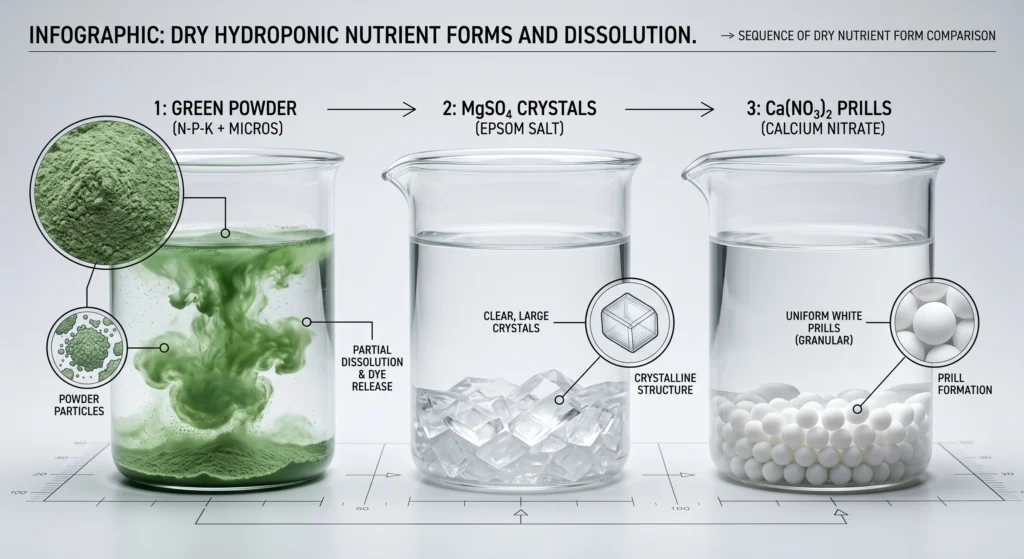
Conversely, hydroponic dry nutrients provide those same mineral salts in raw, un-hydrated crystalline form. You buy the pure compounds: Potassium Nitrate , Monopotassium Phosphate , Magnesium Sulfate, and Calcium Nitrate. By keeping the dry salts segregated until they are diluted into the main water reservoir, you eliminate the risk of premature salt fallout.
Furthermore, dry salts use specific chelated iron complexes. Masterblend utilizes Fe-EDTA, which functions best below a pH of 6.5. Jack’s 3-2-1 uses Fe-DTPA, which remains stable and bioavailable up to a pH of 7.5. This difference makes Jack’s significantly more forgiving if your source water has higher alkalinity or if your reservoir experiences upward pH drift.
Head-to-Head #1: Masterblend 4-18-38 Tomato Formula Breakdown
The masterblend tomato formula is an industry standard dry fertilizer engineered specifically for Solanaceous crops like tomatoes, peppers, and eggplants, yet modified easily for leafy greens. It is designed to be paired with Calcium Nitrate and Epsom Salt to create a complete, balanced hydroponic feed.
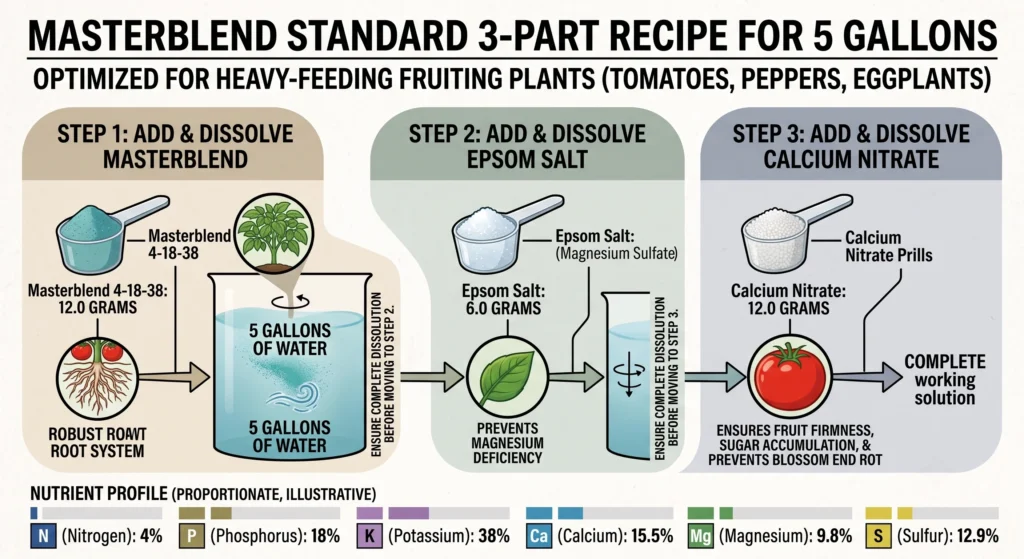
MASTERBLEND STANDARD 3-PART RATIO (Per 5 Gallons of Water):
1. Masterblend 4-18-38 : 12.0 grams
2. Epsom Salt          :  6.0 grams
3. Calcium Nitrate     : 12.0 grams
When dissolved in correct order, this classic mix produces a working solution tailored for heavy-feeding, fruiting plants. The high potassium-to-nitrogen ratio drives reproductive growth, fruit firmness, and sugar accumulation (Brix levels).
Elemental PPM Profile for Masterblend 4-18-38 (Standard 1x Mix per 100 Gal):
| Element | Nitrogen (N) | Phosphorus (P) | Potassium (K) | Calcium (Ca) | Magnesium (Mg) | Iron (Fe) |
| PPM Delivered | 120 | 48 | 215 | 125 | 32 | 2.5 |
Pros of Masterblend:
- Phenomenal Value: Reduces fertilizer expenditures by up to 80% compared to liquid bottles.
- High Potassium Output: The 4-18-38 base ratio naturally promotes dense floral development and massive fruit sizing.
- Long-Term Storage: Dry components cannot freeze, spoil, or form bottom-of-the-bottle sludge during winter storage.
Cons of Masterblend:
- Strict Order of Addition: Adding Calcium Nitrate before dissolving Masterblend and Epsom salt causes immediate water clouding and nutrient precipitation.
- Fe-EDTA Limitations: Iron bioavailability drops rapidly if your system water drifts above a pH of 6.4.
If you are expanding your commercial operation or setting up a high-yield outdoor Dutch bucket array, consult our guide on diy hydroponic systems to match your irrigation layout with dry salt feeding programs.
Head-to-Head #2: Jack’s 3-2-1 (5-12-26) System Breakdown
Jack’s 3-2-1 is a legendary dry salt program manufactured by JR Peters Inc., built around their 5-12-26 Part A formula. The famous jacks 321 recipe gets its name from its volumetric and weight-based ratio of 3 parts Jack’s 5-12-26, 2 parts Calcium Nitrate, and 1 part Epsom Salt.
THE CLASSIC JACK'S 3-2-1 RECIPE (Per 1 Gallon of Water):
1. Jack's 5-12-26     : 3.6 grams (or 3.0g for lighter feeds)
2. Epsom Salt          : 1.2 grams (or 1.0g)
3. Calcium Nitrate     : 2.4 grams (or 2.0g)
Jack’s 3-2-1 delivers a slightly higher base nitrogen level than Masterblend, alongside a higher ratio of micronutrients and a superior Fe-DTPA iron chelate. This makes it an exceptional “universal” feed that works seamlessly from vegetative growth straight through heavy fruiting without needing complex ratio shifts.
Elemental PPM Profile for Jack’s 3-2-1 (3.6g / 1.2g / 2.4g per Gallon):
| Element | Nitrogen (N) | Phosphorus (P) | Potassium (K) | Calcium (Ca) | Magnesium (Mg) | Iron (Fe) |
| PPM Delivered | 150 | 52 | 215 | 116 | 38 | 3.0 |
Pros of Jack’s 3-2-1:
- Fe-DTPA Iron Source: Iron stays fully soluble and accessible to plant roots up to a pH of 7.5.
- Single Formula Simplicity: Works reliably across leafy greens, fruiting vegetables, and medical crops without requiring a “grow” or “bloom” switch.
- Ultra-Clean Dissolution: Dissolves rapidly in cold water with zero leftover residue or chemical haze.
Cons of Jack’s 3-2-1:
- Requires Precision Scales: Needs an accurate 0.01g scale to weigh inputs correctly; guessing or using volumetric spoons will ruin your target EC.
- Hygroscopic Calcium Nitrate: Calcium nitrate absorbs atmospheric moisture rapidly once opened; you must store it in an airtight container to prevent clumping.
To keep track of how Jack’s 3-2-1 performs over full crop rotations, grab a copy of our hydroponic grow journal template to log your daily pH, EC, and water top-up numbers.
Head-to-Head #3: General Hydroponics FloraSeries (3-Part Liquid) Review
The General Hydroponics FloraSeries (FloraGro, FloraMicro, and FloraBloom) is the benchmark liquid nutrient system in hobby hydroponics. A comprehensive flora series review must highlight its unmatched flexibility: by altering the relative ratios of the three bottles, you can create a customized feed for seedlings, leafy greens, aggressive vegetative canopies, or heavy flowering plants.
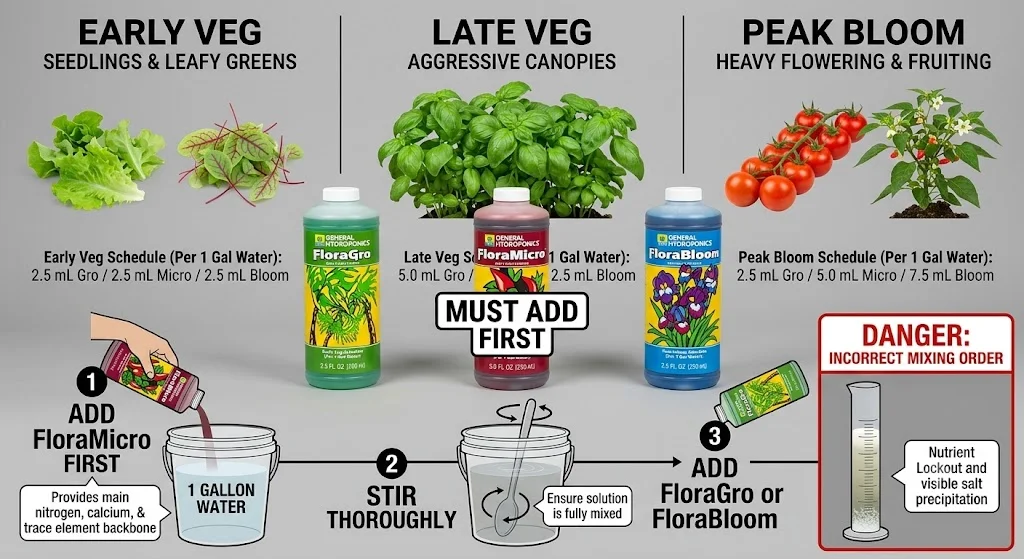
FLORASERIES GENERAL RECIRCULATING SCHEDULE (Per 1 Gallon Water):
- Early Veg : 2.5 mL Gro / 2.5 mL Micro / 2.5 mL Bloom
- Late Veg  : 5.0 mL Gro / 5.0 mL Micro / 2.5 mL Bloom
- Peak Bloom: 2.5 mL Gro / 5.0 mL Micro / 7.5 mL Bloom
Because FloraMicro provides the main nitrogen, calcium, and trace element backbone, it must always be added to the reservoir first and stirred thoroughly before adding FloraGro or FloraBloom. Failing to follow this mixing order results in nutrient lockout and visible salt precipitation inside your measuring cylinder.
Pros of FloraSeries:
- Zero Weighing Required: Simply measure liquid volume in milliliters with a graduated syringe or measuring cup.
- Total Target Versatility: Easily adjust nitrogen downward and phosphorus/potassium upward at the exact moment your plants switch from vegetative growth to flowering.
- Widespread Availability: Available in virtually every hydro shop globally, making replacement bottles easy to grab.
Cons of FloraSeries:
- High Cost per Gallon: You pay a heavy premium for bottled water, packaging, and shipping costs.
- Frequent Bottled Replacements: Small-scale commercial growers will quickly find themselves cycling through 2.5-gallon jugs of liquid nutrients at an unsustainable cost.
- Possible Cal-Mag Deficiencies: When used with Reverse Osmosis (RO) water, FloraSeries often requires supplemental calcium and magnesium, detailed in our cal-mag hydroponics guide.
Cost-Per-Gallon Analysis and ROI
When evaluating long-term farm economics or budgeting for a home grow room, fertilizer input costs compound rapidly. Water accounts for over 90% of the weight in liquid fertilizer bottles; shipping heavy water across the country inflates your cost per gallon of working solution.
The financial breakdown below compares the cost to mix 1,000 gallons of working solution at full strength (~1.8 to 2.0 EC) using current market prices for dry bulk salts versus bottled liquid concentrates.
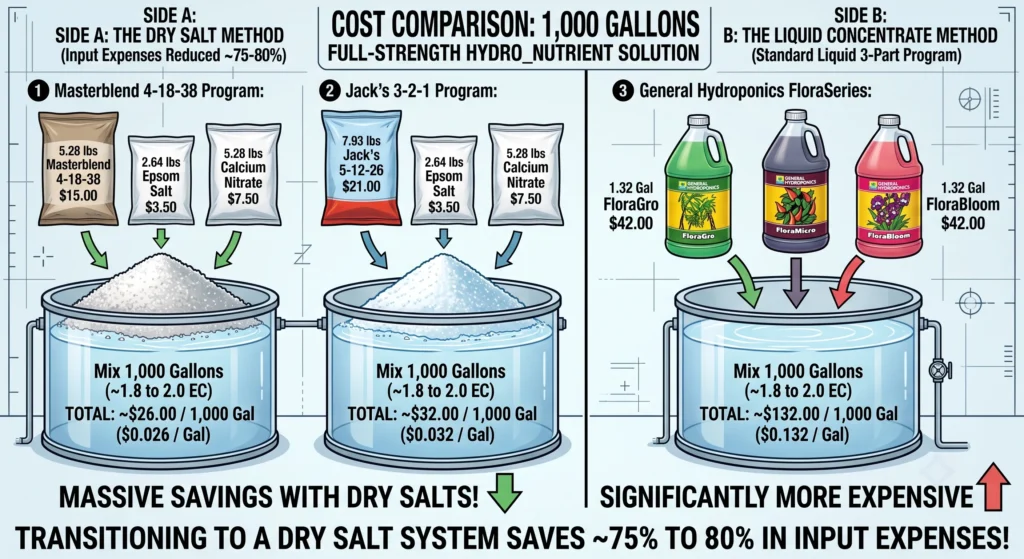
COST COMPARISON TO PREPARE 1,000 GALLONS OF WORKING NUTRIENT SOLUTION:

1. Masterblend 4-18-38 Program:
   - 5.28 lbs Masterblend ($15.00)
   - 2.64 lbs Epsom Salt ($3.50)
   - 5.28 lbs Calcium Nitrate ($7.50)
   TOTAL: ~$26.00 per 1,000 Gallons ($0.026 / Gal)

2. Jack's 3-2-1 Program:
   - 7.93 lbs Jack's 5-12-26 ($21.00)
   - 2.64 lbs Epsom Salt ($3.50)
   - 5.28 lbs Calcium Nitrate ($7.50)
   TOTAL: ~$32.00 per 1,000 Gallons ($0.032 / Gal)

3. General Hydroponics FloraSeries:
   - 1.32 Gal FloraGro ($42.00)
   - 1.32 Gal FloraMicro ($48.00)
   - 1.32 Gal FloraBloom ($42.00)
   TOTAL: ~$132.00 per 1,000 Gallons ($0.132 / Gal)
The mathematical reality is clear: transitioning from a standard liquid 3-part program like FloraSeries to a dry salt system like Jack’s 3-2-1 or Masterblend reduces your nutrient input expenses by roughly 75% to 80%.
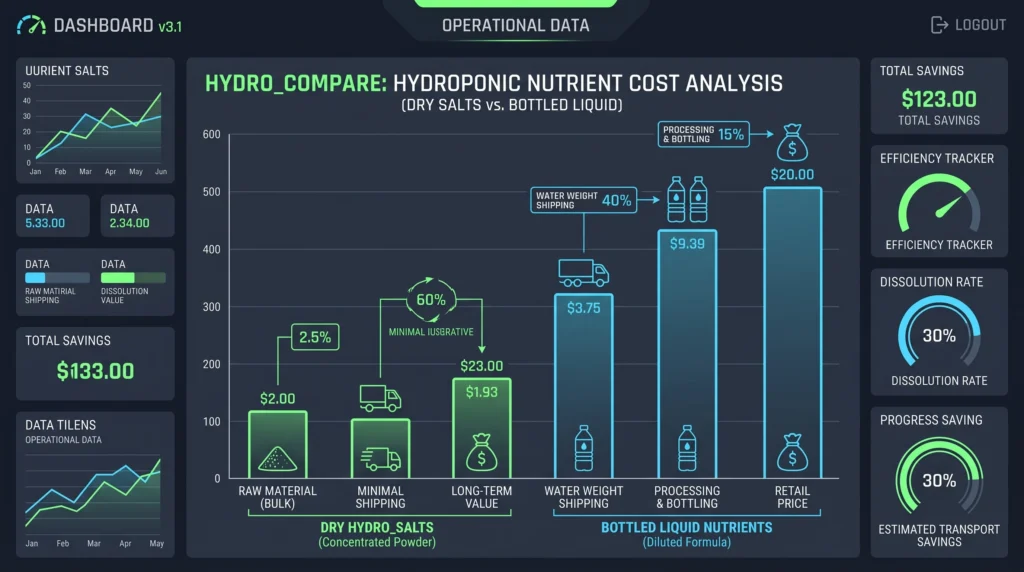
Over a single year running a modest four-bucket Dutch system or a multi-tier vertical rack, those savings pay for your EC meters, replacement pumps, and energy costs. To streamline these calculations for your own layout, use our free hydroponic nutrient calculator.
Mixing Workflow, Precipitation Risks, and A/B Reservoir Management
Proper mixing sequence is the golden rule of hydroponic nutrition. The primary cause of clogged drip emitters, failed pumps, and unexplained nutrient deficiencies is chemical lockout during the dissolution process.
The Science of Dissolution Order
When mixing dry salt formulas (whether executing the masterblend tomato formula or the jacks 321 recipe), never combine the dry powders together before adding them to water. Each component must be fully dissolved individually in the main body of water before adding the next.
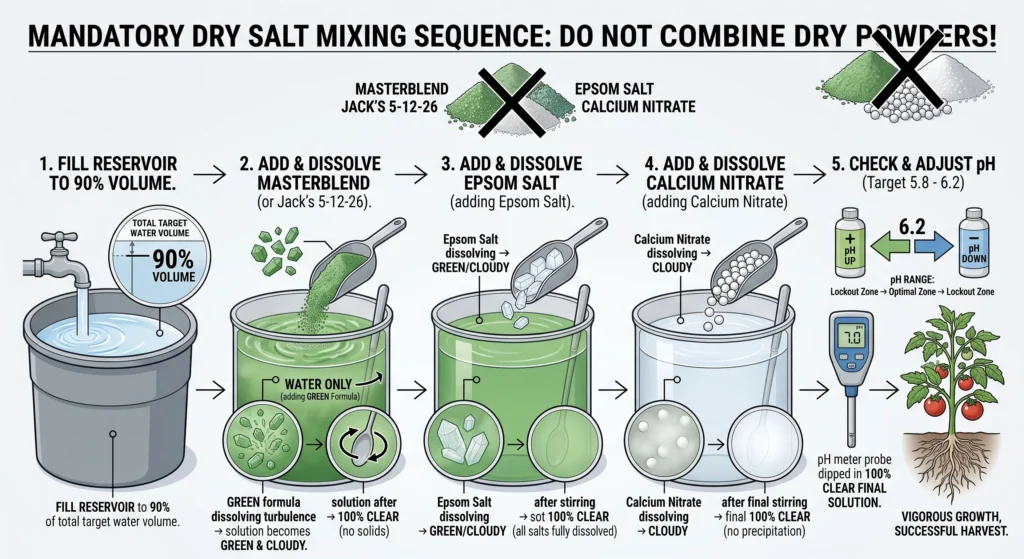
THE MANDATORY DRY SALT MIXING SEQUENCE:

STEP 1: Fill reservoir with 90% of total target water volume.
STEP 2: Add Masterblend (or Jack's 5-12-26) -> STIR UNTIL 100% CLEAR.
STEP 3: Add Epsom Salt (Magnesium Sulfate)  -> STIR UNTIL 100% CLEAR.
STEP 4: Add Calcium Nitrate (15.5-0-0)      -> STIR UNTIL 100% CLEAR.
STEP 5: Check & Adjust pH (Target 5.8 - 6.2).
Why Does Order Matter?
If you dissolve Calcium Nitrate in a small amount of water alongside Masterblend or Epsom Salt, the concentrated calcium ions instantly bind with the concentrated sulfate and phosphate ions. This forms calcium sulfate (gypsum), which precipitates out of solution as an insoluble white sludge that can never be dissolved back into water.
In commercial systems utilizing dual stock tanks (Concentrate A and Concentrate B), Calcium Nitrate and Iron Chelate are assigned exclusively to Tank A, while Masterblend (or Jack’s), Epsom Salt, and Monopotassium Phosphate are assigned to Tank B.
The two concentrated streams are only mixed together after being injected separately into the main irrigation line.
For complete control over your solution acidity after mixing, follow our step-by-step hydroponic pH and EC guide to prevent nutrient lockout.
Real-World Crop Compatibility: Matching Formula to Plant
Not all plants consume nutrients at the same rates. Matching the correct formula to your specific crop profile maximizes growth rates and prevents salt accumulation in the substrate.
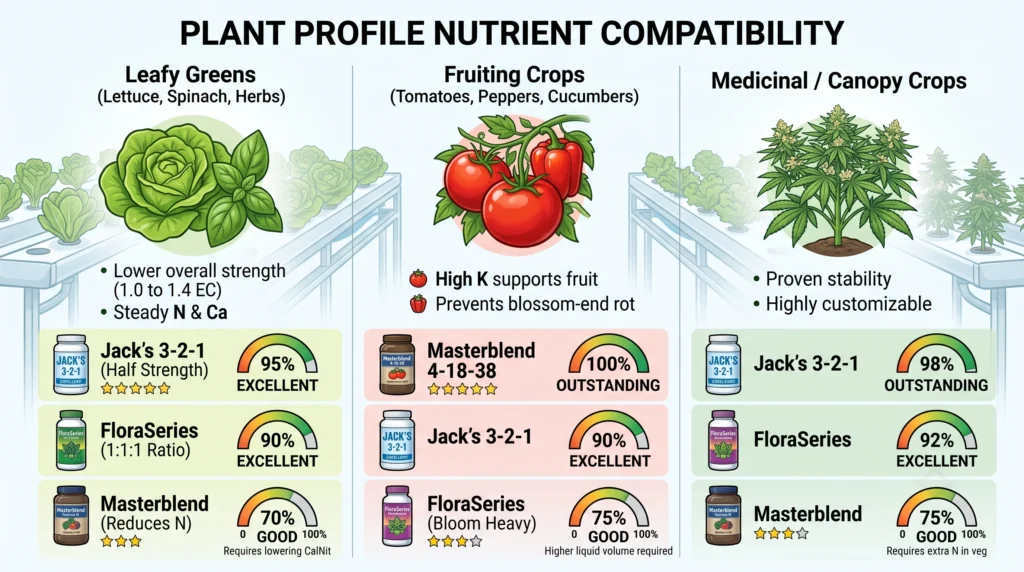
PLANT PROFILE NUTRIENT COMPATIBILITY:

Leafy Greens (Lettuce, Spinach, Herbs):
- Jack's 3-2-1 (Half Strength) : EXCELLENT
- FloraSeries (1:1:1 Ratio)    : EXCELLENT
- Masterblend (Reduces N)       : GOOD (Requires lowering CalNit)

Fruiting Crops (Tomatoes, Peppers, Cucumbers):
- Masterblend 4-18-38          : OUTSTANDING (High K supports fruit)
- Jack's 3-2-1                 : EXCELLENT
- FloraSeries (Bloom Heavy)    : GOOD (Higher liquid volume required)

Medicinal / Canopy Crops:
- Jack's 3-2-1                 : OUTSTANDING (Proven stability)
- FloraSeries                  : EXCELLENT (Highly customizable)
- Masterblend                  : GOOD (Requires extra N in veg)
Leafy greens like butterhead lettuce and basil thrive on lower overall strength (1.0 to 1.4 EC) with a steady supply of nitrogen and calcium. Jack’s 3-2-1 diluted to 50% strength provides an exceptional profile for leafy greens.
Conversely, heavy fruiting crops demand high potassium levels during fruit development to prevent blossom-end rot and hollow fruit; here, Masterblend’s high $K_2O$ output shines.
If you are setting up an indoor green rack, check out our guide on hydroponic lettuce yields to see how EC management directly impacts harvest weights.

Recommended Accessories & Essential Tools
To run dry salt nutrients or liquid concentrates with precision, you need reliable testing gear and measurement tools. Here are three essential tools I rely on in my own grow room:

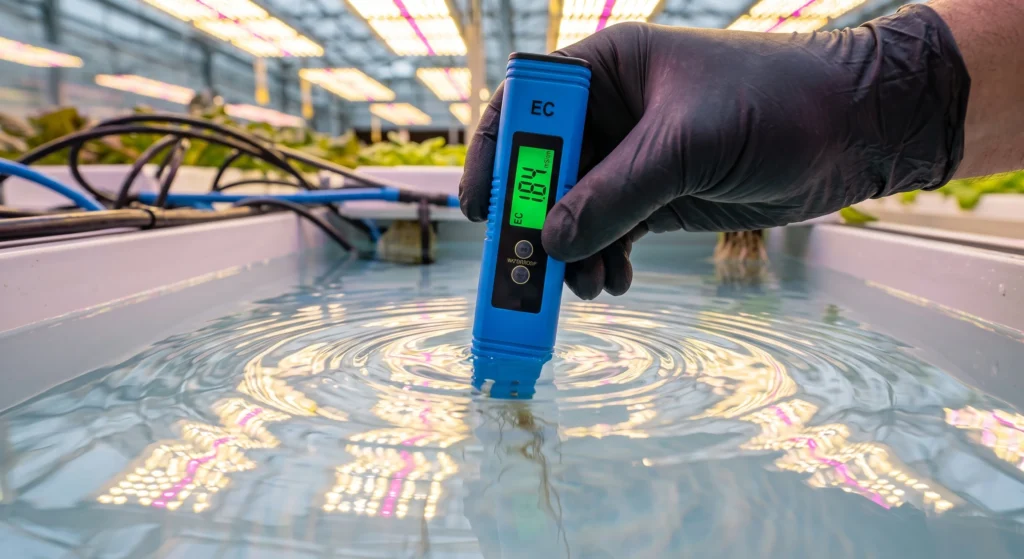
Why I use it: The Bluelab Truncheon is practically indestructible, completely waterproof, and never requires calibration. You simply dip it into your reservoir, and the LED indicators light up your exact EC and PPM readings instantly. It is the absolute gold standard for measuring hydroponic dry nutrients once dissolved.
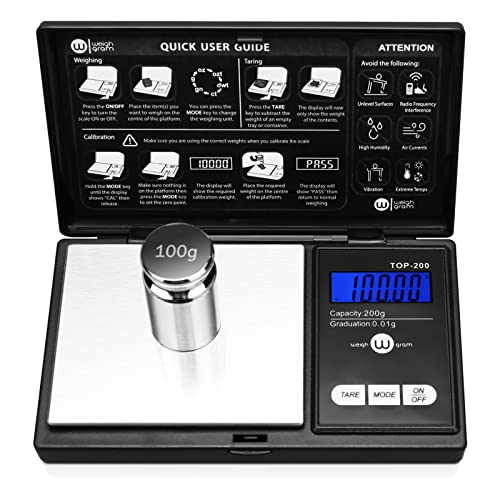
Why I use it: When measuring out the jacks 321 recipe or masterblend tomato formula for smaller 5-gallon reservoirs, kitchen scales aren’t accurate enough. This scale measures down to 0.01 grams, ensuring your Calcium Nitrate and Epsom Salt ratios are dialed in perfectly every single time.

Why I use it: Whether you choose dry or liquid nutrients, controlling pH is non-negotiable. This kit includes premium pH Up and pH Down solutions alongside a simple, foolproof liquid indicator test set that never goes out of calibration.
To compare digital options against manual test kits, read our hands-on pH and EC meter showdown.
Frequently Asked Questions (FAQ)
Can I mix dry Masterblend or Jack’s powders together in a single storage bag?
No, you should never mix the dry powders together in a single container. Calcium Nitrate is highly hygroscopic and will pull moisture out of the air, causing the entire mixture to clump into a solid rock. Additionally, concentrated dry contact can trigger unwanted chemical reactions before the salts ever hit water. Store all three components in separate, airtight containers.
Is Jack’s 3-2-1 better than Masterblend for leafy greens?
Jack’s 3-2-1 generally performs slightly better for leafy greens out of the box because of its higher base nitrogen content (5-12-26 vs 4-18-38) and its use of Fe-DTPA iron, which remains bioavailable over a wider pH range. Masterblend can easily be modified for greens by reducing the base powder slightly and maintaining Calcium Nitrate input, but Jack’s requires fewer adjustments for non-fruiting crops.
Why does my reservoir turn cloudy after adding my dry nutrients?
Cloudiness indicates chemical precipitation—meaning your calcium has bound with sulfate or phosphate to form insoluble salts. This almost always happens because Calcium Nitrate was added to the water u003cemu003ebeforeu003c/emu003e the base powder or Epsom salt was completely dissolved, or because the nutrients were mixed in too small a volume of water. Always dissolve your base formula and Epsom salt fully before stirring in Calcium Nitrate last.
Do I need to add Cal-Mag when using Jack’s 3-2-1 or Masterblend?
In almost all cases, no. Both the Jack’s 3-2-1 recipe and the Masterblend program incorporate Calcium Nitrate and Magnesium Sulfate (Epsom Salt) directly into the main feeding schedule. This provides well over 100 PPM of elemental calcium and 30+ PPM of elemental magnesium, making additional Cal-Mag supplements redundant and a waste of money.
How often should I completely drain and flush my nutrient reservoir?
As a rule of thumb, flush and refill your reservoir with fresh solution every 7 to 14 days, or whenever the total volume of top-up water added equals the original capacity of your tank. Plants absorb ions at different rates, which causes an elemental imbalance over time even if your total EC reading remains stable. Regular flushing resets the elemental baseline.
What is the ideal EC range when running Jack’s 3-2-1 or FloraSeries?
For leafy greens and herbs, aim for an EC between 1.0 and 1.4 mS/cm. For heavy-feeding u003ca href=u0022https://mistculture.com/hydroponic-strawberries-guide/u0022u003efruiting plants u003c/au003elike tomatoes and peppers in full production, target an EC between 1.8 and 2.4 mS/cm. Always adjust your strength downward during hot summer months when plants transpire water at a much faster rate than they consume salts.
Final Verdict: Which Nutrient System Belongs in Your Grow Room?
All three nutrient programs are fully capable of producing world-class harvests, but they serve different grower profiles and operating scales.
- Choose Masterblend 4-18-38 if your primary focus is growing fruiting crops like tomatoes, peppers, and eggplants in Dutch buckets or outdoor run-to-waste systems, and you want the absolute maximum yield for the lowest possible input cost.
- Choose Jack’s 3-2-1 if you want the ultimate balance of commercial efficiency, single-formula simplicity, and superior iron chelation (Fe-DTPA) that works seamlessly across everything from lettuce to heavy-canopy crops.
- Choose General Hydroponics FloraSeries if you operate a small countertop garden, care deeply about the convenience of measuring liquid milliliters over weighing dry powders, or want complete control to dial in custom N-P-K ratios for every micro-stage of plant growth.
Mastering your nutrient chemistry is the fastest way to transition from a struggling grower to an expert operator. Keep your scale accurate, follow the correct mixing order, monitor your EC and pH daily, and your hydroponic system will reward you with lush, high-yielding crops year-round.
For more technical reviews, system build blueprints, and advanced crop management strategies, explore our full archive at mistculture.com/.
More Head-To-Head Reviews: When you are stuck deciding between two top-tier systems or nutrient lines, our rigorous side-by-side testing reveals exactly which product comes out on top for yield, usability, and long-term durability. Read the Head-to-Head Verdicts →

Continue Your Learning Journey