Container Farming vs. Warehouse Builds: The Commercial Reality Check

Table of Contents
- The Infrastructure Dilemma: Turnkey vs. Custom Builds
- Sizing the Capital: CAPEX and OPEX Sizing Models
- Thermal Dynamics & The Inverter HVAC Bottleneck
- Sourcing Commercial Hardware: Racking, Lighting & Automation
- The Strategic Hybrid Deployment Playbook
- FAQ: Hard Truths of Scale and Mobility
- Conclusion: Deciding Your Commercial Cultivation Future
Disclosure: MistCulture summarizes verified product specs, engineering data, and community feedback. We may earn an affiliate commission if you purchase through our links. Regulations vary by location; this content is for educational purposes only.
Container farming utilizing retrofitted shipping containers versus warehouse farming in dedicated grow rooms remains the classic vertical farm build decision. One offers a mobile, turnkey, all-in-one unit ready to drop onto a site. The other represents a scalable, high-throughput facility that requires you to engineer the infrastructure yourself. The right answer for your operation depends entirely on your available capital, your target market, and how you plan to manage crop growth. The indoor farming industry’s history is littered with operations that chose the wrong infrastructure for their specific business model.
The Infrastructure Dilemma: Turnkey vs. Custom Builds
In Controlled Environment Agriculture (CEA), selecting your primary growing envelope is the most critical structural decision you will make. This choice dictates your upfront capital expenditure, long-term operational margins, biosecurity protocols, and your overall capacity to scale. The vertical farming industry is highly capital-intensive and deeply technical. Today, the market presents two competing directions for establishing a commercial indoor grow room: the modular turnkey shipping container and the highly integrated custom warehouse build. Each approach represents a vastly different philosophy of system integration, risk management, and capital allocation.
Turnkey Mobility: The Shipping Container Model
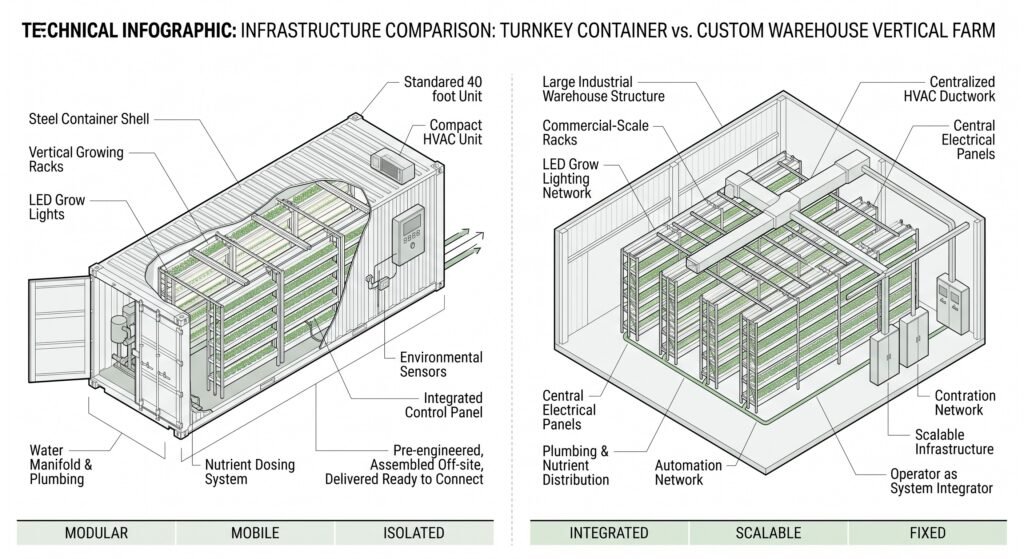
Container farming utilizes retrofitted 20-foot or 40-foot shipping containers, or similar standardized modular footprints, to house a fully integrated vertical cultivation system. These units are pre-engineered and assembled off-site by the vendor. The manufacturer integrates the racking structures, LED grow light grids, HVAC ventilation systems, water manifolds, and environmental sensors into a self-contained unit before delivery. This turnkey approach minimizes local engineering delays; once the container arrives on-site, it is ready to run as soon as electrical and water connections are hooked up.
The primary mechanical benefit of a container farm is its high degree of physical isolation. Because each container represents a closed, isolated micro-climate, growers can maintain strict biosecurity boundaries and simplify disease and contamination control. Additionally, containers are mobile. They can be physically relocated via flatbed trucks to chase shifting regional demand or satisfy hyper-local on-site contracts, such as placing a farm directly adjacent to a university, restaurant, or distribution center. However, this compact engineering and physical mobility require an exceptionally high capital cost per square foot of growing canopy, as buyers pay a premium for custom vendor integration and structural modifications of the steel shell. To achieve maximum light delivery and vegetative efficiency in these narrow spaces without overloading the HVAC systems, containers require high-efficiency, low-heat commercial LED grow lights equipped with passive heat sinks.
The System-Integrator Burden: Warehouse Builds
Warehouse farms take a completely different architectural path, utilizing leased or owned industrial real estate to construct dedicated indoor vertical grow rooms. Instead of relying on pre-fabricated, modular shells, the farm operator acts as the master system integrator. This shifts the entire engineering and design liability directly onto the grower, who must take full responsibility for designing and balancing complex three-dimensional layouts, structural floor weight capacities, electrical panel load allocations, plumbing manifolds, and centralized HVAC ducting networks. Buildouts of this scale can take months of physical engineering, requiring building permits, zoning approvals, and long-term lease commitments to a fixed location.
Yet, by taking on this system-integration burden, warehouse farms unlock massive economic and operational advantages. Consolidating multiple vertical grow rooms under a single roof allows the operator to share centralized infrastructure and access bulk industrial utility rates. This model dramatically lowers the capital cost per square foot of growing space compared to a fleet of independent containers. Sizing warehouse facilities requires heavy-duty commercial steel racking to safely carry the immense water weight of hydroponic reservoirs, such as Deep Water Culture (DWC) rafts or stacked ebb-and-flow tables, alongside overhead lighting arrays. For a deep dive into matching specific hydroponic systems to your available budget, explore our Hydroponic System Cost & Budget Breakdowns.
Physical Mobility: Relocatable. Can be physically transported to follow localized micro‑markets or restaurant contracts.
Optimal Use Case: Initial market proof‑of‑concept, small‑scale localized farming, or short‑term property lease sites.
Structural Insulation: High. Industrial warehouse envelopes offer superior R‑values, significantly lowering ongoing HVAC power costs.
Optimal Use Case: Large‑scale commercial production, high‑volume grocery store supply contracts, and long‑term operations.
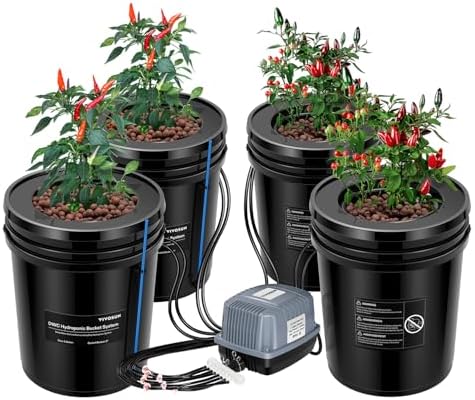
- DWC Bucket +Top Drip Kit: Upgraded DWC hydroponic planting system adopts an unique top drip irrigation design; It provid…
- Powerful Air Pump: Air output: 25 L/min; Voltage: 120V/60HZ; Power: 15W; The air pump and air stone provide sufficient a…
- Grow Faster, Harvest More: The upgraded DWC system enables plants to grow faster and produce higher yields; Compared to …
Sizing the Capital: CAPEX and OPEX Sizing Models
To run a highly profitable vertical farm, you must strictly calculate and balance your upfront capital expenditures (CAPEX) with your ongoing operational costs (OPEX). In indoor CEA, energy is the number one operating cost. Poor thermodynamic insulation or inefficient space configurations will continuously drain your bank account, driving up your production cost per pound and ruining your wholesale margins.
The Linear CAPEX Cost Function of Container Farms
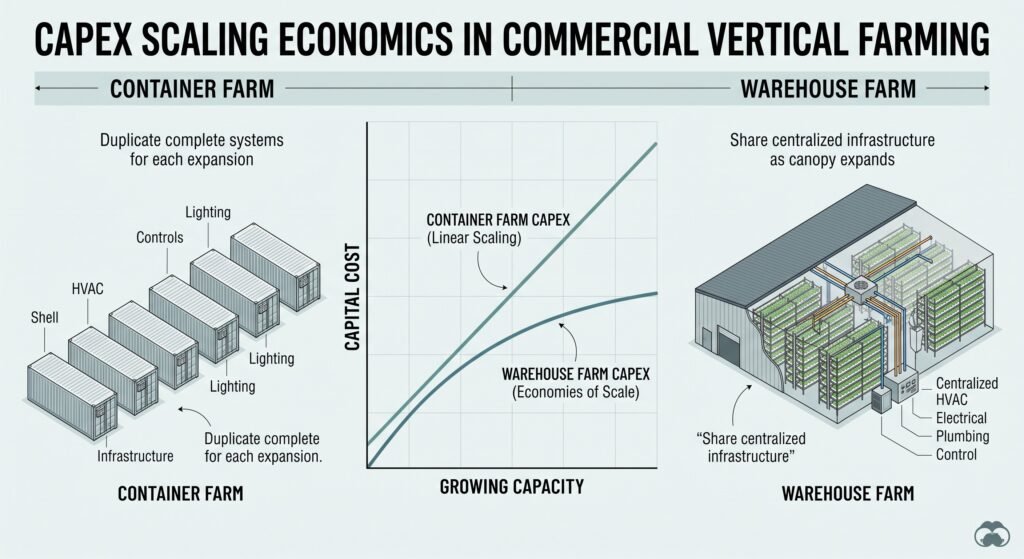
Container farms scale by adding modular, standalone units, resulting in highly linear capital costs. When a container operator needs to expand canopy area, they cannot simply add a rack or run a larger water main. Sizing up capacity requires purchasing an entirely new, fully equipped container. The linear CAPEX cost function can be expressed as:
Where n = number of active container farms, and Cunit = turnkey purchase cost per container
Scaling under this modular model means continuously duplicating heavy steel shells, independent HVAC compressors, and self-contained control systems, maintaining a high, fixed capital cost per growing square foot.
The Warehouse Sizing and Shared CAPEX Efficiencies
Conversely, a warehouse buildout operates under a curved capital scaling model, where bulk component discounts and shared centralized systems reduce the marginal cost of expansion. Rather than duplicating complete enclosures, a warehouse farm scales by expanding vertical rack layers and tying them into existing centralized nutrient and climate networks. The warehouse CAPEX cost equation can be modeled as:
Where Ffixed = fixed design & administrative overhead, A = total canopy area, Ccanopy = material cost per sq ft of vertical shelving & LED fixtures
As your growing footprint (A) expands, the initial fixed overhead is distributed across a much larger crop output, rapidly lowering your overall capital footprint per pound of harvest.
Modeling Thermodynamic OPEX: Shipping Container vs. Warehouse Envelope
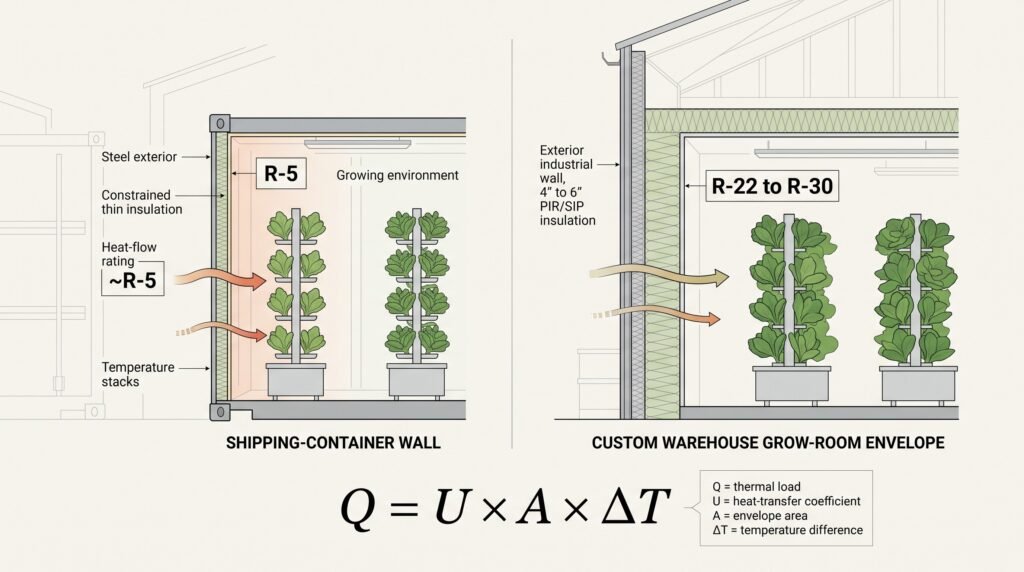
Your ongoing climate control electrical cost is governed by the laws of thermodynamic heat transfer. Maintaining a stable, year-round temperature of 21°C (70°F) for plant transpiration requires your climate equipment to continuously combat the external ambient weather. The thermal heat-loss coefficient equation can be expressed as:
Where Q = hourly thermal energy load (BTU/hr), U = heat transfer coefficient, Ashell = exterior wall surface area, ΔT = temperature differential
📊 To model how different crop selections and yield weights interact with these operating costs, check out our Interactive Hydroponic Yield & Harvest Calculator.
CAPEX & OPEX Sizing Calculator v2.0
Input your target canopy area and utility rates to compare upfront capital costs and monthly power overheads of shipping containers versus custom warehouse builds.
Thermal Dynamics & The Inverter HVAC Bottleneck
In Controlled Environment Agriculture (CEA), energy represents your single largest ongoing operational expense, and climate control is the primary driver of that load. While indoor vertical farms eliminate the weather volatility of conventional open-field farming, they introduce a permanent mechanical challenge: maintaining a perfect, year-round microclimate for plant transpiration regardless of the external elements. The structural envelope of your facility acts as the physical barrier between your high-yield interior environment and the outside climate. If your structural shell lacks proper insulation, your environmental control systems must run continuously, destroying your profitability and driving up your crop production cost per pound.
The Thermodynamic Vulnerability of Shipping Containers
Standard 20-foot and 40-foot shipping containers are constructed of highly conductive industrial steel. While steel offers excellent structural durability and rapid deployment speed, it is a thermodynamic nightmare. Raw steel has virtually zero thermal resistance, exposing the interior cultivation chamber to rapid radiant energy transfer. To fit a vertical growing system into a narrow shipping container footprint, vendors must use ultra-thin insulation layers (typically closed-cell polyurethane spray foam or thin rigid panels) to protect valuable interior grow space. This design constraint limits the container’s structural wall insulation capacity to a low R-5 rating.
To prevent localized temperature spikes and maintain stable plant transpiration rates, growers must rely on responsive digital thermostats to cycle the climate control systems efficiently. Without strict control, continuous temperature swings can shock crop root zones, decrease localized dissolved oxygen levels, and trigger root‑suffocation pathogens like Pythium.
The Insulation Advantage of Custom Warehouse Envelopes
Custom-built warehouse grow rooms take a highly insulated approach to thermodynamic design. Rather than working within a thin metal shell, warehouse farms construct insulated vertical grow walls inside large, masonry-built or steel-framed industrial buildings. Because space inside a warehouse is not constrained to a narrow 8-foot-wide container footprint, operators can install thick, commercial-grade 4-inch or 6-inch Polyisocyanurate (PIR) structural insulated panels (SIPs). This structural insulation easily achieves an R-value of R-22 to R-30, creating a powerful thermal barrier that isolates the interior microclimate from external temperature swings.
📊 To understand how these thermal efficiencies alter your overall financial projections, you can use our Hydroponic System Cost & Budget Breakdowns to model your operating margins.
Heat Transfer: Rapid – continuous load
HVAC Strain: Extreme – constant cycling
Energy Cost: High – continuous operation
Heat Transfer: Minimal – stable envelope
HVAC Strain: Low – modulated operation
Energy Cost: Low – bulk utility rates
The Thermodynamic Equation: Q = U × A × ΔT
Your ongoing climate control electrical cost is governed by the laws of thermodynamic heat transfer. Maintaining a stable, year-round temperature of 21°C (70°F) for plant transpiration requires your climate equipment to continuously combat the external ambient weather. The thermal heat-loss coefficient equation can be expressed as:
Where Q = hourly thermal energy load (BTU/hr), U = heat transfer coefficient (1/R‑value), Ashell = exterior wall surface area, ΔT = temperature differential
Higher R‑value = Lower U‑factor = Better insulation
📊 Use the calculator below to see how different insulation values affect your monthly HVAC costs.
HVAC Heat‑Loss & Energy Cost Calculator v2.0
Input your local temperatures and shell dimensions to calculate the conductive heat‑transfer coefficient (U‑factor), total thermal energy loads, and monthly electrical costs under both building options.

Why it’s necessary: Precise temperature management is required to combat the thermal fluctuations common in steel shipping containers. A reliable thermostat ensures the HVAC equipment cycles efficiently to maintain crop health without wasting excess power.nKey Spec: Programmable day/night temperature differential control.
The Inverter HVAC Bottleneck: Why Standard Units Fail in Containers
Beyond the raw thermodynamic conduction losses through steel walls, container farms face a severe structural bottleneck regarding their environmental control equipment. Because interior space is strictly limited in a container, growers are forced to rely on compact, standalone commercial HVAC packages or lightweight residential mini-split air conditioners to manage humidity and temperature. These compact units must combat extreme external temperature swings through continuous, high-frequency compressor cycling.
- Standard Compressor: ON/OFF cycling → high surge current → premature wear
- Inverter Compressor: Continuous modulation → stable current → extended lifespan
🔬 To diagnose environmental stresses in your canopy or troubleshoot mechanical humidity issues in real‑time, consult our MistCulture Hydro Doctor Tool for instant, crop‑saving solutions.
Sourcing Commercial Hardware: Racking, Lighting & Automation
Once you have solved the thermodynamic challenges of your growing envelope, you must select the physical hardware that will drive your crop production. In indoor vertical farming, your plants are entirely dependent on artificial systems for light, support, and nutrition. Selecting sub-standard hardware or miscalculating your physical building limits can lead to structural failures, electrical fires, or crop loss. To build a highly resilient commercial farm, you must apply strict civil and electrical engineering standards when sourcing racking, lighting, and automation systems.
Racking Engineering: Calculating Static Floor Load Limits
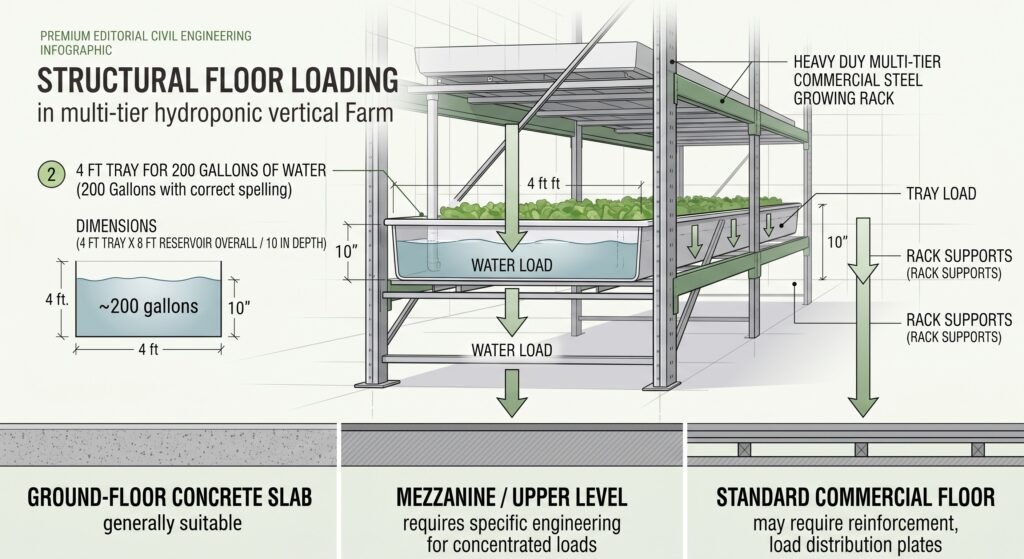
A common mistake for growers transitioning to commercial warehouse spaces is failing to calculate the structural static weight limits of their floors. While vertical racking allows you to multiply your growing space by stacking cultivation layers, it concentrates immense weight onto very narrow areas. This is especially true for water-intensive hydroponic systems like Deep Water Culture (DWC) or stacked ebb-and-flow tables.
To understand the structural load of a multi-tier DWC system, let us run the civil engineering calculations. A standard 4-foot by 8-foot (32 sq ft) cultivation tray running a 10-inch deep DWC reservoir holds roughly 200 gallons of water. This single reservoir tier represents a static water weight of:
📊 To select the safest hydroponic system design that aligns with your building’s structural load capacity, consult our Hydroponic System Cost & Budget Breakdowns.
| Floor Type | Typical PSF Rating | Suitable for Hydroponics? |
|---|---|---|
| Ground Floor Concrete Slab | 250 – 500 PSF | ✅ Yes – Standard |
| Mezzanine / Upper Level | 50 – 125 PSF | ⚠️ Check with Engineer |
| Standard Commercial Floor | 100 – 150 PSF | ❌ Requires Reinforcement |

- [3200lbs Capacity Heavy Duty Wire Shelving Unit] Metal Shelving are made of sturdy heavy duty steel wire and 25.2mm diam…
- [Stable and Durable Metal Shelves] Metal shelves are designed with heavy-duty materials and treated with advanced coatin…
- [Commercial Grade Large Storage Shelves] Wire Shelf size is 55.5“ W X 18‘’D X 71” H, 5 tier organizer pantry shelves pro…
Commercial LED Lighting: Passive Heat Sinks & PPFD Dynamics
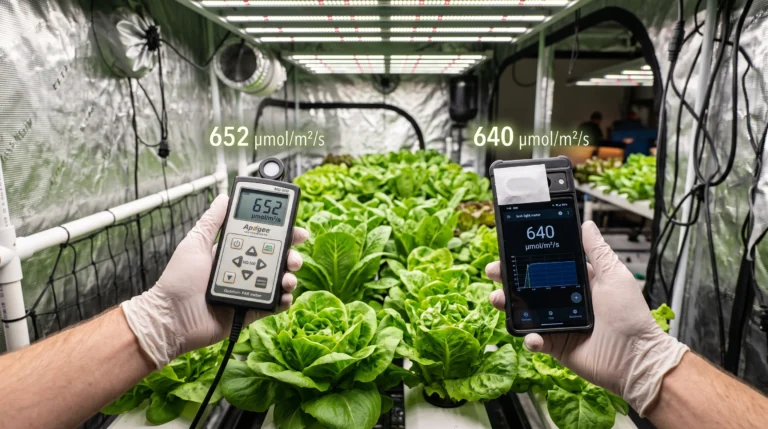
In vertical farming, artificial lighting is the sole driver of photosynthesis. Because you do not have sunlight, your system must deliver consistent, high-intensity light across the entire canopy. Sourcing your lighting requires evaluating two key parameters: Photosynthetic Photon Flux Density (PPFD) and Thermal Heat Dissipation.
To achieve this in multi-tier racks where the lights are mounted only 12 to 18 inches above the plants, you must source wide-angle, low-profile LED light bars. These fixtures spread light evenly over a wide area, eliminating localized hot-spots.
Additionally, you must evaluate how your fixtures manage heat. Every watt of electrical energy delivered to an LED driver is converted into either light or waste heat. If your fixtures use active cooling fans, those fans represent a mechanical point of failure; if a fan fails in a tight multi-tier rack, the heat will quickly build up, burning your canopy.
🌱 To match the perfect lighting specs to your specific crop profiles, use our interactive Plant Selection & System Match Tool.
- Mechanical point of failure
- Fan failure = canopy burn
- Additional power draw
- No moving parts – zero failure risk
- Heat dissipates upward
- Lower long-term maintenance
Commercial Hardware Budget Tracker v2.0
Select the equipment below to dynamically calculate your upfront hardware CAPEX for a standard 1,280 sq ft multi‑tier commercial canopy.

- INDUSTRY-LEADING EFFICIENCY: The 2026 SE7000 LED grow light harnesses premium Bridgeluxdiodes, delivering 2146 μmol/s of…
- SMART APP CONTROL: Manage your grow light anytime, anywhere with the official Spider Farmer App. Customize lighting sche…
- DAISY CHAIN & DIMMABLE: Featuring a dimmable function and clear digital display, the SE7000 lets you fine-tune intensity…
Environmental Automation: Sensor Networks & Failsafes
Operating a vertical farm at scale is far too labor-intensive to manage with manual testing. To maintain tight control over your environmental variables, you must build a robust Internet of Things (IoT) sensor network. This automated brain continuously measures air temperature, relative humidity, carbon dioxide levels, electrical conductivity (EC), and pH levels inside your reservoirs.
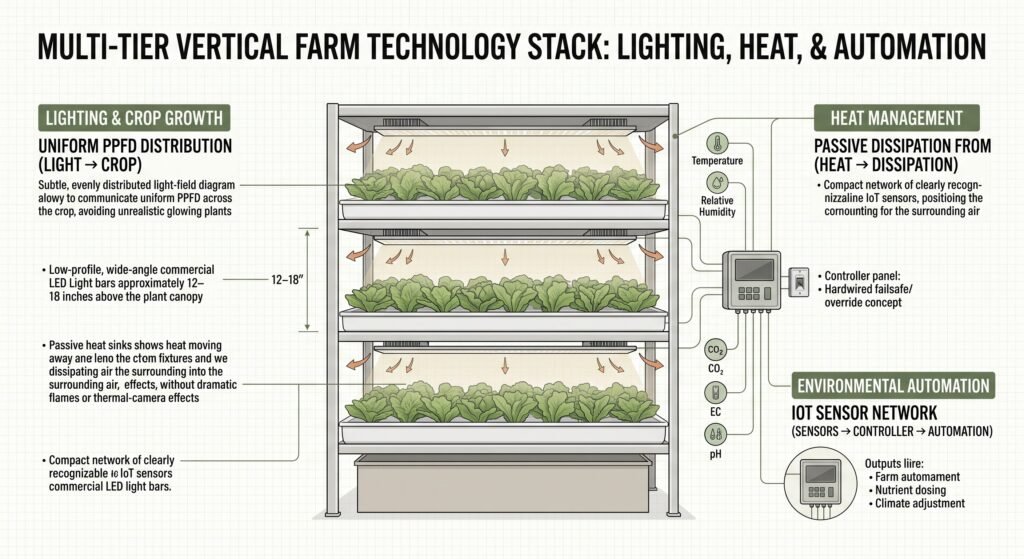
Finally, your automation must include physical failsafes. If your master software freezes or a valve jams, a smart controller must have hardwired overrides to protect your investment.
⚡ If you encounter unexpected electrical surges or want to troubleshoot custom automated dosing loops, consult our step-by-step Hydroponic Operating Cost & ROI Calculator to verify your electrical efficiency and continuous loads.
The Strategic Hybrid Deployment Playbook
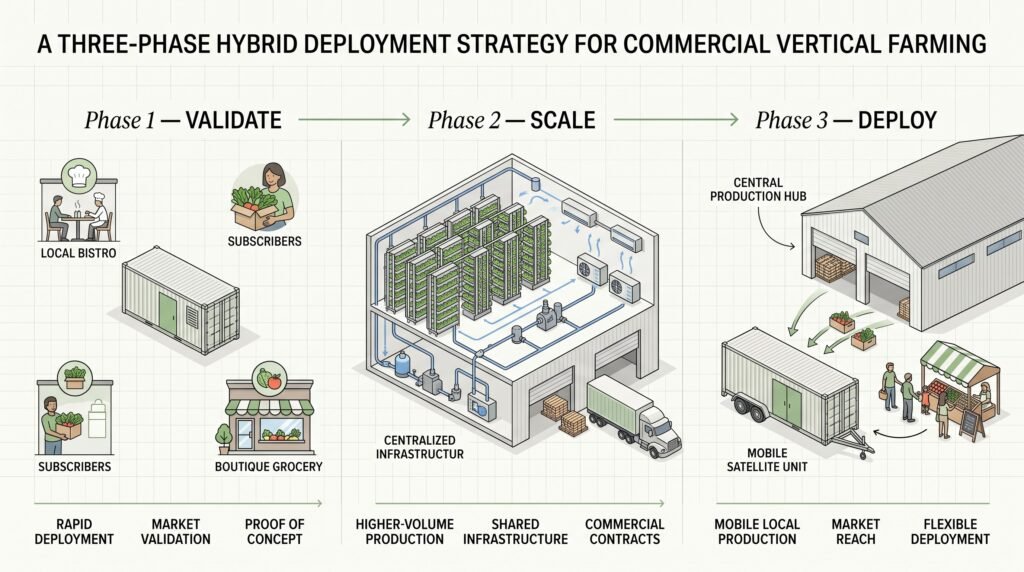
Selecting your primary vertical farming infrastructure does not have to be a rigid, either-or decision. In Controlled Environment Agriculture (CEA), successful commercial growth requires balancing rapid speed-to-market with long-term cost efficiency. Attempting to scale immediately by building a massive, custom industrial warehouse can lead to severe design bottlenecks, permitting delays, and cash flow strain before your first crop is even harvested. Conversely, relying solely on a fleet of modular shipping containers creates a permanent ceiling on your profit margins due to high energy costs and linear cost structures. The most robust and proven playbook in modern vertical farming combines both systems into a single, unified hybrid business model.
Phase 1: Rapid Market Validation & Operational Proof of Concept
The first phase of the hybrid playbook centers on risk mitigation. Instead of signing a long-term industrial warehouse lease and investing hundreds of thousands of dollars into custom electrical and plumbing engineering, start-up farm businesses should deploy a single, turnkey modular shipping container farm. Because shipping containers are pre-engineered and delivered as fully integrated, self-contained growing systems, they allow you to begin cultivation within days of delivery on-site.
More importantly, it allows you to secure early local customer relationships—such as direct-to-consumer subscriber households, local restaurants, or boutique grocers—and validate actual market demand before committing massive amounts of capital.
📊 To project your early harvest weights and coordinate your seeding schedule during this validation phase, use our free Interactive Hydroponic Yield & Harvest Calculator.
Phase 2: Transitioning Core Production to a Scaled Warehouse
Once you have validated local demand, established your brand presence, and secured high-volume, long-term commercial supply contracts, your farm is ready to scale. At this critical juncture, trying to expand by purchasing a massive fleet of individual containers is highly inefficient. The linear cost structure of shipping containers means you must continuously pay for duplicated structural shells, separate HVAC compressors, and independent control panels, maintaining a permanently high cost per harvested pound.
📊 To analyze your complete initial capital budgets and compare running utility costs before starting your warehouse build phase, utilize our detailed Hydroponic System Cost & Budget Breakdowns.
The Hybrid Deployment Lifecycle
Deploy a single turnkey container farm to prove crop cycles, test local water profiles, master daily operations, and establish early local restaurant and direct‑to‑consumer customer networks without heavy capital risk.
Secure a centralized industrial lease. Build out multi‑tier vertical grow rooms, centralize high‑capacity plumbing, and install variable‑speed inverter HVAC systems to achieve maximum energy and utility efficiencies.
Transition all primary, high‑volume crop production (such as standard retail head lettuce) to the warehouse to maximize yields and capitalize on shared overhead, lowering production costs per pound.
Re‑deploy your original validation container as a mobile, hyper‑local satellite unit. Position it directly adjacent to specific high‑value markets, serving as localized pop‑ups, while the warehouse handles the wholesale supply.
Phase 3: Deploying Containers as Mobile Satellites
Once your core production moves into the centralized warehouse, your original shipping container is not discarded. Instead, it becomes a highly strategic, flexible marketing and production asset. While the warehouse manages the heavy, continuous physical volume required to satisfy grocery contracts, the container can be physically relocated to chase fresh revenue opportunities in distinct, hyper-local micro-markets.
🧪 Sizing and balancing your nutrient solutions to ensure consistent flavor profiles across both your mobile containers and central warehouse grow lines is simple; run your crop specs through our free, browser‑based MistCulture Hydroponic Nutrient Calculator to keep your water chemistry fully optimized across your entire network.
- Rapid market entry
- Low initial capital risk
- Operational proof of concept
- Mobile satellite deployment
- Bulk economies of scale
- Lower cost per pound
- Superior insulation (R-22+)
- Centralized shared infrastructure
FAQ: Hard Truths of Scale and Mobility
Making the leap from small-scale indoor cultivation to a commercial vertical farming business is filled with technical, operational, and financial decisions. While theoretical performance curves and equipment specifications look excellent on paper, physical reality has a habit of introducing unexpected bottlenecks. To help you navigate these critical infrastructure choices and protect your startup capital, we have compiled the hard, ground-level answers to the most common questions commercial growers face regarding facility scale, physical mobility, and business longevity.
Commercial Growing Infrastructure FAQ
Click on any question below to expand detailed, civil‑engineering and agribusiness‑focused answers.
Yes, shipping containers are physically relocatable using flatbed tow trucks or crane transport. However, “mobility” is rarely as simple as driving away. Relocating an active container farm requires disconnecting commercial three‑phase electrical connections, draining massive water lines, stabilising internal grow racks, and securing transport permits. Additionally, you must completely prep and zone your new landing site with concrete footings and utility ties. Relocation costs can easily run $5,000 to $15,000, meaning physical mobility should be viewed as a strategic emergency option rather than a routine operational workflow.
Running a single container farm as a standalone business is highly challenging. Because a standard 40‑foot container offers a limited multi‑tier canopy area (typically ~320 sq ft), your total weekly harvest volume is capped. Meanwhile, thin steel walls (R‑5 insulation) result in high electrical OPEX. To cover fixed overheads—such as insurance, land leases, business software, and marketing—and earn a living wage, a standalone container grower must bypass wholesale markets and target ultra‑high‑margin, specialised retail channels (such as high‑end restaurant chefs or microgreen subscription loops) that command premium prices.
Never sign a warehouse lease shorter than 3 to 5 years. Designing a custom warehouse buildout requires substantial, non‑recoverable upfront capital expenditures (CAPEX), such as constructing insulated panels, pouring concrete, and installing commercial three‑phase electrical loops. You need a multi‑year horizon to amortise these initial engineering costs across your crop sales. To safeguard your business, negotiate a 5‑year lease with a pre‑set 5‑year renewal option, ensuring your landlord cannot abruptly displace your physical growing systems once your operations reach peak profitability.
If a wholesale client (such as a grocery store chain or local school district) prepays for a multi‑month crop contract, you must record those upfront funds as deferred revenue (a balance sheet liability) under GAAP guidelines. You do not officially “earn” the cash when it lands in your account. Instead, you recognise portioned earned revenue weekly or monthly as physical crops are delivered. To protect your cash flow from sudden crop failures or disease outbreaks that could trigger client refunds, hold all unearned prepayments in a separate business savings account, only transferring funds to operations as fulfilment occurs.
Managing Longevity: The Transition Threshold
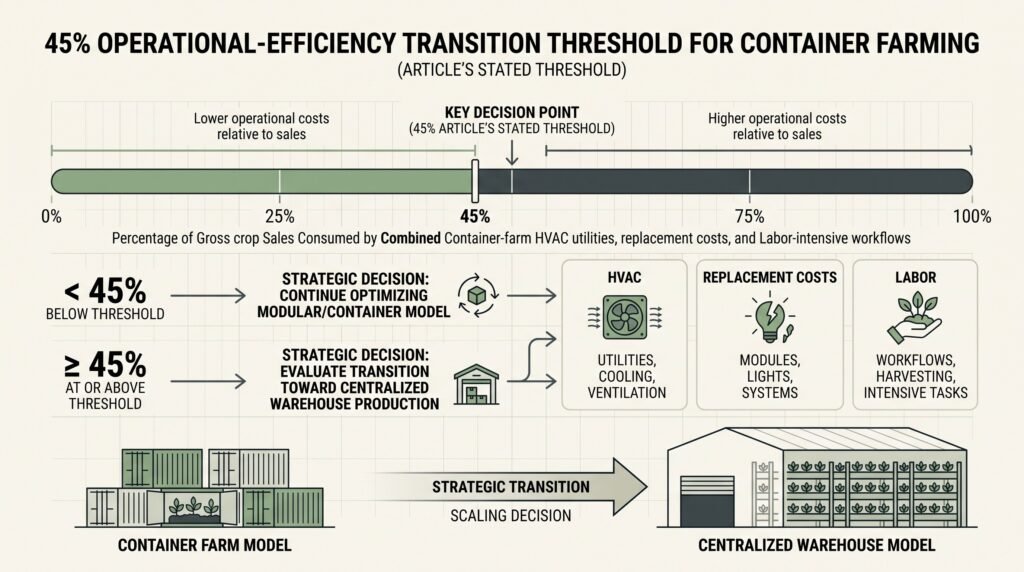
To secure long-term viability in Controlled Environment Agriculture, you must continuously monitor your Operational Efficiency Metrics. If you operate a fleet of shipping containers and find that your combined monthly HVAC utility bills, linear replacement costs, and labour‑intensive workflows are consuming more than 45% of your gross crop sales, your farm has reached the Transition Threshold.
📊 To coordinate your staggered planting schedules and project your expected harvest weights before scaling your facility, run your parameters through our free Interactive Hydroponic Yield & Harvest Calculator.
Get All 5 Vertical Farming Tools in One Place
Access the complete Vertical Farming Infrastructure Tools Suite — a standalone page with the Infrastructure Sizer, HVAC Calculator, Hardware BOM Tracker, Hybrid Roadmap, and FAQ all in one interactive hub.
- CAPEX & OPEX Sizer
- HVAC Heat‑Loss Calculator
- Hardware Budget Tracker
- Hybrid Deployment Roadmap
- Infrastructure FAQ
Conclusion: Deciding Your Commercial Cultivation Future
Deciding between a turnkey shipping container farm and a custom warehouse buildout is not merely a choice of growing hardware—it is a foundational business decision that shapes your entire operational philosophy, scaling trajectory, and financial runway. There is no single "correct" path in Controlled Environment Agriculture; instead, there is only the path that matches your current capital reserves, local market conditions, and long-term business goals.
Watch the Masterclass: Turnkey Containers vs. Custom Warehouses
If you prefer a visual walk-through of these engineering realities, we have filmed a comprehensive video package breaking down the complete unit economics of both commercial envelopes. Watch our deep-dive widescreen documentary masterclass or catch the rapid-fire 60-second summary below to see how these thermodynamic and capital calculations operate in the field.
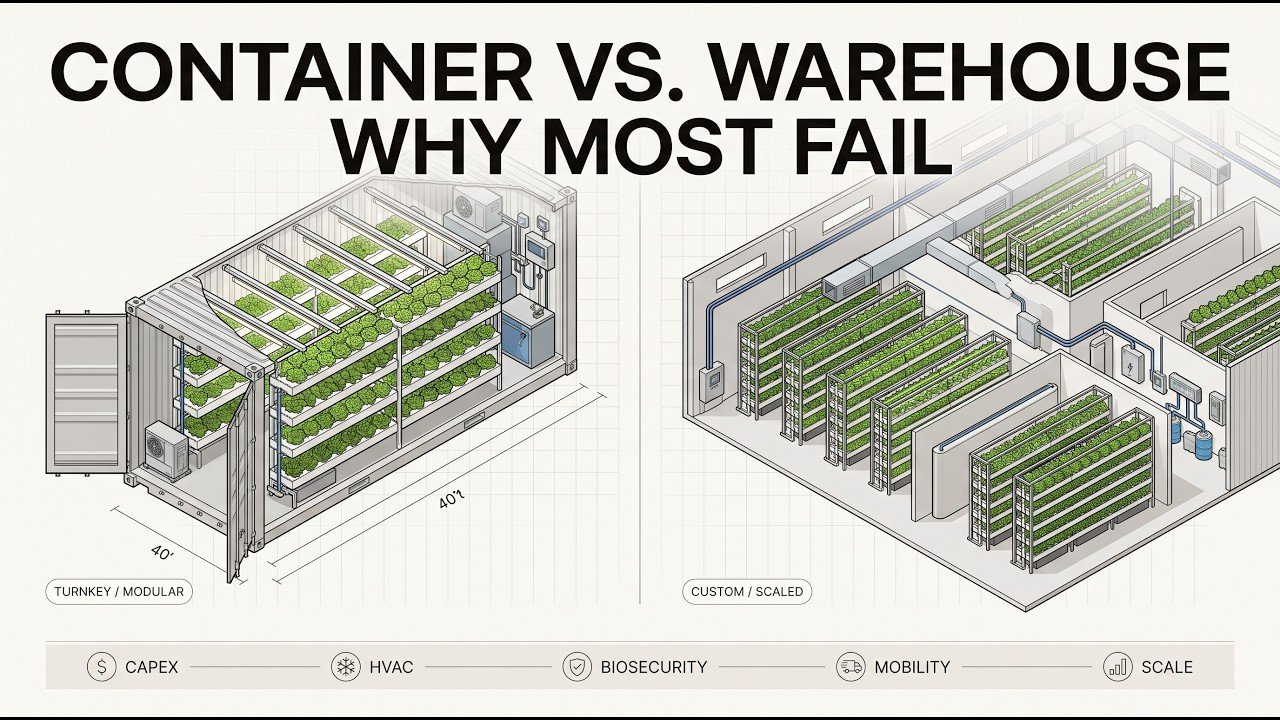
Our comprehensive horizontal guide dives deep into real-world agribusiness economics, including upfront linear CAPEX curves, R‑5 vs. R‑22 insulation energy loads, and static floor load-bearing limits.
▶ Open Masterclass on YouTube
Avoid the ultimate structural and financial mistakes that sink startup container farms. Learn about thermodynamics and modular CAPEX traps.
⚡ Watch Short Reel
Continue Your Learning Journey