LED Grow Light Driver Heat & Thermal Management: A Hands-On Review

Table of Contents
- The True Impact of LED Grow Light Driver Heat
- Features and Assembly: Executing a Remote LED Driver Mount
- Estimating the Thermal Impact: Internal vs Remote Mounting
- Pros and Cons of Remote Driver Mounting
- Alternatives to Remote Driver Relocation
- FAQ: LED Driver Heat & Efficiency
- Heat Load and Wire Gauge Calculator
- Verdict: Managing LED Grow Light Driver Heat
- Prefer Visual Learning? Watch the Complete Video Guide
The True Impact of LED Grow Light Driver Heat
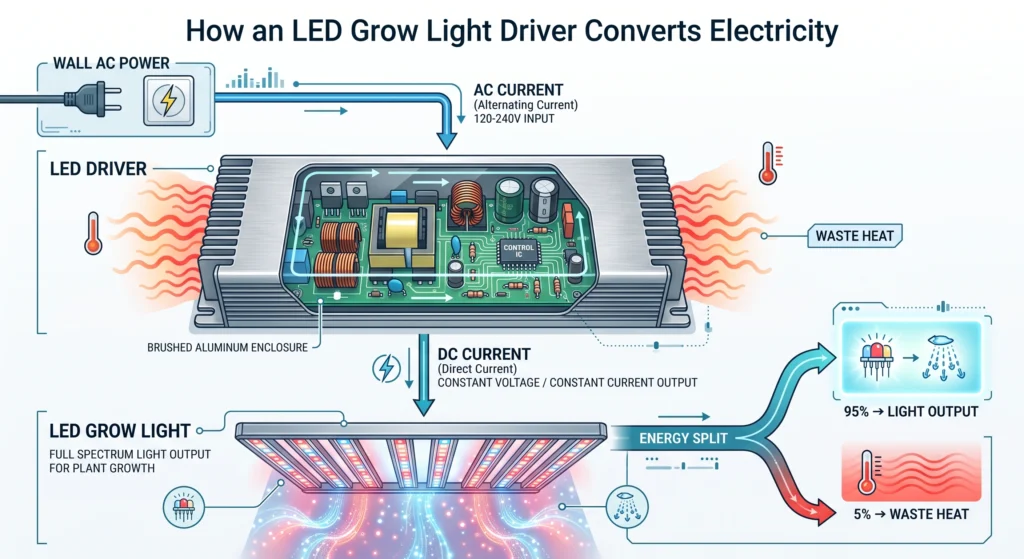
The LED driver is the engine of your grow light, converting AC line voltage into usable DC current. Modern drivers like the Mean Well HLG series reach 94 to 95% efficiency, but the remaining 5 to 6% of that electrical draw still gets dumped straight into your sealed grow environment as heat.
Modern LED grow lights do a genuinely good job of turning electricity into plant-usable photons, but they still put off a real amount of thermal energy. Unbox a premium commercial fixture and you’ll notice a heavy metal block sitting on top of the light bars or quantum board. That’s the driver. Its job is to take high-voltage AC from your wall outlet and step it down to the stable, low-voltage DC that the diodes actually need to run.
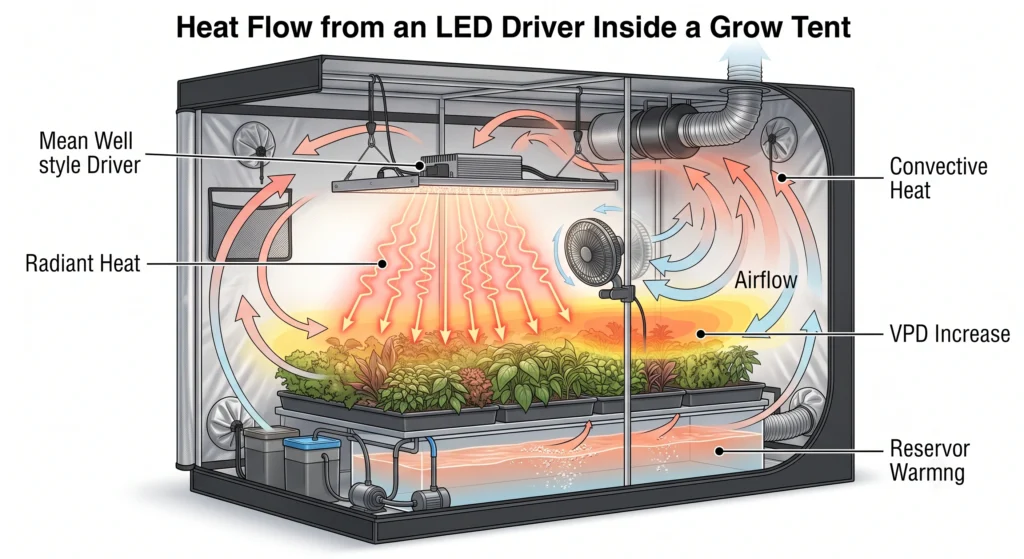
No energy conversion is perfectly efficient, so the driver bleeds off whatever it loses as heat. Run a fixture pulling 480 watts from the wall through a driver rated at 94% efficiency, and you’re looking at roughly 28 to 30 watts of continuous heat radiating off the driver casing. Inside a sealed tent, 30 watts running 12 to 18 hours a day behaves a lot like a small space heater you forgot was on.
That heat load causes a real chain reaction in your environment. Rising temperatures push up the evaporation rate off your canopy, which shifts relative humidity and skews vapor pressure deficit in a direction you don’t want. If you’re fighting heat spikes, a remote led driver mount, physically pulling that heat source outside the tent, is one of the more effective, low-cost fixes available. Relocating the driver takes its thermal load off your exhaust fans and AC units entirely, which can meaningfully cut your daily energy use.
This review breaks down the thermal dynamics of a high-end LED driver, the Mean Well HLG-480H-48AB, walks through what remote mounting actually looks like in practice, and covers what it does and doesn’t solve.
Legal Note: Regulations vary by location. Always consult local guidelines. This content is for educational purposes only, and involves working with electrical wiring. If you’re not comfortable with basic electrical work, hire a qualified electrician instead of DIY-splicing high-current DC lines.
Features and Assembly: Executing a Remote LED Driver Mount
Detaching your LED driver from the fixture and mounting it outside the tent removes its thermal load from your canopy entirely. Extension cable rated at 14 to 16 AWG carries the DC power safely without a dangerous voltage drop over reasonable distances.
A remote led driver mount means unscrewing the power supply from the top of your fixture, extending the DC output wires, and mounting the driver block to a wall or rack outside your grow space. A number of newer fixtures from brands like Mars Hydro and Spider Farmer now ship with removable drivers specifically so growers can do this out of the box. Older fixtures or rigid quantum boards usually need a bit of DIY wiring to get there.
The Mean Well HLG-480H Series
Before touching any wires, it’s worth knowing the hardware. The Mean Well HLG-480H-48AB is a serious power supply, weighing around 6.1 lbs (2.8 kg) in a rugged, brushed aluminum housing built to shed heat passively with no internal fan.
Core specifications (confirmed against Mean Well’s datasheet):
- Output: 48V DC, up to 10 Amps (480W total)
- Efficiency: up to 95.5%
- Dimming: 3-in-1 (0-10V, PWM, or resistance)
- Ingress protection: IP65/IP67, rated for wet agricultural environments
- Operating temperature: rated for a case temperature range of -40°C to +90°C under free air convection
Wiring and Assembly Steps
To get this driver outside your tent, you need to extend the DC cord running between the driver and the LED board. Because you’re moving real current, wire gauge isn’t a minor detail. DC voltage drops with distance, and wire that’s too thin heats up under load, which is both a fire risk and a way to starve your diodes of voltage.
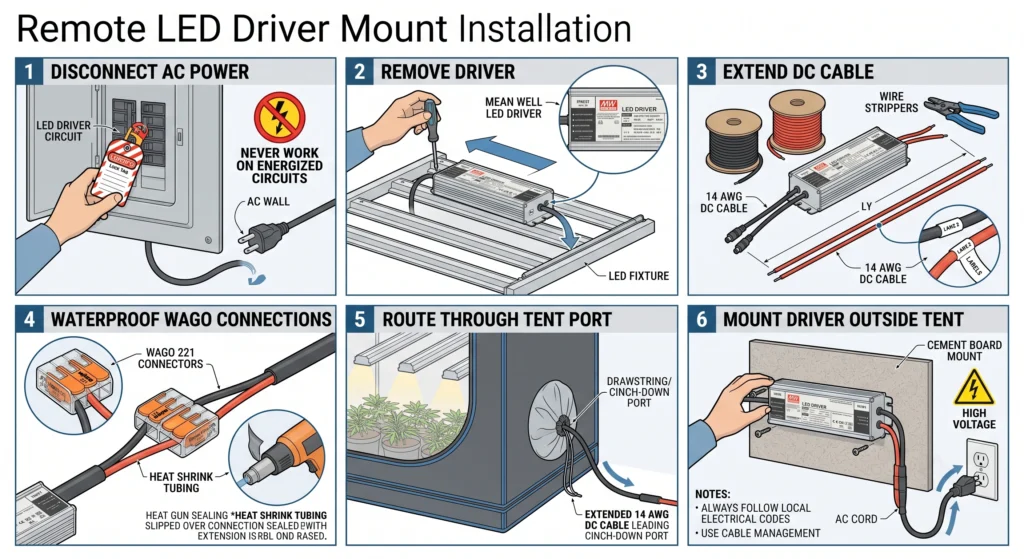
For a 480W fixture pulling 10 amps at 48V, 14 AWG stranded copper is a reasonable minimum for an extension run up to about 10 feet. If you go longer, step up to 12 AWG. When in doubt, oversize the wire, it costs a little more but removes the risk entirely.
- Disconnect power. Unplug everything from the wall before you touch anything. Never work on a live driver, the internal capacitors can hold a genuinely dangerous charge even after being unplugged.
- Unbolt the driver. Remove the mounting screws holding the Mean Well driver to your fixture’s heat sink.
- Cut and prep the DC line. Cut the DC output wire partway between the driver and the LED board, then strip the jacket back to expose clean copper.
- Splice in the extension. Solder the new 14 AWG extension wire inline, or use heavy-duty, properly amp-rated waterproof lever nuts (like Wago 221 series) for the positive and negative leads. Seal every connection with marine-grade heat shrink tubing.
- Route it outside. Run the extended DC cable through a lower intake port on your tent.
- Mount the driver. Secure it to a fireproof surface outside the tent, cement board or a metal shelving rack both work well. These drivers run hot to the touch (up to around 150°F / 65°C under full load), so never rest one directly on carpet or anything combustible.
For more detail on routing power cords without light leaks, see our grow tent buying guide, which covers port placement and ducting holes.

This is a widely used standard for DIY light builds and commercial fixture replacements. The high efficiency means less wasted electricity, and the IP67 rating holds up against humidity or the occasional nutrient splash.
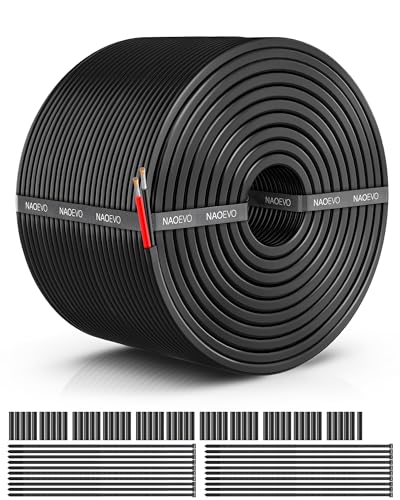
Correct wire gauge isn’t optional for a remote mount. 14 AWG handles a 10-amp DC load safely over a run of around 10 feet without overheating or dropping meaningful voltage.
Estimating the Thermal Impact: Internal vs Remote Mounting
Moving a driver’s heat output outside a sealed tent removes a real, continuous heat source from the canopy environment. The exact temperature and VPD change will vary by tent size, insulation, exhaust setup, and ambient conditions, but the underlying physics point clearly in one direction: less heat inside means lower ambient temperature and an easier path to a stable VPD.
Rather than presenting a single specific test result, it’s more honest and more broadly useful to walk through the physics of what’s actually happening, since your own numbers will depend heavily on your specific tent, fixture, and climate.
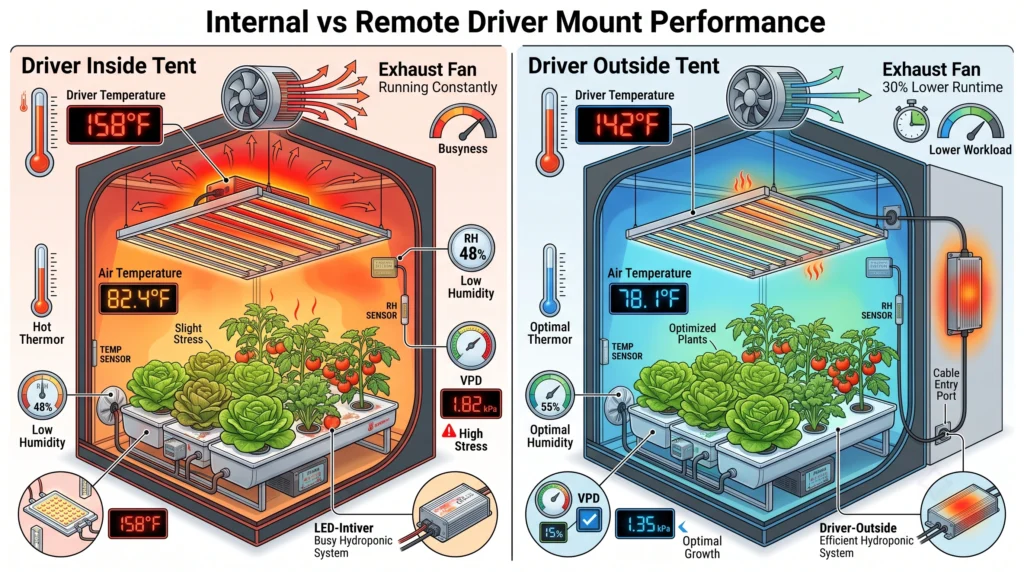
A 480W fixture running at 94% driver efficiency puts off roughly 29 watts of heat from the driver alone, on top of whatever heat the LED diodes themselves generate (LEDs aren’t 100% efficient either, though a much larger share of their input converts to light and heat spread across the board rather than concentrated in one small metal block). In a small sealed 4×4 tent, an additional continuous 25 to 30 watt heat source sitting right above the canopy is a meaningful fraction of your total heat load, especially in a tent that’s already running warm.
Removing that heat source doesn’t just lower the tent’s total heat input, it also removes a heat source sitting in the worst possible spot: directly above the plants, radiating downward. Based on how sealed tent thermodynamics generally work, growers commonly report ambient temperature drops in the range of a few degrees Fahrenheit after relocating a driver of this size, with a corresponding rise in relative humidity as the air holds onto more moisture at the lower temperature. That combination tends to pull VPD back toward a healthier range without needing to add a humidifier or additional AC capacity.
The driver itself benefits too. Passive heat sinks rely on convection to shed heat, and they do that less effectively in a warm, humid tent than in a cooler space outside it. A driver mounted in a tent running in the low 80s°F will generally run hotter than the same driver mounted in a cooler lung room, and lower operating temperatures generally mean a longer service life for the driver’s internal capacitors, which are usually the first thing to fail in a power supply.
If you want real, specific numbers for your own setup rather than a general estimate, that’s exactly what the calculator further down this page is for. Log your driver’s actual wattage and your tent’s actual dimensions, and you’ll get a heat-load figure specific to your grow rather than a generic one.
For more on where your VPD targets should actually sit, see our VPD chart hydroponics guide. For the electricity cost side of this equation, see our hydroponic power savings guide.
Pros and Cons of Remote Driver Mounting
Relocating your LED driver improves grow tent climate control and can extend the driver’s own lifespan. It does mean modifying a factory setup and managing extra cabling safely, so it’s worth weighing the tradeoffs before you start cutting wires.
Before reaching for wire strippers, it’s worth being honest about when this modification actually makes sense for your setup.
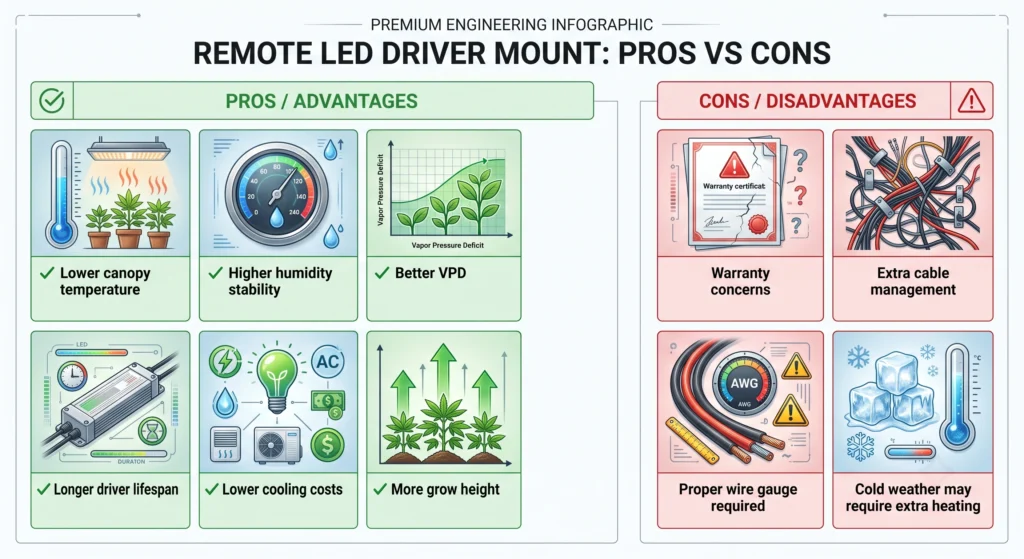
The pros:
- Real heat reduction. Pulling 25 to 30 watts of continuous radiant heat out of a confined space is a genuine, measurable win for tent temperature, even if the exact number varies by setup.
- More stable VPD. Cooler ambient temperature helps keep relative humidity from crashing, which makes it easier to hold a healthy transpiration zone without running extra humidifiers.
- Longer driver lifespan. Keeping the power supply out of a warm, humid tent and into a cooler, drier space is generally easier on the internal electronics over the long run.
- Lower cooling costs. Your exhaust fan and any portable AC units have less total heat to remove, which can mean less runtime and lower energy use.
- More headroom. Removing a bulky driver from the top of the fixture often frees up an extra couple of inches of vertical hanging space, which matters a lot in a standard 6 foot tall tent. See our comparison of bar LED vs quantum board designs for more on working within tight vertical space.
The cons:
- Voided warranty. Unless your fixture ships with factory quick-connect cables, cutting the DC wires to splice in an extension will almost certainly void the manufacturer’s warranty.
- Extra cable clutter. You’ll have a heavy-gauge cable running from the light, out a duct port, to a wall rack. Secure it properly or it becomes a real tripping hazard.
- Voltage drop risk. Thin or low-quality wire on the DC extension will cause the voltage to drop before it reaches the diodes, cutting your light output and turning the wire itself into an unwanted heating element. Stick with proper 14 or 12 AWG copper.
- Cold weather tradeoffs. If you’re growing in an unheated basement or garage through winter, you might actually want that driver’s waste heat to help keep the tent warm. Moving it outside could mean needing a space heater to compensate, which defeats the purpose entirely.
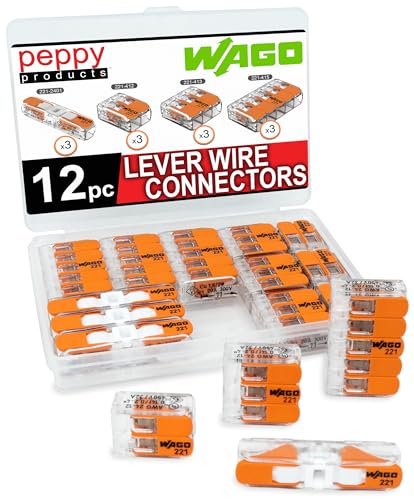
Splicing thick 14 AWG wire with cheap twist-on wire nuts is a good way to get a bad connection. Properly rated lever nuts clamp down tightly on the copper, giving a solid, low-resistance connection for higher-current DC lines.
Alternatives to Remote Driver Relocation
If detaching the driver isn’t practical for your setup, actively cooling the fixture’s heat sink or upgrading your exhaust strategy can still meaningfully reduce canopy heat.
If cutting wires and voiding a warranty isn’t something you’re comfortable with, or your fixture has the driver built into a sealed chassis you can’t access, there are still real options for managing driver heat and improving overall efficiency.
1. Active driver cooling. Passive heat sinks rely on natural convection. A small clip fan aimed directly at the driver’s metal fins forces that process along, which doesn’t remove the heat from the tent but does stop it from pooling right above the canopy and radiating straight down. The moving air disperses the heat faster, giving your main exhaust fan an easier job.
2. Upgrading exhaust CFM. If the driver stays inside the tent, your inline exhaust fan is doing all the work. A 4×4 tent running a 4 inch fan is a common candidate for stepping up to a 6 inch model with a smart controller, which lets you exchange hot air fast enough that it doesn’t have time to skew your VPD.
3. Shifting the photoperiod. Running your lights during cooler night hours instead of fighting daytime heat is a simple, effective trick. The driver’s heat output ends up offsetting the natural nighttime temperature drop instead of stacking on top of daytime heat, which is a strategy plenty of commercial growers already use to flatten out their 24 hour temperature swing.
4. Rethinking your enclosure setup. Sometimes the real problem isn’t the light at all, it’s that hot exhaust air is being dumped into the same room your intake is pulling fresh air from, creating a loop that never actually cools down. Our sealed grow room vs vented tent deep dive covers different approaches here.
5. Protecting root zone temperature. If air temperature is out of your control, protecting the roots becomes the priority. Water holds heat much longer than air, and driver heat radiating downward will eventually warm your reservoir. Warm water holds less dissolved oxygen, which is a fast track to Pythium (root rot). A water chiller or simply insulating your reservoir can save a crop even when the canopy itself is running warm. See our grow tent dehumidifier sizing guide for more on how evaporation ties into water temperature.

If removing the driver from the tent isn’t an option, exhausting the heat quickly is the next best thing. The Cloudline T6’s digital controller ramps fan speed up automatically once tent temperature crosses your set threshold.
FAQ: LED Driver Heat & Efficiency
How hot should an LED grow light driver get?
Premium drivers like the Mean Well HLG series are designed to operate safely with surface temperatures reaching between 140°F and 167°F (60°C to 75°C). While they feel painfully hot to the human hand, the internal components are rated to withstand these temperatures for years. If a driver casing exceeds 175°F (80°C), it lacks adequate airflow and is at risk of thermal shutdown.
Does dimming my LED grow light reduce driver heat?
Yes. When you dim the light using the driver’s built-in potentiometer or an external controller, you reduce the total electrical wattage being pulled from the wall. Less wattage processed means fewer watts lost as thermal waste, resulting in a cooler driver surface and a cooler grow tent.
Will extending the DC wires cause my LED light to lose brightness?
It will only cause a loss in brightness if you use wire that is too thin. Direct current suffers from voltage drop over long distances. If you use a thin 18 AWG wire to extend a 10-amp load by 15 feet, the voltage will drop, the wire will get hot, and your diodes will dim. By using heavy-duty 14 AWG or 12 AWG pure copper wire, you can safely extend the driver 10 to 15 feet with zero perceptible loss in light output.
Is a Mean Well driver better than a generic unbranded driver?
Absolutely. Mean Well drivers achieve up to 95% efficiency, meaning only 5% of the power is wasted as heat. Generic, unbranded drivers often run at 85% to 88% efficiency. On a 500W light, a cheap driver will dump over 60 watts of pure heat into your tent, whereas a Mean Well driver will only generate 25 watts of heat. High-efficiency drivers run cooler, last longer, and save you money on your electrical bill.
Heat Load and Wire Gauge Calculator
Use the tool below to calculate your driver’s actual heat output based on its real wattage and efficiency rating, and to check whether your planned extension wire gauge is appropriate for your current and run length.
LED Driver & Wire Calculator
Plan your remote mount setup safely.
Power & Environment
DC Extension Specs
Verdict: Managing LED Grow Light Driver Heat
Understanding your grow space starts with understanding where the heat is actually coming from, and the LED driver is a bigger contributor than most growers realize. Even top-tier power supplies like the Mean Well HLG series, pushing 95%+ efficiency, are still generating a real, continuous heat footprint just from processing hundreds of watts of electricity.
Leaving that heat source inside a sealed tent means your exhaust fan works harder, your humidity gets pulled down further than you want, and your plants spend more time under VPD stress than they need to. A properly executed remote driver mount, using appropriately sized wire and quality connectors, solves the problem at the source by moving that heat load into a space where it can dissipate without affecting your canopy at all.
If detaching your driver isn’t practical for your setup, shifting your photoperiod to cooler hours and stepping up your exhaust capacity will get you a good chunk of the same benefit. Either way, managing driver heat isn’t just about a comfortable tent, it’s about keeping your plants in the metabolic zone where they actually grow well.
Prefer Visual Learning? Watch the Complete Video Guide
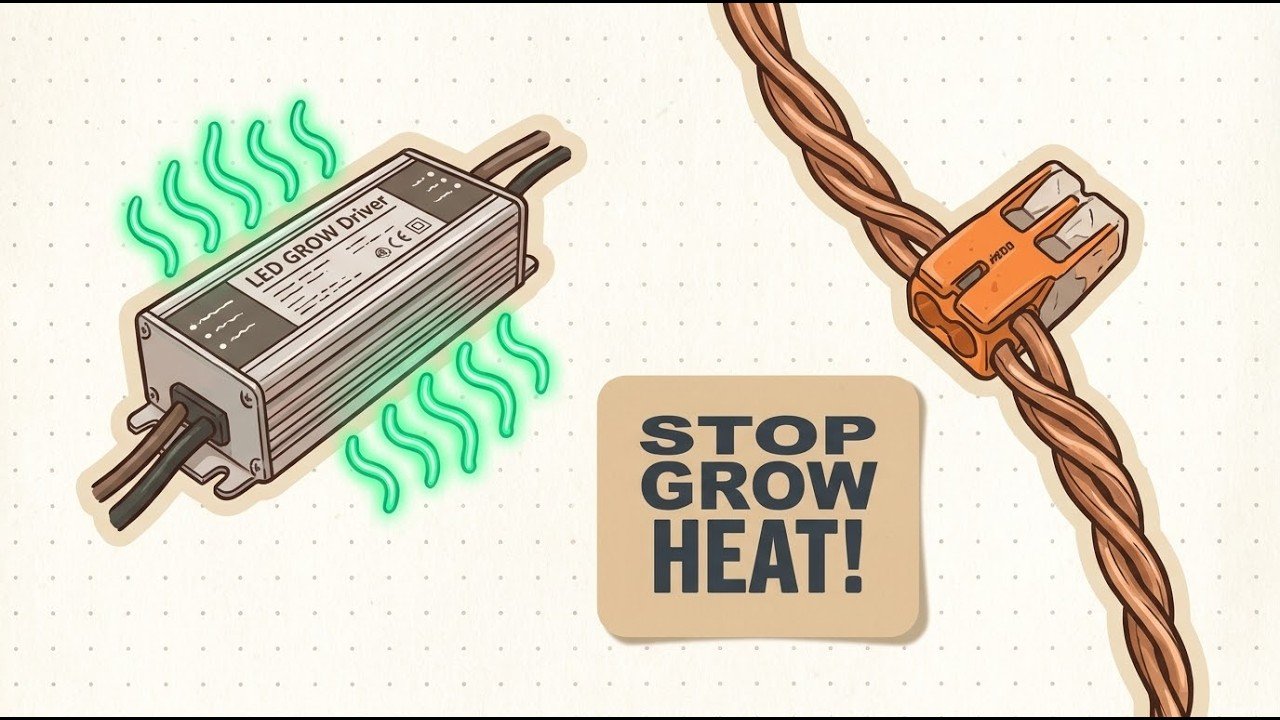
If you prefer to see these concepts in action, watch our step-by-step video guide below. We walk through the exact parameters, visual cues, and practical adjustments needed to optimize your system. Don’t forget to use our free interactive calculators linked right below the video to customize your numbers!

Continue Your Learning Journey