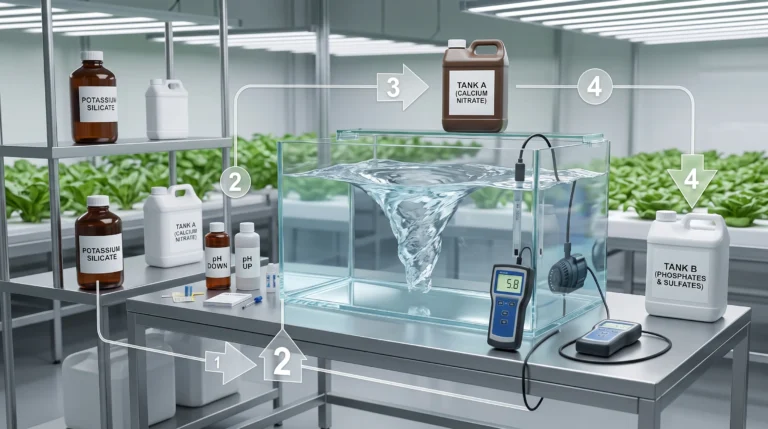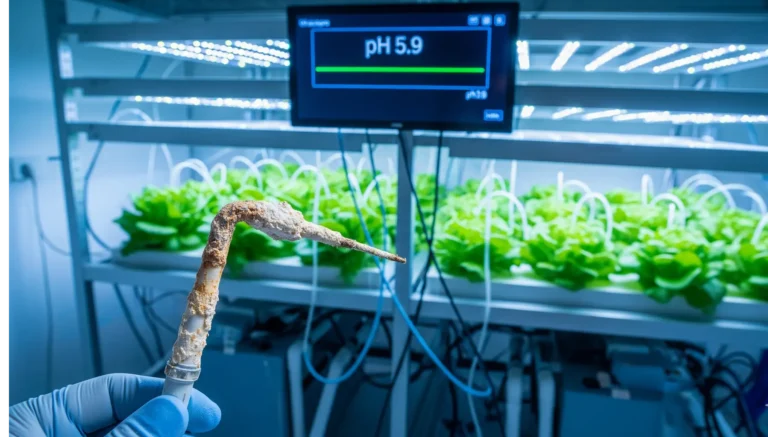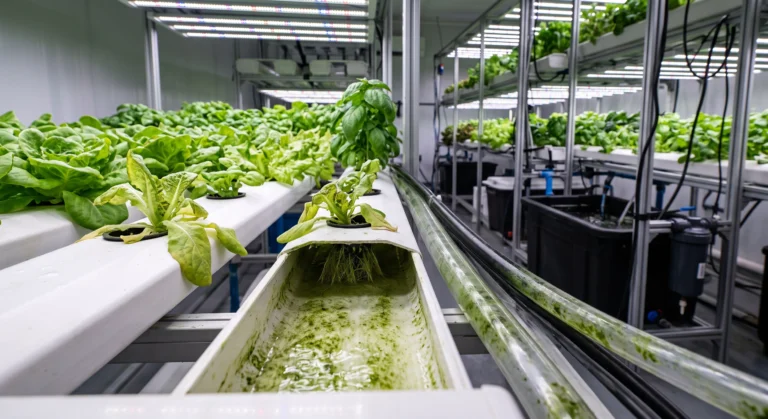
Foliar Feeding Hydroponics: Maximizing Micro-Nutrient Absorption Rates

Table of Contents
- Abstract: The Mechanics of Foliar Uptake
- Methodology: Structuring a Foliar Feeding Protocol
- Metric Tables: Absorption Rates of Essential Elements
- Real-World Case Study: Foliar Spray Calcium Hydroponics
- Essential Gear for Foliar Application
- Industry Implications: Micro-Nutrient Management
- Environmental Interplay: Lighting and VPD
- FAQ: Foliar Feeding in Hydroponics
- Conclusion & Takeaways
Foliar feeding hydroponics is a targeted delivery mechanism where liquid nutrients are applied directly to the plant’s canopy, bypassing the root zone entirely. This method capitalizes on specialized cellular pathways in the foliage to achieve absorption rates up to 20 times faster than traditional root uptake. By understanding plant leaf nutrient absorption, growers can rapidly correct micro-nutrient lockouts and calcium deficiencies before they permanently damage crop yields.
If you have spent any real time managing a nutrient reservoir, you have likely encountered the frustrating reality of nutrient lockout. Your pH drops, your electrical conductivity (EC) spikes, and suddenly your perfectly dialed-in hydroponic tomatoes are showing classic signs of iron chlorosis or blossom-end rot. The nutrients are physically in the water, but chemical antagonism or environmental stress is preventing the roots from doing their job.
This is where foliar feeding hydroponics shifts from a supplementary tactic to an absolute rescue mission. Spraying a highly diluted, targeted nutrient solution directly onto the leaves bypasses the root system entirely. We are going to look deep into the physiological mechanics of plant leaf nutrient absorption, map out the precise absorption rates of specific micro-nutrients, and construct a scientific methodology for using a foliar spray calcium hydroponics regimen to save failing crops.
Legal Note: Regulations vary by location. Always consult local guidelines. This content is for educational purposes only.
Abstract: The Mechanics of Foliar Uptake
The efficiency of foliar feeding relies on the solution’s ability to penetrate the leaf’s waxy cuticle and enter through stomatal pores and ectodesmata. Success depends entirely on droplet size, the point of deliquescence of the chosen nutrient salts, and the ambient vapor pressure deficit (VPD) during application. When executed correctly, foliar application delivers critical elements directly to the metabolic sites where they are needed most.
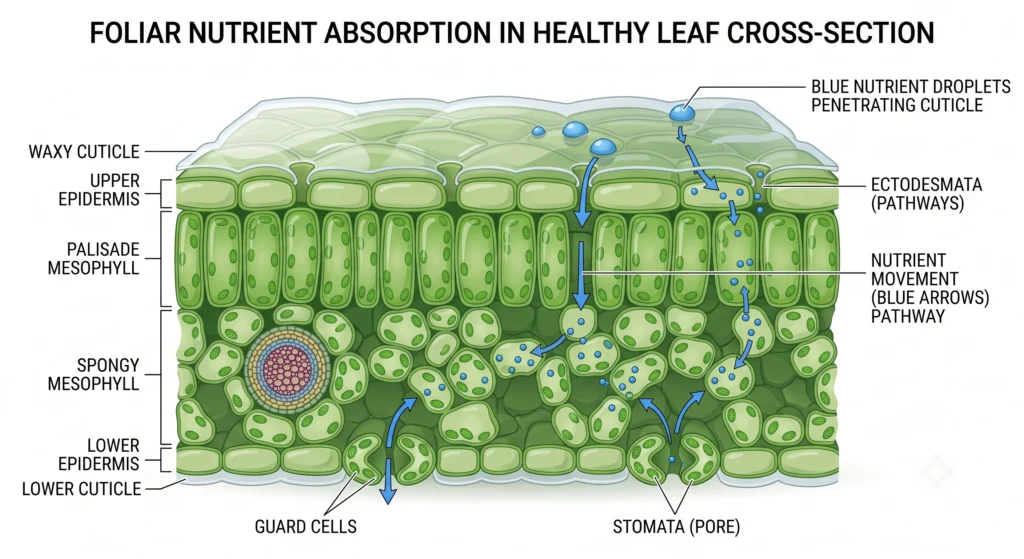
To understand why spraying water on a leaf actually feeds the plant, we have to look at the microscopic architecture of the foliage. Plant leaves are designed primarily for gas exchange and photosynthesis, not nutrient uptake. They are coated in a hydrophobic (water-repelling) waxy layer called the cuticle, which prevents the plant from losing moisture to the atmosphere.
Yet, this cuticle is not a solid, impenetrable wall. It is riddled with microscopic, hydrophilic (water-loving) channels known as ectodesmata. These trans-cuticular pores act as selective pathways, allowing water and dissolved minerals to migrate from the surface of the leaf into the epidermal cells below.
Stomata—the pores responsible for breathing in CO2 and exhaling oxygen and water vapor—also play a role in plant leaf nutrient absorption. While the stomatal cavity itself is highly water-repellent, specialized guard cells and the surrounding epidermal cells can actively absorb nutrients when the stomata are open.
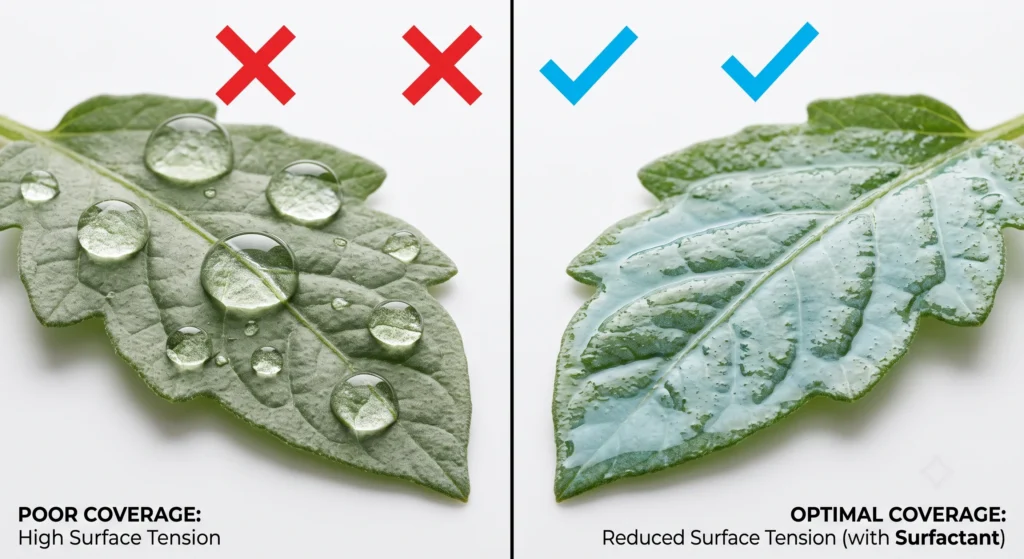
The catch? For these pathways to accept the nutrients, the liquid must be applied in a specific manner. The droplets must be small enough to adhere without rolling off, the surface tension of the water must be broken using a surfactant (wetting agent), and the humidity in the room must allow the droplets to remain in a liquid state long enough for absorption to occur. If the spray dries too quickly into crystallized salts, the plant gets nothing.
Methodology: Structuring a Foliar Feeding Protocol
A successful foliar feeding methodology requires precision in formulation, specific application equipment, and strict adherence to environmental timing. Applying standard root-zone nutrient ratios to foliage will almost certainly result in severe osmotic burn and tissue necrosis. The protocol mandates extreme dilution and the mandatory inclusion of a non-ionic surfactant.
When formulating a spray for foliar feeding hydroponics, the concentration must be drastically lower than your standard reservoir mix. Leaves do not possess the heavy osmotic buffering capacity of a massive root system. If you spray a high-EC solution onto delicate leaf tissue, the salts will literally pull water out of the leaf cells, resulting in a crispy, brown chemical burn.
For safety and efficacy, foliar sprays should be mixed at an EC no higher than 0.5 to 0.8 mS/cm (around 250 to 400 PPM on a 500 scale). For a complete understanding of how these metrics impact your plants, refer to our comprehensive hydroponic ph ec guide 2026.
The Role of Surfactants (Wetting Agents)
Because plant leaves are naturally waxy, water beads up and rolls right off. To facilitate plant leaf nutrient absorption, you must lower the surface tension of the liquid. Adding a few drops of a non-ionic surfactant, such as yucca extract or a commercial horticultural wetting agent, makes the water “wetter.” It causes the droplet to spread out into a thin film across the entire leaf surface, maximizing contact with the cuticle and stomata.
Application Timing and VPD
The environment dictates absorption. If you spray under high-intensity grow lights during the hottest part of the day, the water evaporates in minutes. The salts are left behind on the leaf surface, forming a white crust that blocks light and burns the tissue.
The optimal time to apply a foliar spray is right as the lights turn off, or during the early morning hours just before sunrise in a greenhouse. During these windows, the stomata are often open or preparing to open, the temperatures are cooler, and the Vapor Pressure Deficit (VPD) is low. A low VPD means the air is holding a decent amount of moisture, keeping your foliar spray in a liquid, absorbable state on the leaf surface for the 1 to 2 hours necessary for thorough penetration.
Metric Tables: Absorption Rates of Essential Elements
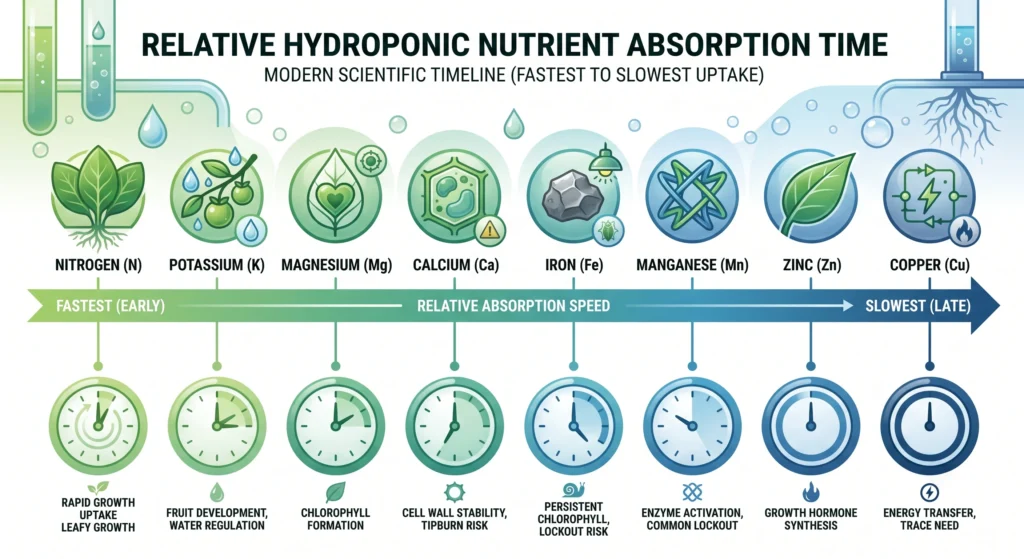
Nutrient absorption through the leaf surface varies dramatically depending on the molecular weight, valency, and mobility of the specific element. Nitrogen and potassium are absorbed rapidly within hours, while heavier, immobile elements like calcium and iron may require days for full assimilation. Tracking these timelines is critical for determining reapplication schedules.
Understanding how quickly a plant can absorb a specific element dictates how we build our foliar feeding hydroponics schedule. If a plant absorbs Zinc in 24 hours, but takes 4 days to absorb Iron, spraying Iron daily will just lead to toxic buildup on the leaf surface.
We turn to baseline absorption metrics established in controlled environment agriculture (CEA) studies to guide our dosing.
Foliar Nutrient Absorption Timetable
| Nutrient Element | Chemical Symbol | Estimated Time for 50% Absorption | Mobility in Plant | Primary Foliar Use Case |
| Nitrogen (Urea) | N | 1 – 2 Hours | Highly Mobile | Rapid green-up, general vigor boost |
| Potassium | K | 10 – 24 Hours | Highly Mobile | Flower/fruit sizing, drought stress |
| Calcium | Ca | 1 – 2 Days | Immobile | Blossom end rot, tip burn prevention |
| Magnesium | Mg | 2 – 5 Hours | Mobile | Interveinal chlorosis recovery |
| Zinc | Zn | 1 – 2 Days | Mobile | Internode elongation, enzyme activation |
| Manganese | Mn | 1 – 2 Days | Immobile | Correcting upper leaf yellowing |
| Iron | Fe | 3 – 5 Days | Immobile | Severe chlorosis in new growth |
| Copper | Cu | 1 – 2 Days | Immobile | Rare; specific pathogen resistance |
Data sourced from standard CEA agronomic benchmarks.
Decoding the Data
Notice that the macronutrients (Nitrogen, Potassium, Magnesium) are absorbed very rapidly. Urea nitrogen, in particular, is a small, uncharged molecule that slips through the cuticle with incredible ease.
However, foliar feeding is rarely used for macronutrients in hydroponics. Your root zone should be handling the heavy lifting for N, P, and K. We use foliar feeding primarily for the elements at the bottom of the table: the micro-nutrients and Calcium. These elements are notoriously difficult to transport through the plant’s vascular system (the xylem), especially under high humidity or poor transpiration conditions.
Real-World Case Study: Foliar Spray Calcium Hydroponics
Calcium is a strictly immobile element within plant physiology, transported exclusively through the xylem via the transpirational pull of water. When ambient humidity is too high, or airflow is too low, transpiration stalls, leading to severe localized calcium deficiencies like tip burn in lettuce or blossom-end rot in tomatoes. A foliar spray calcium hydroponics protocol directly circumvents this vascular bottleneck.
Let’s look at a practical scenario common in indoor growing. You are growing beefsteak tomatoes in a deep water culture (DWC) system. Your reservoir pH is a perfect 6.0, and your calcium nitrate levels are mathematically dialed in. Check out our hydroponic nutrients guide for baseline formulations.
Yet, as the first fruit clusters begin to swell, you notice the dreaded black, sunken lesions of blossom-end rot (BER) forming on the bottom of your tomatoes.
The Diagnosis
The issue is not a lack of calcium in the water; it is a lack of calcium transport. Calcium moves with water. If your grow room has a high relative humidity (above 75%) and sluggish airflow, the leaves are not transpiring (sweating) enough water. Without that upward suction, the heavy calcium ions settle in the lower leaves and stems, never reaching the rapidly expanding fruit tissue at the top of the plant.
The Foliar Rescue Protocol
Because calcium cannot be relocated from older leaves to newer tissue, applying it directly to the affected area is the only viable rapid response.

- Formulation: Mix a highly diluted solution of Calcium Chloride (CaCl2) or Calcium Nitrate (Ca(NO3)2). The target concentration is roughly 0.5 to 1.0 grams per liter of water. Calcium Chloride is often preferred for foliar application as it absorbs slightly faster and avoids adding excess nitrogen during the fruiting phase.
- Surfactant: Add 1-2 drops of a non-ionic wetting agent per liter to ensure the spray coats the waxy skin of the developing fruit and surrounding calyx leaves.
- Application: Using a fine mist sprayer, target the expanding fruit clusters and the newest, upper foliage. You must spray the fruit itself; spraying the lower leaves does nothing to help the fruit because calcium will not migrate upward from those leaves.
- Frequency: Apply 2 to 3 times per week during the rapid fruit expansion phase, ensuring application happens during the lights-off cycle to prevent droplet burn.
Within a week, the progression of BER on newly forming fruits halts completely. The foliar spray calcium hydroponics intervention bypassed the environmental transpiration block, delivering the structural building blocks exactly where cell division was occurring. For more details on preventing these specific crop issues, refer to our hydroponic tomatoes peppers guide.
Essential Gear for Foliar Application
To execute these protocols safely and effectively, you need equipment designed for precision. Standard garden hoses or cheap spray bottles produce droplets that are too large, which simply bounce off the leaf or pool at the edges, causing localized burning.

Why I use it: The key to plant leaf nutrient absorption is micronizing the water droplets. A continuous mist sprayer pressurizes the liquid to deliver a sustained, ultra-fine aerosol mist. This creates an even, microscopic film across the entire leaf surface without heavy pooling or runoff, maximizing cuticular contact.

Why I use it: You absolutely cannot guess the concentration of a foliar spray. Mixing a solution that is too hot (high EC) will destroy your canopy overnight. A reliable digital EC pen ensures your rescue spray remains strictly within the safe 0.5 to 0.8 mS/cm threshold before it ever touches a leaf.

Why I use it: Pure water beads up due to high surface tension. Yucca extract is a natural saponin (soap-like compound) that breaks that tension, acting as a superior organic wetting agent. It guarantees the nutrient solution sheets evenly across hydrophobic leaf surfaces, boosting absorption rates by up to 50%.
Industry Implications: Micro-Nutrient Management
Iron, Zinc, and Manganese deficiencies are rampant in hydroponic systems subject to pH drift. Because heavy metals precipitate out of solution and become locked in unavailable forms when pH rises above 6.5, root-zone correction is often too slow to save a crop. Commercial growers rely on targeted foliar applications of chelated micro-nutrients to bridge the gap while the reservoir is recalibrated.
If your pH controller fails or you buffer your reservoir incorrectly, the pH can climb to 7.0 or higher. At this alkaline level, Iron (Fe) drops out of the solution, oxidizing into forms the roots cannot physically absorb. Within days, your new growth turns bright yellow while the leaf veins remain starkly green—classic Iron chlorosis.
Fixing the reservoir pH takes time, and the roots take even longer to recover their uptake efficiency. Foliar feeding hydroponics provides an immediate bypass.
The Chelated Micro-Nutrient Spray
Applying a micro-nutrient foliar spray requires understanding chelates. A chelate (like EDTA, DTPA, or EDDHA) is an organic claw that holds the metal ion, keeping it soluble.
For foliar application, Iron EDTA is the industry standard. It penetrates the leaf tissue readily and is highly effective when sprayed.
- Mix Rate: 0.1 to 0.2 grams of Iron EDTA per liter of water.
- Target: Spray the newest, yellowing growth thoroughly.
- Result: You will visibly see the yellow leaves begin to green up within 48 to 72 hours as the iron is integrated directly into the chloroplasts for chlorophyll synthesis.
By mastering this technique, commercial facilities save thousands of dollars in potential crop loss, maintaining photosynthetic efficiency while the maintenance team resolves the underlying plumbing or dosing issues in the main nutrient vat.
Environmental Interplay: Lighting and VPD
A crucial aspect of foliar feeding often overlooked by novice growers is the interaction between the spray, the lighting system, and the room’s Vapor Pressure Deficit (VPD).
If you are running high-intensity LED fixtures, the radiant heat and photon density will interact violently with water droplets. Droplets act as tiny magnifying glasses, focusing photons and physically burning the epidermal cells. Always apply sprays during the dark cycle. If you need to understand how your lighting intensity dictates plant stress, read our breakdown on led distance ppfd guide.
Furthermore, the leaf requires the solution to remain wet to absorb the ions. If your grow room has a very high VPD (meaning the air is very dry and thirsty), the water evaporates instantly, leaving behind useless dry salt crystals. If the VPD is too low (extreme humidity), the plant cannot transpire, but the foliar spray will stay wet for hours, which can encourage fungal pathogens like powdery mildew.
Aim to apply foliar sprays when room humidity is between 60% and 70%, ensuring a slow, steady drying time of about 45 to 90 minutes.
FAQ: Foliar Feeding in Hydroponics
Addressing the most common technical questions growers face when implementing a foliar feeding regimen for the first time.
Can I use my regular hydroponic A/B nutrients as a foliar spray?
Yes, but with extreme caution. Standard reservoir nutrients are formulated for root uptake and are highly concentrated. If you use them for foliar feeding, you must dilute them to about 1/4 to 1/8 of their normal strength to ensure the EC does not exceed 0.8 mS/cm. Failing to dilute will cause severe osmotic leaf burn.
How often should I foliar feed my hydroponic plants?
Foliar feeding should be treated as a targeted supplement or a rescue treatment, not a daily feeding regimen. For correcting a specific deficiency (like Iron or Magnesium), spray every 3 to 4 days until symptoms subside. For general health boosts or calcium supplementation during fruiting, 1 to 2 times a week is sufficient.
Should I adjust the pH of my foliar spray solution?
Yes. Just like root zone absorption, plant leaf nutrient absorption is pH dependent. The optimal pH for most foliar sprays is slightly acidic, ideally between 5.5 and 6.2. Use a digital meter to verify the pH after you have mixed in all nutrients and surfactants.
What is the best surfactant to use for edible crops?
For edible crops, natural non-ionic surfactants are the safest choice. Yucca extract (saponin) or mild, unscented castile soap (at a rate of a few drops per gallon) work exceptionally well to break surface tension without leaving toxic residues on leaves or fruit.
Can I foliar feed while the grow lights are on?
It is highly discouraged. Spraying under intense HID or LED lights can cause droplet burn (the magnifying glass effect) and causes the solution to evaporate too quickly for nutrients to be absorbed. Always spray just before the lights turn off, or during the dark cycle when stomata are receptive and evaporation is slower.
Will foliar feeding calcium cure existing blossom-end rot?
No. Blossom-end rot causes cellular death (necrosis) in the fruit tissue, which is irreversible. However, a foliar spray calcium hydroponics routine will protect the newly developing fruit clusters from succumbing to the same deficiency, saving the rest of your harvest.
Conclusion & Takeaways
Foliar feeding is an indispensable tool in the elite hydroponic grower’s arsenal. It provides a highly efficient, fast-acting bypass to the root zone, capable of rescuing crops from micro-nutrient lockouts and environmental transport issues.
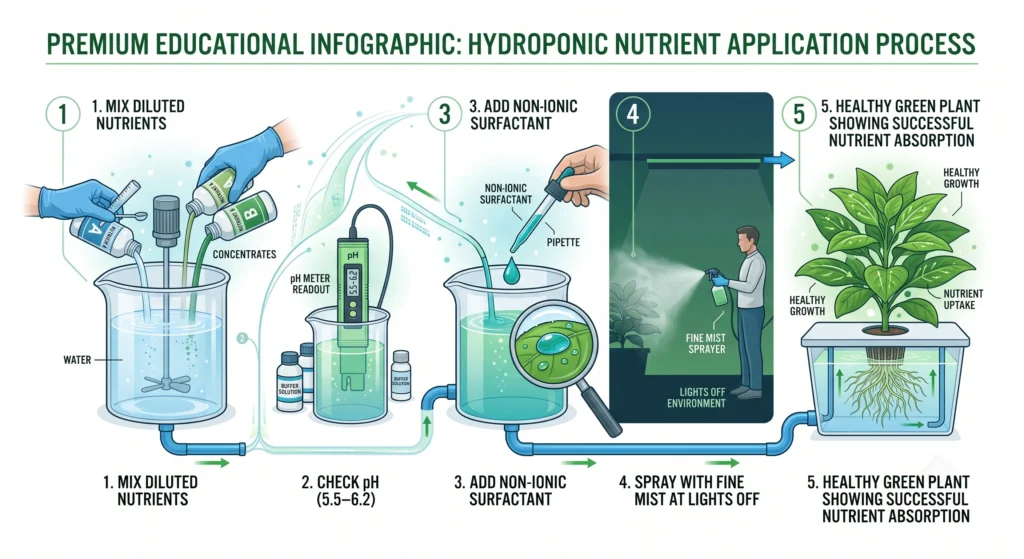
Mastering plant leaf nutrient absorption elevates your control over the crop’s physiological state. We have established that the leaf cuticle is not an impenetrable barrier, but a complex, selective membrane that can be utilized to our advantage. By using ultra-fine mists, lowering surface tension with organic surfactants, and respecting the environmental boundaries of temperature and VPD, we can deliver nutrients exactly where the plant demands them.
Whether you are deploying a foliar spray calcium hydroponics protocol to save a heavy-yielding tomato crop from blossom-end rot, or using Iron EDTA to reverse a sudden alkaline lockout in your lettuce channels, the methodology remains the same: dilute heavily, spray softly, and time it perfectly with your light cycles. Keep your roots handling the heavy macronutrients, but keep your foliar sprayer ready to execute surgical strikes against micro-nutrient deficiencies.
Ready to keep growing? Mastering your reservoir chemistry is just the start. Check out our complete library of growing guides, troubleshooting tips, and setup walk-throughs: View all our Plant care articles.

Continue Your Learning Journey