Hydroponic Leaves Curling: Causes, Diagnosis & Fast Fixes

Table of Contents
- The Mechanics of Upward vs. Downward Curl
- Environmental Drivers: Heat, VPD, and Windburn
- Nutritional Toxicity: The Nitrogen Claw and High EC
- pH Shifts and Nutrient Lockout
- Root Zone Diagnostics: Dissolved Oxygen and Pathogens
- System-Specific Variations (DWC, NFT, Aeroponics)
- Fast-Fix Diagnostic Workflow
- Frequently Asked Questions
- Summary of Leaf Curl Diagnostics
Disclosure: MistCulture summarizes verified product specs, engineering data, and community feedback. We may earn an affiliate commission if you purchase through our links. Regulations vary by location; this content is for educational purposes only.
Leaves act as the primary diagnostic dashboard for your hydroponic crop. When leaves begin curling, rolling, or cupping, the plant is signaling a direct physiological response to structural, environmental, or nutritional stress. Curling is not a disease in itself. It is a mechanical reaction driven by cellular turgor pressure, stomatal regulation, and localized tissue damage.
Reading these signals correctly saves crops. Misdiagnosing them leads to incorrect adjustments that can accelerate plant failure. Heat stress, osmotic pressure imbalances, nitrogen toxicity, and pH drift all force leaves to warp, but they do so in entirely different patterns. By examining the direction of the curl, the specific leaves affected, and the surrounding environmental data, you can isolate the exact variable causing the stress.
This guide breaks down the biological mechanics behind hydroponic leaves curling. We will map the symptom-to-cause workflow, detail the exact differences between upward canoeing and downward clawing, and outline the precise remediation steps required to stabilize your canopy.
The Mechanics of Upward vs. Downward Curl
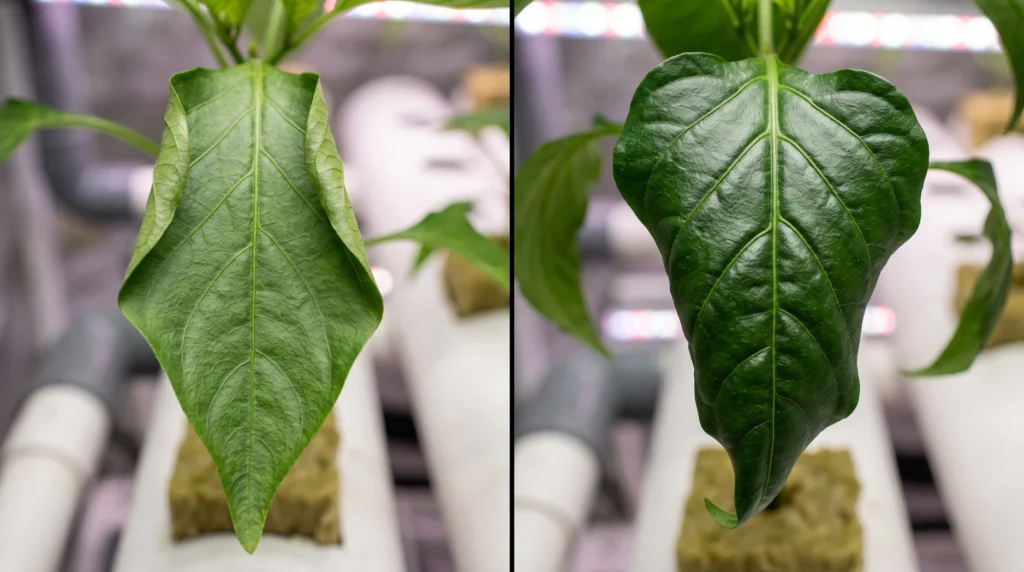
Upward curling typically indicates environmental stress as the plant attempts to conserve water, while downward curling points directly to nutritional toxicity or osmotic imbalance in the root zone. Identifying the direction of the roll is the first step in diagnosing canopy stress.
👉 Keep This Guide Handy in Your Grow Room! Don’t risk pulling up web pages with wet, nutrient-covered hands. Download our Free, Print-Ready Hydroponic Leaf Curl Cheat Sheet to hang right next to your reservoir as a permanent quick-reference dashboard.”
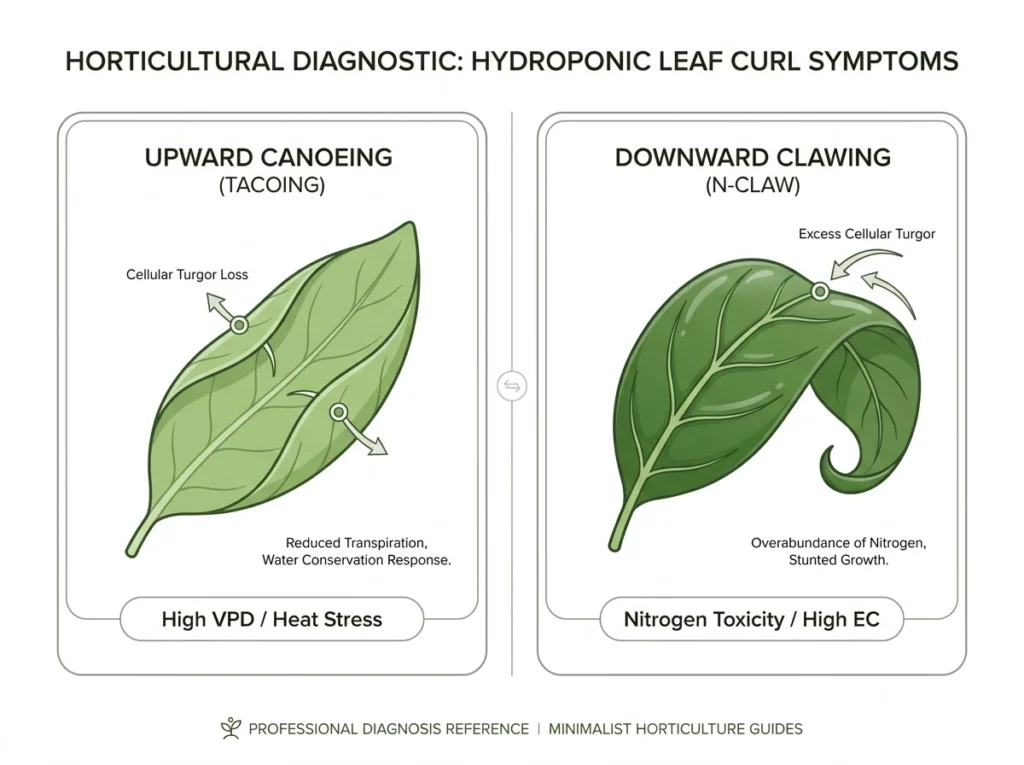
Leaf curl happens because the cells on one side of the leaf expand or contract faster than the cells on the opposite side. When environmental conditions threaten the plant’s water retention, it will actively change its surface area to protect itself.
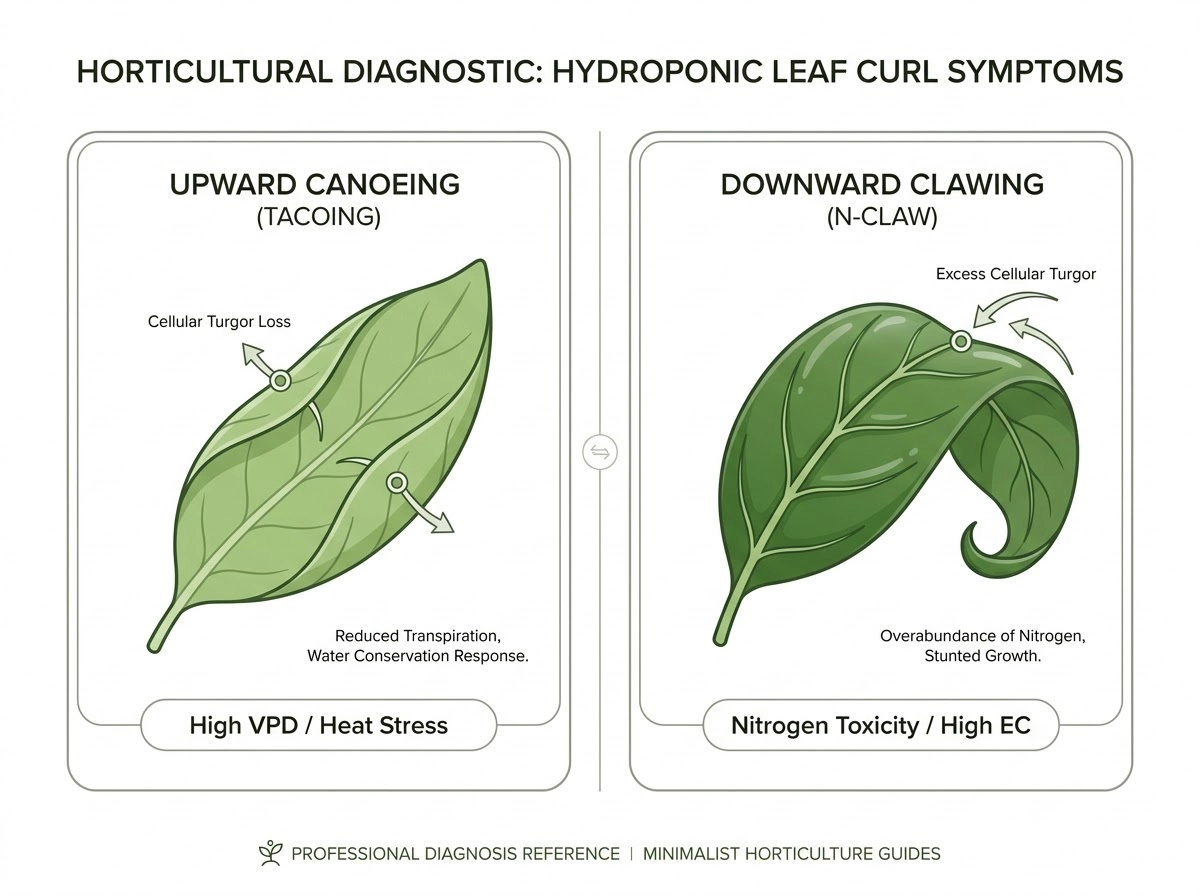
Upward curling, often referred to as “canoeing” or “tacoing,” happens when the margins of the leaf roll inward toward the central vein. The leaf begins to look like a boat. This is almost exclusively an environmental defense mechanism. The stomata (the microscopic pores responsible for gas exchange and transpiration) are located primarily on the underside of the leaf. When the plant is exposed to excessive heat, low humidity, or intense light, it loses water faster than the roots can supply it. To slow this transpiration rate, the leaf rolls upward to create a shaded microclimate that traps a small boundary layer of humid air against the stomata.
Downward curling, frequently called the “claw,” occurs when the tips and margins of the leaf hook downward toward the stem. The leaf surface often looks dark green, shiny, and structurally heavy. This downward hook is rarely environmental. It is a nutritional response. When a plant absorbs excess nitrogen, the cells along the top surface of the leaf elongate at a significantly faster rate than the cells on the bottom surface. The unequal growth rate forces the leaf to bend downward. Osmotic stress from an overly concentrated nutrient solution will produce a similar downward, heavy curl as water is pulled out of the leaf tissue.
To effectively triage the situation, look at the entire plant. Upward curl paired with dry, warm leaves is an airflow or climate issue. Downward curl paired with dark, glossy foliage is a reservoir issue. Never adjust your nutrient mix if the symptoms point to the environment, and never modify your ventilation if the symptoms point to the reservoir.
Environmental Drivers: Heat, VPD, and Windburn
High temperatures and low humidity force the plant into survival mode, triggering rapid upward leaf curl to trap moisture. Stabilizing your Vapor Pressure Deficit (VPD) and redirecting direct airflow are the fastest ways to flatten the canopy.
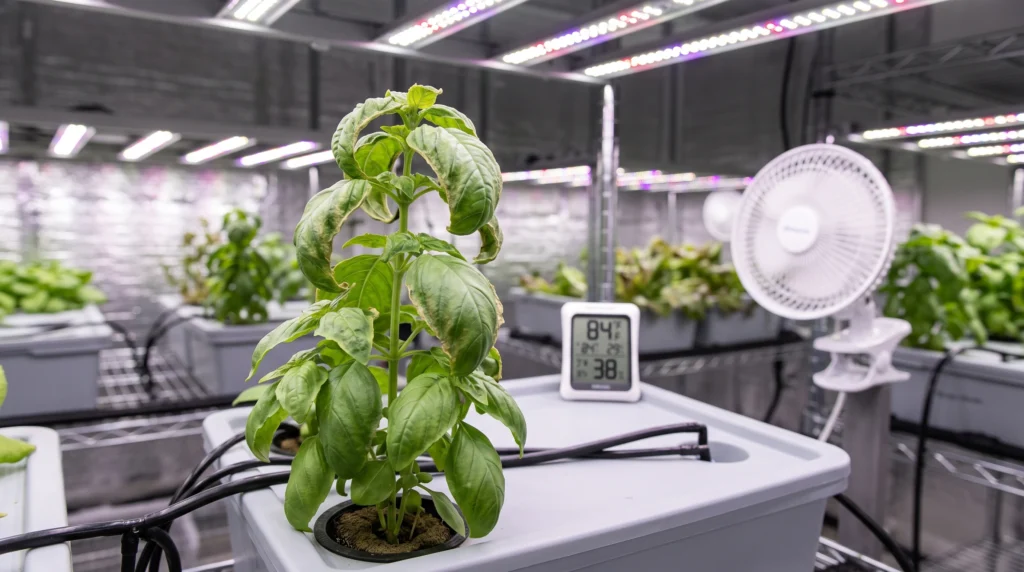
When hydroponic leaves curl upward, the environment is the primary suspect. You must immediately evaluate temperature, humidity, and airflow. The relationship between temperature and humidity is expressed as Vapor Pressure Deficit (VPD). VPD measures the exact drying power of the air. When VPD is too high, the air pulls moisture out of the leaf stomata faster than the roots can replace it.
If your grow room is 85 F (29.4 C) with a relative humidity of 35%, the air is exceptionally dry and hot. The VPD in this scenario is massive. The plant senses the rapid water loss and rolls its leaves upward to protect the stomata. If you do not correct the VPD, the plant will eventually close its stomata entirely, halting photosynthesis and calcium transport.
You can calculate the stress on your plants by measuring the exact VPD. While you do not need to perform this math daily, understanding the formula clarifies why leaves curl under specific conditions.
Interactive VPD Diagnostic Calculator
Input your canopy environment to check your Vapor Pressure Deficit (VPD) risk.
Calculated VPD: 0.00 kPa
The maximum amount of moisture the air can physically hold at a specific temperature.
The actual moisture currently suspended in the air (determined by relative humidity).
- Step 1: Calculate Saturated Vapor Pressure (SVP):
SVP = 610.7 × 10((7.5 × 26.6) / (237.3 + 26.6)) = 3,483 Pa (3.48 kPa) - Step 2: Calculate Actual Vapor Pressure (AVP):
AVP = 3.48 kPa × 0.40 (Relative Humidity) = 1.39 kPa - Step 3: Subtract AVP from SVP to find the deficit:
VPD = 3.48 kPa − 1.39 kPa = 2.09 kPa
Windburn is another distinct environmental driver of leaf curl. If an oscillating fan or an intake vent blows air directly onto the foliage at high velocities, it continuously strips away the humid boundary layer surrounding the leaf. Even if the overall room VPD is perfect, the localized microclimate on that specific leaf is bone dry. The plant reacts by aggressively curling the affected leaves away from the wind source. Windburn curl is easy to diagnose because it is highly localized. Only the leaves in the direct path of the fan will curl, while the rest of the canopy remains flat.
To fix environmental curl, raise your light fixtures to reduce radiant heat on the canopy. Adjust your humidifiers to bring VPD back into the 0.8 to 1.2 kPa range. Bounce your fan airflow off a wall rather than pointing it directly at the plants.

Why it's necessary: Continuous monitoring of temperature and humidity is the only way to track VPD and prevent environmental leaf curl before it starts. This unit logs data to your phone for accurate trend analysis.nnKey Spec: Remote monitoring with a +/- 0.54 F temperature accuracy and +/- 3% RH accuracy.
Nutritional Toxicity: The Nitrogen Claw and High EC
Downward curling is an unmistakable indicator of nutritional stress. The most frequent culprit is nitrogen toxicity, universally known among growers as the "N-Claw." Nitrogen is a highly mobile macronutrient that fuels vegetative growth. When you feed a plant excessive amounts of nitrogen, specifically in the ammonium (NH4+) form, the plant absorbs it rapidly.
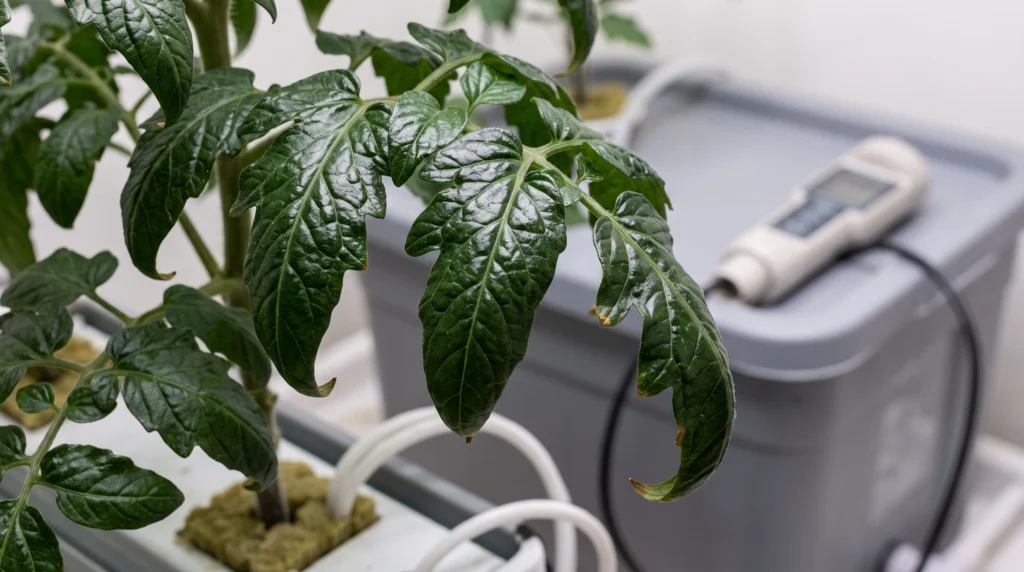
This forces sudden, unbalanced cellular elongation. The cells on the top layer of the leaf grow wildly, while the bottom layer fails to keep pace. The leaf physically bends downward, curling under itself. Leaves suffering from nitrogen toxicity will also appear abnormally dark green, shiny, and leathery. If left untreated, the tips will eventually burn, turn brown, and die.
If you suspect nitrogen toxicity, you must measure your reservoir's Electrical Conductivity (EC). High EC indicates that the total concentration of dissolved fertilizer salts is too strong for the plant. Plants rely on osmotic pressure to draw water into their roots. Water naturally moves from an area of low solute concentration to an area of high solute concentration. Normally, the inside of the root has a higher concentration of solutes than the surrounding water, allowing water to flow into the plant.
When your reservoir EC gets too high, you reverse this osmotic gradient. The water outside the root becomes saltier than the inside of the root. The plant can no longer absorb water effectively. In severe cases, the nutrient solution will actually pull water out of the plant. This causes severe downward curling, wilting, and scorched, crispy leaf margins. You can read more about balancing these metrics in our comprehensive guide to hydroponic nutrients.
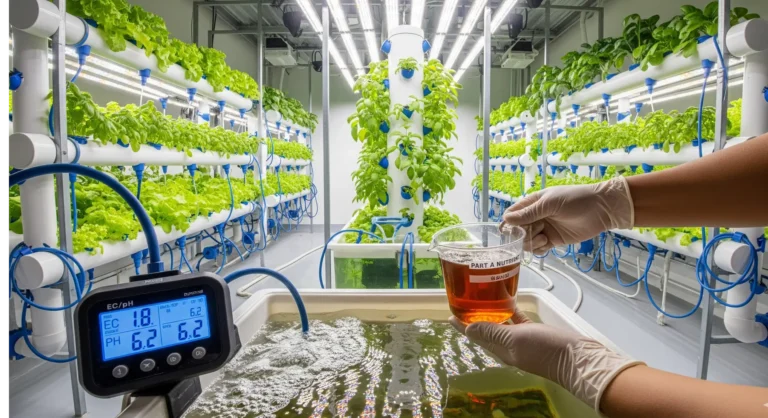
Fixing the N-Claw and high EC requires immediate reservoir dilution. Do not add plain water blindly. You must calculate the exact volume of fresh water needed to hit your target EC.
Reservoir Dilution Calculator
Lower your EC to stop the Nitrogen Claw using your exact reservoir capacity.
Required Action:
Imagine your reservoir currently holds 40 gallons of water with an excessive EC of 3.0, and you need to drop it to a safe 2.0 to stop your plants from clawing:
- Step 1: Set up the equation:
(40 Gallons × 3.0 EC) = (Total Target Volume × 2.0 EC) - Step 2: Solve the current nutrient load (total dissolved minerals):
120 = Total Target Volume × 2.0 - Step 3: Calculate the total required volume:
Total Target Volume = 60 Gallons
You need a total volume of 60 gallons to dilute the 3.0 EC down to 2.0 EC. This means you must add 20 gallons of pure water (0.0 EC). If your reservoir can only hold 40 gallons, you must drain 13.3 gallons of the heavy nutrient solution and replace it with 13.3 gallons of fresh water to reach the 2.0 target. For precise dosing adjustments tailored to your exact system, use our hydroponic nutrient calculator.
Take This Diagnosis to Your Grow Room (Free PDF Download)
Is your phone screen covered in nutrient water every time you try to troubleshoot? Stop squinting at web pages mid-flush. We’ve packaged this entire diagnostic framework into a clean, print-ready dashboard.
- Visual Diagnostic Diagram: Spot the difference between upward canoeing (VPD stress) and downward clawing (high EC/Nitrogen toxicity) instantly.
- The 4-Step Triage Workflow: Isolate root-zone, reservoir, and atmospheric problems systematically without guessing.
- Reservoir Dilution Matrix: Simple math references and formula cheat sheets to safely drop your EC using fresh water.
- Topical Inbound Links: Embedded paths to our master guides on pH/EC control, root rot prevention, and nutrient chemistry.

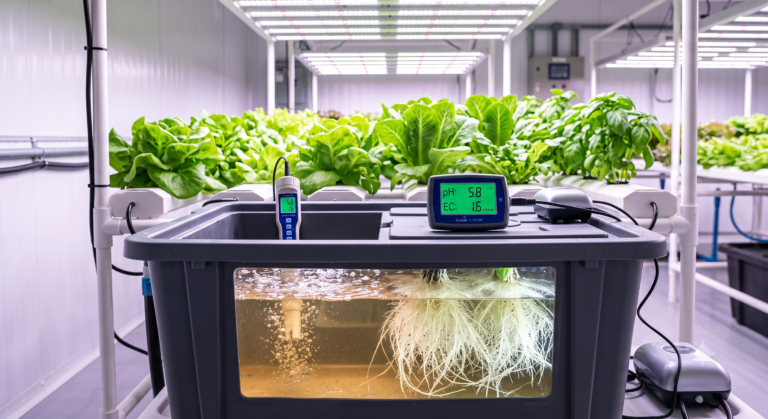
Why it's necessary: Accurately measuring the salt concentration in your reservoir prevents the osmotic stress and nitrogen toxicity that causes the claw. The Truncheon is factory calibrated and entirely waterproof.nnKey Spec: Measures EC (0.2 - 3.6), CF (2 - 36), and PPM scales without requiring manual calibration.
pH Shifts and Nutrient Lockout
A reservoir pH outside the 5.5 to 6.5 range prevents the plant from absorbing specific nutrients, leading to localized leaf cupping, curling, and interveinal yellowing. Correcting the pH restores normal uptake mechanics.
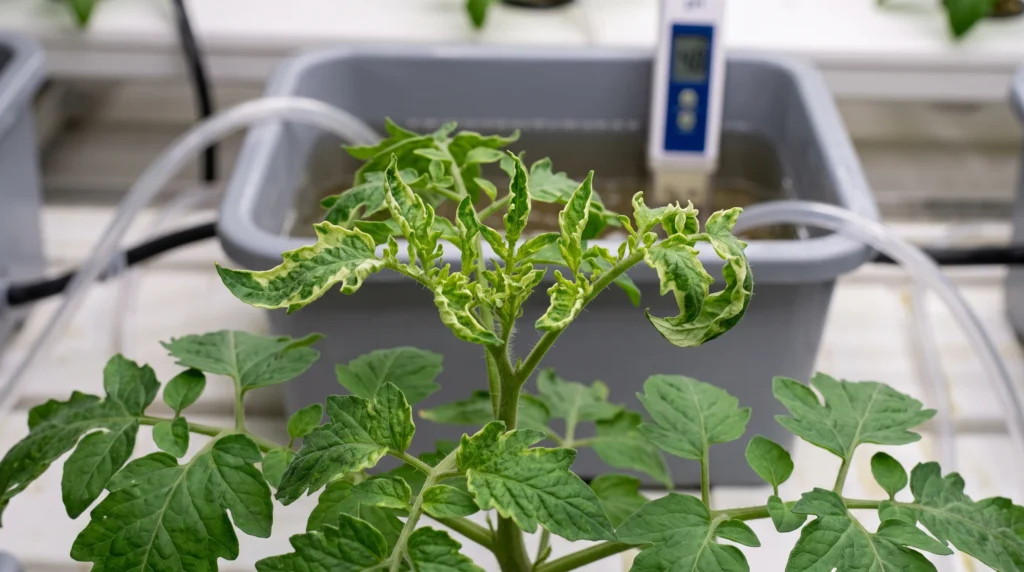
Leaves can curl even when your overall EC is perfect and your environment is dialed in. When this happens, the root cause is almost always pH drift leading to nutrient lockout. The pH level of your hydroponic water determines the electrical charge of the nutrient ions. If the pH drifts too high or too low, the ions bind together and precipitate out of solution, becoming physically unavailable to the plant roots.
For the vast majority of hydroponic crops, the ideal pH range is 5.5 to 6.5. When the pH drops below 5.5 (becoming highly acidic), calcium and magnesium precipitate out. When the pH rises above 6.5 (becoming alkaline), iron, manganese, and phosphorus become locked out. Understanding these dynamics is essential; you can master them by referencing our hydroponic pH and EC mastery guide.
Calcium deficiency presents a very specific curling pattern. Calcium is an immobile nutrient. Once the plant deposits calcium into a cell wall, it cannot move it to new growth later. Therefore, a calcium lockout manifests entirely on the newest, youngest leaves at the top of the plant. The new leaves will cup upward, curl erratically, and appear crinkled or twisted. The tips may die back entirely.
Magnesium deficiency, triggered by low pH, presents differently. Magnesium is a highly mobile nutrient. When lockout occurs, the plant pulls magnesium out of the older, lower leaves to sustain the new growth at the top. The older leaves will develop interveinal chlorosis (yellowing between the veins) and the margins will curl upward.
Never add a Cal-Mag supplement to your reservoir until you have verified your pH. If your pH is 5.0, adding more calcium will not fix the curling leaves. The calcium is already in the water; the plant just cannot absorb it. You must fix the pH first.
Adjusting pH requires a delicate touch. Use potassium hydroxide (pH Up) or phosphoric acid (pH Down). Add the adjuster in tiny increments, wait ten minutes for the solution to fully circulate, and measure again. Massive pH swings shock the root system and will exacerbate the leaf curl. Once the pH is stabilized in the 5.8 to 6.2 sweet spot, the new growth will emerge flat and healthy. The older leaves that have already suffered severe tissue damage will not uncurl, as the physical cell wall structure has already been permanently deformed.

Why it's necessary: Precise pH management is the only way to prevent nutrient lockout and calcium-induced leaf cupping. This pen provides lab-grade accuracy for daily reservoir checks.nnKey Spec: Accuracy of +/- 0.01 pH with automatic temperature compensation (ATC) and a replaceable probe.
Root Zone Diagnostics: Dissolved Oxygen and Pathogens
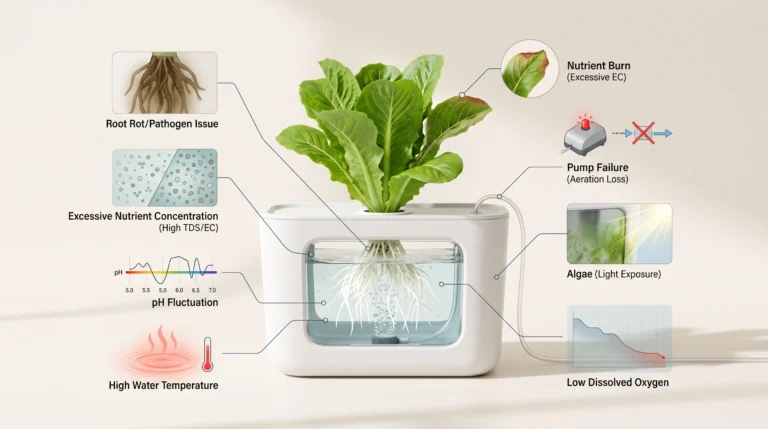
Brown, slimy roots cannot uptake water or oxygen, resulting in upper canopy wilting and severe leaf curl. Increasing dissolved oxygen and maintaining proper root zone temperatures prevents pathogen proliferation.
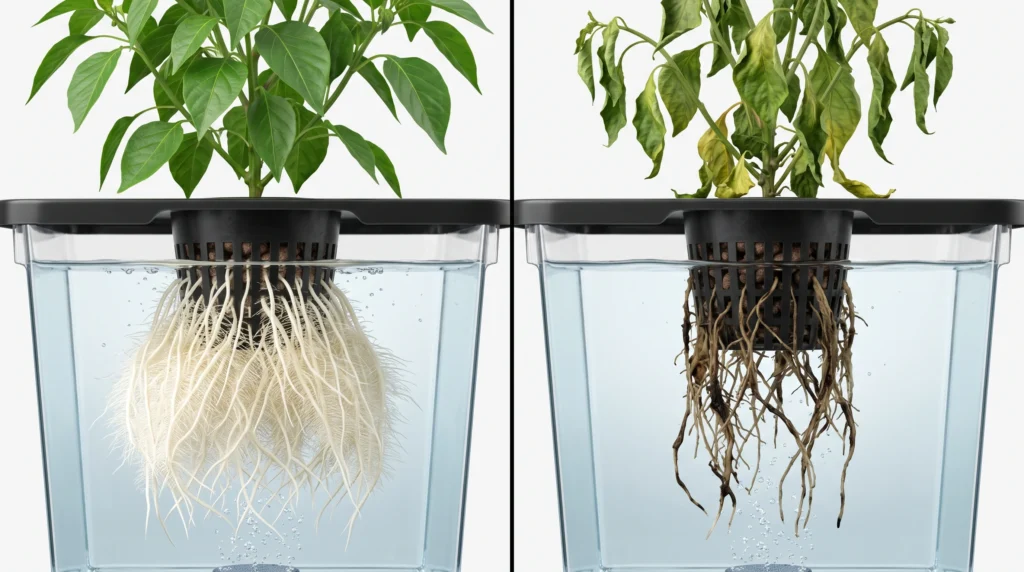
When leaves curl, droop, and look structurally exhausted despite perfect environmental parameters, you must look below the surface. The root zone is the engine of the plant. If the engine fails, the canopy collapses.
Healthy hydroponic roots are bright white, firm, and smell like fresh rain. If you lift your net pots and find brown, slimy, foul-smelling roots, you are dealing with Pythium or another waterborne pathogen. Root rot destroys the fine root hairs responsible for water absorption. The plant begins to dehydrate from the bottom up, forcing the leaves to curl and droop exactly as they would during severe under-watering. If you suspect pathogenic interference, review our protocol for hydroponic root rot prevention.
Root pathogens thrive in warm, stagnant, oxygen-depleted water. The physical temperature of your nutrient solution directly dictates how much Dissolved Oxygen (DO) the water can hold. Cold water holds significantly more oxygen than warm water. At 60 F (15.5 C), water can hold roughly 10 ppm of dissolved oxygen. As the temperature rises to 75 F (23.8 C), the maximum dissolved oxygen capacity drops to about 8.4 ppm.
When reservoir temperatures climb above 72 F (22.2 C), oxygen levels plummet. The plant roots begin to suffocate. At the same time, the metabolic rate of Pythium spores accelerates in the warm water. The combination of suffocating roots and aggressive pathogens causes rapid root death.
To fix root-induced leaf curl, you must chill the reservoir and increase aeration. Ensure your water pump is adequately turning over the reservoir volume; check our hydroponic pump sizing guide
to confirm your flow rates. Add commercial air stones powered by an oversized air pump to aggressively agitate the water surface, which is where true gas exchange occurs. If your ambient room temperatures are high, insulating the reservoir or investing in a thermoelectric water chiller will drop the root zone temperatures back into the safe 65 F to 68 F (18.3 C to 20 C) range.

Why it's necessary: High-output aeration ensures maximum dissolved oxygen levels, preventing root suffocation and keeping Pythium spores at bay.nnKey Spec: 45 LPM (liters per minute) output capacity pushing through 8 adjustable outlets.
System-Specific Variations (DWC, NFT, Aeroponics)
Leaf curl presents differently depending on the specific hydroponic delivery system. DWC systems are prone to aeration failures, NFT systems face localized flow restrictions, and Aeroponics systems suffer from rapid desiccation.
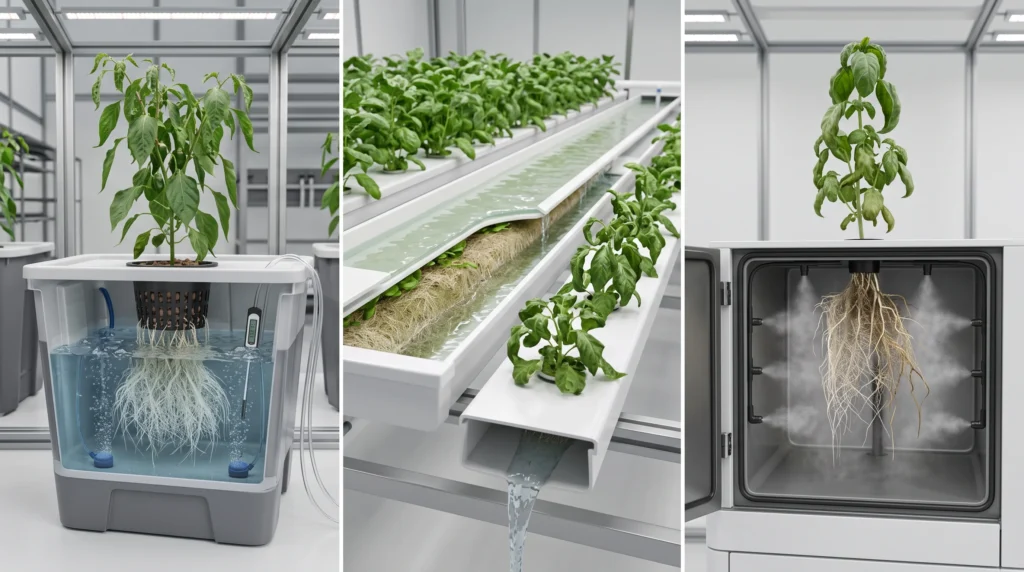
The type of system you operate influences which variables are most likely to fail and cause leaf curl. A Deep Water Culture (DWC) system utilizes a massive volume of standing water. The high thermal mass of the water makes it resistant to rapid temperature swings. However, if the air pump fails in a DWC bucket, the massive volume of standing water becomes stagnant instantly. The roots strip the remaining dissolved oxygen out of the water within hours, leading to immediate drooping and curling of the entire canopy. DWC leaf curl is almost always linked to aeration hardware failure or high water temperatures.
Nutrient Film Technique (NFT) relies on a constant, shallow stream of water moving down a sloped channel. Because the water volume inside the channel is incredibly low, the root zone is highly susceptible to temperature spikes if the ambient room air is hot. Furthermore, as the crop matures, massive root mats can physically block the flow of the nutrient film. The plants at the top of the channel receive full nutrition, while the plants at the bottom of the channel suffer from drought stress and nutrient starvation. If the leaves on the plants at the drain end of your NFT system are curling, but the plants at the intake end look perfect, you have a physical flow restriction.
Aeroponics systems suspend roots entirely in the air, misting them with high-pressure nozzles. This provides the highest possible oxygenation, but carries the highest risk. If a misting nozzle clogs with salt buildup, or a 1000 PSI solenoid fails, the roots have no buffer. They are hanging in dry air. In an aeroponics system, leaf curl can occur in less than 45 minutes of a pump failure as the roots desiccate rapidly. For a broader understanding of how different architectures impact plant health, see our DIY hydroponic systems guide.
Fast-Fix Diagnostic Workflow
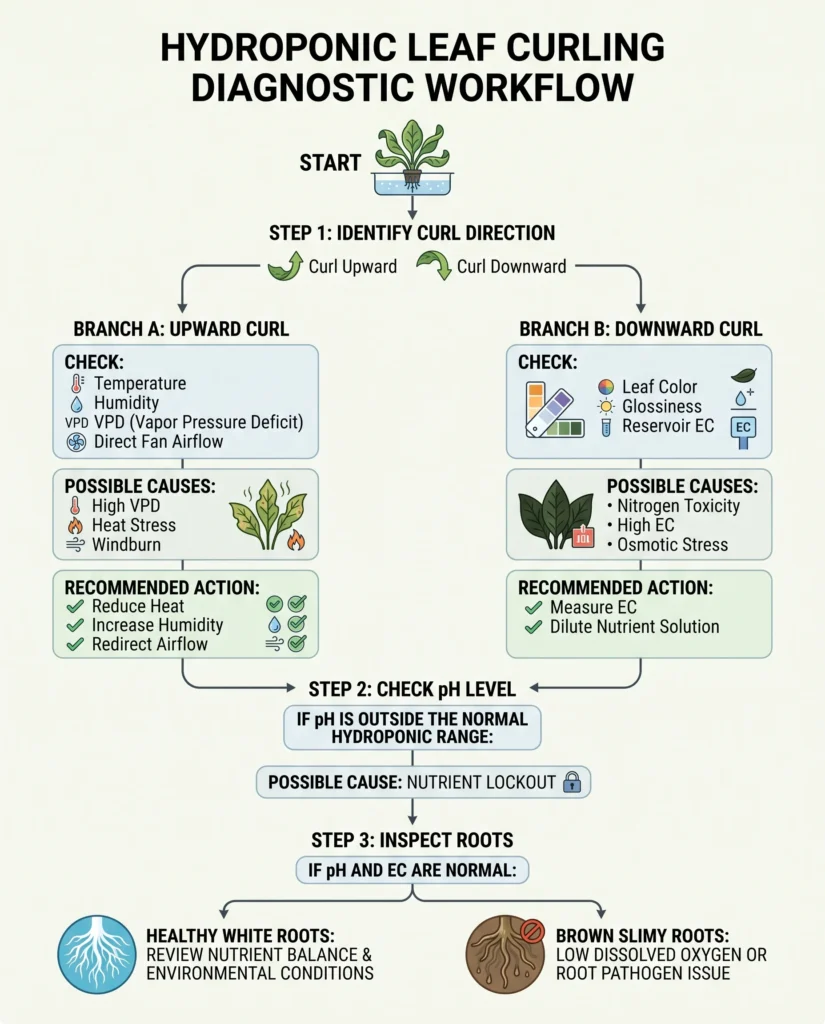
When you identify leaf curl in your system, do not panic and do not make sweeping adjustments to multiple variables at once. If you change the light height, adjust the pH, and dilute the reservoir all on the same day, you will never know which variable actually fixed the problem. Follow this strict triage order:
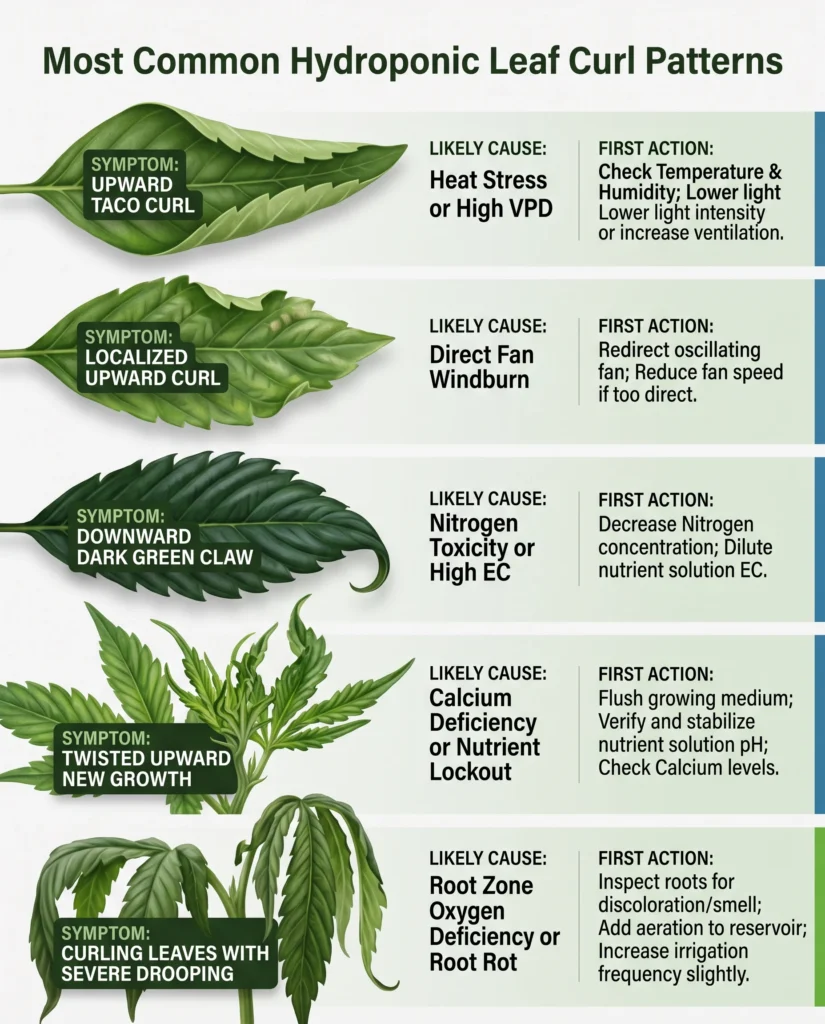
| Symptom Combination | Primary Cause | Immediate Fix |
| Upward Curl + Warm Leaves + Low Humidity | High VPD / Heat Stress | Raise lights, reduce heat, add humidity. |
| Upward Curl + Localized to one side of plant | Windburn | Redirect oscillating fans away from canopy. |
| Downward Claw + Dark Green Glossy Leaves | Nitrogen Toxicity / High EC | Dilute reservoir with fresh water. |
| Upward Cupping + Twisted New Growth | Calcium Lockout (Low pH) | Correct pH to 6.0. Wait for new growth. |
| Curl + Severe Drooping + Brown Roots | Pathogen / Low DO | Chill water, increase aeration, treat roots. |
Frequently Asked Questions
Why are the leaves on my hydroponic tomato plants curling upward like a taco?
Upward curling (canoeing) is an environmental defense mechanism. The tomato plant is experiencing high heat or low humidity, resulting in a Vapor Pressure Deficit (VPD) that is too high. The plant rolls its leaves upward to trap a boundary layer of humid air and reduce transpiration. You must lower the room temperature or increase the relative humidity to flatten the leaves.
What does it mean if my hydroponic leaves are curling downward and look dark green?
Downward curling, especially when paired with a dark green, glossy, or leathery texture, is the classic symptom of nitrogen toxicity, often called the u0022N-Claw.u0022 The plant is absorbing excessive amounts of ammonium, causing the cells on the top of the leaf to outgrow the cells on the bottom. You must measure your reservoir EC and dilute the solution with fresh water.
Can a pH imbalance cause leaf curl in hydroponics?
Yes. If your pH drops below 5.5, calcium and magnesium precipitate out of the solution and become unavailable to the plant. Because calcium is immobile, a deficiency will cause the newest leaves at the top of the plant to cup upward, twist, and curl. Correcting the pH to a range of 5.8 to 6.2 will resolve the lockout for future growth.
Why are my leaves curling and drooping even though the EC and pH are perfect?
If your environmental and nutritional metrics are dialed in but the plant is curling and drooping severely, you likely have a root zone issue. Lack of dissolved oxygen or the presence of root rot (Pythium) destroys the root hairs, preventing the plant from absorbing water. Check your roots; if they are brown and slimy, you must increase aeration and lower the water temperature below 70 F (21.1 C).
Will curled leaves return to normal after I fix the problem?
It depends on the severity and the type of curl. Leaves suffering from mild heat stress will often relax and flatten out once the VPD is corrected. However, leaves that have suffered severe nitrogen toxicity or calcium lockout have permanent cellular deformation. The damaged leaves will remain curled, but the new growth emerging from the top of the plant will be flat and healthy.
How does airflow cause leaves to curl in an indoor grow tent?
Direct, high-velocity airflow from an oscillating fan strips the humid boundary layer off the leaf surface, causing localized dehydration known as windburn. The plant will aggressively curl the affected leaves away from the wind source to protect its stomata. Always aim fans to circulate air above the canopy or bounce off walls rather than blasting the foliage directly.
Summary of Leaf Curl Diagnostics
Curling leaves are the visual output of invisible stress. Whether the plant is battling the physics of high vapor pressure deficit, the chemistry of an acidic pH lockout, or the biological attack of root zone pathogens, it uses leaf morphology to signal the problem. By mastering the mechanical differences between upward environmental curling and downward nutritional clawing, you eliminate guesswork. Rely on accurate meters to read your environment and your reservoir, follow the systematic triage workflow, and make calculated adjustments to restore your canopy to peak operational health.
What specific environmental or nutritional metric will you adjust first to flatten your hydroponic canopy?
Prefer Visual Learning? Watch the Complete Video Guide
If you want to see these visual diagnostics in action, watch our step-by-step companion video.
We walk you through the distinct differences between upward canoeing and downward clawing, show you how to measure VPD and EC in real-time, and run through our emergency grow-room triage workflow. Perfect for playing on your phone or tablet while working in your grow room.


Continue Your Learning Journey