Fusarium & Phytophthora Root Rot: Prevention and Early Identification

Table of Contents
- The Pathology of Fusarium and Phytophthora
- Early Identification: Catching the Rot Before It Spreads
- Environmental Prevention: Building an Unfriendly Climate
- Biological vs Chemical Defenses: Choose One Path
- The 5-Step Outbreak Eradication Protocol
- Essential Pathogen Management Equipment
- Frequently Asked Questions
- Symptom-Based Diagnostic Tool
Nothing destroys a thriving indoor garden faster than an unseen pathogen weaponizing your own water supply. Lighting’s dialed in, nutrient ratios are balanced, ambient climate is under control, but beneath the surface of the net pots a microscopic war can still be underway. When root tissue browns and the canopy wilts under full light for no obvious reason, growers usually blame generic “root rot” or Pythium by default.
Pythium is genuinely common, but it’s often an opportunistic scavenger feeding on roots that are already compromised. The real heavyweight killers in controlled-environment agriculture are Fusarium and Phytophthora, aggressive, resilient pathogens capable of wrecking a commercial hydroponic bay in days. Because recirculating systems like NFT and DWC share a communal water source, one infected root system can spread swimming zoospores to every other plant on the line fast.
Beating these pathogens takes more than dumping hydrogen peroxide into a reservoir. It means understanding their life cycles, recognizing their distinct visual signatures early, and building real structural environmental defenses.
The Pathology of Fusarium and Phytophthora
Fusarium and Phytophthora are aggressive fungal and water-mold pathogens that thrive in warm, poorly oxygenated reservoirs, actively attacking healthy vascular tissue rather than just scavenging what’s already dead.
Treating all root slime as the same problem is a fast path to recurring crop loss, these two pathogens behave quite differently from each other and from Pythium.
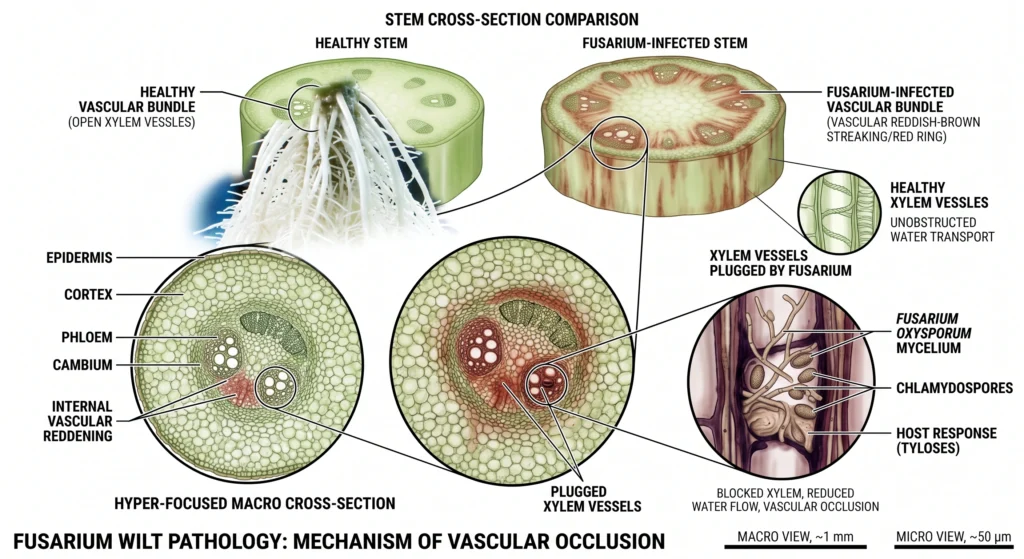
Fusarium oxysporum is a true fungus causing Fusarium wilt and crown rot. Unlike an opportunistic water mold, it actively targets the plant’s vascular tissue, entering through microscopic root wounds and growing upward into the stem, physically plugging the plumbing that carries water and nutrients. That’s why infected plants wilt during peak light hours even with roots fully submerged in water. Fusarium can survive for years in hardware and organic debris by forming resilient resting structures called chlamydospores, a well-documented survival mechanism in plant pathology.
Phytophthora species (the name literally translates from Greek as “plant destroyer”) are oomycetes, water molds closely related to Pythium. Species like P. capsici and P. cryptogea produce motile zoospores with flagella that let them swim through nutrient solution, chemically sensing root exudates and heading straight for the healthiest, most vigorous root tips. Phytophthora is particularly notorious for fast crown rot, where the stem base near the water line turns dark brown or black and collapses.
For chronic, unexplained wilting that might not actually be a pathogen at all, our troubleshooting guide helps rule out basic environmental stressors first.
Early Identification: Catching the Rot Before It Spreads
Identifying the specific pathogen early relies on distinct visual, structural, and smell-based markers. Generic rot looks like light brown slime, but Fusarium often shows unilateral vascular browning, while Phytophthora causes dark, sunken lesions right at the crown line.
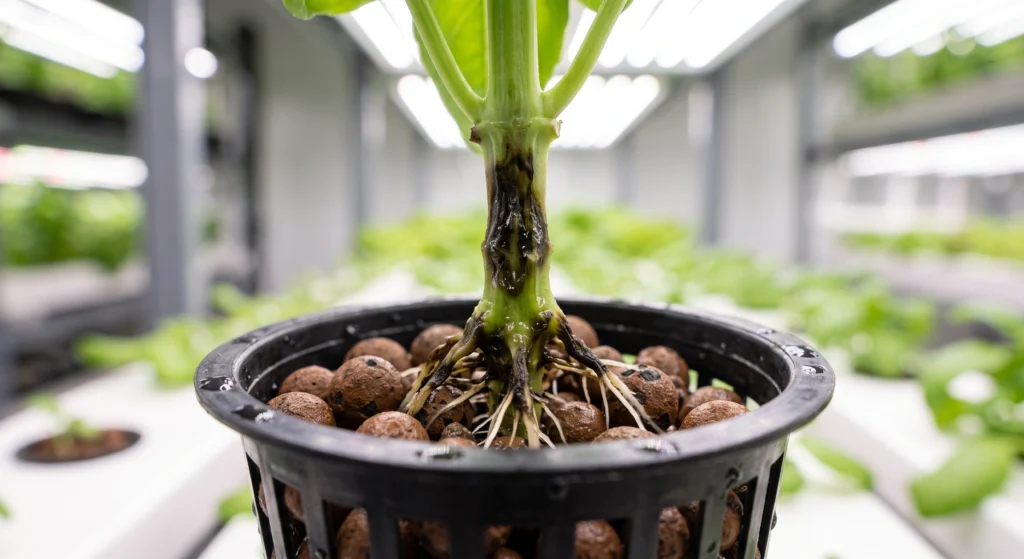
By the time the whole root mass looks like muddy sludge and smells like a swamp, the exact pathogen identity barely matters anymore, the plant’s not coming back. Catching it early is what lets you actually isolate the source.
| Indicator | Fusarium oxysporum | Phytophthora spp. | Pythium (for comparison) |
|---|---|---|---|
| Early Root Symptoms | Reddish-brown discoloration inside vascular tissue; roots may initially stay firm | Dark brown or black water-soaked lesions; outer root sheath sloughs off easily | Mushy, light brown root tips; roots lose structure and feel slimy |
| Crown & Stem Signs | Dark brown vascular streaking visible if the stem is cut open; pinkish mold near the medium line | Sunken, dark black lesions at the crown; rapid stem collapse | Thinning right at the medium surface; plant falls over but stem isn’t strictly black |
| Canopy Symptoms | Unilateral wilting, one side or branch wilts and yellows while the rest looks normal | Sudden, catastrophic wilting of the whole plant; leaves yellow and drop fast | General stunting, lower leaf yellowing, slow decline |
| Smell | Musty, earthy, not inherently rotten early on | Sharp, sour, rotting vegetation smell as necrosis advances | Mildewy, swamp-like, stagnant pond water |
Spotting vascular streaking or crown lesions should immediately shift focus to root rot prevention for the rest of the crop. Remove the infected plant right away, don’t trim off the dead-looking roots and put it back, the pathogen is already inside the main stem by that point.
Environmental Prevention: Building an Unfriendly Climate
The strongest defense is a highly oxygenated, temperature-controlled reservoir. Keeping water below roughly 68°F meaningfully slows Phytophthora zoospore reproduction while maximizing dissolved oxygen at the same time.
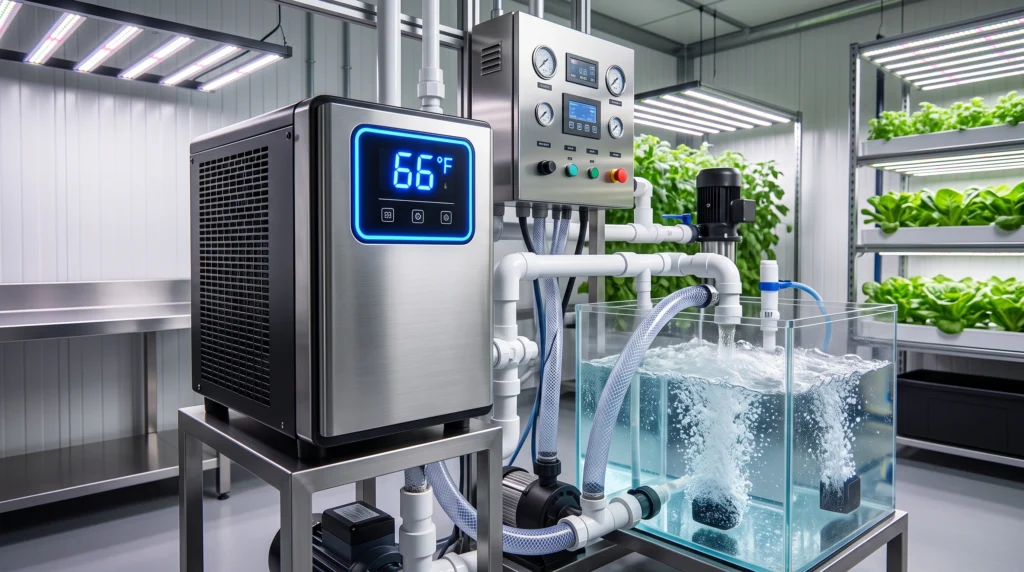
Pathogens want the same things plants want: warmth, moisture, food. Real prevention means engineering water parameters that push plant metabolism up while pushing pathogen reproduction down.
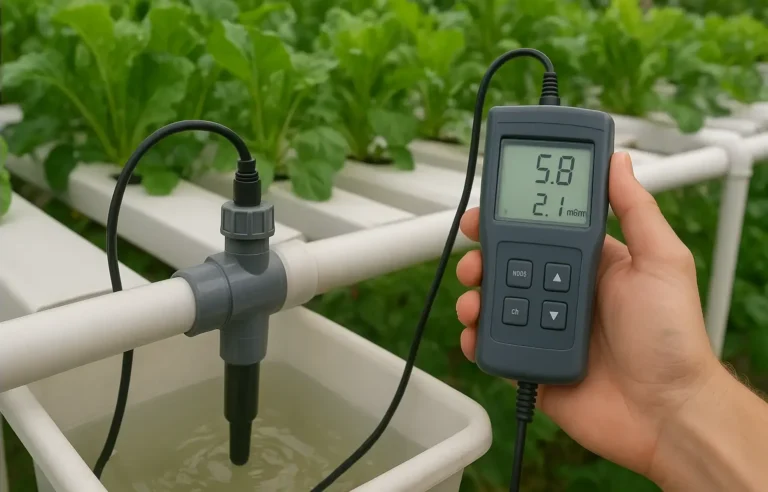
Water temperature is the key variable. Both Phytophthora and Fusarium populations expand fast once water crosses roughly 72°F (22°C), with reproduction accelerating further as temperature climbs toward 75°F (24°C). Holding nutrient solution in the 65 to 68°F (18-20°C) range slows their metabolic rate meaningfully. Extension sources on greenhouse oomycete diseases consistently point to temperature control and avoiding standing anaerobic water as the two most critical management levers.
Maximizing dissolved oxygen. Cold water holds more dissolved oxygen than warm water. High DO (above roughly 6 mg/L) supports thick, bright white root growth, and healthy, well-oxygenated roots have a thicker cellular epidermis that’s genuinely harder for a swimming zoospore to penetrate. If roots look thin or brittle, check aeration first, our pump sizing guide covers the flow rate math.
Strict quarantine. Never bring a clone or seedling straight from an outside nursery into the main system. Pathogens hitchhike on soil plugs, rockwool, and plant tissue. Our clone quarantine protocol covers the full isolation process.
Sources: Penn State Extension: Sources of Plant Disease in Greenhouses · UConn IPM: Root Rot Diseases of Greenhouse Crops (PDF)
Biological vs Chemical Defenses: Choose One Path
Growers generally pick either a sterile reservoir strategy using oxidizing agents, or a biological strategy using competitive-exclusion microbes. These two approaches don’t mix well, chemical oxidizers wipe out beneficial inoculants right alongside pathogens.
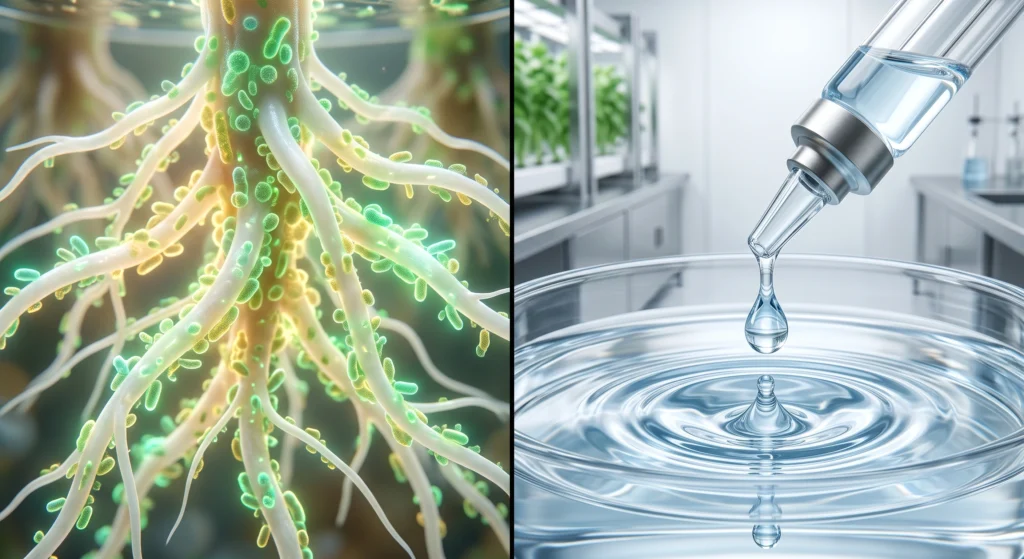
The Biological Approach (Competitive Exclusion)
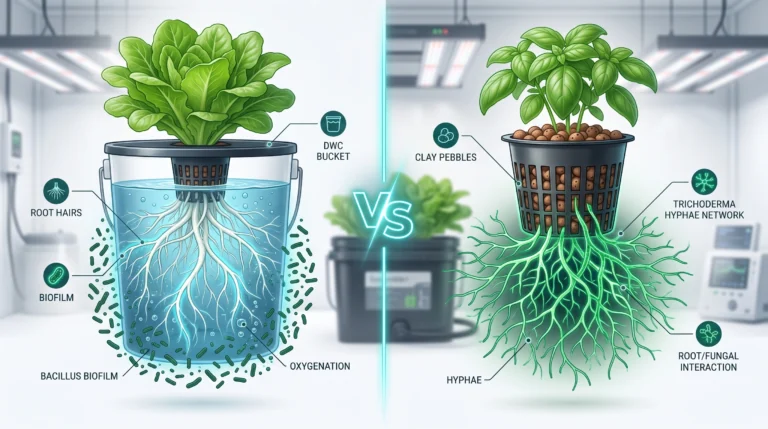
A pristine, well-oxygenated reservoir left uninoculated with good bacteria eventually gets colonized by something less helpful. Introducing beneficial microbes like Bacillus amyloliquefaciens or Trichoderma harzianum coats root hairs in a protective biofilm that physically and chemically outcompetes Fusarium and Phytophthora for space and root exudates, and many Bacillus strains produce enzymes that actively break down attacking pathogen cell walls. Our microbes and enzymes guide covers which strains suit which situations.
The Sterile Approach (Oxidation)
High-pressure aeroponic systems or setups prone to clogging may not tolerate biologicals well, biofilm from live inoculants can gum up fine emitters. In that case, oxidative agents are the better fit. Hypochlorous acid (HOCl) is generally the stronger option here, unlike hydrogen peroxide (which degrades fast and reacts indiscriminately with all organic matter), HOCl stays stable in solution longer and actively breaks down the biofilm Phytophthora uses to shield itself inside PVC piping. Commonly cited dosing runs around 2 to 3mL per gallon for ongoing maintenance.
The 5-Step Outbreak Eradication Protocol
A confirmed Fusarium or Phytophthora outbreak calls for immediate isolation of affected plants and a full chemical reset of the system. Salvaging a heavily infected plant is rarely realistic, the priority shifts fast to protecting everything still healthy.

Spotting the dark, sunken crown lesions of Phytophthora or the unilateral wilting of Fusarium means acting immediately, don’t wait to see if the plant recovers.
- Cull the infected. Pull infected plants, net pots and media included, straight out of the system and into a sealed bag right away. Spores can drop into nearby reservoirs or travel on air currents.
- Dump the reservoir. Drain the entire nutrient solution to waste, it’s carrying millions of zoospores looking for a new host.
- Shock the plumbing. Refill with plain water and add a heavy shock dose of HOCl or concentrated agricultural H2O2. Run pumps for a few hours to push the sterilizing solution through every emitter, channel, and return line, stripping the pathogen biofilm out of the system.
- Rinse and re-dial. Drain the sterilization solution, refill with fresh RO water, add nutrients, and re-lock your pH and EC targets. Our pH and EC mastery guide covers baseline numbers.
- Drop temperature and re-inoculate. Lower the chiller toward 65°F (18°C) to stress any surviving pathogens, and dose a fresh Bacillus-based inoculant to recolonize the roots of surviving plants before anything else gets there first.
If root damage from the outbreak is significant, a reduced EC while the plant pushes new root growth is a reasonable, commonly recommended adjustment, exact numbers vary by crop and severity, so watch plant response rather than targeting one fixed percentage.
Essential Pathogen Management Equipment

Temperature control is close to non-negotiable here. Keeping a reservoir reliably below roughly 68°F takes real pressure off both dissolved oxygen and pathogen reproduction.

A stronger option than H2O2 for clearing plumbing between crop cycles or running a sterile system, breaking down protective biofilm without being harsh on healthy root hairs.

A cheap way to inspect the crown line and roots for early mycelial webbing or the first signs of vascular browning before canopy wilt even shows up.
Frequently Asked Questions
Can you cure a plant once it has Fusarium wilt?
No. Once Fusarium has colonized the xylem, the plant can’t be saved, systemic fungicides generally can’t reach deep enough into vascular tissue to eradicate it without killing the plant in the process. Culling the plant is what protects the rest of the crop.
How does Phytophthora enter an indoor hydroponic system?
Both Phytophthora and Fusarium are naturally occurring soil organisms that almost always hitchhike into a sterile indoor grow, on dirty tools, dust from outdoor clothing, occasionally untreated tap water, or most commonly, hidden inside the root media of clones and seedlings from outside sources.
Is hydrogen peroxide better than hypochlorous acid for treating root rot?
Generally no. H2O2 is highly reactive and burns out within hours as it reacts with organic matter in the tank, nutrients included. HOCl stays stable and active for considerably longer, targeting pathogen cell walls and biofilm specifically without attacking your fertilizer profile as aggressively.
Should I lower my nutrient strength during a root rot outbreak?
Generally yes. Damaged roots lose some of their normal osmotic function, and a high EC can add osmotic stress on top of that, making it harder for the plant to pull in water. Reducing EC somewhat while the plant pushes new healthy root growth is a reasonable, commonly recommended adjustment, watch the plant’s response rather than targeting one fixed number.
Can I reuse expanded clay pebbles after a Phytophthora infection?
Only with thorough sterilization. Phytophthora spores can survive in the porous micro-fissures of clay pebbles. Wash away all organic debris, then soak in a bleach solution (commonly cited around 1 part bleach to 9 parts water) or a strong H2O2 solution for at least a day, rinse thoroughly, then let them dry fully in direct sunlight for several days before reuse.
Symptom-Based Diagnostic Tool
Not sure which pathogen you’re looking at? Answer a few quick questions about what you’re seeing and this tool points you toward the most likely culprit based on the comparison table above.
Answer what you’re observing to get a starting hypothesis. This is a guide based on typical symptom patterns, not a lab diagnosis, when in doubt, a plant diagnostic lab is the only way to confirm a specific pathogen.
This tool suggests a starting hypothesis based on common symptom patterns. It cannot replace a real diagnostic lab confirmation, especially for a valuable crop or a recurring problem.

Continue Your Learning Journey