Iron Chelate Selection: DTPA vs EDDHA vs EDTA by pH Level

Table of Contents
Iron deficiency is the most frequent and visually striking micronutrient disorder in controlled-environment agriculture, driven almost entirely by reservoir pH drift rather than a true absence of iron. Understanding the chemical stability of EDTA, DTPA, and EDDHA chelates at specific pH ranges is the only reliable way to prevent iron lockout and maintain vigorous, green canopy growth.
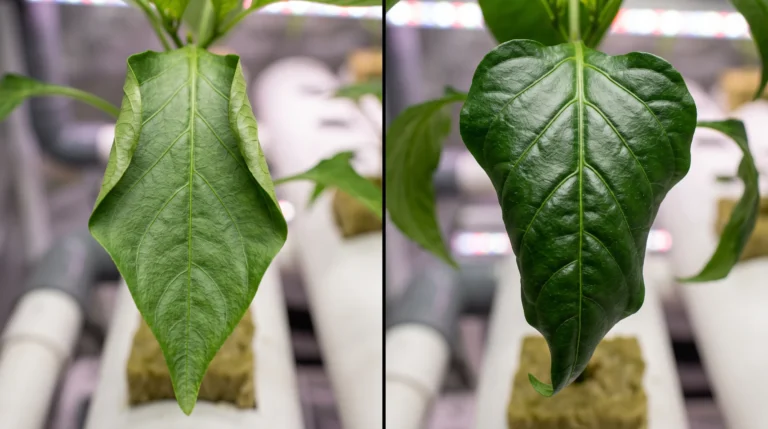
Walk into any indoor garden, and the signs of a struggling nutrient solution usually show up first at the very top of the plant. The new leaves emerge pale yellow or even stark white, while the intricate network of veins remains dark green. This stark contrast, interveinal chlorosis on new growth is the classic signature of iron deficiency.
In soil farming, fixing this issue is complex because soil biology, moisture, and mineral composition all interact in unpredictable ways. In controlled-environment agriculture (CEA), the root cause is almost always straightforward: your reservoir pH has drifted too high, and the specific type of iron chelate in your nutrient mix has failed, dropping the iron out of solution and rendering it invisible to your plants.
At MistCulture, our lead engineers spend a lot of time analyzing nutrient profiles. We constantly see growers buying expensive “cal-mag-plus-iron” supplements to fix yellowing leaves, entirely missing the core chemistry at play. Pumping more of the wrong kind of iron into a high-pH reservoir does nothing but waste money and build up sludge in your pipes.
To solve this, we must look at the biochemical delivery mechanisms protecting the iron ions in your water. This guide breaks down the exact science of iron chelate hydroponics, comparing EDTA, DTPA, and EDDHA, and provides actionable steps to match the right chemistry to your system’s parameters.
Legal Note: Regulations vary by location. Always consult local guidelines. This content is for educational purposes only.
The Biochemistry of Chelation: Shielding the Iron Ion
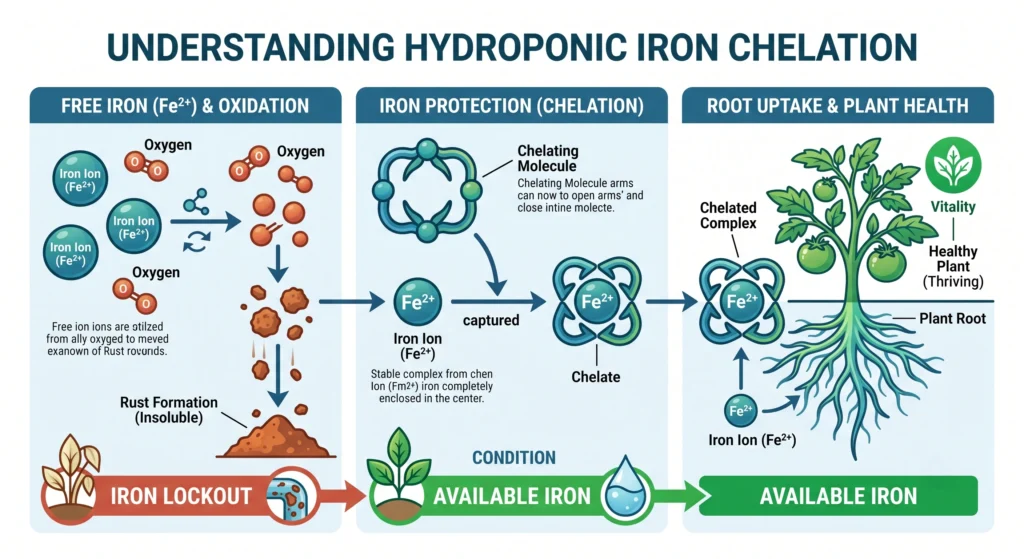
Chelates are organic molecules that act as a protective claw around heavy metal ions, preventing them from reacting with oxygen and precipitating out of the nutrient solution as unusable rust. Without these organic shields, hydroponic iron would oxidize within hours and become entirely unavailable for root absorption.
To understand why you need to choose your iron source carefully, you must first understand the behavior of raw iron in water. Iron is an essential micronutrient. Plants require it to synthesize chlorophyll, maintain chloroplast structure, and drive the electron transport chain during photosynthesis. Without iron, the plant simply cannot produce green pigment, and energy production grinds to a halt.
When you dissolve raw, unchelated iron (like iron sulfate, FeSO₄) into highly oxygenated hydroponic water, it rapidly reacts with the dissolved oxygen and hydroxide ions. The iron oxidizes from its soluble ferrous state (Fe²⁺) into the ferric state (Fe³⁺) and forms iron oxide or iron hydroxide. In plain English: it turns into microscopic rust. This rust precipitates, meaning it drops out of the liquid solution and settles on the bottom of your reservoir or coats the inside of your PVC pipes. The plant roots cannot absorb these solid rust particles.
To bypass this chemical reaction, fertilizer manufacturers use chelates. The word “chelate” comes from the Greek word chēlē, meaning “claw.” A chelating agent is a large, synthetic organic molecule that wraps around the iron ion like a claw, shielding it from the surrounding oxygen and hydroxide ions in the water.
When the chelated iron molecule brushes against a plant root, the root exudes specific organic acids and reductive enzymes. These biological exudates weaken the chemical claw, allowing the root membrane to strip the iron ion out of the chelate and absorb it into the plant’s vascular tissue. The empty chelate molecule is then left behind in the water.
The catch? These claws are highly sensitive to the electrical charge of the water, which is dictated by the pH. As the pH of your reservoir rises, the water becomes more alkaline, filled with negatively charged hydroxide (OH⁻) ions. These hydroxide ions aggressively attack the chelate claw. If the pH goes high enough, the hydroxide rips the iron out of the claw, oxidizes it, and locks it out. The strength of the claw, and the pH level at which it breaks apart depends entirely on which molecule you are using: EDTA, DTPA, or EDDHA.
For a broader understanding of how all macro and micronutrients behave in solution, check out our comprehensive hydroponic nutrients guide.
EDTA, DTPA, and EDDHA: The pH Compatibility Breakdown
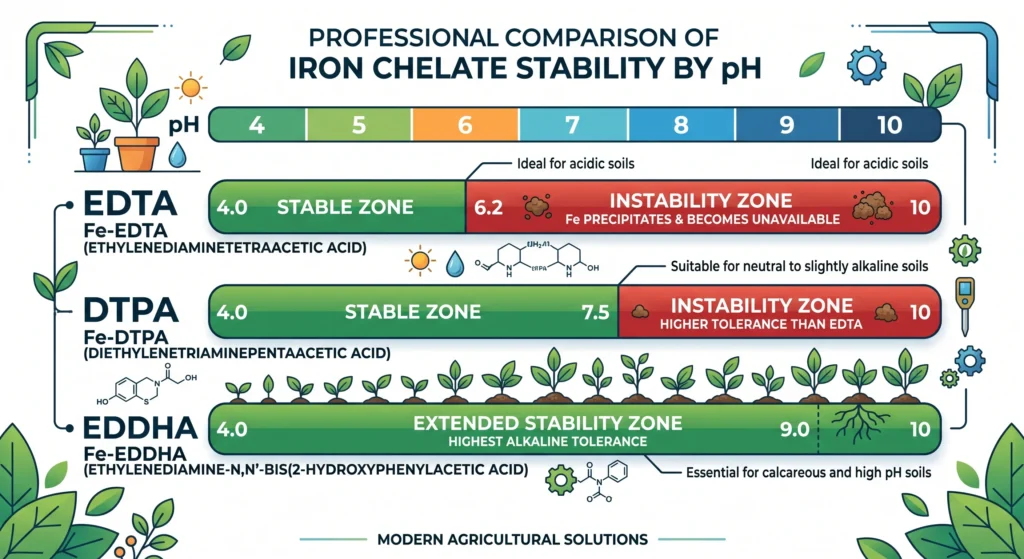
The three primary chelating agents used in hydroponics EDTA, DTPA, and EDDHA offer ascending levels of protection against alkaline water, with EDTA failing early at pH 6.5, DTPA holding strong until 7.5, and EDDHA providing absolute stability up to pH 9.0 and beyond.
Choosing the right iron chelate hydroponics strategy means looking at the back of your fertilizer bag, checking the guaranteed analysis, and matching the listed chelate to your daily reservoir realities.
1. Iron EDTA (Ethylenediaminetetraacetic acid)
Iron EDTA is the cheapest and most common chelate found in low-tier liquid fertilizers and generic garden store formulations. It typically contains about 13% iron by weight.
- The pH Limit: EDTA is a relatively weak claw. It remains perfectly stable in acidic conditions, but as the pH rises past 6.0, it begins to lose its grip. By the time your reservoir hits pH 6.5, nearly 50% of the iron has been stripped from the EDTA and locked out as rust.
- The Verdict: If you are running a hyper-precise system where the pH never exceeds 5.8, EDTA works fine. However, in dynamic systems where pH naturally drifts upward between reservoir checks, EDTA is a major liability. We do not recommend relying solely on EDTA for your primary iron source.
2. Iron DTPA (Diethylenetriaminepentaacetic acid)
Iron DTPA is the industry standard for professional hydroponic cultivation. You will find it in high-quality commercial dry salt mixes like Masterblend and Jack’s 321. It usually contains 10% or 11% iron by weight.
- The pH Limit: DTPA is a much stronger molecule than EDTA. It holds onto the iron ion securely all the way up to a pH of 7.0, and only begins to significantly degrade around 7.5.
- The Verdict: This is the “Goldilocks” chelate. Because the optimal pH for most hydroponic crops is between 5.5 and 6.5, DTPA provides a massive buffer. Even if your pH dosing pump fails or you forget to check your reservoir for a few days and the pH spikes to 6.8, the iron remains completely soluble and available to the plants. If you are growing heavy feeders like hydroponic tomatoes and peppers, DTPA is your best baseline defense.
3. Iron EDDHA (Ethylenediamine-N,N’-bis(2-hydroxyphenylacetic acid))
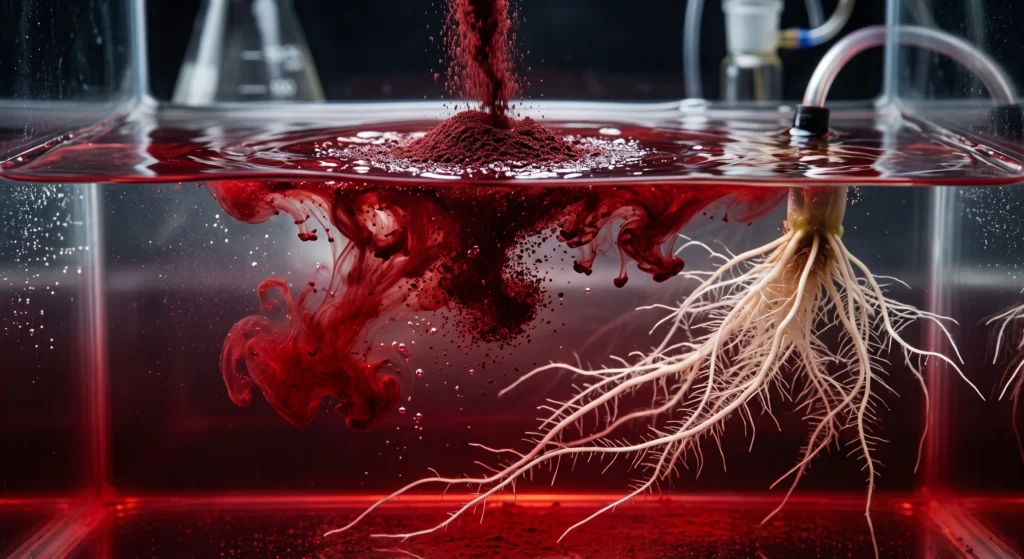
Iron EDDHA is the heavy artillery of the chelate world. It is a large, complex, and expensive molecule, typically containing 6% iron by weight. It is sold as a dark, granular powder that turns water a brilliant, deep blood-red when dissolved.
- The pH Limit: EDDHA is nearly indestructible under normal agricultural conditions. It remains stable and keeps iron soluble up to a staggering pH of 9.0 or higher.
- The Verdict: EDDHA is not usually required for a perfectly tuned hydroponic system, but it is an absolute lifesaver in three specific scenarios:
- Aquaponics: Because fish waste and nitrification processes require higher pH ranges (usually around 6.8 to 7.2) to keep the biofilter healthy, DTPA is pushed to its limits. EDDHA thrives here.
- Hard Water Regions: If you are running tap water with extreme alkalinity and high carbonate hardness, your pH will constantly fight to rise. EDDHA ensures your plants never starve for iron while you battle the pH drift.
- Emergency Rescue: If your plants are showing severe interveinal chlorosis, dosing a small amount of EDDHA directly into the reservoir provides immediate, guaranteed iron uptake regardless of your current water chemistry.
Field Note: Be aware that EDDHA’s dark red color will stain PVC pipes and make visual inspection of root health slightly more difficult, as the roots will take on a slight reddish-brown tint.
Parameter Table: Iron Chelate Efficacy by pH Level
Reference this parameter table to quickly identify the chemical stability, cost efficiency, and optimal use-case for each iron chelate based on your specific reservoir pH targets.
| Chelate Type | Iron Content | Max Stable pH | Visual Indicator in Water | Relative Cost | Best Use Case |
| Fe-EDTA | ~ 13% | 6.2 | Slight yellow/clear | Low | Strict pH control < 5.8 |
| Fe-DTPA | 10% – 11% | 7.5 | Amber/Yellow | Medium | Standard CEA (pH 5.5-6.5) |
| Fe-EDDHA | 6% | 9.0+ | Deep Blood Red | High | Aquaponics, Hard Water, Rescue |
| Fe-Amino Acid | Varies | 6.5 | Cloudy/Brown | Very High | Certified Organic/Veganic |
Data compiled from agronomic standards. Note: Amino acid chelates are often used in organic setups but degrade rapidly in reservoirs with high microbial activity as bacteria consume the amino acid chains.
Actionable Steps for Correcting Iron Lockout
Correcting iron lockout requires a systematic approach: confirming the deficiency via visual symptoms, calibrating your monitoring tools to verify pH drift, applying a targeted foliar spray for immediate relief, and adjusting the reservoir chemistry with the appropriate chelate.
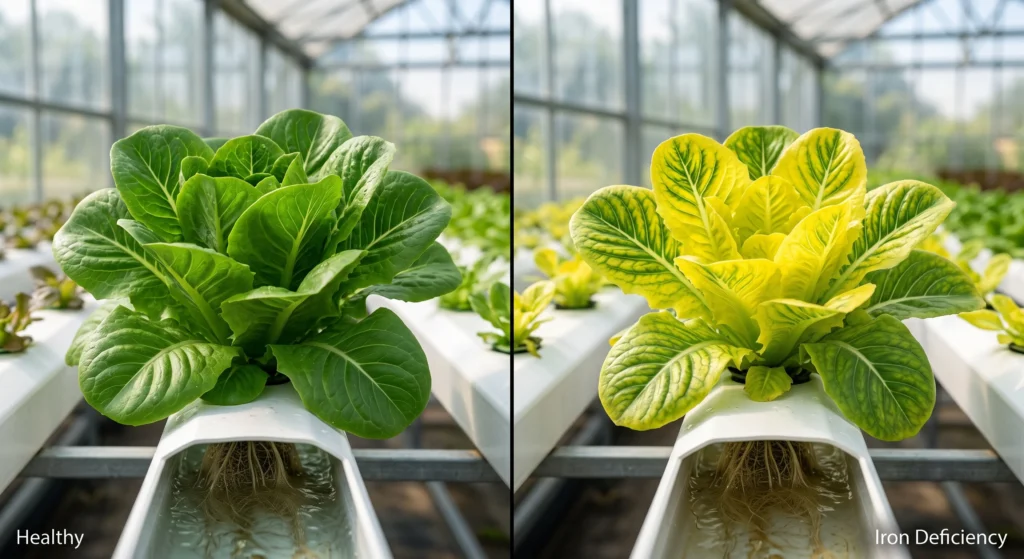
When the top of your canopy turns pale yellow, panic is the wrong response. Dumping raw iron into the tank will likely cause precipitation with phosphorus or calcium, creating an entirely new set of lockouts. Follow this precise protocol to reverse the deficiency safely.
Step 1: Verify the Deficiency
Iron is an immobile nutrient. This means the plant cannot steal iron from older leaves and move it to the new growth. Therefore, iron deficiency always appears on the newest, topmost leaves first. The veins will remain distinctively green while the tissue between them turns yellow or white.
If the entire plant is turning yellow, or if the yellowing is starting at the bottom on the oldest leaves, you do not have an iron problem; you likely have a nitrogen or magnesium deficiency. You can cross-reference these symptoms in our hydroponic troubleshooting guide.
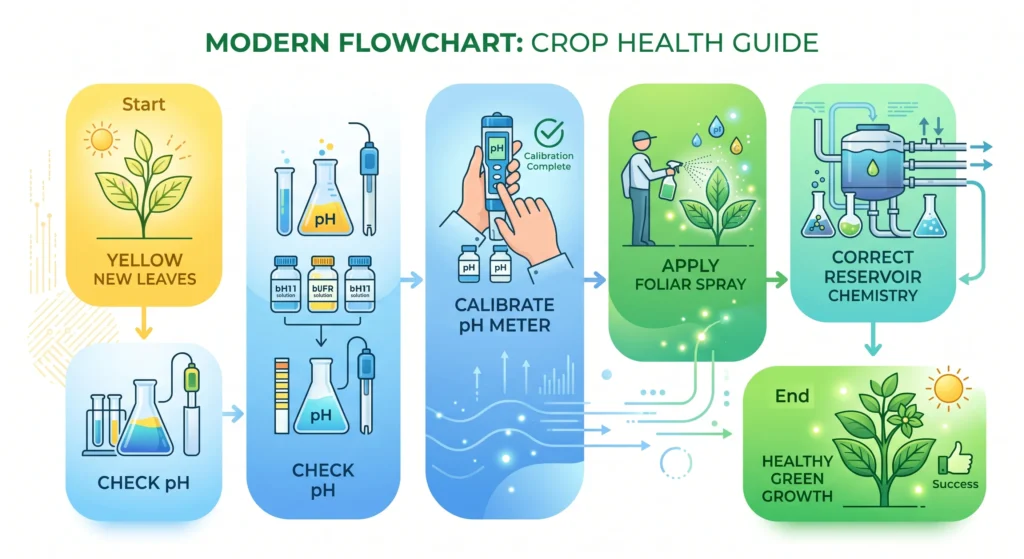
Step 2: Calibrate Your pH Pen
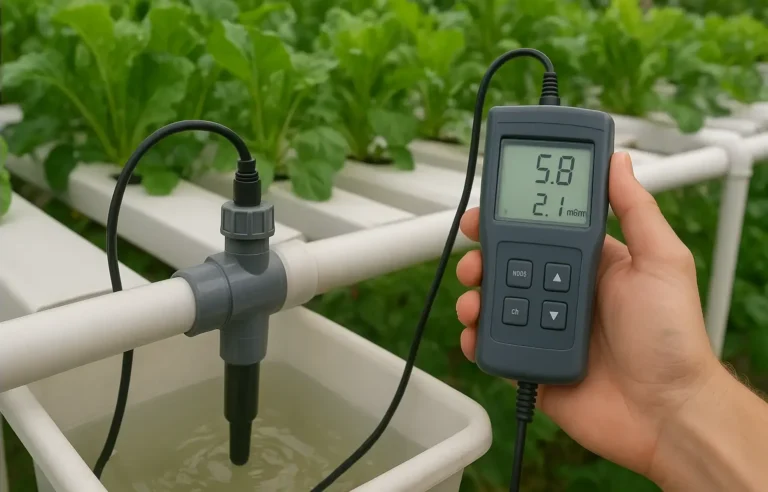
Do not add anything to your reservoir until you know your pH is accurate. pH pens naturally drift over time. If your pen is reading 5.8, but it hasn’t been calibrated in three months, your actual reservoir pH might be 6.9—which explains why your EDTA iron is locking out. Use fresh 4.0 and 7.0 buffer solutions to verify your pen’s accuracy.
Step 3: Immediate Relief via Foliar Application
Because iron locked out in the root zone takes days to correct, you must bypass the roots to save the current new growth.
- Mix a weak solution of Iron DTPA or a dedicated foliar micronutrient spray. Use highly purified water (RO or distilled).
- Add a few drops of a non-ionic surfactant (or pure castile soap) to break the surface tension of the water.
- Turn off your grow lights or apply just before the lights-out cycle to prevent the water droplets from acting as magnifying glasses and burning the leaves.
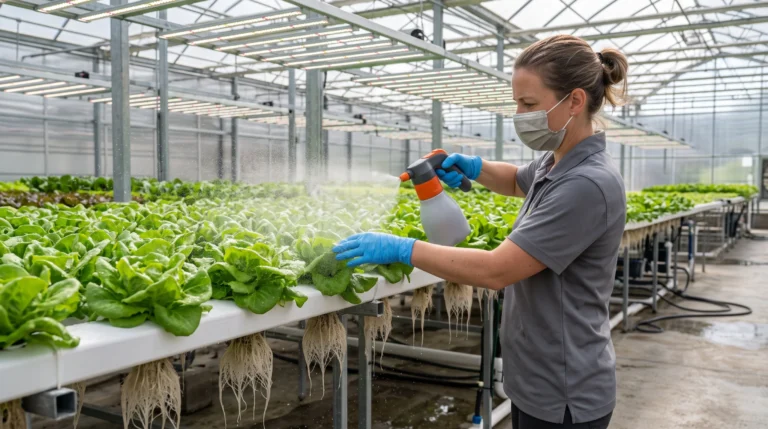
- Mist the underside of the leaves, where the stomata are concentrated. The plants will absorb the iron directly into the leaf tissue, and you will see “greening up” within 48 to 72 hours.
Step 4: Reservoir Chemistry Correction
Once the canopy is stabilized, fix the root zone.
- If your pH is above 6.5, use phosphoric acid (pH Down) to slowly walk the reservoir back down to 5.8.
- Check the label of your base nutrient. If it relies on EDTA, consider switching to a brand that uses DTPA, or supplement your mix with dry DTPA powder.
- If you are running aquaponics or dealing with stubbornly high pH, add a small dose of EDDHA iron directly to the tank (usually 1/8th of a teaspoon per 10 gallons, but follow manufacturer instructions).
Step 5: Address UV and Oxidation Factors
Chelates are highly susceptible to photodegradation. If you have intense grow lights shining directly onto an exposed nutrient reservoir, the UV rays will break down the chelate molecules and destroy your iron availability. Ensure your reservoir is completely light-proof.
Similarly, if you are running a high-wattage UV-C water clarifier to kill root pathogens, be aware that constant UV-C exposure will rapidly strip chelates from iron and other heavy metals. If running UV-C, you must dose supplemental iron (preferably DTPA or EDDHA) more frequently to compensate for the degradation.
For a deeper understanding of baseline water chemistry parameters, review our hydroponic pH and EC guide.
Equipment for Iron & pH Management
You cannot manage iron chelate hydroponics without precision measurement and access to high-quality dry salts. Relying on liquid “cal-mag-iron” blends often leads to over-application of nitrogen. Buy the raw chelates and own your chemistry.

Why I use it: This is the most reliable, fast-reading, and durable pH pen in the under-$50 category. It holds calibration beautifully. You cannot diagnose iron lockout if you cannot trust your pH readings.

Why I use it: This is the professional standard for DTPA iron. A 1-pound bag will last a home grower for years. When I mix custom nutrient batches or need to slightly elevate iron for heavy-feeding tomatoes without adding extra nitrogen, this is the exact powder I dose.
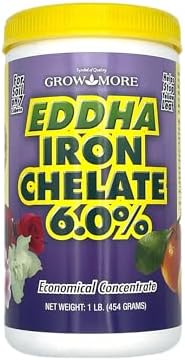
Why I use it: The ultimate rescue powder. I keep this on hand specifically for aquaponic setups or when a client has a massive pH spike and needs the plants to green up immediately while we stabilize the main reservoir. It dissolves instantly and works in almost any water condition.
Frequently Asked Questions (FAQ)
Anticipating the chemical interactions in your reservoir is key to preventing lockouts; these common questions address the practical realities of mixing chelates, dealing with water staining, and managing biological systems like aquaponics.
Can I mix iron chelate with calcium nitrate in my concentrated stock tanks?
No. Never mix concentrated micronutrients, sulfates, or phosphates in the same stock tank as calcium nitrate. The concentrated calcium will react and form insoluble precipitates (like gypsum or calcium phosphate), destroying your nutrient profile. Always mix calcium nitrate in Stock Tank A, and put your iron chelates, phosphates, and sulfates in Stock Tank B. They should only meet when diluted in the main reservoir.
My water turned bright red after adding EDDHA. Will this stain my roots or hurt my plants?
The deep red color is completely normal for EDDHA iron. It will slightly tint your roots a brownish-red hue, which can sometimes be mistaken for root rot by inexperienced growers. It is harmless to the plants, but it will permanently stain white PVC pipes, silicone tubing, and your hands if you spill the raw powder.
Can I use EDDHA iron as a foliar spray?
While you technically can, it is not recommended. EDDHA is a very large molecule designed for root absorption in alkaline conditions. Because of its dark red color, it will leave severe, rusty-looking stains all over your plant foliage and grow tent walls. Stick to DTPA or specialized amino-acid chelates for foliar applications.
Why does my aquaponics system always suffer from iron deficiency?
In aquaponics, the nitrification process (bacteria converting fish ammonia into plant-available nitrates) naturally consumes alkalinity and lowers pH. However, to keep the fish and bacteria healthy, aquaponic operators must constantly buffer the water upwards, usually aiming for a pH of 6.8 to 7.0. At this pH, the standard iron from fish feed or generic EDTA supplements is completely locked out. Aquaponics systems absolutely require EDDHA iron supplementation to keep plants green at pH 7.0.
How long does chelated iron last in a mixed reservoir?
In a completely light-proof reservoir with a stable pH of 6.0, DTPA iron will remain soluble and stable for weeks. However, active plant roots secrete enzymes that break down chelates, and high temperatures or microbial activity can accelerate this degradation. In a standard recirculating system, you should be doing a full reservoir flush and nutrient reset every 10 to 14 days to ensure all micronutrients remain balanced and available.
Ready to keep growing? Mastering your reservoir chemistry is just the start. Check out our complete library of growing guides, troubleshooting tips, and setup walk-throughs: View all our Plant care articles.

Continue Your Learning Journey