Hydroponic pH Keeps Rising or Dropping? The Complete Drift Fixing Guide

Table of Contents
- Decoding Reservoir pH: The Mechanics of Hydrogen Ion Equilibrium
- Cause 1: Source Water Carbonate Buffering (The Carbonate Rebound)
- Cause 2: Anion vs. Cation Nutrient Uptake Biology
- Cause 3: Transpiration, Evaporative Concentration, and EC Stacking
- Cause 4: Reservoir Aeration, Off-Gassing, and Pathogenic Activity
- System Architecture: How System Design Shapes pH Stability
- Comprehensive Diagnostic & Decision Blueprint
- Step-by-Step Protocol to Fix Hydroponic pH Drift Permanently
- Recommended Gear for Precision pH Control
- Frequently Asked Questions
- Optimizing Reservoir Health for Long-Term Yields
- Prefer Visual Learning? Watch the Complete Video Guide
Disclosure: MistCulture summarizes verified product specs, engineering data, and community feedback. We may earn an affiliate commission if you purchase through our links. Regulations vary by location; this content is for educational purposes only.
Pouring liquid acid into a hydroponic reservoir only to watch the reading bounce back to its original baseline six hours later is one of the most maddening cycles in indoor agriculture. Many growers assume they have a failing pH probe, low-quality adjusting solutions, or bad nutrient salts. In reality, chasing pH with liquid adjusters without resolving the underlying chemical and biological drivers is like bailing out a boat without plugging the leak. Every milliliter of acid or base added to a system alters the solution’s electrical conductivity (EC) and skews elemental ratios. When pH drift becomes a daily battle, treating the symptom with quick fixes stresses root tissue, causes nutrient lockout, and impairs crop yields.
To stabilize a hydroponic system, you must understand what pH movement actually represents. Solution pH is not a static property; it is a live indicator of plant metabolic activity, chemical buffering dynamics, microbiological activity, and gas exchange. When pH creeps upward or drops rapidly, your reservoir is communicating specific changes in ionic balance, root exudation, or water chemistry. Addressing pH drift permanently requires diagnosing the precise mechanism driving the shift and applying root-cause engineering fixes.
Decoding Reservoir pH: The Mechanics of Hydrogen Ion Equilibrium
pH in hydroponics measures free hydrogen ion activity within the root zone solution, directly governing nutrient solubility and cellular membrane transport. A shifting pH indicates that chemical buffers have collapsed or that plants are actively altering the solution charge through metabolic ion exchange.
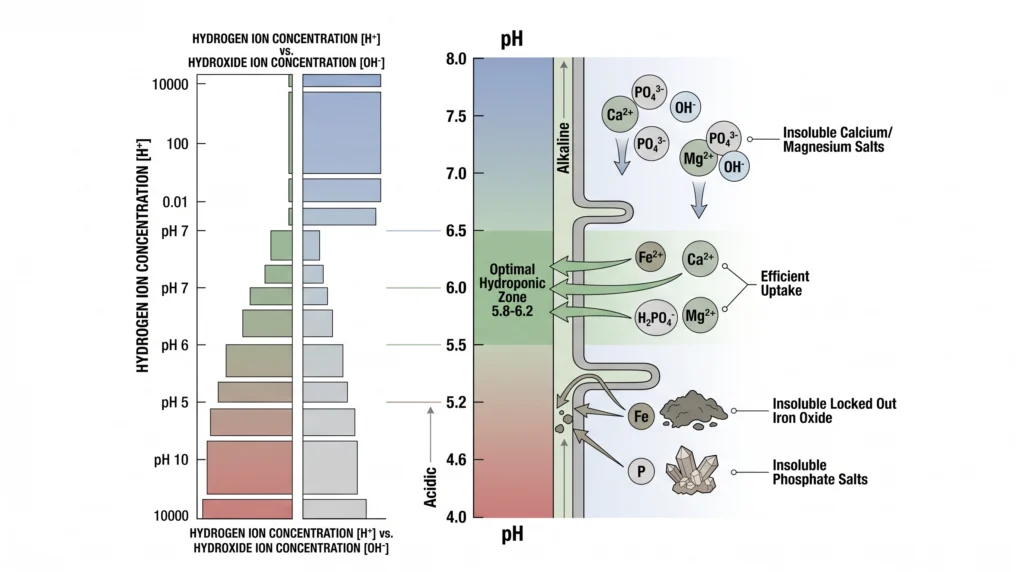
At its core, pH measures the concentration of free hydrogen ions (H⁺) relative to hydroxide ions (OH⁻) in an aqueous solution. Mathematically, it is defined as the negative logarithm of hydrogen ion activity:
pH = -log10[H⁺]
Because the scale is logarithmic, every single-unit shift in pH represents a tenfold change in hydrogen ion concentration. A solution at pH 5.0 contains ten times more free H⁺ ions than a solution at pH 6.0, and one hundred times more than a solution at pH 7.0.
In a hydroponic reservoir, free hydrogen ions directly dictate whether mineral elements remain dissolved in solution or bind together to form solid chemical salts. Root cell membranes rely on proton pumps (H⁺-ATPase enzymes) to maintain an electrochemical gradient across cell walls. This gradient allows roots to pull essential cations and anions out of the liquid and into plant tissue.
HYDROPHONIC NUTRIENT AVAILABILITY VS. SOLUTION pH
| pH Range | Iron (Fe) | Phosphorus (P) | Calcium (Ca) | Magnesium (Mg) | Root Zone Status |
| < 5.0 | Excessive | Locked Out | Locked Out | Locked Out | Root Burn / Aluminum Toxicity Risk |
| 5.2 – 5.5 | High | Moderate | Marginal | Marginal | Acceptable for Select Acid-Lovers |
| 5.8 – 6.2 | Optimal | Optimal | Optimal | Optimal | Target Window for Most Hydro Crops |
| 6.5 – 6.8 | Precipitating | Marginal | High | High | Early Micro-Nutrient Deficiencies |
| > 7.0 | Locked Out | Insoluble Salt | Precipitating | Precipitating | Severe Chlorosis / Total Lockout |
When solution pH rises above 6.5, positively charged iron (Fe²⁺ and Fe³⁺), manganese (Mn²⁺), and zinc (Zn²⁺) react with hydroxide ions and phosphates, forming insoluble oxides and hydroxides that sink to the bottom of the tank. Conversely, when pH drops below 5.2, excessive hydrogen ions damage tender root tips and disrupt the uptake of calcium (Ca²⁺), magnesium (Mg²⁺), and potassium (K⁺). Maintaining a stable pH within the 5.8 to 6.2 target window keeps all seventeen essential elements bioavailable while preventing cellular shock.
Cause 1: Source Water Carbonate Buffering (The Carbonate Rebound)
High source water alkalinity, driven by dissolved bicarbonate and carbonate ions, acts as a chemical buffer that neutralizes added acids. As carbonic acid breaks down into dissolved carbon dioxide and off-gasses into air, the solution pH inevitably rebounds back upward.
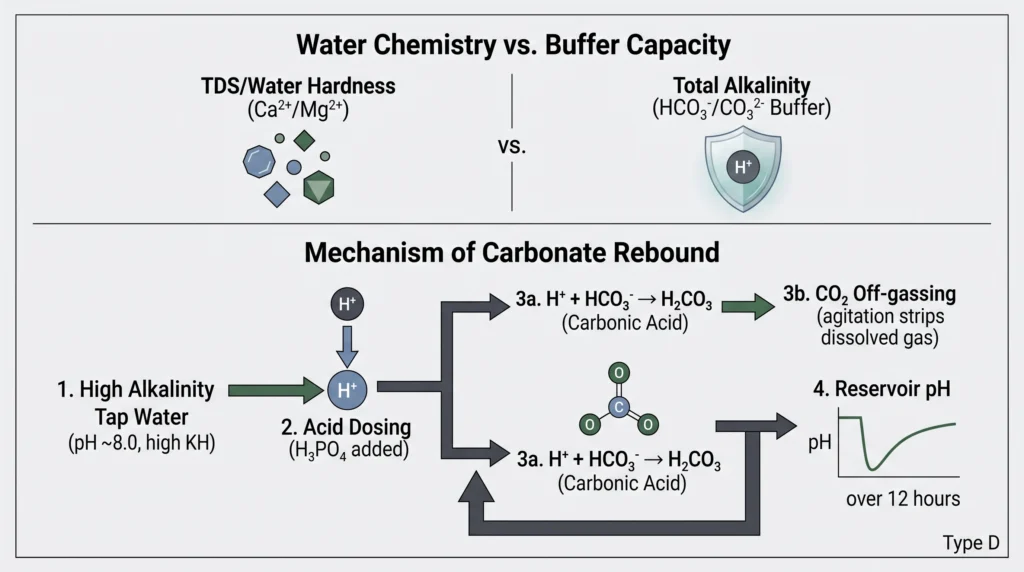
The single most common cause of persistent upward pH drift in residential and commercial hydroponics is source water carbonate alkalinity. Many growers confuse total dissolved solids (TDS) or water hardness with alkalinity, but they are distinct chemical metrics. Water hardness measures the total concentration of dissolved calcium (Ca²⁺) and magnesium (Mg²⁺) ions. Carbonate alkalinity (measured as dKH or ppm CaCO₃) measures the water’s acid-neutralizing capacity – specifically its concentration of bicarbonate (HCO₃⁻) and carbonate (CO₃²⁻) ions.
When tap or well water contains high alkalinity, it operates under an active carbon dioxide-carbonate buffer system:
CO₂ + H₂O ⇌ H₂CO₃ ⇌ H⁺ + HCO₃⁻ ⇌ 2H⁺ + CO₃²⁻
When you add an acid like phosphoric acid (H₃PO₄) to lower the pH of high-alkalinity water, the added hydrogen ions (H⁺) react immediately with the dissolved bicarbonate ions (HCO₃⁻) to form carbonic acid (H₂CO₃):
H⁺ + HCO₃⁻ → H₂CO₃
The pH reading on your meter drops instantly, giving the illusion that the solution is balanced. However, carbonic acid in water is unstable. Over several hours, it dissociates into water (H₂O) and dissolved carbon dioxide gas (CO₂):
H₂CO₃ → H₂O + CO₂ (dissolved)
As your system’s air stones, water pumps, and spray nozzles agitate the liquid, the dissolved CO₂ gas off-gasses into the grow room air. The removal of CO₂ drives the chemical equilibrium in reverse, consuming the free H⁺ ions you introduced with your acid addition. As free H⁺ ions disappear, the pH reading steadily rebounds back up to where it began.
Chasing this buffer with continuous acid additions leads to severe phosphate or sulfate loading, raising solution EC while failing to fix the underlying drift. Review our comprehensive hydroponic pH and EC mastery guide to learn how to measure baseline electrical conductivity before introducing fertilizers. If you are filtering source water down to zero dissolved solids, consult our cal-mag hydroponics guide to properly rebuild your mineral profile.
Cause 2: Anion vs. Cation Nutrient Uptake Biology
Plants actively alter reservoir pH to maintain electrochemical neutrality across their root membranes. Absorbing negatively charged nitrate ions causes roots to release basic hydroxide ions that raise pH, while absorbing positively charged ammonium ions releases acidic hydrogen ions that drop pH.
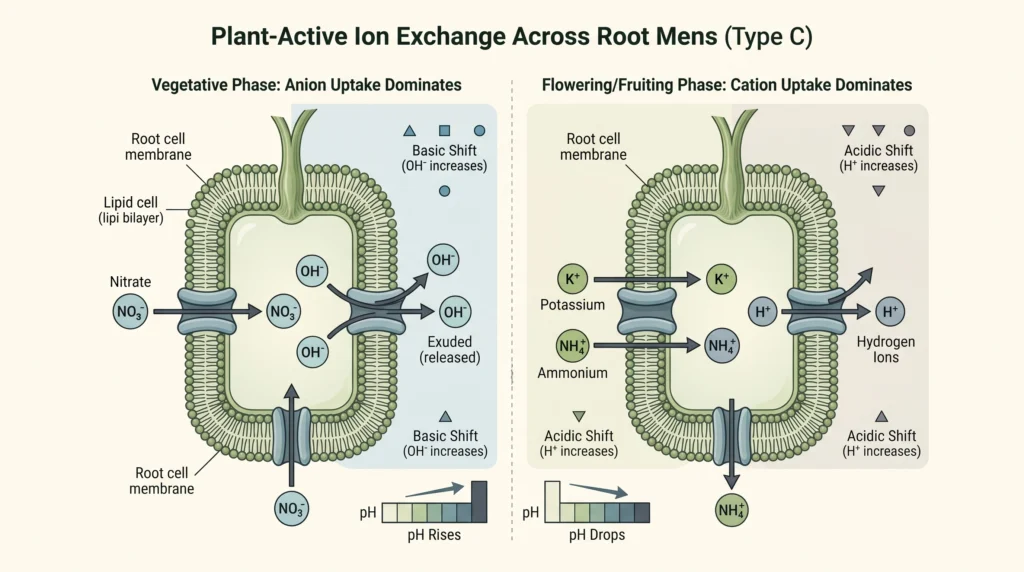
Even when using pure Reverse Osmosis (RO) water with zero carbonate buffering, reservoir pH rarely stays completely flat. This occurs because living plant roots are active chemical pumps, constantly exchanging ions with the surrounding solution to maintain electrochemical equilibrium across cell membranes.
PLANT ROOT ION EXCHANGE DYNAMICS
| Uptake Type | Target Ion Absorbed | Root Exudate Released | Reservoir pH Impact |
| Anion Uptake | Nitrate (NO₃⁻) Phosphate (H₂PO₄⁻) Sulfate (SO₄²⁻) | Hydroxide (OH⁻) or Bicarbonate (HCO₃⁻) | pH RISES (Basic shift) |
| Cation Uptake | Ammonium (NH₄⁺) Potassium (K⁺) Calcium (Ca²⁺) Magnesium (Mg²⁺) | Hydrogen Ion (H⁺) | pH DROPS (Acidic shift) |
When a plant absorbs a negatively charged anion, such as nitrate (NO₃⁻), it must release a negatively charged hydroxide ion (OH⁻) or bicarbonate ion (HCO₃⁻) into the reservoir to maintain an internal neutral charge. The exudation of OH⁻ drives the solution pH upward. Conversely, when roots absorb a positively charged cation, such as potassium (K⁺), calcium (Ca²⁺), or ammonium (NH₄⁺), they extrude a hydrogen ion (H⁺), driving solution pH downward.
ANION UPTAKE (pH Rises)
• Absorbed: Nitrate (NO₃⁻)
• Exuded: Hydroxide (OH⁻)
Reservoir pH Increases (Basic)
CATION UPTAKE (pH Drops)
• Absorbed: Potassium / Ammonium (K⁺ / NH₄⁺)
• Exuded: Hydrogen (H⁺)
Reservoir pH Decreases (Acidic)
During rapid vegetative growth, crops like leafy greens, basil, and early-stage fruiting plants consume massive quantities of nitrogen relative to all other elements. Because standard hydroponic fertilizers supply the vast majority of nitrogen in the nitrate (NO₃⁻) form to prevent ammonium toxicity, nitrate absorption dominates root transport channels. The resulting continuous release of OH⁻ causes a natural, predictable, and healthy upward pH drift.
During late flower and fruit development, crop metabolic demand shifts dramatically toward potassium (K⁺) and phosphorus. As cation uptake outpaces anion uptake, root cells release elevated levels of H⁺ ions, causing upward pH drift to slow down, stabilize, or reverse into rapid downward drift.
Adjusting the ratio of ammonium (NH₄⁺) to nitrate (NO₃⁻) in your fertilizer mix allows you to engineer biological pH stability. Supplying between 5% and 10% of total nitrogen in the ammonium form acts as an internal acidifying agent. As roots absorb the positive NH₄⁺ ions, the extruded H⁺ counteracts the basic OH⁻ released from NO₃⁻ uptake.
For precise elemental blending and custom salt adjustments, reference our complete hydroponic nutrients guide and input your target ratios into our interactive hydroponic nutrient calculator.
Cause 3: Transpiration, Evaporative Concentration, and EC Stacking
High Vapor Pressure Deficit (VPD) forces plants to absorb water faster than dissolved mineral salts. This evaporative concentration increases total solution EC, stressing roots and causing erratic pH shifts as ionic ratios become severely imbalanced.
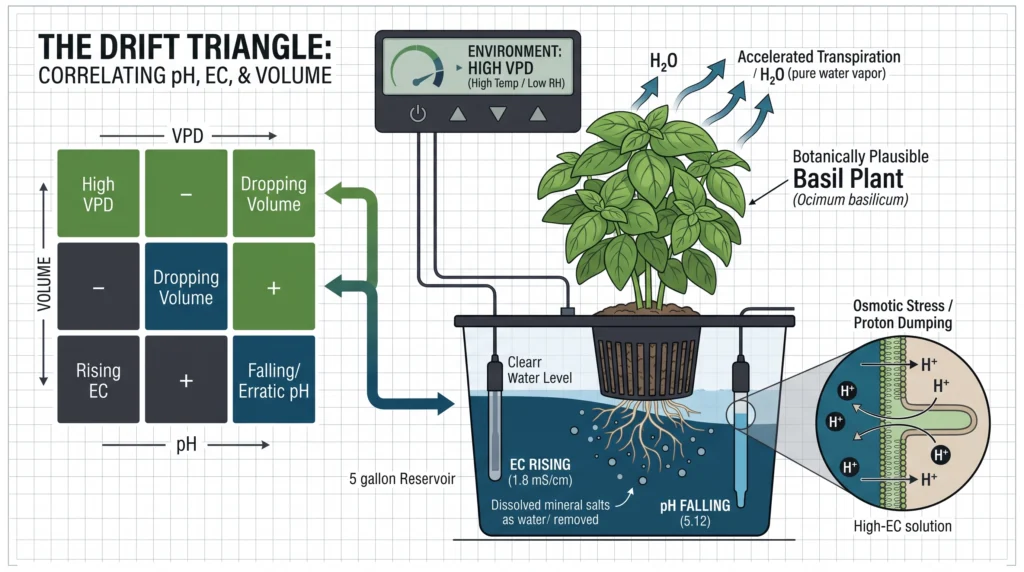
Environmental conditions within the grow room heavily dictate how fast plants drink water relative to their mineral consumption. When indoor temperatures are high, light intensity is extreme, or relative humidity drops below optimal levels, the atmospheric Vapor Pressure Deficit (VPD) surges. Under high VPD conditions, plants open their stomata and transpire pure water vapor into the air at accelerated rates to cool leaf surfaces.
If plants pull pure water from the reservoir faster than they absorb mineral ions, the water volume drops while dissolved salts remain behind. This process – known as evaporative concentration – causes solution electrical conductivity (EC) to climb continuously.
THE DRIFT TRIANGLE: CORRELATING pH, EC, AND WATER VOLUME
| pH Trend | EC Trend | Water Volume | Primary Cause | Immediate Corrective Action |
| Rising | Rising | Dropping | Solution concentrating; high VPD | Top up reservoir with pure RO water; reduce base EC. |
| Rising | Falling | Dropping | Healthy, rapid nitrate uptake | Top up with light nutrient solution; adjust pH down. |
| Falling | Rising | Dropping | Severe salt stress; root exudation | Flush system; reduce nutrient strength by 20-30%. |
| Falling | Falling | Dropping | Heavy cation uptake / root decay | Inspect roots for rot; top up with balanced mix. |
As solution EC stacks higher, osmotic pressure in the root zone increases. The high concentration of salts outside the root makes it mechanically difficult for cells to absorb water. Osmotic stress forces root cells to alter their membrane permeability, frequently leading to passive leakage of organic acids or rapid proton dumping.
When pH drift is accompanied by rising EC readings and declining water levels, adding pH adjusters or extra nutrients will worsen root stress. The solution must be diluted immediately with pure, pH-neutral water to restore osmotic balance.
Cause 4: Reservoir Aeration, Off-Gassing, and Pathogenic Activity
Dissolved gas dynamics and microbiological activity significantly influence pH stability. Aggressive mechanical aeration strips carbonic acid from solution to raise pH, while pathogenic root decay releases organic compounds that cause rapid, unpredictable swings.
Physical system mechanics and biological activity outside plant roots can also alter reservoir pH.
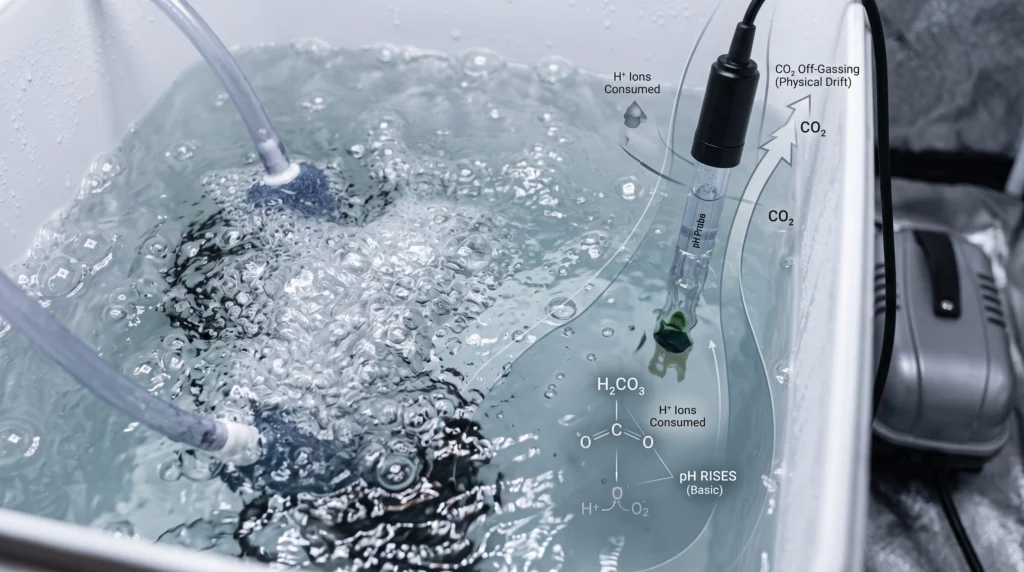
Mechanical Aeration and Dissolved Gas Exchange
Pure water exposed to ambient air naturally absorbs carbon dioxide, forming trace amounts of carbonic acid (H₂CO₃) that sit at a baseline pH of roughly 5.6 to 5.8. When high-output air pumps push large volumes of ambient air through coarse air stones in Deep Water Culture (DWC) or Recirculating DWC (RDWC) systems, mechanical agitation strips dissolved CO₂ gas out of the water.
As CO₂ escapes into the room, carbonic acid concentration drops:
H₂CO₃ (aq) → CO₂ (g) ↑ + H₂O (l)
The loss of carbonic acid removes free hydrogen ions from the liquid, causing reservoir pH to rise by 0.3 to 0.8 units within 24 hours – even in a reservoir with no plants present. High aeration is vital for root respiration, but over-sizing air pumps in small reservoirs creates constant upward physical drift. To properly size your air delivery hardware without over-agitating your solution, check our guide on the best DWC air pumps.
MECHANICAL AERATION OFF-GASSING CYCLE
Mechanical Agitation
Gas escapes solution into atmosphere
Loss of aqueous carbonic acid (H₂CO₃)
Solution becomes more alkaline
Microbiological Activity: Algae and Root Rot
Unintended biological growth introduces unpredictable pH swings:
- Algae Photosynthesis: Light leaking into reservoirs, sight tubes, or grow channels allows green algae to colonize the liquid. During lights-on hours, algae undergo active photosynthesis, rapidly consuming dissolved CO₂ and pushing pH sharply upward. During lights-off hours, photosynthesis stops and cellular respiration takes over, releasing CO₂ back into solution and causing night-time pH drops.
- Pathogenic Root Decay: Infections from waterborne pathogens such as Pythium, Fusarium, or Phytophthora destroy root tissue. As root cells die and decompose, cellular proteins leak into the reservoir. Anaerobic bacteria break down these proteins, releasing ammonia (NH₃) and organic amines that cause sudden upward spikes or erratic downward crashes.
If your solution smells sour, turns turbid, or exhibits slime formation alongside wild pH fluctuations, review our protocol for hydroponic root rot prevention to restore biological health.
System Architecture: How System Design Shapes pH Stability
Reservoir volume per plant, liquid turnover rates, and substrate chemistry dictate how rapidly pH shifts occur. System designs with small fluid volumes or unbuffered media experience far greater pH volatility than high-capacity recirculating setups.
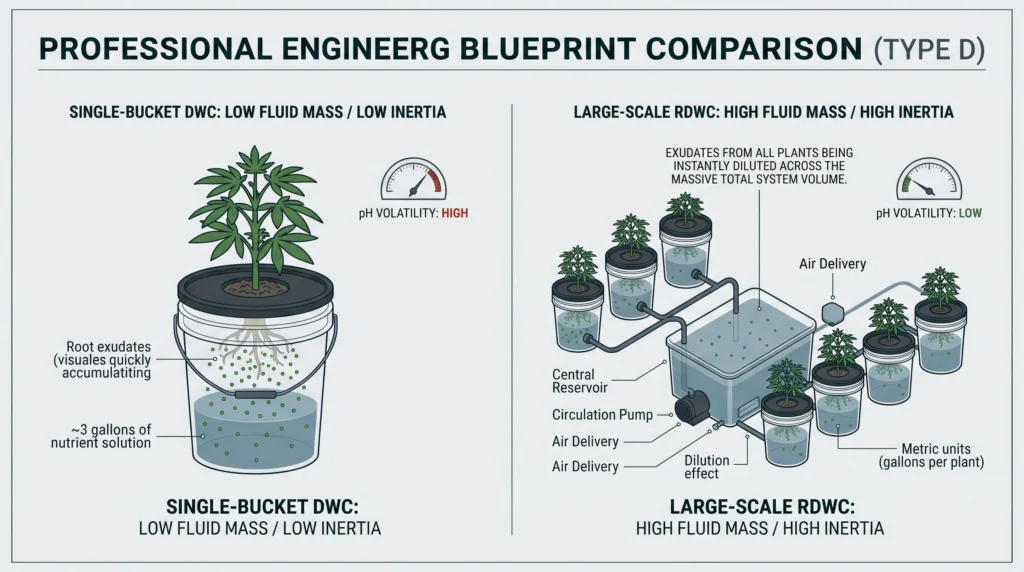
The structural design of your hydroponic system dictates its inherent buffer capacity and thermal mass.
SYSTEM TYPE VS. pH STABILITY PROFILE
| System Design | Solution Volume / Plant | Gas Exchange Rate | Native pH Drift Risk | Primary Drift Driver |
| Single-Bucket DWC | Low (2-3 Gallons) | Extreme | High | Aeration off-gassing + Rapid uptake |
| Large-Scale RDWC | High (10-15 Gallons) | Moderate | Low (High Stability) | Gradual nitrate uptake |
| NFT Channels | Very Low (< 1 Gallon) | High | Extreme | Atmospheric CO₂ exchange |
| High-Pressure Aeroponic | Minimal | Extreme | Extreme | Droplet off-gassing + Temp shifts |
| Coco Coir Drain-to-Waste | N/A (Substrate) | Moderate | Moderate | Media Cation Exchange (CEC) |
Deep Water Culture (DWC) vs. Large RDWC
Single-bucket DWC setups with small fluid volumes (2 to 5 gallons per plant) have low chemical inertia. A fast-growing tomato or cannabis plant can absorb a significant fraction of available nitrogen within twelve hours, causing rapid upward pH movement.
Expanding system volume by connecting buckets to a centralized 50-to-100-gallon main reservoir (RDWC) increases total chemical mass. Exudates released by roots are instantly diluted across a massive fluid volume, dramatically smoothing out daily pH fluctuations.
Substrate Hydroponics and Cation Exchange Capacity (CEC)
Growing in inert media like Rockwool or Perlite introduces almost zero media-based pH shifting. However, raw or unbuffered Coco Coir possesses a natural Cation Exchange Capacity (CEC).
Coco coir naturally holds negatively charged complex sites loaded with sodium (Na⁺) and potassium (K⁺) ions. If unbuffered coco is used, the media will actively strip calcium (Ca²⁺) and magnesium (Mg²⁺) out of your nutrient solution and swap them for potassium. This rapid exchange alters the ionic balance of the runoff, leading to unexpected pH drops and severe calcium lockouts.
For diagnosing crop-specific media imbalances and leaf symptoms, refer to our deep-dive guide on cannabis pH and nutrient lockout.
Comprehensive Diagnostic & Decision Blueprint
Identifying the exact root cause of pH drift requires correlating pH movement with EC changes, reservoir water level, and plant growth stage. Systematic testing prevents unnecessary acid additions and preserves nutrient solution balance.
Before adding correcting chemicals to your reservoir, work through this decision matrix to identify the primary driver of your system’s drift.
HYDROPONIC pH DRIFT DIAGNOSTIC DECISION MATRIX
| Observation / Symptom | Secondary Indicator | Primary Root Cause | Target Corrective Action |
| pH climbs 0.5+ within hours of adding acid adjusters | Baseline tap water KH > 4 dKH (100+ ppm CaCO₃) | Carbonate buffer off-gassing in tap/well water | Switch source to RO water or pre-treat with inline acid 24 hrs prior to mixing. |
| pH climbs steadily by 0.2 to 0.4 units per 24 hours | EC slowly dropping; Water level dropping | Normal biological nitrate (NO₃⁻) uptake in vegetative phase | Accept natural trend; adjust daily with dilute phosphoric acid or add 5% NH₄⁺. |
| pH drops rapidly below 5.2 within 24 to 48 hours | EC climbing; Water level dropping rapidly | Salt accumulation / Osmotic stress / Root dumping protons | Top up reservoir with pure RO water; drop target operational EC by 20%. |
| pH swings erratically; liquid turns cloudy or slimy | Off-odors present; roots brown and soft | Pathogenic root rot infection releasing organic breakdown acids | Sanitize reservoir; apply microbial inoculants or hypochlorous acid (HOCl). |
| pH climbs during lights-on; drops during lights-off | Clear tubing or open light leaks into tank | Algae colonization undergoing active photosynthesis/respiration | Black out all light-exposed lines, sight glass tubes, and net pots immediately. |
Step-by-Step Protocol to Fix Hydroponic pH Drift Permanently
Eliminating pH drift requires a four-stage protocol: stripping source water buffers with reverse osmosis, balancing nitrogen ion ratios, maintaining proper reservoir volume-to-plant ratios, and executing routine system sanitization.
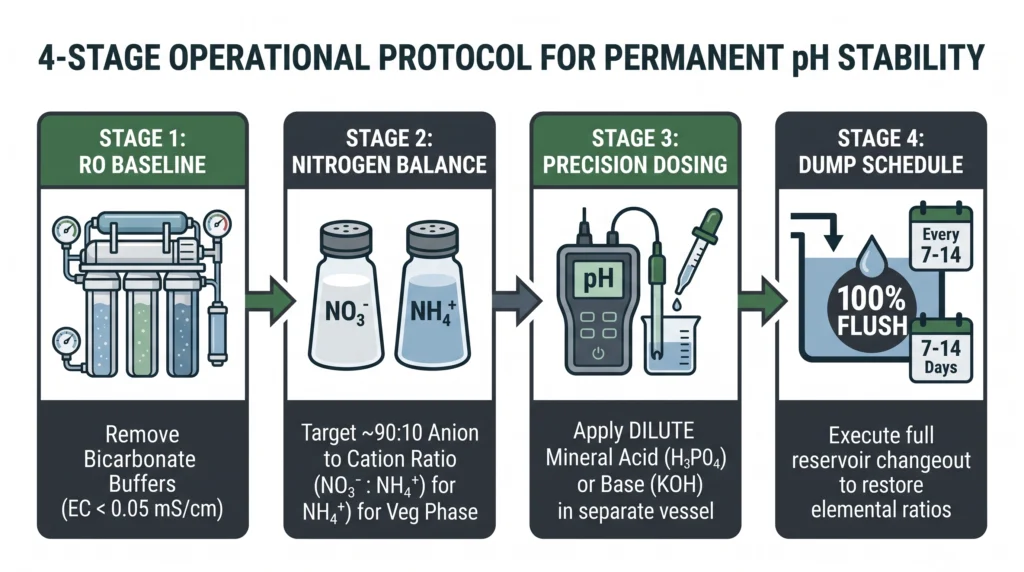
Follow this engineered operational procedure to eliminate erratic pH shifts and establish total reservoir control.
Strip Bicarbonate Buffers (EC < 0.05 mS/cm)
Blend 90:10 NO₃⁻ to NH₄⁺ Ratio for Veg Phase
Apply Dilute Mineral Acid (H₃PO₄ / KOH)
100% Reservoir Flush Every 7-14 Days
Stage 1: Standardize Water Source and Remove Bicarbonate Buffers
- Test Source Water: Use a calibrated EC meter and a liquid KH titration test kit to measure your raw water. If source water EC exceeds 0.3 mS/cm or alkalinity exceeds 3 dKH (approx. 50 ppm CaCO₃), tap water buffers will cause continuous upward pH rebound.
- Install RO Filtration: Pass source water through a multi-stage Reverse Osmosis membrane to strip total dissolved solids down to < 10 ppm (EC < 0.02 mS/cm).
- Remineralize Controlled Base: Rebuild your pure RO water by adding calcium and magnesium down to an initial base EC of 0.2 to 0.4 mS/cm before introducing primary N-P-K fertilizers.
Stage 2: Calculate and Balance Nitrogen Ion Ratios
- Review Nutrient Labels: Inspect your base fertilizer components for Guaranteed Analysis numbers detailing Nitrate Nitrogen (NO₃⁻) versus Ammoniacal Nitrogen (NH₄⁺) or Urea.
- Target Ratio: Maintain an approximate 90:10 ratio of NO₃⁻ to NH₄⁺ during aggressive vegetative growth. The small ammonium fraction releases sufficient H⁺ during uptake to counter the OH⁻ exuded from nitrate uptake, flattening the daily pH curve.
- Avoid Excess Ammonium: Never allow ammoniacal nitrogen to exceed 15% of total nitrogen. Excess ammonium causes carbohydrate depletion in roots, leading to stem collapse and severe root burn.
Stage 3: Establish a Precision Dosing Routine
- Select Industrial Adjusters: Use concentrated 75-85% Phosphoric Acid (H₃PO₄) for lowering pH during vegetative and flowering stages. Use Potassium Hydroxide (KOH) for raising pH. Avoid organic acids like citric acid, vinegar, or ascorbic acid; soil bacteria consume carbon-based organic acids within 24 to 48 hours, feeding bacterial blooms and causing massive secondary pH spikes.
- Dilute Stock Adjusters: Never pour concentrated acid or base directly into a reservoir containing living roots. Dilute your adjusting chemical in a separate 1-gallon jug of RO water (e.g., 5-10 mL concentrated acid per gallon of pure water) before dosing the main tank.
- Allow Circulation Time: After adding dilute adjusters to a recirculating reservoir, wait at least 15 to 20 minutes with high-flow pumps running before re-testing solution pH. Rapid re-testing leads to over-correction.
Stage 4: Maintain System Volume and Execution Dump Cycles
- Maintain Fluid Ratios: Target a minimum reservoir volume of 5 to 10 gallons per large fruiting plant (or 1 to 2 gallons per leafy green plant) to provide physical dilution mass.
- Schedule Weekly Dumps: Perform a 100% full reservoir changeout every 7 to 14 days. As plants absorb specific ions selectively, unused background ions accumulate, altering elemental ratios and degrading natural solution buffers.
Stay organized throughout your grow cycles by leveraging our master hydroponic grow checklist, align your reservoir changeouts with our detailed hydroponic nutrient schedule guide, upgrade your testing hardware using our ph ec meter showdown 2025 , and troubleshoot broader system failures using our master hydroponic troubleshooting guide.
Recommended Gear for Precision pH Control

- Real-time Monitoring: The Bluelab Guardian Monitor Wi-Fi allows you to monitor your reservoir’s pH, Conductivity, and Te…
- Comprehensive Display and Control: Equipped with built-in Wi-Fi, this device offers monitoring and control. Conductivity…
- Alerts Directly to your Smartphone: The device features high/low pH, temperature, and conductivity alerts, and a non-vol…
- Why it’s necessary: Continuous real-time monitoring of pH, EC, and solution temperature eliminates measurement lag and catches rapid drift before nutrient lockout occurs.
- Key Spec: Continuous 24/7 dual-screen displays with high/low visual alarms and automatic temperature compensation (ATC).

- Acid formulation uses food grade phosphoric acid
- Add when your nutrient pH is too high in order to lower the pH to the proper level
- Promotes pH stability
- Why it’s necessary: Industrial-grade concentrated phosphoric acid provides long-lasting pH reduction without introducing unstable organic carbon sources that feed reservoir bacteria.
- Key Spec: Food-grade concentrated formula designed specifically for recirculating hydroponic reservoirs.

- Base solution is formulated using potassium hydroxide and potassium carbonate
- Add when your nutrient pH is too low in order to raise the pH to the proper level
- Promotes pH stability
- Add a little at a time if your nutrient pH is too low in order to raise the pH to the proper level
- Why it’s necessary: Formulated with potassium hydroxide and potassium carbonate to safely raise reservoir pH while supplying bioavailable potassium to growing plants.
- Key Spec: Premium liquid alkaline adjuster safe for all hydroponic and aeroponic systems.

Why it’s necessary: Accurate drift diagnosis requires weekly calibration of digital probes; uncalibrated meters create artificial pH problems through inaccurate readings.nnKey Spec: Precision laboratory reference standards sealed against light and atmospheric carbon absorption.
Frequently Asked Questions
Why does my hydroponic pH keep rising overnight?
Overnight upward pH drift is typically driven by biological nitrate uptake combined with dissolved gas off-gassing. Plants engage in rapid cellular expansion during dark hours, absorbing nitrate ions (NO₃⁻) and releasing basic hydroxide ions (OH⁻) into the root zone. Simultaneously, continuous air stone operation drives dissolved carbon dioxide out of solution, stripping carbonic acid and raising pH.
How much pH Down should I add per gallon of water?
The precise volume of pH Down required depends entirely on your source water carbonate alkalinity (dKH) and current solution EC. Hard water with high alkalinity requires significantly more acid to drop one pH unit than pure RO water. Always mix 1 mL to 2 mL of concentrated acid into a gallon of pure water first, dose your main reservoir in small increments, circulate for 15 minutes, and re-test.
Can I use vinegar or lemon juice to lower hydroponic pH?
You should avoid using organic acids like acetic acid (vinegar) or citric acid (lemon juice) in recirculating hydroponic systems. Organic acids contain carbon bonds that serve as food for reservoir bacteria. Bacteria consume these organic acids within 24 to 48 hours, causing massive microbiological blooms, depletion of dissolved oxygen, and rapid rebound of solution pH. Use mineral acids like phosphoric or nitric acid instead.
Why does my pH drop rapidly during the flowering stage?
pH drops rapidly during flowering because crop metabolic demand shifts from anion uptake (nitrate) to cation uptake (potassium, calcium, and magnesium). When roots absorb positively charged cations, they extrude positively charged hydrogen ions (H⁺) into the liquid, acidifying the reservoir. Rapidly dropping pH can also indicate salt accumulation or early-stage root rot.
Does air stone bubbling change hydroponic pH?
Yes. Aggressive mechanical aeration strips dissolved carbon dioxide (CO₂) gas out of the water. Dissolved CO₂ forms weak carbonic acid in solution; driving this gas out of the liquid removes free hydrogen ions, causing reservoir pH to rise by 0.3 to 0.8 units within 24 hours without any plant uptake occurring.
What happens if I adjust pH too quickly in a DWC reservoir?
Rapidly swinging solution pH by more than 0.5 to 1.0 units in a short timeframe causes osmotic and chemical shock to tender root hairs. Sudden pH changes alter the cellular charge across root membranes, leading to temporary root shutdown, tip burn, and nutrient precipitation in the tank. Always make gradual adjustments over several hours.
How often should I calibrate my digital pH probe?
Calibrate digital pH probes once every one to two weeks using fresh pH 4.01 and pH 7.00 reference buffer solutions. Glass electrode probes naturally drift over time due to mineral buildup, temperature variations, and probe aging. An uncalibrated, drifting meter causes growers to add unnecessary chemicals to perfectly balanced solutions.
Optimizing Reservoir Health for Long-Term Yields
Managing hydroponic pH is not about achieving a frozen, unmoving number on a digital screen. Dynamic, small pH fluctuations between 5.8 and 6.2 are natural and beneficial, allowing different mineral elements to reach peak bioavailability at various points throughout the week. Operational success lies in eliminating severe, uncontrolled drift driven by hard water buffers, imbalanced nitrogen forms, high VPD evaporative concentration, or root disease.
By switching to a clean RO water baseline, balancing anion and cation uptake ratios, maintaining adequate reservoir dilution volume, and adhering to routine sanitization protocols, you eliminate the root causes of pH instability. Instead of chasing readings daily with liquid adjusters, you establish a stable, self-buffering chemical environment that supports aggressive root development, maximal nutrient absorption, and peak crop yields.
For deeper technical breakdowns, custom system designs, and hardware evaluations, explore our complete Hydroponics Comparison Hub, dive into specialized plant maintenance strategies in our Plant Care Section, or leverage our suite of precision tools in the Tools and Resources Hub.
Prefer Visual Learning? Watch the Complete Video Guide
If you prefer seeing the concepts explained visually, watch the complete MistCulture video guide on hydroponic pH drift. It walks through why reservoir pH can rise or fall and connects the major diagnostic factors; including source water, nutrient uptake, EC, aeration, biological activity, and system design; into a practical troubleshooting framework.

Continue Your Learning Journey