Venturi vs Air Stones in DWC: Aeration Compared

Table of Contents
Deep Water Culture rests on one absolute requirement: dissolved oxygen. Suspend roots in a reservoir and they consume oxygen fast, deprive them of it and root rot sets in within hours. How you deliver that oxygen shapes your system’s reliability, maintenance, noise, and plant health. For decades, the default was a porous air stone. More recently, growers chasing genuinely fine bubble aeration have turned to fluid dynamics instead, swapping a humming air pump for a silent Venturi injector.
If you’re building a DIY DWC kit, aeration is one of the more consequential engineering decisions you’ll make. This comparison covers the real physics of gas exchange, thermal load, and maintenance burden for both approaches.
Aeration Methods Summary Table
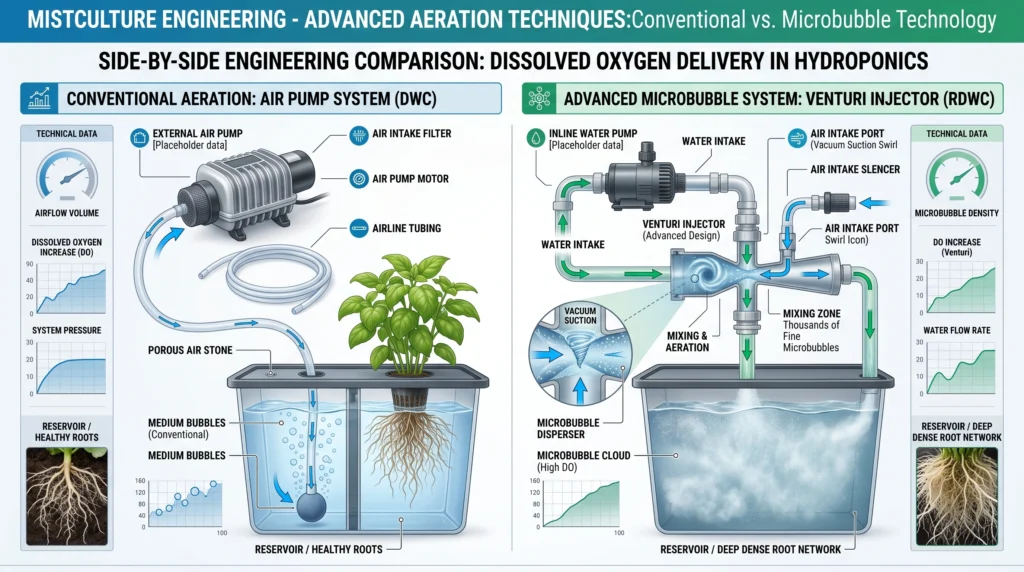
Venturi injectors use water pressure to create a vacuum that shears air into micro-bubbles, with zero moving air-pump parts. Standard air stones rely on an external compressor pushing air through porous ceramic, reliable but prone to mineral scaling and biofilm clogging over time.
| Feature | Standard Air Stones | Venturi Air Injectors |
|---|---|---|
| Primary Mechanism | External air pump forcing air through porous media | Submerged or inline water pump creating vacuum suction |
| Bubble Size | Medium to large, varies by stone quality | Micro to fine bubble aeration |
| Dissolved Oxygen Transfer | Good, relies largely on surface agitation | Excellent, high surface-area-to-volume gas mixing |
| Noise Profile | Constant low-frequency hum/vibration | Quiet pump hum, slight hiss at the air intake |
| Heat Load on Reservoir | Minimal | Real, a submerged pump adds thermal load directly |
| Maintenance | Higher, stones need periodic scrubbing or replacement | Lower, no pores to clog, mainly pump filter upkeep |
| Setup Cost | Low to moderate | Moderate to high, needs correct pump sizing |
Core Evaluation Criteria for DWC Aeration
Evaluating DWC aeration means weighing dissolved oxygen transfer, thermal loading on the reservoir, noise, and long-term maintenance, not just how aggressive the bubbles look.
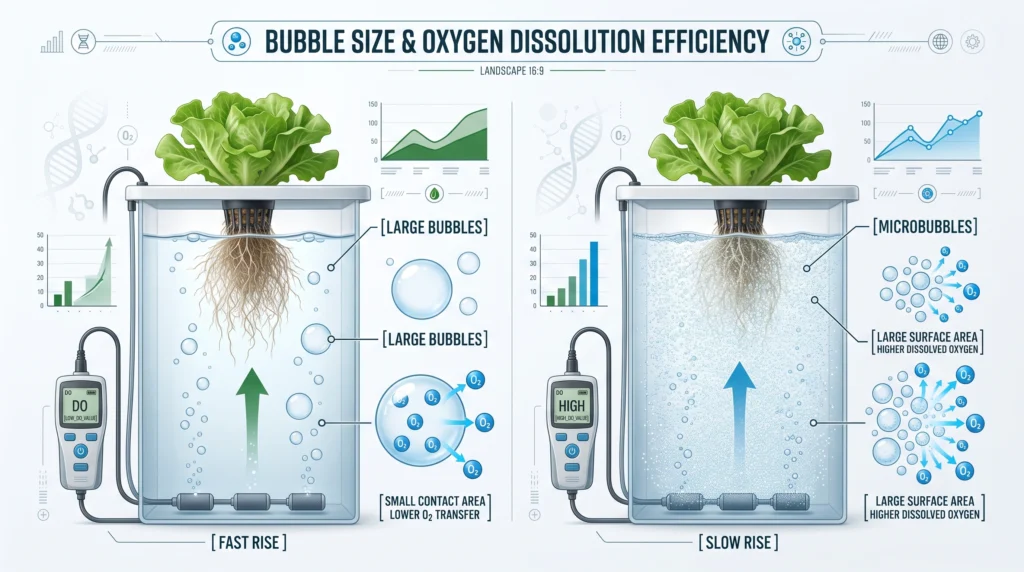
Dissolved oxygen transfer efficiency. Plants absorb oxygen dissolved into water, not bubbles directly. Smaller bubbles have a much higher surface-area-to-volume ratio and rise more slowly, both of which mean more actual oxygen transfer per bubble. Surface agitation matters too, breaking surface tension lets atmospheric oxygen dissolve into the top layer.
Thermal loading. Oxygen solubility drops as water warms. Any aeration hardware that adds heat to the reservoir is working against the whole point of aerating in the first place, worth weighing seriously when comparing device types.
Acoustic noise. In a basement, garage, or spare room, this genuinely matters. Air compressors produce a low-frequency hum that travels through walls and floors persistently, while water pumps tend toward a higher-frequency, more muffled sound. See our quiet DWC setup guide for managing this specifically.
Maintenance and longevity. Nutrient solution is loaded with calcium, magnesium, and organic root exudates, a real recipe for scaling and biofilm. Devices with microscopic pores are especially vulnerable to clogging, right when mature plants need oxygen most.
Head-to-Head: Venturi Air Injectors vs Standard Air Stones
Air stones offer plug-and-play simplicity and keep water cooler. Venturi injectors give superior micro-bubble mixing and eliminate vibrating compressors, but genuinely require correct pump sizing to work at all.
Round 1: Oxygen Transfer and Bubble Dynamics
Air stones work by brute force, an external pump forces air through porous ceramic or bonded alumina, and pore size determines bubble size. Cheap stones produce large, fast-rising bubbles that look aggressive but don’t dissolve much oxygen directly, their main benefit is surface disruption. Premium micro-pore stones produce smaller bubbles but need powerful, louder pumps to overcome the stone’s back-pressure.
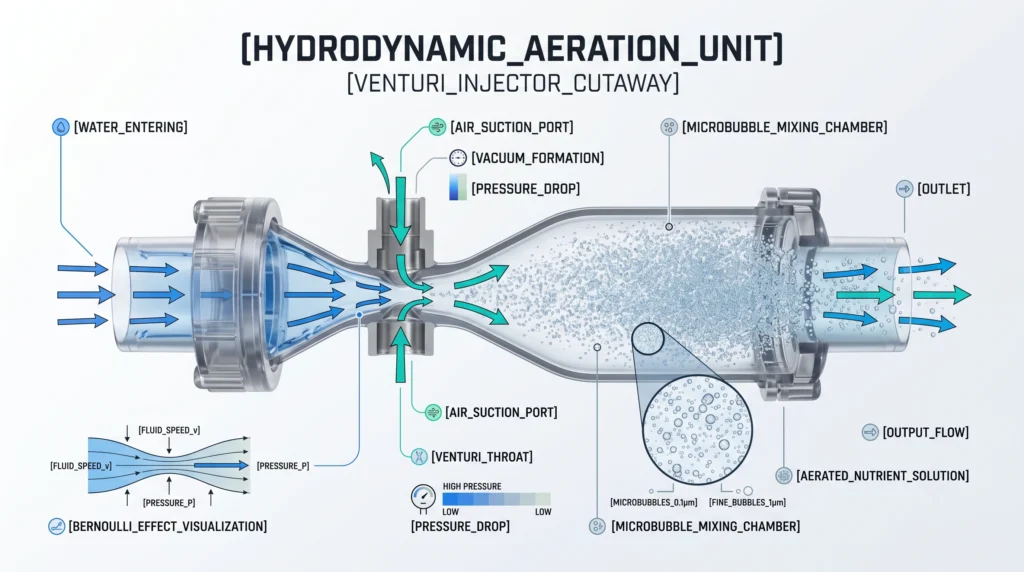
Genuine Mazzei venturi injectors work on Bernoulli’s principle: a pump forces water through a constricted throat, the resulting velocity increase creates a pressure drop, and that vacuum pulls atmospheric air in through a side port, shearing it violently into thousands of micro-bubbles in the mixing zone. Those bubbles stay suspended in solution longer than air-stone bubbles do, meaning meaningfully better dissolved oxygen saturation.
Winner: Venturi Air Injectors. Violent gas-liquid shearing genuinely produces smaller bubbles and better saturation than forcing air through static rock pores.
Round 2: Reservoir Thermal Loading
This is where Venturi systems have a real tradeoff. Driving one requires a submerged or inline water pump, and that pump adds heat as it runs continuously. In a small reservoir, a pump running 24/7 can raise nutrient solution temperature by a few degrees Fahrenheit above ambient, and as temperatures climb past roughly 72°F, DO capacity drops and pathogens like Pythium get more comfortable. Venturi setups in small reservoirs often need supplemental cooling to offset this.
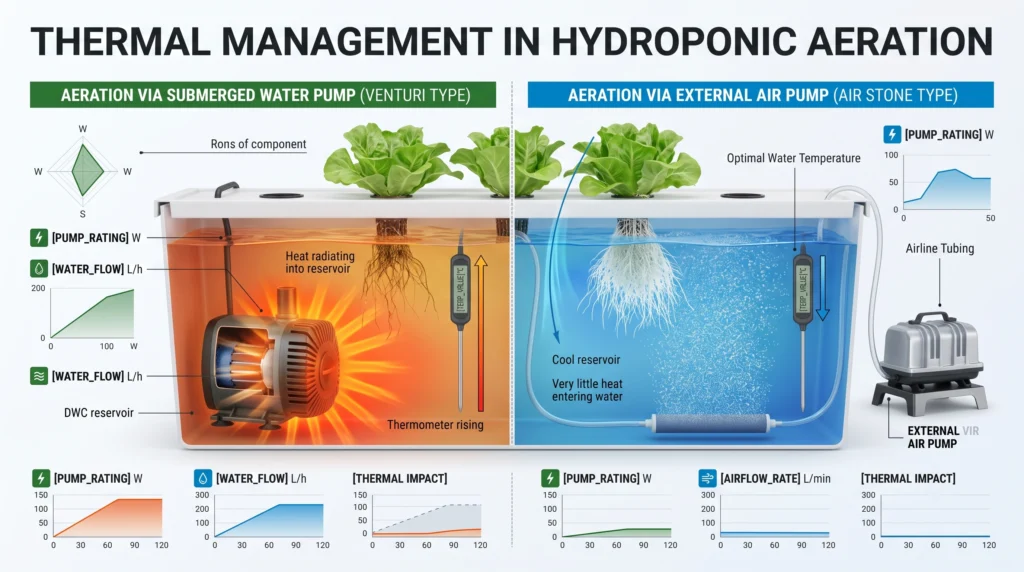
Air stones keep water cooler by comparison, the pump sits entirely outside the reservoir, and the only heat transferred is the mild warmth of compressed air moving through the line.
Winner: Standard Air Stones. Keeping motorized hardware out of the water protects the reservoir’s thermal baseline.
Round 3: Maintenance and Biofouling
Air stones fight a losing battle against calcium scale and biofilm binding to their porous surface, output drops from a vigorous boil to a weak fizzle over weeks, and eventually they need an acid soak or outright replacement, a genuine consumable cost.
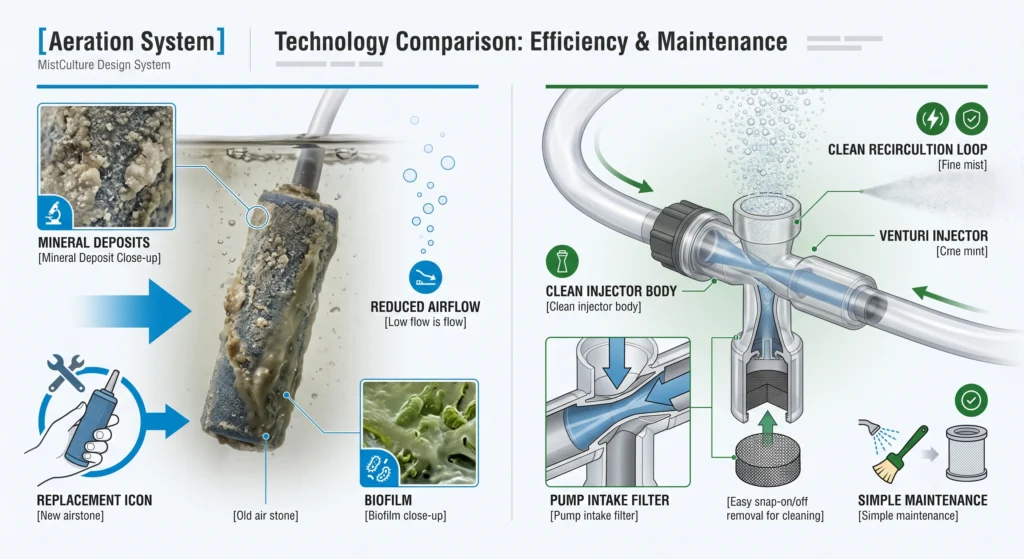
A Venturi injector is essentially a shaped piece of PVC or Kynar with no moving parts and no pores to clog, so it won’t lose efficiency to calcium scaling the way a stone does. The real maintenance burden shifts to keeping the driving pump’s intake filter clear of root debris instead.
Winner: Venturi Air Injectors. Fewer consumable parts and real resistance to scaling.
Round 4: Acoustic Noise
Commercial piston air pumps vibrate audibly and often need suspension mats to stay tolerable, and even muffled, low-frequency hum travels through building structure easily.
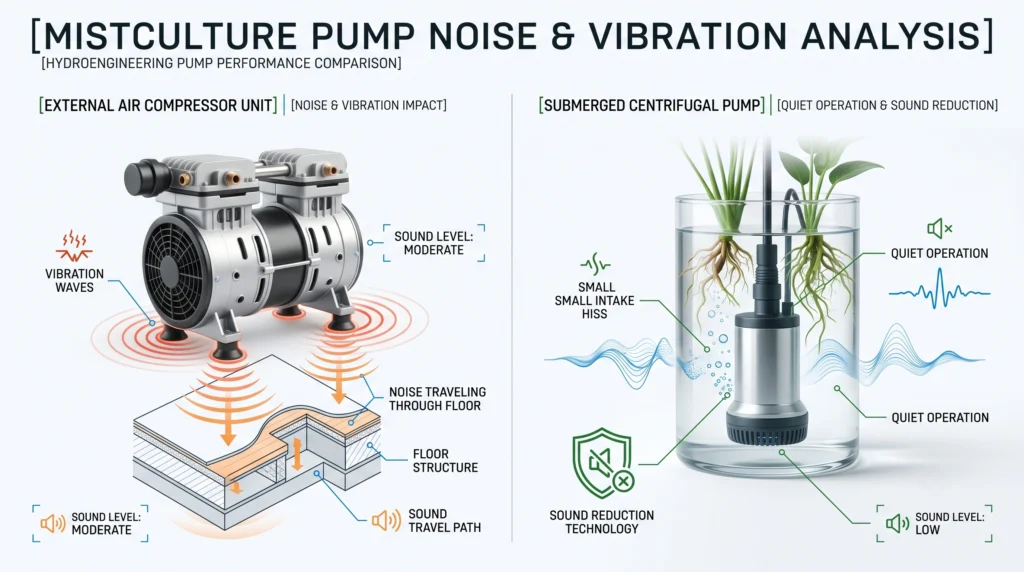
A Venturi setup swaps that for a submerged water pump, generally much quieter mechanically since water damps vibration. What you will hear instead is the air intake’s hiss or slurp, which can be muffled significantly with an inline silencer or a simple filter stuffed into the intake line.
Winner: Venturi Air Injectors, once properly muffled, a well-set-up system runs notably quieter than a vibrating diaphragm compressor.
Product Profiles

The genuine article when growers talk about venturi injectors. Precise internal geometry gives strong suction for the motive flow required, and agriculture-grade plastics resist UV and nutrient corrosion. Before buying a pump to drive one, check Mazzei’s own performance tables for your specific model and desired operating pressure, generic sizing rules of thumb can send you shopping for an underpowered pump.

Cheap stones crumble after one cycle. Sintered alumina is baked dense and durable, needs more pressure to drive but produces a genuinely finer bubble matrix, and is heavy enough to stay put on the bucket bottom without tangling in roots.
Essential Aeration Accessories
Please choose display type!Frequently Asked Questions
Do Venturi injectors alter the pH of the nutrient solution?
Not directly through the mixing action itself, but aggressive aeration off-gasses dissolved CO2, and since dissolved CO2 acts as a weak carbonic acid, removing it can cause a gradual, mild pH rise over the first day of operation. Watch your readings and see our u003ca href=u0022https://mistculture.com/hydroponic-ph-ec-guide-2026/u0022u003epH and EC guideu003c/au003e for buffering.
What size water pump do I need for a Mazzei injector?
This depends on your specific injector model and target operating pressure, not just a flat GPH number. Mazzei’s own published performance tables (available on their site) show motive flow and pressure requirements for each model, and a pump’s advertised GPH rating (usually measured at zero head) often overstates what it can actually deliver against real operating pressure. Check the real performance data for your model before buying a pump, a pump that u0022flows plenty of wateru0022 at zero resistance can still fail to create suction against a restrictive injector.
Can I run a Venturi and air stones in the same reservoir?
You can, but it’s largely redundant. A properly tuned Venturi is already achieving strong dissolved oxygen saturation on its own, adding air stones mostly just adds noise and another consumable part to maintain, undercutting the Venturi’s low-maintenance advantage.
Why did my Venturi stop sucking air?
Three common culprits: the pump’s intake sponge is clogged with debris, dropping pressure below what’s needed for suction; the water level is too high, creating back-pressure against the injector outlet; or the air intake line itself is pinched or clogged. Checking the pump’s pre-filter first resolves this most often, but if suction was marginal from the start, an undersized pump is also worth ruling out.
Are air stones or Venturis better for a 5-gallon bucket DWC?
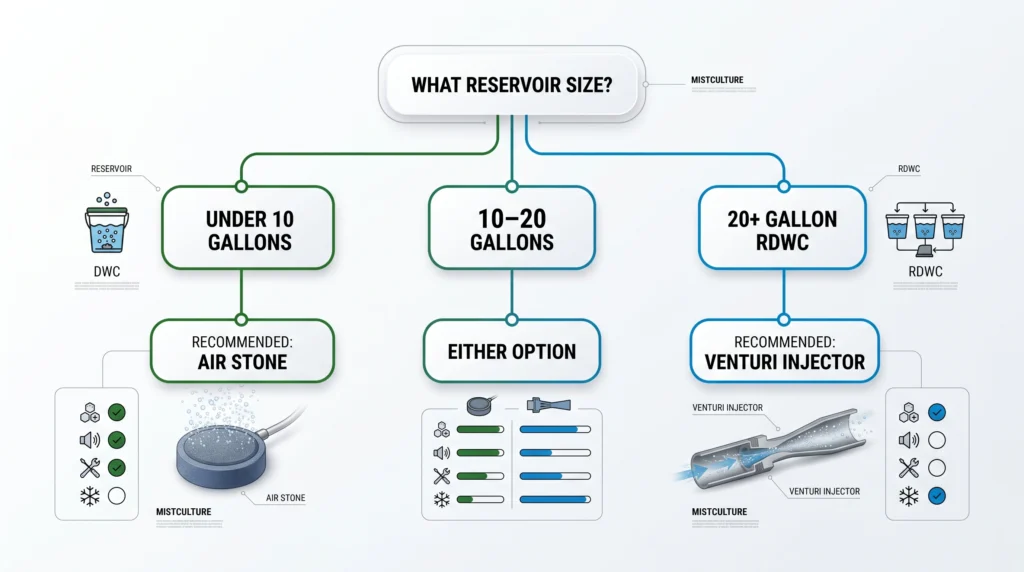
For individual small buckets, air stones are generally the more practical choice. Putting a pump with enough output to drive a Venturi inside a 5-gallon bucket risks meaningfully heating the water. Venturi injectors tend to make more sense for larger, linked RDWC systems or single reservoirs of 20+ gallons, where the water’s thermal mass can better absorb the pump’s heat output.
Pump Heat Load Estimator
Curious how much heat a submersible pump might realistically add to your specific reservoir? Use the tool below, based on real thermodynamics (specific heat of water), to get a rough estimate.
Estimate how much a submerged pump could raise your reservoir temperature over time, based on the pump’s wattage and your reservoir volume. Uses the real specific heat capacity of water, not a rule of thumb.
This estimates heat added with no heat loss to ambient air, a worst-case upper bound. Real systems lose heat to the room, so actual temperature rise will typically be lower and will plateau rather than climb indefinitely. Use this as a planning signal, not an exact prediction.
The Final Verdict
Choosing between the two comes down largely to system size and your appetite for routine maintenance. For a single-bucket DWC or a small tote, air stones remain the more sensible default, cooler water, cheaper replacement, reliable surface agitation, without the risk of cooking your roots with an oversized pump crammed into a small volume.
For a multi-site RDWC system with a large central reservoir, a properly sized Mazzei venturi is a genuine engineering upgrade, eliminating loud compressors and the recurring chore of scrubbing scaled air stones, while pushing dissolved oxygen closer to its physical ceiling. The deciding factor either way is matching your hardware to your actual reservoir volume and getting pump sizing right from Mazzei’s real spec data, not a rule of thumb.

Continue Your Learning Journey