TrolMaster Hydro-X vs AC Infinity Controller 69 Pro: Technical Comparison

Table of Contents
- System Architecture and Expandability
- Feature Comparison: Sensors, Controls, and Automation
- Electrical Relay Control and Device Compatibility
- Automation Programming and Conditional Logic
- Pricing and Value Analysis
- Data Logging and Historical Analysis
- Common Problems and Troubleshooting
- Controller Architecture and Sensor Integration
- Future Upgrade Paths
- Frequently Asked Questions
- Conclusion
Disclosure: MistCulture summarizes verified product specs, engineering data, and community feedback. We may earn an affiliate commission if you purchase through our links. Regulations vary by location; this content is for educational purposes only.
The grow room controller market has matured significantly, shifting from rudimentary timers to highly advanced microprocessors capable of predictive environmental modeling. Two clear leaders dictate the current landscape: the TrolMaster Hydro-X and the AC Infinity Controller 69 Pro. Both systems promise comprehensive environmental control, yet they take fundamentally different approaches to architecture, scalability, and user experience. Selecting the correct control system dictates the baseline efficiency of your entire facility, whether you manage a small residential tent or a multi-zone commercial warehouse.
To maintain accurate records and ensure smooth integration of any new hardware into your existing infrastructure, we recommend tracking all device MAC addresses, firmware versions, and calibration schedules using the mistculture-master-tracking-workbook.pdf file provided in our resource section.
This head-to-head comparison breaks down every measurable factor—from relay load capacities and sensor communication protocols to pricing structures and proportional-integral-derivative (PID) logic algorithms.
System Architecture and Expandability
The TrolMaster Hydro-X relies on an industrial RS-485 daisy-chain network optimized for wide-area scaling, while the AC Infinity Controller 69 Pro utilizes a proprietary UIS (Universal Infinity System) protocol designed for seamless, plug-and-play localized integration.
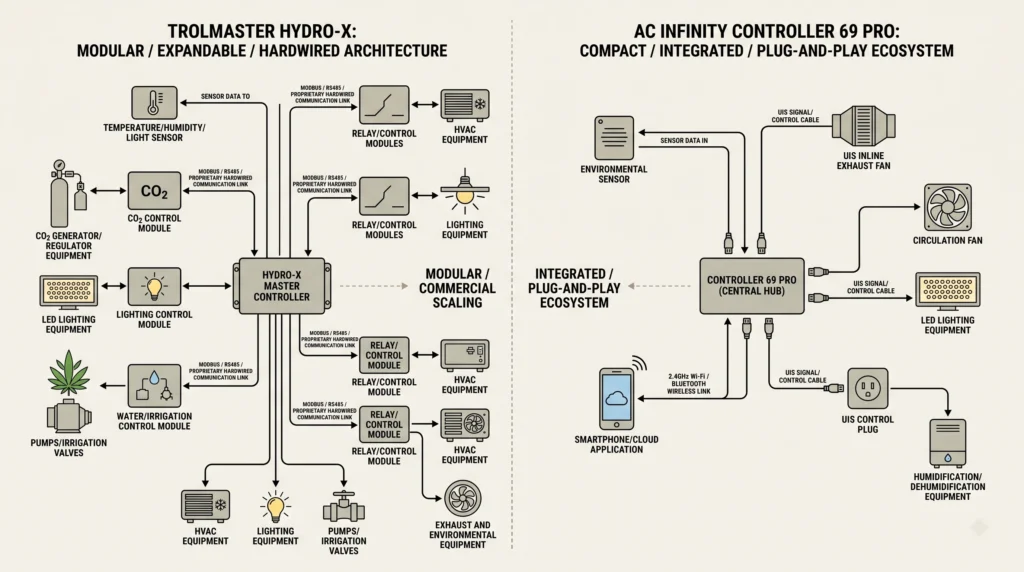
TrolMaster Hydro-X uses a modular architecture with a central controller (the Hydro-X main brain) that connects to various sensor and control modules via a proprietary communication protocol operating over standard RJ12 cables. The system scales by adding dedicated nodes for specific tasks: temperature/humidity sensors, CO2 controllers, lighting adapters, and irrigation timers all plug into the central unit’s distinct lines.
Key expandability features of the Hydro-X system:
- Supports up to 8 sensor/control devices per Hydro-X main unit.
- Capable of bridging to the Hydro-X Water (irrigation control), Hydro-X CO2, and Hydro-X Lighting modules.
- Facilitates multi-room control by linking multiple Hydro-X units back to a central PC or the TrolMaster cloud app.
- Pushes SMS and application notifications for hard-limit alarms.
AC Infinity Controller 69 Pro takes a tightly integrated approach, combining the controller with their high-efficiency inline fan ecosystem. The Controller 69 Pro was engineered specifically around the AC Infinity Cloudline T6, S6, and their respective circulation fans, merging pulse-width modulation (PWM) motor control directly with environmental monitoring.
Key expandability features of the Controller 69 Pro system:
- Controls up to 8 AC Infinity UIS devices simultaneously via a central hub.
- Integrates highly accurate, Swiss-made temperature and humidity sensors directly into the primary sensor probe.
- Cross-compatible with AC Infinity’s full hardware line, including duct fans, oscillating clip fans, and LED grow lights.
- Heavily app-based interface with localized Bluetooth control and remote WiFi access.

- A digital controller designed to equip AC Infinity devices with smart controls to produce the optimal environment.
- Control up to four devices from fans to grow lights and provide each with their own independent programming.
- Automate devices to dynamically change speed and brightness levels in response to temperature, humidity, and VPD.
- Why it’s necessary: This hub acts as the brain for a unified, whisper-quiet ventilation and climate system, perfect for residential spaces where noise and cable management are primary concerns.
- Key Spec: Controls up to 8 UIS devices with dynamic VPD (Vapor Pressure Deficit) triggers.
If you are setting up a localized environment and need to understand baseline spacing requirements, refer to our grow tent buying guide to match your controller capabilities with your cubic footage.
Feature Comparison: Sensors, Controls, and Automation
TrolMaster acts as a broad-spectrum facility manager handling distinct zones of light, water, and air, whereas AC Infinity excels as an active climate manipulator with industry-leading fan motor integration.
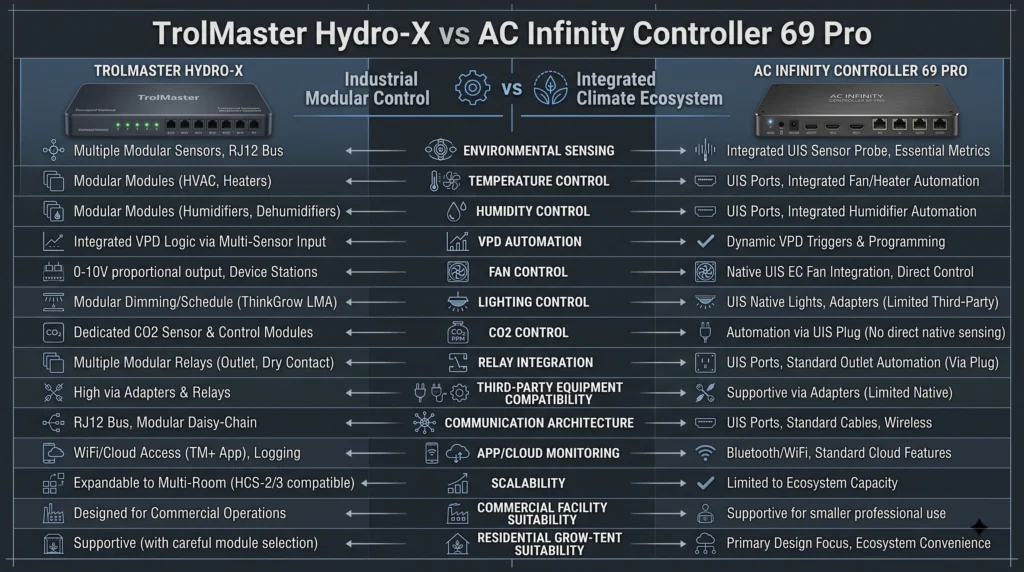
TrolMaster Hydro-X offers broader, distinct environmental control channels. The unit splits its command signals into separate RJ12 lines, isolating lighting signals from HVAC signals.
- Temperature control encompasses distinct heating and cooling stages, allowing for custom deadbands (the temperature range where no equipment is activated) to prevent rapid on/off cycling of heavy compressors.
- Humidity control handles both dehumidification and humidification, triggering external relays based on exact percentage drops.
- CO2 enrichment control uses a dedicated sensor module to target specific parts per million (PPM) parameters, managing solenoid valves or gas burners.
- Lighting control provides 0-10V or PWM dimming signals compatible with major ballast brands, allowing for simulated sunrise/sunset ramping.
AC Infinity Controller 69 Pro focuses its processing power on climate control through fan integration.
- Temperature and humidity monitoring utilize advanced PID control algorithms to dynamically adjust exhaust fan speeds rather than simply relying on binary ON/OFF triggers.
- Intake and exhaust fan motor control ramps speeds up and down based on the severity of the climate spike.
- Lighting control offers basic scheduling and dimming for compatible UIS LEDs.
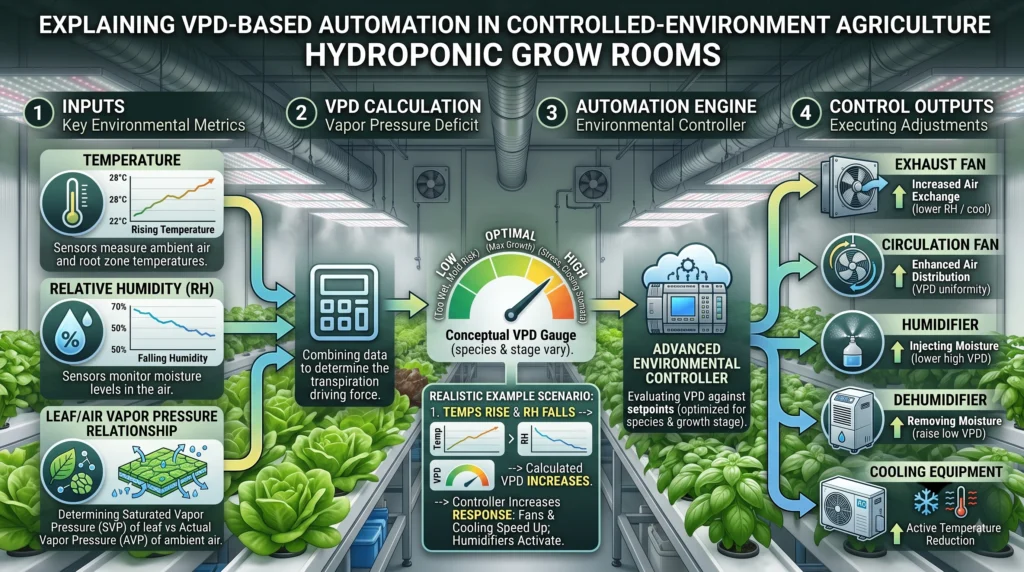
- The system calculates and triggers automation based on real-time VPD (Vapor Pressure Deficit), a highly accurate metric for plant transpiration.
The PID math used by AC Infinity creates a smoother environment. Instead of waiting for a room to reach 85 degrees Fahrenheit and blasting an exhaust fan at 100% capacity, the PID algorithm calculates the rate of temperature climb. The logic follows a standard loop: Output = (Kp * Error) + (Ki * Integral) + (Kd * Derivative). As the temperature inches closer to the threshold, the fan speed gradually increases to 20%, then 40%, flattening the temperature curve before it breaches the limit.
To fully utilize these advanced triggers, growers must maintain calibrated measurement devices. Read our hydroponic sensors guide to understand how sensor placement impacts controller responses.
Electrical Relay Control and Device Compatibility
Relay capacity determines the absolute limit of what heavy equipment a controller can manage safely without risking electrical fire or equipment failure.
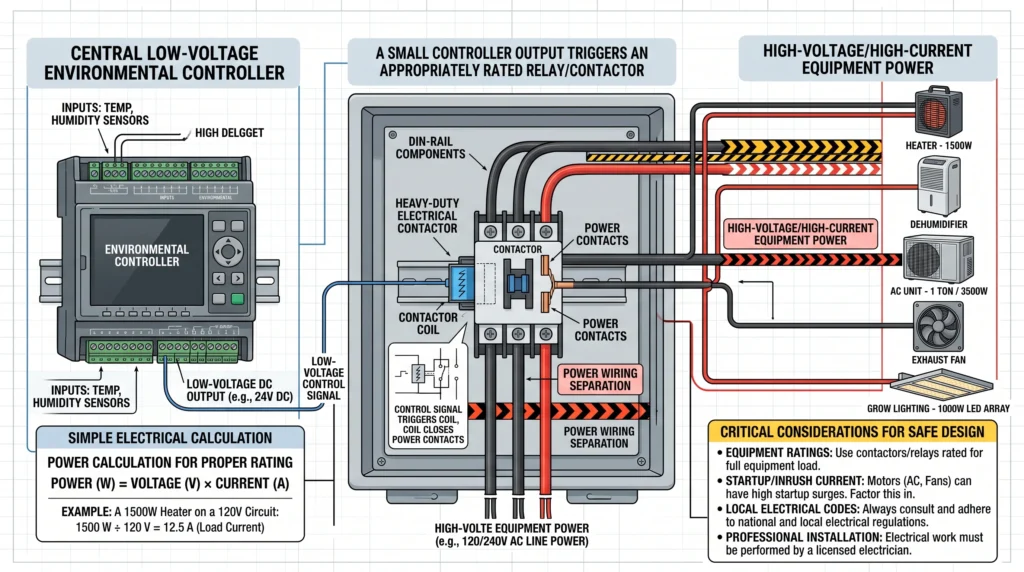
TrolMaster requires external relay stations to manage power. The main Hydro-X board only sends low-voltage data signals. To turn on a 1500W heater, the Hydro-X sends a signal to a TrolMaster ARS-1 or DST-1 module, which contains an internal mechanical relay. These modules are rated for 10 Amps at 120 Volts.
Understanding the basic electrical load calculation is mandatory here: Watts = Amps x Volts. If you are running a 1500-watt ceramic heater on a standard 120V household circuit, it draws exactly 12.5 Amps (1500 / 120 = 12.5). Plugging this into a 10A TrolMaster relay will overload the circuit, melt the relay contacts, and present a severe fire hazard. High-current devices like commercial air conditioners or heavy-duty dehumidifiers require heavy-duty external contactor boards (often 30A or 40A ratings) that are triggered by the smaller 10A TrolMaster relay.
AC Infinity handles third-party devices using UIS Control Plugs. These plugs bridge standard 120V “dumb” devices (like standard humidifiers or heaters) into the smart ecosystem. The UIS plugs are rated for up to 15 Amps. A 15A rating safely accommodates up to 1800 Watts of continuous draw at 120V.
For small grow tents (2-4 plants), AC Infinity’s integrated ecosystem is highly efficient. For larger installations utilizing multiple high-draw appliances, TrolMaster’s isolated signal routing to heavy-duty relays is the standard engineering practice. If you are building a custom electrical board, review our guidelines on smart plugs and timers for hydroponic to ensure you are sizing your relays properly.

- TrolMaster’s Hydro-X system can control most of the horticultural lighting fixtures sold on the market today.
- Why it’s necessary: Serves as the central command hub for commercial-scale operations, allowing distinct line isolation for lighting, HVAC, and CO2 injection without relying on wireless signals.
- Key Spec: Hardwired RS-485 communication supporting up to 16 distinct control modules.
Automation Programming and Conditional Logic
Programming an environmental controller requires establishing specific hierarchies of operation. A well-programmed unit handles conflicting scenarios; like a drop in temperature occurring simultaneously with a spike in humidity.
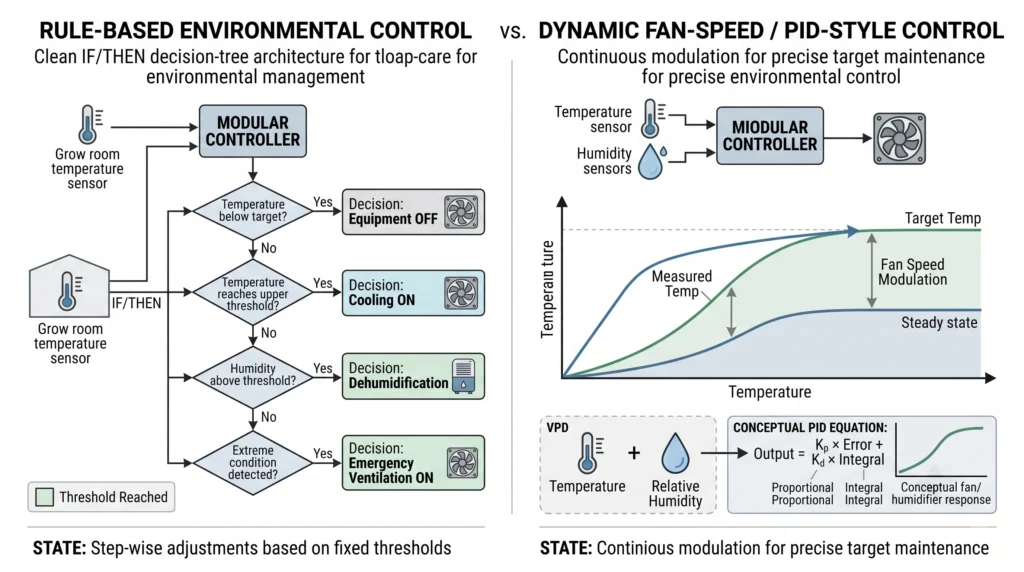
TrolMaster programming logic relies heavily on traditional, graphic-based IF/THEN/ELSE statements. You assign parameters for distinct timeblocks (Day Mode vs Night Mode).
- Time-based scheduling sets absolute boundaries for lighting.
- Sensor-based triggers operate on assigned deadbands. If the target temperature is 78F with a 2F deadband, cooling equipment activates at 80F and shuts down when the room returns to 78F.
- Macro programming allows for high-level facility resets, such as shutting down all CO2 injection and activating all exhaust fans if smoke is detected or an extreme temperature threshold is breached.
AC Infinity operates through an app-centric automation design that excels at threshold triggers and dynamic ramping.
- Port-to-Port programming allows you to tell Port 1 (Exhaust Fan) to ramp up based on the sensor probe’s VPD reading, while Port 2 (Circulation Fan) runs on an independent continuous loop.
- Buffer transitions prevent the AC Infinity fans from rapidly cycling speeds. You can set transition temperatures: at 78F the fan runs at speed 2, at 80F it ramps to speed 5, and at 82F it hits speed 10.
- Scene modes permit quick swapping of entire environmental parameters based on the current growth phase (Seedling, Vegetative, Flowering).
When configuring your environment, understanding the interaction between temperature, humidity, and the resulting VPD is non-negotiable. Refer to our hydroponic pH and EC mastery guide to see how root zone metrics interact with the atmospheric conditions dictated by these controllers.
Pricing and Value Analysis
Hardware selection must be justified through a precise cost-benefit analysis scaling from residential hobbyist setups to commercial cultivation floors.
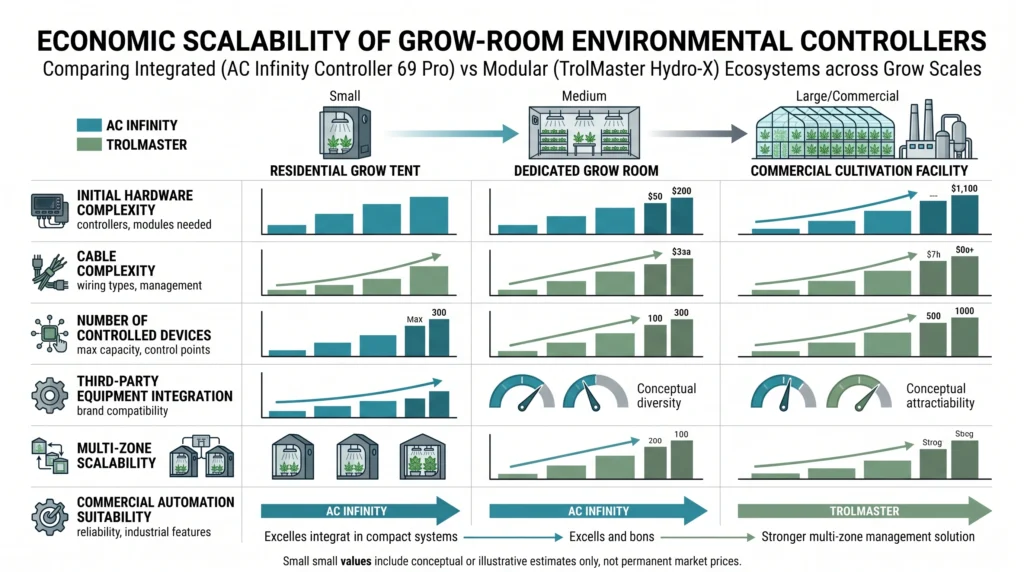
The baseline entry cost separates these two systems immediately.
- The AC Infinity Controller 69 Pro retails around 70 to 100 dollars for the brain alone, but it requires AC Infinity hardware (or UIS plugs) to function. A complete tent package (Controller, T6 Inline Fan, Clip Fan, UIS Plug for a heater) totals approximately 300 to 400 dollars.
- The TrolMaster Hydro-X (HCS-1) main controller starts near 300 dollars. Adding the 3-in-1 sensor, two ARS-1 relay stations, and a lighting adapter pushes the baseline entry cost to over 600 dollars before purchasing a single fan, light, or heater.
| Installation Scale | AC Infinity Total Est. Cost | TrolMaster Total Est. Cost | Primary Value Driver |
| 4-Plant Residential Tent | 350 USD | 800 USD | AC Infinity provides superior cost-efficiency and cable management for tight spaces. |
| 16-Plant Dedicated Room | 800 USD | 1,200 USD | TrolMaster offers better integration with existing heavy-duty third-party HVAC equipment. |
| Commercial Warehouse | N/A (Requires Multiple Hubs) | 3,500+ USD | TrolMaster allows centralized PC monitoring of hundreds of distinct data points. |
For small setups, the AC Infinity infrastructure offers lower barrier to entry. For commercial setups, TrolMaster provides the necessary industrial infrastructure. Managing the budget for your facility requires balancing climate control costs against your consumable nutrient costs. Use our hydroponic nutrient calculator to project ongoing operational expenses to ensure you have capital left for proper hardware scaling.
Data Logging and Historical Analysis
Accessing historical environmental data allows engineers to identify micro-climates, pinpoint hardware failures, and optimize future crop cycles.
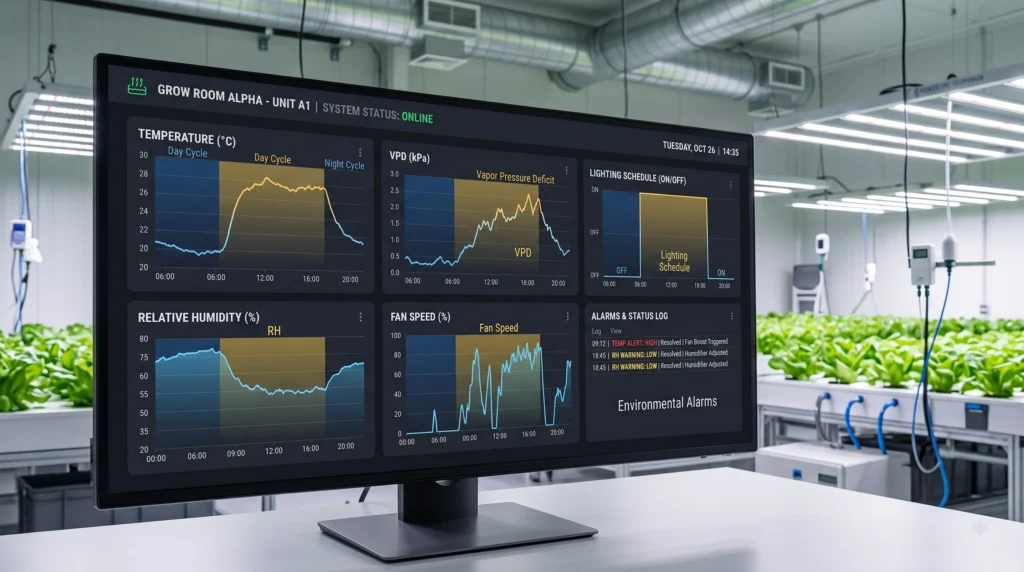
TrolMaster Hydro-X provides local data logging. The unit records metrics and stores up to 30 days of high-resolution data on a physical Micro-SD card. This data can be exported as a CSV file for manual analysis in spreadsheet software. The TrolMaster app also pushes data to the cloud for remote viewing.
- Local storage ensures data integrity even if the facility loses internet access.
- Exportable CSV logs are often mandated by state compliance boards to prove environmental safety standards are met in commercial operations.
AC Infinity Controller 69 Pro defaults to continuous cloud storage via AWS (Amazon Web Services). The unit syncs data via WiFi to the AC Infinity app, logging temperature, humidity, VPD, and fan speeds.
- Data is stored indefinitely and can be viewed on dynamic, pinch-to-zoom graphs.
- Data export is available directly through the app.
- Cloud reliance means that if the local WiFi network drops, remote monitoring is disabled until the connection is restored, though the controller will continue executing its local logic parameters autonomously.
For facilities struggling with electrical costs due to aggressive HVAC data trends, analyzing these logs is the first step to optimization. You can review strategies in our hydroponic power savings guide to lower your kWh usage based on controller data.

- Designed to ventilate hydroponic grow rooms, transfer heating/cooling, cool AV closets, and exhaust odors.
- Dynamic temperature and humidity programming, with timers, grow cycles, scheduling, minimum speed.
- Remotely connect to our WiFi app to access advance programs, view climate data, and set automation.
- Why it’s necessary: Connects directly to the Controller 69 Pro using native UIS cables, providing highly efficient, PWM-controlled airflow without the loud humming associated with voltage-dimmed motors.
- Key Spec: 402 CFM capacity with an incredibly low 32 dBA noise rating.
Common Problems and Troubleshooting
Even advanced microprocessors experience communication faults. A systematic diagnostic approach minimizes facility downtime.
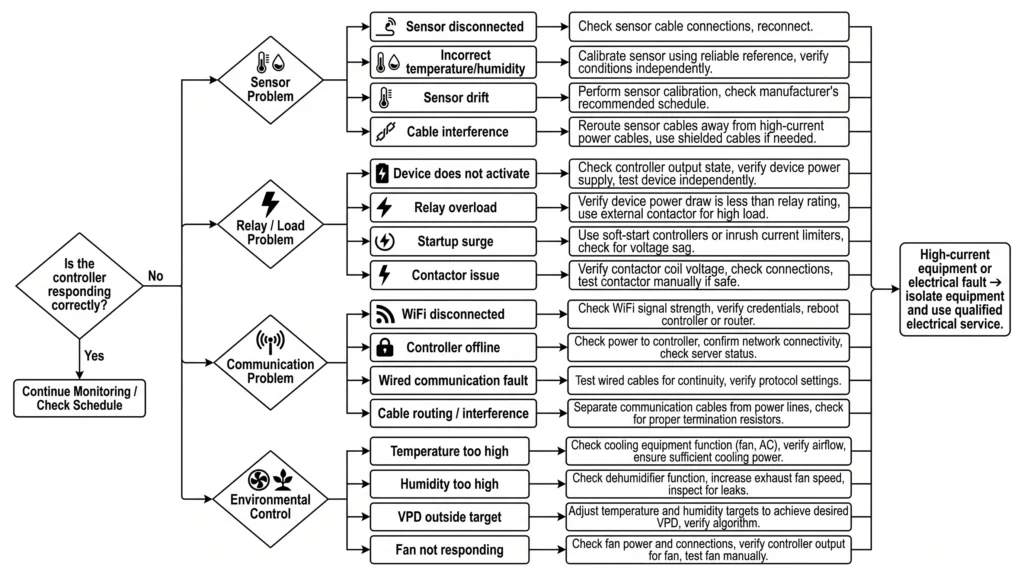
Both systems are generally robust, but environmental controllers operate in harsh, humid conditions subjected to significant electromagnetic interference (EMI).
Sensor Disconnection or Drift
TrolMaster sensors communicate via RJ12 cables. If an RJ12 cable is run parallel to high-voltage lighting ballasts, EMI can corrupt the data packets, causing the sensor to drop offline. Route low-voltage data cables perpendicular to high-voltage power lines. If a sensor shows inaccurate readings, perform a manual calibration using a verified secondary hygrometer.
Unresponsive Relays
If a TrolMaster ARS-1 module or an AC Infinity UIS plug fails to activate, check the load capacity. Surges from compressor-based units (like air conditioners) can fuse the internal contacts of a relay closed. Always ensure the starting surge amperage does not exceed the relay’s maximum rating.
Connectivity Issues
AC Infinity relies on a 2.4 GHz WiFi band. Dual-band routers that automatically merge 5 GHz and 2.4 GHz bands will frequently cause the Controller 69 Pro to drop connection. Log into your router administration panel and split the bands into separate SSIDs to ensure stable connectivity.
For a comprehensive breakdown of diagnosing hardware and software faults across complex setups, consult our hydroponic troubleshooting guide.
Controller Architecture and Sensor Integration
Hardwired sensor buses provide industrial reliability, while Bluetooth beacons offer deployment flexibility.
TrolMaster Hydro-X utilizes a daisy-chained sensor bus. The main unit features separate ports for specific device classes. You run a cable from the “Sensors” port to the 3-in-1 Temp/Humid/Light sensor. From that sensor, you can chain a cable to a CO2 sensor. This RS-485 architecture ensures zero signal latency and eliminates wireless interference. However, maximum cable run lengths apply. Extending an RJ12 line beyond 150 feet requires signal boosters to prevent voltage drop.
AC Infinity Controller 69 Pro features four independent UIS ports on the controller face. The primary sensor probe occupies one port, or plugs into a dedicated sensor slot depending on the specific hardware revision. AC Infinity has expanded to include Bluetooth-enabled remote sensors. You can place wireless sensors in distinct corners of the room to average the temperature readings across a broader space.
If you are planning to build custom manifolds or need to measure specific water metrics alongside air metrics, explore our DIY hydroponic systems guide to see how distinct sensor placements impact system design.
Future Upgrade Paths
Scalability dictates whether a controller is a short-term purchase or a long-term facility investment.
TrolMaster is engineered for infinite scaling. A grower starting with a single Hydro-X unit can easily upgrade to the Hydro-X Pro, which features a larger touchscreen, deeper programming logic, and the capacity to control multiple distinct rooms simultaneously. Add-on modules like the WD-1 water detector or the MBS-SD smoke detector integrate seamlessly into the existing bus.
AC Infinity is rapidly expanding the UIS ecosystem. Upgrading involves adding more Controller 69 Pros to the network and managing them via the unified app interface. They recently introduced target-specific modules like the UIS smart outlet and target-VPD humidifiers. For residential and mid-tier commercial growers, AC Infinity provides a clear, single-brand upgrade path.
Maintaining exact targets across these scaled upgrades requires strict monitoring of nutrient delivery alongside climate variables. Baseline requirements for water chemistry are outlined in our hydroponic pH EC guide 2026.
Frequently Asked Questions
Does the TrolMaster Hydro-X support third-party exhaust fans?
Yes. TrolMaster offers 0-10V control adapters and standard relay modules. If your inline fan supports 0-10V analog speed control, the Hydro-X can regulate its speed. If it only operates on a standard wall plug, a TrolMaster relay can turn it on and off, but cannot modulate the motor speed.
Can the AC Infinity Controller 69 Pro control my existing grow lights?
Yes, provided you purchase the correct UIS lighting adapter. AC Infinity manufactures Type-A and Type-B lighting adapters that convert the UIS digital signal into 0-10V or PWM signals compatible with brands like Spider Farmer, Mars Hydro, and HLG.
Why is Vapor Pressure Deficit (VPD) so important for these controllers?
VPD measures the exact drying power of the air by calculating the difference between the amount of moisture in the air and how much moisture the air can hold when saturated. It is a more accurate metric for plant transpiration than relative humidity alone. Both controllers use temperature and humidity readings to calculate VPD and trigger equipment to stay within optimal ranges.
What happens to the controllers during a power outage?
Both controllers feature non-volatile internal memory. In the event of a total power loss, all programming parameters, deadbands, and schedules are retained. Once power is restored, the units will reboot and resume normal operations without requiring manual reconfiguration.
Can I run a commercial air conditioner directly off these controllers?
No. Commercial air conditioners draw massive amounts of starting amperage (inrush current) that will destroy the internal components of standard 10A or 15A smart relays. You must wire the heavy equipment to a heavy-duty mechanical contactor, and then use the controller’s relay to trigger the low-voltage coil on the contactor.
Does the TrolMaster app require a monthly subscription?
No. The TrolMaster application and basic cloud data logging services are currently provided without recurring monthly subscription fees.
How accurate are the sensors on the AC Infinity probe?
The AC Infinity sensor probes utilize high-grade thermistors and capacitive humidity sensors, generally accurate to within +/- 0.5 degrees Fahrenheit and +/- 2% relative humidity. Regular cleaning of the probe tip with compressed air prevents dust buildup from skewing the readings.
Conclusion
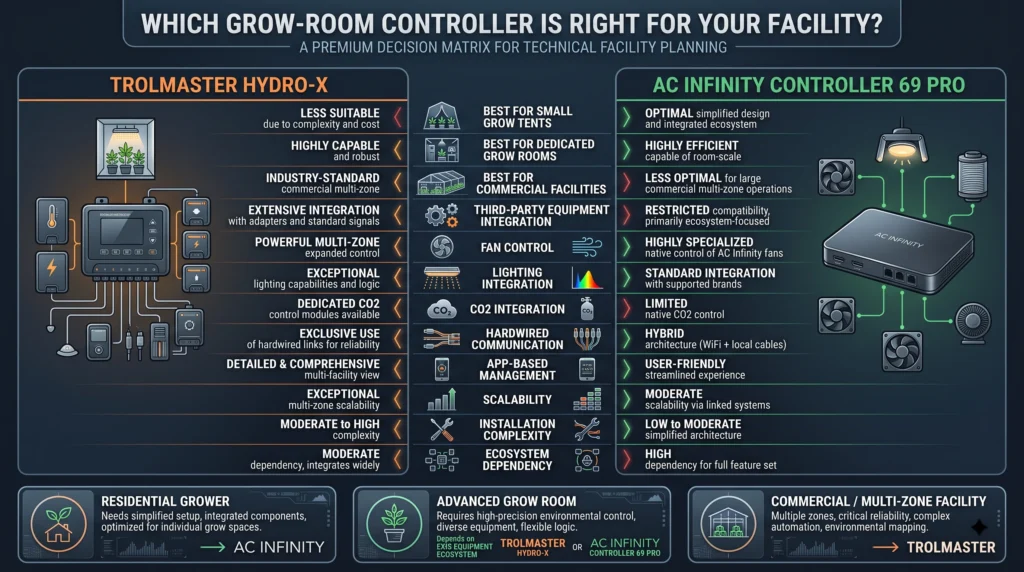
The decision between the TrolMaster Hydro-X and the AC Infinity Controller 69 Pro comes down to the scale of your facility and your engineering preferences. The TrolMaster system is the definitive choice for commercial cultivators managing massive electrical loads, injecting CO2, and requiring strict industrial reliability through hardwired communication buses. Conversely, the AC Infinity Controller 69 Pro offers unparalleled value and user experience for residential growers and boutique commercial setups, providing precise motor control, dynamic VPD tracking, and a sleek, unified app interface. Evaluate your specific electrical requirements, plan your scaling trajectory, and select the architecture that aligns with your operational footprint.
For a complete breakdown of other hardware options and tier-based reviews, explore our Best Hydroponic Controllers Under $200 guide to find the exact match for your facility’s needs.

Continue Your Learning Journey