Submersible Water Chillers: Active Aqua vs IceCraft vs ChillKing

Table of Contents
- The Thermodynamics of Hydroponic Water Cooling
- Active Aqua 1/10 HP Water Chiller: Residential Efficiency
- IceCraft 1/5 HP Water Chiller: The Commercial Bridge
- ChillKing 1/3 HP Water Chiller: Commercial High-Capacity Integration
- Fluid Dynamics and Frictional Head Loss in Chiller Loops
- System Design Principles: Insulation and Passive Thermal Mitigation
- Component Selection and Technical Specification Comparison
- Frequently Asked Questions
- Conclusion
Disclosure: MistCulture summarizes verified product specs, engineering data, and community feedback. We may earn an affiliate commission if you purchase through our links. Regulations vary by location; this content is for educational purposes only.
Water temperature management dictates the overall success, stability, and yield velocity of any advanced hydroponic facility. Nutrient solution temperature directly affects dissolved oxygen saturation limits, nutrient salt solubility, root metabolism rates, and disease susceptibility. When ambient temperatures in a grow room or greenhouse exceed 75 F (24 C), active chilling equipment becomes non-negotiable for stable commercial and residential operations. Without mechanical cooling, operators risk catastrophic crop failure due to oxygen deprivation and opportunistic root zone pathogens.
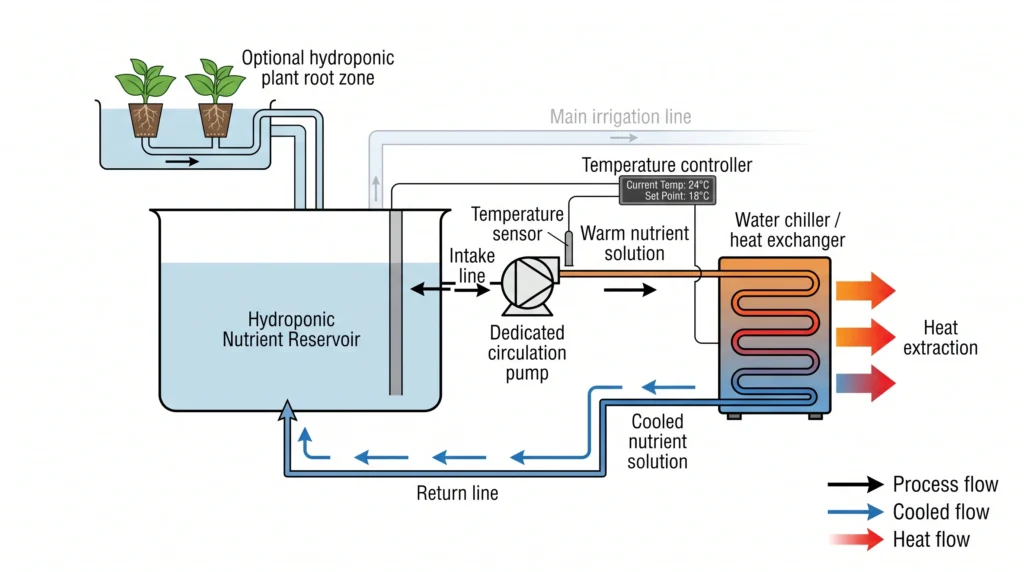
This comprehensive engineering evaluation examines the three leading submersible and inline chiller brands in the controlled environment agriculture market: Active Aqua, IceCraft, and ChillKing. Understanding the thermodynamic principles behind heat loads, refrigeration cycles, and fluid dynamics ensures that cultivators can select the exact equipment specifications required for their unique reservoir configurations. From small deep water culture totes to massive commercial dosing tanks, matching the chiller’s thermal extraction capacity to the environmental heat load is the foundation of high-performance hydroponic design.
The Thermodynamics of Hydroponic Water Cooling
Calculating the exact heat load of your hydroponic reservoir requires assessing ambient heat transfer, pump wattage, and biological root respiration. Sizing a chiller correctly ensures energy efficiency, prevents premature compressor failure, and maintains absolute control over the root zone climate.
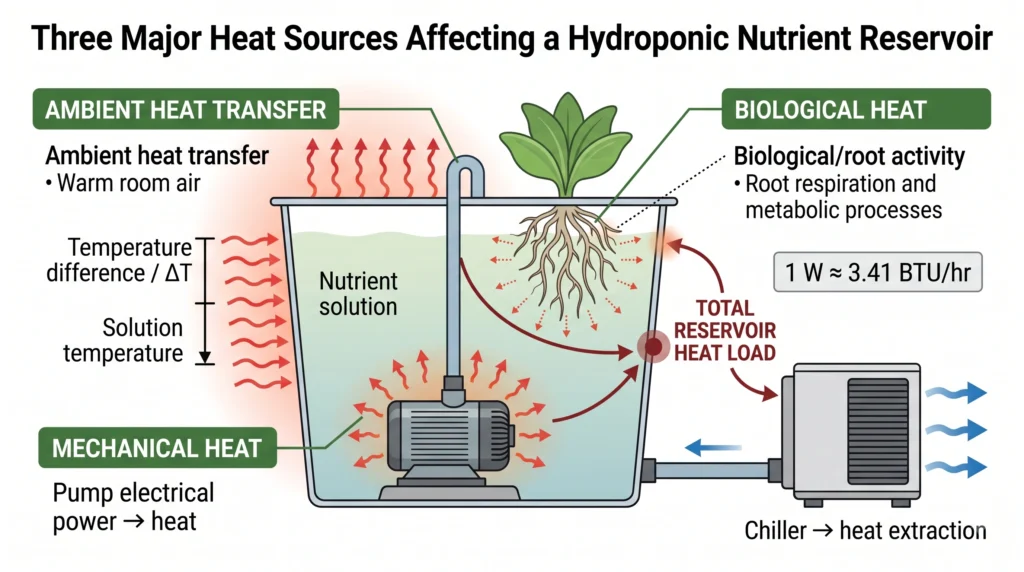
To properly select a chiller among the Active Aqua, IceCraft, and ChillKing lineups, operators must first quantify the heat load of their specific system. Heat enters a hydroponic reservoir through three primary avenues: ambient air transfer, mechanical equipment heat, and biological heat generated by plant roots and microbial life.
Ambient heat transfer occurs because thermal energy naturally flows from a warmer area to a cooler area. If your grow room air is 85 F and your target water temperature is 65 F, the ambient air constantly warms the reservoir walls. The rate of this transfer depends on the surface area of the reservoir, the temperature differential (Delta T), and the thermal resistance (R-value) of the reservoir material.
Mechanical heat is introduced primarily by water pumps and air pumps. Submersible water pumps sit directly inside the nutrient solution, meaning 100% of their operational inefficiency is released as thermal energy directly into the water column. The standard engineering conversion dictates that 1 watt of electrical power generates 3.41 BTU/hr of heat. Therefore, a 150-watt submersible pump injects a continuous 511.5 BTU/hr into the system. If you are operating a small chiller, the pump alone can consume a massive percentage of your total cooling capacity.
To determine the initial cooling requirement, engineers use the specific heat capacity formula. Water weighs 8.34 pounds per gallon, and it takes 1 BTU to raise or lower the temperature of 1 pound of water by 1 F.
To calculate the BTUs required to pull down a reservoir to the target temperature, use the following equation:
BTUs required = Volume in Gallons * 8.34 lbs/gal * Delta T in F
Consider a 100-gallon reservoir that needs to be cooled from 80 F down to 65 F. The Delta T is 15 F.
BTUs required = 100 * 8.34 * 15 = 12,510 BTUs.
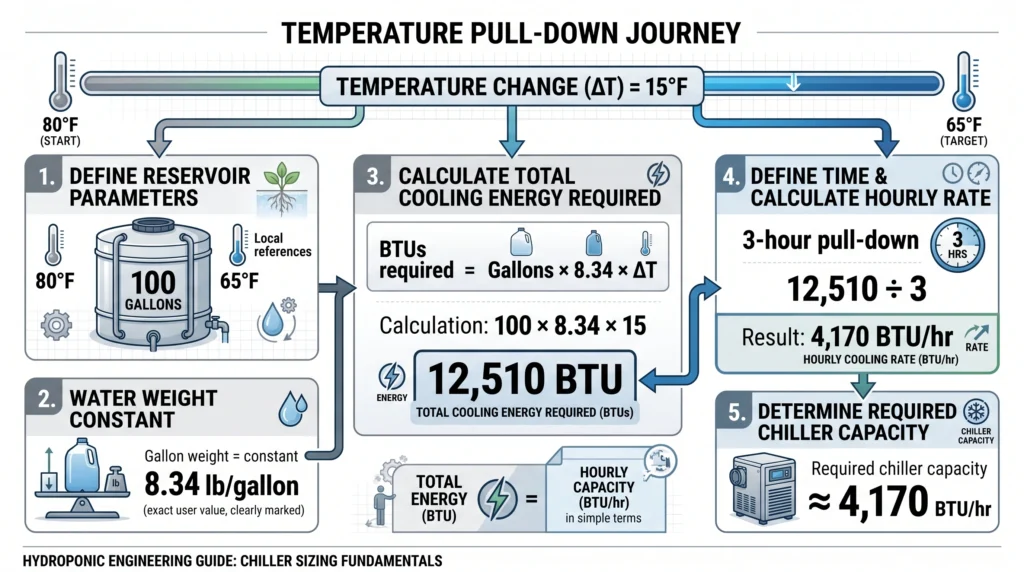
If an operator wants the chiller to achieve this temperature drop within 3 hours, the required hourly extraction rate is 12,510 / 3 = 4,170 BTU/hr. This mathematical reality immediately rules out smaller 1/10 HP units and directs the buyer toward a 1/5 HP or 1/4 HP model to handle the initial pull-down phase efficiently. Monitoring these shifts requires precise telemetry. You can master the chemistry aspects of these temperature shifts by reviewing our hydroponic pH and EC mastery guide.

- Sensor for H5151 Gateway: The Bluetooth freezer thermometer H5108 can connect with the WiFi Gateway H5151 to work as a W…
- Upgrade Accuracy Probe: Our wide measuring range of -40° to 158°F with ±0.9°F / 0.5°C accuracy and 2s fast refresh to en…
- Easy to Place: The unique holder reduces messy cables and better secures the probe inside the freezer. With the design o…
- Why it’s necessary: Continuous real-time monitoring of reservoir temperatures allows operators to set custom high/low parameter alarms. This prevents total crop loss if the chiller trips a breaker or the compressor fails during a heatwave.
- Key Spec: 0.1 F accuracy with continuous logging memory.
Active Aqua 1/10 HP Water Chiller: Residential Efficiency
The Active Aqua 1/10 HP chiller is engineered for residential and small-scale operations, providing up to 2,100 BTU/hr of cooling capacity. It features a pure titanium evaporator and utilizes R134a refrigerant, making it highly suitable for maintaining 50-gallon to 100-gallon setups in moderate ambient conditions.
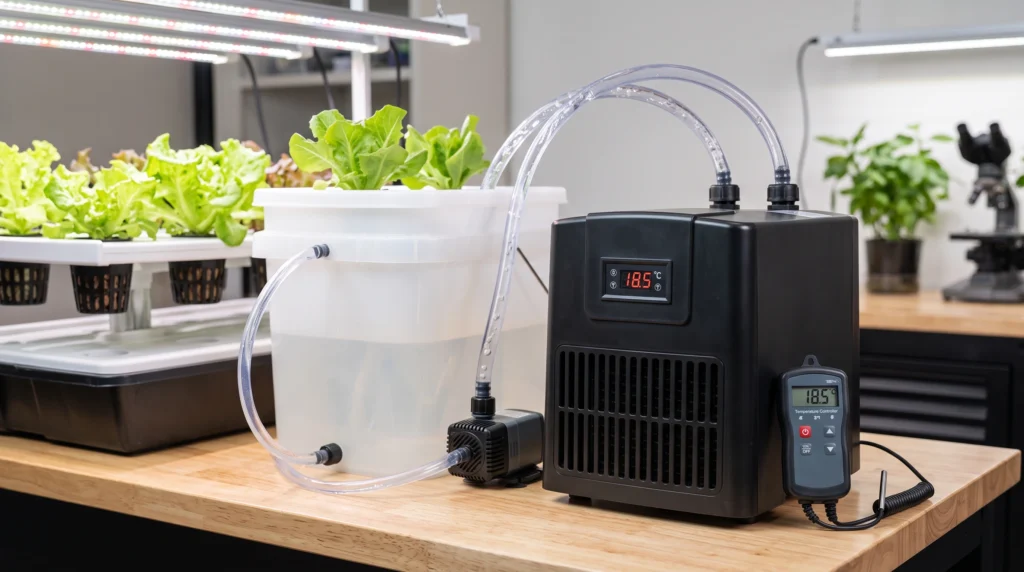
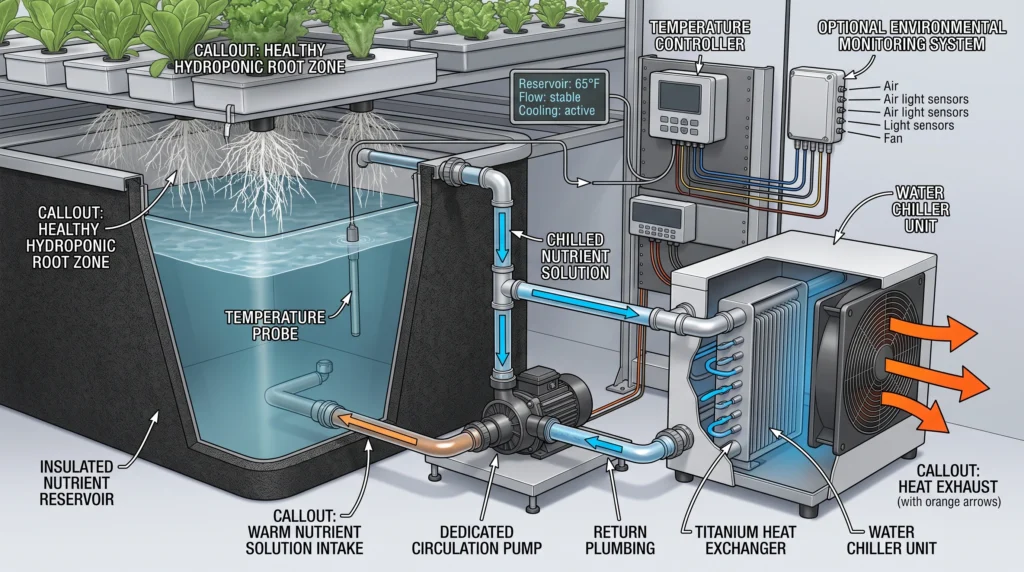
The Active Aqua line is perhaps the most recognized brand among hobbyist and mid-tier hydroponic growers. The 1/10 HP model utilizes a vapor-compression refrigeration cycle identical to household refrigerators. The compressor pressurizes the R134a refrigerant gas, pushing it through the condenser coil where a fan exhausts the heat into the room. The cooled, high-pressure liquid then passes through an expansion valve into the evaporator barrel.
A defining feature of the Active Aqua unit is its pure titanium heat exchanger. Hydroponic nutrient solutions contain highly corrosive mineral salts. If standard copper or aluminum heat exchangers were used, the acidic environment of the nutrient solution would rapidly corrode the metal, leading to heavy metal toxicity in the plants and equipment failure. Titanium is chemically inert to standard hydroponic pH ranges (5.5 to 6.5) and prevents any risk of nutrient lockout caused by heavy metal precipitation.
The Active Aqua 1/10 HP unit requires a specific flow rate to operate efficiently, typically rated between 132 and 396 Gallons Per Hour (GPH). If the water flows too slowly through the titanium barrel, it can freeze, expanding and potentially cracking the internal housing. If the water flows too quickly, it does not spend enough time in contact with the evaporator coils, drastically reducing the heat transfer efficiency. Cultivators using this model often pair it with dedicated inline pumps to isolate the chilling loop from the main irrigation manifold. For growers transitioning from basic setups, the Active Aqua serves as a reliable entry point into mechanical temperature management.

- COMPACT POWER FOR COLD THERAPY: Engineered for smaller cold plunge setups, this 0.10 HP chiller delivers spa-grade cooli…
- CONSISTENT, PRECISE COOLING: Digital control system maintains your target temperature with exceptional accuracy, giving …
- PURE TITANIUM PERFORMANCE: Built with a corrosion-resistant titanium evaporator, designed for long-lasting durability in…
- BOOST FUNCTION TECHNOLOGY: Activate extra cooling power to quickly reach your desired chill zone, perfect for spontaneou…
- WELLNESS MEETS VERSATILITY: Designed for modern lifestyles—works flawlessly with cold plunge tubs, aquariums, reef tanks…
- Why it’s necessary: Ideal for small to medium setups, this unit prevents root zone pathogen explosions by holding exact temperatures in 50-gallon reservoirs without requiring commercial electrical drops.
- Key Spec: 2,100 BTU/hr cooling capacity with a pure titanium evaporator.
IceCraft 1/5 HP Water Chiller: The Commercial Bridge
Filling the gap between hobbyist components and massive commercial systems, the IceCraft 1/5 HP unit delivers 4,200 BTU/hr of thermal extraction. Its precise digital temperature controller maintains a tight deadband of 0.1 F for highly sensitive crop profiles.
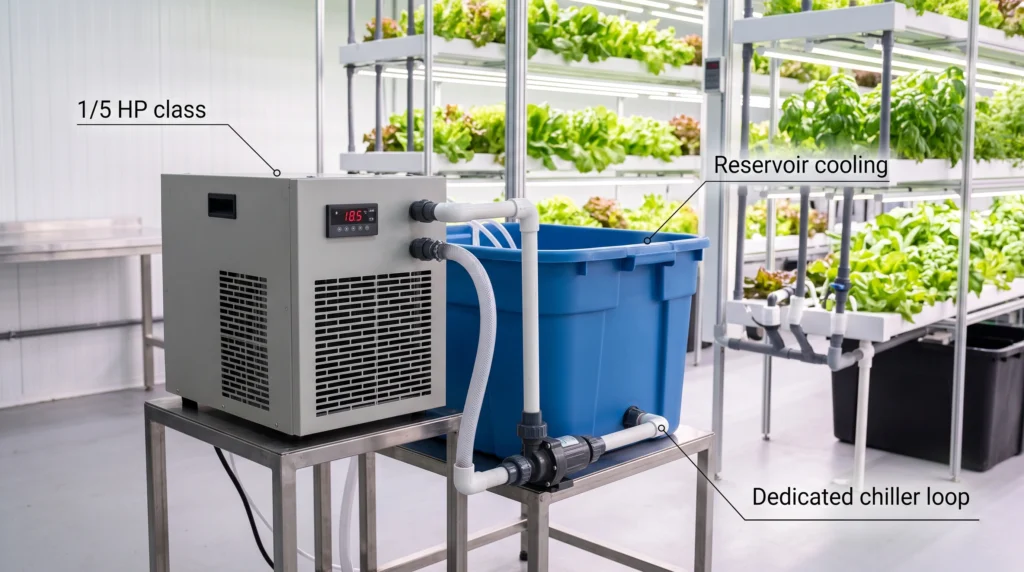
IceCraft chillers are engineered with upgraded compressor architecture to handle heavier thermal loads without rapid cycling. Short-cycling occurs when a chiller turns on and off too frequently. Every time a compressor engages, it draws a massive spike of electrical current (inrush current) and incurs mechanical wear. IceCraft units utilize advanced PID (Proportional-Integral-Derivative) logic controllers that allow the operator to adjust the temperature deadband.
A deadband is the temperature variance allowed before the compressor activates. For example, if the target temperature is 65 F and the deadband is set to 2 F, the chiller will cool the water to 65 F, shut off, and will not re-engage until the water temperature drifts up to 67 F. While wider deadbands save compressor life, highly sensitive crops like hydroponic wasabi or cold-water kelp require extreme stability. IceCraft controllers can be dialed down to a 0.1 F differential, forcing the compressor to maintain absolute precision.
The 1/5 HP IceCraft unit outputs 4,200 BTU/hr, making it capable of managing reservoirs up to 150 gallons even in high-heat environments like sealed grow tents with intense LED lighting. The plumbing connections on the IceCraft are reinforced, allowing for seamless integration into larger PVC manifolds without risking stress fractures at the intake and outtake ports. Operators often utilize these units in modular setups, pairing one IceCraft chiller per individual growing module to establish mechanical redundancy across the facility. Integrating these mid-tier chillers into your workflow is fully explored in our hydroponics comparison hub.
ChillKing 1/3 HP Water Chiller: Commercial High-Capacity Integration
Built for intense commercial agriculture, the ChillKing 1/3 HP chiller outputs a massive 6,300 BTU/hr and features a heavy-duty stainless steel chassis. It supports high-flow applications and integrates seamlessly into centralized facility management networks.
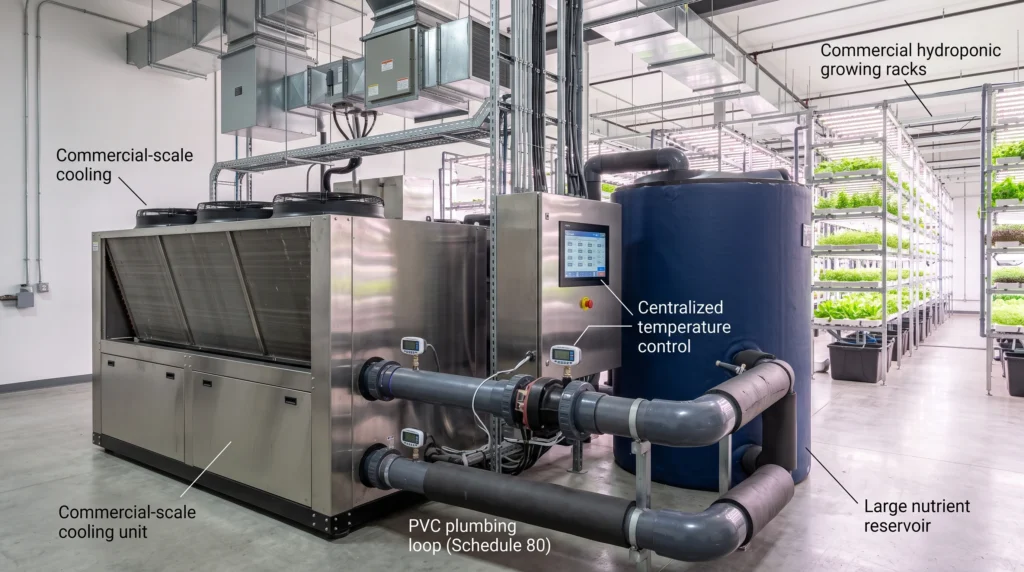
When evaluating chilling infrastructure for large vertical farming infrastructures, the equipment must withstand continuous operation in harsh, high-humidity environments. ChillKing answers this demand by abandoning plastic external housings in favor of industrial-grade stainless steel. The 1/3 HP model represents the entry point into their commercial lineup, offering 6,300 BTU/hr of cooling power.
ChillKing units are designed to handle high static pressure and immense fluid flow velocities. In massive commercial reservoirs, moving water rapidly through the chiller prevents particulate settling and algae buildup inside the heat exchanger. The 1/3 HP unit accommodates pump speeds exceeding 1,000 GPH. At these velocities, the fluid dynamics inside the titanium barrel shift entirely into turbulent flow. Turbulent flow creates chaotic fluid mixing, breaking up the thermal boundary layer against the metal surface. This constant mixing maximizes the convective heat transfer coefficient, allowing the chiller to pull heat out of the water with exceptional speed.
Commercial operators rely on ChillKing because the units feature built-in remote telemetry integration. Instead of relying on a localized digital screen, facility managers can wire the ChillKing thermostat logic board directly into central environmental controllers. This allows for automated shutdown sequences if a leak is detected, or predictive chilling protocols where the unit pre-cools the reservoir minutes before the high-intensity overhead grow lights activate. For commercial deep water culture operations, sizing the infrastructure correctly is paramount, as detailed in our guide on contrasting deep water culture against aeroponics.
Fluid Dynamics and Frictional Head Loss in Chiller Loops
Sizing the delivery pump for your chiller loop demands calculating the frictional head loss across pipes, elbows, and the chiller’s internal heat exchanger. Proper pump selection guarantees the chiller operates within its engineered flow rate parameters for maximum thermal transfer.
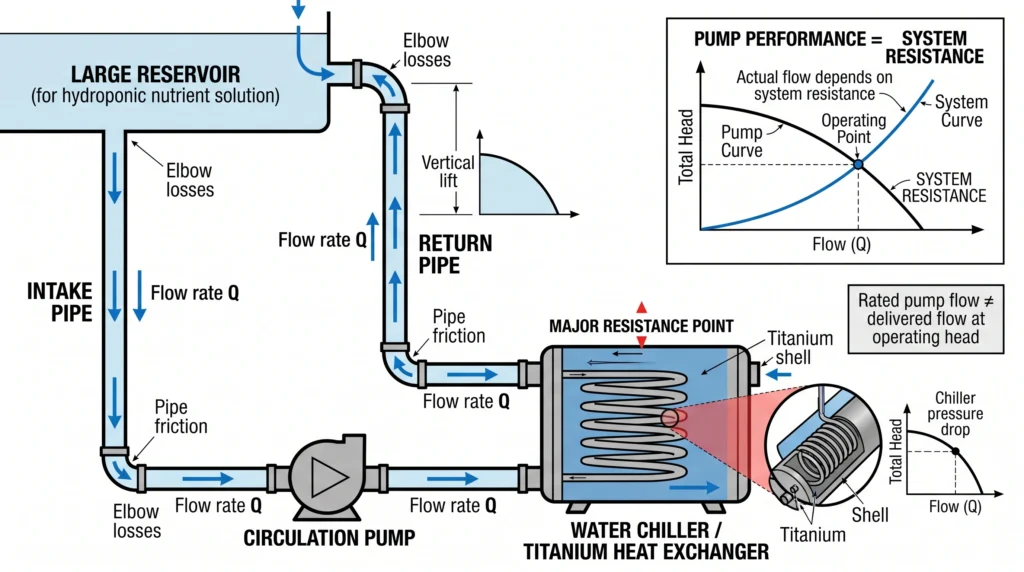
One of the most common errors in hydroponic system design is mismatching the water pump to the chiller. If the pump is undersized, the water moves too slowly, risks freezing inside the evaporator, and triggers low-flow safety shutoffs. If the pump is massively oversized, the excess hydraulic pressure can blow out internal O-rings or cause the water to transit the heat exchanger so quickly that no meaningful thermal transfer occurs.
To size the pump accurately, engineers must calculate the total dynamic head of the plumbing loop. Total dynamic head includes the vertical lift (static head) from the reservoir water line to the highest point in the loop, plus the frictional head loss caused by the water rubbing against the interior walls of the PVC pipes, elbows, and the chiller barrel itself.
Frictional loss is mathematically modeled using the Hazen-Williams equation. For standard calculation purposes, it is written as:
h_f = 10.67 * L * Q^1.852 / (C^1.852 * d^4.8704)
In this formula, h_f represents the friction head loss in feet of water. L is the total length of the pipe. Q is the volumetric flow rate. C is the roughness coefficient of the pipe material (standard schedule 40 PVC has a C-value of 150). The variable d represents the internal diameter of the pipe.
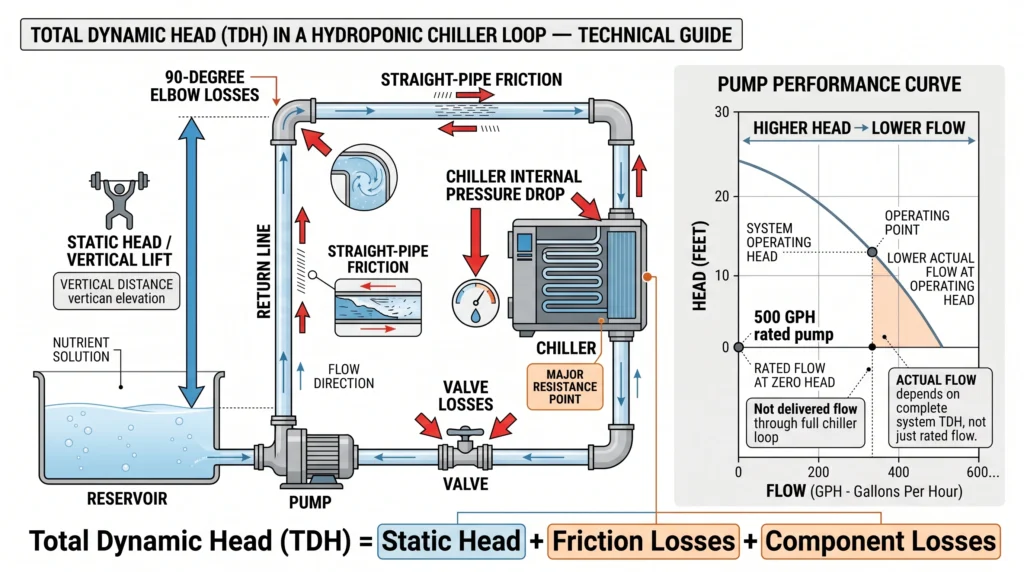
Every 90-degree elbow in the plumbing loop adds the equivalent of several feet of straight pipe friction. Furthermore, the internal titanium coils of the chillers impose a severe pressure drop. Manufacturers state the required flow rate, but operators must consult pump performance curves to verify that the chosen pump can deliver that specific GPH while overcoming the calculated total dynamic head. A 500 GPH pump might only deliver 200 GPH once the resistance of the chiller and 15 feet of ribbed hosing are factored into the equation. Cultivators must calculate these variables rigorously; we detail this math extensively in our sizing delivery pumps guide.
System Design Principles: Insulation and Passive Thermal Mitigation
Mitigating ambient heat transfer through reservoir insulation directly reduces the duty cycle of your chiller’s compressor. Applying closed-cell foam or radiant barriers drastically cuts electrical consumption and extends cooling equipment lifespan.
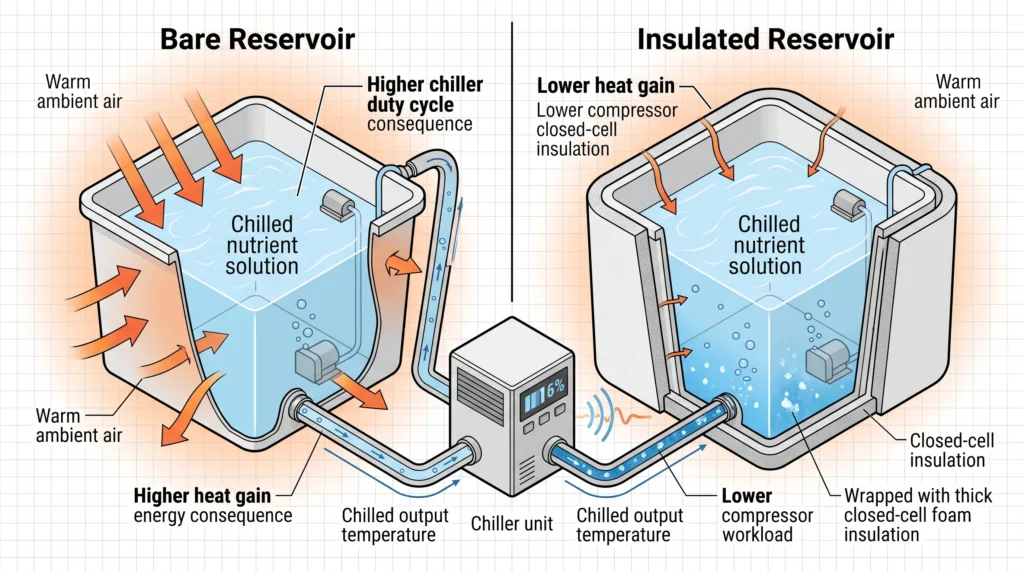
Mechanical chilling consumes vast amounts of electrical energy. To optimize the operational expenditure of the facility, operators must implement aggressive passive thermal mitigation strategies. A bare, high-density polyethylene (HDPE) reservoir provides almost zero thermal resistance. If the ambient air is 80 F and the water is chilled to 65 F, the reservoir constantly absorbs heat, forcing the chiller to cycle on rapidly.
By wrapping the reservoir in double-reflective radiant barriers or applying closed-cell elastomeric foam insulation, the R-value of the reservoir wall increases significantly. Insulation slows the rate of thermal conduction. A well-insulated 100-gallon reservoir might only gain 0.5 F per hour in a warm room, whereas a bare plastic reservoir could gain 3 F per hour under the same conditions.
Lowering the thermal gain reduces the chiller’s duty cycle. The duty cycle is the percentage of time the compressor remains active versus resting. A chiller that runs for 15 minutes and rests for 45 minutes has a 25% duty cycle. Reducing the duty cycle lowers the electrical draw, minimizes the ambient heat the chiller’s condenser dumps back into the grow room, and prevents the mechanical degradation of the compressor motor.
Operators should also isolate hot mechanical components from the water column. Inline pumps, rather than submersible pumps, transfer their operational motor heat into the air rather than the nutrient solution. Upgrading to larger diameter plumbing also reduces fluid friction, which slightly lowers the mechanical heat generated by the pump impeller. You can assess structural configurations to minimize heat loads by utilizing our hydroponic nutrient calculator toolsets and reading through our passive thermal mitigation strategies.

Why it’s necessary: Completely halts ambient heat from warming chilled nutrient solutions, reducing compressor workload and slashing electrical costs associated with mechanical cooling.nKey Spec: High R-value closed-cell foam with a heavy-duty moisture-resistant outer barrier.
Component Selection and Technical Specification Comparison
Side-by-side technical evaluation reveals exact operational parameters for the Active Aqua, IceCraft, and ChillKing units. Comparing compressor horsepower, BTU extraction rates, and optimal flow dynamics streamlines the component selection process.
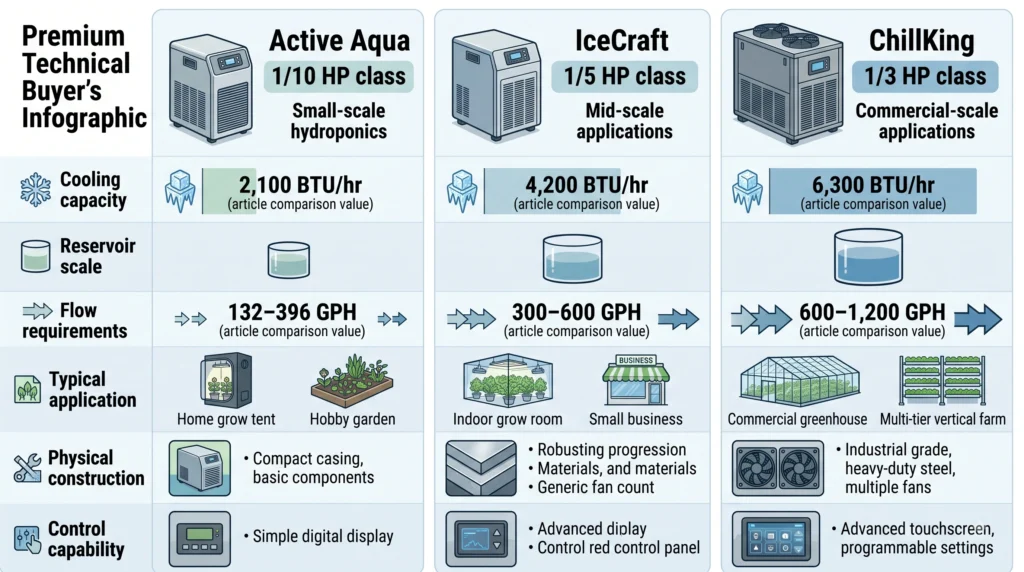
To facilitate precise engineering decisions, the following data table isolates the core performance metrics of each unit. Operators must align the BTU/hr capacity with the mathematical heat load calculated earlier in the design phase.
| Chiller Brand | Compressor HP | Cooling Capacity (BTU/hr) | Optimal Flow Rate (GPH) | Ideal Reservoir Size | Best Use Case |
| Active Aqua | 1/10 HP | 2,100 BTU/hr | 132 – 396 GPH | 20 – 50 Gallons | Residential setups, grow tents, hobbyist deep water culture. |
| IceCraft | 1/5 HP | 4,200 BTU/hr | 300 – 600 GPH | 50 – 100 Gallons | Mid-tier commercial, precise botanical applications, tight deadbands. |
| ChillKing | 1/3 HP | 6,300 BTU/hr | 600 – 1,200 GPH | 100 – 250 Gallons | Large-scale commercial agriculture, multi-module manifold integration. |
Selecting the correct unit involves matching the extraction rate to the biological and environmental loads. Undersizing the equipment results in continuous, uninterrupted compressor operation, which will permanently damage the unit within months. Oversizing the equipment by an extreme margin causes rapid short-cycling, which fails to dehumidify the air surrounding the condenser and damages the electrical relays. The objective is to achieve a balanced duty cycle where the chiller operates efficiently during peak thermal loading hours.
Frequently Asked Questions
How do I calculate the required BTU/hr for my specific reservoir volume?
To calculate your exact requirements, determine the total gallons of water and the temperature drop needed (Delta T). Multiply the volume in gallons by 8.34 (the weight of water) and multiply that sum by the Delta T. This gives the total BTUs needed. Divide this number by the hours you want the pull-down phase to last to find your required BTU/hr rating.
What happens if the pump pushing water through the chiller is too strong?
Excessive hydraulic flow velocity reduces the residence time of the water inside the titanium evaporator coil. The water transits the system so fast that the heat transfer coefficient collapses, meaning the water exits the chiller at almost the exact same temperature it entered. High pressure can also blow out the internal seals.
Does a titanium heat exchanger react with standard hydroponic nutrient solutions?
No. Titanium is selected specifically because it is chemically inert to the acidic pH ranges (5.5 to 6.5) and the harsh, concentrated mineral salts found in hydroponic fertilizers. Standard copper or aluminum heat exchangers would rapidly corrode and leach heavy metals into your root zone.
How frequently should the condenser coils on a water chiller be cleaned?
Condenser coils should be vacuumed or blown out with compressed air every 30 to 60 days. Airborne dust, pet hair, and particulate matter coat the aluminum fins of the condenser, insulating them and preventing the fan from exhausting the heat. A dirty condenser drastically lowers the cooling capacity of the unit. You can structure regular maintenance using our u003ca href=u0022https://mistculture.com/hydroponic-troubleshooting-guide/u0022 target=u0022_blanku0022 rel=u0022noreferrer noopeneru0022u003esystematic troubleshooting proceduresu003c/au003e.
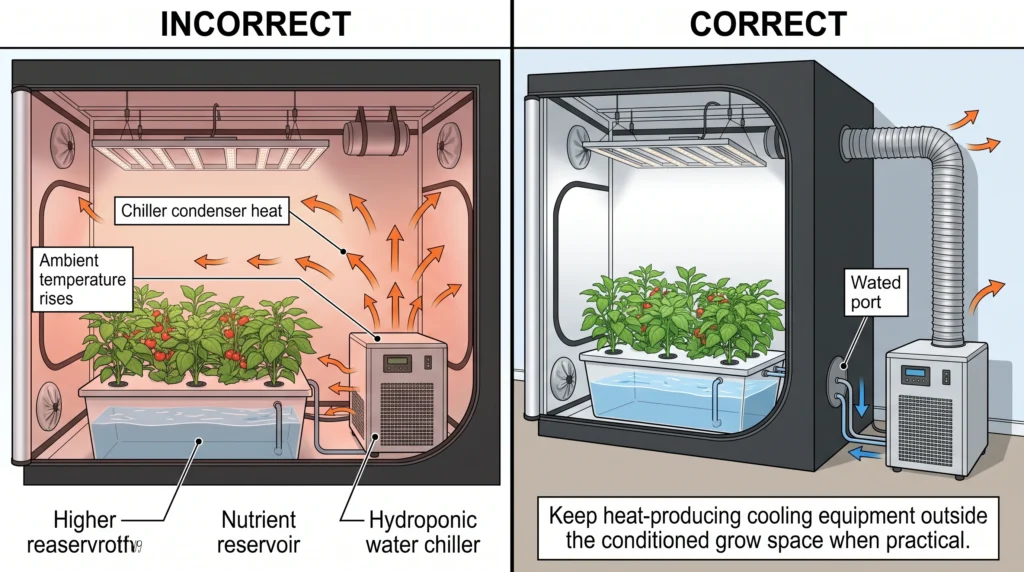
Can I place the water chiller inside the grow tent with my plants?
Placing a chiller inside a sealed grow tent creates a destructive feedback loop. The chiller removes heat from the water and exhausts that heat directly into the ambient air of the tent. The hotter air then warms the reservoir walls faster, causing the chiller to run continuously until the tent overheats completely. Chillers must be placed outside the growing environment or vented directly outdoors.
What is compressor short-cycling and how do I prevent it?
Short-cycling occurs when a chiller turns on and shuts off within a span of just a few minutes. This happens when the chiller is massively oversized for the water volume or when the temperature deadband is set too tightly. To prevent it, operators should widen the deadband tolerance on the digital thermostat or increase the total volume of water in the system to act as a larger thermal mass.
Is a dedicated chiller loop better than integrating the chiller into the main irrigation line?
Yes. A dedicated closed-loop ensures that the fluid velocity through the chiller remains absolutely constant and optimized for thermal transfer. Integrating the chiller into a main irrigation manifold means that as irrigation valves open and close across the facility, the pressure and flow rate through the chiller will fluctuate wildly, damaging efficiency.
How does water temperature correlate to root disease?
Water temperature inversely correlates to dissolved oxygen capacity. Warmer water holds less oxygen. Without adequate oxygen, plant roots cannot perform cellular respiration, causing the root tissue to die and ferment. This dead tissue acts as a food source for anaerobic pathogens like Pythium. Keeping water chilled guarantees high oxygen ceilings, serving as the foundation of u003ca href=u0022https://mistculture.com/hydroponic-root-rot-prevention/u0022 target=u0022_blanku0022 rel=u0022noreferrer noopeneru0022u003eroot rot prevention protocolsu003c/au003e.
Conclusion
Deploying the correct submersible or inline water chiller secures the thermal stability of your entire hydroponic infrastructure. The Active Aqua 1/10 HP unit provides reliable, entry-level cooling for residential growers seeking basic protection against heat spikes. The IceCraft 1/5 HP delivers precise digital control for specialized mid-tier applications where thermal drifting cannot be tolerated. For expansive commercial facilities operating massive nutrient dosing tanks, the stainless steel ChillKing 1/3 HP chiller offers unmatched durability and high-capacity thermal extraction.
Matching your environmental heat load with the exact BTU/hr specification of these chillers prevents equipment degradation and ensures your plants thrive in highly oxygenated, pathogen-free water. Cultivators looking to expand their engineering knowledge on advanced aeroponics and environmental controls should review our detailed DIY aeroponic setups to scale their operations efficiently.

Continue Your Learning Journey