Hydroponic Trays Compared: Botanicare, FastFit & Active Aqua

Table of Contents
- The Material Science of Commercial Flood Tables
- Botanicare: The Heavy-Duty Standard
- FastFit: The Mid-Range Workhorse
- Active Aqua: The Budget-Friendly Solution
- Structural Integrity and Load Calculations
- Fluid Dynamics and Drainage Efficiency
- Setup Blueprint: Bulkhead Installation and Plumbing
- Commercial vs. Residential Considerations
- Frequently Asked Questions
- Final Thoughts
Disclosure: MistCulture summarizes verified product specs, engineering data, and community feedback. We may earn an affiliate commission if you purchase through our links. Regulations vary by location; this content is for educational purposes only.
Commercial grade hydroponic trays serve as the structural backbone for high-yield indoor farming operations. Whether you are running a sprawling ebb and flow system, setting up a customized drip irrigation line, or configuring the catch-basin for a specialized nutrient film technique build, the tray you select dictates the long-term reliability of the entire farm. Selecting the wrong tray leads to bowing, micro-fractures, pooling water, and catastrophic leaks that can ruin electrical equipment and decimate crop yields.
The industry standard options for commercial operations are heavily concentrated among three leading brands: Botanicare, FastFit, and Active Aqua. While all three utilize food-grade plastics, the specific engineering tolerances, wall thicknesses, UV stabilization ratings, and drainage channel designs vary significantly. This guide breaks down the physical properties, flow dynamics, and material science behind these top-tier flood tables to help commercial and large-scale residential growers select the exact tray suited for their weight loads and environmental conditions.
The Material Science of Commercial Flood Tables
High-density polyethylene (HDPE) and polypropylene (PP) are the primary thermoplastics used in hydroponic tray construction due to their chemical resistance to concentrated nutrient solutions and low water absorption rates. Structural integrity is dictated by the manufacturing process, specifically the wall thickness and the integration of stress-distributing geometric features like corner gussets.
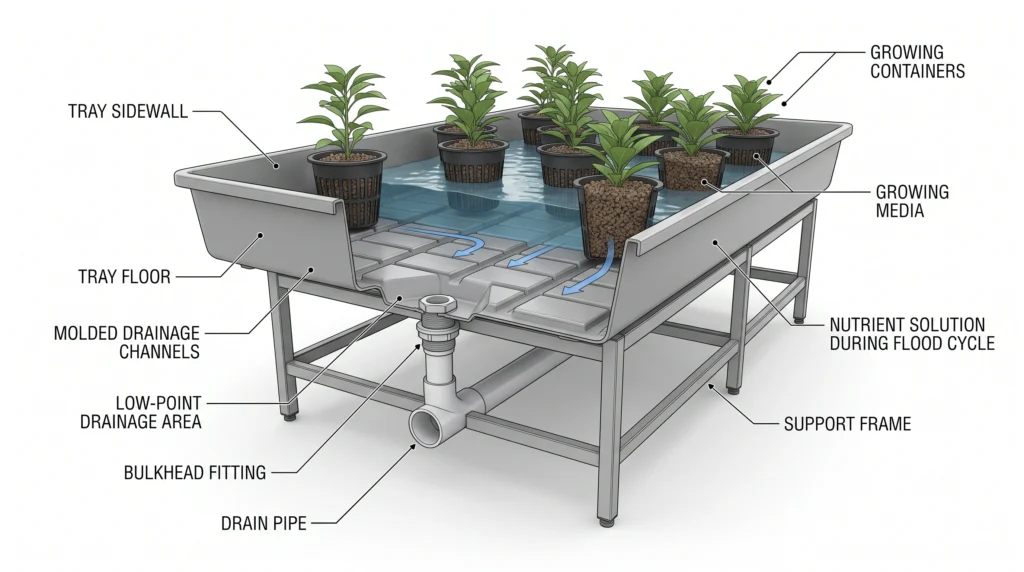
When selecting commercial grade hydroponic trays, the composition of the plastic dictates how the tray reacts to thermal expansion, heavy loads, and continuous light exposure. A fully saturated 4 ft x 8 ft tray holding six inches of wet growing media generates hundreds of pounds of downward force. Over time, inferior plastics will warp, creating low spots where water pools. Stagnant water breeds anaerobic bacteria, attracts pests, and leads directly to root rot.
Most premium trays are constructed from High-Density Polyethylene (HDPE) or ABS plastic. HDPE offers a specific gravity of approximately 0.93 to 0.97 g/cm3, yielding an exceptionally high strength-to-density ratio. It easily withstands continuous exposure to acidic environments, which is a mandatory trait since most hydroponic nutrient solutions run at a pH of 5.5 to 6.5. Furthermore, raw HDPE is naturally susceptible to degradation from ultraviolet light. Commercial manufacturers mitigate this by mixing UV inhibitors and carbon black into the polymer matrix during the thermoforming or injection molding process.
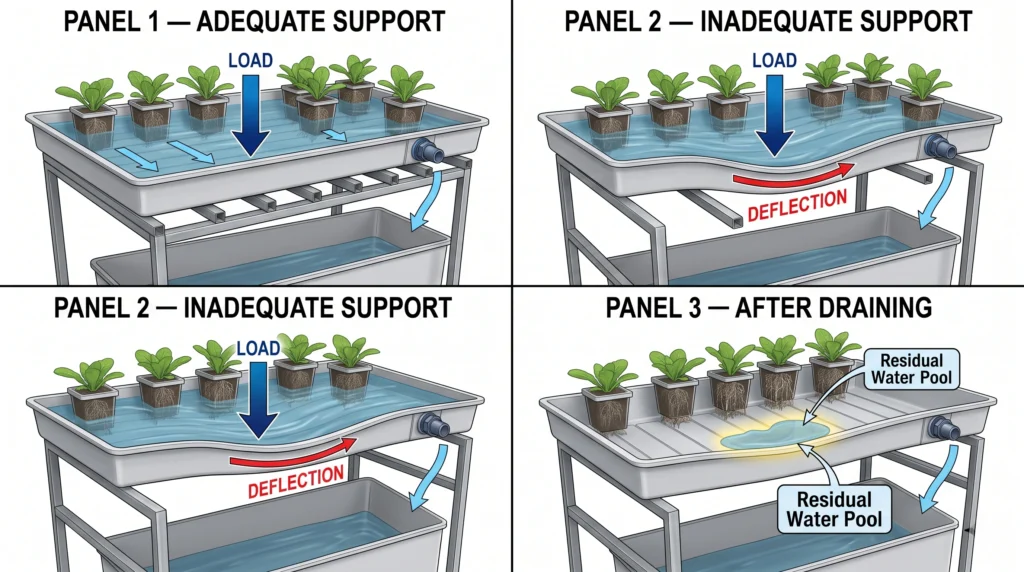
Wall thickness acts as the primary defense against deflection. Deflection is the degree to which a structural element bends under a load. In hydroponic applications, a tray that bows in the middle will fail to drain completely. A standard 1/8-inch single-wall tray offers minimal resistance to deflection and must be supported by a rigid, perfectly flat underlying table structure. Conversely, trays manufactured with 1/4-inch double-walled construction can span wider gaps on rolling benches without sagging.
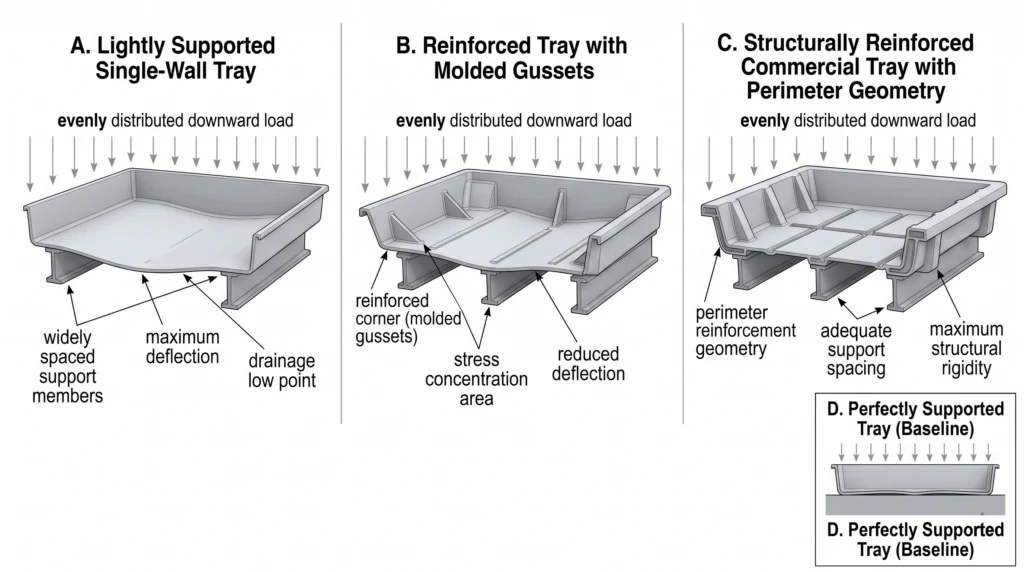
Understanding the difference between the brands requires analyzing their specific engineering choices. You cannot judge a tray strictly by its footprint. You must look at the cross-sectional thickness, the design of the drainage channels, and the reinforcement mechanisms at the corners. For more context on choosing the right foundational structure for your layout, check our comprehensive DIY hydroponic systems guide.
Botanicare: The Heavy-Duty Standard
Botanicare trays utilize double-walled HDPE construction with reinforced corners and an industry-leading 1/4-inch wall thickness. Designed for maximum load-bearing applications in commercial rolling bench setups, they resist bowing under extreme weight and carry a 10-year UV degradation warranty.
Botanicare is widely considered the premium benchmark in the commercial hydroponics sector. Their trays are engineered for high-volume, high-weight environments where failure is not an option. The defining feature of the Botanicare line is the thermoformed double-wall construction. Instead of a single sheet of plastic, the edge of the tray rolls over, creating an air gap between an inner and outer wall along the perimeter. This geometric structure provides massive longitudinal and transverse stiffness, similar to the web of an I-beam.
The 1/4-inch wall thickness ensures the tray remains completely rigid even when loaded with fully saturated rockwool blocks and mature fruiting plants. For growers utilizing heavy aggregate media like expanded clay pebbles or gravel, this rigidity prevents the center of the tray from dipping. If you are growing heavy, top-weighted crops, you can reference our hydroponic tomatoes and peppers guide to see why structural support matters for heavy vining plants.
Botanicare trays feature a very specific grid pattern on the floor. The channels are molded to force water toward the pre-designated drainage bulkheads. The deep grooving allows water to flow rapidly underneath the growing containers, preventing the roots from sitting in stagnant puddles. The corners are reinforced, eliminating the stress fractures that often plague cheaper trays during transport or installation.

- Designed to fit standard (48 L x 18 D x 69 H inches) chrome wire shelving
- Increase your production by more than 300% without sacrificing additional square footage
- Perfect for large-scale microgreen or commercial propagators looking to maximize their production
- Why it’s necessary: The sheer dimensions of this tray combined with the 1/4-inch double-walled HDPE construction make it the ultimate foundational table for commercial rolling benches.
- Key Spec: UV-stabilized HDPE with deep directional drainage channels.
FastFit: The Mid-Range Workhorse
FastFit flood tables strike a balance between affordability and commercial reliability. They feature single-wall construction augmented by integrated corner gussets and a 3/16-inch wall thickness, offering excellent performance for static bench setups.
FastFit trays are designed for growers who require commercial reliability but do not necessarily want to pay the premium associated with double-walled construction. By utilizing a 3/16-inch thick ABS or heavy-duty PP blend, FastFit creates a tray that is highly resilient but slightly lighter than the Botanicare equivalent.
The primary engineering achievement of the FastFit line is the inclusion of corner gussets. In structural engineering, corners are high-stress concentration points. When a tray filled with water shifts, the torsional force transfers directly to the 90-degree bends at the corners. FastFit integrates molded gussets—small triangular reinforcements—at these junctions to distribute the stress across a wider surface area. This prevents the corners from splitting over time.
Because they use single-wall construction, FastFit trays require slightly more underlying support than double-walled alternatives. If you are building a custom wooden frame or using expanded metal benching, you must ensure the cross-supports are spaced no more than 16 inches apart. FastFit trays are exceptional for standard ebb and flow setups. The drainage patterns are aggressive enough to move water quickly, which is critical for aeration.
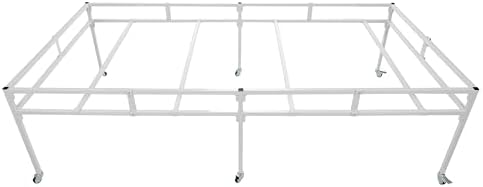
- Sturdy and Durable Construction: Hydroponic tray plants stand is made from durable steel, which can offer excellent stre…
- Convenient Mobility: A flood table stand with sliding wheels enables effortless mobility, allowing you to easily reposit…
- Enhanced Plant Accessibility and Maintenance: Toolless assembly tray stand provides a comfortable working height for ten…
- Why it’s necessary: Offers immense square footage with reinforced corner gussets to prevent splitting, striking the perfect ratio of durability to cost.
- Key Spec: Fits standard 11-inch net pots and features specialized grid channels.
Active Aqua: The Budget-Friendly Solution
Active Aqua flood tables cater to budget-conscious commercial operations and dedicated home growers. Utilizing a 1/8-inch single-wall construction, these trays require comprehensive underlying support but feature aggressive grid patterns to facilitate rapid drainage.
Active Aqua trays are the most prevalent trays found in small to mid-sized setups. They are manufactured using a thinner 1/8-inch ABS plastic. While this thinner material brings the cost down significantly, it drastically changes how the tray must be installed. A 1/8-inch tray possesses minimal inherent structural stiffness. If you place an Active Aqua tray on a bench with wide gaps between the support bars, the plastic will sag under the weight of the water.
To mitigate this, Active Aqua incorporates a very tight, sloped grid pattern on the tray floor. This grid does two things. First, the ridges act as mini-corrugations, adding a slight amount of stiffness to the floor. Second, the tight grid ensures that water is funneled swiftly toward the drain hole. However, because the plastic is thinner, it is more susceptible to thermal warping. If placed under high-intensity discharge (HID) lights without a canopy to shade the plastic, the tray can warp slightly, disrupting the drainage slope. To avoid light-induced temperature spikes, review our hydroponic controllers under $200 guide to manage your room’s climate accurately.
Active Aqua trays are ideal for lightweight media setups. If you are using aeroponic cloning machines that sit inside the tray as a catch basin, or if you are running a low-profile NFT system where the tray merely catches the runoff, Active Aqua is an excellent choice. You save capital on the tray, which you can redirect into better pumping or lighting equipment.
Structural Integrity and Load Calculations
Understanding the immense forces at play inside a commercial tray requires looking at the raw mathematics of fluid dynamics and weight distribution. Water is incredibly heavy, weighing roughly 62.4 pounds per cubic foot (or 8.34 pounds per gallon). When you flood a tray, you are introducing massive temporary loads to the plastic structure.
Let us calculate the load on a standard 4 ft x 8 ft flood tray during an ebb and flow cycle.
- Total Surface Area: 4 ft * 8 ft = 32 square feet.
- Depth of Flood: Assume a standard flood depth of 4 inches (0.333 feet).
- Total Volume of Water: 32 sq ft * 0.333 ft = 10.65 cubic feet of water.
- Total Weight of Water: 10.65 cubic feet * 62.4 lbs/cubic foot = 664.5 pounds.
This calculation strictly accounts for the water. You must then factor in the weight of the growing media. A single 6-inch rockwool block weighs a few ounces dry but can hold several pounds of water when fully saturated. If you place forty mature plants in this 4×8 tray, the combined weight of the wet media, the biological mass of the plants, and the flood water easily exceeds 1,000 pounds.
When 1,000 pounds is distributed across 32 square feet, the load is roughly 31.25 pounds per square foot.
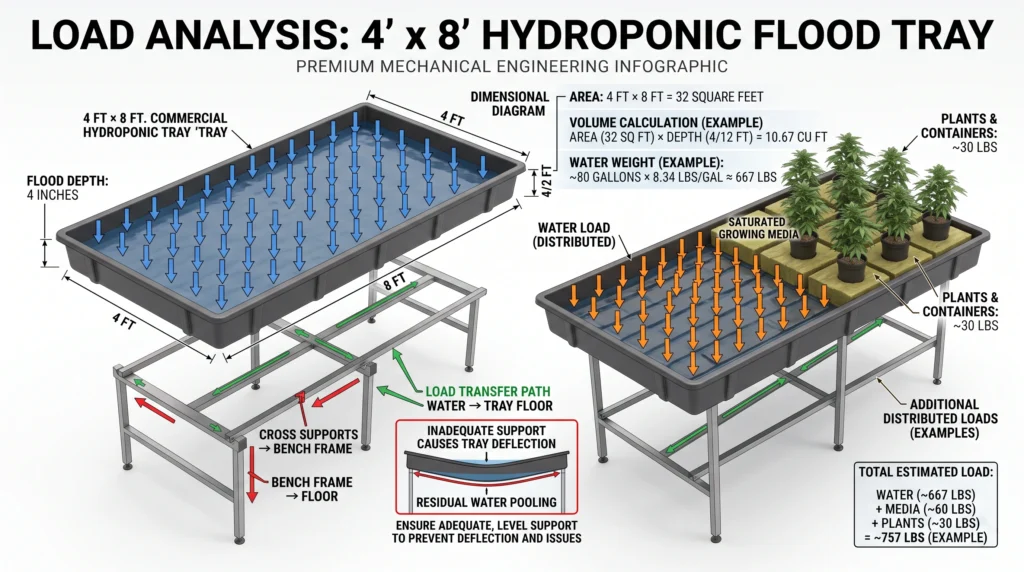
Botanicare trays, with their 1/4-inch thickness and double-walled rims, distribute this load efficiently without requiring a perfectly solid table underneath. Expanded metal rolling benches with 12-inch cross-bar spacing handle this perfectly. If you attempted to place an Active Aqua tray on that same expanded metal bench with 12-inch gaps, the 1/8-inch plastic would bulge downward between the steel supports. This bulge would hold stagnant water after the drain cycle completes.
If you want to track exactly how much nutrient solution you are moving per flood cycle to maximize your pump efficiency, utilize our hydroponic nutrient calculator. It will assist you in mapping out your parts-per-million (PPM) thresholds based on the exact water volume of your customized tray.
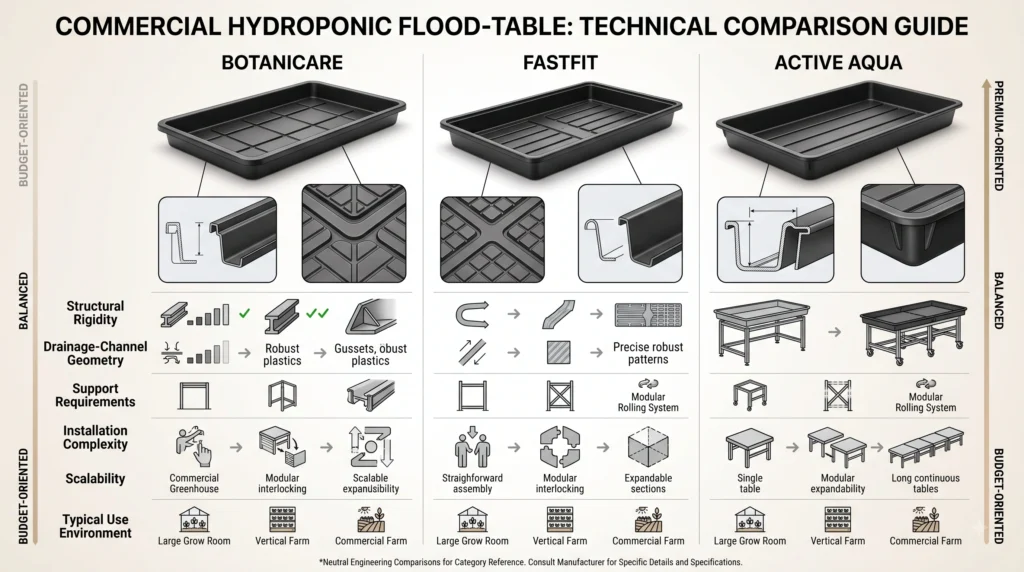
| Feature | Botanicare | FastFit | Active Aqua |
| Material Thickness | 1/4 inch | 3/16 inch | 1/8 inch |
| Wall Construction | Double-wall rolled | Single-wall | Single-wall |
| Corner Support | Heavy reinforced | Molded gussets | Standard 90-degree |
| Required Support | Crossbars OK | Tight crossbars | Solid flat surface |
| UV Resistance | 10-Year Warranty | 5-Year Warranty | 2-Year Warranty |
| Price Tier | Premium | Mid-Range | Budget |
Fluid Dynamics and Drainage Efficiency
The primary function of a hydroponic tray is to hold plants and manage the flow of the nutrient solution. Drainage efficiency is dictated by two factors: the pitch (slope) at which the tray is installed, and the molded grid pattern on the floor of the tray.
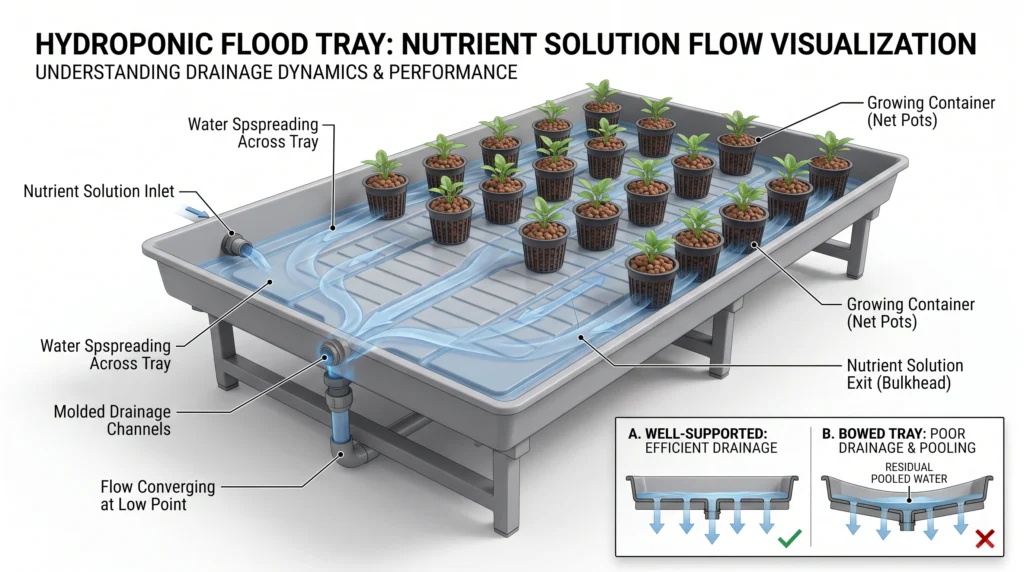
Water follows the path of least resistance. In a perfectly flat tray with no molded channels, water creates a chaotic flow pattern, pooling in areas dictated entirely by the surface tension of the plastic. To correct this, manufacturers mold channels into the tray. Botanicare utilizes a deep, wide channel design. This creates distinct, high-volume flow paths that allow water to rush to the drain bulkhead rapidly. Wide channels are excellent for avoiding blockages caused by stray aggregate, such as fallen clay pebbles or loose rockwool fibers.
Active Aqua uses a much tighter, narrower grid pattern. Because the plastic is thinner, the tighter grid is necessary to maintain rigidity. The downside of a narrow grid is that it can trap particulate matter more easily. If roots escape the net pots and begin growing along the floor of the tray, they will quickly fill the narrow channels of an Active Aqua tray, leading to localized flooding. Proper management of the root zone is required to prevent this. For tips on managing aggressive root growth and preventing blockages, read our article on how to fix NFT channel clogs.
FastFit strikes a middle ground with a specialized diagonal or stepped channel layout that moves water efficiently while remaining easy to sweep clean during system resets.
Sizing Your Pump for the Tray
The speed at which your tray floods is just as critical as how fast it drains. If your pump is undersized, the plants nearest the inlet will sit in water for much longer than the plants at the far end of the tray while waiting for the water level to rise. This creates an imbalance in root zone oxygenation across the crop.
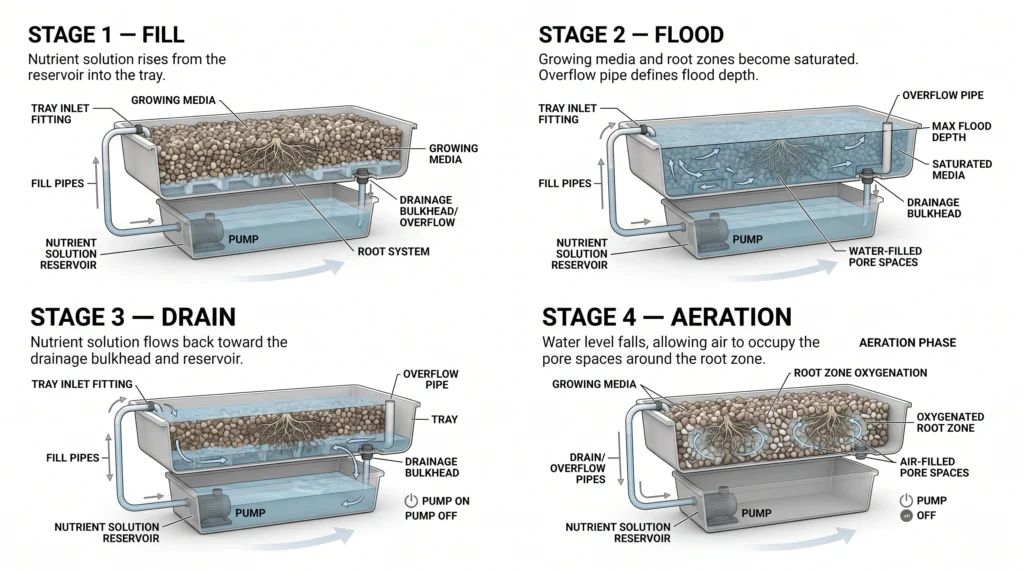
To flood a 4×8 tray to a depth of 4 inches (10.65 cubic feet or roughly 80 gallons of water) within a standard 10-minute flood window, you need a pump capable of delivering 8 gallons per minute (480 gallons per hour) AT the head height of your table. Because pumps lose flow capacity as they push water vertically, a pump rated for 480 GPH at zero head height will not suffice. You need to calculate the dynamic head pressure. For a complete mathematical breakdown of pump head height and friction losses, check our hydroponic pump sizing guide.
Setup Blueprint: Bulkhead Installation and Plumbing
No commercial tray functions without the proper installation of bulkhead fittings. The bulkhead is the specialized plumbing connection that penetrates the plastic tray to connect your PVC or vinyl tubing. Installing bulkheads incorrectly is the number one cause of leaks in commercial and DIY setups alike.
Most commercial trays come with pre-dimpled locations indicating where the drain and fill holes should be drilled. However, you are not strictly bound to these locations. Depending on your benching layout, you may need to drill custom drainage points.
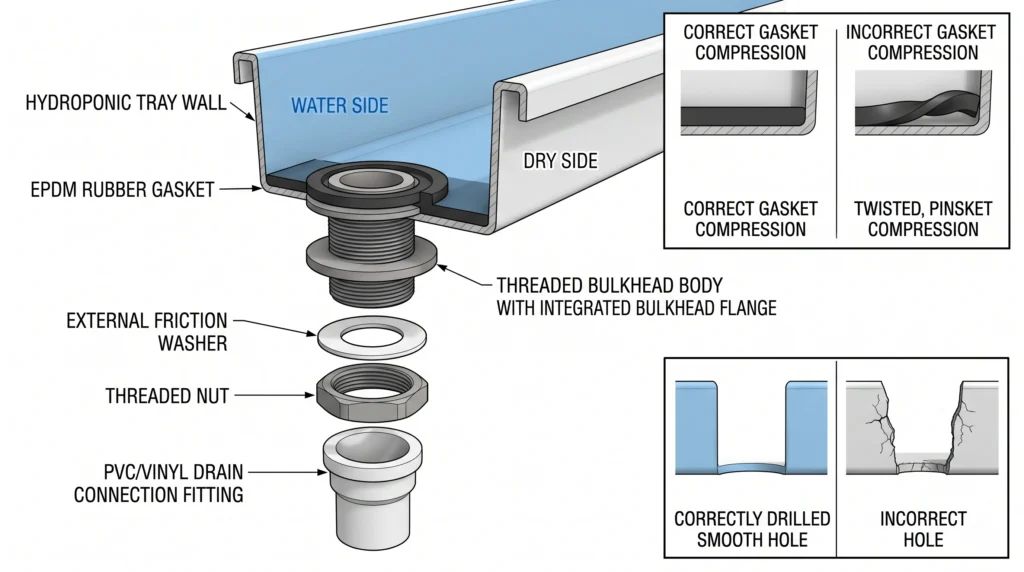
Step-by-Step Bulkhead Installation:
- Tool Selection: Use a bi-metal hole saw attached to a power drill. Spade bits or standard twist drill bits will snag the plastic, causing micro-fractures that will eventually spiderweb and ruin the tray.
- Sizing: The hole size must precisely match the outer diameter of the bulkhead’s threaded shaft. For a standard 3/4-inch bulkhead, you generally need a 1-3/8 inch or 1-1/2 inch hole saw. Measure your specific fitting with digital calipers before cutting.
- Drilling Technique: Run the drill in reverse (counter-clockwise) for the first few seconds to score the plastic. This melts a clean groove into the tray. Once scored, switch to forward rotation and apply light pressure. Let the teeth of the saw do the cutting; forcing it will crack the tray.
- Deburring: Use a deburring tool or a half-round file to remove the plastic shavings from the edge of the hole. The surface must be perfectly smooth. If a stray piece of plastic remains, the gasket will not seat correctly, causing a slow drip.
- Gasket Placement: The rubber (EPDM) gasket always goes on the inside of the tray (the water side), regardless of whether the threaded nut is on the top or bottom. The rubber creates the watertight seal against the smooth plastic. The hard friction washer (if included) goes on the dry side against the nut.
- Torque: Hand-tighten the bulkhead nut, then use a wrench to give it one additional quarter-turn. Over-tightening will deform the rubber gasket, causing it to squeeze out from under the flange and fail.

- COMPLETE 7-PIECE EBB AND FLOW FITTING KIT: This fill and drain fitting kit includes everything you need: 1x 1/2″ tub out…
- DURABLE BPA-FREE CONSTRUCTION: Crafted from 100% black virgin plastic that is completely BPA free. Each fitting is manuf…
- VERSATILE HYDROPONIC COMPATIBILITY: Works with multiple growing systems including ebb and flow (flood and drain), aeropo…
- Why it’s necessary: Piecing together individual plumbing parts is tedious. A complete kit ensures the bulkhead, standpipe, and overflow screen all feature matching thread pitches and EPDM gaskets designed specifically for hydroponic tray thicknesses.
- Key Spec: Includes adjustable standpipes to customize the flood height of your specific crop.
Commercial vs. Residential Considerations
When scaling up a system, the differences between these trays become exponentially more pronounced. In a residential grow tent, placing a 3×3 Active Aqua tray on a flat plywood table is highly effective and cost-efficient. The temperature in a residential home remains relatively stable, meaning the plastic is subjected to minimal thermal expansion and contraction.
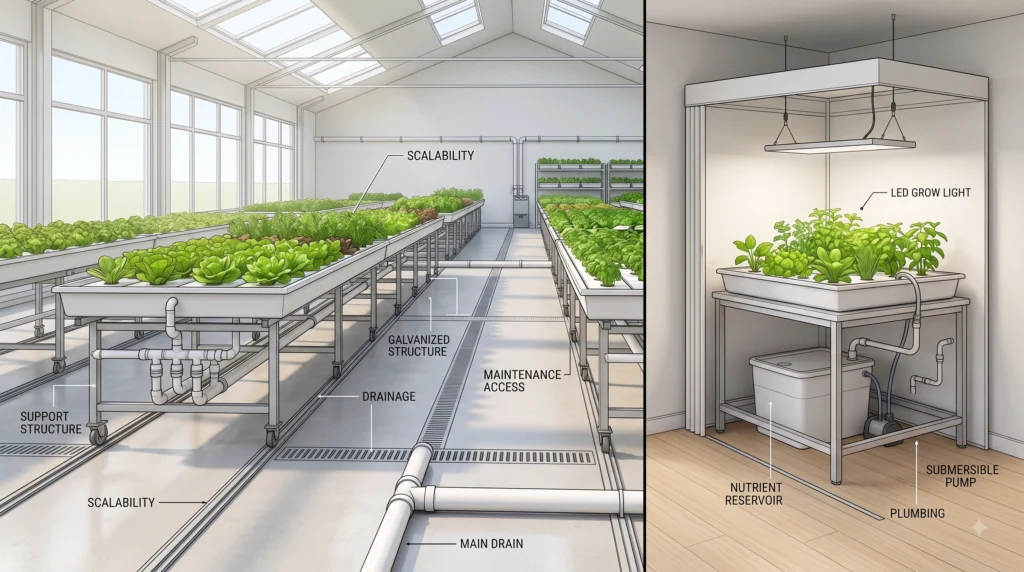
In a commercial greenhouse, temperatures can swing by thirty degrees or more between day and night cycles. Trays expand and contract constantly. Long runs of FastFit or Botanicare trays bolted together on rolling benches must be installed with expansion gaps. If trays are butted tightly against one another, thermal expansion will cause them to buckle and warp the drainage slope.
Commercial operations also require frequent, aggressive sanitation protocols. After a crop cycle, trays are scrubbed with hydrogen peroxide, hypochlorous acid, or industrial bleach solutions. The thicker HDPE of Botanicare trays resists chemical degradation better than thinner ABS plastics. Scratches on the surface of the plastic can harbor pathogens like Pythium. The robust surface density of premium trays resists scoring from coarse media like clay pebbles. If you are comparing different high-density growing methods, review our DWC vs NFT vs Aeroponics comparison to see how tray selection impacts the broader system design.
For tracking your water usage and calibrating your reservoir top-offs during these high-volume commercial cycles, utilize our hydroponic water efficiency calculator to monitor your total system consumption.

- BPA-Free – Non-toxic and BPA-free safe plastic for consumable plants. Durable design can withstand years of frequent use…
- Ample Slits – The slits are spaced apart just right, it’s perfect for the roots poking out, let roots are stretch and gr…
- Wide Rim – 0.8in Wide lip makes net pots easy to lift to inspect roots growth and plant health. Fits wide mouth ball jar…
- Why it’s necessary: Standardizing your container size allows you to map out plant density accurately on your flood tables. These heavy-duty pots resist UV light and support massive root structures without cracking.
- Key Spec: Wide-lip design prevents pots from tipping over during high-velocity flood cycles.
Frequently Asked Questions
Can I use PVC cement to secure my PVC pipes directly to the plastic tray?
No. PVC cement works via solvent welding, which chemically melts PVC to PVC. It will not form a chemical bond with the HDPE, PP, or ABS plastic used in flood trays. The joint will peel apart under pressure. You must use threaded bulkhead fittings with rubber EPDM gaskets to transition through the wall of the tray.
How much slope should I build into the table supporting my commercial tray?
Most commercial trays are molded with a built-in draft (slope) that guides water to the drainage points. Therefore, the tables or benches supporting the trays should be built perfectly level. If you add additional pitch to the table, you risk pooling water at the deep end because the water level will rise unevenly during the flood cycle.
Why does my flood tray hold a thin layer of water even after the pump turns off?
This is usually caused by inadequate table support causing the plastic to bow downward, creating a low spot below the level of the bulkhead drain. It can also be caused by an improperly installed bulkhead fitting that sits too high above the floor of the tray. Ensure your bench provides cross-support at least every 18 inches.
Are these trays safe for growing consumable food crops?
Yes. Botanicare, FastFit, and Active Aqua all utilize BPA-free, food-grade plastics. They do not leach harmful plasticizers or endocrine disruptors into the nutrient solution, even when exposed to high-intensity grow lights or acidic nutrient solutions.
How do I clean algae off my flood tray without scratching the plastic?
Do not use stiff wire brushes or abrasive scouring pads. Micro-scratches in the plastic create permanent homes for algae and bacterial pathogens. Instead, use a soft sponge and a solution of 3% hydrogen peroxide or hypochlorous acid to chemically oxidize the algae, allowing it to be wiped away easily. For deep system resets, read our guide on building a clean DIY hydroponic DWC kit which features sanitation best practices.
Can I drill drainage holes anywhere on the tray?
While you can technically drill anywhere, you should aim for the lowest molded points (the drainage channels) and avoid drilling through the raised structural ridges. Drilling through a structural ridge compromises the tray’s rigidity and leaves the bulkhead fitting sitting too high to drain the surrounding channels effectively.
What is the maximum temperature these trays can withstand?
Standard HDPE and ABS hydroponic trays maintain their structural integrity up to ambient air temperatures of roughly 120°F to 140°F. However, sustained exposure to water temperatures above 85°F will soften the plastic temporarily, increasing the likelihood of bowing if the tray is heavily loaded and poorly supported.
Can I use a commercial tray for an aeroponic setup?
Yes. Commercial trays make excellent catch-basins for custom aeroponic manifolds. You can build a PVC manifold with misting nozzles, lay it inside the tray, and cover the tray with a custom-drilled rigid lid to hold the net pots.
Final Thoughts
Designing a high-yield hydroponic farm demands precision in every component, and the structural trays acting as your foundation are no exception. Botanicare provides maximum durability and double-walled stiffness for uncompromising commercial environments. FastFit delivers intelligent stress-distribution with corner gussets, offering a highly reliable mid-range option. Active Aqua provides aggressive drainage channeling in a lightweight, budget-friendly format that performs exceptionally well when properly supported.
Evaluate your specific load requirements, budget constraints, and benching infrastructure before finalizing your decision. Whichever route you take, ensure your plumbing is secured with properly installed bulkheads and your pumps are sized accurately for your exact flood volume.
For a complete breakdown of comparing system types and optimizing your overall build, visit our Hydroponics Comparison Hub to explore head-to-head reviews on controllers, chillers, and lighting setups.

Continue Your Learning Journey