DIY Hydroponic Nutrient Formulation: Master the Exact Salt Mixing Math

Table of Contents
- The Chemistry of Hydroponic Salts: Beyond the N-P-K Ratio
- Essential Dry Salts for Custom Formulations
- Understanding Elemental Math and PPM Targets
- Step-by-Step Calculation: Building a Custom Tomato Formulation
- Interactive DIY Hydroponic Nutrient Calculator
- Balancing the A and B Tanks to Prevent Precipitation
- Salt Solubility Limits by Temperature
- Micronutrient Math and Chelates
- Accounting for Water Quality: Adjusting for Alkalinity and Source Minerals
- Commercial vs. Residential DIY Mixing Protocols
- Troubleshooting Custom Nutrient Mixes
- Frequently Asked Questions (FAQ's)
- Mastering Your Hydroponic Independence
Disclosure: MistCulture summarizes verified product specs, engineering data, and community feedback. We may earn an affiliate commission if you purchase through our links. Regulations vary by location; this content is for educational purposes only.
Transitioning from pre-mixed commercial liquid nutrients to raw agricultural salts is a mandatory rite of passage for any serious hydroponic grower. Commercial liquid fertilizers consist of 80% to 95% water. When you buy bottled nutrients, you are paying heavy shipping premiums for water you already have at the tap. Purchasing dry agricultural-grade salts and mixing them using elemental math eliminates these overhead costs and grants you absolute control over the elemental parts per million (PPM) in your reservoir.
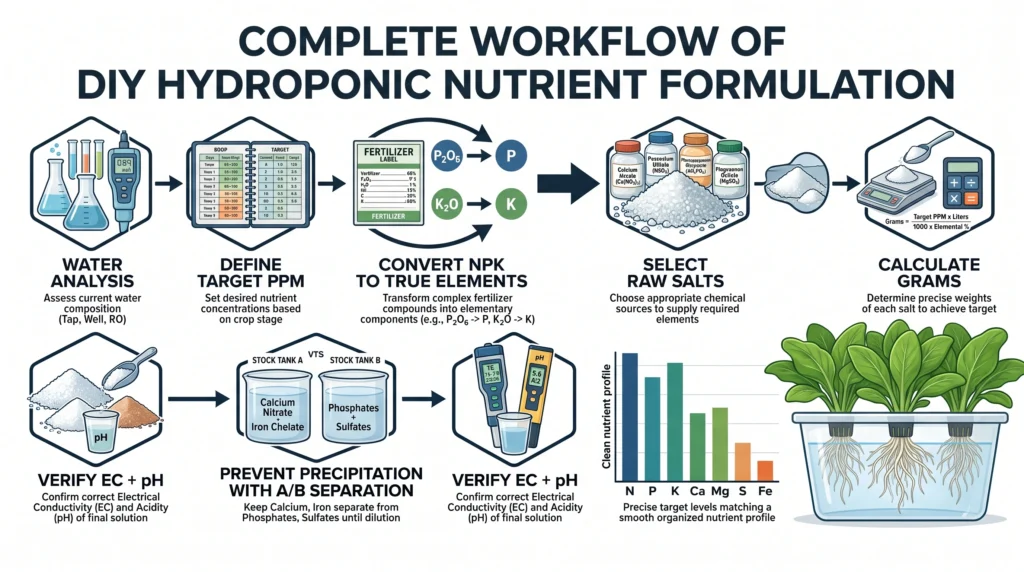
Mastering the mathematics of dissolved agricultural salts shifts an operation from consumer-grade dependency to commercial-level autonomy. A proper DIY hydroponic nutrient formulation requires understanding the difference between N-P-K labeling and actual elemental mass. You must learn how to target specific PPM profiles for different growth stages, balance cationic and anionic loads, and prevent chemical precipitation in concentrated stock tanks. This guide breaks down the exact calculations required to build professional-grade nutrient profiles from scratch.
At a Glance: The Elemental Math
Before diving into custom formulations, memorize these three baseline rules of dry-salt hydroponics. These equations represent the core chemistry required to bypass commercial liquid markups.
P = P₂O₅ × 0.436K = K₂O × 0.830
Grams = (Target PPM × Liters) / (1000 × % Element)
The Chemistry of Hydroponic Salts: Beyond the N-P-K Ratio
Discover why standard N-P-K numbers on fertilizer labels do not represent the actual elemental mass of phosphorus and potassium, and learn the exact conversion factors required for accurate hydroponic dosing.
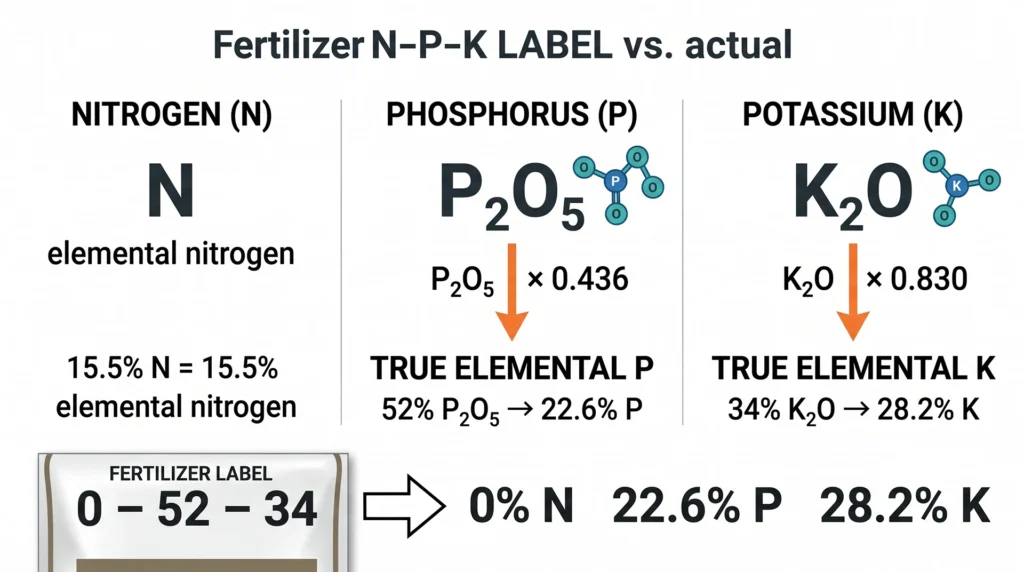
Before mixing raw salts, you have to decode fertilizer labeling standards. The familiar N-P-K numbers printed on fertilizer bags represent Nitrogen (N), Phosphorus (P), and Potassium (K). However, agricultural labeling laws established decades ago require manufacturers to list Phosphorus as Phosphorus Pentoxide (P2O5) and Potassium as Potassium Oxide (K2O).
Nitrogen is listed as actual elemental nitrogen, but the phosphorus and potassium numbers are artificially inflated because they include the weight of the oxygen atoms attached to them in these standardized oxide forms. To formulate a precise DIY mix, you must strip away the oxygen weight to find the true elemental percentage.
Atomic Weights and Calculating Molar Mass
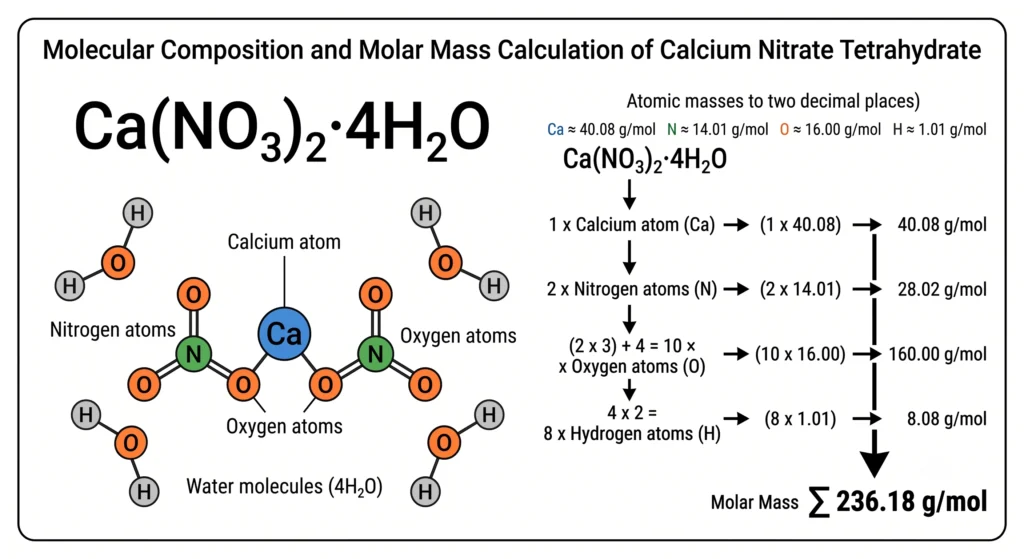
To figure out how much raw salt delivers your target ppm of an element, calculate the molar mass of the compound from the atomic weights of its parts.
Standard atomic weights for fertilizer elements:
| Element | Atomic Weight (g/mol) |
|---|---|
| Nitrogen (N) | 14.01 |
| Phosphorus (P) | 30.97 |
| Potassium (K) | 39.10 |
| Calcium (Ca) | 40.08 |
| Magnesium (Mg) | 24.31 |
| Sulfur (S) | 32.06 |
| Oxygen (O) | 16.00 |
| Hydrogen (H) | 1.01 |
Worked example – Calcium Nitrate, a staple of any DIY hydroponic nutrient formulation:
Formula: Ca(NO₃)2 · 4H2O (technical grade tetrahydrate — the “4H2O” means four water molecules are locked into the crystal lattice)
- Ca: 1 × 40.08 = 40.08 g/mol
- N: 2 × 14.01 = 28.02 g/mol
- O (in nitrate): 6 × 16.00 = 96.00 g/mol
- H2O (bound water): 4 × ((2 × 1.01) + 16.00) = 72.08 g/mol
Total molar mass = 40.08 + 28.02 + 96.00 + 72.08 = 236.18 g/mol
Mass percentage of calcium in this pure salt:
%Ca = 40.08 ÷ 236.18 = 0.1697 → 16.97%
Commercial greenhouse-grade calcium nitrate usually blends in a small amount of ammonium nitrate to improve solubility, which shifts the guaranteed analysis on the bag to 19% Ca and 15.5% N. Always use the manufacturer’s guaranteed analysis label when it’s available, it’s more accurate than the pure-compound calculation above.
We calculate these oxide-to-element conversion factors using standard atomic weights. By isolating individual elements on the periodic table, we can strip away the weight of the attached oxygen atoms to find the true nutritional yield of our dry agricultural salts:
Phosphorus has an atomic weight of 30.97; Oxygen is 16.00.
(30.97 × 2) + (16.00 × 5) = 141.94
To isolate the ratio of actual Phosphorus, divide total P weight by total molecular weight:
Potassium has an atomic weight of 39.10; Oxygen is 16.00.
(39.10 × 2) + 16.00 = 94.20
To isolate the ratio of actual Potassium, divide total K weight by total molecular weight:
Core Elemental Conversion Factors:
| Fertilizer Oxide Label | Conversion Factor | True Elemental Yield | Chemical Rationale |
|---|---|---|---|
| Phosphorus (P₂O₅) | 0.436 | True P = P₂O₅ × 0.436 | Strips away the heavy oxygen molecular weight (atomic weight 16.00) attached to Phosphorus. |
| Potassium (K₂O) | 0.830 | True K = K₂O × 0.830 | Accounts for potassium’s molecular relationship within potassium oxide formulations. |
If you buy Monopotassium Phosphate (MKP) labeled as 0-52-34, the actual elemental composition is 0% Nitrogen, 22.6% Phosphorus (52 * 0.436), and 28.2% Potassium (34 * 0.830). Understanding this conversion is the foundation of any DIY custom mix. For a broader overview of base nutrient requirements, review our comprehensive hydroponic nutrients guide.
Essential Dry Salts for Custom Formulations
Review the five primary agricultural salts that make up 95% of the bulk mass in any professional hydroponic nutrient profile, including their elemental breakdowns.
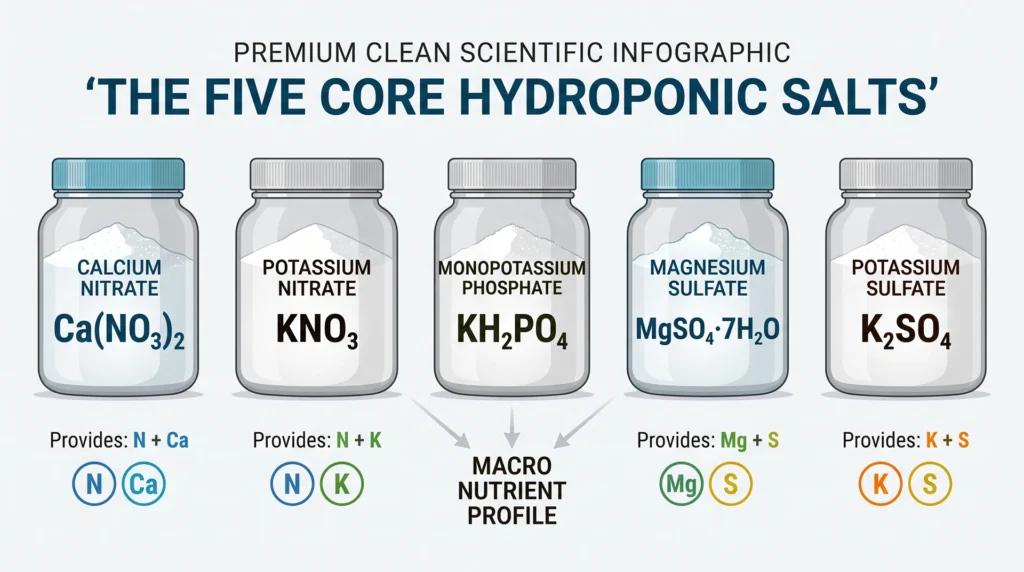
To build almost any vegetative or flowering profile, you need five primary macro-nutrient salts and a pre-chelated micronutrient mix. Procuring these in greenhouse-grade (fully water-soluble) format guarantees clean lines and stable pH.
| Salt Name & Chemical Formula | Standard NPK Label | True Elemental Yield | Core Cultivation Function |
|---|---|---|---|
| Calcium Nitrate 5Ca(NO₃)₂ • NH₄NO₃ • 10H₂O | 15.5 – 0 – 0 + 19% Ca | 15.5% N (14.4% Nitrate / 1.1% Ammonium) 19% Ca | Primary baseline provider of vegetative nitrogen and structural cell-wall calcium. |
| Potassium Nitrate KNO₃ | 13 – 0 – 46 | 13% N (Nitrate) 38.1% K | Delivers highly clean nitrate-based nitrogen paired with heavy vegetative potassium. |
| Monopotassium Phosphate KH₂PO₄ | 0 – 52 – 34 | 22.6% P 28.2% K | Key phosphorus standard. Delivers crucial blooms and rooting support. |
| Magnesium Sulfate MgSO₄ • 7H₂O | 0 – 0 – 0 + 9.8% Mg + 13% S | 9.8% Mg 13% S | The sole provider of chlorophyll-stabilizing magnesium and structural sulfur. |
| Potassium Sulfate K₂SO₄ | 0 – 0 – 50 + 18% S | 41.5% K 18% S | Boosts late fruiting weight and flavor profiles without triggering vegetative growth. |
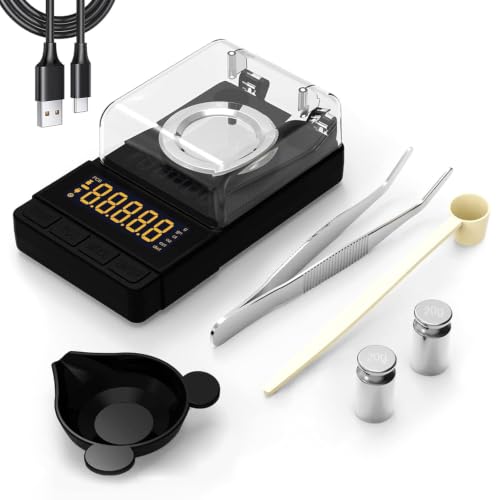
Why it’s necessary: When measuring highly concentrated dry salts for small to medium reservoirs, kitchen scales are dangerously inaccurate. A scale that measures down to 0.01g guarantees you hit exact PPM targets, especially when dosing raw micronutrients.nnKey Spec: 500g capacity with 0.01g resolution and protective draft shield.
Understanding Elemental Math and PPM Targets
Learn the foundational equation to convert dry grams of agricultural salt into liquid Parts Per Million (PPM) within a specific volume of water.
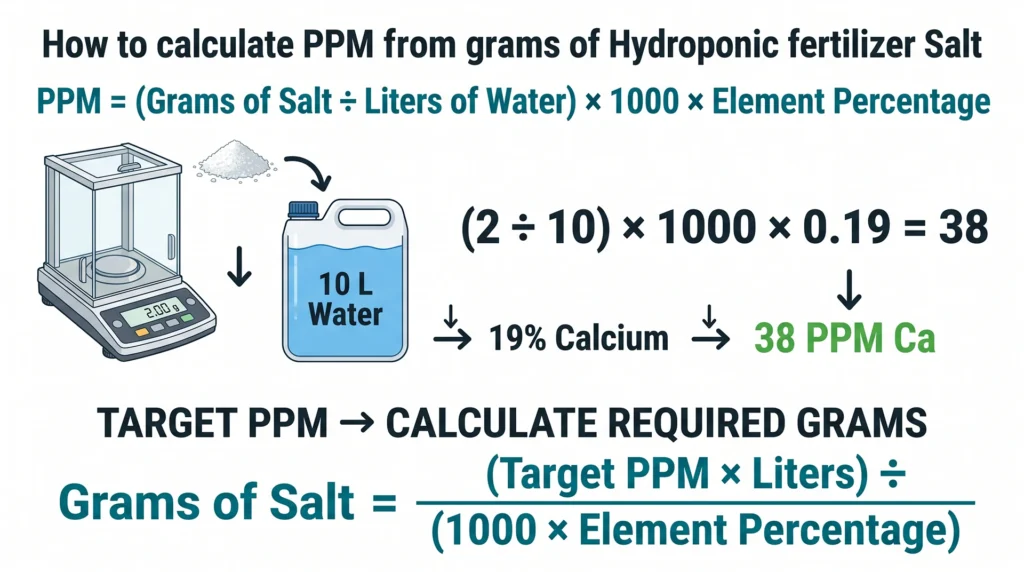
In hydroponic chemistry, 1 PPM is exactly equal to 1 milligram of an element per 1 Liter of water (1 mg/L).
Since there are 1,000 milligrams in a gram, adding 1 gram of a 100% pure element to 1 Liter of water yields exactly 1,000 PPM.
Because we are working with salts that only contain a percentage of our target element, we must scale the math accordingly. The universal formula for calculating the PPM added by any salt is:
Example: If you add 2 grams of Calcium Nitrate (19% Ca) to 10 Liters of water:
PPM Ca = 0.2 × 1000 × 0.19 = 38 PPM of Calcium
Conversely, if you know your target PPM and want to find out how many grams of salt to weigh out, you rearrange the algebra:
If your crop requires a specific baseline conductivity, you will use these formulas extensively. Check our hydroponic pH and EC mastery guide to find the baseline targets for your specific growth stage before doing the math.
Step-by-Step Calculation: Building a Custom Tomato Formulation
Walk through a complete, real-world mathematical breakdown to formulate a high-yield flowering tomato nutrient profile from raw dry salts.
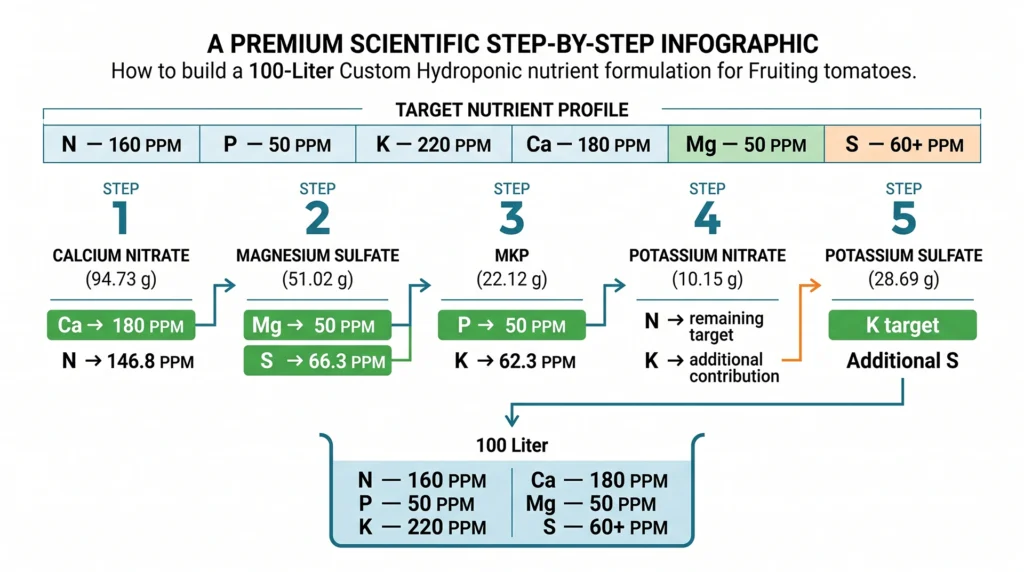
Let us build a complete custom recipe for a 100-Liter reservoir targeting a standard fruiting tomato profile. During heavy fruit set, tomatoes demand high Potassium and Calcium, moderate Nitrogen and Phosphorus, and baseline Magnesium.
Target Profile (in PPM)
Calculated for a standard 100-Liter reservoir volume.
Step 1: Calculate Calcium Nitrate to hit the Calcium target
We must hit 180 PPM of Ca. We use Calcium Nitrate (19% Ca, 15.5% N).
Grams = 18000 / 190 = 94.73 grams
Nitrogen Back-Check: How much Nitrogen did this add to our 100L reservoir?
PPM N = (94.73 / 100) * 1000 * 0.155 = 146.8 PPM
Target is 160 PPM N. We still need 13.2 PPM of Nitrogen.
Step 2: Calculate Magnesium Sulfate to hit the Magnesium target
We must hit 50 PPM of Mg. We use Magnesium Sulfate (9.8% Mg, 13% S).
Grams = 5000 / 98 = 51.02 grams
Sulfur Back-Check:
PPM S = (51.02 / 100) * 1000 * 0.13 = 66.3 PPM
This easily meets our minimum 60 PPM Sulfur requirement.
Step 3: Calculate Monopotassium Phosphate (MKP) to hit the Phosphorus target
We must hit 50 PPM of P. We use MKP (22.6% P, 28.2% K).
Grams = 5000 / 226 = 22.12 grams
Potassium Back-Check:
PPM K = (22.12 / 100) * 1000 * 0.282 = 62.3 PPM
Target is 220 PPM K. We still need 157.7 PPM of Potassium.
Step 4: Calculate Potassium Nitrate to hit the remaining Nitrogen target
We still need 13.2 PPM of Nitrogen. We use Potassium Nitrate (13% N, 38.1% K).
Grams = 1320 / 130 = 10.15 grams
Potassium Back-Check:
PPM K = (10.15 / 100) * 1000 * 0.381 = 38.6 PPM
Current total K = 62.3 (MKP) + 38.6 (KNO₃) = 100.9 PPM. We still need 119.1 PPM of Potassium.
Step 5: Calculate Potassium Sulfate to hit the remaining Potassium target
We need 119.1 PPM of Potassium without adding Nitrogen or Phosphorus. We use Potassium Sulfate (41.5% K, 18% S).
Grams = 11910 / 415 = 28.69 grams
Additional Sulfur Back-Check:
PPM S = (28.69 / 100) * 1000 * 0.18 = 51.6 PPM
Total Sulfur is now 66.3 + 51.6 = 117.9 PPM. (Perfect, highly beneficial level for heavy-feeding tomatoes).
📋 Final 100-Liter Recipe Weights
Weigh these dry agricultural salts out carefully on a high-precision digital scale before dissolving sequentially in water:
- Calcium Nitrate: 94.73g
- Magnesium Sulfate (Epsom): 51.02g
- Monopotassium Phosphate (MKP): 22.12g
- Potassium Nitrate: 10.15g
- Potassium Sulfate: 28.69g
Rather than doing this longhand every time you alter a profile, highly engineered software takes care of the recursive math. Utilize our hydroponic nutrient calculator to adjust reservoir sizes and target PPMs on the fly, saving hours of manual algebra. For detailed environmental pairing with this formulation, consult our hydroponic tomatoes and peppers guide
Interactive DIY Hydroponic Nutrient Calculator
While mastering the manual math is crucial for understanding nutrient dynamics, you do not have to perform these conversions by hand every time you mix a reservoir. Use our interactive calculator below to automatically convert your target Parts Per Million (PPM) into precise dry salt weights in grams, or vice versa. This calculator handles the underlying oxide-to-element equations automatically.
Crop-Specific Target PPM Tables
Leafy greens thrive on lower overall EC and relatively higher nitrogen; fruiting crops need a big jump in potassium and calcium during their generative stage.
| Element | Leafy Greens / Lettuce (Veg) | Tomatoes / Peppers (Fruiting) | Strawberries (Generative) |
|---|---|---|---|
| Nitrogen (N) | 150 ppm | 180 ppm | 100 ppm |
| Phosphorus (P) | 50 ppm | 50 ppm | 40 ppm |
| Potassium (K) | 200 ppm | 350 ppm | 180 ppm |
| Calcium (Ca) | 150 ppm | 200 ppm | 120 ppm |
| Magnesium (Mg) | 50 ppm | 60 ppm | 45 ppm |
| Sulfur (S) | 60 ppm | 80 ppm | 50 ppm |
| Iron (Fe) | 2.0 ppm | 3.0 ppm | 2.0 ppm |
| Manganese (Mn) | 0.5 ppm | 0.8 ppm | 0.5 ppm |
| Zinc (Zn) | 0.1 ppm | 0.3 ppm | 0.1 ppm |
| Copper (Cu) | 0.05 ppm | 0.1 ppm | 0.05 ppm |
| Boron (B) | 0.3 ppm | 0.4 ppm | 0.25 ppm |
| Molybdenum (Mo) | 0.05 ppm | 0.05 ppm | 0.03 ppm |
Balancing the A and B Tanks to Prevent Precipitation
Understand the chemical rules of concentrated stock solutions. Placing incompatible salts in the same concentrated batch tank causes irreversible precipitation, stripping your plants of calcium and phosphorus.
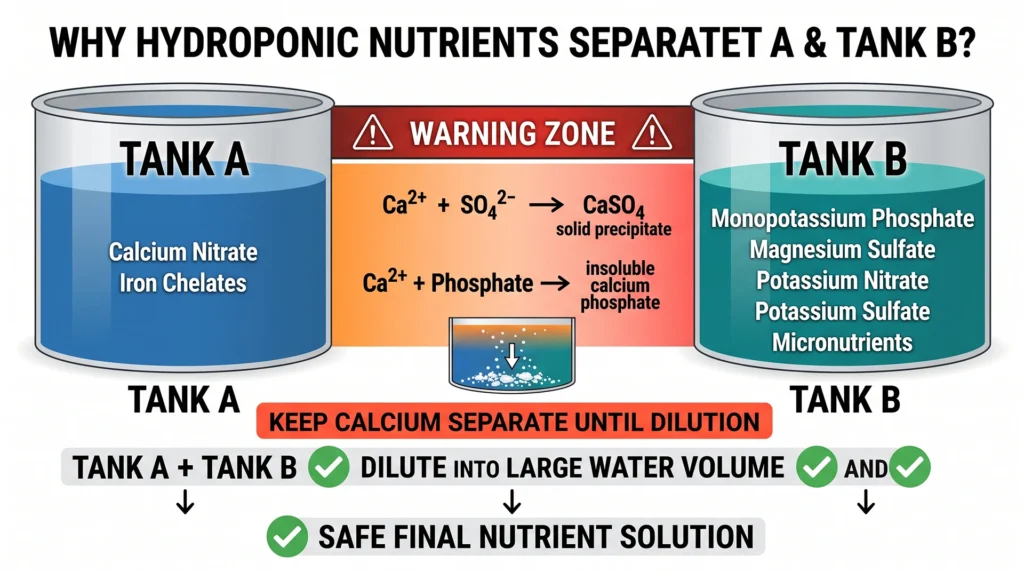
You cannot mix all these dry salts into a single concentrated stock tank. If you attempt to make a highly concentrated liquid mix containing both Calcium Nitrate and any form of Sulfate or Phosphate, a severe chemical reaction occurs. The concentrated Calcium ions (Ca2+) will bind with the Sulfate ions (SO42-) to form Calcium Sulfate (Gypsum), which is insoluble and drops out of the solution as a hard white sludge. Similarly, Calcium binds with Phosphates to form Calcium Phosphate rock.
Once precipitation occurs, the bound elements are completely unavailable to the plants. The nutrient solution is ruined. To solve this, commercial growers utilize a two-part stock system: Tank A and Tank B.
To prevent chemical lockouts and precipitation in high concentrations, your stock concentrates must be divided into two separate vessels: Tank A and Tank B.
🧪 Tank A (Calcium & Iron)
- Calcium Nitrate
- Iron Chelates
⚗️ Tank B (Phosphates, Sulfates & Micros)
- Monopotassium Phosphate
- Magnesium Sulfate
- Potassium Nitrate
- Potassium Sulfate
- All other Micronutrients (Manganese, Zinc, Copper, Boron, Molybdenum)
When running a 100x concentrated stock solution, you multiply the raw gram weights of your 100-Liter recipe by 100 and dissolve them into a 100-Liter Tank A and a 100-Liter Tank B. You then inject 10 mL of Tank A and 10 mL of Tank B per Liter of fresh water moving through your irrigation manifold. The dilution in the main line happens fast enough and at a low enough concentration that the elements remain suspended safely in the water column without reacting. Proper timing of these injections is handled automatically by sophisticated dosers; read our evaluation of reliable units in our controllers under 200 guide.
Critical Incompatibility: Keep Out of Concentrate!
Never combine Calcium Nitrate and Magnesium Sulfate or Monopotassium Phosphate in a single concentrated tank. At high concentrations, calcium binds instantly with sulfates and phosphates to form insoluble gypsum sludge. This chemical fallout locks out calcium and phosphorus permanently, turning your investment into useless tank debris.
Salt Solubility Limits by Temperature
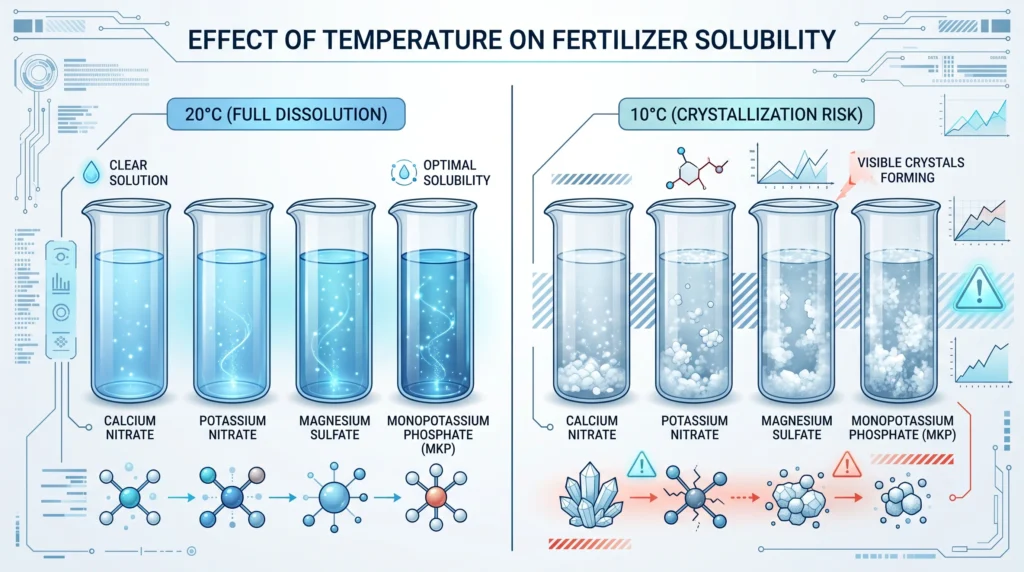
Concentrated stock solutions are limited by the physical solubility limit of each salt in water. Dissolve too much dry salt and the solution saturates, leaving undissolved crystals at the bottom. Water temperature directly affects this limit, a stock tank mixed at room temperature (20°C / 68°F) in summer can drop crystals out of solution when temperatures fall at night in winter.
| Fertilizer Salt | Chemical Formula | Max Solubility (20°C) | Max Solubility (10°C) | Tank |
|---|---|---|---|---|
| Calcium Nitrate | Ca(NO₃)2 · 4H2O | 1,210 g/L | 1,020 g/L | A |
| Potassium Nitrate | KNO₃ | 316 g/L | 209 g/L | B |
| Monopotassium Phosphate | KH2PO₄ | 226 g/L | 183 g/L | B |
| Magnesium Sulfate | MgSO₄ · 7H2O | 710 g/L | 550 g/L | B |
| Potassium Sulfate | K2SO₄ | 111 g/L | 92 g/L | B |
Pro tip: Potassium sulfate has a low solubility ceiling (111 g/L). If your Tank B formula needs high potassium and sulfur together, keep total K2SO₄ concentration below 90 g/L to avoid crystallization during cold spe
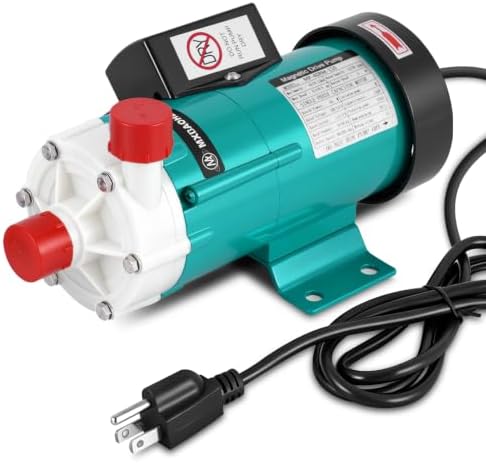
Why it's necessary: Concentrated stock solutions require aggressive, continuous circulation to ensure total dissolution of dry salts, especially Potassium Sulfate which dissolves slowly. A heavy-duty magnetic drive pump prevents salt build-up at the bottom of stock tanks.nnKey Spec: Oil-free, 800 GPH continuous duty, acid/salt resistant impeller.
Micronutrient Math and Chelates
Diluting trace elements requires extreme precision. Learn how to manage parts-per-billion metrics using standard agricultural pre-mixes and pH-specific chelation strategies.
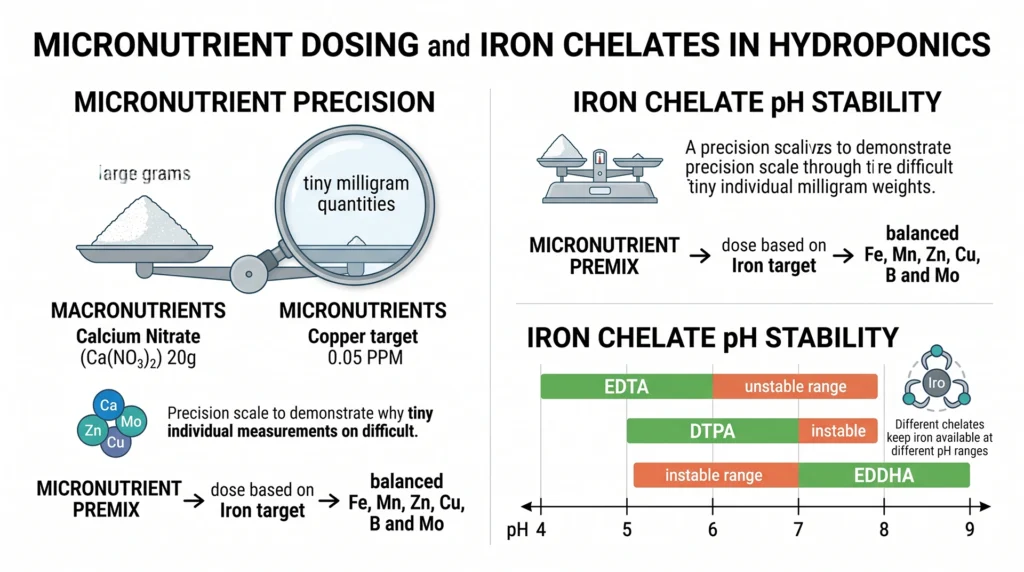
Micronutrients; Iron (Fe), Manganese (Mn), Zinc (Zn), Copper (Cu), Boron (B), and Molybdenum (Mo)—are required in microscopic amounts. A typical target for Copper is 0.05 PPM. Attempting to weigh out the exact amount of Copper Sulfate for a 10-Liter reservoir would require measuring 0.0019 grams. Even precision scales struggle with accuracy at this threshold.
Instead of buying raw individual trace minerals, the industry standard is to buy a blended micronutrient premix. These agricultural premixes contain exactly balanced ratios of trace elements. You calculate the dose based on the Iron target. If your tomato crop requires 2.5 PPM of Iron, you calculate the grams of the micronutrient mix needed to hit 2.5 PPM of Fe. Because the manufacturer balanced the mix, hitting the Iron target automatically pulls the Mn, Zn, Cu, B, and Mo into their correct optimal ranges.
Understanding Chelates:
Metals like Iron easily oxidize and drop out of solution. To keep them available to plant roots, the metal ions are wrapped in organic claw-like molecules called chelates. The type of chelate you select dictates the pH range your system can operate within before the iron becomes locked out.
- EDTA (Ethylenediaminetetraacetic acid): Holds Iron stable up to a pH of 6.0. Above 6.0, Iron drops out rapidly.
- DTPA (Diethylenetriaminepentaacetic acid): Holds Iron stable up to a pH of 7.0. This is the industry standard for recirculating hydroponics.
- EDDHA (Ethylenediamine-N,N'-bis(2-hydroxyphenylacetic acid)): Holds Iron stable up to a pH of 9.0. It turns the water blood red and is highly effective in hard water setups.
If you observe yellowing on new growth (a classic iron deficiency) despite hitting your PPM targets, your chelate is likely breaking down due to pH drift. Check out our deep dive on cal-mag and micronutrient balancing to diagnose specific lockout issues.
Accounting for Water Quality: Adjusting for Alkalinity and Source Minerals
Your source water is never entirely blank unless you use reverse osmosis. You must subtract the naturally occurring calcium, magnesium, and carbonates in your tap water from your dry salt calculations.
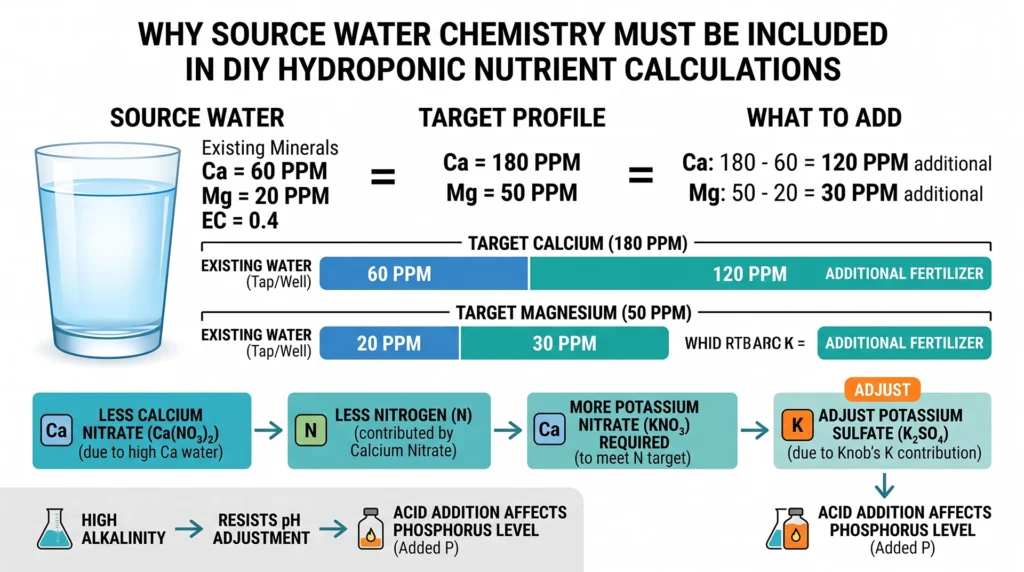
A DIY hydroponic nutrient formulation calculated perfectly on paper will fail in practice if the source water profile is ignored. Municipal tap water and well water contain existing mineral loads. If your well water already contains 60 PPM of Calcium and 20 PPM of Magnesium, and you add the 180 PPM Ca / 50 PPM Mg tomato recipe calculated earlier, your final reservoir will sit at 240 PPM Ca and 70 PPM Mg. This excess causes nutrient antagonism; too much Calcium blocks the uptake of Potassium, leading to artificial deficiencies.
You must obtain a water quality report or use a digital tester to find your baseline. If your baseline water has an EC of 0.4 (approx 200 PPM on the 500 scale), you need to know what those 200 PPMs are made of. Usually, it is Calcium Carbonate.
Adjusting the Math:
If source water = 60 PPM Ca. Target Ca = 180 PPM.
New Target = 180 - 60 = 120 PPM Ca.
You will recalculate the Calcium Nitrate needed to hit only 120 PPM. Consequently, the Nitrogen provided by that Calcium Nitrate drops, forcing you to increase the Potassium Nitrate to hit your Nitrogen target, which forces you to decrease your Potassium Sulfate. This cascading mathematical adjustment is exactly why understanding the elemental formulas is superior to following generic mixing charts.
Alkalinity (Carbonate hardness) also acts as a powerful pH buffer. High carbonate water resists pH down (Phosphoric Acid). When you add acid to drop the pH, you are adding elemental Phosphorus to the reservoir. A grower fighting 200 PPM of carbonates with acid might unintentionally add 40 PPM of Phosphorus to the tank, throwing off the P target. To master these interactions, read our guide on hydroponic pH and EC meters to ensure you are accurately reading your baseline water chemistry.
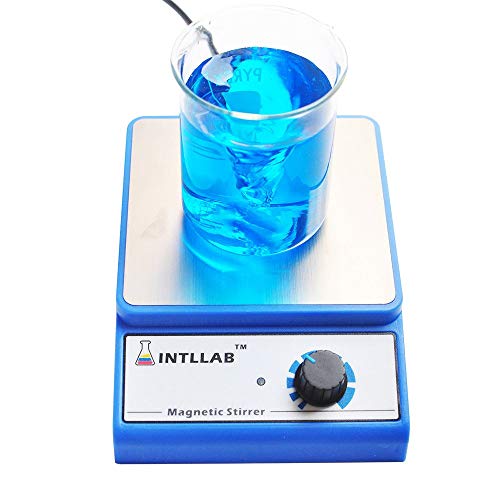
Why it's necessary: When creating small 1-liter concentrated micronutrient or pH buffer stock bottles, dissolving the raw powder evenly prevents dangerous hot-spots in the solution. A magnetic stirrer automates continuous, heated agitation.nnKey Spec: 100-2000 RPM stepless speed regulation with aluminum heating plate.
Commercial vs. Residential DIY Mixing Protocols
The logistics of mixing salts differ drastically between a 50-gallon home setup and a 5,000-gallon commercial facility. Learn the procedural differences between batch mixing and automated inline injection.
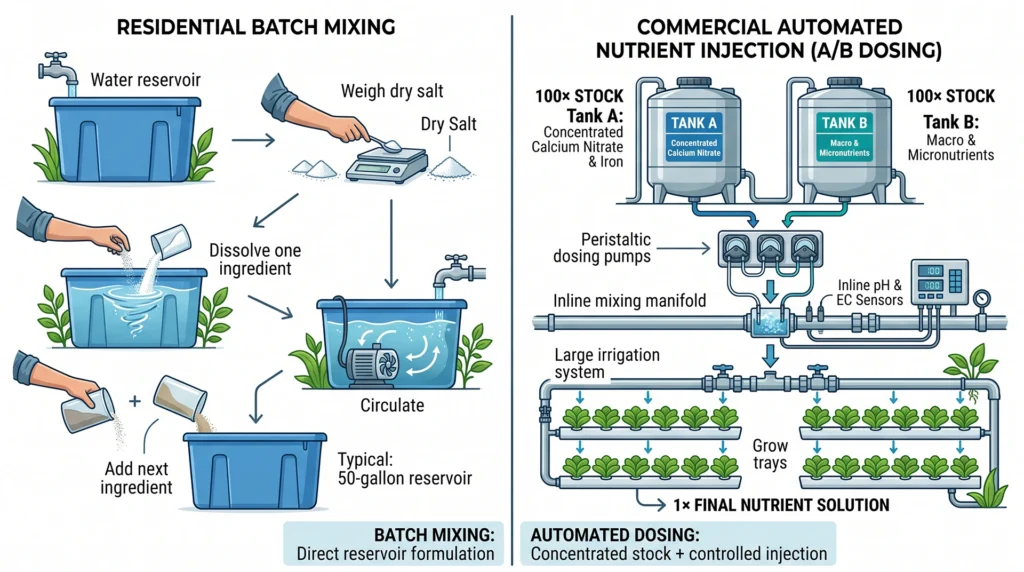
In a residential DIY setting (e.g., a 50-gallon deep water culture tote), growers usually perform direct "batch mixing". The grower fills the 50-gallon tank with water, weighs the exact grams of dry Calcium Nitrate required for 50 gallons, and dissolves it thoroughly directly into the reservoir. Next, they weigh the Magnesium Sulfate, dissolve it, and so on. Because the salts dissolve in a massive volume of water one by one, precipitation is avoided.
In a commercial or large-scale operation, batch mixing every reservoir by hand requires extreme labor overhead. Commercial setups use highly concentrated A/B stock tanks (often 100x or 200x concentration). A mechanical dosing system, such as a peristaltic pump rack, pulls liquid from Tank A and Tank B into a mixing manifold just before the water enters the grow trays.
Stock Solution Math Rule:
If a formula requires 50 grams of MKP for a standard 100-Liter batch, a 100x concentrated Tank B requires 5,000 grams (5kg) of MKP per 100 Liters of stock water.
When formulating 100x stock tanks, maximum solubility limits become a physical barrier. Potassium Sulfate (K2SO4) has a relatively low solubility limit of about 120 grams per Liter of water at room temperature. If your 100x formula requires 150 grams of Potassium Sulfate per Liter in the stock tank, it will simply refuse to dissolve, sitting as a solid layer at the bottom of the barrel. When solubility limits are breached, commercial growers transition to 50x stock solutions or split the mix into A, B, and C tanks. For advanced integration of dosing systems, refer to our hydroponic nutrient schedule framework.
Troubleshooting Custom Nutrient Mixes
Correcting errors in custom formulations requires observing physical reactions in the water and immediate pH drift, rather than waiting for plant tissue symptoms to manifest.
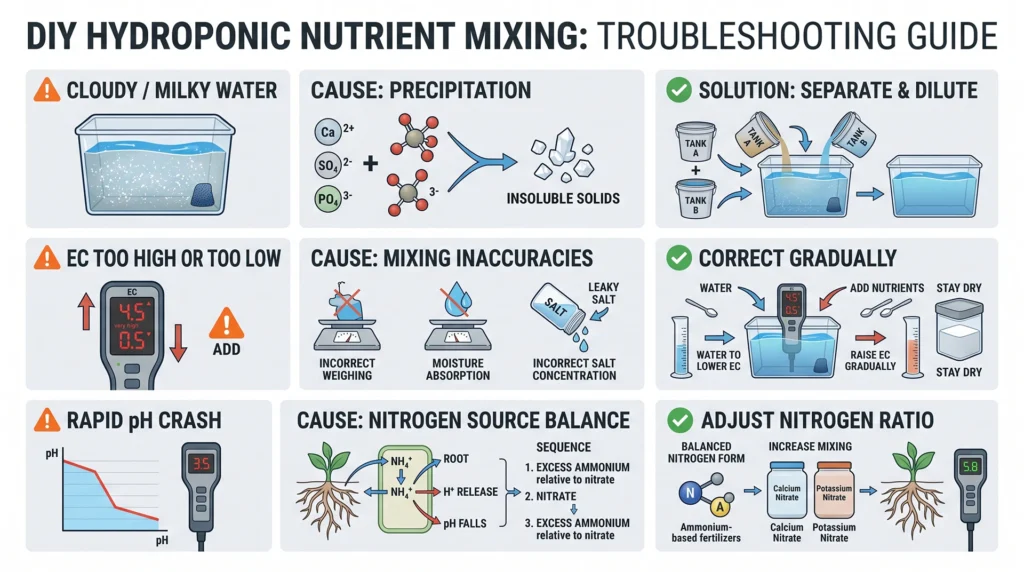
If your math is perfect but your execution is flawed, the water chemistry will immediately flag an error.
Diagnosis: You caused Calcium Sulfate or Calcium Phosphate precipitation. This usually happens if you mix the dry salts together in a small bucket of water before pouring them into the main reservoir, or if you pour Stock A and Stock B into the reservoir simultaneously without letting the pump circulate the first addition.
Action: The precipitated calcium is permanently locked out. Dump the reservoir, rinse the pumps to clear abrasive particulates, and start over. Mix salts one by one directly into the full water volume.
Diagnosis: Your dry salts absorbed atmospheric moisture (hygroscopy). Calcium Nitrate is highly hygroscopic. If the bag was left unsealed, it absorbed water from the air. When you weighed out 100 grams, 15 grams of that weight was actually trapped water. You under-dosed the actual elemental calcium and nitrogen.
Action: Store all bulk salts in airtight buckets with heavy-duty desiccant packs. Calculate the deviation using your EC meter and slowly add a 10% corrective dose. Review our hydroponic troubleshooting guide for granular EC recovery protocols.
Diagnosis: The Ammoniacal Nitrogen (NH₄⁺) to Nitrate Nitrogen (NO₃⁻) ratio is unbalanced. When plants uptake ammonium ions, they excrete hydrogen ions (H⁺), driving the pH down aggressively. If your custom mix uses Ammonium Nitrate to supply more than 10-15% of the total nitrogen, the pH will crash continuously.
Action: Reformulate the recipe to ensure 90% of the nitrogen is supplied via Calcium Nitrate and Potassium Nitrate.
Symptom: Milky White Reservoir (Precipitation Triggered)
If your water turns milky immediately after dosing, you have triggered a precipitation event. This typically occurs because dry salts were premixed in a small bucket first, or Stock A and Stock B were added to the reservoir simultaneously without sufficient water displacement.
- Dump and Clean: The calcium is bound permanently. Dump the reservoir and flush the lines to clear abrasive particles.
- Dilute Sequencing: Refill, run your mixing pump vigorously, and dissolve Calcium Nitrate completely before introducing sulfates or phosphates.
Frequently Asked Questions (FAQ's)
What is the difference between agricultural grade and greenhouse grade salts?
Greenhouse grade salts undergo a highly refined purification process to remove insoluble coatings and heavy metals, leaving them 100% water-soluble. Agricultural grade salts (meant for field soil application) often feature anti-caking wax coatings that will leave an oily scum on the surface of your hydroponic reservoir and clog fine drip emitters.
Can I mix Calcium Nitrate and Magnesium Sulfate in the same dry blend bag for storage?
No. Even in dry form, ambient humidity can trigger a reaction at the contact points between the two salts, creating localized gypsum precipitation and caking the bag into a solid brick. Always store your bulk raw salts in separate, airtight containers.
How do I calculate the elemental percentage of a custom NPK mix if I combine multiple salts?
You calculate the total elemental milligrams of N, P, and K added across all salts for a specific water volume. Divide the total milligrams of each element by the total weight of all the dry salts used, then convert that decimal to a percentage. Remember to convert elemental P and K back into P2O5 and K2O if you intend to label it under standard commercial NPK formatting.
Why does my custom hydroponic solution turn cloudy immediately after mixing?
Cloudiness indicates a precipitation event, usually the formation of Calcium Phosphate or Calcium Sulfate. This occurs when local concentrations of incompatible ions become too high. To prevent this, always dissolve Calcium Nitrate completely into the full volume of water first, ensure vigorous circulation, and then slowly add your Sulfates and Phosphates.
How long do mixed concentrated stock solutions last?
Stored in light-proof, airtight containers in a cool room, concentrated inorganic stock solutions (Tank A and Tank B) can remain stable for up to 6 to 12 months. However, if exposed to UV light, the chelated iron in Tank A will degrade rapidly, and any organic additives will begin to ferment and spoil within days.
What is the optimal dilution ratio for Tank A and Tank B?
The industry standard for commercial dosing is a 100x concentration (a 1:100 dilution ratio). This requires 10 mL of Tank A and 10 mL of Tank B per 1 Liter of fresh water to hit your targeted 1x formulation profile. High-solubility recipes may run at 200x, while heavier flowering profiles prone to saturation limits may require a 50x concentration.
Mastering Your Hydroponic Independence
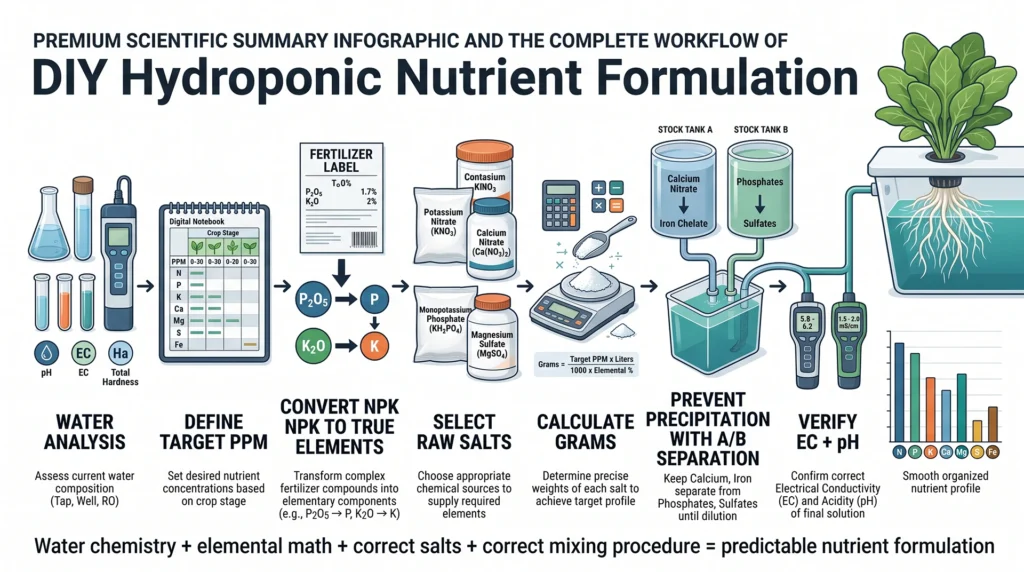
Transitioning to a DIY hydroponic nutrient formulation eliminates the markup of commercial bottled water and provides total dominance over your crop's elemental diet. By mastering the conversion of P2O5 and K2O to true elemental values, mapping the precise stoichiometry of raw greenhouse-grade salts, and respecting the laws of solubility and precipitation, you elevate your indoor farm from basic hobbyist to professional grade. The mathematics require strict attention to detail, but the resulting baseline stability, explosive vegetative growth, and targeted fruiting yields justify the initial learning curve.
To streamline the algebra and avoid manual spreadsheet data entry for every crop phase change, utilize our proprietary Tools and Resources calculators. As you scale your reservoir sizes, continue benchmarking your custom salt mixes against commercial systems by reviewing our deep-dives in the Hydroponics Comparison Hub. Consistent execution of these formulas ensures predictable, high-yield harvests cycle after cycle.
Prefer Visual Learning? Watch the Complete Video Guide
If you prefer to see the math in action, watch our step-by-step visual tutorial below.
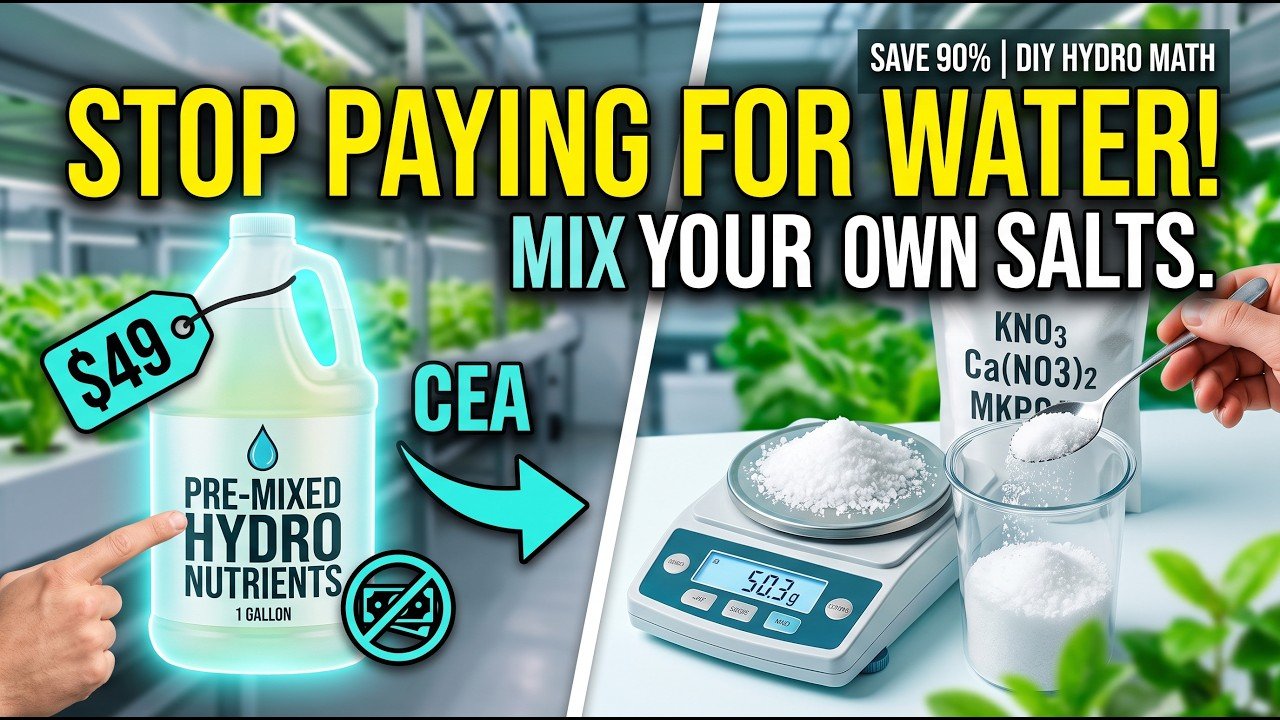
This cinematic guide walks you through the exact process of measuring dry agricultural salts, separating concentrate tanks, and utilizing elemental conversions to build high-yield nutrient profiles. Pair it with the article to gain complete autonomy over your reservoir chemistry.

Continue Your Learning Journey