Hydroponic Dwarf Fruit Trees: Engineering DWC Systems for Citrus and Figs

Table of Contents
- Deep Water Culture vs. Other Hydroponic Methods for Trees
- Reservoir Engineering and Structural Support
- Maximizing Dissolved Oxygen in Large Reservoirs
- Nutrient Protocols for Dwarf Citrus and Figs
- Climate Control and Thermal Management
- Root Canopy Development and Pruning
- Indoor Pollination Mechanics
- Integrated Pest and Disease Management (IPM)
- Photobiology and Lighting Requirements
- Economic Analysis and Yield Projections
- Troubleshooting Common Dwarf Tree Issues
- Frequently Asked Questions
Disclosure: MistCulture summarizes verified product specs, engineering data, and community feedback. We may earn an affiliate commission if you purchase through our links. Regulations vary by location; this content is for educational purposes only.
The intersection of hydroponic growing and dwarf fruit tree cultivation represents a highly rewarding frontier in controlled environment agriculture. While most indoor growers focus their infrastructure entirely on rapid-cycle leafy greens or annual fruiting crops like tomatoes, cultivating perennial woody plants indoors offers long-term, high-value harvests. Dwarf citrus varieties, such as Meyer lemons, Calamondins, and Key limes, along with various dwarf fig cultivars, possess unique physiological traits that allow them to thrive in Deep Water Culture (DWC) reservoirs.
Transitioning from annual herbaceous crops to woody perennials requires a fundamental shift in how you design your water delivery infrastructure. Standard shallow channels and minimal root volumes will not support a tree meant to bear heavy fruit loads over several years. When the engineering parameters are correctly matched to the specific demands of woody root systems, hydroponic fruit trees outpace their soil-bound counterparts in growth speed, fruit set, and overall canopy development. This guide provides the complete blueprint for converting a standard hydroponic environment into a productive, multi-year fruit tree production platform.
Deep Water Culture vs. Other Hydroponic Methods for Trees
Dwarf fruit trees possess fundamentally different root architectures than annual crops. Their woody root systems demand structural support and oxygen delivery methods that differ drastically from the delicate, fine fibrous roots of basil or lettuce. In traditional soil cultivation, fruit trees frequently suffer from soil compaction, poor drainage, and anaerobic pockets that suffocate root hairs and invite fungal pathogens.
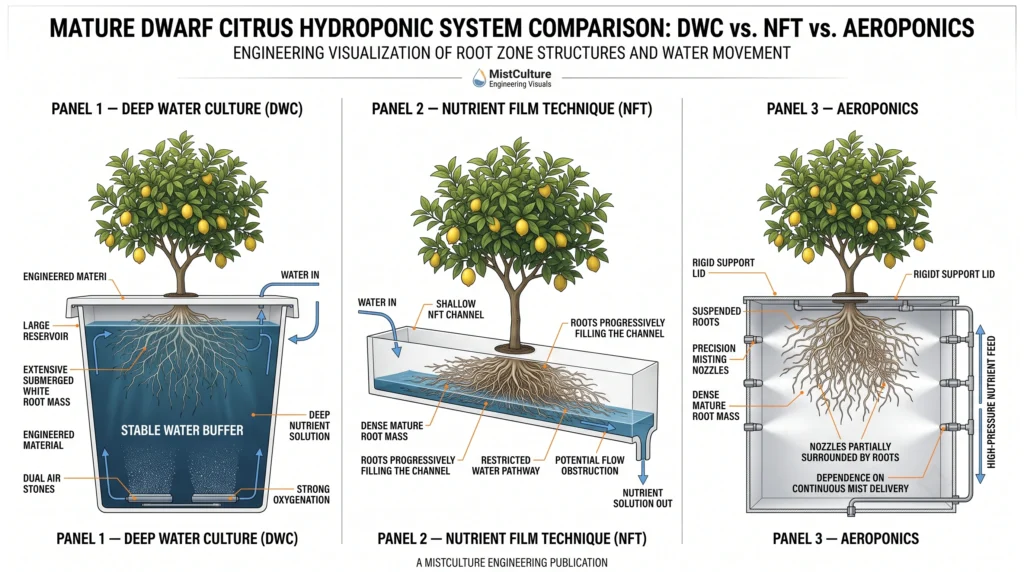
When you place a dwarf fruit tree in a Deep Water Culture system, the constant oxygenation and unlimited nutrient availability bypass the limitations of soil. The root system develops into a massive, dense fibrous mat rather than a traditional thick taproot system. This morphological adaptation massively increases the root surface area available for nutrient absorption. Because the plant expends near-zero energy searching for water or breaking through hard soil pans, it redirects that stored energy directly into canopy expansion and fruit production.
While Aeroponics and the Nutrient Film Technique (NFT) are highly efficient for small crops, they present severe mechanical risks for perennial trees. The sheer mass of a mature citrus root system will quickly clog an NFT channel, damming the water flow and flooding the system. Aeroponic misting nozzles are easily choked by the dense root mats of a fig tree, leading to catastrophic drying if a nozzle fails. DWC provides a large, fail-safe buffer of water. If a pump fails, the roots remain submerged in nutrient solution, buying the grower significant time to resolve the hardware failure before the tree suffers irreversible damage. You can compare the structural limitations of different setups in our DWC vs NFT vs Aeroponics guide.
Reservoir Engineering and Structural Support
The primary engineering hurdle with fruit trees in DWC is managing the physical weight and delivering sufficient dissolved oxygen to a root mass that is ten to twenty times larger than a standard vegetable crop. A mature dwarf Meyer lemon tree loaded with fruit, suspended over a large volume of water, generates an immense point load.
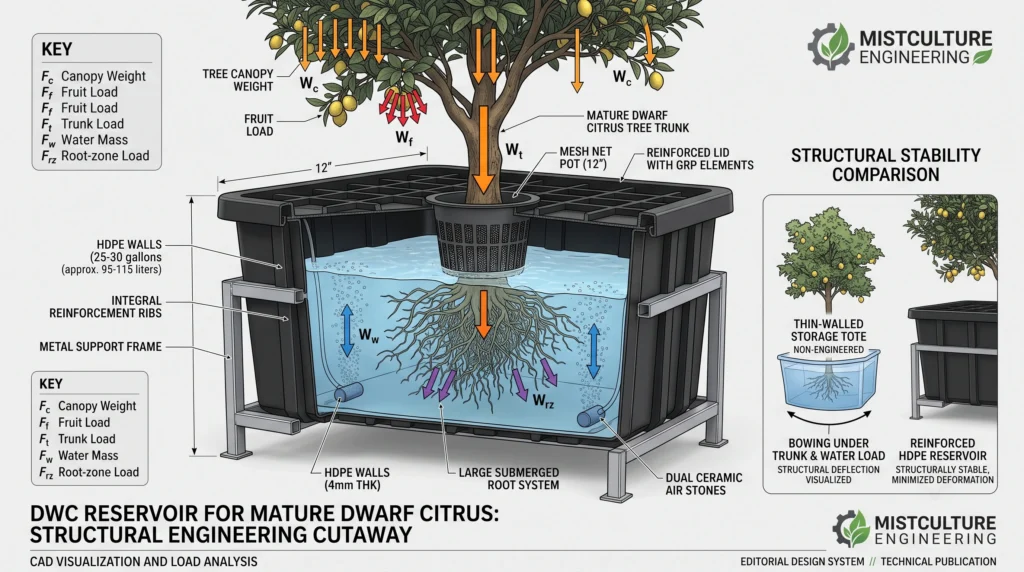
A standard 5-gallon bucket is entirely inadequate for a fruit tree. The absolute minimum root zone volume required for a dwarf citrus or fig tree is 15 to 20 gallons, with 25 to 30 gallons being the optimal target for long-term, multi-year production. Water weighs approximately 8.34 pounds per gallon. A 25-gallon reservoir holds over 200 pounds of fluid. When you add the weight of the saturated growing media, the tree trunk, the canopy, and a heavy fruit set, the total weight easily exceeds 300 pounds per plant. Standard thin-walled plastic storage bins will bow, stress-fracture, and eventually burst under this continuous static pressure.
You must utilize heavy-duty commercial totes constructed from high-density polyethylene (HDPE) rated for heavy loads, or build custom rigid wooden frames to encase the plastic reservoirs. The lid of the reservoir also requires reinforcement. A 12-inch heavy-duty mesh net pot is necessary to accommodate the woody crown of the tree, and the lid must support this pot without sagging.

- Constructed from blow-molded polyethylene, zinc-plated steel and aluminum.Fit Type: Universal Fit
- Front-mounted double wheel-swivel engineered for easy maneuvering and mounted on a heavy-duty, extra large mounting plat…
- Designed to be a quiet and smooth rolling tote tank
- Why it’s necessary: Standard plastic bins bow and crack under the static weight of 25 gallons of water combined with a heavy fruit tree canopy. Industrial HDPE construction prevents catastrophic reservoir failures.
- Key Spec: UV-stabilized, food-grade HDPE rated for 350+ pounds of continuous load.
Maximizing Dissolved Oxygen in Large Reservoirs
Large root masses respire heavily, consuming dissolved oxygen (DO) at a rapid rate. Hypoxia (oxygen starvation) is the fastest way to kill a hydroponic tree. The dense root mats of a citrus tree will strip the surrounding water of oxygen within hours if the aeration system fails.
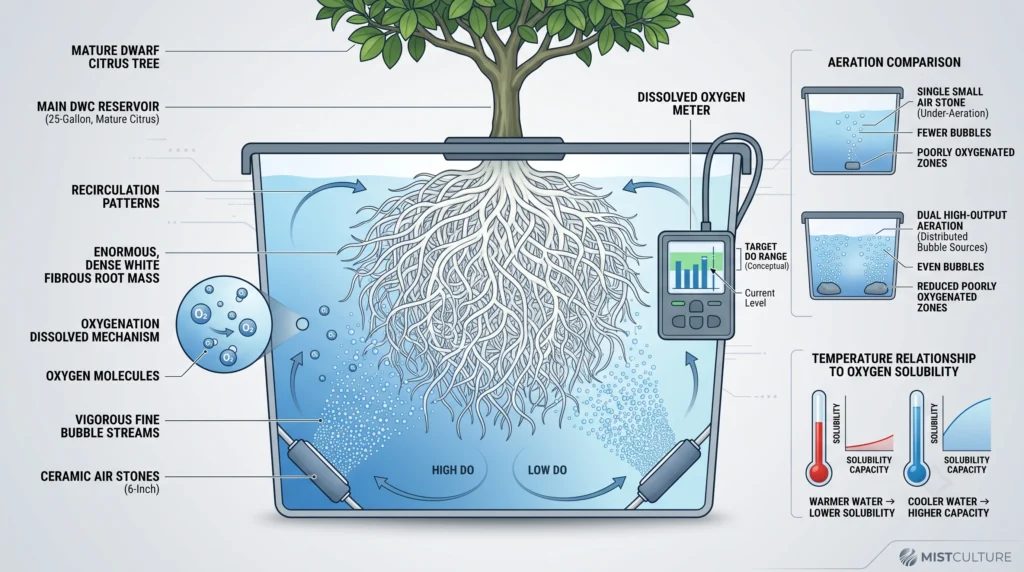
Standard DWC setups utilizing a single small air stone per bucket will not suffice. For a 25-gallon reservoir supporting a fruit tree, you must deploy an aggressive aeration strategy:
- Install two 6-inch high-output ceramic air stones, positioned at opposite diagonal corners of the reservoir to ensure uniform gas exchange.
- Utilize an air pump rated at 15 to 20 watts per reservoir, capable of delivering a total airflow of 8 to 10 Liters Per Minute (LPM).
- For commercial arrays, integrate a venturi injector on the main circulation line to mechanically entrain ambient air into the water stream before it enters the root zone.
The physical target for dissolved oxygen in a fruit tree reservoir is 7 to 9 mg/L. Because oxygen solubility decreases as water temperature rises, clamping your reservoir temperature between 65 and 72 F (18 to 22 C) is mandatory to hit this DO target. For quiet, high-efficiency aeration options, review our breakdown of the best DWC air pumps. If you are running multiple large reservoirs in an apartment or shared living space, managing the acoustic output of these large air pumps requires strategic planning, which we detail in our DIY DWC quiet setup manual.

- POWERFUL AERATOR PUMP & ENERGY CONSERVATION – AQQA fish tank air pump 3 watt equipped with a high-quality pump, the pump…
- NOISE REDUCTION ULTRA QUIET FUNCTION – The aquarium air pump features a sturdy double-layer structure with a built-in ai…
- DURABLE STAINLESS STEEL DUAL OUTLET DESIGN – The fish air pump designed with 2 stainless steel outlets, long service lif…
- Why it’s necessary: Large root systems deplete dissolved oxygen rapidly. Dual outlets allow you to position air stones at opposite ends of a large tote, eliminating anaerobic dead zones.
- Key Spec: 10 LPM total airflow at high static pressure for deep water penetration.
Nutrient Protocols for Dwarf Citrus and Figs
Woody perennials dictate an entirely different nutritional profile than fast-growing leafy greens. While a lettuce crop demands high nitrogen for rapid vegetative expansion, applying a generic high-nitrogen formulation to a mature fruit tree will result in massive foliage overgrowth, delayed flowering, and poor fruit set.
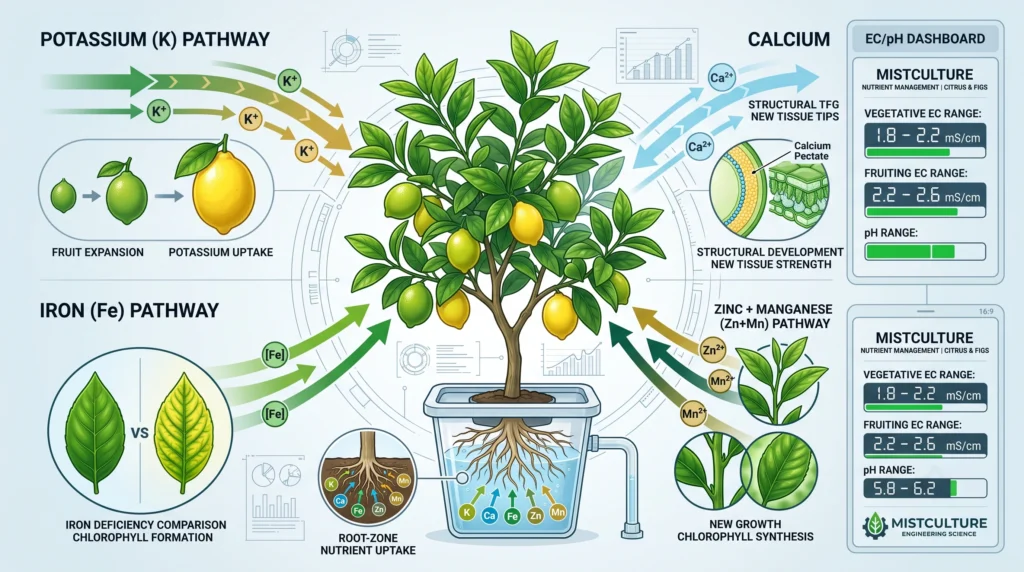
The transition from vegetative growth to fruiting requires precise adjustments in the N-P-K ratios:
1. Potassium (K) Dominance: Fruit development, expansion, and sugar accumulation rely entirely on potassium. Potassium acts as the primary osmoticum within the plant, drawing water into the fruit cells to swell the lemons or figs. During the fruiting phase, potassium levels must be spiked significantly. 2. Calcium (Ca) Supplementation: Calcium is a non-mobile element within plant tissue, meaning the tree cannot move calcium from old leaves to new fruit. It must be continuously available in the root zone. Calcium provides the structural integrity for cell walls. A localized calcium deficiency during fruit expansion causes cell walls to collapse, resulting in blossom end rot and split fruit. 3. Micronutrient Ratios: Citrus trees are particularly sensitive to deficiencies in iron (Fe), zinc (Zn), and manganese (Mn). These trace elements are critical for enzyme activation and chlorophyll synthesis. Iron deficiency rapidly presents as interveinal chlorosis (yellowing between green veins) on new growth.
Target Parameters:
- Vegetative Stage: Target Electrical Conductivity (EC) of 1.8 to 2.4 mS/cm.
- Fruiting Stage: Target EC of 2.0 to 2.8 mS/cm.
- pH Range: Clamp the reservoir pH tightly between 5.8 and 6.2. At pH levels above 6.5, iron and manganese precipitate out of solution, becoming completely unavailable to the tree.
Always verify your baseline water chemistry before mixing salts. Use our hydroponic nutrient calculator to balance your specific elemental parts-per-million (ppm) targets. For a deeper understanding of calcium mobility and interactions, consult our Cal-Mag hydroponics guide.

- Measures pH/EC/TDS (ppm)/Salinity/Temp. in a quick and professional manner
- Replaceable multi-parameter probe with easy installation
- When the smiley face icon stays on screen, it’s the right time to record the measurements.
- Why it’s necessary: Precision management of fruit tree nutrition requires daily validation of the reservoir chemistry. Fluctuations outside the 5.8-6.2 pH band immediately lock out critical micronutrients.
- Key Spec: Features Automatic Temperature Compensation (ATC) and multi-point calibration for laboratory-grade accuracy.
Climate Control and Thermal Management
Fruit trees evolved in specific outdoor climates and rely on temperature fluctuations to regulate their biological clocks. You must simulate these environmental cues indoors to trigger proper flowering and fruit retention.
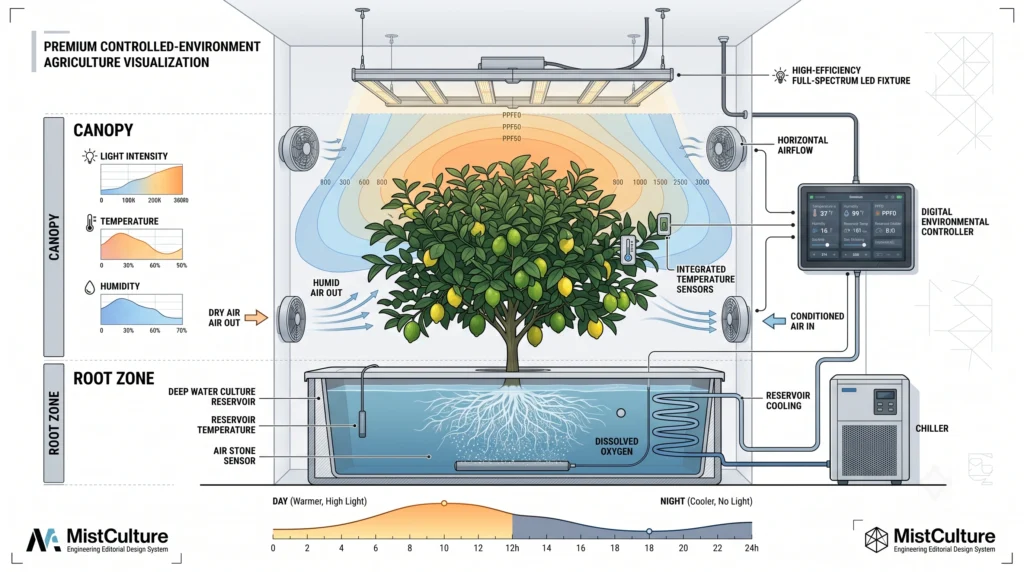
Dwarf citrus requires distinct day and night temperature bands. The ideal daytime temperature ranges from 65 to 75 F. The nighttime temperature must drop to between 55 and 65 F. This day/night temperature differential (DIF) is a primary biological trigger for blossom initiation. Cultivating citrus in a room that remains a constant 72 F around the clock often results in heavy vegetative growth but near-zero flower production.
Humidity plays an equally significant role. Citrus prefers a Relative Humidity (RH) between 50% and 70%. If the air is too dry (below 40% RH), the stigmas in the flowers dry out prematurely, preventing pollen germination, which causes the tree to abort the blossoms. If the humidity is too high, you invite fungal pathogens like sooty mold and botrytis. Deploy humidifiers or dehumidifiers based on your regional ambient baseline, and monitor the room continuously with digital hygrometers.
Cooling the environment during peak summer months is a major logistical challenge for indoor growers running high-wattage lighting. Evaporative cooling is highly effective in arid environments, while mechanical air conditioning is mandatory in humid regions. You can explore energy-efficient temperature regulation in our passive hydro cooling guide.
Root Canopy Development and Pruning
In a soil environment, a tree sends out a thick taproot to anchor itself against the wind, followed by lateral roots to search for water. In DWC, the tree does not need structural anchoring roots, nor does it need to search for water. Consequently, the root system develops into a massive, highly efficient network of fine, fibrous feeder roots.
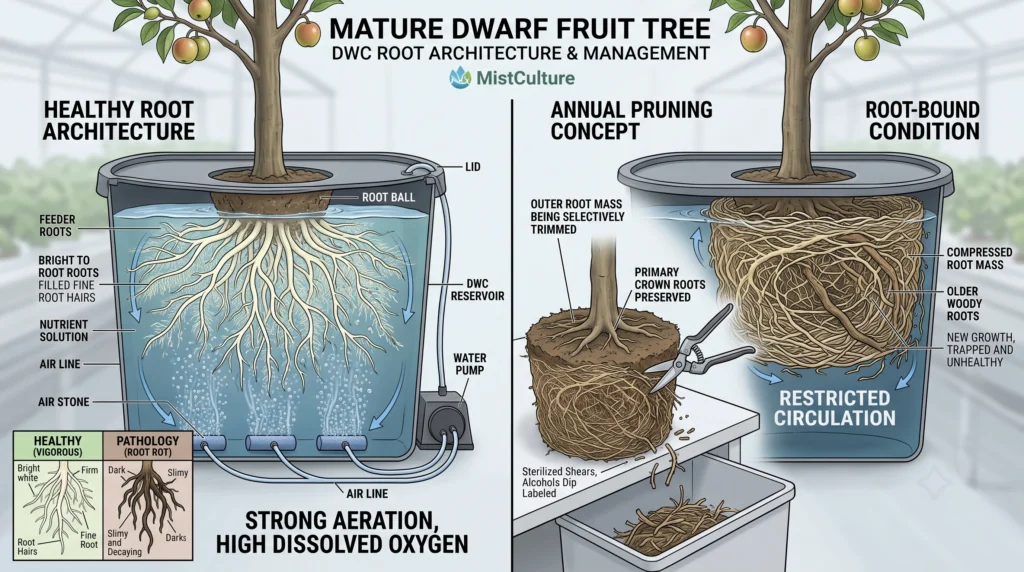
While this maximizes nutrient absorption, a confined 25-gallon tank provides limited physical space. Over several years, these roots will hit the plastic walls and begin circling, eventually choking the reservoir and restricting fluid circulation. To maintain long-term tree health, you must implement an annual root pruning protocol.
Root pruning sounds intimidating but is standard practice in hydroponic tree cultivation and traditional bonsai. Once a year, preferably immediately after the primary harvest before new vegetative growth pushes, lift the tree out of the reservoir. Using sterilized pruning shears, trim away the outer 15% to 20% of the root mass, focusing on any circling roots or older, woody roots. Never cut the primary thick roots descending directly from the crown.
Healthy hydroponic tree roots should appear bright white or pale cream and be covered in fine microscopic root hairs. If you observe dark brown, black, or slimy roots that easily slough off their outer sheath, the tree is suffering from pythium (root rot), almost certainly caused by insufficient oxygenation or reservoir temperatures exceeding 75 F. For immediate remediation steps, apply the protocols found in our hydroponic root rot prevention breakdown.

- Drainage Insert:You will receive 2 round drainage pads, sufficient for your usage and replacement needs. Each pad provid…
- Perfect Design: The unique double-layer structure promotes drainage and enhances airflow, effectively preventing root ro…
- Cuttable Size: Each planter filler insert mesh disc measures approximately 12 inches in diameter and 0.4 inches thick, f…
- Why it’s necessary: Standard 6-inch net cups will snap under the expanding girth of a woody fruit tree trunk. Large mesh pots distribute the crown weight evenly across the reservoir lid.
- Key Spec: Extra-thick UV-resistant plastic lip to prevent the tree from tipping under heavy fruit loads.
Indoor Pollination Mechanics
A major hurdle for indoor fruit production is the complete absence of wind and pollinating insects. While dwarf citrus and fig varieties are generally self-fertile—meaning they do not require pollen from a completely different tree to set fruit—they still require mechanical assistance to move the pollen from the anther to the stigma within the same flower.
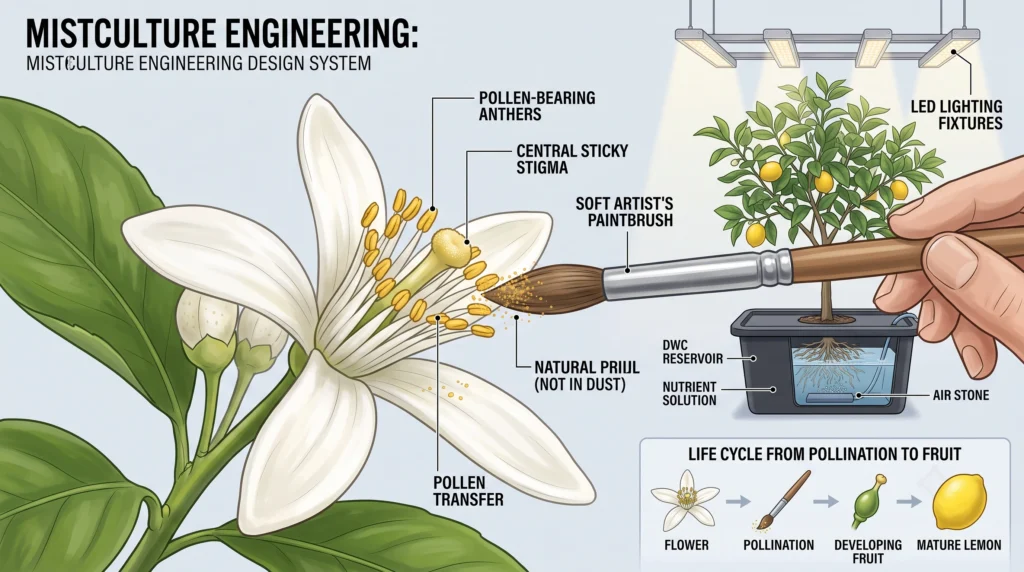
Without your intervention, the flowers will open, dry up, and fall off the tree without producing a single lemon or fig.
Hand Pollination Protocol:
- Wait until the flowers are fully open and the pollen is visibly fluffy on the anthers.
- Use a small, soft-bristled artist’s paintbrush. Gently swirl the brush inside the flower, collecting the yellow pollen.
- Brush the pollen directly onto the sticky, central stigma of the flower.
- Move systematically from flower to flower. Cross-pollinating between different flowers on the same tree often yields higher fruit retention than strictly self-pollinating a single flower.
Alternatively, some commercial growers utilize an electric toothbrush. By holding the vibrating back of the toothbrush against the stem immediately behind the flower cluster for two seconds, the vibration shakes the pollen loose, allowing it to fall onto the stigmas.
Do not panic if you observe significant fruit drop during the first year of production. A young dwarf citrus tree will frequently abort 70% to 80% of its initial fruit set. The tree naturally regulates its crop load based on what its current canopy and root structure can physically and metabolically support. As the tree matures and the trunk thickens in years two and three, fruit retention increases dramatically.
Integrated Pest and Disease Management (IPM)
Woody perennials act as permanent fixtures in your grow room, making them long-term hosts for indoor pests. Unlike a 30-day lettuce crop that is harvested and cleared away, a citrus tree provides a permanent home for pests to establish multi-generational colonies.
The most common adversaries for indoor citrus and figs include aphids, two-spotted spider mites, scale insects, and whiteflies. Because the environment is heavily controlled, natural predators do not exist, allowing a minor pest incursion to explode into a catastrophic infestation within weeks.
Establish a rigid weekly inspection routine. Examine the undersides of the leaves, the junctions where leaves meet the stems, and the developing fruit clusters.
- Sticky Traps: Deploy yellow sticky cards to intercept flying adults like whiteflies and fungus gnats. Deploy blue sticky traps specifically for thrips.
- Scale Insects: Scale appears as small, hard, brown or tan bumps on the stems and leaves. They are impervious to most sprays due to their armored shells. You must manually remove them by wiping the stems with a cotton swab dipped in isopropyl alcohol.
- Spider Mites: Mites thrive in hot, dry air. Maintaining your humidity above 50% slows their reproductive cycle. If webbing appears, apply cold-pressed neem oil mixed with an emulsifying soap every 7 days to break their hatching cycle.
Chemical pesticides should be avoided, especially indoors where ventilation is limited. Focus entirely on organic, mechanical, and biological controls. You can map out a comprehensive defense strategy using our hydroponic IPM guide.
Photobiology and Lighting Requirements
Fruit trees are high-energy crops. Developing dense wood, thick leaves, and sugar-heavy fruit requires massive amounts of photosynthetic radiation. A windowsill will not support a productive fruit tree.
Dwarf citrus and figs require full sun equivalents. In an indoor environment, this translates to a Photosynthetic Photon Flux Density (PPFD) target of 600 to 800 µmol/m2/s at the upper canopy. To achieve this intense light saturation without burning the leaves, you must deploy high-efficiency LED arrays.
Full-spectrum LED fixtures provide the heavy red-band wavelengths required to fuel blossom development and fruit expansion, while emitting significantly less radiant heat than older High-Pressure Sodium (HPS) bulbs. Run your lighting on strict 12 to 16-hour photoperiods. For exact calculations on fixture height and canopy penetration, consult our LED distance and PPFD guide.

- 2026 UPGRADED HIGHLY-REFLECTIVE HOOD LED LIGHT: The upgraded white reflector design on TS1000 grow light is patented, Wi…
- NEW DIODES LAYOUT & HIGH EFFICIENCY WHITE LED GROW LIGHT : The new diodes arrangement of dense in the middle and sparse …
- LOW ENERGY CONSUMPTION GROW LIGHTING: Consuming only 150W with 354 LEDS! Equipped with Newest SMD LED technology to prov…
- Why it’s necessary: Fruiting crops require intense light density to synthesize the sugars necessary for fruit development. Weak lighting results in dropped blossoms and bitter fruit.
- Key Spec: Provides high PPFD output with optimized red/blue spectrums for reproductive growth without excessive thermal output.
Economic Analysis and Yield Projections
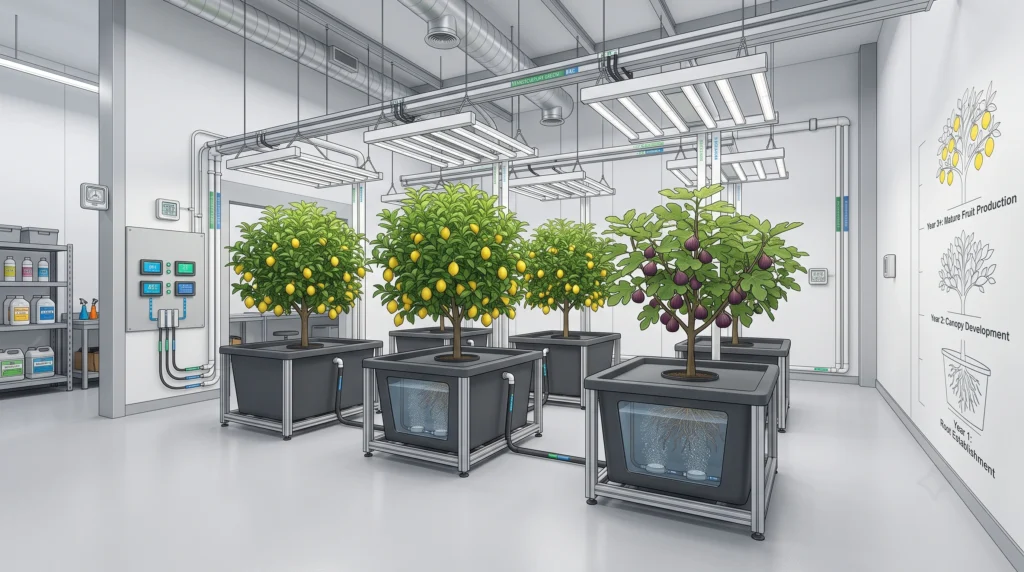
The initial capital expenditure for a dedicated DWC fruit tree system is higher than standard vegetable racks, but the return on investment justifies the cost over a multi-year timeline. A premium 4-tree DWC setup—incorporating heavy-duty reservoirs, high-output aeration, digital monitoring hardware, and high-intensity LED lighting—requires a startup investment between $1,500 and $3,000.
During the first 12 to 18 months, the trees focus entirely on establishing their root networks and primary scaffolding branches. Yields during this establishment phase are negligible. However, by year two and beyond, a healthy dwarf Meyer lemon tree cultivated in optimal hydroponic conditions will yield between 50 and 80 pounds of fruit annually.
Assuming an average yield of 65 pounds per tree across a 4-tree system, the annual production reaches 260 pounds of premium, pesticide-free fruit. At a retail replacement value of $5.00 per pound for organic Meyer lemons, the system generates $1,300 in gross equivalent value per year. Subtracting the recurring costs of electricity and bulk dry nutrients, the hardware investment achieves full payback within 2.5 to 3.5 years. Following the break-even point, the system produces decades of high-value yields. You can adjust these financial models for different hardware tiers using our hydroponic upgrades ROI guide.
Troubleshooting Common Dwarf Tree Issues
Woody perennials communicate environmental and nutritional stress through specific visual markers. Recognizing these signals early allows you to correct the reservoir chemistry before fruit is lost.
- Widespread Yellowing Leaves (Chlorosis): If the entire canopy turns pale yellow, the tree is suffering from a severe nitrogen deficiency or the root zone is suffocating from overwatering/hypoxia. Check your air pump function immediately. If aeration is aggressive, increase your baseline EC to deliver more nitrogen.
- Sudden Leaf Drop: Rapid, green leaf drop is almost always caused by severe temperature shock or a sudden, drastic drop in ambient humidity. Ensure your grow room temperatures are not fluctuating violently when the lights turn off.
- Premature Fruit Drop: While minor drop is normal, shedding large quantities of developing fruit indicates the tree is metabolically stressed. This is frequently caused by inconsistent moisture (allowing the DWC reservoir to drop too low before refilling) or poor pollination.
- Interveinal Chlorosis: Yellowing leaves with distinct, dark green veins indicate an iron or manganese deficiency, almost exclusively caused by the reservoir pH drifting above 6.5.
If your tree is exhibiting complex overlapping symptoms, cross-reference the visual markers in our comprehensive hydroponic troubleshooting guide to isolate the exact variable.
Frequently Asked Questions
Can I grow standard fruit trees in hydroponics, or must they be dwarf varieties?
You must strictly utilize dwarf or semi-dwarf rootstocks for indoor hydroponics. Standard fruit trees possess genetic programming to grow 20 to 30 feet tall. Even with aggressive pruning, a standard tree’s root system will outgrow any practical indoor reservoir within 24 months, leading to nutrient lockouts and system failure. Dwarf varieties are genetically constrained to manageable heights (typically 4 to 8 feet) while still producing full-sized fruit.
How often do I need to completely change the nutrient solution for a fruit tree?
For mature fruit trees in 25-gallon reservoirs, a complete reservoir flush and nutrient replacement should be performed every 4 to 6 weeks. While you will top off the water and add nutrients continuously during that period to maintain the target EC, trees uptake elements at different rates. Over a month, unused trace elements and carbonates accumulate, skewing the chemical balance. Flushing the tank prevents toxic salt buildups.
Do I need to support the branches once the tree starts fruiting?
Yes. Hydroponic plants grow faster and often set heavier fruit loads than their woody stems have had time to harden and support. A branch loaded with Meyer lemons will easily snap under its own weight. Use soft horticultural wire or tomato trellising clips to tie heavy fruit-bearing branches back to the central trunk, or suspend them from the ceiling structure of your grow room to prevent mechanical breakage.

Continue Your Learning Journey