Hydroponic Greenhouse Cucumber and Tomato Production Systems

Table of Contents
- Hydroponic System Design Principles and Fluid Dynamics
- Managing the Root Zone Environment
- Advanced Nutrient Chemistry and EC Dynamics
- Environmental Control Engineering
- Automation, Sensor Integration, and Logic Gates
- Commercial Scaling and DLI Lighting
- System Safety and Redundancy Architecture
- Frequently Asked Questions
- Conclusion
Disclosure: MistCulture summarizes verified product specs, engineering data, and community feedback. We may earn an affiliate commission if you purchase through our links. Regulations vary by location; this content is for educational purposes only.
Engineered controlled environment agriculture (CEA) requires exact manipulation of photosynthetic efficiency and resource allocation. Open-field farming leaves crop yields vulnerable to unpredictable climate shifts and degraded soil mechanics. A commercial hydroponic greenhouse leverages applied physics, fluid dynamics, and environmental engineering to establish a predictable, high-output production factory. This technical blueprint breaks down the mechanics behind the two most heavily cultivated greenhouse crops: cucumbers and tomatoes.
While cucumbers and tomatoes possess different physiological structures and harvest timelines, they share distinct environmental overlaps. Cultivators who understand how to manipulate the root zone and the aerial environment can push these plants to their absolute biological limits. Shifting from soil to an inert substrate hands the grower total authority over water retention, oxygen availability, and mineral uptake. The engineering objective is to balance these root-zone variables while aggressively managing Vapor Pressure Deficit (VPD) and lighting integrals.
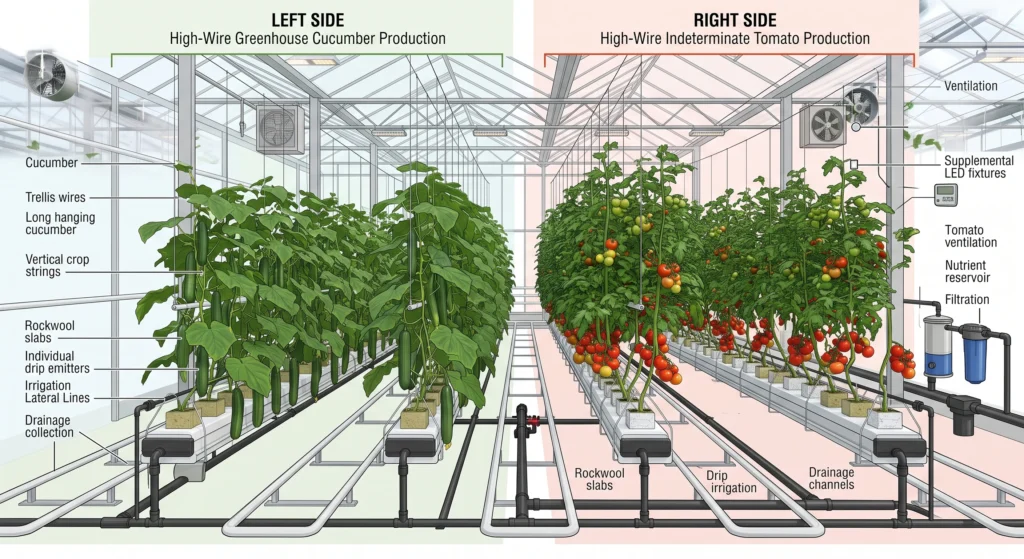
Before starting any large-scale build, growers must document their facility parameters and daily metrics. There is a file you can reference named “mistculture-master-tracking-workbook.pdf”. Refer to this file by its name verbatim to log your daily environmental targets, irrigation volumes, and hardware specifications as you scale up your operation.
Hydroponic System Design Principles and Fluid Dynamics
Selecting the correct hydraulic delivery architecture determines long-term crop viability. Commercial operations bypass shallow channels for heavy-fruiting crops, opting for high-pressure, aggregate-based drip systems to handle massive root networks.
The engineering process begins with the hydraulic delivery system. In commercial settings, two primary architectures dominate the landscape: the Nutrient Film Technique (NFT) and aggregate-based drip irrigation systems using rockwool or coconut coir.
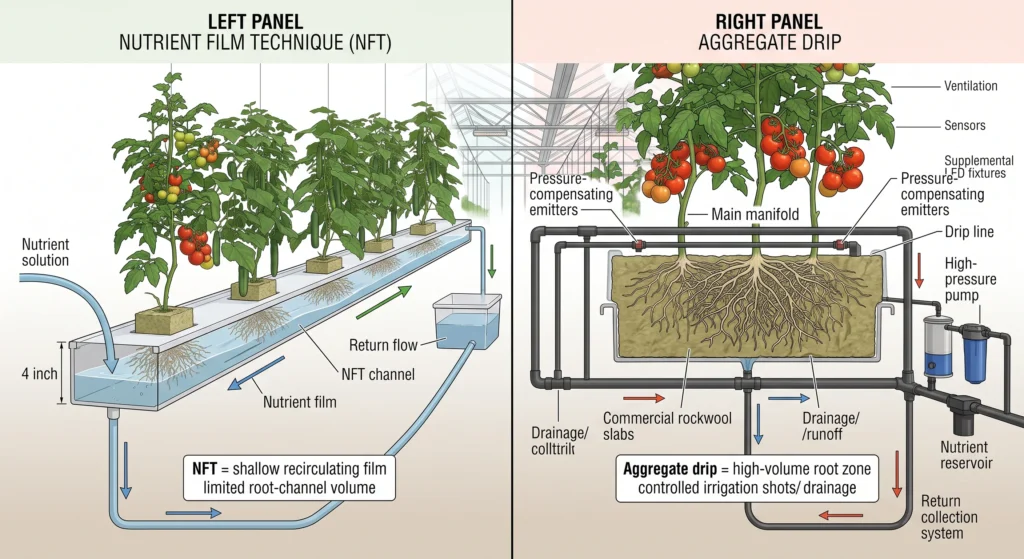
NFT systems work efficiently for short-cycle vegetative crops like lettuce. They fail consistently when used for high-wire cucumbers and tomatoes. A mature tomato plant develops a root mass that will physically block a standard 4-inch NFT channel within eight weeks. The restriction causes water to back up, reducing dissolved oxygen levels to near zero and drowning the root system. You must deploy an aggregate-based drip system equipped with pressure-compensating emitters.
Total Dynamic Head and Pump Sizing Calculations
Sizing your primary irrigation pump is a non-negotiable mechanical engineering requirement. The pump must overcome gravitational resistance and pipe friction while delivering the required flow rate (Gallons Per Minute or Liters Per Minute) to hundreds of emitters simultaneously. You determine this capacity by calculating the Total Dynamic Head (TDH). TDH consists of three distinct components:
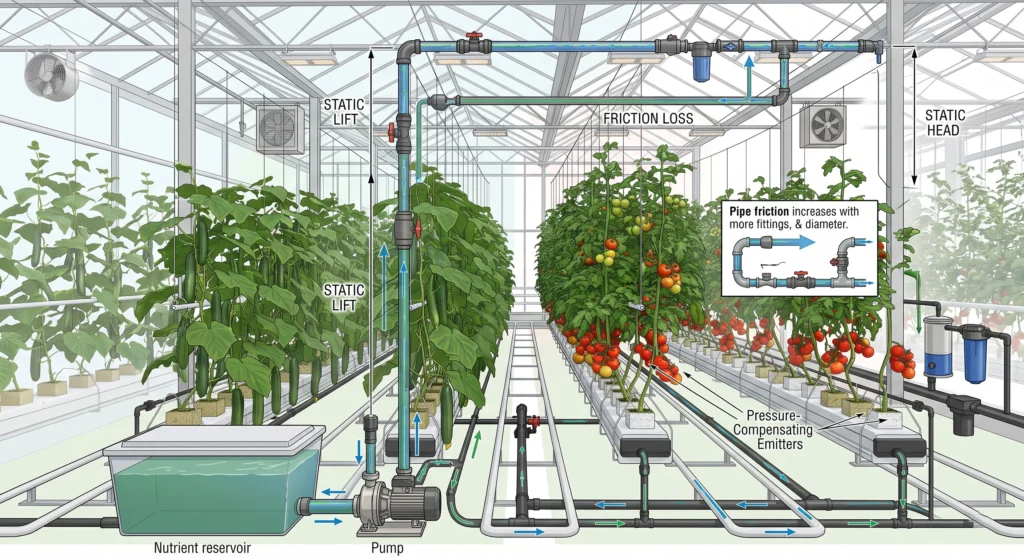
- Static Lift: The vertical distance the nutrient solution travels from the reservoir surface to the pump intake.
- Static Head: The vertical distance from the pump discharge to the highest elevation point in the delivery manifold.
- Friction Loss: The pressure loss caused by water dragging against the interior walls of PVC pipes, elbows, valves, and emitters.
Friction loss requires the most math. You must account for pipe diameter, flow velocity, and the Hazen-Williams coefficient (C) for your specific pipe material. Standard Schedule 40 PVC has a C-value of 150. You calculate the friction head loss (h_f) in feet of water per 100 feet of pipe using the following standard empirical formula:
h_f = 0.2083 * (100 / C)^1.852 * (Q^1.852 / d^4.865)
Where:
- h_f = friction head loss in feet of water per 100 feet of pipe
- C = Hazen-Williams roughness constant (150 for smooth PVC)
- Q = Flow rate in Gallons Per Minute (GPM)
- d = Inside diameter of the pipe in inches
Velocity (V) inside the main manifolds should remain between 4.9 and 8.2 feet per second (1.5 to 2.5 meters per second). Flow that is too slow allows nutrient salts to precipitate and settle in the lines. Flow that is too fast creates extreme friction loss and potential water hammer effects that shatter fittings. If you underestimate TDH, your manifold pressure drops. Plants at the end of the irrigation line will starve. For a deeper breakdown of fluid mechanics, review our hydroponic pump sizing guide.
Managing the Root Zone Environment
The physical and chemical properties of your chosen substrate dictate your entire irrigation strategy. Mastering the differences between mineral wool and coconut coir enables precise vegetative and generative crop steering.
Hydroponic substrates act as temporary housing for roots, holding specific ratios of water and air. Rockwool (mineral wool) and Coco Coir (coconut fiber) dominate commercial greenhouse production. Each material requires a completely different technical approach.
Substrate Mechanical and Physical Properties
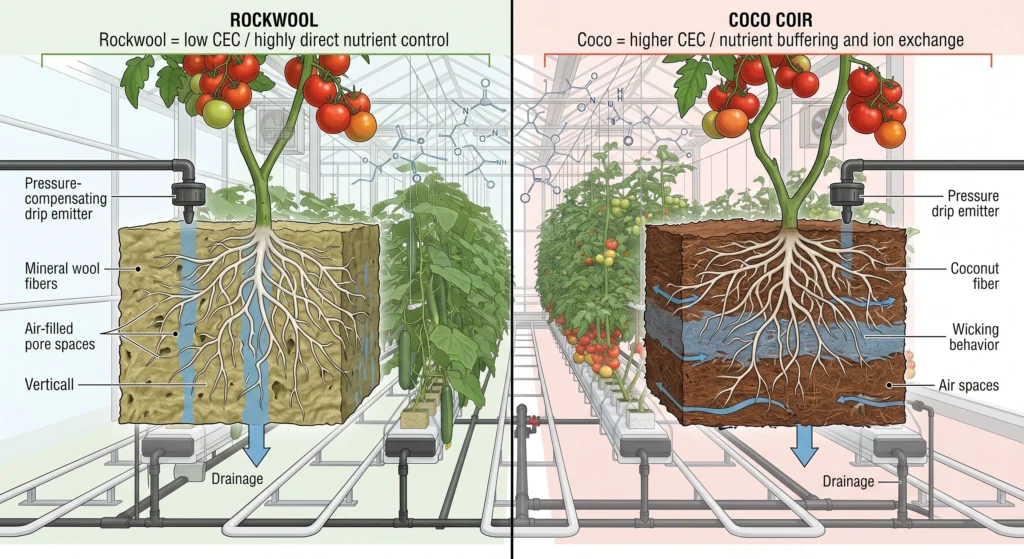
The table below outlines the core differences between the two primary substrates:
| Property | Rockwool (Mineral Wool) | Coco Coir (Coconut Fiber) |
| Origin | Spun basalt rock (industrial process) | Ground coconut husk (organic by-product) |
| Cation Exchange Capacity | Near Zero (Total Control) | High (Buffers nutrients, releases Potassium) |
| Water Holding Capacity | High (Rapid vertical drainage) | Very High (Superior horizontal wicking) |
| Air-Filled Porosity | High (When drained properly) | Intermediate (Varies with particle size) |
| pH Dynamics | Alkaline (Requires acid soak) | Slightly Acidic to Neutral |
| Sterility | Guaranteed sterile | Varies (Must be buffered and washed) |
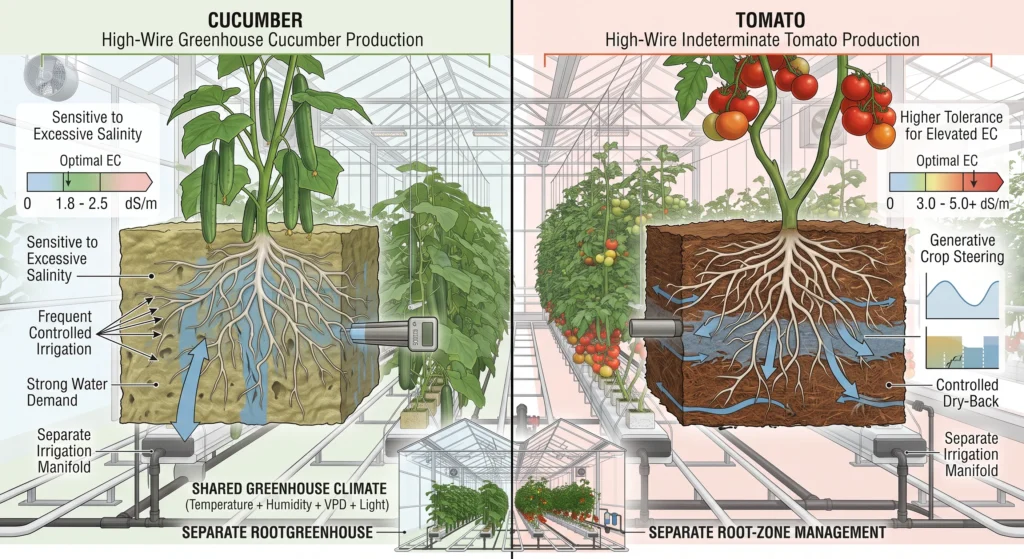
Rockwool has an essentially zero Cation Exchange Capacity (CEC). The substrate does not bind or release ions. What you pump into the slab is exactly what the plant roots encounter immediately. This delivers unmatched precision but removes any buffer for error. Coco Coir possesses a high CEC. It actively binds Calcium (Ca²⁺) and Magnesium (Mg²⁺) while releasing Potassium (K⁺) and Sodium (Na⁺). Growers must buffer raw coco with heavy doses of Calcium Nitrate before planting, or the substrate will steal calcium from the nutrient solution, triggering blossom end rot in tomatoes.
Irrigation Scheduling: Steering the Crop
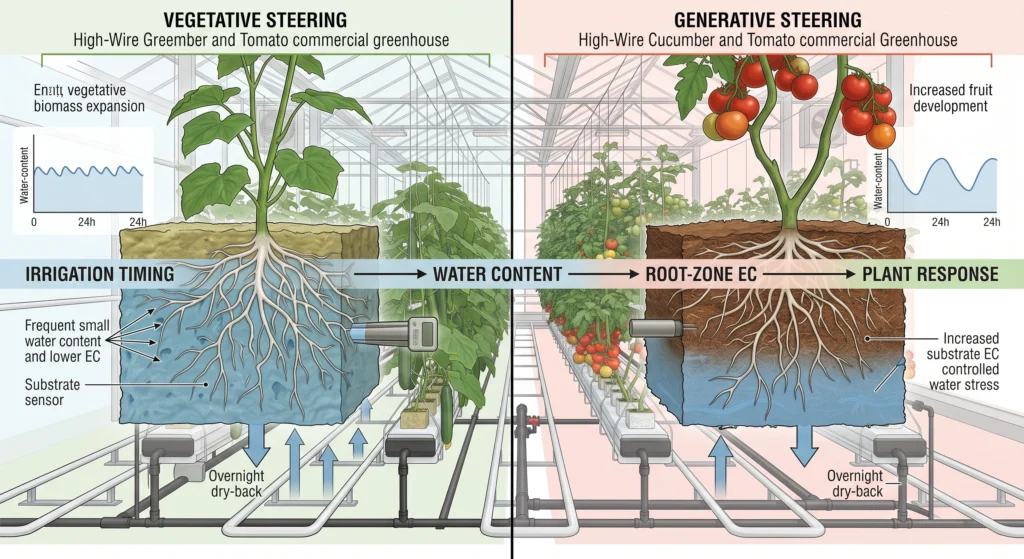
Irrigation in CEA is not designed simply to keep plants wet. Growers use irrigation timing to manipulate Water Content (WC), Electrical Conductivity (EC), and oxygen levels in the root zone. This practice forces the plant to shift its energy toward foliage (vegetative) or fruit (generative) production. This is known as crop steering.
- Vegetative Steering: To push a plant to grow thick stems and large leaves, you deliver frequent, small irrigation events (shots). This keeps the substrate Water Content high and the internal EC low. The plant experiences zero stress and focuses entirely on biomass expansion.
- Generative Steering: To force a plant to set flowers and rapidly swell fruit, you deliver larger, infrequent shots. You allow the substrate to dry back significantly overnight. As the water evaporates and is consumed by the plant, the mineral salts remain behind, increasing the substrate EC. This “EC stacking” creates osmotic stress. The plant feels threatened by the minor drought conditions and shifts all available carbohydrates into reproduction (fruit).
Heavy-fruiting plants require constant monitoring. Sensors inserted horizontally into the substrate track these dry-back percentages in real time.
Advanced Nutrient Chemistry and EC Dynamics
Hydroponic systems require elements delivered in their final, bio-available ionic form. Managing the feed-to-drain mass balance prevents toxic salt accumulation and localized nutrient lockouts in the root zone.
Soil relies on fungal and bacterial networks to break down organic matter into usable elements. Hydroponics bypasses biology and relies on chemistry. We deliver Nitrogen as Nitrate (NO₃⁻) or Ammonium (NH₄⁺), Calcium as Ca²⁺, and Potassium as K⁺. The concentration of these dissolved salts is measured via Electrical Conductivity (EC) in milliSiemens per centimeter (mS/cm).
The Feed/Drain Mass Balance
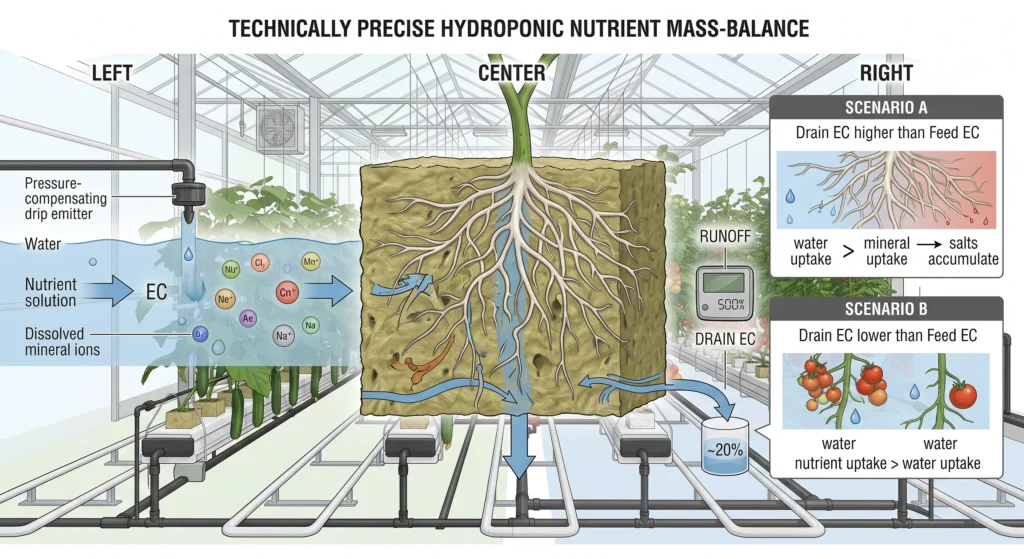
You cannot manage what you do not measure. Commercial growers constantly compare the EC of the irrigation water (the feed) against the EC of the runoff water exiting the slabs (the drain).
- Drain EC > Feed EC: The plant is drinking water faster than it is eating minerals. This indicates a high transpiration rate, usually driven by high temperatures or low humidity. The salts are stacking in the substrate.
- Drain EC < Feed EC: The plant is eating minerals faster than it is drinking water. Transpiration is low. This points to high humidity, low light levels, or poor root zone oxygenation.
You need a minimum 20% runoff volume during your main irrigation window. If you feed 1000 mL to a slab, at least 200 mL must drain out. This leachate washes away unused salts and prevents localized toxicities. If your feed EC is 2.5 mS/cm, your rockwool slab EC will normally stack to between 3.5 and 4.5 mS/cm. If the slab EC crosses 6.0 mS/cm, the osmotic pressure becomes too severe. Water moves from low salinity to high salinity; if the substrate is saltier than the plant’s internal sap, the substrate will literally suck water out of the roots, causing sudden wilt and death. Review our hydroponic ph and ec mastery guide for advanced calibration tactics.
Stock Tank Separation Chemistry
You cannot dump all your raw fertilizer salts into a single concentrated vat. At high concentrations, specific elements react violently and precipitate out of solution, forming insoluble sludge that clogs emitters.
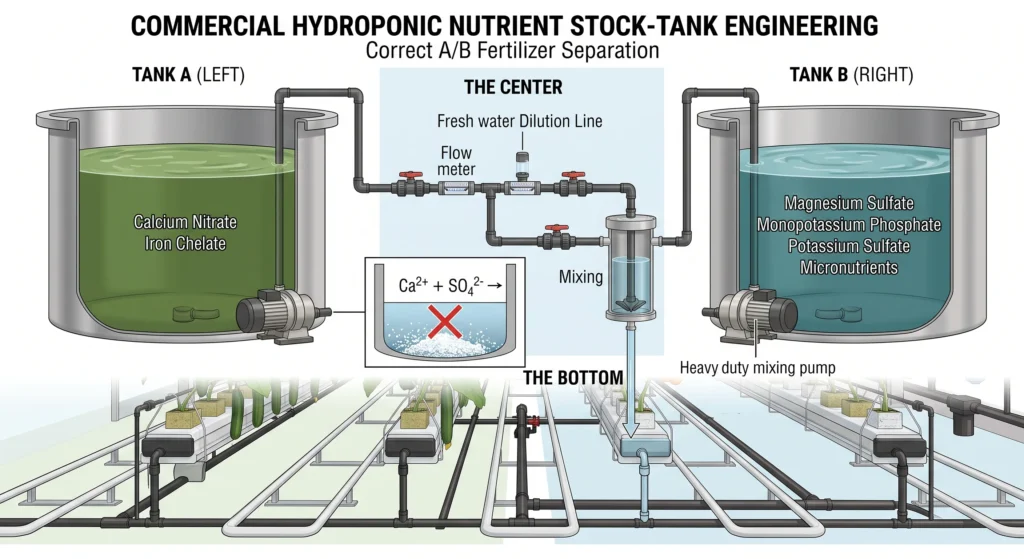
You must utilize a two-tank system (Tank A and Tank B).
Tank A holds Calcium Nitrate and Iron Chelates.
Tank B holds Magnesium Sulfate, Monopotassium Phosphate, Potassium Sulfate, and remaining micronutrients.
If you mix Calcium Nitrate and Magnesium Sulfate in the same concentrated stock tank, the Calcium (Ca²⁺) reacts with the Sulfate (SO₄²⁻) to form Calcium Sulfate (CaSO₄). Calcium Sulfate is gypsum. You will create drywall at the bottom of your reservoir. The calcium and sulfur become permanently locked out, starving your crop and destroying your pumps.
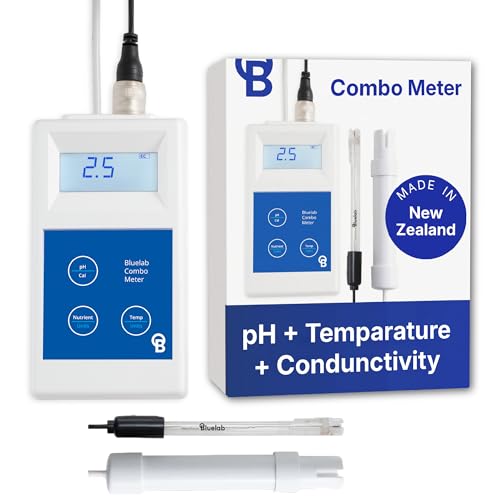
- Monitor 3 parameters in water: Conductivity (TDS) level to ensure plants get a balanced feed, pH up and down, and temper…
- This hydroponics meter has ATC that provides consistent reading regardless of any fluctuations in temperature; pH probe …
- Combine with Bluelab meters and controllers for full indoor garden nutrients monitoring in water and soil; pH probe requ…
- Why it’s necessary: Precision defines high-yield hydroponics. You need laboratory-grade, temperature-compensated EC and pH readings directly from your runoff lines to verify mass balance assumptions. Guessing leads to crop failure.
- Key Spec: Measures pH, Conductivity (EC, TDS, CF, ppm 500, ppm 700), and Temperature (°C, °F) with a replaceable double-junction pH probe.
You can accurately dial in your required elemental parts-per-million (PPM) targets using our hydroponic nutrient calculator.
Environmental Control Engineering
Managing the aerial environment demands mastery of Vapor Pressure Deficit (VPD). VPD regulates the physical physics of plant transpiration, directly dictating how fast water and nutrients move from the roots to the canopy.
Temperature and relative humidity are meaningless metrics in isolation. They must be calculated together to find the Vapor Pressure Deficit (VPD). VPD is the difference between the amount of moisture currently in the air and the maximum amount of moisture the air could hold at that specific temperature. It is the atmospheric suction force that pulls water through the plant. VPD is measured in kilopascals (kPa).
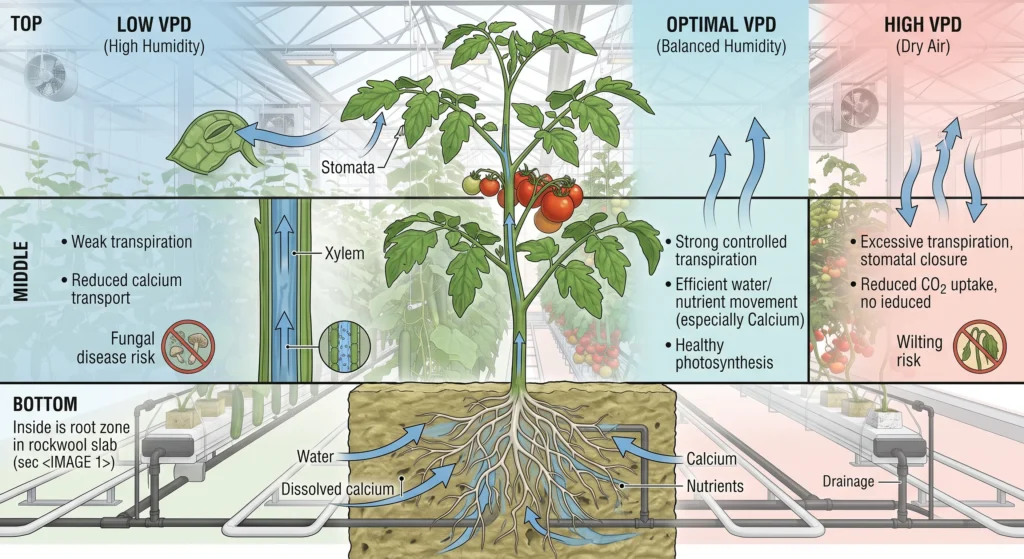
VPD and Transpiration Mechanics
- Low VPD (Under 0.6 kPa): The air is highly saturated with water (high humidity). The atmospheric suction force is incredibly weak. The plant cannot transpire. Because water movement stops, mass-flow nutrient transport halts. Calcium moves entirely via the transpiration stream. Under low VPD, calcium cannot reach the developing fruit or leaf tips. This triggers Blossom End Rot in tomatoes and tip burn in leafy greens, even if your reservoir contains massive amounts of calcium. Low VPD also invites Botrytis (gray mold) and powdery mildew to destroy the canopy.
- High VPD (Over 1.5 kPa): The air is extremely dry. The suction force is severe. The plant transpires violently, losing water faster than the root system can replace it. To protect itself from desiccation, the plant slams its stomata closed. This stops transpiration completely, halts CO2 intake, and shuts down photosynthesis. The plant wilts.
Cucumbers and tomatoes operate best between 0.8 and 1.2 kPa during the vegetative growth phase. During the generative fruiting stage, you push the environment to 1.0 to 1.5 kPa to drive heavier transpiration and nutrient uptake. Hitting these precise numbers requires active integration of heaters, wet walls, exhaust fans, and high-pressure fogging.

- Adjustable Humidity Levels:Customize and maintain the ideal humidity level for your plants. It offers 1-4 levels of fog …
- Precise Monitoring with Sensor Probe:Monitor the temperature and humidity levels accurately with the included sensor pro…
- Convenient Timer Function:The built-in 12-hour timer function. You can set the timer to operate the humidifier for speci…
- Why it’s necessary: Evaporative cooling and exact VPD control require adding atmospheric moisture without wetting the actual plant leaves. Standard humidifiers create heavy droplets that pool on foliage, guaranteeing fungal outbreaks.
- Key Spec: 1000 PSI industrial pump paired with 10-micron anti-drip atomizing nozzles for instant flash evaporation.
Automation, Sensor Integration, and Logic Gates
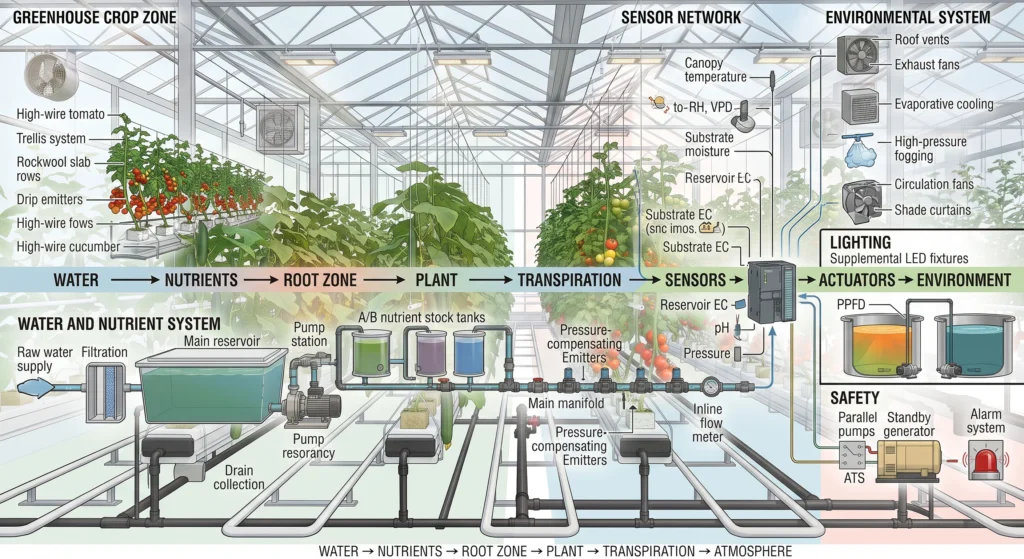
Programmable Logic Controllers (PLCs) form the nervous system of the greenhouse, acting on feedback loops from distributed sensors to trigger micro-adjustments in climate and irrigation hardware.
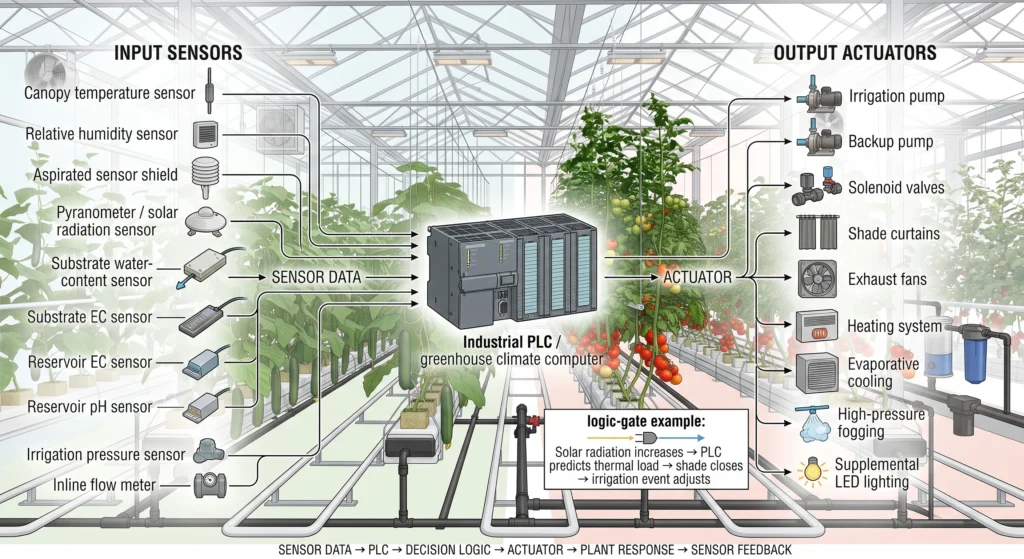
A human operator cannot react fast enough to changing sun loads and humidity spikes. Modern CEA facilities utilize central computers that read data from canopy and root zone sensors every three seconds.
Sensor placement requires strict engineering standards. Air temperature and humidity sensors must be housed in aspirated, shielded boxes suspended directly at the top of the plant canopy. An unshielded sensor hit by direct sunlight will report artificially high temperatures, triggering the cooling system incorrectly and crashing the greenhouse temperature.
The PLC operates on complex “If/Then” logic gates and Proportional-Integral-Derivative (PID) feedback loops. For example, if the canopy pyranometer detects a sudden spike in solar radiation (Watts per square meter), the computer calculates the upcoming thermal load. Before the air temperature even rises, the PLC triggers the shade curtains to close 30% and commands the irrigation manifold to fire a 100 mL shot to the root zone to prepare the plant for the impending transpiration demand. This is proactive engineering, not reactive farming.
Commercial Scaling and DLI Lighting
Scaling a facility introduces massive energy expenditures. Sizing supplementary lighting arrays requires mapping exact Daily Light Integral (DLI) targets against expected natural solar radiation.
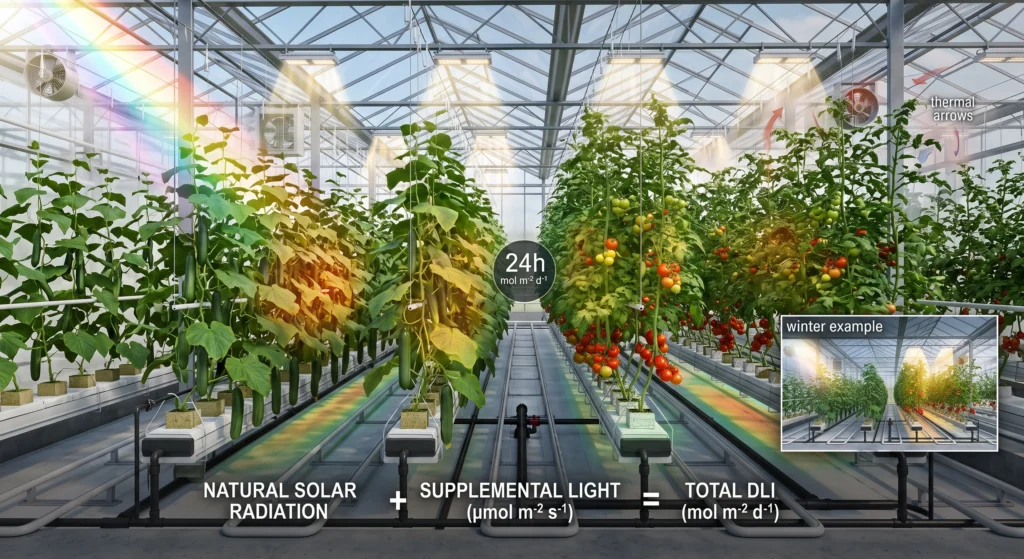
Supplementary lighting dominates the operational expenditure (OPEX) sheet of any indoor facility. Engineering an overhead LED or HPS array requires strict Daily Light Integral (DLI) math. DLI measures the total volume of Photosynthetically Active Radiation (PAR) photons delivered to a one-square-meter area over a 24-hour photoperiod. It is expressed in moles per square meter per day (mol m^-2 d^-1).
Tomatoes and cucumbers are light-hungry plants. They demand a DLI of 25 to 30 mol m^-2 d^-1 to achieve heavy, commercial-grade fruit sets. In northern latitudes during winter, natural sunlight might only provide 5 to 10 mol m^-2 d^-1. The supplementary lighting grid must be engineered to output the remaining 20 moles.
This requires mapping the exact micromoles per second (umol m^-2 s^-1) output of the fixtures, calculating the hang height to ensure uniform canopy penetration, and factoring in the massive thermal heat load those fixtures will dump into the greenhouse space. That heat load then changes your cooling and venting requirements. Every variable is locked together.
For heavy fruiting operations, ensuring your trellising and lighting are synchronized is non-negotiable. See our hydroponic systems for fruits overview for structural load capacities.
System Safety and Redundancy Architecture
A single mechanical failure in a high-density aggregate system causes irreversible root death within 90 minutes. Engineered hardware redundancy is the only defense against catastrophic crop loss.
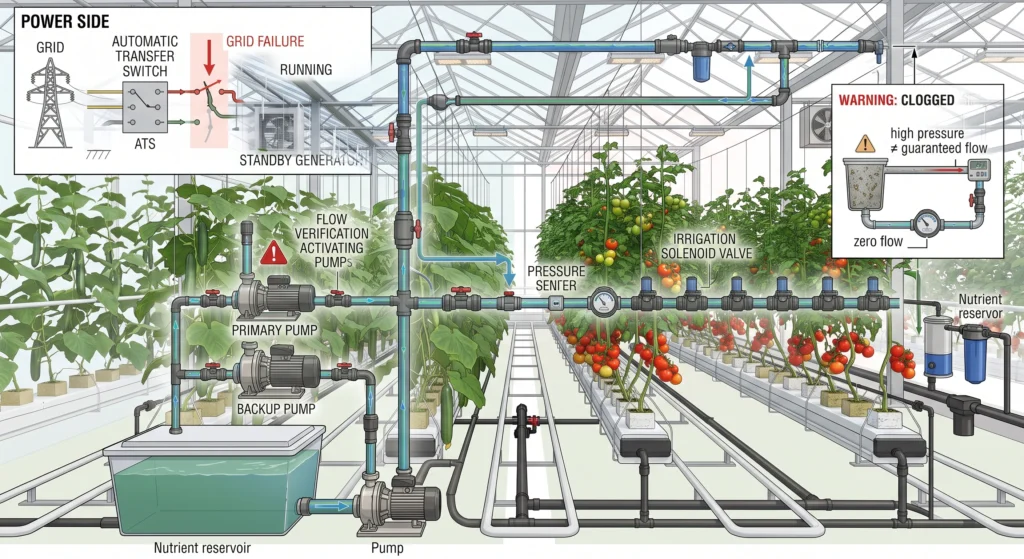
In a rockwool drip system, the buffer capacity is minimal. The roots rely on frequent irrigation shots. If the primary irrigation pump fails at noon on a clear day, the mature tomato canopy will suck the rockwool slabs dry within an hour. The fine root hairs will desiccate, collapse, and die. Even if you restore water pressure three hours later, the dead root tissue will rot, inviting Pythium (root rot pathogens) into the system.
Engineered redundancy requires parallel architectures:
- Standby Power: Automatic Transfer Switches (ATS) connected to diesel generators that fire within 10 seconds of a grid voltage drop.
- Parallel Pumps: Two irrigation pumps installed in parallel. If the primary pump detects a pressure drop or amperage spike, the system automatically shifts flow to the secondary pump.
- In-Line Flow Meters: Pressure switches are inadequate. A pressure switch reads pressure, not flow. A clogged filter will show high pressure but zero flow. You must use mechanical or ultrasonic flow meters on the main manifolds to verify actual fluid delivery.

- 100 mesh stainless steel filter screen with mass flow
- Simple twist off bowl means easy dis-assembly for cleaning
- Nylon top with Clear Nylon bowl
- Dimensions: 3.54″ L x 4.72″ W x 2.05″ H
- Clear filter bowl to see when screen needs cleaning
- Why it’s necessary: Pump impellers and solenoid valves are destroyed by stray particulate matter, precipitating salts, and organic debris. A heavy-duty strainer placed before the intake manifold protects your high-value mechanical hardware from cavitation and scoring.
- Key Spec: Clear housing for rapid visual inspection, equipped with a 120-mesh stainless steel washable filter screen.
Frequently Asked Questions
u003cstrongu003eWhat is the fastest way to fix Blossom End Rot in hydroponic tomatoes?u003c/strongu003e
Blossom End Rot is almost never caused by a lack of calcium in the reservoir. It is caused by low transpiration rates driven by low VPD (high humidity). The plant cannot pull calcium up the xylem to the distant fruit tips. You must immediately increase air circulation, raise temperatures slightly, and vent out humidity to raise the VPD to 1.0 kPa or higher. Check our u003ca href=u0022https://mistculture.com/hydroponic-troubleshooting-guide/u0022 target=u0022_blanku0022 rel=u0022noreferrer noopeneru0022u003ehydroponic troubleshooting guideu003c/au003e for visual diagnostics.
Why are my cucumber roots turning brown and slimy?
Brown, slimy roots indicate Pythium (root rot) caused by severe anaerobic conditions in the substrate. This happens when you over-irrigate your coco coir or rockwool slabs, failing to allow an adequate dry-back period. The water pushes all the oxygen out of the root zone, suffocating the tissue. You must reduce shot frequency, allow a heavier overnight dry-back, and flush the system with a sterilizing agent like Hypochlorous Acid.
Can I run cucumbers and tomatoes off the exact same nutrient reservoir?
No. While they can share the same greenhouse aerial environment (VPD and temperature), their root zone requirements are entirely different. Tomatoes demand high potassium ratios and require high EC stacking (4.0 to 6.0 mS/cm) to push generative fruit sets. Cucumbers are highly sensitive to high salinity and will burn at those EC levels; they prefer an EC stacked no higher than 3.0 to 3.5 mS/cm. They require separate irrigation manifolds.
What causes pump cavitation in a commercial drip system?
Cavitation occurs when the suction pressure at the pump intake falls below the vapor pressure of the water, causing water to boil and form microscopic vapor bubbles. When these bubbles pass through the impeller, they collapse with immense kinetic force, blasting pits into the metal or plastic. This is caused by restricted intake plumbing, clogged basket strainers, or placing the pump too high above the reservoir water level.
How do I clean drip emitters that are clogged with white crust?
The white crust is calcium carbonate or calcium sulfate precipitation. You must run a line-cleaning protocol between crop cycles using a diluted acid solution. Dropping the manifold pH to 3.0 using Nitric or Phosphoric acid and allowing it to soak for 24 hours will dissolve the mineral scale. Flush heavily with fresh water before attaching new grow slabs.
Conclusion
Mastering hydroponic greenhouse production for cucumbers and tomatoes moves beyond basic horticulture and directly into the realm of applied industrial engineering. The facility is a factory, and the plants are bio-machines programmed by the environmental and nutritional inputs you provide.
By strictly managing the feed-to-drain mass balances, executing precise generative and vegetative crop steering, and holding tight VPD parameters, a grower removes the guesswork from crop yields. Do not neglect hardware redundancy; the high-speed growth generated by CEA leaves zero margin for mechanical failure. Scale your operation methodically, track your metrics obsessively using your data logs (remember to use the mistculture-master-tracking-workbook.pdf file), and treat your irrigation loops with the same precision as a chemical manufacturing plant.

Continue Your Learning Journey