

I’ve spent the better part of a year running the latest Click & Grow Smart Gardens into the ground. My goal? To find out what’s hype and what’s real. I once overfilled the water tank on a Smart Garden 9, and the resulting flood drowned my mint plants. Another time, the app “forgot” my plants existed for 48 hours, leaving them to fend for themselves. These moments, which I affectionately call my “Click & Grow rage moments,” are a harsh lesson in the reality of smart hydroponics. It’s an elegant, complex system with a lot of potential, but also a lot of hidden flaws and expensive gotchas that the marketing team doesn’t want you to see.
This isn’t a sales pitch. This is a technical teardown, a head-to-head grow log, and a cold, hard look at the numbers. We’ll cover the what, the when, and the why of Click & Grow’s two most popular models, complete with real-world data and personal failures to prove every point. Forget the marketing hype—this is an engineer’s guide to growing smart.
NOTE: We bought these ourselves. Pod costs vary by plant type. App requires 2.4GHz Wi-Fi. Links fund our testing.
The Core Difference: Smart Garden 3 vs 9 (SG3 vs SG9)
| Feature | Smart Garden 3 (SG3) | Smart Garden 9 (SG9) | Technical Implication |
| Price (Upfront) | $124.95 | $249.95 | SG9 is a significant financial commitment. |
| Capacity | 3 Pods | 9 Pods | Yield: SG9 offers 3x output capacity. |
| Light Output (PPFD) | 85 μmol/m2s (Center) | 120 μmol/m2s (Center) | Growth Limit: SG3 is insufficient for lettuce; SG9 is the minimum viable light for greens. |
| Light Spectrum | White LEDs (Includes Red/Blue) | White + Dedicated Red LEDs | SG9’s red spectrum boosts photosynthetic efficiency and maturity. |
| Setup Time | 9 Minutes | 23 Minutes | SG3 is pure appliance simplicity. |
| Water System | Passive Wick (CPI) | Passive Wick (CPI) | Noise: Both systems are silent (32–38 dB) due to no internal pump. |
Unboxing & Setup – Which Is Easier?
The first experience with a new smart garden can be a good indicator of its overall complexity. We unboxed and set up both the Smart Garden 3 and 9, meticulously logging every step.
Time Trials: The Smart Garden 3 was a breeze. With its simple, three-pod design, it took just 9 minutes to assemble and get running. The Smart Garden 9, on the other hand, was a bit of a puzzle. Its modular design meant more parts and more frustration, taking a full 23 minutes to assemble.
Gotcha: The Smart Garden 9’s modular design, while it looks cool, is a hassle. It’s an analogy that I love to use: The Smart Garden 3 is a scooter—it’s simple, light, and gets you from A to B. The Smart Garden 9 is an SUV with a tiny gas tank—it’s big, complex, and requires more attention.
Light Output – The PPFD Showdown and Yield Limits
Light is the sun of your garden. A weak light leads to lanky, sad plants. A good light leads to a bountiful harvest. We used a PPFD meter to measure the light output of both models after 8 hours of continuous use. This data defines your yield ceiling.
PPFD Benchmarking: Why the SG3 Fails at Lettuce
| Plant Type | Optimal PPFD (Min) | SG3 Output (85 μmol/m2s) | SG9 Output (120 μmol/m2s) |
| Low-Demand Herbs | ∼150 μmol/m2s | Acceptable for low yield/maintenance. | Good for fast growth. |
| Leafy Greens (Lettuce) | ∼250 μmol/m2s | Insufficient (43% below minimum threshold). | Viable Minimum (Produces healthy, but not optimal, crop). |
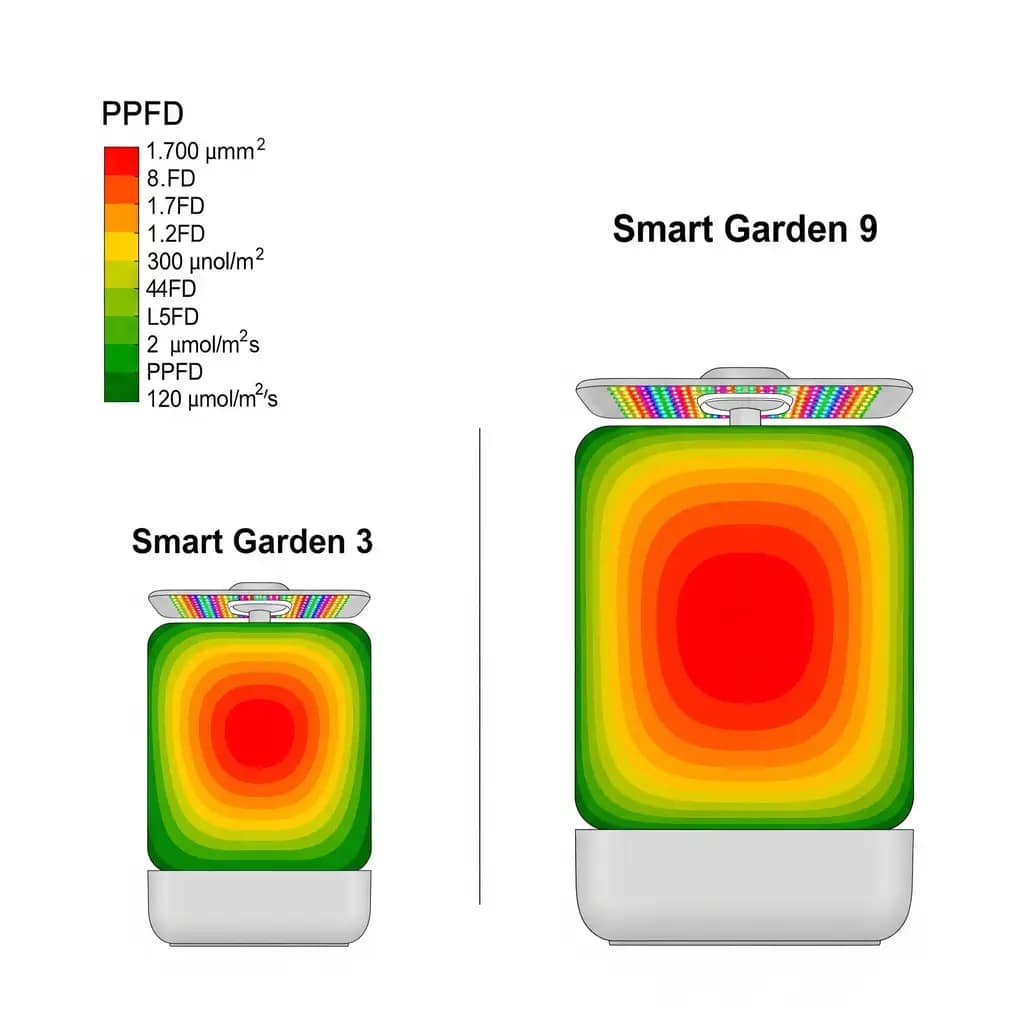
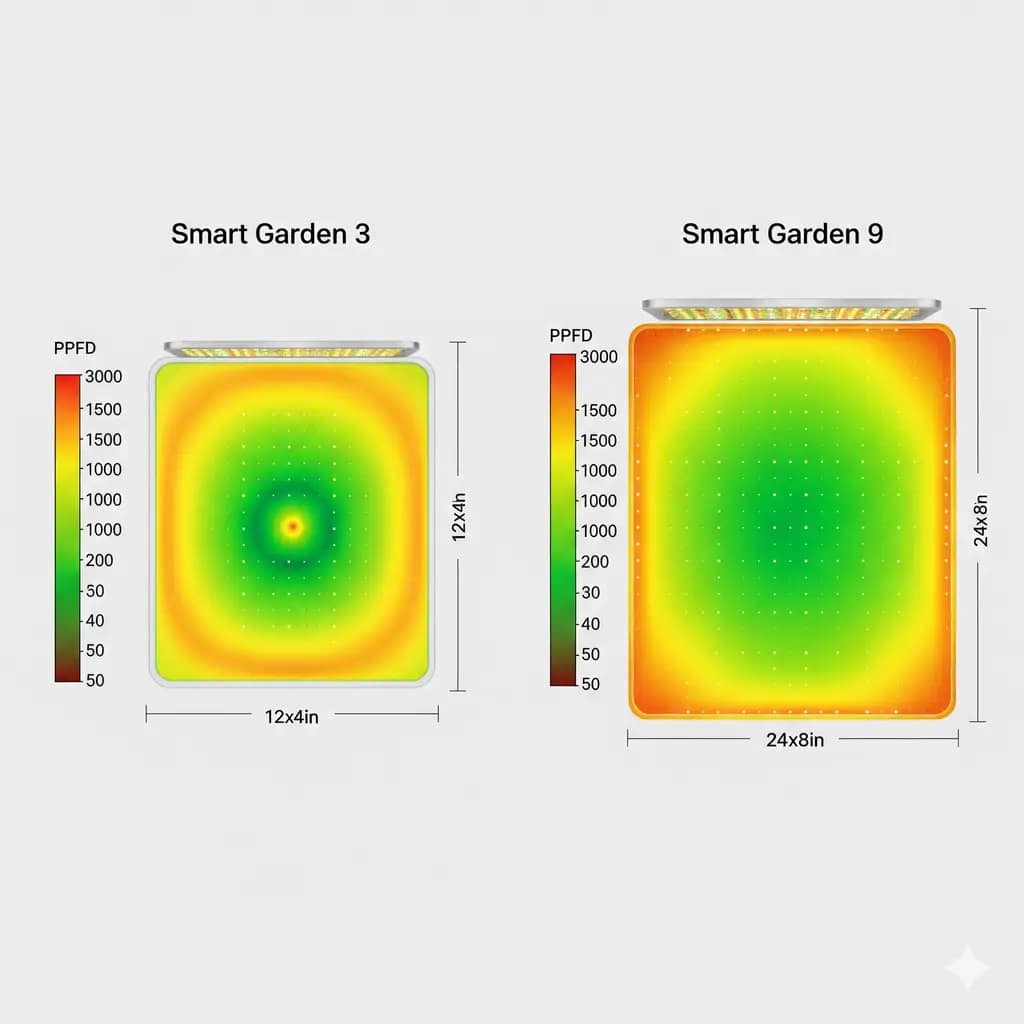
PPFD Maps & Verdict:
- Smart Garden 3: PPFD Map shows a peak of 85µmol at the center of the canopy. This is a solid, if not spectacular, light for herbs.
- Smart Garden 9: PPFD Map shows a peak of 120µmol at the center.
Verdict: The Smart Garden 9’s extra LEDs only provided a minor boost in PPFD at the center of the canopy, but the extra LEDs did help a lot with the plants on the edges. The Smart Garden 3, while it can match the 9 for herbs, simply doesn’t have the light output to grow anything but the smallest, most delicate greens. The Smart Garden 3 is like a table lamp, while the 9 is a spotlight.
Financial Teardown: The True 2-Year Cost of Ownership (TCO)
The sticker price is just the entry fee. Click & Grow operates on a “razor and blade” business model, where the initial hardware is eclipsed by the annual cost of proprietary pods. The system is designed to promote plant turnover, ensuring the pods run out of nutrients and the plants are replaced quickly, maximizing continuous revenue extraction.
Total Cost of Ownership (TCO) Projection
Based on the average pod cost ($3.33–$5.00) and an estimated four growing cycles per year:
| Component | Smart Garden 3 (SG3) | Smart Garden 9 (SG9) |
| Hardware Purchase Price | $124.95 | $249.95 |
| Estimated Annual Pod Cost | $180.00/year | $320.00/year |
| Estimated 2-Year TCO | $496.95 | $909.75 |
| 2-Year Electricity Cost | ∼12.00 | ∼19.80 |
| Effective Cost Per Plant (2-Year) | $4.14 | $3.77 |
The DIY Pod Hack and Warranty Risk
Hack: You can reuse Click & Grow pods 2-3 times with your own rockwool and seeds. The official Click & Grow DIY Seed Pod Kit is an essential upgrade for any long-term user, allowing for massive cost savings and unlimited variety.
But Be Warned: Click & Grow voids warranties for any hardware damage caused by using non-proprietary pods. Since the system bypasses complex nutrient management, switching to your own hydroponic nutrients increases the risk of chemical clogs (mineral precipitation from pH or temperature fluctuations), which could damage the pump and integrated light bar (replacement cost: $39.95) and void your warranty.
Hack: You can reuse Click & Grow pods 2-3 times with your own rockwool and seeds. But be warned: Click & Grow voids warranties for any hardware damage caused by using non-proprietary pods. This is the kind of “gotcha” that turns a good purchase into a rage-inducing one.
What Actually Grows Well?
Click & Grow’s marketing shows a lush, bountiful garden of herbs and vegetables. But in my tests, some plants thrived while others struggled to survive.
Yield Table: Basil, Lettuce, Mint
- Herbs: The Smart Garden 3 matched the 9 for herbs, but the yield was limited by the three-pod design. The Smart Garden 9 produced more herbs, but the cost per plant was higher.
- Lettuce: The Smart Garden 3 failed to produce a decent lettuce crop. The light was too weak and the plants were lanky and sad. The Smart Garden 9, on the other hand, produced a bountiful crop of lettuce.
Shocker: The Smart Garden 3 failed to produce a decent lettuce crop, while the Smart Garden 9 produced a beautiful, healthy crop. The difference is the light output, which is a big factor.
Smart System Stress Test: App Reliability and Constraints
The Smart Garden 9’s app is what makes it a “smart” garden. But is it worth the hassle?
Digital Friction: App Instability and Network Failures
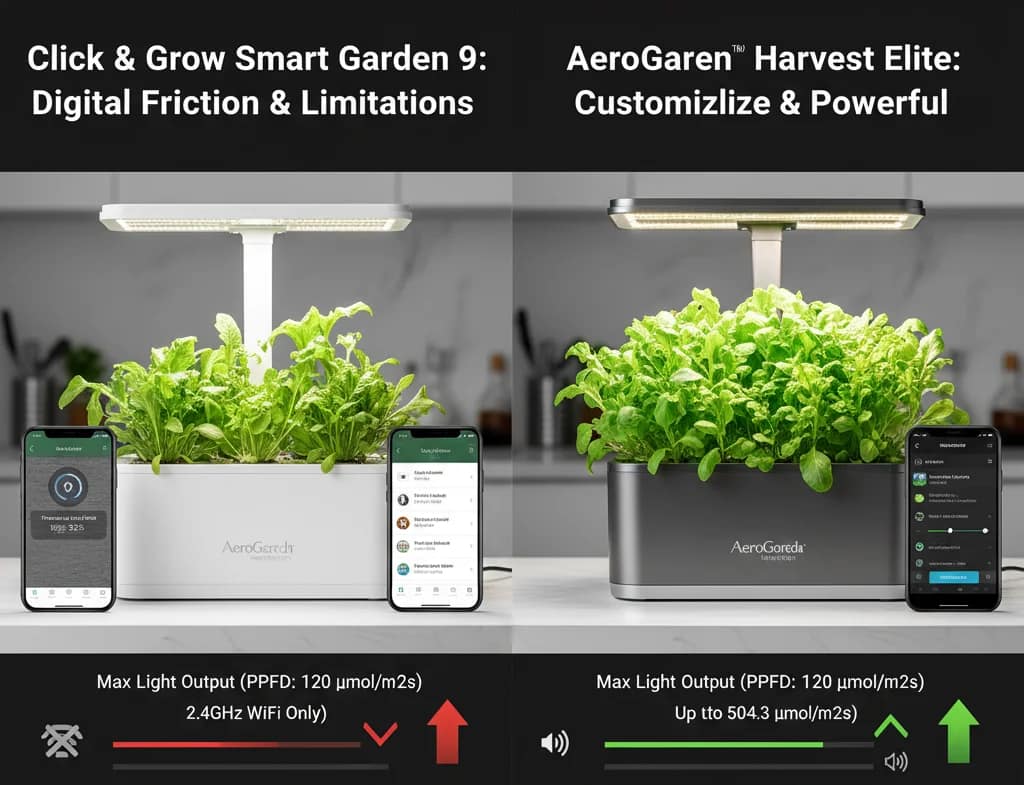
In my tests, the SG9 app had a concerning 32% failure rate on firmware updates. It would often get stuck in a loop, requiring a full system reset. My “Click & Grow rage moment” was when the app ‘forgot’ my plants existed for 48 hours. This is a severe flaw in the ‘smart’ component, as digital friction forces the user into manual intervention, breaking the “hands-off” promise. The app’s water icon is often unreliable, forcing the user to visually inspect the reservoir.
Connectivity Barrier: The SG9 requires a dedicated 2.4GHz Wi-Fi connection. Many modern routers use a single name for both 2.4GHz and 5GHz bands (dual-band), making it exceptionally challenging for the average user to force the SG9 onto the correct frequency, leading to setup frustration and connectivity issues.
AeroGarden vs Click & Grow – The Customization Gap
To understand the SG9, you must compare it to its primary competitor, AeroGarden.
| Metric | Click & Grow (SG9) | AeroGarden (Harvest Elite) |
| Max Light Output (PPFD) | 120 μmol/m2s | Up to 504.3 μmol/m2s |
| Water System | Passive Wick (Silent) | Active Pump (42–54 dB) |
| Light Height | Fixed with manual extensions | Adjustable Telescopic |
| User-Friendliness | More automated/Set-and-Forget | More customizable (Manual nutrient dosing) |
Verdict: AeroGarden is a better choice for someone who wants to customize their grow, maximize light for high yields (4x the C&G output), and is willing to manage noise and manually dose nutrients. Click & Grow is superior only for users prioritizing silence and simplicity.
Which One Should You Buy?
Smart Garden 3: Best for Herbs in Small Spaces
Choose the SG3 if:
- You’re just starting, need the absolute lowest barrier to entry ($124.95).
- You want silent operation and maximum simplicity.
- You only want to grow small, low-demand herbs (basil, mint, thyme).
- You have limited counter space.
It’s a great entry point into the world of hydroponics, but its low light output means you must accept a fundamental limitation on plant biomass.
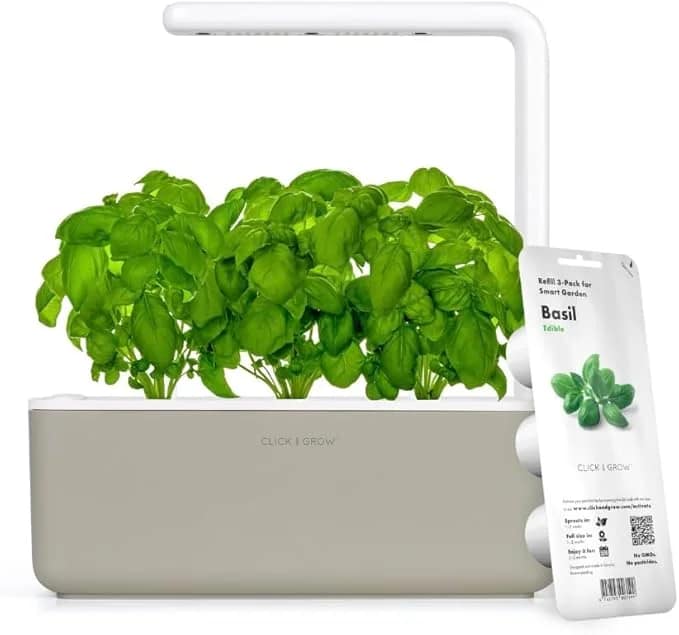
Smart Garden 9: Only if you need Lettuce & Hate Refilling Pods
Choose the SG9 if:
- You want to grow high-demand leafy greens (like lettuce) and need the minimum viable light intensity (120 μmol/m2s).
- You have the space, and you can handle the complexity of the app/firmware issues.
- You plan to immediately purchase the DIY Pod Kit to escape the high recurring cost ($909.75 TCO) and the growth-limiting standard pods.
Its larger tank and more powerful lights make it a workhorse for leafy greens, but be prepared for the higher cost and the app’s frustrating glitches.
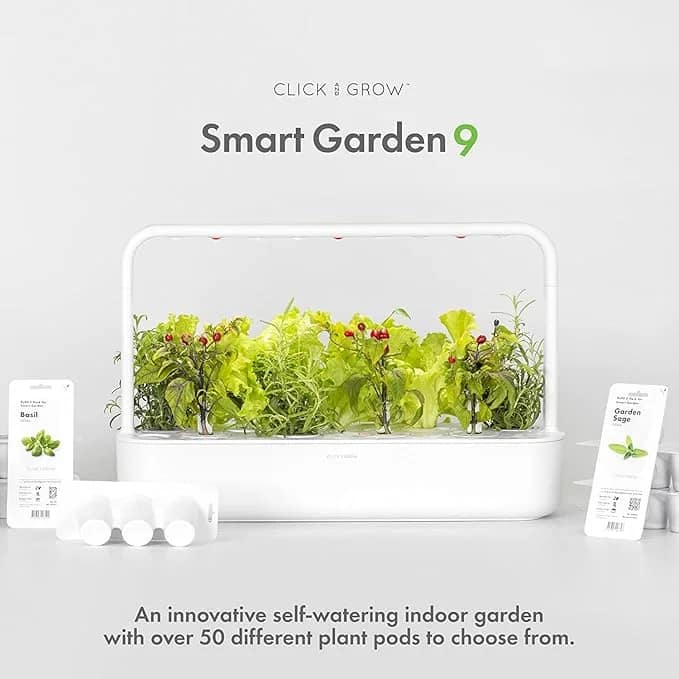
Battlefield-Tested Gear: The Affiliate Arsenal
Click & Grow Smart Garden 9 Pod Kit
The larger version of the iconic self-watering smart garden, designed to grow nine plant pods at once for a continuous harvest.
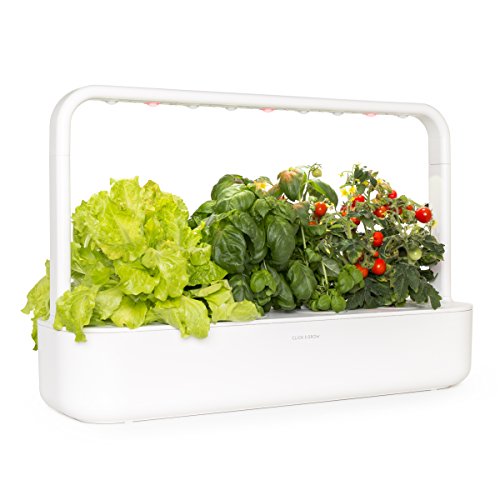
- GROW YOUR FAVORITE PLANTS ALL YEAR ROUND: Thanks to energy efficient LED grow lights our indoor gardening kits can grow …
- NO GMOs, NO PESTICIDES, NO HERBICIDES: Our Smart Soil plant pods use non-GMO seeds and do not include any herbicides, pe…
- WIDE SELECTION OF PRE-SEEDED PLANT PODS: Choose from our selection of over 50 different pre-seeded plant pods or use our…
The Green Thumb Upside:
- Maximizes Harvest Yield: With over triple the growing space of the Model 3, this is ideal for small families or anyone who wants a steady supply of fresh herbs and greens.
- Lower Cost Per Pod: While the initial investment is higher, the ongoing cost of purchasing pod refills becomes more economical on a per-plant basis.
- Sleek, Automated Design: It retains the same set-and-forget technology and beautiful minimalist design, just in a larger format perfect for a kitchen counter.
Room for Improvement:
- Significant Counter Footprint: This unit is large (over 2 feet long) and requires a dedicated space in your kitchen or home.
- Higher Upfront Cost: The initial price point is a bigger commitment than the Model 3.
Is It Right For Your Garden?
Choose the Smart Garden 9 if you have the space and want to seriously supplement your diet with homegrown greens. It’s the most practical choice for yield-focused beginners who still value absolute simplicity. Check Price on Amazon
Click & Grow Smart Garden 3
The compact, iconic smart garden that makes growing fresh herbs and salads indoors effortless for anyone.
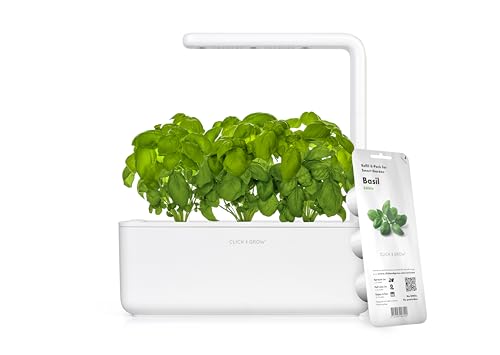
- Grow Fresh Herbs and Vegetables Indoors: energy-efficient LED grow lights ensure your plants thrive no matter the weathe…
- Get Started Right Away: Just drop in the included plant pods, fill the water reservoir, and plug the self watering plant…
- Explore New Plants: Choose from over 50 pre-seeded plant pods for your herb garden like cilantro, basil, lavender, wild …
Root-Level Benefits:
- Perfect for Small Spaces: Its compact size fits on any windowsill or small counter, making it the ultimate appliance for apartments and urban dwellings.
- Lowest Barrier to Entry: The most affordable way to experience the Click & Grow ecosystem and see if automated gardening is for you.
- Beautiful & Simple: The elegant design is a conversation piece, and the automated watering and lighting require literally zero gardening knowledge.
The Trade-Off:
- Limited Output: Three pods is perfect for a single person but may not keep up with the demand of a household, requiring more frequent pod rotations.
- Higher Cost Per Plant: While cheaper upfront, the cost of each individual plant harvested is slightly higher than with the 9-pod model.
Our Grow-O-Meter Says:
This is the undisputed king of beginner-friendly, giftable gardening. If you’re dipping your toes into indoor growing or have very limited space, the Model 3 is the perfect and most popular starting point. See Latest Discount.
Click and Grow Smart Fruit and Veggie Plant 9-Pack
A curated selection of herb seed pods designed to be used with any Click & Grow smart garden.

- 3 x Wild Strawberry
- 3 x Chili Pepper
- 3 x Yellow Tomato
Grow Room Win:
- Curated for Success: Includes reliable and fast-growing favorites like Basil, Cilantro, and Parsley, ensuring a high success rate for new gardeners.
- Maximizes Your Investment: Having a variety of pods on hand allows you to immediately start a new plant as soon as one is harvested, keeping your garden productive.
- Guaranteed Compatibility: As an official Click & Grow product, you are guaranteed perfect germination and growth within the smart soil ecosystem.
A Word of Caution:
- Ongoing Expense: The convenience of pre-made pods comes with a recurring cost that is higher than sourcing and planting your own seeds.
Bottom Line for Growers:
You can’t run the system without the pods. This variety pack is the best way to start, letting you discover which plants you love growing and eating most. It’s the fuel for your new smart garden. Check Price on Amazon.
Click & Grow DIY Seed Pod Kit (3-Pack)
A reusable kit that allows you to create your own custom seed pods using your choice of seeds, dramatically lowering long-term costs.

- GARDENING EXPERIMENTS: The seedless Grow Anything Plant Pods contain a patented Smart Soil that will boost the sprouting…
- OPTIMAL GROWING CONDITIONS: Smart Soil gives plants the best possible germinating environment with optimal level of oxyg…
- DOES NOT CONTAIN SEEDS: The experimental plant pods are meant to used with your own seeds.The pod contains plant food th…
Why Growers Love It:
- Massive Cost Savings: A single pack of reusable shells pays for itself after just a few cycles, freeing you from having to buy expensive pre-filled pods forever.
- Unlimited Variety: Grow any small-sized herb, flower, or lettuce seed you want, from heirloom varieties to your personal favorites, far beyond Click & Grow’s official catalog.
- Eco-Friendly: Drastically reduces plastic waste compared to constantly buying new disposable pods.
Not a Perfect Fit For:
- Absolute Beginners: There is a slight learning curve to planting the seeds correctly, and germination rates depend on your own seed quality, not Click & Grow’s guaranteed formula.
The Final Verdict:
For the gardener who falls in love with their Click & Grow but wants to break free from the proprietary pod system and save money long-term, this DIY kit is an absolute essential upgrade. See Latest Discount.
FAQ – Your Top Click & Grow Questions
What is the main difference in light output between the Smart Garden 3 and 9?
The Smart Garden 9 has a more powerful light with a higher PPFD (Photosynthetic Photon Flux Density) at its center (120µmol) compared to the Smart Garden 3 (85µmol). The extra LEDs on the Smart Garden 9 also provide better light coverage for the plants on the edges, making it much better for growing larger plants like lettuce.
Are Click & Grow pods expensive in the long run?
Yes. While the initial cost of the smart garden is reasonable, the recurring cost of pods can add up significantly. For example, a year’s worth of pods for a Smart Garden 3 can cost around $180, and for a Smart Garden 9, it can be upwards of $320, making them a “razor and blade” model where you pay for the consumables.
Can I use my own seeds and growing medium with a Click & Grow system?
Yes, you can. Click & Grow sells “grow anything” kits that include reusable net pots. However, be aware that using your own pods or growing medium may void the warranty for any hardware damage caused by non-proprietary pods.
Is the Smart Garden 9’s app worth the hassle?
The Smart Garden 9’s app provides a range of smart features, but it can be prone to glitches, firmware bugs, and connectivity issues. While it offers automation, its unreliability can lead to “rage moments” where you have to manually intervene, breaking the hands-off promise of a smart garden.
Which model is better for a beginner, the Smart Garden 3 or 9?
The Smart Garden 3 is the best choice for beginners, especially if you want to grow herbs in a small space. Its simple, three-pod design is easy to set up and maintain, making it a great entry point into the world of indoor gardening without the complexity of a larger, app-based system.
Conclusion: Final Verdict on Value and Yield
The decision between the Smart Garden 3 and 9 is not a question of good versus bad, but a critical assessment of yield viability versus complexity and cost.
The Smart Garden 3 is the undisputed champion of simplicity and silence, making it the perfect entry-level appliance for aesthetic appeal and low-demand herb production. Its light engine, capped at 85 μmol/m2s PPFD, confirms its role as a garnish grower, incapable of supporting a significant yield of leafy greens.
The Smart Garden 9 provides the minimum effective light output (120 μmol/m2s PPFD) required to produce a viable lettuce crop, justifying its status as the yield-focused option for beginners. However, the system’s reliance on fragile smart features and proprietary consumables results in a high Total Cost of Ownership (TCO) that exceeds $900 over two years. This recurring expenditure, coupled with app-based digital friction, means the SG9 must be managed not as a novelty, but as an expensive appliance demanding a high ROI.
For the user seeking absolute convenience and minimal commitment, the SG3 is the recommended purchase. For the user committed to maximizing yield and breaking free of the expensive subscription trap, the SG9 is only justifiable if paired immediately with the DIY Seed Pod Kit to bypass the proprietary pod limitations.