Hydroponic Produce Packaging: Sizing, Container Specs & Shelf-Life

Table of Contents
- The Post-Harvest Respiration Race
- Model Your Packaging Cost & Estimated Shelf-Life
- Sourcing Directory: Recommended Amazon Affiliate Picks
- Crop-Specific Packaging Guidelines
- Chapter 4: Post-Harvest Spoilage Troubleshooting
- Chapter 5: Post-Harvest Packaging FAQ
- Watch the Cinematic Post-Harvest Protection Masterclass
Disclosure: MistCulture summarizes verified product specs, engineering data, and community feedback. We may earn an affiliate commission if you purchase through our links. Regulations vary by location; this content is for educational purposes only.
Growing a pristine, vibrant hydroponic crop is only half the battle. If your post-harvest packaging fails to preserve freshness, manage transpirational moisture, or communicate premium quality, your profit margins will collapse on the retail shelf. This guide breaks down the science of packaging design, cold-chain thermodynamics, and how to select the ultimate containers for your commercial farm. Grab our print-ready companion manual below to track your packing line inputs offline.
The Post-Harvest Respiration Race
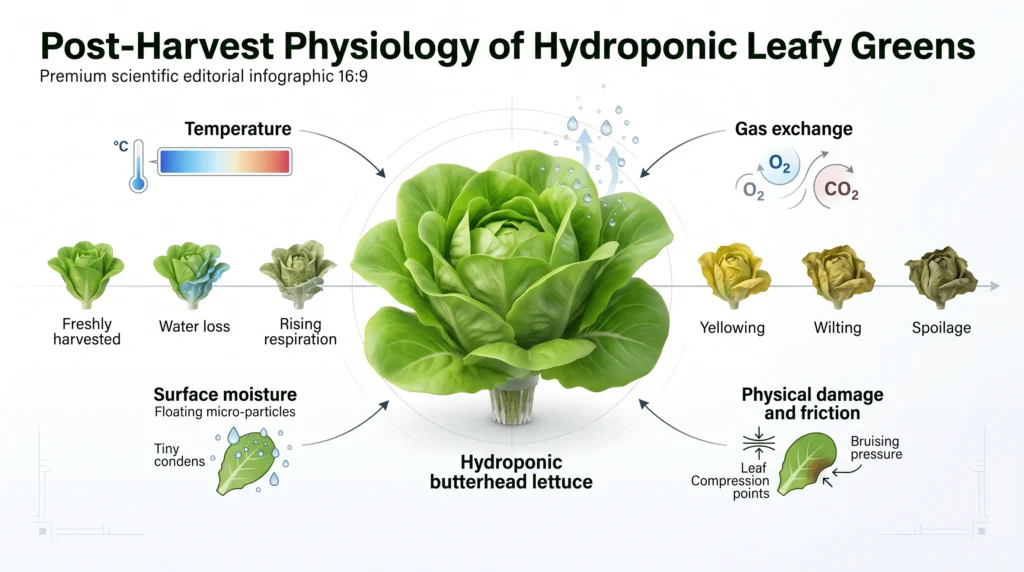
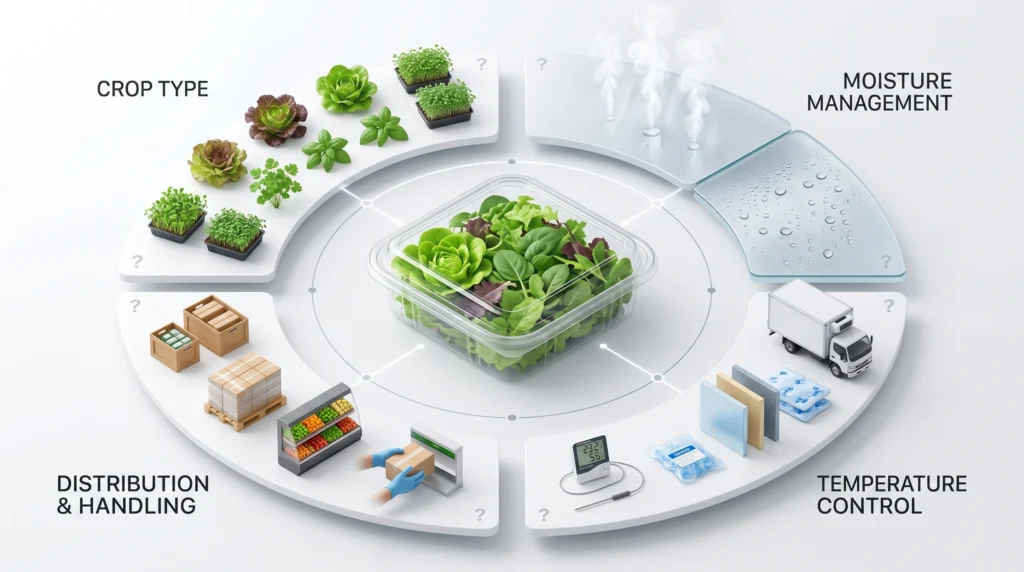
The biological clock begins to wind down the exact millisecond your crop is harvested. Even when severed from its root zone, a plant is still a living, breathing organism that continues to transpire water vapor and consume stored sugars through metabolic respiration. If your post-harvest packaging fails to manage these key environmental variables—specifically temperature, physical friction, gas exchange, and surface moisture—your premium crop will rapidly collapse into a wilted, yellow, or anaerobically decaying mass before it reaches your customer’s kitchen.
The Live-Root Illusion
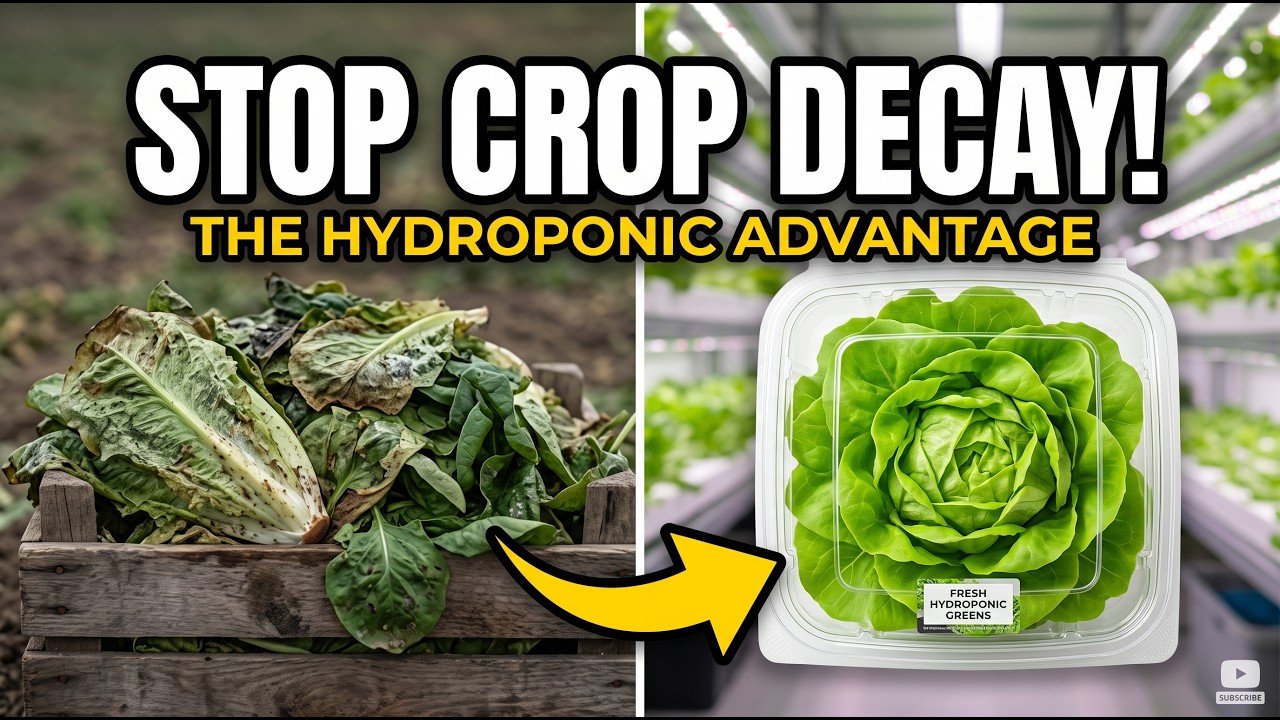
Many home and small-scale commercial growers fall for the ultimate marketing trap: “Live-Root Packaging.” The romantic concept of shipping loose leafy green heads with a messy ball of raw roots dangling into a flimsy plastic bag seems like a guarantee of pristine freshness. However, large-scale commercial studies have long since exposed this as an expensive operational bottleneck.
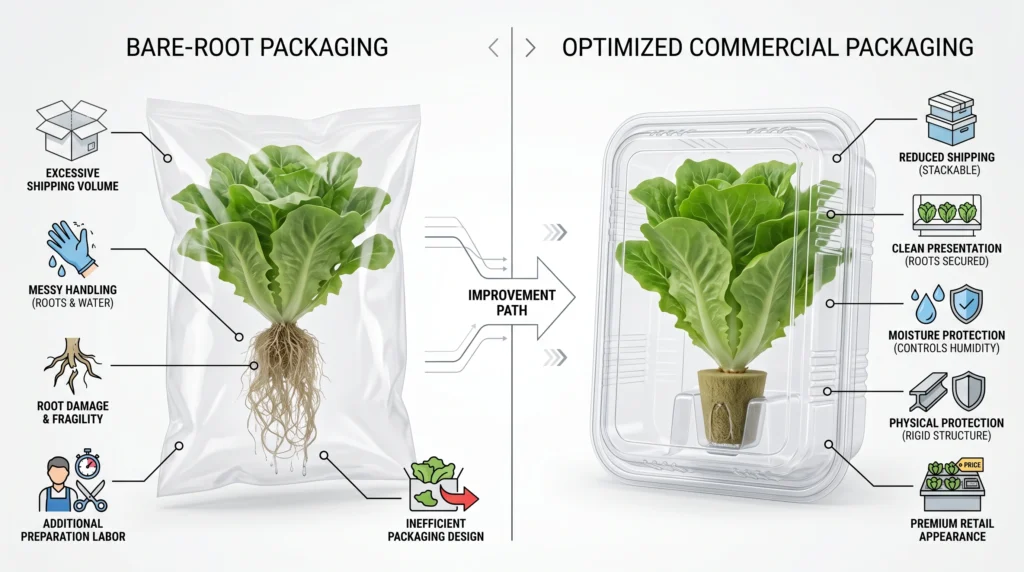
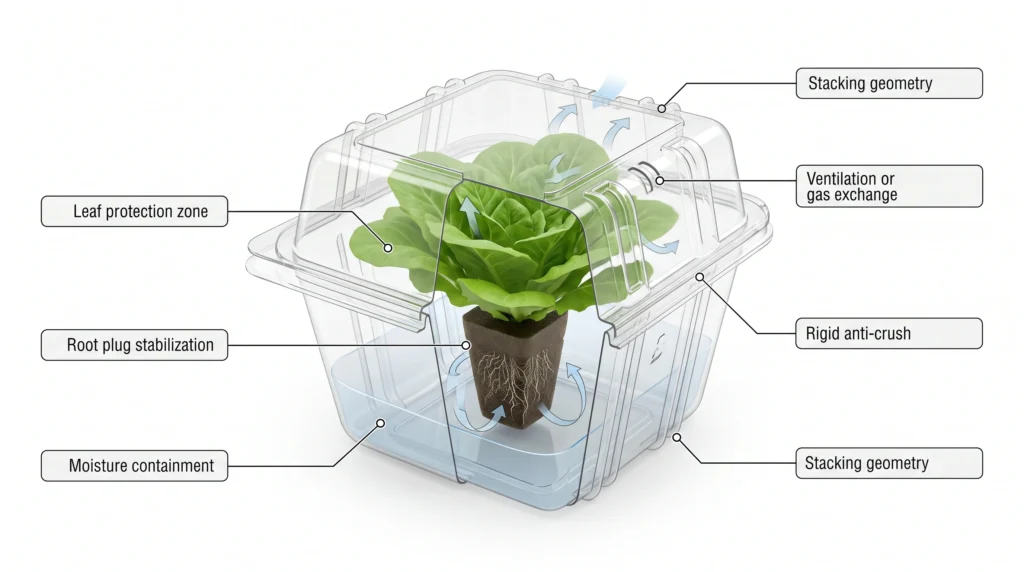
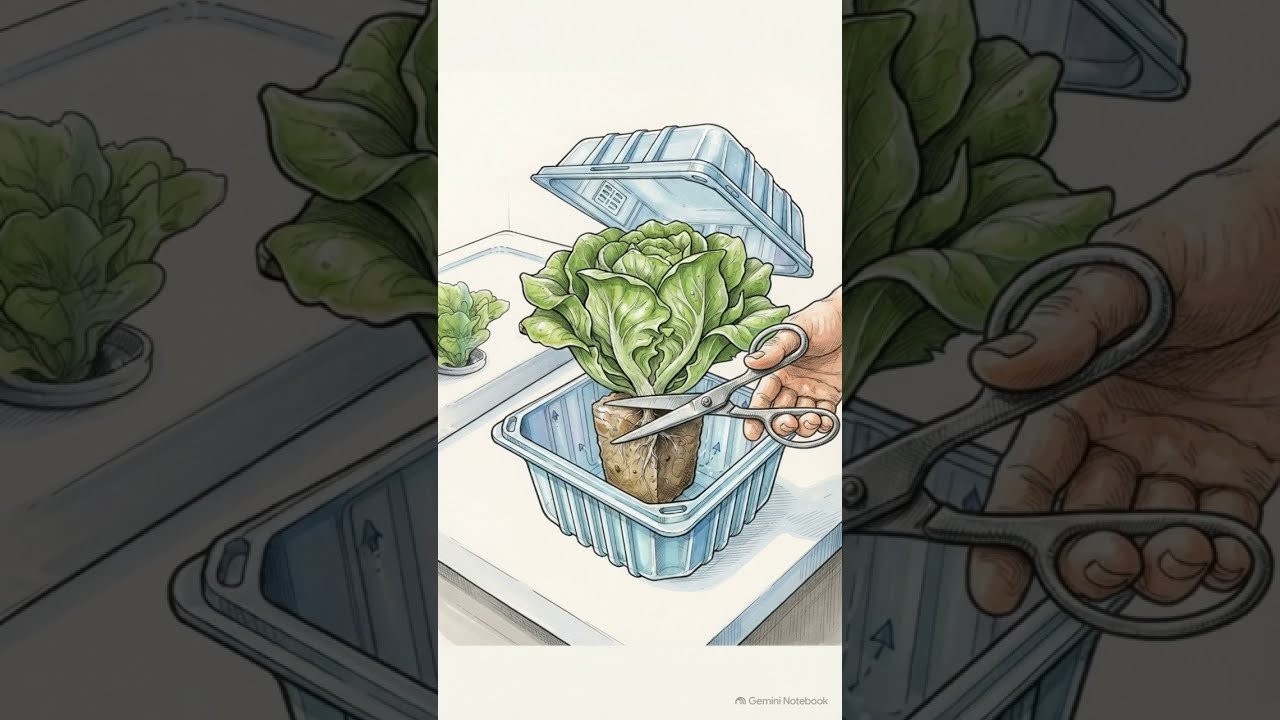
Landmark agricultural trials conducted in Arizona compared bare-root storage inside loose plastic bags to standardized post-harvest handling. The results were conclusive: leaving bare, soil-laden roots intact did not increase crop shelf life. Instead, the process was three times more expensive to prepare on the wash-and-pack line, was repeatedly rejected by grocery wholesalers due to transport mess, and drastically increased shipping overhead due to the dead weight and volumetric space of the un-pruned root balls. Today’s commercial standard has bypassed this entirely: we leave the clean rockwool or coco starter plug intact, but prune the excess trailing root mass and isolate the root plug inside a custom-molded, rigid plastic clamshell. This captures moisture, protects the leaf canopy from physical bruising, and commands a premium price point without the shipping weight bottleneck.
Cold-Chain Thermodynamics & Humidity
Slowing down crop cellular breakdown is a thermodynamic imperative. The respiration rate of harvested leafy greens doubles or triples for every 10°C rise in temperature. To lock in maximum shelf life, you must harvest crops during the coolest hours of the morning (between 5:30 AM and 8:00 AM) before your high-intensity grow lights trigger transpiration spikes, and move them into cold storage within thirty minutes.
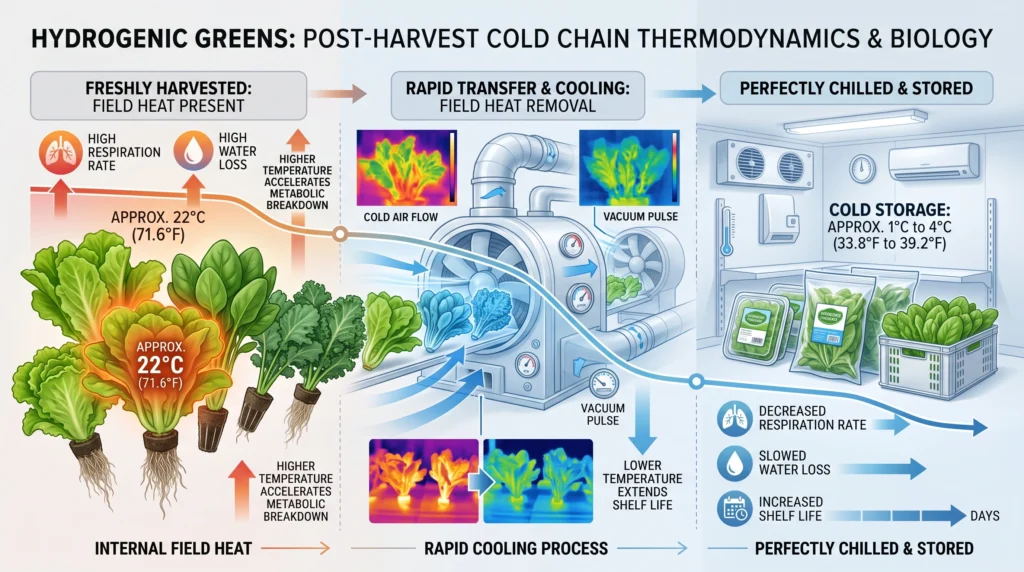
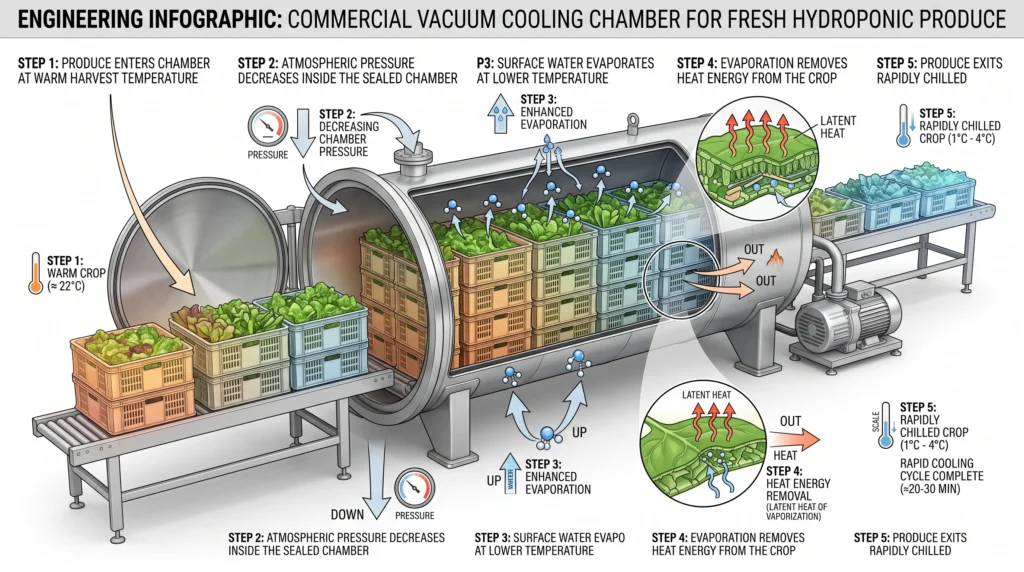
On a commercial scale, standard walk-in refrigeration is too slow to remove heat trapped in the leaf tissues. Large-scale farms route bulk, boxed crops through a vacuum cooling chamber (vacuum cooler). By lowering the atmospheric pressure inside a sealed chamber, water on the leaf surfaces evaporates at a lower temperature, instantly pulling out the “field heat” and dropping the core crop temperature from 22°C down to 1°C to 4°C in under twenty minutes. Once chilled, you must maintain a relative humidity range of 90% to 95% inside your cold room; any drop below 85% causes rapid water weight loss, leading to limp, unsellable crops.
Model Your Packaging Cost & Estimated Shelf-Life
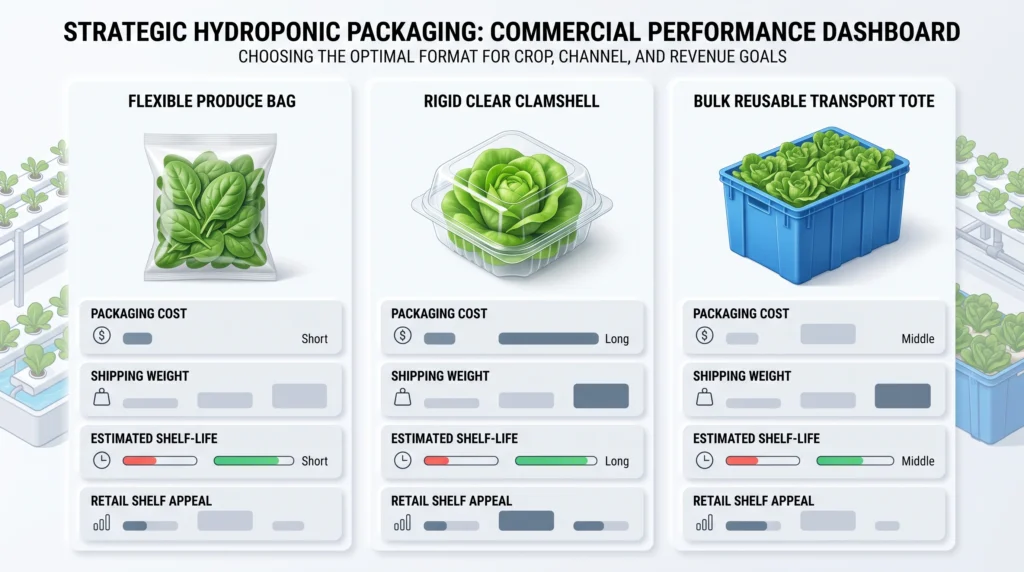
Input your target crop type, preferred packaging format, and storage environment parameters into our interactive post-harvest sizer. This calculator instantly estimates your packaging COGS, unit weight, estimated shelf-life window, and retail shelf-appeal score.
Hydroponic Packaging & Shelf-Life Auditor v1.5
Optimize your container type and cold-chain factors to maximize your retail shelf-life and protect margins.
Sourcing Directory: Recommended Amazon Affiliate Picks
Standardizing your farm’s packing line is key to minimizing manual labor and avoiding shipping damages. We recommend securing these professional-grade post-harvest tools and logistics crates. Every purchase made through our direct affiliate links below routes a commission to fund our precision indoor trials at zero extra cost to you.
Standardize your batch traceability. Print professional, high-resolution barcode stickers, harvest dates, and regulatory nutrition panels directly onto your clamshell lids with no ink or toner expenditures.
The essential hardware for packaging wholesale bulk lines and bagging English cucumbers. Creates clean, airtight thermal welds on polybags and sleeve bottoms in under a second with adjustable heat timers.
Bypass retail over-packing. Enforce strict portion control on your packaging line. Features a splash-proof shield, percentage weighing mode, and a large, cleanable stainless steel platform for heavy daily washroom use.
Enforce standard transport stacking. Solid food-grade nesting crates protect delicate clamshells and bagged greens from being crushed or bruised in transport under heavy loads.
Crop-Specific Packaging Guidelines
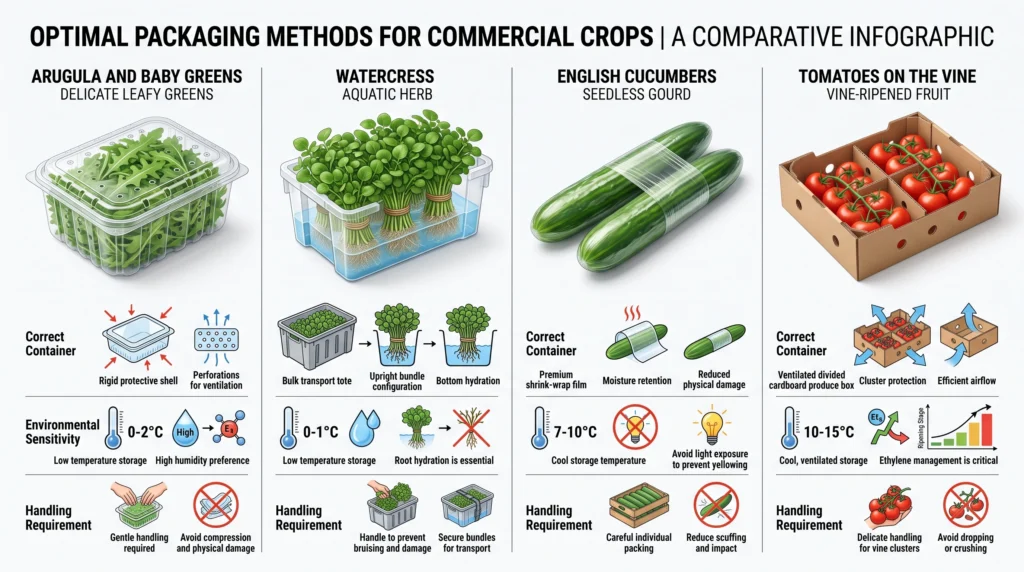
Different crops possess completely different physical structures and post-harvest respiration curves. Standardizing on a single, one-size-fits-all containment choice will result in rapid crop loss. For example, watercress is highly sensitive to turgidity loss and must be packed in wet bundles, while English cucumbers will dehydrate rapidly if left un-shrink-wrapped.
| Commercial Crop | Packaging Container | Critical Environmental Spec | Logistical Packing SOP |
|---|---|---|---|
| Arugula & Baby Greens | Perforated rigid clamshells | Relative humidity: 90%–95%; Temp: 1°C | Pack dry to prevent leaf-mashing; stack clamshells vertically in nesting transport crates. |
| Watercress | Opaque bulk plastic totes (B2B) | Roots submerged in 2cm fresh cold water | Tie watercress into 0.5-kg bundles and pack upright in returnable transport bins to maintain turgidity. |
| English Cucumbers | Shrink-wrap plastic film | Impermeable barrier; Temp: 10°C | Shrink-wrap cucumbers with an L-bar sealer and heat tunnel to prevent transpirational moisture loss. |
| Tomatoes-on-the-Vine (TOV) | Ventilated, divided cardboard boxes | Temp: 12°C–15°C (Never chill below 10°C) | Pack tomatoes directly into final boxes right in the greenhouse to eliminate double-handling and bruising. |
Chapter 4: Post-Harvest Spoilage Troubleshooting
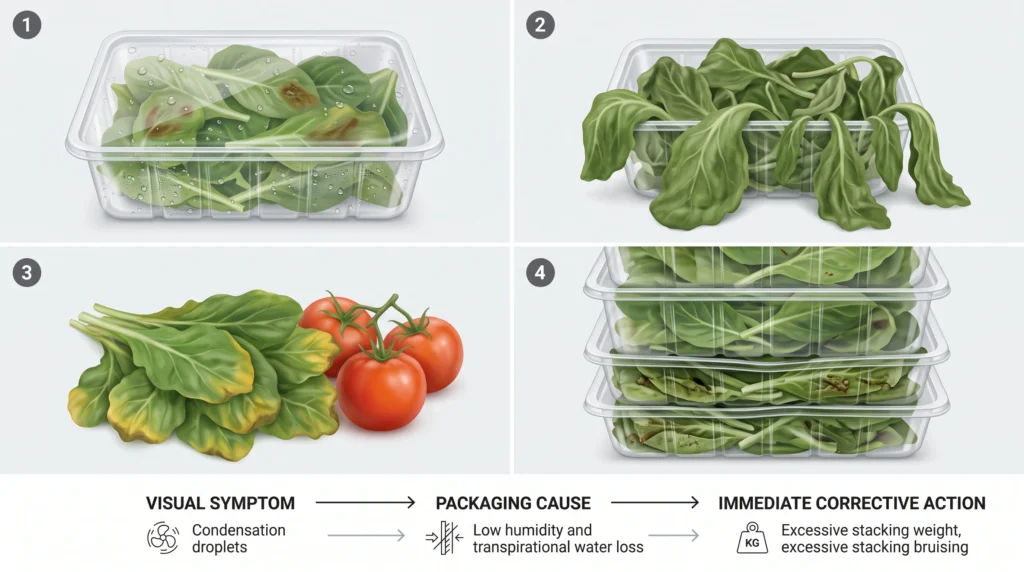
When packing line errors occur, crop visual symptoms can easily be misdiagnosed as mineral deficiencies. Use our diagnostic post-harvest troubleshooting matrix to isolate and resolve packing defects:
| Observed Crop Symptom | Primary Packaging Defect | Financial / Physical Root Cause | Immediate Corrective Action |
|---|---|---|---|
| Slimy, brown rotting patches on leaf surfaces inside containers. | Excessive Free Moisture | Water droplets remaining on leaves after washing are trapped inside an airtight container. | Extend centrifugal spin-dry time to 90 seconds; swap standard bags for micro-perforated bag vents. |
| Crops arrive limp, wilted, and dehydrated at retail. | Transpirational Water Loss | Relative humidity inside the transport compartment or retail display dropped below 85%. | Enforce a strict 90%–95% cold room humidity target; shield transport boxes from sun or air vents. |
| Leafy green edges yellow and curl rapidly; premature spoilage. | Ethylene Gas Poisoning | Co-packing high-ethylene emitting crops (like vine-ripe tomatoes) adjacent to sensitive leafy salads. | Isolate post-harvest storage facilities; never co-pack or store tomatoes and lettuce in the same cold box. |
| The bottom layers of clamshell leafy green packages are crushed. | Improper Crating & Stacking | Failure to follow “Heaviest-on-Bottom” transport rules on delivery trucks. | Enforce nesting transport totes; standardise delivery crating and limit stack heights to 4 boxes max. |
Chapter 5: Post-Harvest Packaging FAQ
Hydroponic Post-Harvest & Sizer FAQ
Expert agribusiness answers on materials, cold-chain operations, and grocery labeling compliance.
The commercial standard for produce clamshells is PET (Polyethylene Terephthalate, Recycling Code 1) or PLA (Polylactic Acid, compostable plant-based plastic). PET has excellent clarity and structural strength to prevent crushing, while PLA is highly favored by premium organic consumer segments. Avoid polystyrene (Code 6) or PVC (Code 3) due to chemical leaching risks.
At a minimum, FDA produce labeling requires: (1) The common name of the crop (e.g., Sweet Italian Basil), (2) An accurate net weight declaration in ounces and grams, (3) The name and address of the business (your farm), and (4) A clear lot number or harvest date barcode for trace-back safety. Standardize this on a single direct thermal label printed from a MUNBYN labeler.
While a vacuum cooler is highly cost-prohibitive for starter micro-farms (often exceeding $20,000 upfront), small boutique farms can replicate its thermal benefits. Enforce a strict harvest schedule during the coldest morning hours, wash greens in pre-chilled 2°C water (hydrocooling) immediately, spin dry, and move into your cold room within fifteen minutes of harvest to lock in turgidity.
Watch the Cinematic Post-Harvest Protection Masterclass
To see these packing line operations in action, understand the “roots-on” shipping debate, and learn to audit your farm’s delivery logistics, watch our widescreen agribusiness masterclass and viral shorts below. They provide a step-by-step visual guide to optimizing cold-chain thermodynamics.
10 Critical Hydroponic Mistakes (Widescreen)
Agribusiness Capital Sizing: A comprehensive widescreen masterclass detailing how to protect your starting capital, structure stock solutions safely, and size your operating cash runway.
The Hydroponic Cash Runway Trap (9:16 Short)
The Capital Allocation Trap: A fast-paced, high-energy mobile short explaining the #1 error of spending 100% of capital on hardware and neglecting utility cash reserves.
Ready to Secure Your Post-Harvest Shelf Life?
Don’t let shipping damage or moisture spoilage compromise your agribusiness earnings. Audit your packaging parameters today or explore our step-by-step DIY blueprints.

Continue Your Learning Journey