Wholesale Pricing Strategies for Hydroponic Produce: From Cost-Plus to Value-Based

Table of Contents
- The Cost-Plus Safety Floor
- Value-Based Premium Pricing
- Calculate Your Sales Channel ROI & Gross Margins
- 🛒 Sourcing Directory: Recommended Amazon Affiliate Picks
- Sales Channels: Retail vs. Wholesale Strategies
- Costing & Sourcing Troubleshooting
- Produce Pricing FAQ
- Watch the Agribusiness Pricing & Sizing Masterclass
Disclosure: MistCulture summarizes verified product specs, engineering data, and community feedback. We may earn an affiliate commission if you purchase through our links. Regulations vary by location; this content is for educational purposes only.
Setting the correct price points for your crops dictates the difference between a profitable commercial indoor farm and an expensive, cash-draining hobby. Shifting from agricultural optimism to strict commercial engineering is key. To help you build a resilient, scale-ready agribusiness, we have compiled our complete financial sizer and channel guidelines. Grab our print-ready farm companion manual below to track your direct production inputs offline.
The Cost-Plus Safety Floor
Setting accurate price points requires a foundational understanding of your exact production numbers. Many indoor farms fail not because of crop diseases or poor gardening skills, but because of business-model failure. Operators often establish their selling prices based on industry gossip or vague national price averages. National pricing averages obscure extreme regional fluctuations, local shipping logistics, and seasonal price dumps, leaving your business plan highly vulnerable to sudden market shocks.
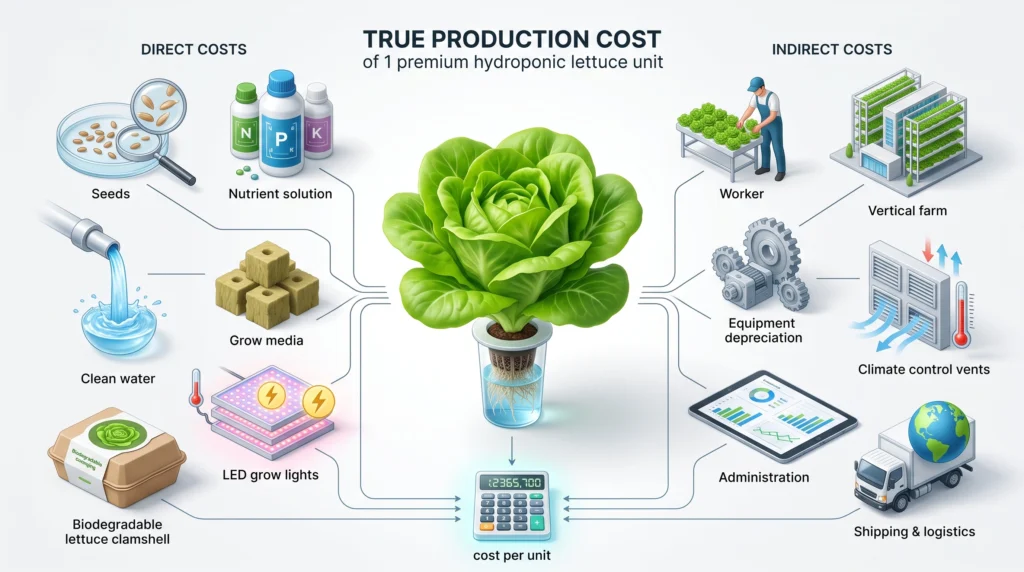
The cost-plus pricing method serves as your primary financial safety floor. It guarantees that every unit of produce sold contributes predictably to your farm’s operational survival by establishing a baseline. You begin by compiling every expenditure required to bring a single head of lettuce, a clamshell of herbs, or a pound of microgreens to market. These expenses are divided into two distinct categories:
- Direct Variable Costs: Fluctuate based on production volume. This includes seeds, growing media, fertilizer salts, direct packaging clamshells, water usage, and the exact kilowatt-hour (kWh) electricity draw of your LED grow grids and HVAC systems during that specific crop cycle. Labor directly tied to seeding, transplanting, and harvesting also falls here.
- Indirect Fixed Overhead: Remains static regardless of crop output. This encompasses facility rent or lease payments, equipment depreciation schedules, commercial insurance, and the baseline value of your own management time.
To calculate your cost-plus price, determine your total compiled operational expenses per unit, then add your target margin. Commercial Controlled Environment Agriculture (CEA) facilities must target a 40% to 60% gross margin to remain viable and absorb market fluctuations. Calculate your gross margin using the standard formula:
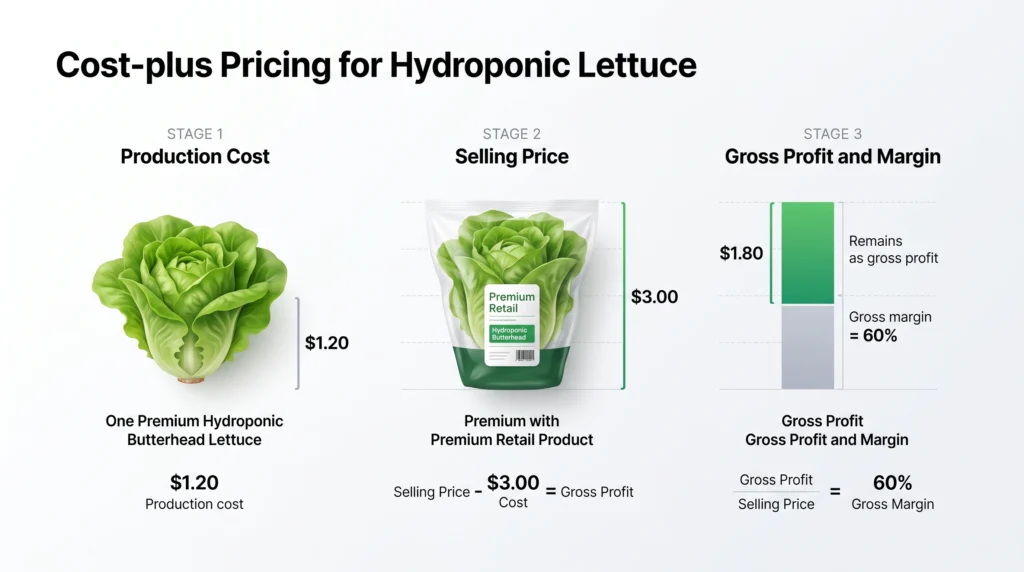
Let’s look at a concrete, step-by-step worked example. If your total direct and indirect inputs result in a base cost of $1.20 to produce a single premium head of butterhead lettuce, and your target gross margin is 60%, your selling price applies as follows:
Subtracting your cost ($1.20) from your target price ($3.00) yields a gross profit of $1.80 per unit. Dividing this gross profit ($1.80) by the price ($3.00) results in 0.60, representing a healthy 60% gross margin. If your overall gross margin drops below 50% in a capital-heavy indoor grow room, your cost structure is too high or your pricing is too low. Always fix the cheaper of the two issues first.
Value-Based Premium Pricing
While cost-plus pricing provides a reliable safety floor to ensure bills get paid, value-based pricing is what generates actual wealth. Under a value-based model, you price your produce based on the specific, high-value outcomes the buyer receives rather than the cost of your inputs. You are no longer selling loose leaves; you are selling premium quality, predictability, and custom characteristics. Customers and commercial buyers are highly willing to pay a premium for three distinct pillars:
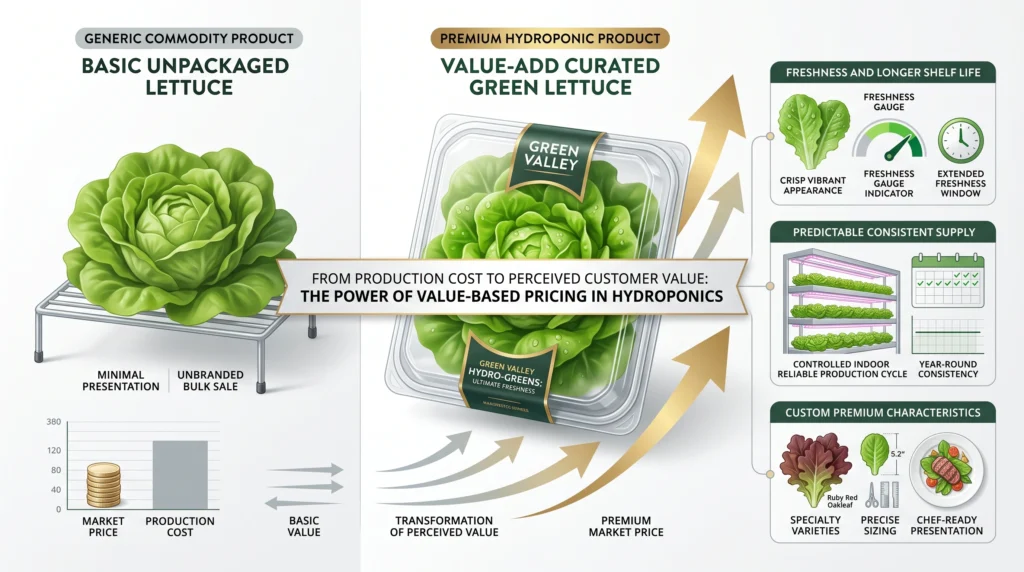
- Extreme Freshness and Extended Shelf Life
Conventional field-grown greens are shipped thousands of miles through complex refrigeration networks, losing nutrients and decaying rapidly. Locally grown hydroponic crops, delivered same-day with roots intact, last up to three weeks longer in a commercial kitchen, drastically reducing restaurant food waste. - Bespoke Flavor Profiles and Gourmet Cultivars
Controlled environments allow you to grow delicate, high-value varieties bred specifically for exquisite taste, crisp texture, or intense color (such as sweet Salanova lettuce or micro-basils) rather than structural durability for long-distance trucking. - Absolute Cleanliness and Food Safety
By practicing strict sanitation and growing in a sterile, soil-free environment, your produce is completely free of dirt, insects, and human-borne pathogens. This “hands-free,” pesticide-free quality is a major selling point for premium grocery retailers and health-conscious consumer segments.
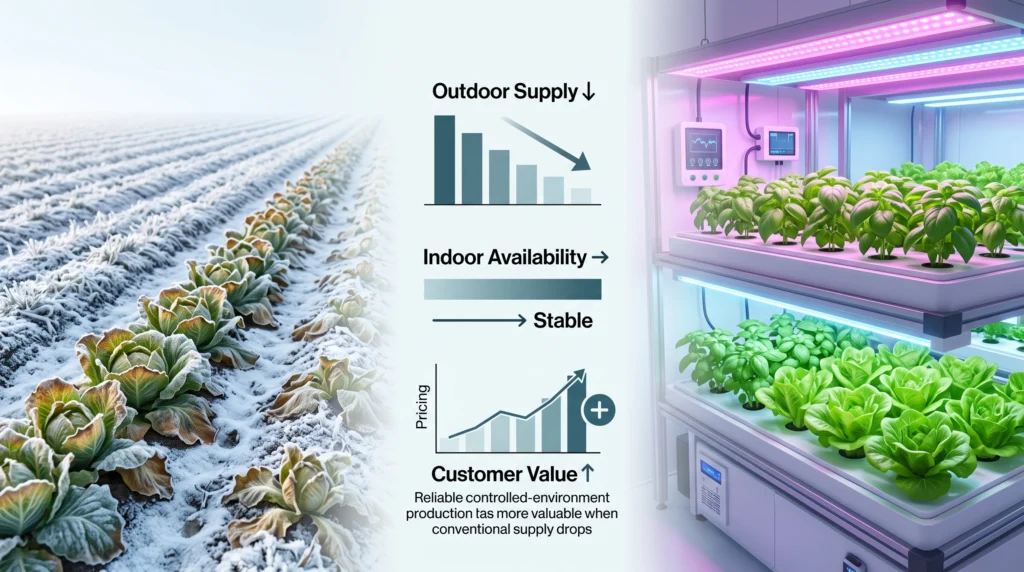
By leveraging value-based pricing, you can sell a $1.20 head of lettuce inside a professional branded clamshell for $3.00, achieving a 60% margin. Value-based strategies are especially powerful during seasonal extremes. When local field-growers are hit by winter freezes, high-tech indoor farms remain fully operational. Commanding a premium is easy when you offer the only locally grown, fresh sweet basil available during a blizzard.
Calculate Your Sales Channel ROI & Gross Margins
Use our interactive commercial pricing calculator to audit your system’s financial performance. Select your target sales channel, enter your direct production costs, and test proposed selling prices to instantly calculate your real gross margins, weekly gross profits, and overall agribusiness health grade.
Hydroponic Gross Margin & Pricing Auditor v2.0
Evaluate the financial viability of your crops across different sales channels to safeguard your gross margins.
Grade A: Highly Profitable
60.0%
$900.00
$6,000.00
EXCELLENT MARGIN: Your pricing strategy successfully secures your gross margins. High capability for reinvestment and capital scaling!
🛒 Sourcing Directory: Recommended Amazon Affiliate Picks
Costing and pricing are analytical processes that require meticulous tracking. We recommend securing these professional, high-performance tracking and logistics tools using our direct affiliate links below. Every purchase made routes an affiliate commission to help fund our precision agricultural trials at zero extra cost to you.
Print professional crop traceability labels, lot codes, barcodes, and harvest dates directly onto your clamshell packaging. High-speed direct thermal technology eliminates the need for expensive ink or toner cartridges.
Stop guessing your utility overhead. Plug your LED grid or active water chiller directly into this digital meter to physically measure exact cumulative kilowatt-hour draw, letting you calculate your exact energy cost per crop.
The industry standard scale for packaging premium culinary greens and fresh-cut herbs. Features a heavy-duty, cleanable stainless steel platform and a baker’s percentage weighing model for consistent portions.
Food-grade, heavy-duty stackable plastic bins designed for executing our standardized transport SOPs. Nested design protects delicate salad leaves and microgreen boxes from getting crushed or bruised in transport.
Sales Channels: Retail vs. Wholesale Strategies
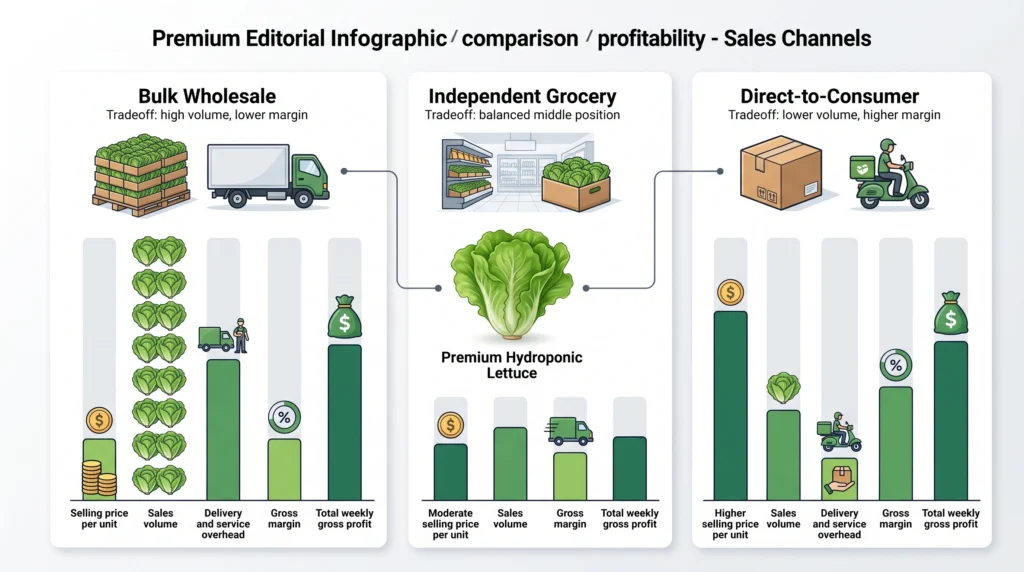
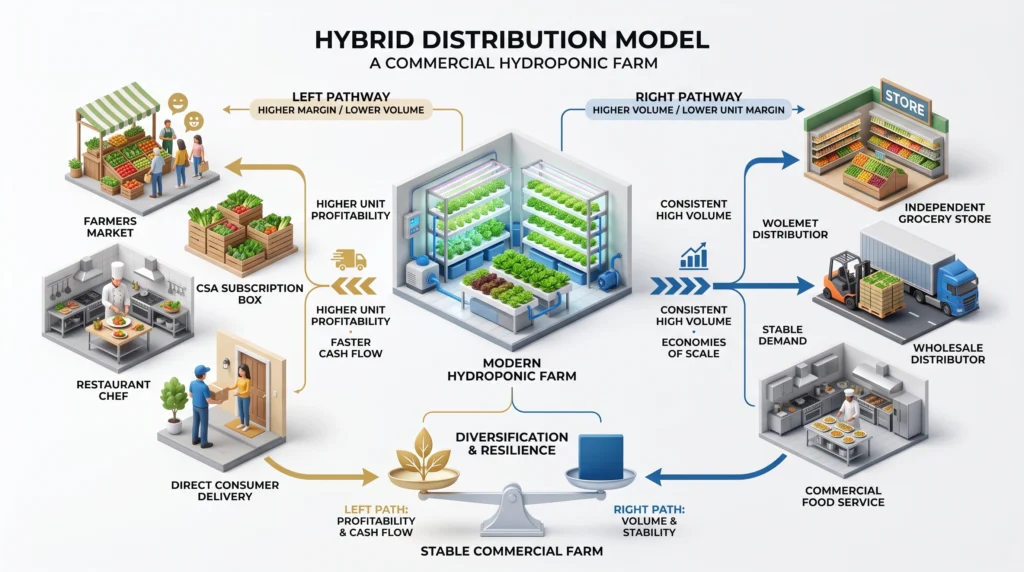
While your base production cost remains static, the price you charge must adapt to the specific channel you are supplying. Each sales channel carries its own unique service overhead, delivery minimums, and transaction volume expectations. Successful commercial farms balance these channels to secure a reliable, stable business model:
| Sales Channel | Typical Price Per Unit | Target Gross Margin | Sales Volume Profile | Key Advantage & Risk |
|---|---|---|---|---|
| Farmers Market Retail | Highest ($3.50–$4.50) | 50%–70% | Lowest (Individual Units) | Maximum unit profits; immediate upfront cash. Low volume makes it labor-intensive. |
| Boutique Restaurant Wholesale | Medium ($2.50–$3.20) | 35%–50% | Medium (Weekly Case Rates) | Reliable recurring orders. Chefs are willing to pay for custom varieties and day-of harvest. |
| Independent Retail Grocery | Lowest ($1.80–$2.40) | 20%–35% | Highest (Continuous Bulk Cases) | Massive volume movement. Rigid delivery schedules; contracts contain financial penalties for short deliveries. |
Instead of relying on single channel distribution, the most resilient indoor farms utilize a hybrid distribution model. Direct-to-consumer retail (like CSA subscription boxes or local farmers markets) generates the high unit-margins and cash flows needed to establish a financial buffer, while bulk wholesale accounts (grocers and distributors) secure the high, consistent volumes required to exploit economies of scale and keep your facility operating at capacity.
Costing & Sourcing Troubleshooting
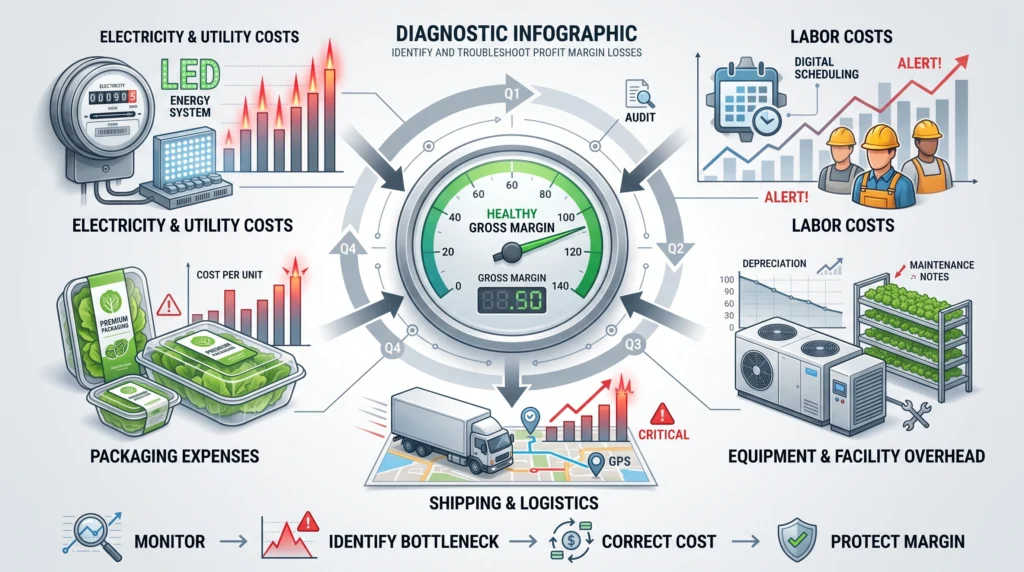
Protecting your farm’s operating margins requires continuous, quarterly auditing. When utility rates spike or shipping costs rise, you must instantly identify the operational bottleneck before it drains your cash runway. Use our diagnostic directory to isolate and resolve agribusiness margin threats:
| Visual / System Symptom | Primary Operational Error | Financial / Physical Root Cause | Immediate Corrective Action |
|---|---|---|---|
| Monthly electricity bill exceeds total crop revenue. | Unoptimized Light Scheduling | Grow lights running continuously during municipal “Peak” tariff hours, doubling utility costs. | Utilize a smart programmable timer to shift the 18-hour lighting photoperiod to “Off-Peak” night-time hours (8:00 PM to 2:00 PM next day). |
| High delivery costs erode wholesale restaurant margins. | Inefficient Delivery Routing | Delivering small weekly orders (under $50) across scattered, un-zoned regional restaurant accounts. | Establish strict geographic delivery zones and enforce a $100 delivery minimum for free delivery, applying a drop fee for small orders. |
| High packaging costs exceed 25% of unit production costs. | Sourcing Low-Volume Consumables | Purchasing expensive, non-bulk clamshells or bags from local retail suppliers. | Source direct from wholesale agricultural suppliers in quantities of 1,000+ units, utilizing direct-thermal labels for custom barcodes. |
| Leaf margins curl downward; root tip necrosis under high EC. | Osmotic Salt Stress (Toxicity) | Excessive fertilizer salt accumulation in the root zone from continuous feeding without adequate fresh runoff. | Flush reservoir with pure RO water and re-balance nutrient salts using a mass-balance dilution formula to safe target EC windows. |
Produce Pricing FAQ
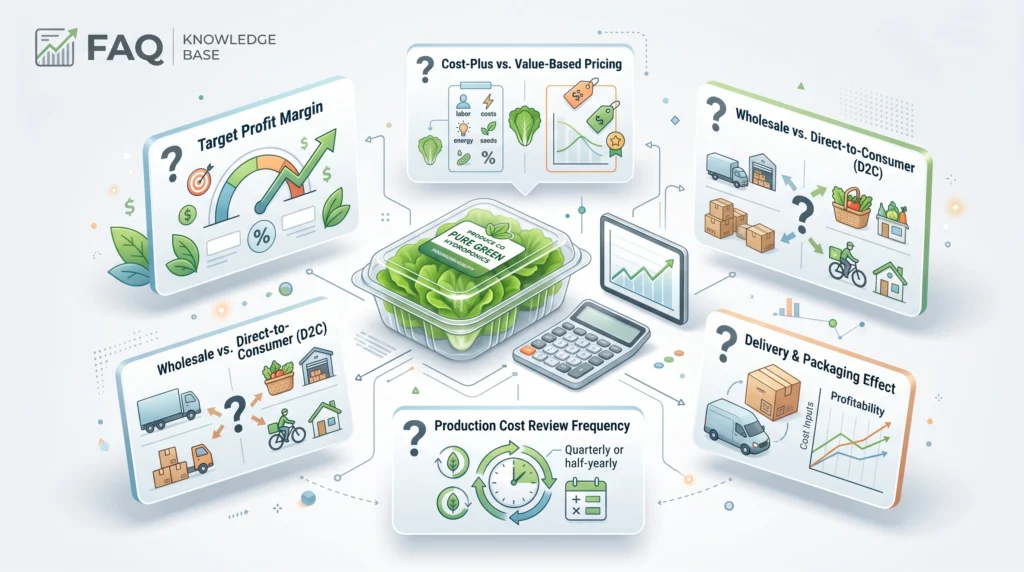
Hydroponic Agribusiness Pricing & Margin FAQ
Expert financial clarifications on cost-accounting, margins, and restaurant sales channels.
Healthy commercial indoor farming operations must target an overall gross margin of 50% to 70% for direct-to-consumer retail sales, and 20% to 50% for wholesale accounts. Operating with an overall gross margin below 50% leaves the farm highly vulnerable to cash flow shortfalls during power rate spikes, seasonal crop losses, or delivery vehicle failures.
Aggregate every direct variable cost incurred during a single crop cycle (seeds, media plug, fertilizer salts, direct packaging clamshells, direct labor, and water and power draw) and add a proportional percentage of your indirect fixed overhead (monthly facility rent, equipment depreciation schedules, commercial insurance, and management overhead). Divide this total sum by the exact number of sellable, premium-quality units harvested at the end of the cycle.
Do not attempt to compete on price against field-grown, commodity-imported crops. Instead, compete entirely on value-based premium characteristics: sell superior local freshness, local origin branding, custom crop mixes, and an extended shelf life. Restaurants and premium grocers will readily pay a 20% to 30% price premium when they realize the product reduces their internal kitchen spoilage and provides an unbeatable consumer experience.
Watch the Agribusiness Pricing & Sizing Masterclass
To see how commercial growers organize their startup capitals and protect their cash runways from bankruptcy, watch our agritech widescreen masterclass and vertical shorts below. They provide a step-by-step financial breakdown of scale bottlenecks and crop steering tactics.
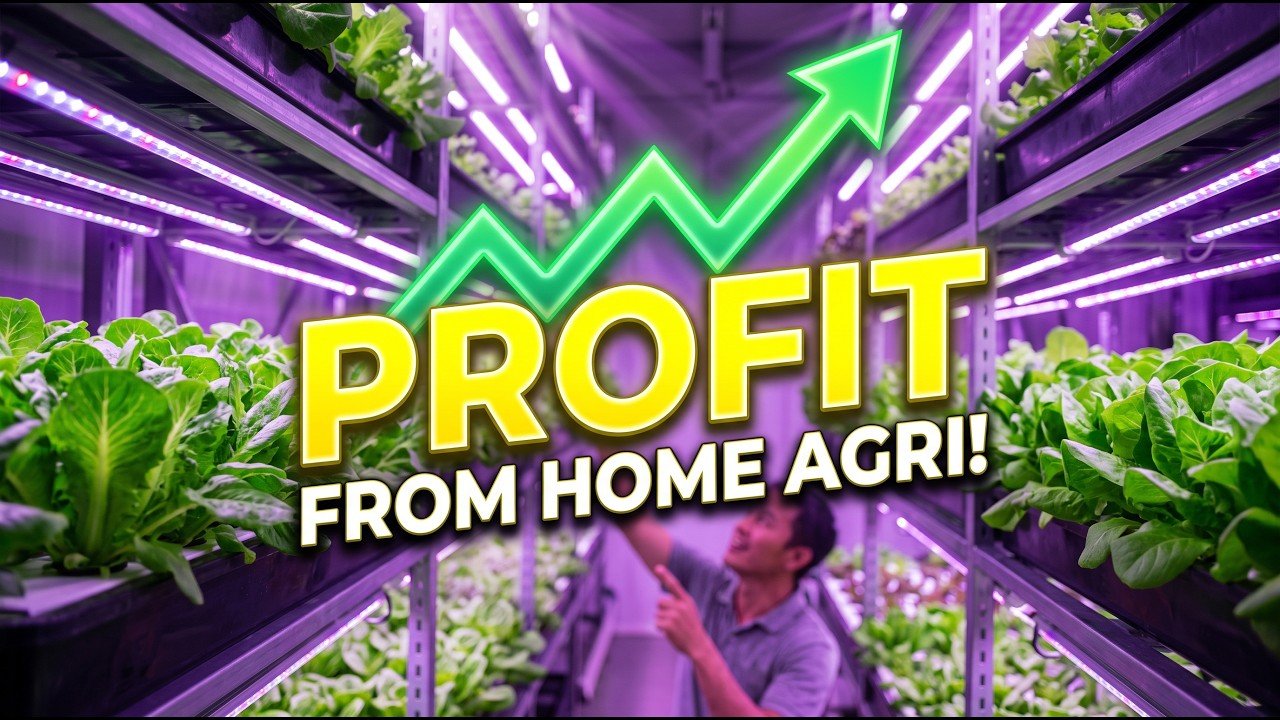
10 Critical Hydroponic Mistakes (Widescreen)
Agribusiness Capital Sizing: A comprehensive widescreen masterclass detailing how to protect your starting capital, structure stock solutions safely, and size your operating cash runway.

The Hydroponic Cash Runway Trap (9:16 Short)
The Capital Allocation Trap: A fast-paced, high-energy mobile short explaining the #1 error of spending 100% of capital on hardware and neglecting utility cash reserves.
Ready to Audit Your Agribusiness Margins?
Don’t price your crops blind. Run your exact cost metrics through our free, browser-based Gross Margin Auditor to establish your target price floors across wholesale and retail channels.

Continue Your Learning Journey