Hydroponic Farm Business Plan: A 12-Month Template for Small-Scale Producers

Table of Contents
- The One‑Page Agribusiness Summary
- Local Market Analysis & The "Pre‑Sell" Secret
- Production Mathematics & Yield Projections
- Sourcing Your Startup Financials & Capital Runway
- Energy Sizing: The Make-or-Break Line
- Operations, Standard SOPs & Traceability
- Conclusion: From Plant Science to Agribusiness Execution
Disclosure: MistCulture summarizes verified product specs, engineering data, and community feedback. We may earn an affiliate commission if you purchase through our links. Regulations vary by location; this content is for educational purposes only.
Most indoor farm failures aren’t crop failures — they’re business‑model failures. This guide breaks down the numbers that actually decide whether a hydroponic farm survives its first year: market validation, production math, energy costs, capital runway, and daily operations. Grab the companion template below, then work through each section with your own local numbers.
The One‑Page Agribusiness Summary
A hydroponic farm business plan is not merely a dense document that banks force you to write to secure a commercial loan. It serves as the definitive operational and financial tool that tells you exactly whether your farm will make money before you spend a single dollar on equipment. Shifting from agricultural optimism to strict commercial engineering is key. The reality of Controlled Environment Agriculture (CEA) is harsh: most indoor farm failures are not the result of catastrophic crop diseases or poor gardening skills. They are business-model failures. Growing premium, pesticide-free crops means nothing if you target the wrong local demographic, establish an unviable pricing structure, or rely on overly optimistic energy assumptions.
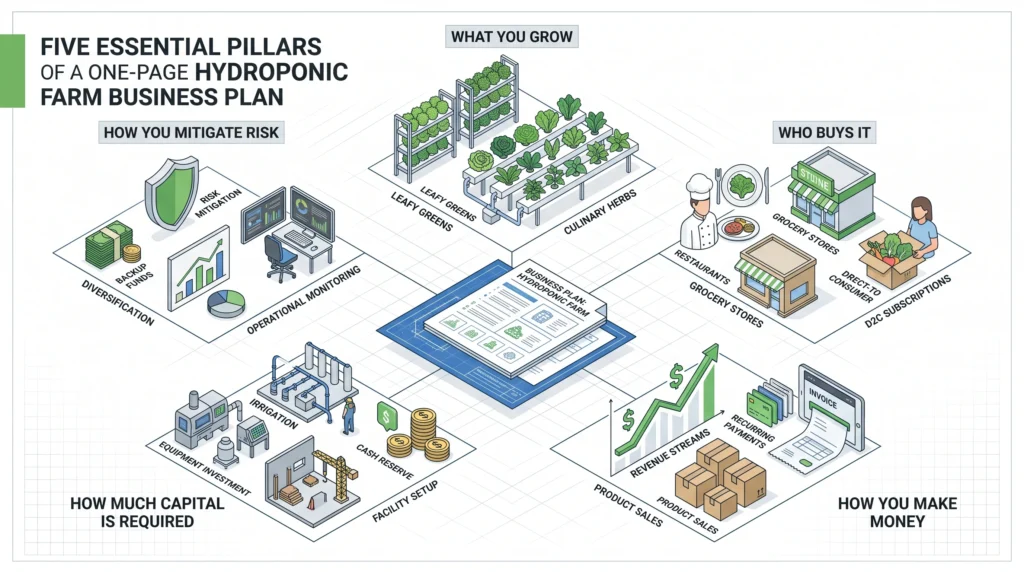
The one‑page summary distills your entire proposed 12‑month operation into five foundational pillars: What you grow, Who buys it, How you make money, How much capital is required, and How you mitigate risk. By auditing these five core variables under a unified framework, you can immediately identify critical margins, coordinate your early seeding schedules, and plan a viable distribution route.
Define specific crop formats (e.g., butterhead lettuce, cut‑leaf greens, or microgreens) and your projected weekly harvest volume. Volume directly dictates physical footprint, light cycle times, and labour.
Production Planning
Pinpoint precise sales channels: local restaurants, regional grocers, distributors, direct‑to‑consumer (DTC) subscription boxes, or local farmer’s markets. Document what they currently pay.
Market Research
The core financial metric is the spread between your commanded retail/wholesale price per unit and the fully loaded cost (COGS) to produce that exact pound, driven heavily by local utility rates.
Unit Economics
Calculate your total upfront capital expenditure (CAPEX) for plumbing, racking, and lighting. Secure a dedicated working capital buffer to cover 3 to 6 months of ongoing OPEX before breaking even.
Financial Planning
Local Market Analysis & The “Pre‑Sell” Secret
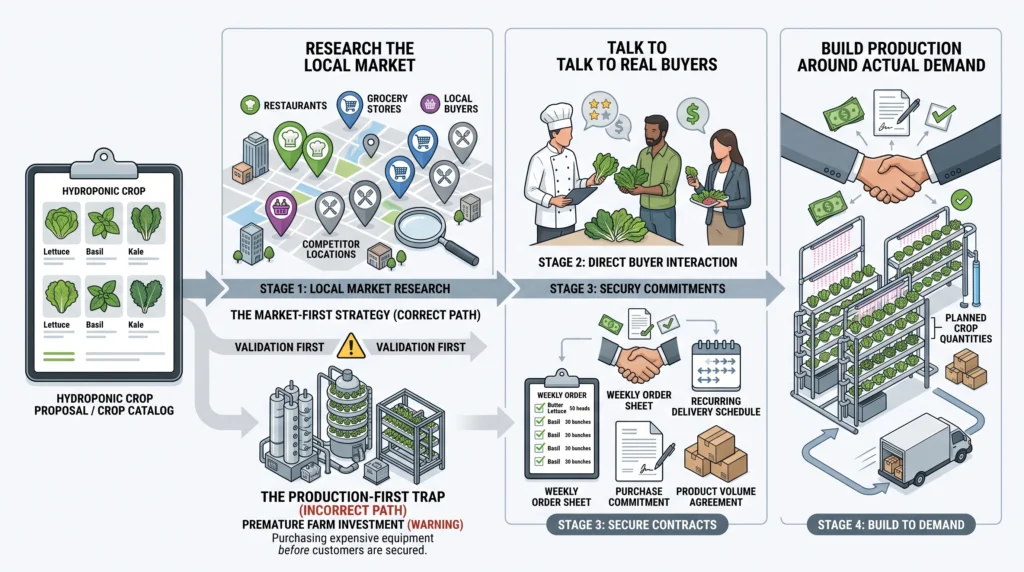
An indoor facility producing the most aesthetically perfect crop in the world that nobody actually wants to buy will only succeed in paying for a high electricity bill. To build a secure, resilient business model, you must complete your local market analysis and secure early customer buy‑in before ordering a single piece of hydroponic equipment. Many beginning growers fall into the trap of using national or global industry price averages to draft their financial forecasts. National pricing averages obscure extreme regional fluctuations, shipping logistics, and seasonal price dumps, leaving your business plan highly vulnerable to local market shocks.
Executing the “Pre‑Sell” Protocol
Rather than relying on abstract, theoretical spreadsheet predictions, your first step should be direct outreach. Walk into local restaurants, talk directly to executive chefs, and meet with regional independent grocery buyers. A simple “pre‑sell” conversation where a chef or produce manager reviews your proposed crop catalog and commits to a trial purchase or weekly volume agreement is worth more than any hypothetical financial forecast.
- What specialty crops they struggle to source reliably
- What quality issues they face with regional shipping distributors
- What specific prices they currently pay
Chefs are highly receptive to buying ultra‑fresh, harvested‑the‑same‑day salad greens or culinary herbs, and they will often pay a premium for custom signature blends or specialty varieties.
Assessing Local Competition & Price Points
Map out your competitors meticulously. Identify which national, commercial‑scale growers currently supply the retail shelves and restaurant distributors in your zone, and document their pricing. In small‑scale operations, you cannot compete on price with massive agricultural powerhouses that exploit huge economies of scale. Trying to do so will erode your margins instantly.
- 🌿 Absolute harvest‑to‑table freshness – harvested the same day
- 📍 Hyper‑local community origin – transparent and trustworthy
- 🔬 Pristine biosecure growing standards – pesticide‑free, controlled environment
- 🚚 Responsive, direct‑delivery service – flexible and reliable
📊 To see how different target retail prices and local market sizes alter your break‑even timelines and long‑term customer margins, utilize our Interactive Hydroponic Operating Cost & ROI Calculator.
- Rely on national price averages
- Build before securing buyers
- Compete on price with industrial farms
- Talk to local chefs and buyers first
- Secure pre‑sell agreements
- Differentiate on freshness and service
Production Mathematics & Yield Projections
To run a highly predictable hydroponic business, you must move away from generic planting advice and master the raw physical mathematics of crop yield cycles. In Controlled Environment Agriculture (CEA), your physical growing canopy is a high-cost manufacturing space. Every square foot of space must be systematically optimised to generate maximum biomass per watt of electricity and gallon of water. Sizing your system configurations incorrectly or selecting the wrong growing method for your target crop will lead to structural space bottlenecks, low turnover rates, and inflated operating costs.
Ideal for: Fast‑turnover, short‑cycle leafy greens like butterhead lettuce and loose‑leaf basil. Maintains a continuous, shallow stream of nutrient‑rich water over bare roots, maximising oxygenation and nutrient uptake. Harvest full heads of lettuce in 28–35 days from transplanting.
Rapid Turnover
Best for: High‑density baby green mixes and heavy heading crops. Uses large, water‑filled reservoirs with floating foam rafts. The sheer volume of water provides an excellent thermal buffer, keeping root temperatures stable during extreme weather.
High Density
Perfect for: Propagating young seedlings, root cuttings, or cultivating heavy‑feeding herbs in aggregate media like clay pebbles. Functions as a biological bellows, pushing stagnant gases out and sucking fresh oxygen into the roots.
Versatile
Mandatory for: Large, long‑term fruiting crops such as vining tomatoes, cucumbers, and bell peppers. Standardise on heavy‑duty Dutch Buckets paired with pressure‑compensating drip emitters for identical, metered doses of water and nutrients.
Precision Feeding
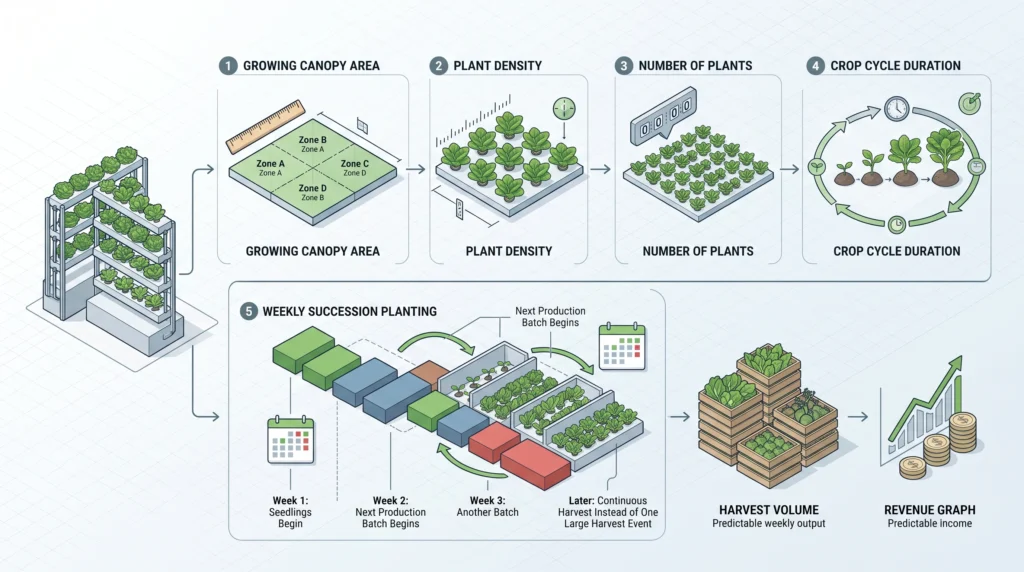
The 12‑Month Succession Planting Equation
To secure a steady, predictable weekly income, you must run a continuous succession planting schedule. Rather than planting and harvesting your entire facility all at once, which creates a chaotic “boom and bust” cycle that local restaurants and grocery buyers hate, you must divide your growing canopy into staggered, weekly production segments.
Sourcing Your Startup Financials & Capital Runway
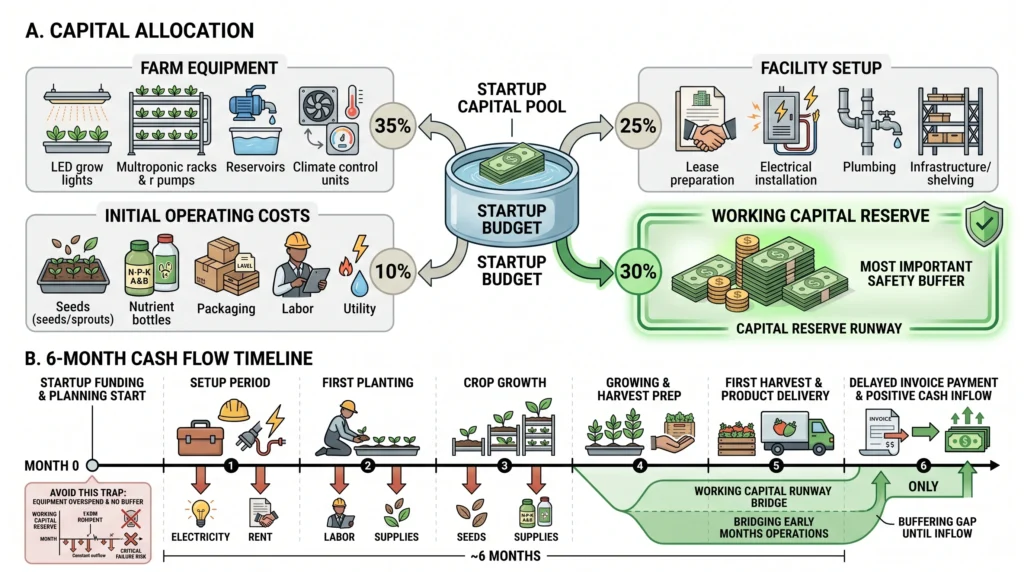
The single most common operational error that destroys new indoor farming businesses is failing to calculate their true break‑even metrics and ignoring their necessary capital runway. Many enthusiastic growers spend 100% of their startup capital purchasing high‑end automated control panels, custom LED grow light rigs, and heavy‑duty vertical racking, leaving themselves with zero working cash to cover running utility bills, lease payments, and packaging during their first 3 to 6 months of cultivation. If you run out of capital before your first commercial crops reach wholesale maturity, your agribusiness will fail regardless of how high your theoretical yields are.
Building a Realistic COGS Ledger
To establish an accurate financial forecast, you must build a comprehensive Cost of Goods Sold (COGS) ledger. Your COGS represent the direct, variable costs required to produce and package a single pound of harvest. This ledger must include:
- Consumable InputsSeeds, propagation rockwool plugs, high‑purity mineral nutrients, and pH adjustment acids.
- Primary PackagingRecyclable clamshells, food‑grade heat‑sealed bags, or reusable 50L plastic nesting totes for delivery routes.
- Operational UtilitiesWater consumption fees, municipal waste management, and the electrical draw of LED grow lights and pumps. Solar & Battery Backup Sizing Guide →
- Variable LaborThe direct hourly wages paid for seeding, transplanting, harvesting, packaging, and driving the delivery vehicle.
Evaluating the Working Capital Runway
Your business plan must secure a dedicated cash reserve, known as your working capital runway, separate from your initial equipment purchase budget. It typically takes a new commercial farm 30 to 45 days to complete its first major crop cycle, and another 30 to 60 days to collect on outstanding invoices from wholesale restaurant and grocery distributors.
Financial Break‑Even & Yield Simulator v2.0
Input your operational overheads, pricing margins, and crop loss to model your required weekly harvest yields and determine your project’s financial risk level.
Energy Sizing: The Make-or-Break Line
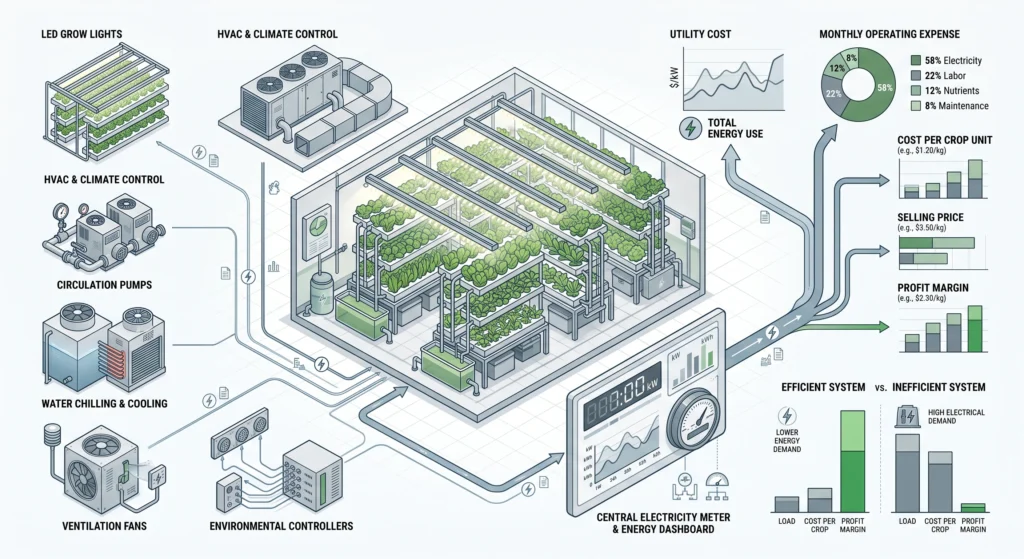
In Controlled Environment Agriculture (CEA), your climate control and lighting systems represent your highest continuous operating expenses. While outdoor soil farmers rely on free solar radiation and natural atmospheric currents, an indoor hydroponic grower is entirely dependent on municipal power networks to sustain plant life. Sizing your electrical loads incorrectly, failing to understand commercial utility rate structures, or ignoring seasonal energy price fluctuations will quickly push your production costs above your market sale price, leading to sudden business insolvency.
Strategy: Shift your 18‑hour lighting cycles to run primarily during off‑peak hours (e.g., 8 PM – 2 PM). This can slash monthly electricity bills by up to 35% and reduce HVAC load during the hottest part of the day.
Cost Saving
Target: Butterhead lettuce requires a DLI of 14–17 mol/m²/day. Convert DLI to PPFD and photoperiod to size your LED grid. Inefficient fixtures waste heat, doubling cooling costs.
Precision Sizing
Critical: Unplanned grid failures or transformer blowouts can destroy a crop. Size a robust solar + battery backup system to keep pumps and climate controls running during outages.
Emergency
Pro tip: Lock in fixed‑rate utility contracts during winter months when rates are low. Model rate spikes using our interactive cost simulator to protect your margins.
Risk Management
Energy Cost & Backup Sizing Simulator v1.1
Estimate your monthly lighting costs, cooling load, and the battery capacity needed to survive a 4‑hour grid outage.
Operations, Standard SOPs & Traceability
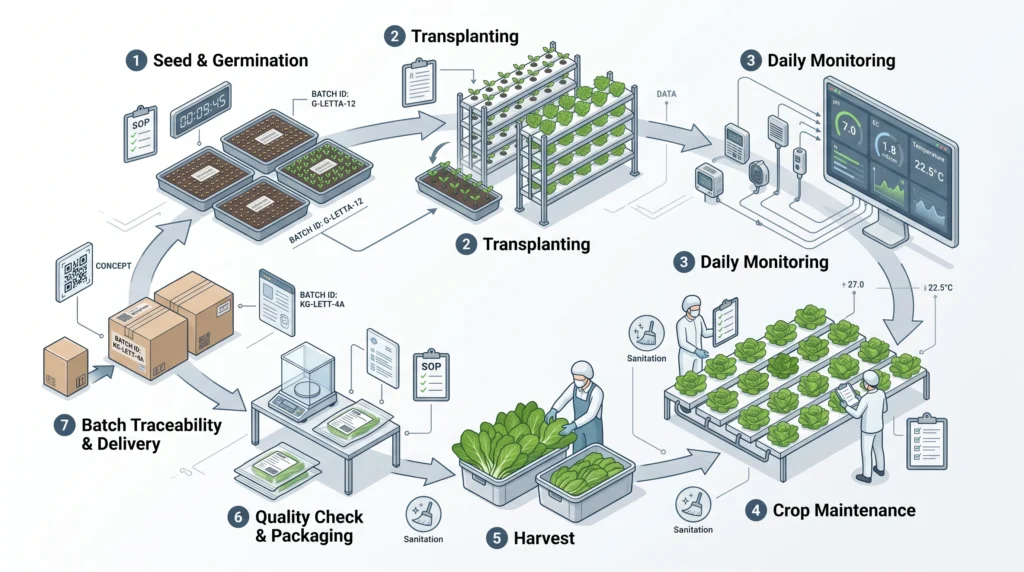
Transitioning from a hobbyist grower to a commercial agribusiness owner requires a strict focus on operational consistency. In a commercial facility, you cannot rely on casual observations or loose schedules to manage your crops. Scaling up your production canopy requires documented Standard Operating Procedures (SOPs) and rigid tracking protocols to ensure product safety, satisfy wholesale distribution requirements, and optimize daily labor allocations.
Efficiency: Implement a strict “One‑Touch” rule – each plant is handled only during transplant and again at harvest. This minimises handling time and reduces labour costs, which are the second largest expense.
Labour Optimisation
Packaging: Use standardized 50L nesting totes and place heavier items at the bottom to prevent delicate greens from bruising during transport. This ensures restaurant‑grade quality upon arrival.
Quality Control
Food Safety: Every harvest batch must be labeled with a unique lot number tied to seeding date, substrate lot, and water quality logs. Must be traceable within 2 hours in case of contamination.
Compliance
Records: Maintain water‑resistant logbooks or a digital dashboard to record daily pH, EC, temperature, and sanitation cycles. Integrate with Home Assistant for local‑first automation.
Smart Monitoring
Sourcing Checklist & Capital Planner v2.0
Select your required operational equipment, set your monthly OPEX, and determine the total startup cash needed to survive the first 3–6 months.
Hydroponic Farm Business FAQs
Click on any question below to expand the answer and get clear, actionable guidance for your agribusiness planning.
Startup capital is widely variable based on your crop and scale. A small microgreens operation can launch for under $1,000 (see the microgreens startup guide). Conversely, constructing a full‑scale warehouse vertical farm typically requires a six‑to‑seven‑figure build. A thorough business plan tells you the exact number you need before you spend a single dollar.
Profitability is achieved by keeping your cost per pound below your selling price at a sufficient volume. With tightly controlled energy usage, low waste rates, and real, paying customers, healthy margins are highly achievable. Without these elements, no business plan survives contact with a utility bill. Mastering break‑even math dictates the entire game.
Yes, even a short one is mandatory. The process forces you to confront the harsh revenue versus cost math that most small‑farm failures skip entirely. It also doubles as your daily operating scorecard to track performance.
Write your own plan using real local numbers. The true value lies in the process itself. You will learn your market, identify your actual costs, and discover your true break‑even point. Templates provide an excellent structure, but the numbers must be your own.
Conclusion: From Plant Science to Agribusiness Execution
Launching a commercial vertical farm requires a fundamental shift in mindset from passionate plant science to strict agribusiness execution. While mastering vapor pressure deficit, nutrient stock tank chemistry, and light spectrum configurations is critical to plant health, your farm’s long‑term survival is governed entirely by the laws of unit economics. If you do not maintain a healthy spread between your production cost‑per‑pound and your commanded local market price, your business model will remain highly vulnerable to operational shocks.
To secure your cash flow and protect your startup capital during the critical first 12 months, avoid over‑investing in non‑essential hardware. Instead, focus your energy on securing early “pre‑sell” commitments from executive chefs, designing a high‑velocity localized delivery route, and holding a robust 3‑to‑6‑month working capital buffer. By utilizing our Hydroponic CSA & Subscription Models Guide to capture predictable, recurring direct‑to‑consumer revenue, your farm can bypass volatile wholesale markets and establish a stable, profitable foundation for future expansion.
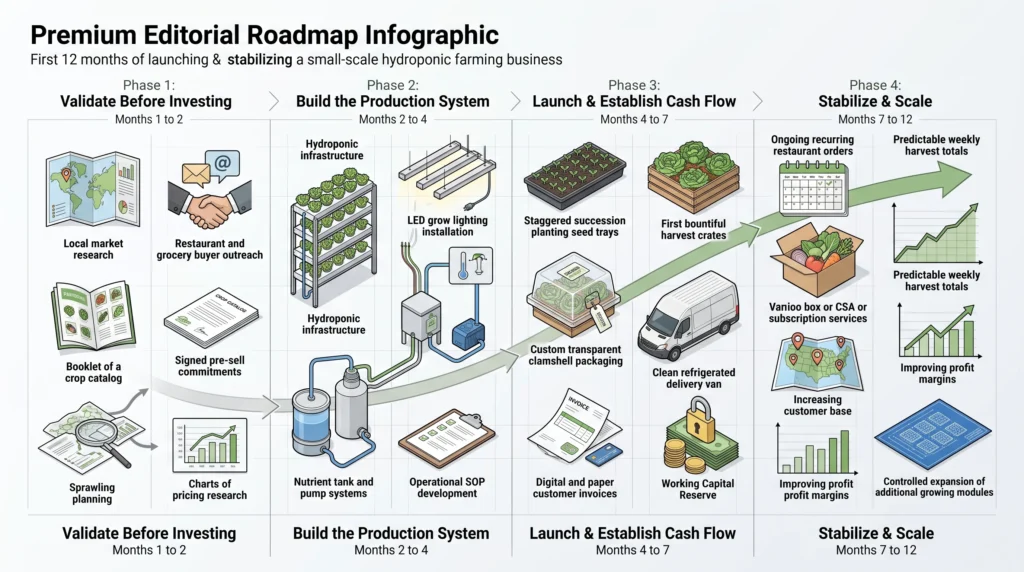
Watch the Masterclass: Sizing a Profitable Hydroponic Subscription
To help you visualise your business expansion, we have compiled a comprehensive media guide detailing the logistics, accounting, and box‑packing mechanics of indoor vertical farming models. Watch our widescreen commercial masterclass or dive into our rapid 60‑second shorts breakdown below to master the financials of recurring agricultural revenue.
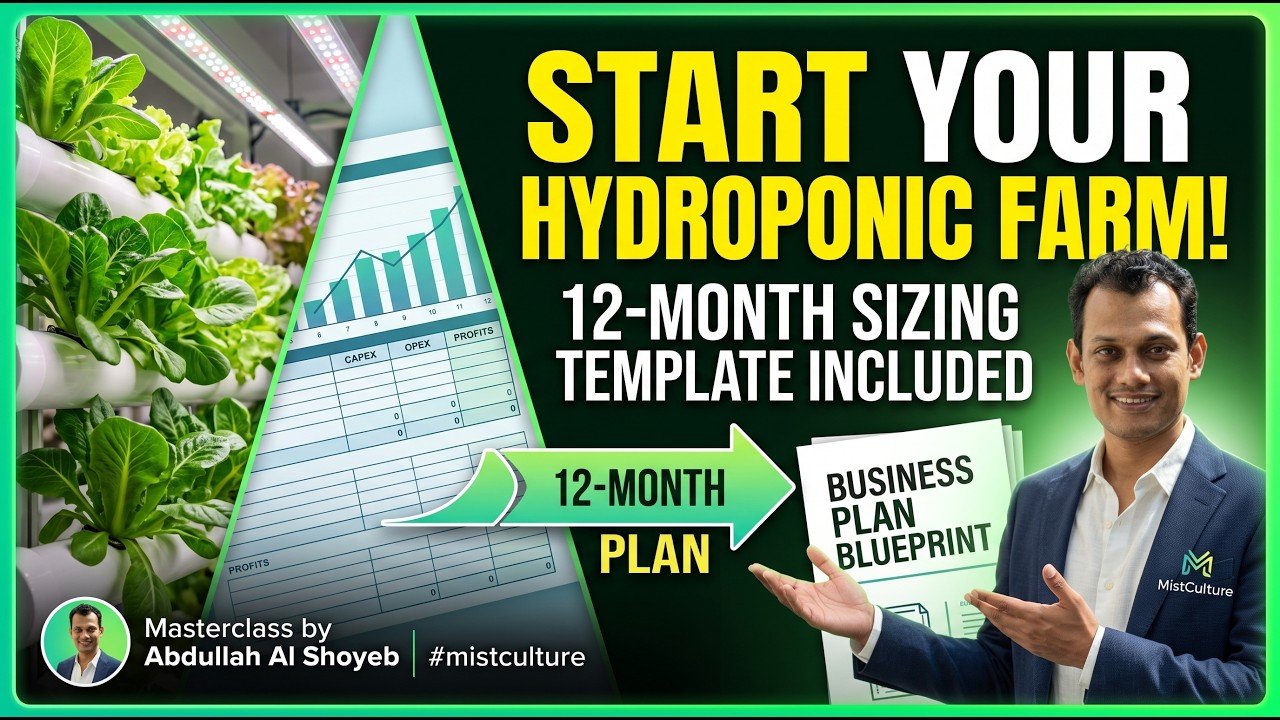
Full Masterclass
Hydroponic Subscriptions: Sizing Recurring Revenue Our comprehensive widescreen guide analyzes upfront seasonal CSA cash flows vs. predictable weekly hydroponic cycles, subscriber break‑even math, and GAAP deferred revenue accounting rules.
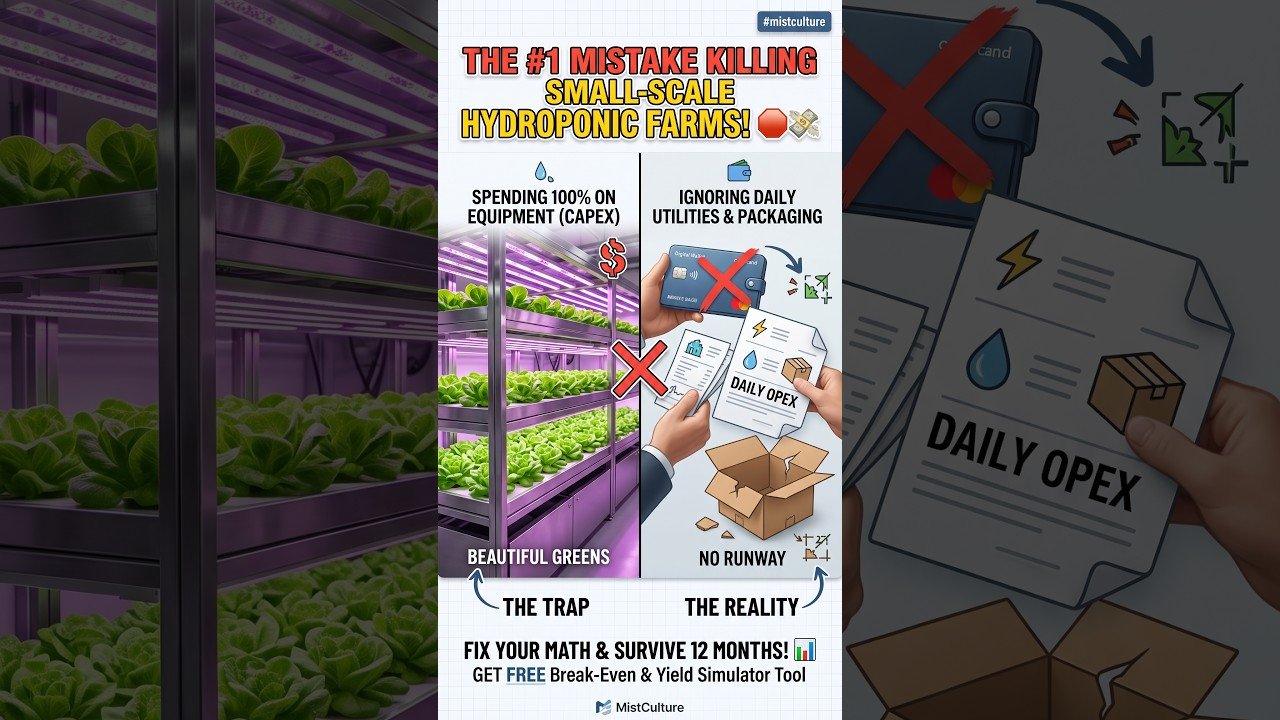
60‑Second Short
The Volumetric Packing SOP Avoid product damage on delivery routes. Learn the ‘Heaviest‑on‑Bottom’ volumetric packing physics to eliminate crop bruising.
Turn Horticultural Optimism into Predictable Business Cash Flow
Ready to deploy your 12‑month small‑scale hydroponic plan? Stop guessing your capital expenditures or electrical running costs. Settle your required canopy dimensions, weekly harvest weights, and projected net profits instantly using our suite of interactive, browser‑based calculators.

Continue Your Learning Journey