Bluelab Dosetronic vs Autopot Smartvalve for Large Reservoirs

Table of Contents
- Dosing Accuracy and Precision
- System Design Principles
- Component Selection and Specification
- Installation and Commissioning Procedures
- Operation and Maintenance Protocols
- Troubleshooting and Problem Resolution
- Performance Monitoring and Data Analysis
- Safety Systems and Risk Management
- Economic Analysis and Business Planning
- Frequently Asked Questions
- Conclusion
Disclosure: MistCulture summarizes verified product specs, engineering data, and community feedback. We may earn an affiliate commission if you purchase through our links. Regulations vary by location; this content is for educational purposes only.
Automated nutrient dosing establishes the dividing line between hobbyist hydroponics and high-yield commercial production. Scaling a facility requires moving away from manual bucket mixing toward systems capable of managing fluid dynamics and chemical balances across hundreds of gallons. Two systems dominate the high-end market with radically different engineering philosophies. The Bluelab Dosetronic is an active, peristaltic pump-based dosing system designed for continuous EC and pH monitoring and precise electronic control. The Autopot Smartvalve takes a completely different approach, functioning as a passive, mechanical float-driven system that manages irrigation purely through gravity and fluid displacement.
When outfitting large reservoirs of 200 gallons or more, choosing between active electronic dosing and passive mechanical delivery dictates your entire facility’s plumbing architecture, maintenance schedules, and scaling potential. This breakdown analyzes both technologies through the lens of fluid mechanics, component reliability, and long-term operational efficiency.
Dosing Accuracy and Precision
Both the Bluelab Dosetronic and Autopot Smartvalve deliver nutrients to the root zone, but they operate on opposing principles of precision. Active dosing relies on continuous chemical sensors, whereas passive delivery trusts pre-mixed tank stability and mechanical triggers.
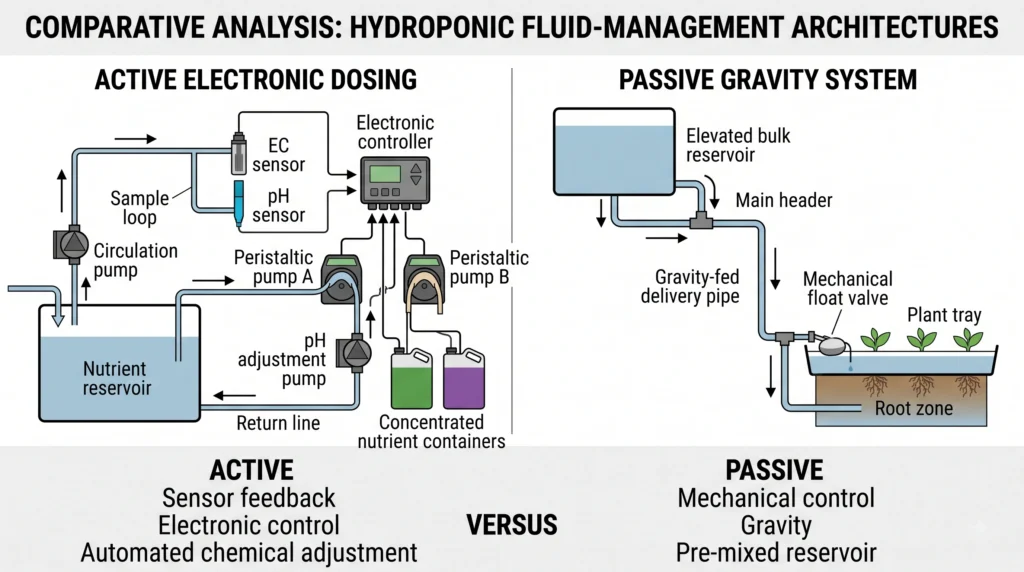
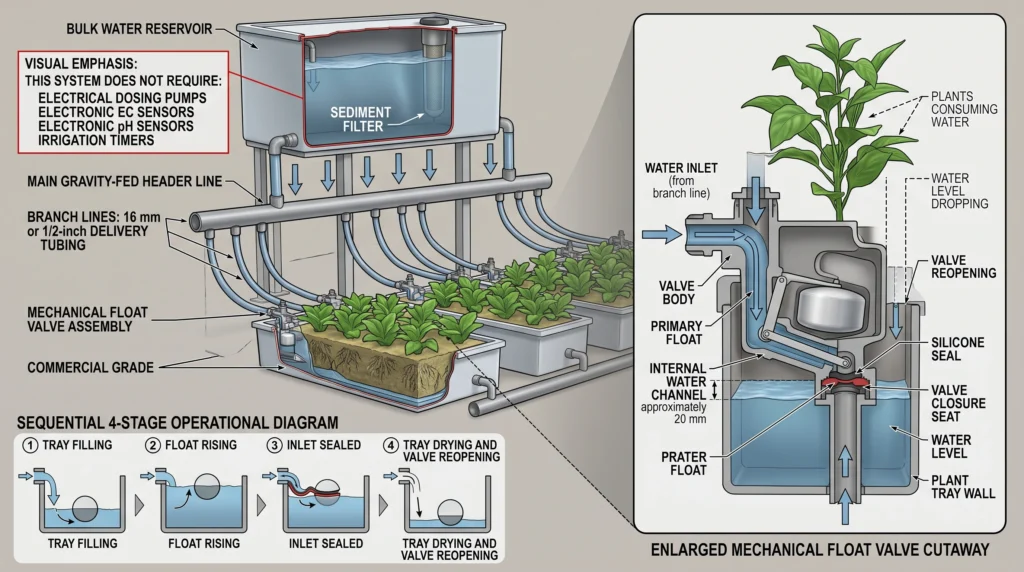
The Bluelab Dosetronic commands the market for active nutrient management by utilizing continuous sensor feedback to drive precision peristaltic pumps. These pumps deliver distinct, programmed doses of concentrated Part A, Part B, and pH modifiers directly into a sample loop connected to the main reservoir. The peristaltic action works by compressing a chemical-resistant tube using a series of rotating rollers. This creates a vacuum that draws the exact programmed volume of fluid through the line, isolating the pump’s mechanical components from the harsh acidic or alkaline concentrates. With a dosing precision down to 0.1 mL, the Dosetronic is calibrated to respond to minute fluctuations in the reservoir’s chemical makeup.
Research validates the necessity of strict parameter enforcement in automated systems. As noted in the Bulletin of Electrical Engineering and Informatics (Rusdiyana et al., Vol. 13, No. 5, 2024), “The pH level of the solution is less than 6, which causes the pH pump to become active. The pH pump will be turned off when the pH level of the solution reaches above 7.” This binary logic is executed with granular precision by the Dosetronic, preventing the aggressive pH swings that can lock out nutrient uptake in heavily feeding crops.
Conversely, the Autopot Smartvalve (often referred to as the AquaValve) contains zero electronic components and performs no chemical adjustments. Instead, it relies on the pre-mixed accuracy of your bulk reservoir. The valve sits inside the plant tray and uses a simple but highly effective dual-float mechanism. Water from the elevated reservoir fills the tray to a preset depth of 20 mm. At this point, the primary float rises and forces a silicone seal against the inlet, halting the flow. The plant then consumes the water over several days. The valve will not reopen until the tray is entirely dry, which triggers the secondary release and repeats the flood cycle.
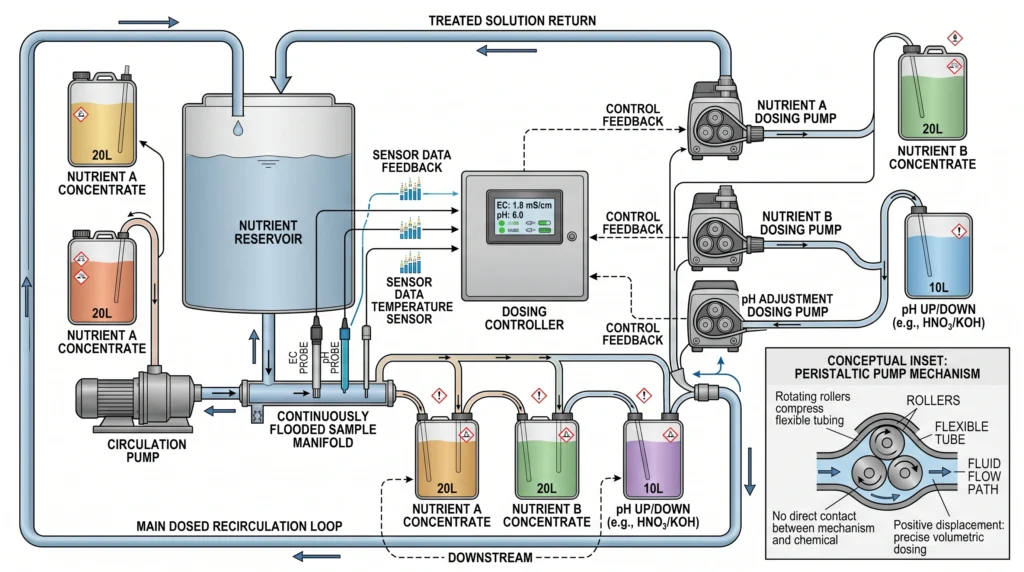
For large reservoirs, the Dosetronic’s active monitoring prevents the nutrient solution from drifting over time. If a 500-gallon tank sits for a week, environmental evaporation and temperature shifts will inevitably alter its concentration. The Dosetronic counteracts this continuously. The Autopot system forces the grower to manually verify the reservoir’s integrity using external tools to ensure the static mixture remains stable before gravity feeds it to the plant trays.

- Designed for use with Bluelab Pro Controller (CONTPRO) to monitor and control pH up and down and nutrient level; General…
- Automatically maintain parameters (pH, temperature TDS, PPM, and EC) in your reservoir; No need for spot checks or manua…
- Pro Controller with pumps are compatible with most modern growing systems including recirculating and drain to waste sys…
- Why it’s necessary: Provides unmatched continuous monitoring and automated correction of EC and pH levels, removing human error from large-scale reservoir management.
- Key Spec: 0.1 mL dosing precision via continuous sensor feedback.
System Design Principles
Engineering a reliable hydroponic feed network requires accounting for flow dynamics, head pressure, and component integration. The choice between an active doser and a passive valve dictates the entire plumbing layout.
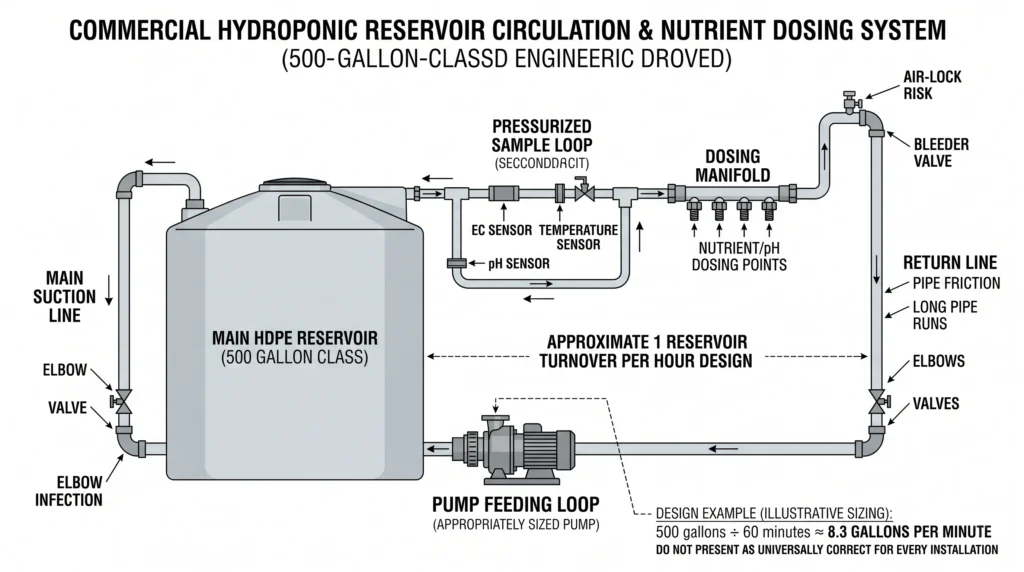
Designing an efficient hydroponic architecture requires careful attention to hydraulic principles. When integrating a Bluelab Dosetronic, you are building an active, pressurized loop. The controller relies on a continuous stream of water passing over its EC and pH probes to make accurate decisions. This necessitates an inline pump pulling from the main reservoir, pushing water through a manifold where the probes sit, and returning it to the tank. The injection points for the peristaltic pumps must be located downstream of the probes to prevent concentrated chemicals from hitting the sensors and triggering false high readings.
Calculating the flow rate for this sample loop is a core design requirement. To maintain a homogenous mixture in a 500-gallon tank, you need a turnover rate that cycles the entire volume through the manifold at least once an hour. A dedicated pump rated for a minimum of 8.3 gallons per minute (GPM) is required, but pushing fluids through elbows and narrow manifold pipes introduces friction loss. Engineers calculate this pressure drop using standard fluid dynamics formulas to ensure the pump does not stall or cavitate under the load. Proper hydroponic pump sizing prevents air locks from forming inside the sensor manifold, which would immediately derail the Dosetronic’s calibration.
The Autopot system demands a completely different design paradigm based entirely on gravity and static head pressure. Because the Smartvalve operates mechanically, the reservoir must be elevated to generate enough downward force to overcome the friction inside the delivery pipes. The manufacturer requires a minimum height of 6 inches above the highest valve in the system. However, for a commercial deployment running hundreds of feet of 16mm or 1/2-inch PVC header lines, friction loss increases significantly. If a 200-gallon reservoir is placed too low, the fluid velocity drops, allowing suspended salts to precipitate and settle inside the lines, eventually causing blockages at the valve inlet.
To model the layout for a sprawling passive system, you must limit stagnation zones. Branching lines should be looped back or terminated with flush valves to allow for weekly line clearing. While the Autopot eliminates the need for electrical pumps in the delivery phase, the physical elevation of a massive reservoir introduces structural engineering challenges. A 200-gallon tank weighs over 1,600 pounds when full, requiring reinforced steel staging to safely maintain the required head height.

- MADE IN THE USA – Proudly manufactured in America to strict OEM standards, RecPro tanks undergo rigorous pressure testin…
- HEAVY-DUTY SEAMLESS CONSTRUCTION – Built for the rigors of the road, these tanks feature a seamless, one-piece rotationa…
- POTABLE WATER SAFE – Constructed from high-quality, BPA Free polyethylene. This ensures your drinking water remains clea…
- Why it’s necessary: Built with UV-stabilized high-density polyethylene (HDPE), this tank safely supports bulk mixing for commercial setups without degrading or leaching chemicals.
- Key Spec: UV-resistant HDPE construction with integrated bulkhead ports.
Component Selection and Specification
Selecting durable, chemically resistant components determines whether a system runs smoothly for years or fails catastrophically mid-crop. Sensor accuracy and tubing material are non-negotiable specifications.
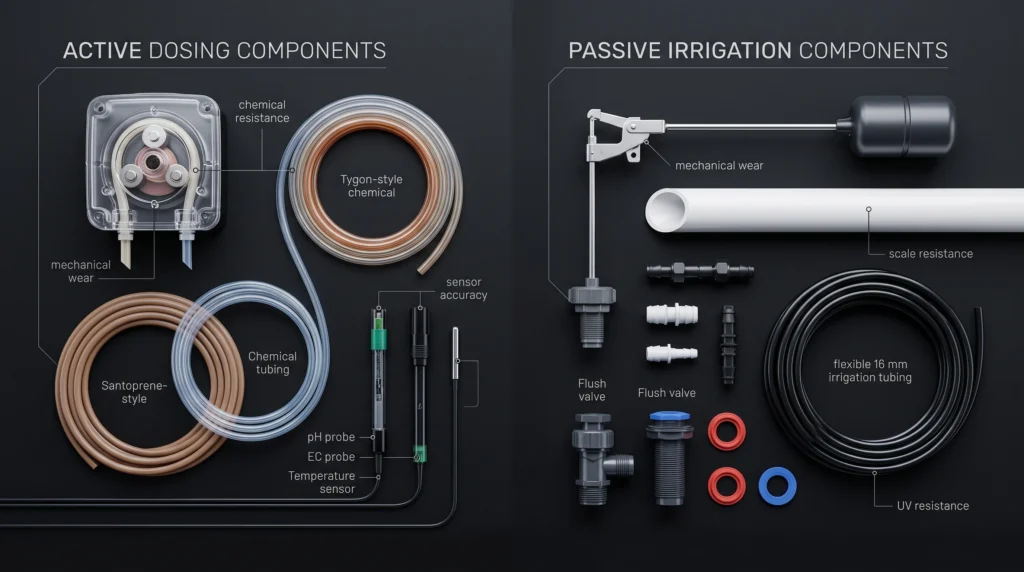
Active dosing environments expose equipment to highly concentrated, caustic liquids. The tubing that runs through the Bluelab peristaltic pumps must withstand constant mechanical compression while transporting aggressive acids (like Phosphoric or Nitric acid for pH Down) and dense mineral salts. Standard vinyl tubing will harden, crack, and fail under these conditions. Industrial-grade Santoprene or Tygon chemical tubing is required for the dosing lines. Over time, even high-grade tubing flattens out, changing its internal volume. If a tube is compressed, a pump rated for 50 mL per minute might only deliver 40 mL, throwing off the controller’s timing logic.
The sensors themselves dictate the reliability of the entire operation. Bluelab utilizes high-grade, double-junction pH probes and factory-calibrated EC probes with Automatic Temperature Compensation (ATC). Because electrical conductivity changes based on fluid temperature, an ATC-enabled probe adjusts its readings dynamically to ensure the dosing logic remains consistent whether the reservoir is 65°F or 80°F. If you need to map out exact feed rates based on your specific base water profile, utilizing a hydroponic nutrient calculator helps establish the baseline EC targets the Dosetronic will target.
For the Autopot Smartvalve, component selection revolves around mechanical tolerances. The valve relies on a small silicone disc to create a watertight seal against the incoming water pressure. If this silicone seal degrades, hardens, or becomes coated in calcium scale, the valve will fail to close. A failed valve leads to a continuous flood state, drowning the plant roots and draining the main reservoir onto the floor. Food-grade, BPA-free plastics are used for the valve body to resist UV degradation, but the internal silicone inserts must be treated as consumable wear parts replaced annually.
When piping either system, rigid PVC (Schedule 40) is preferred for long main headers due to its durability and smooth internal walls, which reduce friction. Flexible 16mm or 1/2-inch poly tubing is generally reserved for the final lateral runs connecting the main header to the specific dosing manifold or individual Autopot trays.
Installation and Commissioning Procedures
Commissioning a large-scale fluid management system requires methodical testing to verify flow rates, sensor calibrations, and mechanical tolerances before introducing live plants to the environment.
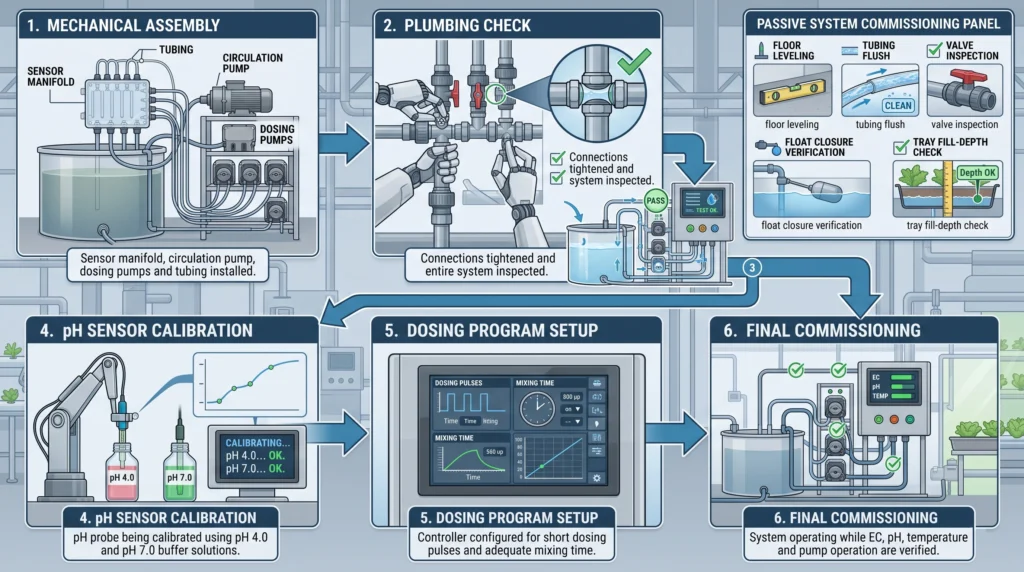
Integrating the Bluelab Dosetronic into a facility starts with the mechanical assembly of the sensor and dosing manifold. The probes must be installed in a pressurized section of the line that remains constantly flooded; if the line drains when the pump shuts off, the pH probe will dry out and suffer irreversible damage. Once the plumbing is secured and leak-tested using plain water, the electronic commissioning begins.
The operator must calibrate the pH probe using standard 4.0 and 7.0 buffer solutions. This establishes the baseline curve the controller uses to interpret the raw millivolt signals from the water. Next, the dosing intervals are programmed. If the system is managing a 500-gallon tank, setting the “On” time too high will dump massive amounts of concentrate into the water, causing an overshoot. The controller must be tuned to inject short bursts (e.g., 2 seconds on, 5 minutes off) to allow the heavy liquids to circulate and register on the sensors before the next dose fires. Reviewing a hydroponic pH and EC mastery guide provides the theoretical foundation needed to program these PID (Proportional-Integral-Derivative) logic loops safely.
Deploying the Autopot network requires laser-focused attention to floor leveling. Because the Smartvalves rely on gravity to fill the trays to a precise 20 mm depth, any variance in the floor grade will cause uneven filling. If a tray sits on a slight incline, the water may reach the float and shut the valve before the roots on the high side of the tray receive adequate moisture.
During the Autopot commissioning phase, the entire delivery network is flushed with water-only to push out plastic shavings or debris left over from cutting the tubing. A single piece of PVC burr lodged in the 4mm inlet of a Smartvalve will permanently block flow to that plant. Once the lines are clear, the reservoir is filled, and the main valve is opened to observe the fill rate and verify that every float successfully seals once the 20 mm mark is reached.

- 【WIDE APPLICATION】: Peristaltic pump tube is suitable for the life science of silicone pipes, used for fluid transmissio…
- 【SILICONE MATERIAL】: Peristaltic pump tubing is made of strong and sturdy silicone material, which has the characteristi…
- 【-60°F TO 275°F TEMPERATURE RANGE】: High temp silicone tubing can be used repeatedly under high temperature and high pre…
- Why it’s necessary: Preventative maintenance requires swapping out compressed or hardened dosing tubes before they fail and leak highly concentrated acid or nutrients.
- Key Spec: Chemical-resistant Santoprene construction designed for millions of compression cycles.
Operation and Maintenance Protocols
Routine maintenance prevents cascading hardware failures. While active dosing systems require frequent sensor care, passive mechanical systems demand rigorous physical cleaning to prevent scale buildup.
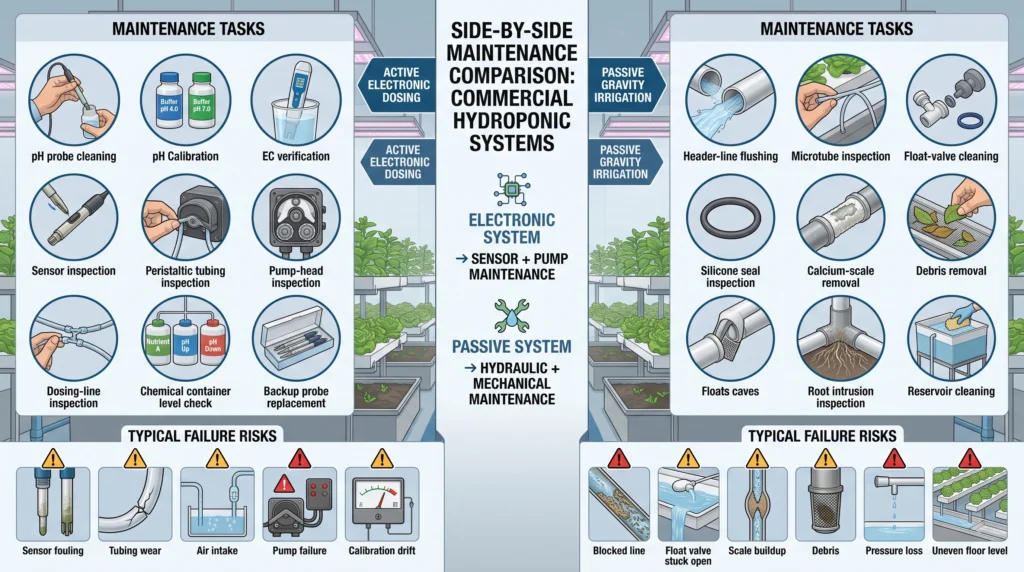
The daily operation of a Bluelab Dosetronic is highly automated, but it shifts the grower’s labor from mixing buckets to managing sensor health. The EC and pH probes must be inspected weekly. Biofilm, algae, or salt precipitation coating the glass bulb of the pH probe will insulate it from the water, resulting in sluggish response times or wildly inaccurate readings. Cleaning the probes with a soft brush and specialized probe cleaner restores accuracy. Furthermore, the peristaltic pump heads must be visually inspected for leaks. If the internal tubing ruptures, caustic pH Down will destroy the pump’s rotor assembly.
Managing the bulk reservoir chemistry remains critical. Even with an automated doser, the base water entering the system dictates how hard the pumps have to work. High alkalinity in the source water requires excessive amounts of acid to maintain a target pH of 5.8. Understanding how to manage pH and EC ensures the reservoir environment does not exhaust your chemical supplies prematurely.
The Autopot system’s operational protocol is defined by strict nutrient selection. Because the water moves slowly through the lines and sits static in the plant trays, thick organic fertilizers or suspensions will rapidly separate, ferment, and clog the Smartvalves. Only highly refined, fully soluble synthetic mineral salts can be used successfully.
Maintenance for the Autopot focuses on the physical clearing of the delivery lines. Every two weeks, the flush valves at the end of the header lines should be opened to blast out any settling sediment. The Smartvalves themselves require a monthly visual check to ensure roots have not breached the copper-infused root control discs and invaded the float chamber. At the end of every crop cycle, the entire system must be broken down and soaked in a mild acid solution to dissolve calcium carbonate scale off the moving plastic parts and silicone seals.
Troubleshooting and Problem Resolution
Systematic fault isolation minimizes crop downtime. Active systems require diagnosing electronic and hydraulic feedback loops, while passive systems usually suffer from physical blockages or pressure drops.
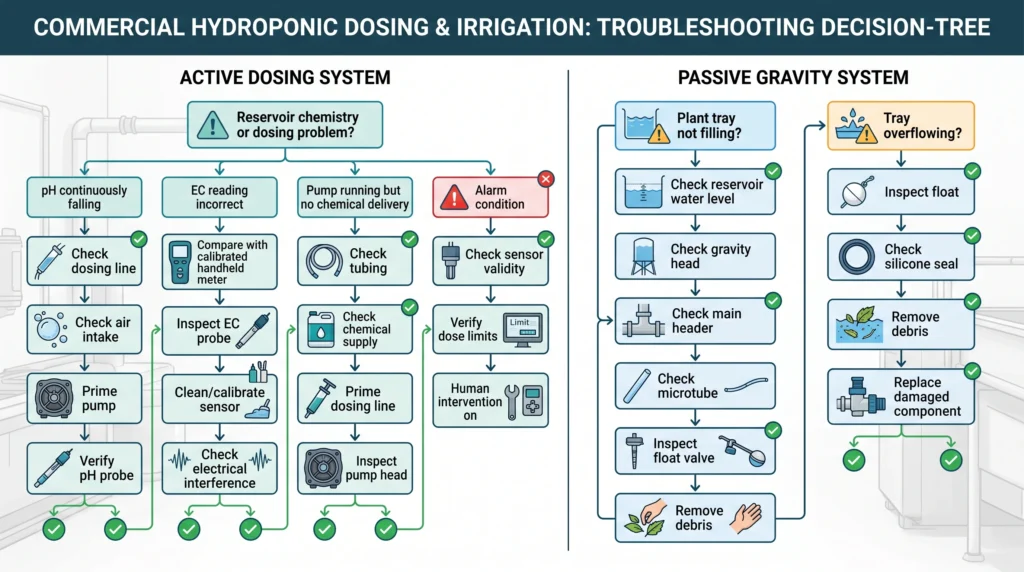
When a Bluelab Dosetronic triggers an alarm, troubleshooting requires understanding the interaction between the fluid loop and the controller logic. If the system reports a continuously dropping pH despite the dosing pumps running, the immediate suspect is an airlock in the dosing line. If the intake tube pulls air instead of liquid, the pump spins harmlessly without injecting any modifier. The operator must prime the line manually to restore suction.
Another common fault is sensor drift. If the reservoir reads an EC of 3.0 mS/cm but manual testing shows it is actually 1.5 mS/cm, the Dosetronic will starve the plants by refusing to dose. This points directly to a fouled EC probe or electromagnetic interference from a nearby ungrounded water pump skewing the sensor’s readings. Cross-referencing the automated data with manual checks using a calibrated handheld pen is a standard operating procedure for validating system health. Exploring a pH and EC meter showdown highlights the necessity of keeping reliable backup testing equipment on hand.
Autopot troubleshooting usually revolves around flow restriction or flood events. If a single plant tray remains dry while the rest of the system fills, the 4mm micro-tubing connecting the valve to the main header is likely blocked. Isolating the line and blowing compressed air through the micro-tube usually dislodges the salt crystal causing the blockage.
If a tray overflows and floods the greenhouse floor, the Smartvalve has failed to seal. This is almost universally caused by debris trapped between the silicone seal and the water inlet port, preventing the float from seating flush. Removing the valve, pulling the silicone seal out with tweezers, and rinsing the assembly in warm water resolves the leak. If you operate in an environment with frequent hardware anomalies, studying a comprehensive hydroponic troubleshooting guide prepares the facility to react quickly to mechanical failures before they cause irreversible drought stress.
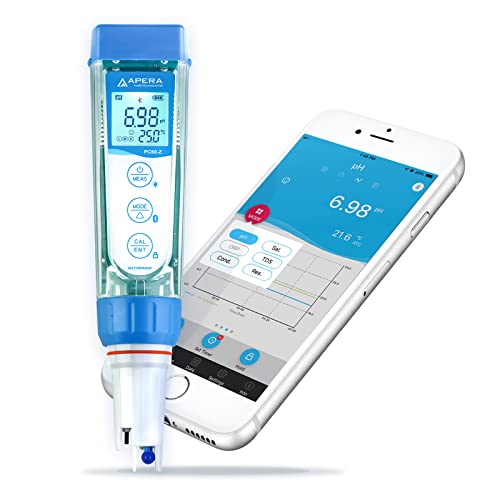
- Smart Integration –– Easily connect the tester to your smartphone, tablet, or MacBook via Bluetooth with the ZenTest app…
- Precision Measurement –– Featuring a double-junction pH/conductivity combo sensor for high accuracy and durability, ensu…
- Cloud-Based Data Logging –– Securely log, manage, and share your test data with our cloud-based data management system, …
- Why it’s necessary: Serves as a vital calibration reference and manual backup to verify that your automated dosing sensors are reading accurately.
- Key Spec: ATC-enabled dual probes with USB data export for trend analysis.
Performance Monitoring and Data Analysis
Continuous optimization relies on data visibility. Active controllers provide rich digital logs for environmental mapping, whereas passive systems require manual tracking to build performance metrics.
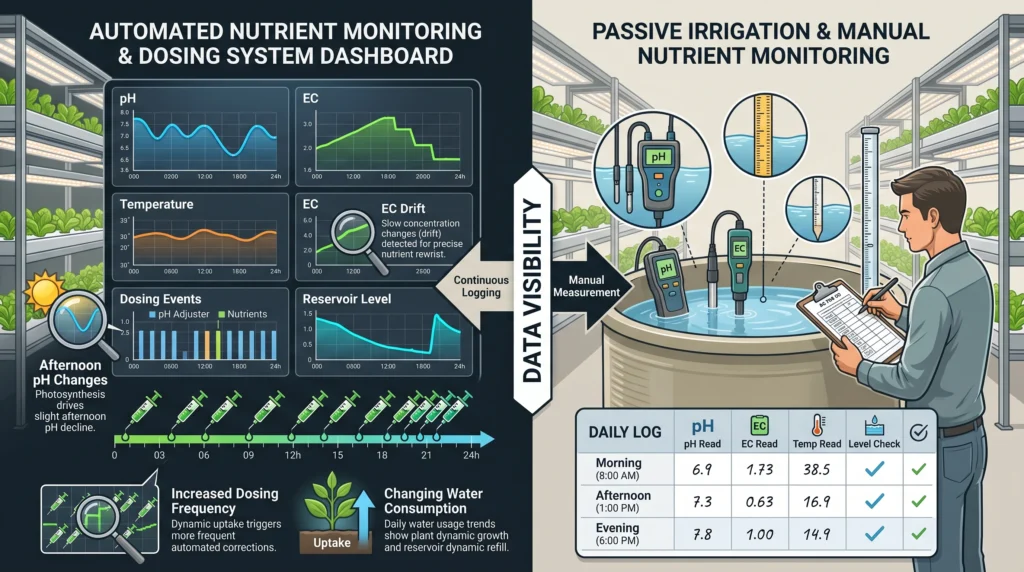
The modern commercial hydroponic facility runs on data. The Bluelab Dosetronic excels in this arena by integrating directly with software platforms that log every parameter shift and pump activation. This real-time parameter tracking provides immediate visibility into system operation. If the data log shows the pH pump firing rapidly every afternoon at 2:00 PM, the facility manager can correlate that event with a spike in greenhouse temperature causing heavy plant transpiration.
Trend analysis identifies gradual changes that indicate developing problems. A slow, steady rise in base EC over several weeks suggests the plants are consuming more water than nutrients, indicating the feed formulation is too aggressive. These insights allow for dynamic adjustments to the feed schedule rather than waiting for visual nutrient burn on the foliage. Integrating data from your dosing controller with external environmental sensors creates a complete picture of your facility’s performance. Reviewing hydroponic sensor integration helps operators connect root-zone metrics with atmospheric conditions.
The Autopot system provides no native data logging. Because it operates purely mechanically, the system cannot alert an operator to a dropping EC or a shifting pH in the bulk reservoir. Performance monitoring in an Autopot facility requires strict operational discipline. Technicians must physically measure and record the tank parameters on a clipboard or tablet twice a day.
Analysis in a passive system involves calculating the total volumetric drawdown of the main reservoir to determine the crop’s aggregate transpiration rate. If a 100-plant array consumes 50 gallons on Monday but only 20 gallons on Tuesday, the operator must investigate whether a shift in environmental humidity suppressed transpiration or if a vapor lock in the main header halted fluid delivery.
Safety Systems and Risk Management
Hardware redundancy and fail-safe engineering protect against catastrophic events. Managing hundreds of gallons of nutrient-dense water requires planning for the worst-case scenario.
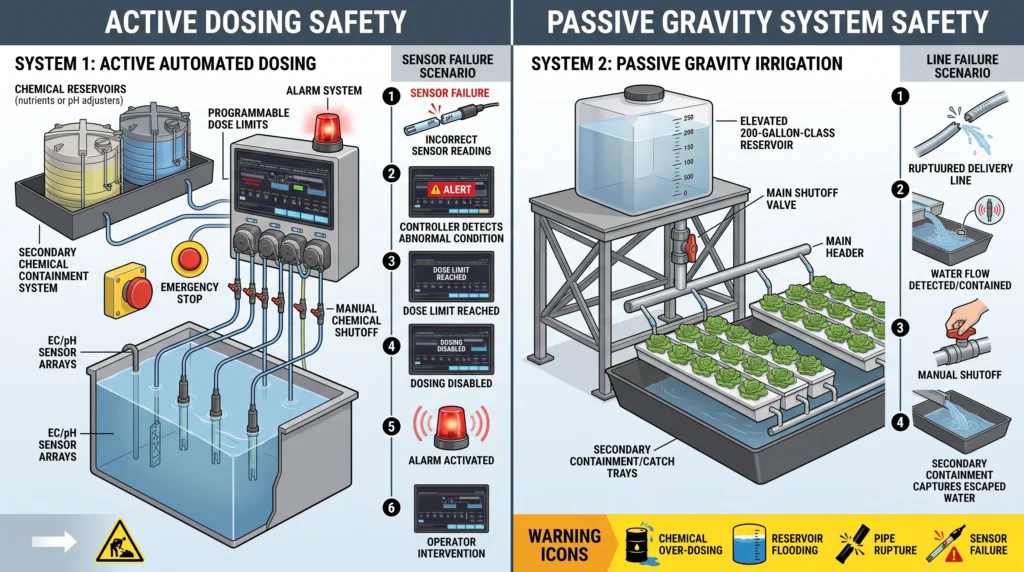
When relying on automated electronics, safety systems must account for software glitches and hardware lockups. The Bluelab Dosetronic incorporates safety lockouts to prevent chemical dumping. If a sensor fails and reads a pH of 10.0, a poorly designed system would continuously pump acid until the reservoir became toxic. The Dosetronic uses programmable dose limits; if the target pH is not reached within a specific number of pump cycles, the system enters an alarm state and disables all dosing until human intervention occurs.
Redundancy measures in active systems include keeping backup probes and replacement pump rotors on site. Sensor drift can happen overnight, and having a pre-calibrated probe ready to swap minimizes downtime.
For the Autopot system, risk management focuses entirely on flood prevention. Because the system is gravity-fed, a ruptured main header line will empty the entire 200-gallon reservoir onto the floor. Installing an inline manual shutoff valve directly below the reservoir allows for an immediate emergency shutdown. Furthermore, utilizing deep, heavy-duty ABS plastic catch trays under the entire Autopot grid provides a secondary containment layer to capture water if a Smartvalve fails to seal.
Economic Analysis and Business Planning
Scaling a hydroponic facility requires balancing upfront capital expenditure (CapEx) against long-term operational expense (OpEx) reduction through labor savings and yield consistency.
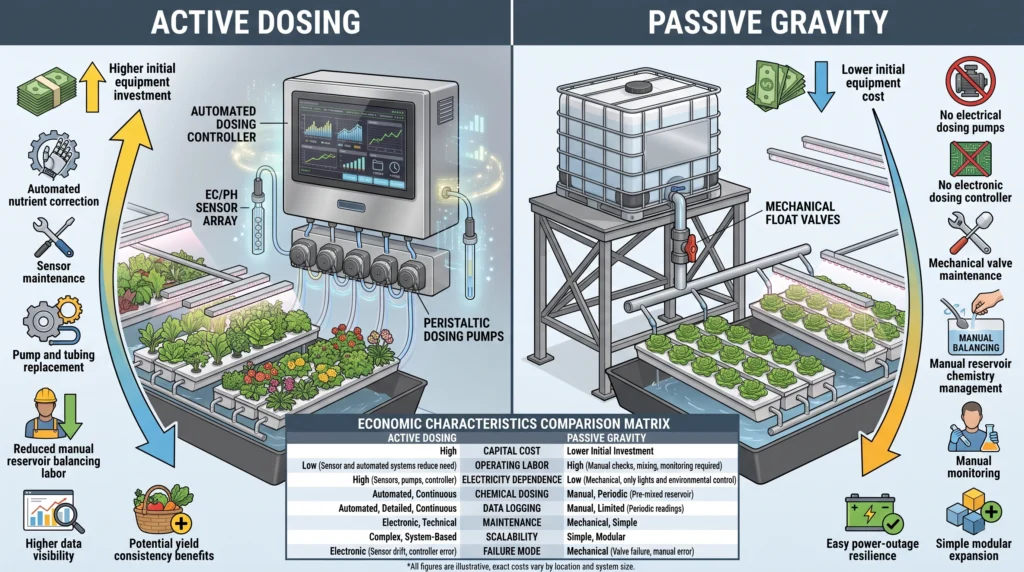
The economic argument for the Bluelab Dosetronic hinges on labor efficiency and crop yield maximization. The initial capital investment is significant, often exceeding $2,500 to $3,500 for the controller, manifold, and pump modules. However, manually checking and balancing a 500-gallon reservoir takes an experienced technician approximately 20 to 30 minutes a day. At standard commercial labor rates, this equates to thousands of dollars a year in operational expense. The Dosetronic reclaims those labor hours while simultaneously eliminating the human error that leads to costly crop shock.
For facilities evaluating a vertical farming reality check, the precision offered by active dosing allows for maximum yield extraction from expensive square footage. The ROI calculation includes the payback period achieved through reduced fertilizer waste and faster crop turnaround times due to optimized nutrition.
The Autopot Smartvalve system presents a highly scalable, low-CapEx deployment model. Outfitting a 100-plant array with Autopot modules, delivery lines, and a bulk reservoir generally costs under $1,500. Because it requires no electrical infrastructure, no pumps, and no complex controllers, it is incredibly cheap to install and expand. The economic trade-off comes in the form of manual labor required to manage the bulk reservoir chemistry and the time spent cleaning the mechanical valves between crop cycles.

- Self-Watering, Gravity-Fed Hydroponic System for indoor gardening
- Why it’s necessary: Offers a highly scalable, electricity-free automated irrigation solution that feeds plants on demand using fluid displacement and gravity.
- Key Spec: Operates purely on gravity head pressure, requiring zero pumps or timers.
Frequently Asked Questions
Can I run organic nutrients through a Bluelab Dosetronic or an Autopot system?
It is highly discouraged for both systems. Organic nutrients contain heavy biological suspensions that will quickly clog the fine tubing of a peristaltic pump and completely block the 4mm inlet of an Autopot Smartvalve. Using refined synthetic mineral salts prevents biological fouling and mechanical failure. Discover more about compatible mixtures in our u003ca href=u0022https://mistculture.com/hydroponic-nutrients-guide/u0022 target=u0022_blanku0022 rel=u0022noreferrer noopeneru0022u003ehydroponic nutrients guideu003c/au003e.
How often do the pH and EC probes on the Dosetronic need calibration?
For commercial accuracy, pH probes should be calibrated every two to four weeks using 4.0 and 7.0 buffer solutions. EC probes are generally factory calibrated but should be verified monthly against a standard conductivity solution to account for any organic buildup on the sensor face.
What happens to an Autopot system during a power outage?
Nothing. Because the Autopot operates entirely on gravity and mechanical float valves, a power outage has zero effect on fluid delivery. The plants will continue to feed normally as long as there is water in the elevated reservoir.
Can I use a cheaper controller instead of the Bluelab Dosetronic?
Yes, smaller facilities can utilize budget-friendly electronics, but they often lack the commercial-grade fail-safes and robust peristaltic pumps found in flagship models. Reviewing the u003ca href=u0022https://mistculture.com/best-hydroponic-controllers-under-200/u0022 target=u0022_blanku0022 rel=u0022noreferrer noopeneru0022u003ebest hydroponic controllers under $200u003c/au003e can help hobbyists find a middle ground before upgrading to enterprise gear.
Conclusion
Choosing between the Bluelab Dosetronic and the Autopot Smartvalve comes down to whether your facility prioritizes digital precision or mechanical simplicity. The Dosetronic requires a higher initial investment and strict sensor maintenance, but it delivers absolute control over the reservoir’s chemical composition, driving maximum crop yields. The Autopot strips away the complexities of electronics, offering an incredibly scalable, power-independent irrigation network that trades automated dosing for low-cost reliability. Designing a system that matches your operational capabilities ensures long-term success. For more deep dives into optimizing your facility’s fluid dynamics and hardware selection, explore our Growing Systems hub and utilize our technical calculators to map out your next build.

Continue Your Learning Journey